
That patchy, water-pooling lawn isn’t beyond saving — it’s just suffocating. When soil compacts, air, water, and nutrients can’t reach the roots, and your grass slowly chokes. A manual aerator punches through that crust, opening channels so your lawn can breathe and drink again. For small yards, the right tool makes this possible without renting a gas-powered behemoth or spending hours on your knees.
I’m Rikta — the co-founder and writer behind Lawn Gear Lab. I’ve spent weeks cross-referencing spike depths, tine configurations, handle ergonomics, and build materials, and cross-checking hundreds of owner reports to find out which aerators actually deliver measurable results on modest-sized properties.
The goal of this guide is to cut through the noise and help you pick the right aerator for small lawn based on your specific soil type, your tolerance for manual effort, and the square footage you need to cover.
How To Choose The Best Aerator For Small Lawn
Not every aerator treats soil the same way. For a small lawn, you’re deciding between two distinct mechanisms: spikes that poke holes and hollow tines that extract cores. Each affects compaction differently, and the wrong choice can make your work less effective. Here’s what to look for.
Spike vs. Core (Plug) Aeration
Spike aerators (like rolling drums or step-on forks) push soil aside to create holes. This works best on loamy or sandy soil that isn’t severely compacted. On heavy clay, spikes can actually compact soil further around the hole. Core aerators use hollow tines to extract a plug of soil, physically removing material and creating room for roots to expand. For high-traffic or clay-heavy small lawns, core aeration delivers measurable improvements that spikes can’t match.
Build Material and Tine Durability
Look for heat-treated steel or stainless-steel tines that resist bending when you hit a rock or root. Powder-coated finishes prevent rust from morning dew and wet soil. On rolling models, the connection between the axle and the drum is the weak point — reinforced brackets or tripod structures hold up better under repeated weight loads.
Handle Ergonomics and User Height
Manual aeration is repetitive work, so handle height and grip matter. Look for adjustable or extended handles that keep your spine neutral — a handle that forces you to stoop will fatigue your lower back after a few passes. Padded T-bars or foam rubber grips reduce hand strain. For step-on models, a wide foot pedal or bar distributes pressure evenly and gives better leverage when you push into dry soil.
Total Weight and Ballast Options
Rolling aerators need sufficient heft to drive spikes deep. Some models allow you to add sand or water to a hollow drum to increase weight. A lightweight drum that bounces over hard soil is useless. Conversely, a 24-pound unit may require more effort to pull but will penetrate more consistently. Match the weight to your own physical strength and the hardness of your soil.
Quick Comparison
On smaller screens, swipe sideways to see the full table.
| Model | Category | Best For | Key Spec | Amazon |
|---|---|---|---|---|
| VEVOR Rolling Aerator | Spike Roller | Covering entire lawn surface efficiently | 27 spikes, 2-inch depth | Amazon |
| Saker Step-On Aerator | Spike Stepper | Spot-aerating patches and high-traffic zones | 15 spikes, 2.3-inch length | Amazon |
| LawnVigor Core Aerator | Manual Corer | Pulling deep cores in compacted clay | 3 hollow tines, 3-inch cores | Amazon |
| EEIEER Core Aerator | Manual Corer | Clean core removal with soil storage basket | 3 hollow tines, 38-inch handle | Amazon |
| Dolibest 4-Corer Aerator | Manual Corer | Maximum plugs per step on moderate soil | 4 hollow tines, 3.5-inch length | Amazon |
| Yard Butler Spike Aerator | Spike Stepper | Light, easy entry-level aeration | 4 spikes, 3-inch depth | Amazon |
| Seeutek Rolling Aerator | Spike Roller | Heavy weight for deeper roll penetration | 23-inch drum, 2-inch spikes | Amazon |
In‑Depth Reviews
1. LawnVigor Manual Core Aerator
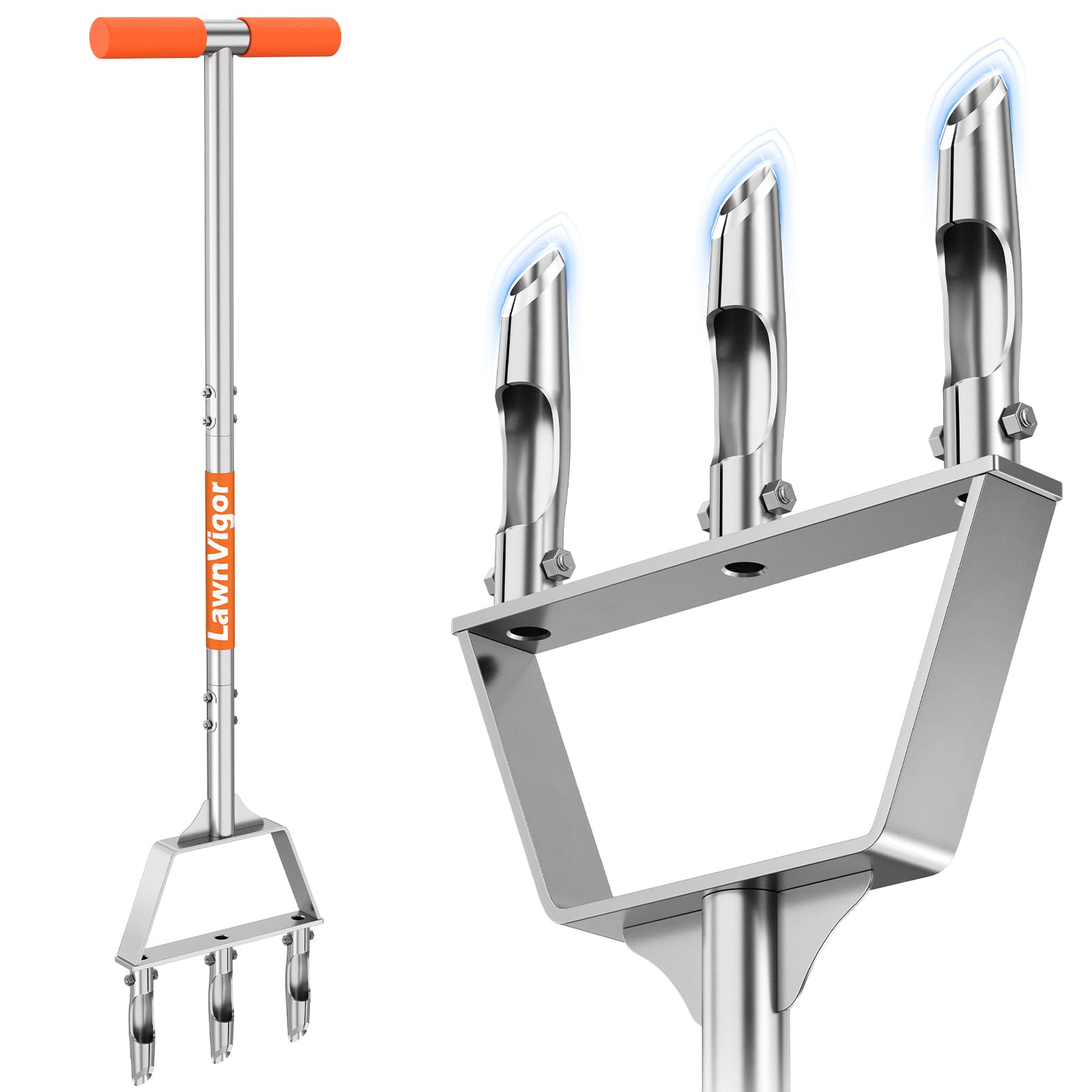
The LawnVigor core aerator strikes the most balanced combination of build quality, effective core extraction, and ergonomic design for a small yard. Its three heat-treated hollow tines pull 3-inch-deep soil plugs on moist ground, creating real physical space in the soil matrix — the kind of aeration that actually relieves compaction in clay-dominant lawns. The semi-assembled package includes a wide T-handle with foam grips that minimizes hand fatigue over repeated plunges.
What separates this unit from cheaper alternatives is the tine ejection mechanism. The white plastic inserts inside each tine help release the soil core cleanly, preventing the frustrating clogs that plague many manual corers. Owners consistently report that after a few uses, the technique becomes intuitive, and the tool’s all-steel construction shows no signs of bending even when encountering buried roots or rocks.
There is a learning curve — rocking or twisting the tines while they’re in the ground can tear turf, and dry hard soil requires pre-watering. But for anyone with a yard under 3,000 square feet who needs genuine core aeration rather than surface poking, this tool delivers professional-grade results without the expense of renting a machine.
What works
- Heat-treated hollow tines remove actual soil cores up to 3 inches deep
- White inserts prevent plugs from sticking inside the tines
- Ergonomic T-handle reduces back strain during repetitive use
What doesn’t
- Rocking side-to-side can pull up grass if not careful
- Requires moist soil for easy penetration
2. Dolibest 4-Corer Plug Aerator
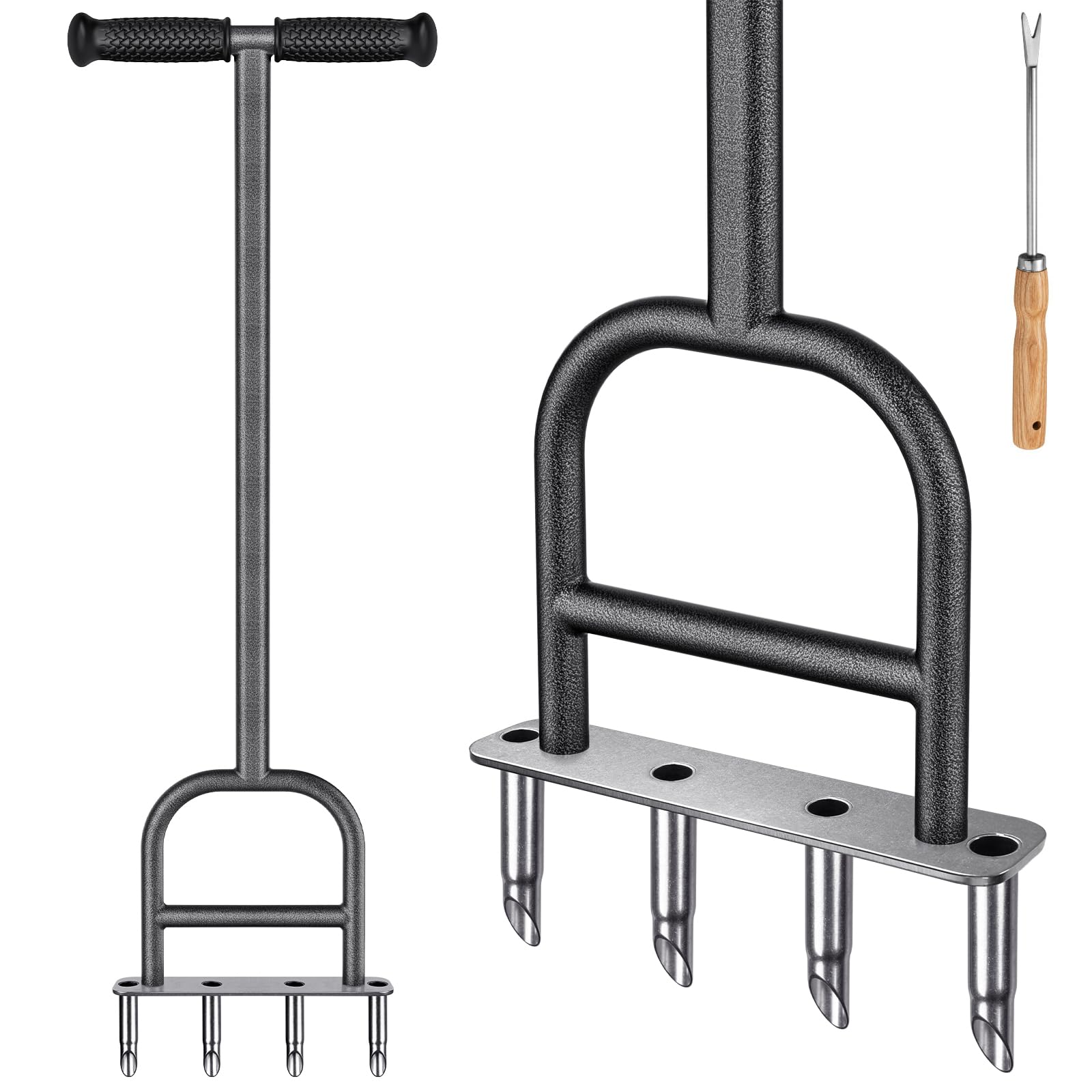
The Dolibest stands out by packing four stainless-steel corer plugs into a single foot-operated unit, which means you extract 33% more soil per step compared to standard three-tine models. Each tine measures 3.5 inches long and 0.5 inches wide, producing deep, narrow plugs that leave clean holes across the lawn. The bottom section and corer plugs are stainless steel, resisting rust far better than powder-coated carbon steel.
A foot bar positioned above the tines keeps your boot from interfering with the plug as it ejects out the top, a small design detail that noticeably speeds up workflow. The soft rubber grip on the handle prevents blisters during extended sessions, and the included 12-inch weeder tool doubles as a cleaning rod for clearing any stuck material from the hollow barrels.
Some users note that the rounded foot pedal reduces leverage compared to a flat step design, requiring a bit more body weight to sink all four tines in hard ground. Clogging can happen if the soil is too moist, and clearing four barrels takes slightly longer than three. Still, for small lawns up to 4,000 square feet, this is the fastest manual corer you can operate without a motor.
What works
- Four stainless tines extract more soil per step than three-tine models
- Foot bar prevents shoe interference with core ejection
- Included weeder tool doubles as a barrel cleaning rod
What doesn’t
- Rounded foot pedal offers less leverage on hard soil
- Clogs more easily in wet or sandy conditions
3. Yard Butler Spike Aerator
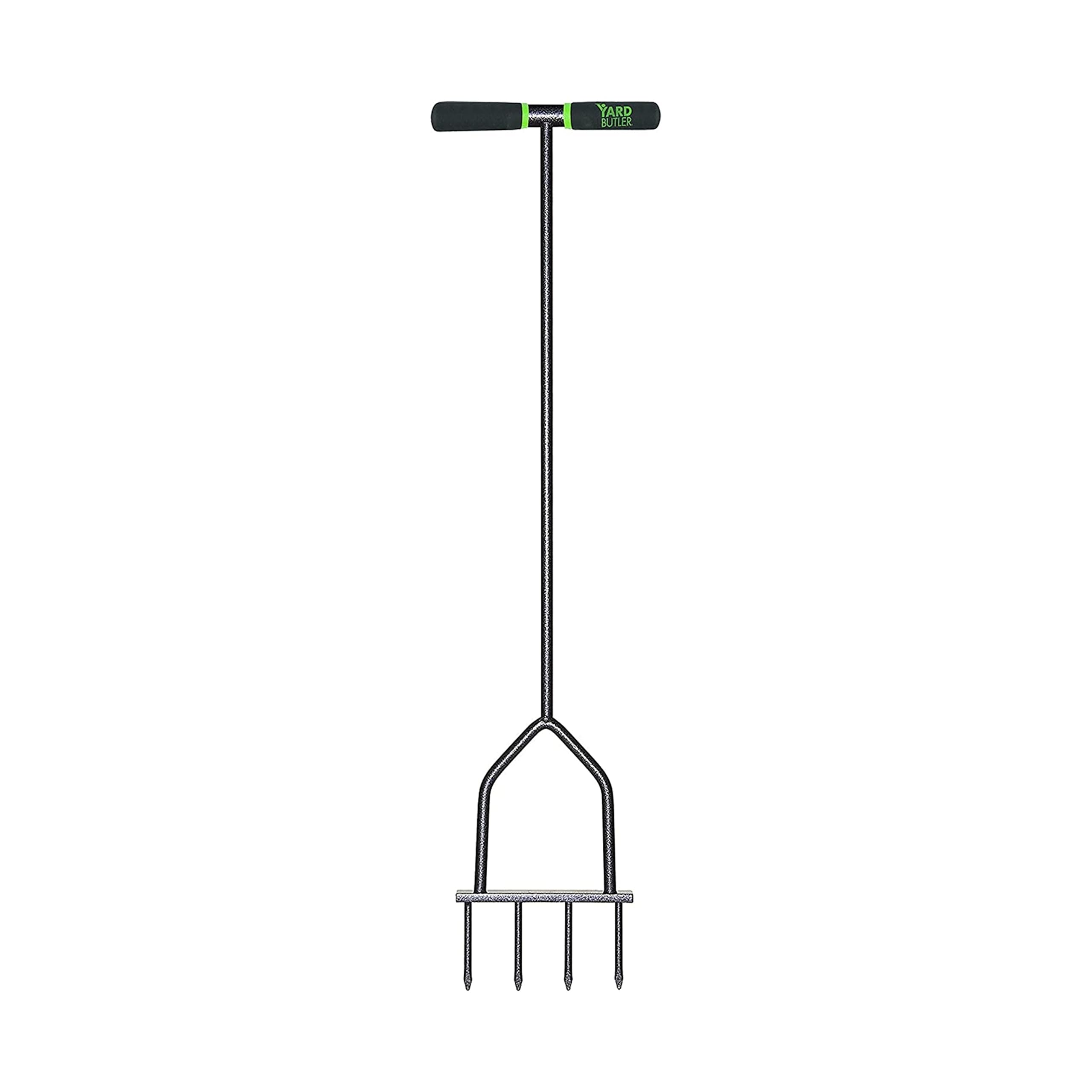
Yard Butler’s IM-7C spike aerator is a straightforward, no-frills tool built around a single principle: get 3-inch spikes into the soil without back strain. The handle extends long enough that most users can stand upright while operating, and the powder-coated steel frame has held up for years in owners’ sheds without rusting. Each push delivers four deep spike holes, which is adequate for loosening surface compaction in loamy or sandy soil.
This model is best understood as an entry-level tool for general lawn maintenance rather than a cure for severe compaction. The spike method does not remove soil, so it works best when your goal is improving water infiltration and overseeding contact rather than creating long-term root channels in clay. Owners of tall stature (over 6 feet) occasionally report that the 37-inch handle still forces a slight stoop, though most find it comfortable.
The biggest limitation is speed — covering even a 2,000-square-foot lawn takes deliberate effort, and the four-spike head covers less ground per step than eight-spike or rolling alternatives. But for a budget-friendly, lightweight tool that takes up minimal storage space and requires no assembly beyond snapping on the handle, the Yard Butler remains a solid choice for spot treatment on small patches.
What works
- Long handle allows upright operation without bending
- Powder-coated steel resists rust in wet storage conditions
- Lightweight at only 2.25 pounds for easy handling
What doesn’t
- Four-spike head covers ground slowly on larger lawns
- Short handle height may cause stooping for users over 6 feet
4. VEVOR Rolling Lawn Aerator
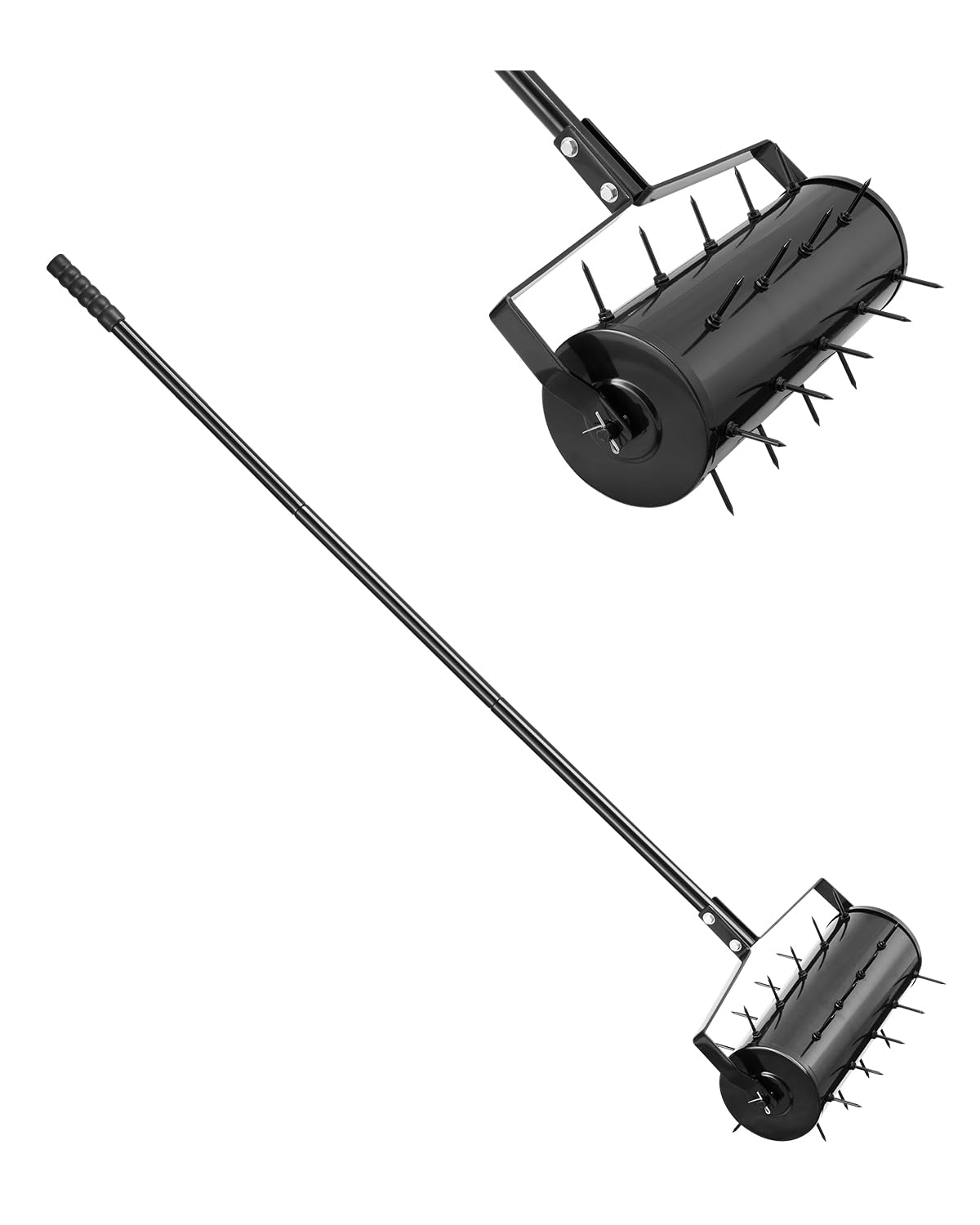
For small-lawn owners who want to walk a straight line and cover the entire yard in minutes rather than spending an hour stepping on a handheld tool, the VEVOR rolling aerator is the most practical option. Its 18-inch-wide drum carries 27 spikes, each 2 inches long, distributing the weight across a wide surface so you don’t have to wrestle with alignment on every pass. The 51.6-inch adjustable handle lets you maintain a natural walking posture.
The build uses high-strength metal spikes with a rust-resistant powder coating, and the spikes come pre-installed — you only attach the handle and locking mechanism, which most owners report completing in under 10 minutes. The drum can be filled with sand or soil via a side cap to increase penetration weight, a necessary step on harder ground where the base 9.9-pound weight may not sink deep enough.
Owner reports indicate that the weak point is the Z-shaped metal brackets connecting the axle to the handle frame. Under heavy weight loads or when hitting dense soil, these brackets can bend, causing the drum to bind. Light to moderate use on moist, sandy-loam soil works well, but this is not a tool for aggressive compaction relief on dry clay. Treat it as a seasonal soil refresher rather than a rehab tool.
What works
- 18-inch drum covers width efficiently for whole-lawn aeration
- Adjustable 51.6-inch handle suits different user heights
- Fills with sand or water for customizable penetration weight
What doesn’t
- Axle bracket can bend under heavy load on hard soil
- Not effective on dry, compacted clay without pre-watering
5. EEIEER Core Aerator with Storage Basket

The EEIEER addresses one of the most annoying aspects of manual coring: scattered soil plugs littering the lawn. Its integrated soil storage basket catches the expelled cores as they exit the hollow tines, so you’re not left with dozens of dirt pellets to sweep up afterward. The 38-inch ergonomic handle and wider 4.3-inch foot pedal make the tool easier to drive into the ground, and the patented one-piece bottom structure avoids the weld-failure issues seen on budget corers.
The high-density alloy construction with thickened 2mm inner walls is noticeably sturdier than the 1.2mm walls on earlier versions. The included cleaning stick serves double duty as a weeding tool, and the three 3-inch tines release plugs reliably on soft to moderately moist soil. For small lawns under 3,000 square feet, this tool delivers a cleaner operation than any other manual corer in this price bracket.
The downsides are specific but real. The foam handle grips may degrade after a season of UV exposure, and the storage basket fills quickly — on a 1,000-square-foot yard you may need to empty it multiple times. In damp clay soil, the tines can still clog, and the cleaning stick only helps if you stop to clear them. For dry, loose soil, however, this remains the neatest way to manually core a small lawn.
What works
- Soil storage basket catches expelled cores for easy cleanup
- Thickened 2mm alloy walls resist bending and breaking
- Wide foot pedal provides good leverage for soil penetration
What doesn’t
- Foam handle grips may degrade with UV exposure over time
- Storage basket fills quickly and needs frequent emptying
6. Saker Manual Lawn Aerator
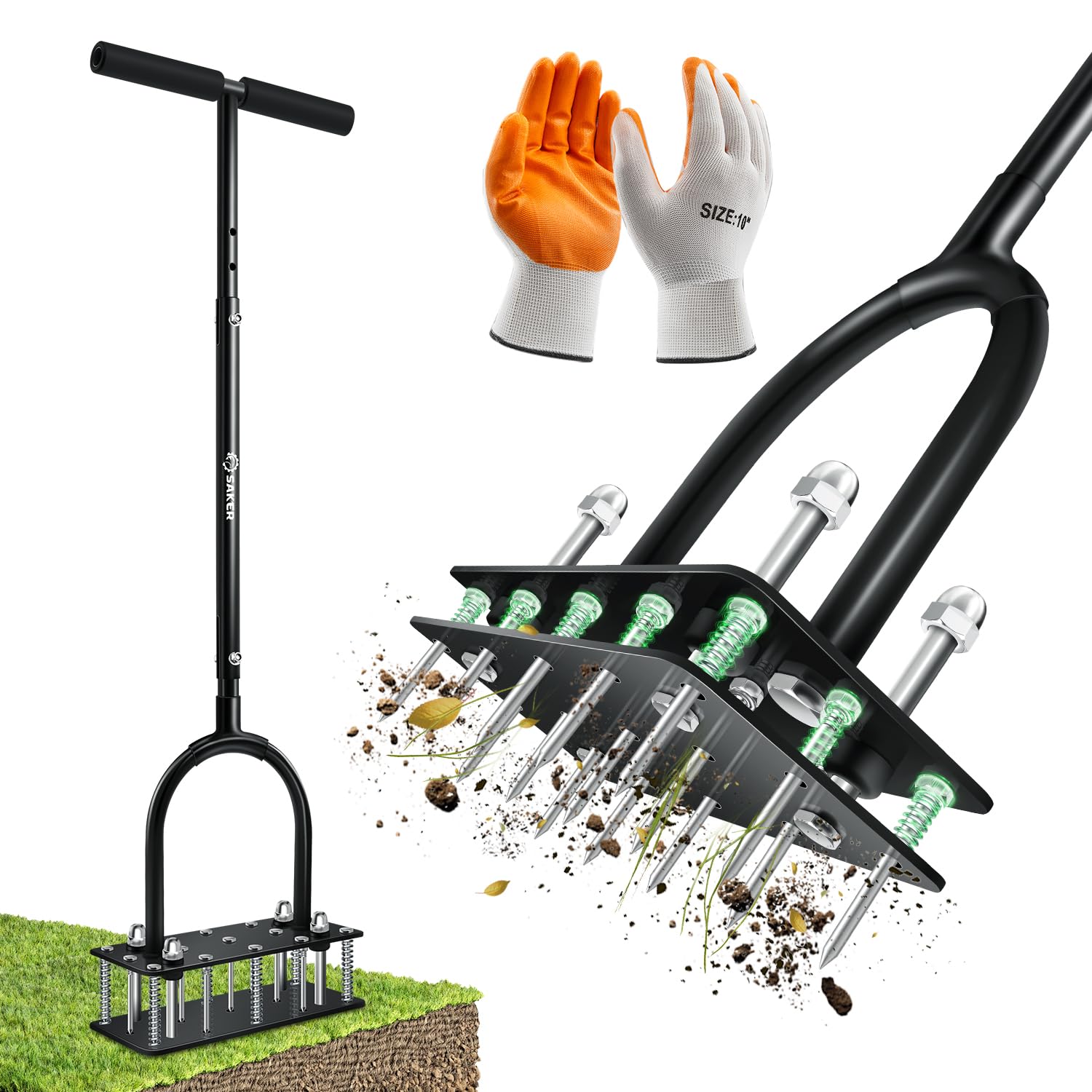
The Saker step-on aerator is engineered around comfort and ease of use for spot-treatment situations. Its 15 sharp iron spikes, each 2.3 inches long, create a dense pattern of holes per step, and the double-layer spring system automatically pushes soil and debris out of the spike head as you lift your foot — a real time-saver compared to models that require manual cleaning after every third push.
The height adjusts from 32.2 to 35.4 inches, accommodating different user statures without forcing a hunched posture. The 2026 reinforced construction replaces welded joints with high-strength screw connections on the foot pedal, eliminating the common failure mode where welds snap under repeated pressure. At 6.52 pounds, it’s heavy enough to sink spikes on its own weight but light enough to carry from patch to patch.
Owner feedback consistently confirms that this tool works best on moderately moist, non-compacted soil. On hard, dry clay, the spike length may not achieve full penetration, and the user has to add significant downward force. A few owners noted that the spring mechanism can lose tension over heavy use, but for seasonal aeration of small patches and garden beds, the Saker offers a genuinely comfortable user experience.
What works
- Double-layer spring ejects soil automatically to prevent clogging
- Adjustable handle height reduces back strain for different users
- Reinforced screw connections on foot pedal outlast welded joints
What doesn’t
- Struggles to penetrate hard, dry clay at full spike depth
- Spring mechanism may lose tension after extended heavy use
7. Seeutek 23 Inch Rolling Lawn Aerator

The Seeutek rolling aerator brings a 23-inch drum and a 24-pound empty weight to the table, making it the heaviest manual roller in this roundup. That mass alone drives the 2-inch star-shaped spikes deeper into the soil without requiring the user to push down — you just walk and let gravity do the work. The tripod connection between the handles and the drum axle is significantly more stable than the Z-bracket design on lighter rollers.
Three adjustable handle heights accommodate a range of user statures, and the padded T-bar handle adds comfort during extended sessions. A clever 2.5 cm side hole lets you add water or sand to the drum for even more weight, which is useful when you hit isolated patches of hard ground. The laser-welded spikes eliminate the need for on-site assembly of the drum itself — you mostly just attach the handles and tighten bolts.
The weight, however, becomes a liability on slopes or if you need to lift the unit over garden borders. Assembly instructions are minimal and use small pictures, which can make the build process take up to an hour. A small number of owners reported that the handle support metal can bend under extreme force if the drum hits a solid obstruction. For flat, small to medium lawns with average compaction, this is the most effortless roller option available.
What works
- Heavy 24-pound drum drives spikes deep without extra force
- Stable tripod handle connection resists bending under load
- Can add water or sand for even more penetration weight
What doesn’t
- Heavy weight makes it difficult to lift over obstacles
- Assembly instructions are poorly detailed and time-consuming
Hardware & Specs Guide
Spike Depth and Length
The penetration depth of an aerator directly determines how far below the surface you’re breaking compaction. Grass roots typically grow 4-6 inches deep, but even 2-3 inch holes create enough channeling for water infiltration and root expansion. Spike models (rollers and step-ons) range from 2.0 to 3.0 inches. Core aerators with hollow tines typically extract 3.0 to 3.5 inch plugs, removing soil volume rather than just displacing it. For compacted clay, a core depth of at least 3 inches is recommended.
Drum Width and Coverage Rate
For rolling aerators, drum width dictates how much ground you cover per pass. An 18-inch drum like the VEVOR covers 1.5 feet per row. A 23-inch drum like the Seeutek covers nearly 2 feet per row. On a 2,000-square-foot lawn, a 23-inch drum saves roughly 20% more passes than an 18-inch drum. Step-on and handheld aerators are measured by number of tines per footprint — three to four tines per step is standard for manual core removal, with four-tine models covering area faster but requiring more physical force to operate.
FAQ
Should I use a spike aerator or a core aerator on a small lawn with clay soil?
How many times per season should I aerate a small lawn?
Do I need to water my lawn before using a manual aerator?
What is the maximum lawn size for a manual aerator?
Final Thoughts: The Verdict
For most gardeners, the aerator for small lawn winner is the LawnVigor Manual Core Aerator because it pulls genuine 3-inch soil cores with a durable, ergonomic build that handles clay compaction without breaking the bank. If you want a fast whole-lawn roll instead of step-by-step coring, grab the VEVOR Rolling Aerator for its wide 18-inch coverage and customizable weight. And for maximum efficiency per step on moderately compacted soil, nothing beats the Dolibest 4-Corer Aerator with its four stainless-steel tines.