
Commercial weed eaters are the backbone of professional landscaping, built to endure punishing daily schedules where downtime is unacceptable. Unlike residential trimmers that fade under thick brush, these machines pack higher-displacement engines, sturdier shafts, and more robust cutting heads to clear acres of dense growth without blinking. With options spanning 28cc-to-30cc gas two-strokes and 18V-to-60V battery platforms, choosing the right one balances raw torque, ergonomic practicality, and whether you stick with gas or transition to high-voltage battery systems.
I’m Rikta — the co-founder and writer behind Lawn Gear Lab. My methodology involves cross-referencing engine displacement, cutting width, corrosion-resistant metals, shaft coupling systems, and servicing intervals. I pull from hundreds of verified owner experiences to isolate the tools that hold up under commercial-grade churn, not just weekend use. This guide compares five of the most capable models across gas and battery platforms, focusing on what truly separates a five-year workhorse from a warranty headache.
Whether you stick with gas for all-day runtime or move to a battery platform for quieter job sites, this breakdown of the best commercial weed eaters isolates the specs most buyers overlook until breakdowns start costing them jobs.
How To Choose The Best Commercial Weed Eater
Commercial trimmers cost more than consumer units for a reason — thicker gauge steel, heavier-gauge line capacity, and engine components designed for daily restart loads. You have to evaluate three main pillars: power delivery method, cutting system robustness, and the interface between your body and the tool over a four-hour shift. Here is what matters most.
Engine Displacement and Power Configuration
Displacement in a 2-cycle trimmer directly dictates how much torque you get when the head bogs into inch-thick stalks. A 25cc to 28cc engine is adequate for routine grass and light weeds, but once you face briars or saplings, 30cc and above provides the reserve torque to maintain spindle speed. 4-cycle engines trade a slightly lower power-to-weight ratio for no mixed fuel headaches and quieter operation, but they add weight and complexity. Larger 4-cycle walk-behind units use displacement well beyond 100cc to convert rotating mass into momentum that doesn’t stall in heavy cover, though none of the five models compared here fall into that walk-behind category.
Cutting Width, Line Capacity, and Head Design
Cutting width — from 15 inches to 22 inches — determines how many passes you need per job. Wider swaths clear faster but require more engine power to keep line speed up. Commercial heads must support .095-inch to .155-inch line diameter. Thinner .080-inch line whips through grass quickly but snaps in brush. The bump-feed or Speed-Feed system you choose affects how often you stop. Rapid Replace or tool-less designs reduce downtime, while traditional bump heads are simpler and less prone to mechanical failure.
Shaft Build, Coupling, and Vibration Dampening
A straight steel shaft transmits torque more efficiently than a curved one and allows deeper reach under fences. The wall thickness and whether the shaft is solid steel or hollow tube matter — commercial units should feel rigid with no flex under load. Coupling systems like Husqvarna’s detachable shaft or Milwaukee’s Quik-Lok let you swap attachments without tools, but any coupling joint is a potential failure point if the locking mechanism loosens. Vibration dampening — LowVib on Husqvarna or rubber grip inserts on Echo — reduces hand fatigue and long-term nerve strain over a full work week.
Fuel System and Starting Reliability
The most common commercial frustration is a trimmer that won’t restart after a break. Digital ignition systems (Husqvarna), spring-assisted pull cords (Echo), and purge bulbs that clear air from the carburetor all reduce the tug count at the start of every cycle. Automatic return stop switches that reset to “on” prevent the most common operator error. For battery systems, the relevant spec is voltage combined with amp-hours — 36V nominal with 4Ah or higher delivers commercial-level runtime, while 60V systems can match a tank of gas for moderate thickness.
Serviceability and Warranty Support
Commercial trimmers demand easy access to the air filter, spark plug, fuel lines, and cutting head. Tool-less air filter covers, like those on Echo’s iSeries, let you clean or replace elements in the field without tools. Warranty length signals manufacturer confidence — 2-year commercial or 5-year limited warranties are better than 90-day consumer coverage. Note which parts are covered and whether the warranty includes labor or only parts, because many commercial operators report paying for repairs on trimmers that are still under “limited” warranties.
Quick Comparison
On smaller screens, swipe sideways to see the full table.
| Model | Category | Best For | Key Spec | Amazon |
|---|---|---|---|---|
| Husqvarna 330LK | Gas 2-Cycle | Large properties, attachment versatility | 20” cutting width, 8000 RPM | Amazon |
| Echo X Series 30.5cc | Gas 2-Cycle | Professional brush clearing | 1.8 HP, 10,000 RPM | Amazon |
| Makita XUX01ZM5 | Battery 36V | Quiet operation, multi-attachment | 7100 RPM, 3-speed selectable | Amazon |
| Milwaukee FUEL Combo (Blower) | Battery 18V | Cordless convenience, multi-tool kit | 8.0Ah Forge battery, Quik-LOK system | Amazon |
| DEWALT 60V Combo | Battery 60V | Trimmer & chainsaw combo | 15” swath, 3Ah battery | Amazon |
In‑Depth Reviews
1. Husqvarna 330LK Gas String Trimmer

The Husqvarna 330LK is the logical upgrade from Husqvarna’s residential-grade 130L for operators who cover larger properties and want attachment flexibility. Its 28cc engine spins the head at 8,000 RPM with a dual-width option — 20 inches for open swaths or 18 inches for concentrated torque in thick vegetation. The detachable shaft accepts Husqvarna’s range of click-on tools, making it a single power head that converts to an edger, blower, or pole saw. The spring-assisted pull and Air Purge system dramatically reduce the effort to start on cold mornings, and the transparent fuel tank lets you see remaining mix without unscrewing a cap.
The LowVib anti-vibration system is not a marketing gimmick — over a three-hour trimming session, the reduced handle vibration genuinely lessens finger numbness compared to rigid-frame competitors. The Rapid Replace trimmer head spins counterclockwise and reloads string by aligning and twisting, which is faster than disassembling a spool but requires the right motion to avoid cross-threading. The T-handle design provides good control on slopes, though some users with long arms find the handle position slightly low.
Owner feedback confirms that this trimmer handles two to three tanks of gas per week without issues, with multiple reports of it running strong past the two-year mark. The most common complaint targets the new head design — a few owners report the head failing to engage after five to ten uses. If you rely on the trimmer for everyday commercial work, consider having a spare head or sticking the older Husqvarna T35 head as a backup. The 2-year commercial warranty provides decent coverage, but warranty processing time has frustrated some users.
What works
- 20-inch cutting swath clears large areas quickly with 8,000 RPM torque
- Detachable shaft accepts multiple Husqvarna attachments for task versatility
- Spring-assisted start and Air Purge reduce pull effort significantly
- LowVib technology minimizes hand fatigue over multi-hour shifts
What doesn’t
- New Rapid Replace head has sporadic engagement failures reported by some users
- Low handle position may not suit taller operators for prolonged use
- Warranty process is slow for commercial users needing fast turnaround
2. Echo X Series 30.5cc Professional-Grade String Trimmer
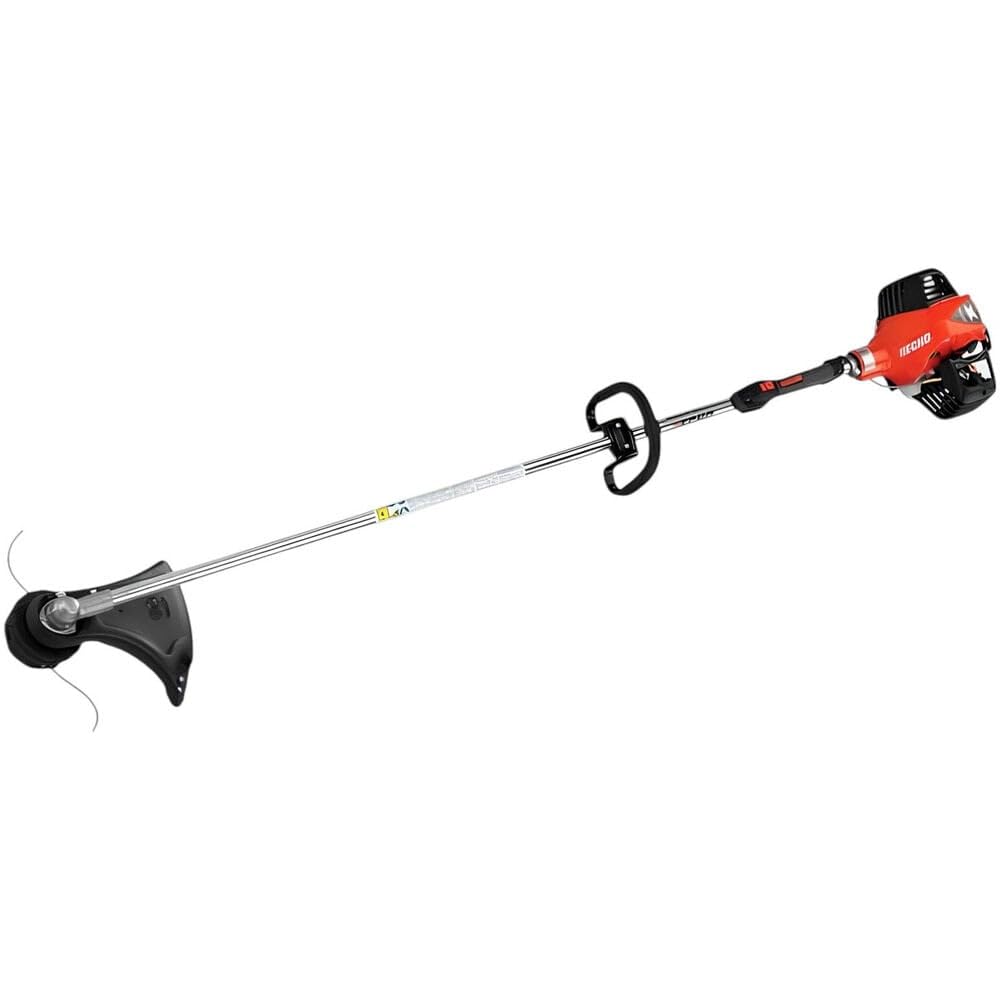
The Echo X Series SRM-30.5cc pushes 1.8 HP from its professional-grade 2-stroke engine, which is roughly 20 percent more displacement than standard 25cc units. This extra cubic capacity translates directly into the ability to spin heavier .155-inch line at 10,000 RPM without bogging down in 6-foot brush or half-inch saplings. The 2:1 high-torque gear ratio ensures the engine’s power is delivered to the head rather than wasted in the shaft, making it one of the most aggressive gas trimmers available in the sub- range. The tool-less air filter access lets you service the two-stage paper and foam filter in under a minute without tools — a critical feature for crews working in dusty conditions.
The rubber front and rear grips provide excellent shock absorption, but the vibration dampening is not as refined as Husqvarna’s LowVib. At weight listed at 50 pounds (which includes packaging; the unit itself is closer to 14 pounds), the trimmer is heavy for a handheld tool, and the harness is strongly recommended for all-day use. Starting reliability receives mixed marks — while most owners report a quick start after the first few pulls, a vocal minority describes chronic starting failure that leads to expensive repairs. The i-30 start system and purge bulb help, but this engine seems sensitive to fuel quality and storage conditions.
Users consistently praise its ability to chew through overgrown lots, blackberry patches, and small woody brush that would stall lesser trimmers. The Speed-Feed head loads .155 line without modification, though the line must be wound tightly to prevent tangling. The biggest risk is the quality-control variance — a small percentage of units arrive with carburetion issues that require dealer intervention. If you buy this, run the first tank of non-ethanol premix to confirm the engine is properly dialed. The 5-year consumer warranty is generous, but commercial users should verify coverage terms with their dealer before purchase.
What works
- 1.8 HP and 10,000 RPM deliver class-leading brush-cutting torque
- Tool-less air filter servicing saves time in dusty commercial conditions
- 2:1 high-torque gear ratio prevents stalling in thick, woody growth
- Speed-Feed head handles .155-inch line without modification
What doesn’t
- Starting reliability is inconsistent across units, with some chronic failure reports
- Heavier than comparable 25cc trimmers, requiring a harness for long shifts
- Vibration dampening is adequate but not as refined as Husqvarna’s LowVib system
- Commercial warranty coverage may require dealer validation
3. Makita XUX01ZM5 36V (18V X2) LXT Brushless Couple Shaft Power Head

The Makita XUX01ZM5 demonstrates how far battery-powered trimming has come, using two 18V LXT batteries wired in series to produce a nominal 36V system with brushless motor efficiency. The motor hits up to 7,100 RPM on high speed, with a three-speed selector (4,200, 6,000, 7,100 RPM) that lets you dial down speed for lighter grass to conserve battery or crank it up for heavy weeds. The Couple Shaft attachment system — using a lever-style lock — lets you swap between string trimmer, edger, hedge trimmer, and pole saw attachments without tools. The included EM405MP string trimmer attachment delivers a 15-inch cutting swath, which is narrower than gas competitors but standard for battery platforms.
Runtime is the critical metric here. With two 5.0Ah batteries, owners report 20 to 30 minutes of continuous heavy use or up to 90 minutes of intermittent trimming. For commercial-scale properties, you need at least two pairs of batteries and a dual rapid charger to keep going without downtime. The variable speed trigger adds fine control, and the bump-feed head works well when the collet is tightened firmly — otherwise the head can spin off during heavy cutting. Owners appreciate the quiet operation compared to 2-stroke engines, allowing early-morning or noise-sensitive job sites. The trimmer comes with a storage bag, which is a rare bonus.
The main trade-off is weight distribution. The motor head housing places the weight toward the rear, and with two batteries seated back, the trimmer feels slightly tail-heavy. A harness is strongly recommended for all-day use, though some users report that the included bag does not contain a harness. The proprietary attachment system means you cannot use universal Trimmer Plus attachments — only Makita’s Couple Shaft accessories. For users already invested in Makita’s 18V LXT ecosystem, this trimmer makes perfect sense. For others, the battery investment adds significant upfront cost.
What works
- Brushless 36V motor delivers near-gas torque with three speed settings for power management
- Lever-style tool-less attachment system swaps quickly without wrenches
- Silent operation allows use in noise-sensitive environments
- Includes storage bag and comes with Makita’s 3-year limited warranty
What doesn’t
- Tail-heavy design needs a harness for balance during extended use
- Proprietary attachment system limits accessory compatibility
- Requires multiple battery pairs and rapid charger for commercial runtime
- 15-inch cutting width is narrower than most gas commercial trimmers
4. Milwaukee M18 FUEL Brushless String Trimmer Kit w/Quik-LOK Chain Saw & Blower

Milwaukee’s flagship M18 FUEL trimmer kit bundles the Quik-LOK power head, string trimmer attachment, and a M18 FUEL blower with a single REDLITHIUM FORGE XC8.0Ah battery and rapid charger. This is a complete system for operators who want to leave gas behind entirely. The brushless PowerState motor delivers impressive torque output that owners consistently describe as equal to or better than 25cc gas trimmers, with the advantage of instant torque on trigger pull. The Quik-LOK mechanism lets you swap attachments in seconds, and the system supports edger, hedge trimmer, pole saw, and broom attachments — all tool-less.
The 8.0Ah Forge battery provides roughly 60 minutes of continuous trimming under moderate load, or about 30 minutes in heavy brush. For commercial use, you need at least two batteries and the rapid charger to keep swapping. The trimmer weight with the 8.0Ah battery is around 12 pounds, which feels balanced due to the battery placement under the motor. The variable speed trigger on this model provides excellent control for detail edging without the line throwing debris. The blower included in the kit is a powerful handheld unit that works well for cleanup, but it shares the same battery, so multitasking drains runtime faster.
Owner satisfaction is high for the system’s power and convenience, but there are two notable failure points. A small number of users report the main shaft snapping near the motor housing due to what they describe as thin-wall construction. The string advance mechanism is also criticized — the bump-feed design on the Quik-LOK attachment is less intuitive than gas competitors. The kit is a premium investment, but for crews already running Milwaukee M18 tools, the battery compatibility makes it a cost-effective long-term play. The 5-year limited warranty on the tool (batteries have a separate 3-year coverage) is solid.
What works
- Brushless motor delivers torque comparable to 25cc gas trimmers
- Quik-LOK system enables fast, tool-less attachment swapping
- 8.0Ah Forge battery provides commercial-grade runtime with rapid charging
- Includes blower for complete job-site cleanup capability
What doesn’t
- Main shaft has reported snapping failures under heavy brush load
- Bump-feed string advance design is less reliable than gas heads
- Battery sharing between trimmer and blower limits multitasking runtime
- Premium price requires existing M18 ecosystem investment for cost efficiency
5. DEWALT FLEXVOLT 60V MAX String Trimmer & Chainsaw Combo Kit

DEWALT’s FLEXVOLT 60V MAX combo pairs the DCST970B string trimmer with the DCCS670 chainsaw on a single 3Ah battery platform, targeting operators who need both tools for lot clearing and property maintenance. The trimmer uses a high-efficiency brushless motor and a 15-inch cutting swath with 0.080-inch line — the lighter line diameter limits its use to grass and lighter weeds rather than thick brush. The chainsaw features a 16-inch bar, tool-less chain tensioning, and auto-oiling via Lubrilink technology, and it arrives extremely sharp from the factory. The included 3Ah battery delivers roughly 30 minutes of continuous trimming or enough power to cut through half a cord of logs in a single charge.
The trimmer’s availability with the 60V system means higher voltage for more torque than 18V platforms, but the trade-off is that the 3Ah battery is small for the voltage. Users who need longer runtime must invest in larger 9Ah or 12Ah batteries, which significantly increase the upfront cost. The trimmer’s handle is adjustable for angle but not shaft length, meaning taller operators may find the shaft too short for comfortable use — a few owners report needing to hunch over. The string replacement process is frustrating: the bump head is difficult to remove, and pre-wound spools are expensive, forcing users to learn re-stringing via tear-down.
Despite these limitations, owners are overwhelmingly positive about the chainsaw’s performance — it cuts fast and the auto-oiling is consistent. The trimmer is adequate for residential-scale commercial work but pushes its limits on thick weeds. The kit ships in two separate boxes that may arrive on different days, so plan for partial delivery. For crews already running DEWALT 60V or 20V tools, this combo is a practical extension, but heavy brush operators will find the trimmer underpowered compared to gas competitors in this price tier. DEWALT’s customer service for battery replacement is cited as responsive and helpful.
What works
- High-voltage 60V system provides strong torque for a cordless trimmer
- Chainsaw cuts aggressively with sharp chain and reliable auto-oiling
- Tool-less chain tensioning is quick and convenient for field adjustments
- DEWALT customer service is responsive for battery replacement issues
What doesn’t
- 0.080-inch line diameter is too light for commercial brush clearing
- Trimmer shaft is not adjustable in length, uncomfortable for taller operators
- 3Ah battery provides limited runtime, requiring large capacity upgrades
- String replacement on bump head is difficult and time-consuming
- Kit ships in two boxes that may not arrive simultaneously
Hardware & Specs Guide
2-Cycle vs 4-Cycle Engine Design
A 2-cycle engine completes its power cycle in two piston strokes — one up, one down — which gives a higher power-to-weight ratio and simpler construction. The trade-off is that 2-cycle engines require oil mixed with fuel and produce more exhaust noise. A 4-cycle engine completes its cycle in four strokes and has a dedicated oil sump, eliminating fuel mixing and reducing noise, but adding weight and complexity. For commercial trimmers, 2-cycle designs dominate for handheld units because the weight savings matter for arm fatigue, while 4-cycle engines appear in walk-behind units where weight is a minor concern and low noise matters for residential job sites.
Cutting Diameter and Line Compatibility
Cutting diameter ranges from 15 inches on compact battery units to 22 inches on walk-behind mowers. A wider swath cuts fewer passes but requires more engine torque to maintain line speed. Line diameter compatibility is equally important — thinner .080-inch lines whip fast and cut grass efficiently but snap in brush. Commercial operators should use .095-inch to .155-inch line for durability. .105-inch is the sweet spot for mixed grass and light weeds. .155-inch is reserved for heavy brush and walk-behind applications. Always check the head’s maximum line diameter rating before buying, as some heads physically cannot accept thicker gauge lines.
LowVib and Anti-Vibration Systems
Professional landscapers operate trimmers for four to eight hours daily, and prolonged vibration exposure can cause hand-arm vibration syndrome. LowVib (Husqvarna) and similar rubber-isolation systems decouple the engine from the handle using elastomer dampeners. Echo uses rubber isolators between the engine and handle tube. Reductions of 30 to 50 percent in transmitted vibration are common. If you are buying for commercial use, a trimmer with documented anti-vibration technology is worth the premium — the reduction in cumulative fatigue and long-term nerve damage justifies the cost difference.
Detachable Shafts and Attachment Systems
Systems like Husqvarna’s detachable shaft, Milwaukee’s Quik-LOK, and Makita’s Couple Shaft allow the power head to accept multiple attachments — string trimmer, edger, pole saw, hedge trimmer, and blower. The attachment interface must be metal-on-metal with a positive locking mechanism. Plastic coupling collars wear over time and can slip under load, so inspect the locking mechanism before purchase. Detachable shafts add a potential failure point, but for operators who need a multi-tool system, the convenience outweighs the risk. Non-detachable fixed shafts are stiffer and more durable for trimming-only applications.
FAQ
What engine displacement is best for commercial weed eating?
How does the Speed-Feed head compare to a bump-feed head for commercial use?
Can I use universal trimming attachments on any commercial weed eater?
What line diameter should a commercial operator use for mixed properties?
Is a 60V battery trimmer a viable replacement for a gas commercial trimmer?
Final Thoughts: The Verdict
For most commercial landscapers, the best commercial weed eaters winner is the Husqvarna 330LK because it combines a 28cc engine with an 20-inch cutting width, reliable starting, and attachment versatility in a lightweight frame. If you need extreme torque for brush clearing and sapling cutting, choose the Echo X Series 30.5cc with its 1.8 HP engine. If you want to leave gas behind for quieter, tool-less multi-attachment operation, the Milwaukee M18 FUEL Quik-LOK kit delivers the closest battery equivalent to 25cc gas power. Match the tool to your daily load, and buy one tier higher than you think you need — commercial work always demands more torque than residential guesswork suggests.