
That sickly yellow patch creeping across your turf isn’t a watering problem—it’s a fungal invasion that can ruin months of lawn care in a single humid week. Whether you’re fighting brown patch, dollar spot, or powdery mildew, the right chemical or biological weapon is the only thing standing between your grass and a full-blown outbreak.
I’m Rikta — the co-founder and writer behind Lawn Gear Lab. I’ve spent dozens of hours poring over product labels, decoding active-ingredient concentrations, cross-referencing EPA registrations, and analyzing thousands of owner reports to build this guide on the most effective solutions for every major turf disease.
The shortlist below covers seven distinct approaches, from gentle biofungicides for organic gardens to professional-grade systemic concentrates for severe infestations. After weeks of head-to-head spec analysis, here is your definitive guide to the absolute best lawn fungus treatment on the market today.
How To Choose The Best Lawn Fungus Treatment
Picking the wrong fungicide wastes money and lets the disease spread. Focus on three factors: the active ingredient’s mode of action, whether you need a curative or preventative formula, and the application format that fits your lawn size.
Active Ingredient: Systemic vs. Contact
Systemic fungicides like propiconazole and myclobutanil are absorbed into the plant’s tissue, protecting new growth from the inside out. They are ideal for stopping established infections and providing residual control for two to four weeks. Contact fungicides like chlorothalonil and neem oil remain on the leaf surface, killing spores on contact but washing off in rain. Use contacts for prevention; use systemics for active outbreaks.
Coverage Area & Application Method
Granular products like the Scotts 2-in-1 cover up to 4,000 sq. ft. per bag and require a spreader, making them convenient for large lawns. Liquid concentrates give you precise control over dilution and are better for targeting specific spots or spraying ornamentals. Always check the label for how many square feet the bottle treats at the recommended rate.
Organic vs. Synthetic Chemistry
Biofungicides (Bacillus subtilis, neem oil extract) are OMRI-approved for organic gardening and safe to use up to the day of harvest. They work best as a preventative, triggering the plant’s natural immune response. Synthetic chemistries (propiconazole, chlorothalonil) are more potent for severe, fast-moving diseases like brown patch or large patch but require strict adherence to re-entry intervals and PPE guidelines.
Quick Comparison
On smaller screens, swipe sideways to see the full table.
| Model | Category | Best For | Key Spec | Amazon |
|---|---|---|---|---|
| Quali-Pro Propiconazole 14.3 | Systemic Concentrate | Active brown patch & dollar spot control | 14.3% propiconazole – 32 oz treats up to 16,000 sq. ft. | Amazon |
| Dow AgroSciences Eagle 20EW | Turf Systemic | Multi-disease prevention on turf & ornamentals | 20% myclobutanil – 16 oz, systemic mode | Amazon |
| Ortho Rose & Flower Disease Control | Systemic Spray | Black spot & powdery mildew on ornamentals | Rainproof in 24 hours, controls up to 4 weeks | Amazon |
| Scotts Turf Builder Fungicide + Lawn Food | Granular 2-in-1 | Preventative feeding & disease control | Covers 4,000 sq. ft., controls 27 diseases | Amazon |
| Bonide Fung-onil | Contact Concentrate | Broad-spectrum blight & leaf spot | Chlorothalonil 29.6% – 16 oz concentrate | Amazon |
| Garden Safe Fungicide3 | Organic RTU Spray | 3-in-1 organic prevention on veg & flowers | Neem oil extract, 1-gallon ready-to-use | Amazon |
| Bonide Revitalize Biofungicide | Organic Concentrate | Immune-system trigger for organic produce | Bacillus subtilis, 16 oz – harvest day safe | Amazon |
In‑Depth Reviews
1. Quali-Pro Propiconazole 14.3 Fungicide

This professional-grade systemic concentrate packs 14.3% propiconazole, a triazole fungicide that moves through the plant’s vascular system to stop brown patch, dollar spot, and summer patch from the inside. The microemulsion formulation reduces odor and improves tank stability, making it a favorite among superintendents and serious lawn owners. One 32-ounce bottle treats up to 16,000 square feet at the curative rate—enough to handle a standard suburban lawn with leftover for spot treatments.
Owner reports confirm that visible recovery often begins within 7 to 10 days of the first spray, even on St. Augustine sod hit by silver leaf or brown patch. Users who alternated this product with a granular fungicide every two weeks for two months saw full recovery by the next growing season. The label covers cool- and warm-season grasses, plus trees, shrubs, and flowers, giving you a single solution for the entire landscape.
The catch is safety: this is a restricted-use-level concentrate that demands full PPE—respirator, goggles, gloves, and protective clothing. The math for mixing (ounces per 1,000 square feet) can feel intimidating at first, but the results justify the caution. For homeowners battling a stubborn outbreak that cheaper products couldn’t stop, this is the weapon that ends the fight.
What works
- Systemic action eradicates deep-rooted fungal infections in warm- and cool-season turf.
- Excellent tank-mix compatibility with fertilizers and other fungicides.
- Very economical price per square foot—one bottle covers most home lawns.
What doesn’t
- Requires accurate measuring and full protective gear for safe handling.
- Less effective on some St. Augustine-specific diseases compared to targeted alternatives.
2. Dow AgroSciences Eagle 20EW Fungicide

Eagle 20EW delivers 20% myclobutanil, a trusted DMI fungicide that penetrates leaf tissue and protects new growth from over 15 listed diseases including powdery mildew, rust, leaf spot, and zoysia large patch. The emulsifiable concentrate mixes cleanly with water and stays in solution without constant agitation, a practical advantage when treating large turf areas or multiple ornamental beds in one session.
Real-world results from zone 7 gardeners show this product is a go-to for powdery mildew control on ornamentals and annuals. One user reported that two applications roughly 30 days apart completely eliminated clover and dandelion encroachment on zoysia—an unexpected but welcome side effect.
The major hurdle is the mixing mathematics: the label gives rates in ounces per acre, and home-scale users must carefully convert to ounces per gallon. Owners who don’t own a quality backpack sprayer may struggle to get uniform coverage. It also requires the same full PPE as other agricultural fungicides. But for sheer systemic staying power, Eagle 20EW is a top contender.
What works
- Broad-spectrum control across turf, ornamentals, fruit, and nut trees.
- Rainfast once dry—systemic protection won’t wash off.
- Well tolerated by sensitive ornamental and turf species.
What doesn’t
- Mixing instructions are written for commercial acreage, not home gardens.
- 16-ounce bottle is small for large lawns requiring multiple treatments.
3. Ortho Rose & Flower Disease Control Concentrate

Ortho’s systemic concentrate is engineered specifically for rose bushes, flowering ornamentals, and shrubs, with a formulation that becomes rainproof within 24 hours. The active chemistry targets black spot, rust, and powdery mildew—the three diseases that disfigure roses faster than anything else. It begins working within 24 hours and provides residual control for up to four weeks, reducing the spray frequency during the peak growing season.
Long-time rose enthusiasts report that a single application reversed yellowing leaves with black spots, returning foliage to deep green within a week. The systemic action means reapplication is only necessary after heavy rain or rapid new growth, making it an excellent choice for busy gardeners who can’t spray every weekend. The concentrate format lets you mix only what you need, avoiding waste.
The primary drawback is its specialized scope: this product is not labeled for turf or vegetable gardens. It also contains an active ingredient not permitted for sale in New York, so regional availability varies. For dedicated rose and flower beds, however, few products deliver this level of targeted, rainfast protection.
What works
- Rainproof systemic action stops black spot and powdery mildew quickly.
- Four-week residual control reduces the number of applications per season.
- Concentrate stretches further than ready-to-use spray bottles.
What doesn’t
- Label is limited to roses, flowers, and ornamentals—not for turf or edibles.
- Not available for shipment to all states due to regional restrictions.
4. Scotts Healthy Turf Builder Fungicide and Lawn Food
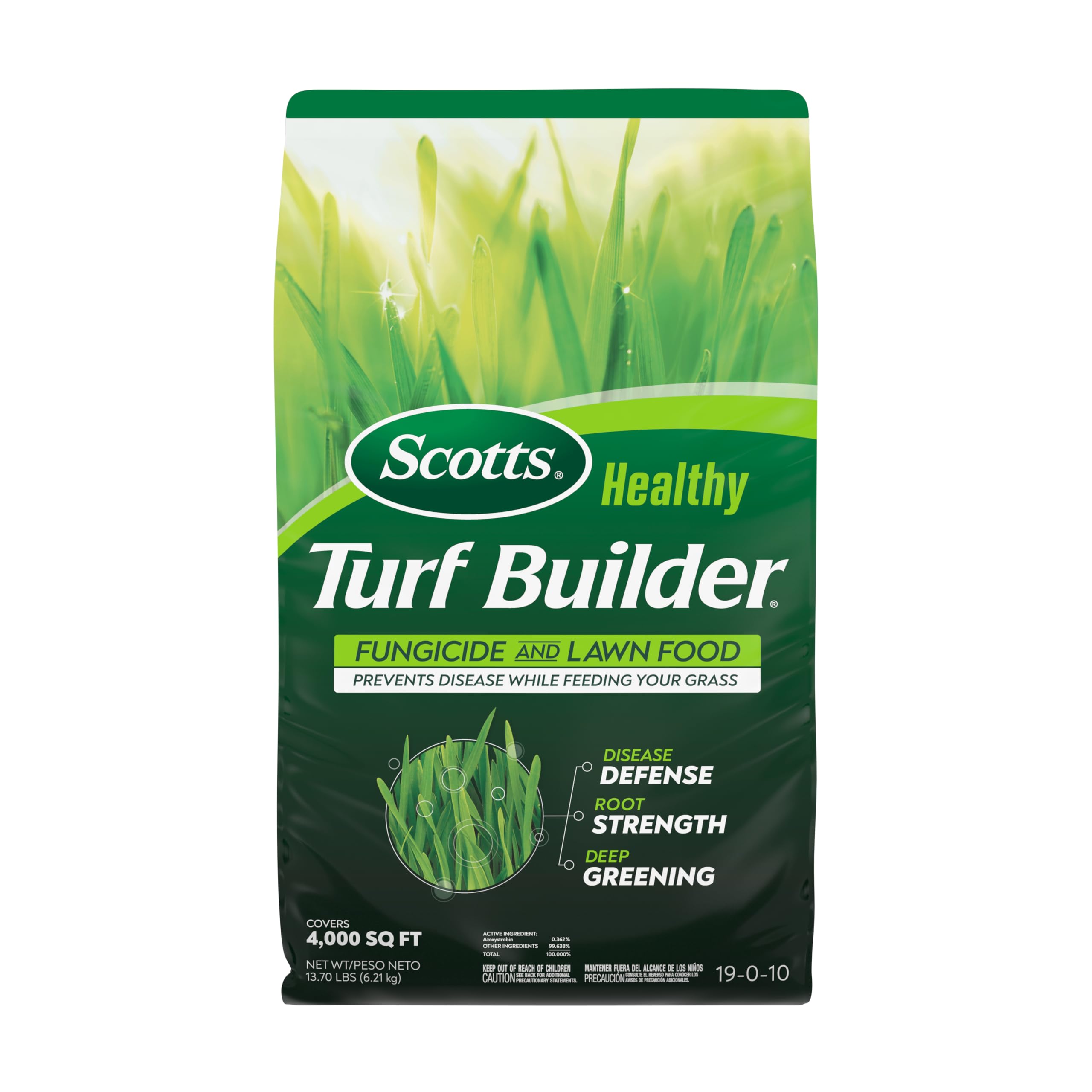
This 2-in-1 granular product from Scotts combines a broad-spectrum systemic fungicide with a balanced lawn fertilizer, letting you feed your turf while simultaneously preventing 27 listed diseases including brown patch, leaf spot, powdery mildew, and red thread. Each 13.7-pound bag covers up to 4,000 square feet, and the spreader-friendly format makes it the most convenient option for homeowners who want a single pass treatment.
Owner reports consistently mention that the grass greened up and thickened noticeably within days of application, while active fungal symptoms faded over the following week. Users who alternated this product with a straight fungicide concentrate every three to four weeks during extreme summer humidity found it to be an excellent maintenance tool that kept the lawn disease-free without extra steps.
The caveat: as a granular product, it requires moisture to activate the fungicide and move it into the root zone. It’s most effective as a preventative rather than a curative for severe outbreaks. If you already have a heavy infestation, a liquid systemic concentrate will deliver faster, more thorough results. But for routine seasonal disease prevention with built-in feeding, this is the easiest route.
What works
- Fungicide and fertilizer in one bag saves time and labor.
- Covers 27 diseases including brown patch and red thread.
- Easy to apply with a standard broadcast or drop spreader.
What doesn’t
- Less effective as a curative for severe, active fungal outbreaks.
- Requires watering in after application, which may be impractical during drought.
5. Bonide Fung-onil Multi-Purpose Fungicide Concentrate

Fung-onil packs 29.6% chlorothalonil, a contact fungicide that forms a protective barrier on leaf surfaces to prevent spore germination. It is labeled for use on beans, tomatoes, fruits, ornamentals, shrubs, and trees, making it one of the most versatile products for edible gardens. The milky-white concentrate clings to foliage even in humid conditions, and its broad-spectrum coverage extends to leaf spot, rust, blight, mildew, and scab.
Tomato growers have reported that two applications spaced ten days apart slowed the spread of early blight and septoria leaf spot significantly, allowing plants to retain enough foliage to finish the season strong. One owner treated boxwood shrubs that were already showing signs of disease and observed improvement after just two spray cycles combined with pruning. The white residue that dries on leaves and fruit washes off easily and does not affect flavor.
Because chlorothalonil is a contact fungicide, it does not move within the plant—new growth remains unprotected, so you must reapply every 7 to 14 days during active disease periods. The label instructions can also feel vague for mixing smaller quantities. But for the price, few products offer this breadth of crop-category coverage with such reliable knockdown power.
What works
- Extremely broad label—vegetables, fruits, ornamentals, trees, and shrubs.
- High 29.6% chlorothalonil concentration gives strong contact protection.
- Leaves a visible coating that confirms coverage on treated foliage.
What doesn’t
- Contact-only mode means new growth is unprotected until resprayed.
- Leaves a white residue on fruit and leaves that some users find unappealing.
6. Garden Safe Brand Fungicide3
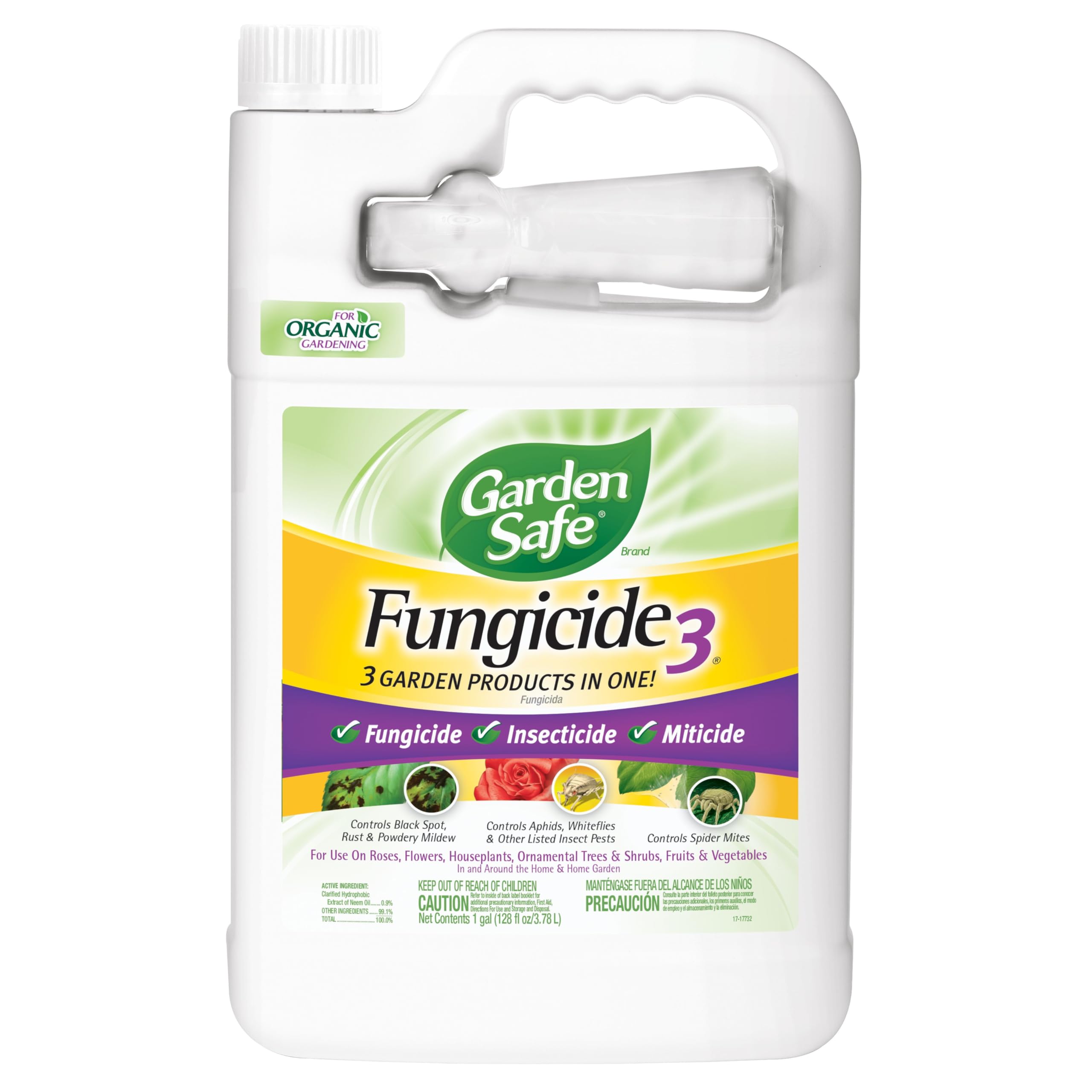
Fungicide3 combines clarified hydrophobic extract of neem oil with a ready-to-use sprayer, making it a triple-threat product that works as a fungicide, insecticide, and miticide in one bottle. The neem oil disrupts fungal cell membranes and sufficates soft-bodied pests, giving organic gardeners a single solution for powdery mildew, black spot, rust, aphids, whiteflies, and spider mites. The EPA-registered formula is OMRI-compatible for use on vegetables, herbs, and fruit up to the day of harvest.
Gardeners who sprayed weekly on roses, hibiscus, tomatoes, and blueberries report that after a month of consistent use, existing powdery mildew stopped spreading and new foliage emerged clean. The neem oil also improved overall plant vigor, with better leaf color and increased yields in treated vegetable beds. Users appreciate the convenience of the attached sprayer—no mixing, no measuring, just pump and go.
The downsides: the included sprayer wand has a short 4-inch coil that makes it awkward to reach the underside of leaves or the center of dense bushes. Some users found that spraying during hot, sunny hours caused leaf burn, so evening or overcast-day application is recommended. It also has a strong garlic-like odor that lingers for several hours after spraying.
What works
- 3-in-1 organic formula controls fungus, insects, and mites with one product.
- Ready-to-use bottle with built-in sprayer eliminates mixing steps.
- Safe for edibles up to harvest day, ideal for organic vegetable gardens.
What doesn’t
- Integrated sprayer wand is too short for reaching deep into dense foliage.
- Neem oil can burn tender leaves if applied in direct sunlight.
7. Bonide Revitalize Biofungicide Concentrate

Revitalize uses Bacillus subtilis, a beneficial bacterium that colonizes leaf and root surfaces and triggers the plant’s own systemic immune response—a mechanism that prevents disease without introducing synthetic chemistry into the garden. It is approved for organic production and can be applied up to the day of harvest with zero pre-harvest interval. The 16-ounce concentrate treats a wide range of plants including vegetables, fruits, trees, shrubs, and houseplants.
Houseplant owners have found this to be a gentle but effective solution for recurring fungal issues on indoor specimens where strong chemicals are unappealing. Outdoor tomato growers who struggled with septoria leaf spot saw a real turnaround after switching to Revitalize as a weekly foliar spray. Users note that the product smells strong—a characteristic of the live bacterial culture—but that the odor dissipates quickly after drying.
The limitation: biofungicides are best used preventatively or at the very first sign of disease. They lack the knockdown power of concentrated synthetic systemics for advanced infections. The bottle treats a smaller area compared to chemical concentrates, so larger operations may find it cost-prohibitive for routine coverage. For organic growers who prioritize soil health and long-term plant immunity, however, this is the smartest foundation treatment available.
What works
- OMRI-approved organic formula safe for edibles up to harvest day.
- Works systemically by boosting the plant’s natural immune response.
- Safe for indoor and outdoor use on a huge range of plant types.
What doesn’t
- Not effective as a curative for severe, advanced fungal outbreaks.
- Live bacterial culture creates a strong odor during mixing and spraying.
Hardware & Specs Guide
Systemic vs. Contact Mode of Action
Systemic fungicides like propiconazole and myclobutanil are absorbed into the plant’s xylem and move upward to protect new tissue. They are rainfast after drying and provide residual protection for 2 to 4 weeks, making them the best choice for curative treatment of active infections. Contact fungicides like chlorothalonil and neem oil remain on the leaf surface and must be reapplied after rain or every 7–14 days. They excel at preventing spore germination on existing foliage but cannot stop an infection already inside the plant.
Active Ingredient Concentration
The percentage of active ingredient (AI) listed on the label tells you how potent the concentrate is. A 14.3% propiconazole product requires a higher dose rate than a 20% myclobutanil product to achieve the same coverage per thousand square feet. Higher AI concentration generally means better value per ounce, but it also demands more careful measuring. Always calculate the recommended ounces per 1,000 sq. ft. rather than comparing bottle sizes directly.
Coverage Area & Dilution Ratios
Granular products like the Scotts 2-in-1 specify a fixed coverage per bag (4,000 sq. ft.), while liquid concentrates vary by dilution rate. A 16-ounce bottle of chlorothalonil concentrate might treat 2,000 to 4,000 sq. ft. depending on the disease pressure. Always read the “Application Rates” section of the label for the specific disease you are targeting, as curative rates are often double the preventative rate.
Organic Certification and PHI
Products labeled for organic use (OMRI-listed or containing Bacillus subtilis, neem oil, or sulfur) have no synthetic residues and can be used right up to the day of harvest—called a zero-day pre-harvest interval (PHI). Synthetic fungicides may require a 7- to 30-day waiting period between application and harvest, depending on the crop and chemical. Always verify the PHI for your specific vegetable or fruit type before spraying.
FAQ
How often should I apply lawn fungicide during an active outbreak?
Can I use a biofungicide like Revitalize on my vegetable garden?
What is the difference between a granular and liquid lawn fungicide?
Will fungicide kill my grass if I apply too much?
Final Thoughts: The Verdict
For most gardeners, the best lawn fungus treatment winner is the Quali-Pro Propiconazole 14.3 because its systemic action and generous coverage area make it highly effective against the most common turf diseases like brown patch and dollar spot. If you want a convenient 2-in-1 formula that feeds while it protects, grab the Scotts Healthy Turf Builder Fungicide and Lawn Food. And for organic gardeners who prioritize soil health and zero synthetic residues, nothing beats the Bonide Revitalize Biofungicide.