
Specs are compiled from manufacturer listings and verified buyer reviews and can change over time — please confirm the key details on the product page before buying.
Pulling weeds by hand is a losing battle — you snap the stem, the root stays deep, and next week the same spot is green again. A real hand weed cutter changes that: it slides under the soil, severs the taproot cleanly, and pulls the whole plant out without you having to kneel or strain. The trick is finding one that stays sharp, fits your grip, and doesn’t bend on the first tough weed.
I’m Rikta — the founder and writer behind Lawn Gear Lab. This guide is built by comparing the manufacturers’ published specifications and the patterns across verified customer reviews, so you get each pick’s real strengths and trade-offs instead of marketing spin.
By the time you finish this, you’ll know exactly which best hand weed cutter matches your garden size, your grip strength, and your tolerance for bending over in the sun.
Our Picks at a Glance


How To Choose The Best Hand Weed Cutter
A good hand weed cutter is about three things: the blade’s ability to reach the root, the handle’s comfort during repetition, and the steel’s resistance to rust. Here is what to watch for.
Blade shape and cutting style
Sickle-style blades (curved) slice through stems and roots like a scythe, making them fast for clearing patches. Straight or L-shaped blades work more like a lever — you pry the root out of a crack or crevice. If you mostly deal with dandelions and deep taproots in loose soil, a pulling motion works best. If you have crabgrass in hard-packed ground or between pavers, a sharp cutting edge matters more.
Steel type and maintenance
Stainless steel resists rust in damp soil and is easier to wipe clean, but premium carbon steel (like 45# medium carbon steel) holds a sharper edge longer and is easier to re-sharpen with a stone. The trade-off: carbon steel needs a dry wipe after every use to avoid rust, and you will want a sharpening stone nearby. Stainless is lower-maintenance but can be harder to get truly razor-sharp.
Handle length and ergonomics
Short handles (around 5–6 inches) give you precision in tight beds and crevices but force you to squat or kneel. Longer handles (10–13 inches) let you reach without bending as far, though they reduce control in tight corners. An ergonomic grip — curved, contoured, or shaped for right and left hands — makes the difference between 15 minutes of comfortable work and a stiff wrist the next day.
Quick Comparison
| Model | Best For | Blade material | Weight | Handle length | Amazon |
|---|---|---|---|---|---|
| CobraHead Mini Weeder★ Best Overall | All‑day precision weeding | Tempered alloy steel | 5 ounces | Compact | Amazon |
| ZELARMAN Japanese SickleBest Value | Thick‑stem, fast‑cutting | 45# medium carbon steel | 7.8 ounces | 13 inches | Amazon |
| LOOHOI Deep Root WeederTop Performer | Deep taproots in lawns | 304 stainless steel | 10.8 ounces | 15 inches | Amazon |
| Theuzi 3‑Piece Set | Versatile crevice work | Stainless steel | 15.8 ounces | 13 inches | Amazon |
| TOYPOPOR Nejiri Kama | Shaving broad patches | High‑carbon steel | 7.4 ounces | 17 inches | Amazon |
| Jardineer Grass Shears | Edging & tight spots | Heat‑treated carbon steel | 1 lb | 12.2 inches | Amazon |
| AON 2‑Piece Set | Paver cracks & driveways | Heat‑treated stainless steel | 8 ounces | 12.5 inches | Amazon |
| Garden Guru Crack Weeder | Sidewalk expansion joints | Stainless steel | 6.7 ounces | 13.3 inches | Amazon |
| Truly Garden Sickle | Fast bed clearing | Carbon steel | 0.35 kg | Medium | Amazon |
In‑Depth Reviews
1. CobraHead Mini Weeder & Cultivator
Our pick — over 4.5★ from 600+ verified ratings; the strongest balance of quality and price.
A 5‑ounce precision tool that makes deep‑root weeding feel almost easy.
The CobraHead weighs only 5 ounces, while the LOOHOI deep‑root weeder weighs 10.8 ounces, so you will actually grab it on a hot afternoon instead of leaving it in the shed. The curved tempered‑steel blade acts like a small plow: you slide it under the weed, lever the root with a rocking motion, and the whole plant pops free. The recycled plastic handle is contoured for both right and left hands, and the mini size lets you work between perennials without crushing your flowers.
Buyers report that this tool “cleared large area in 2 hours” — a claim that matches its design. It comes with a one‑year unconditional warranty, though feedback suggests the real reason people buy a second one is they lose the first in the garden.
Smart trade‑off: At 5 ounces it is light enough to carry in a pocket, but the compact size means less leverage for pulling enormous dock‑root dandelions. If your soil is heavy clay or your weeds are truly monstrous, you may want a longer handle.
Your best pick if: you value comfort and precision over raw leverage, and you want a tool that makes weeding a kneeling‑height, wrist‑friendly job instead of a back‑breaking chore.
Look elsewhere if: you need to stand upright while weeding a large lawn — a long‑handle weeder will serve you better.
2. ZELARMAN Japanese Sickle Hand Hoe
A razor‑sharp sickle that chops through 4‑foot mustard stalks without flinching.
The ZELARMAN uses 45# medium carbon steel — the same material traditional Japanese farm tools are forged from — so it stays sharp longer than the stainless steel on the Theuzi set. The blade arrives exceptionally sharp, and owners mention it “cuts through thick roots of 4ft mustard weeds” without dulling. The ergonomic wooden handle is bent at an angle that puts your wrist in a natural slicing position, which means you can clear a weedy patch without the fatigue that comes from a straight handle.
At 7.8 ounces it is heavier than the CobraHead, but that heft works in your favor when you need to drive the blade through a tough stalk. The design does not pull roots — it cuts them at the base. That means you will need to kneel or bend to reach the crown of the weed, but the payoff is speed: one sharp chop and the top is gone.
Why it wins
- Blade is sharp enough for thick weeds and retains its edge well
- Bent handle reduces wrist strain during repetitive cutting
- Wood handle is warm and comfortable in the hand, even without gloves
The honest catch
- Because it cuts stems rather than pulling roots, some weeds will regrow if you don’t get the crown
- Requires more muscle on very dense taproots than a lever‑style weeder
Reach for this if: you face tall, thick‑stemmed weeds and want to clear them fast with a single swipe.
skip it if: you want to remove the entire root system in one motion without any regrowth — a puller is better for that.
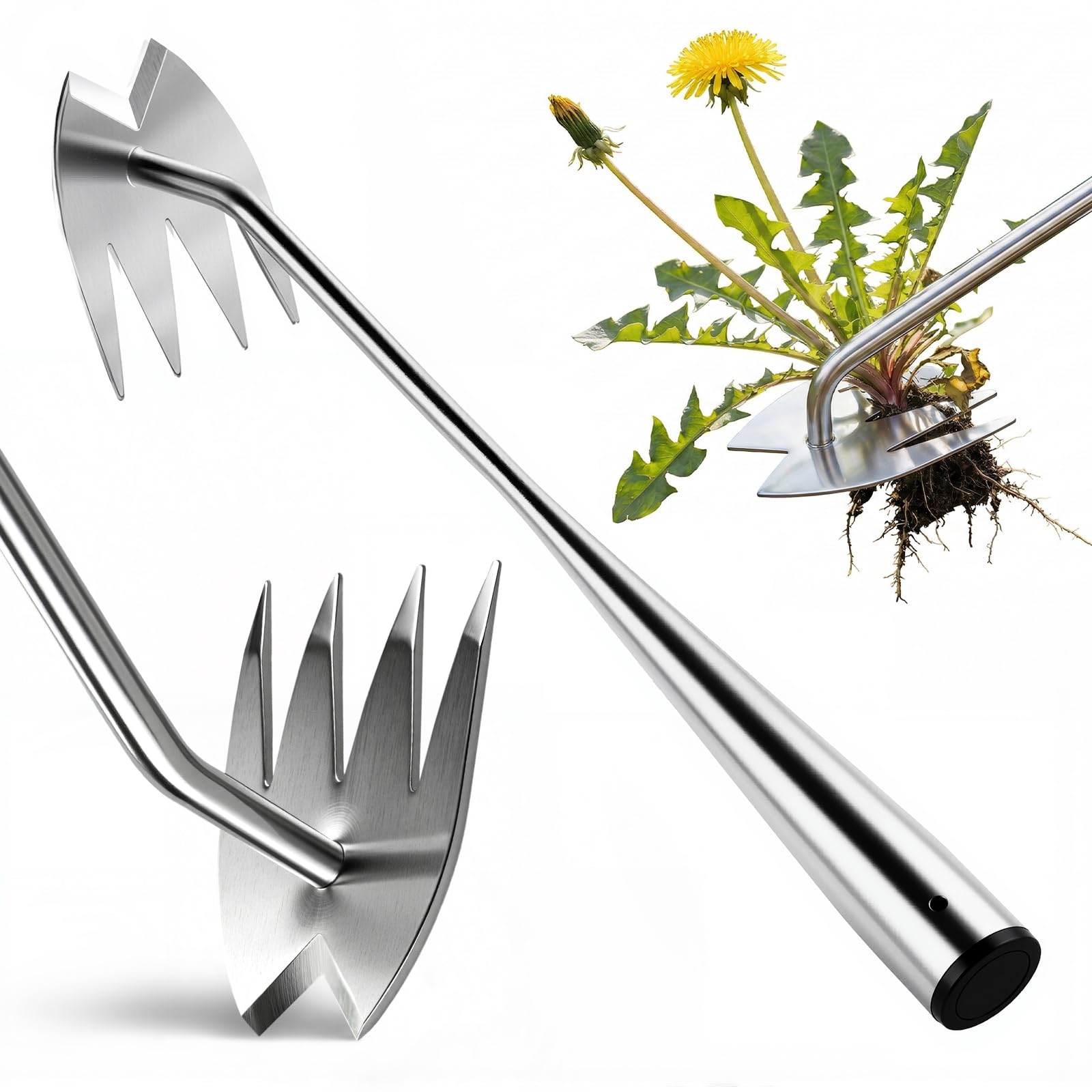
3. LOOHOI Deep Root Weed Puller
A one‑piece stainless steel rod built to pry dandelions out by the root without bending.
The LOOHOI is a lever, not a cutting tool. You push its forked tip into the soil next to the weed and rock the handle back — the whole root comes out in one piece. The 10.8‑ounce solid 304 stainless steel shaft has no welds or joints to snap, so it handles tough soil without bending. Buyers call it a “back-saver” because the 15‑inch handle lets you stand instead of kneel while you work.
That length also makes it the heaviest pick on this list, but the heft translates to durability. The trade‑off buyers mention most is the handle — at 15 inches it is still short enough that some wish it were longer for standing‑upright use. The manufacturer notes you can “make the handle longer with the proper extender,” which owners confirm works well.
Best for: clearing a lawn of dandelions, crabgrass, and thistles in a single season, one clean root‑pull at a time.
Your pick if: you hate bending over and want a sturdy tool that yanks the whole root out of the ground.
Not ideal if: you work in tight flower beds where a long shaft can’t fit between plants.
4. Theuzi 3-Pack Crack Weeder Set

Three different heads for every corner of the yard — cracks, beds, and paths.
Theuzi’s set gives you an L‑shaped crack weeder, a hand weeder, and a 4‑tine weed puller, each with a pine‑wood handle. The L‑shaped tool is the star for brick and paver crevices — its thin blade slides into expansion joints and scrapes out moss and grass. The 4‑tine puller works like a small claw for loosening soil and yanking tougher weeds.
The package weight of 15.8 ounces is the heaviest in the bunch, but spread across three tools the individual weight is manageable. Buyers consistently note the set is “durable, no metal bending after clearing paver deck” and that the thick steel resists deformation even on old concrete. One caution: the brace on the puller broke for one owner on day one, though they continued using it with a substitute tool and still praised the overall value.
What makes it versatile
- Three distinct blade shapes let you switch tactics without switching brands
- Hanging holes in the handles make storage neat and accessible
- Sharp stainless steel resists rust in damp conditions
Watch for
- The 4-tine puller’s brace can be fragile — treat it gently
- At 13 inches, the handles are still short enough that you will bend or kneel
Pick this if: you have a mix of paver cracks, flower beds, and lawn edges and want one order that covers all three.
Skip if: you only need one tool for a single job — you will carry two extras you don’t use.
5. TOYPOPOR Nejiri Kama Sickle Hoe

A twisted‑blade Japanese hoe that shaves the soil surface clean of young weeds.
The Nejiri Kama design (“nejiri” meaning twisted, “kama” meaning sickle) orients the blade horizontally to the ground, so you use it like a miniature hoe. A pushing, shaving motion cuts weeds off just under the surface — the fastest way to clear a dense patch of young weeds before they set deep roots. The 17‑inch total length gives you the most reach of any pick here, and at 7.4 ounces it is light enough to swing all afternoon.
The blade is high‑carbon steel, which takes an excellent edge but needs immediate drying after use. Opinion on sharpness is mixed: some buyers find it very sharp from the start, while others say they had to sharpen it before first use. One owner cleared a 100‑foot soft garden in under an hour but reported “tennis elbow” from the repetitive motion — a reminder that any slicing tool requires good technique.
Who it fits: the gardener who maintains beds preventively, skimming off weeds before they become a problem.
Your pick if: you want a stand‑and‑slice tool that clears large areas fast without yanking up your perennials.
Not for you if: your weeds are already tall and thick — the pulling tools above will handle those better.
6. Jardineer Sharp Grass Shears

Hand‑held clippers that snip grass flush against rocks, beds, and borders.
These are not a puller or a sickle — they are bypass shears, meaning two sharp blades slide past each other like scissors. The heat‑treated carbon steel blades have a non‑stick coating that prevents sap and wet grass from gumming up the cut. At 1 pound (0.46 kg), they are the heaviest single tool here but the weight is balanced for one‑handed use.
The safety lock is a thoughtful addition: it keeps the blades closed during storage so you don’t cut yourself reaching into a drawer. The cutting width is just 0.5 inches, which makes them ideal for detail work around flower beds, trees, and sidewalks — exactly where a string trimmer can’t reach without damaging bark.
What owners love
- Sharp, clean cuts on grass and thin roots without tearing
- Anti‑slip grip stays comfortable during extended trims
- Safety lock keeps the tool safe when not in use
Know before you buy
- Not meant for shrubs, twigs, or thick branches — only soft grass and thin roots
- The 0.5‑inch cutting width means larger patches take more passes
Best for: the homeowner who wants a precise edge around patios and flower beds without pulling out a string trimmer.
Overkill if: you need to clear large swaths of weeds — reach for a sickle or puller instead.
7. AON 2‑Piece Crack Weeder & Root Remover
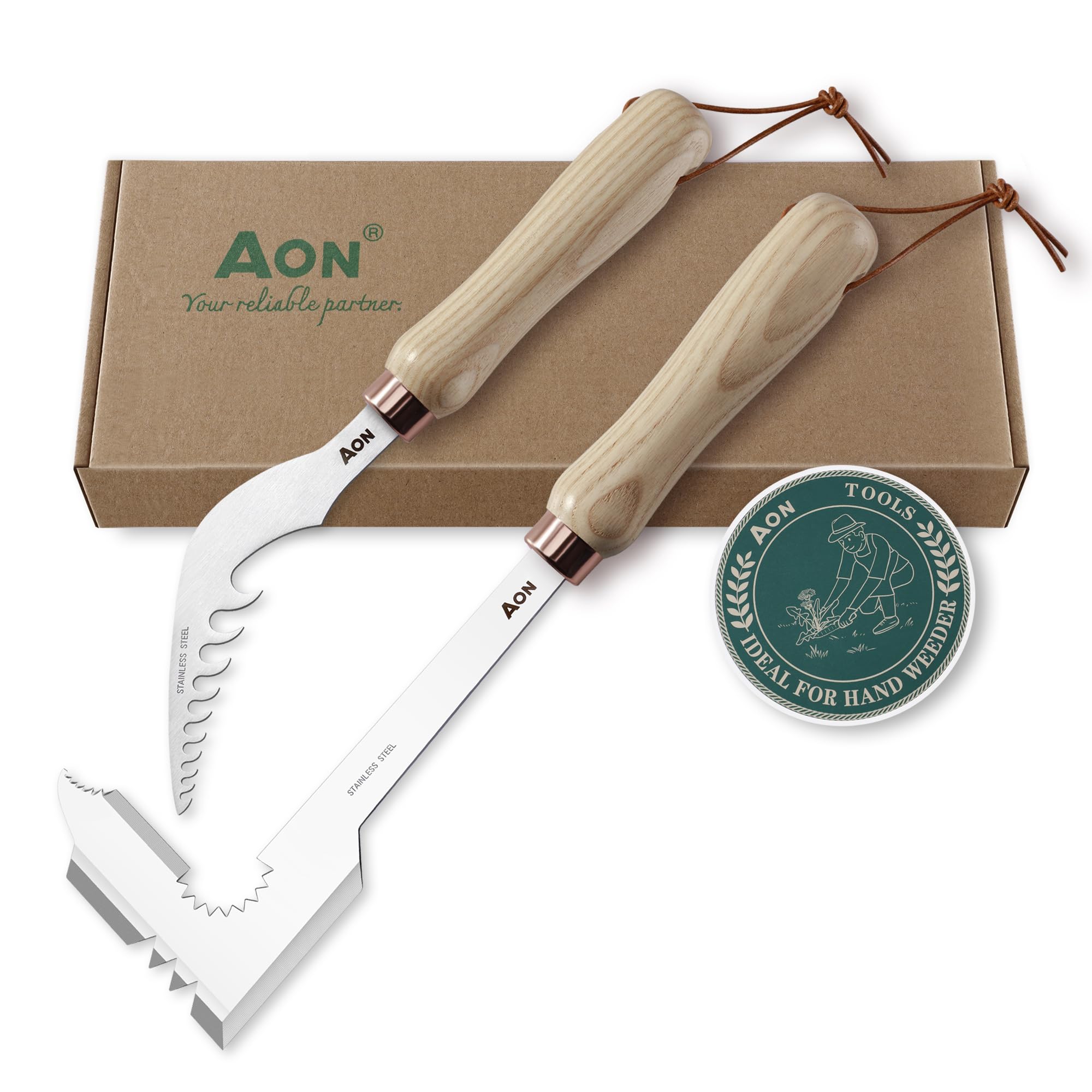
Two tools with heat‑treated steel edges that lift roots without leaving craters.
AON’s set comes with an L‑shaped crevice weeder (with tiny prongs that grip the root) and a curved‑tip puller. The L‑shaped tool has a 10‑degree angled handle, which reduces wrist fatigue when you are working your way down a long sidewalk crack. The steel is heat‑treated for hardness and resistance to bending, and the ash wood handles have a cowhide lanyard so you can hang them between uses.
Buyers are enthusiastic about the crevice tool for paver patios and aggregate driveways — the prongs latch onto even thin weed stems and pull them out intact. A few owners note that the blade is too thick for very narrow brick gaps, so if your pavers are tight, measure the gap first. The curved‑tip tool gets praise for lifting dandelions without tearing up the surrounding lawn, much like the LOOHOI but in a more compact shape.
Built for: meticulous removal of weeds from hardscape — the kind of job where you want every root gone and no visible damage.
Choose these if: your main battle is between paving stones, driveway cracks, and brick edging.
Pass if: your weeding is mostly in open garden soil — the L‑shape is tune for crevices, not beds.
8. Garden Guru Patio Crack Weeder

An L‑shaped blade that slides into expansion joints and lifts the weed whole.
The Garden Guru is built for one job: cleaning weeds out of concrete expansion joints and paver gaps. The stainless steel L‑shaped head is thin enough to fit into standard sidewalk cracks, and the ergonomic soft‑grip handle has contoured finger grooves that give you control even with sweaty hands. At just 6.7 ounces, it is only slightly heavier than the CobraHead, and the 13.3‑inch length means you can keep one foot on the ground while you work.
Durability is a mixed point in the reviews — most owners find it sturdy and rust‑resistant, but a small number report the head breaking off under heavy use. The lifetime warranty covers that, and the 90‑day “no questions asked” satisfaction guarantee means you can test it risk‑free. The company is also a member of 1% For The Planet, so every purchase supports environmental causes.
Why it works
- Thin L‑head reaches deep into narrow cracks
- Soft grip reduces hand fatigue during long sessions
- Lifetime warranty and carbon‑neutral production
Heads up
- Not designed for soil‑bed weeding — the shape is tune for hard surfaces
- A few buyers experienced the head snapping; the warranty applies
Grab it if: your biggest frustration is the grass and moss growing between concrete slabs and bricks.
Look elsewhere if: you need a general garden weeder — the AON set above gives you more versatility for the same money.
9. Truly Garden Weeding Sickle

A carbon‑steel sickle that comes with a leather sheath and a sharpening stone for long‑term sharpness.
Truly Garden’s sickle stands out because it includes everything you need to keep it razor‑sharp for years. The carbon‑steel blade is inspired by Japanese sickle design, with an efficient angle that lets you cut through weeds at the root line without straining. The thick leather sheath is a real safety upgrade — you can toss it in a garden bucket or tool belt without worrying about the edge nicking your fingers.
The ergonomic handle fits both right and left hands, which is rare for a sickle at this level. Customers note that the blade is “extra sharp” from the start and that a quick pass with the included stone brings the edge right back after heavy use. The 5‑year warranty is a solid confidence signal, and owners who bought it alongside a Hori Hori knife describe it as comparable quality at a lower price.
Best for: the gardener who wants a complete kit — tool, sheath, sharpening stone — and intends to maintain the blade for years of service.
Pick this if: you like the idea of a traditional, craftsman‑grade sickle that stays sharp and comes with storage.
pass on it if: you prefer stainless steel for lower maintenance — this blade needs drying and occasional honing.
Understanding the Specs
Stainless vs carbon steel
Stainless steel (like 304 stainless) resists rust and is easier to clean after muddy work, but it is harder to sharpen to a true razor edge. Carbon steel (like the 45# medium carbon used on the Japanese sickle) takes a much sharper edge and holds it longer, but it will rust if you leave it wet. If you store tools in a damp shed, go stainless. If you like a blade that feels surgical and you are willing to dry it off, carbon steel is your match.
Blade shape: sickle vs lever vs shear
A sickle blade uses a slicing motion — you pull or push it sideways to cut stems at the base. A lever‑style weeder (like the LOOHOI) uses a forked tip and a rocking motion to lift the whole root. Grass shears (like the Jardineer) use a scissor action for precise snips. None is universally better; the right shape depends on whether you are clearing open soil, prying from cracks, or edge‑trimming around hardscaping.
FAQ
What is the difference between a hand weed cutter and a stand‑up weeder?
Can I use a hand weed cutter on all soil types?
How do I keep a carbon steel sickle from rusting?
Which tool is best for pulling dandelions by the root?
Is a Japanese sickle better than a traditional curved weeder?
How often do I need to sharpen a hand weed cutter?
Can I use a hand weed cutter to edge between pavers?
What length handle is best for avoiding back pain?
Do I need multiple handheld weeders or just one?
Is a heavier hand weed cutter better for tough weeds?
Final Thoughts: The Verdict
For most gardeners, the best hand weed cutter is the CobraHead Mini Weeder because it combines an unbeatable 5‑ounce weight, a curved blade that slips under roots, and a comfortable ergonomic handle that makes weeding feel like a quick job rather than a chore. If you want the fastest clearance for thick‑stemmed weeds, the ZELARMAN Japanese Sickle offers a sharp carbon‑steel blade at a wallet‑friendly price. And for deep‑root extraction on a lawn full of dandelions, the LOOHOI puller gives you the leverage to yank the whole weed out — roots and all — without ever bending to the ground.
How We Picked
We do not accept paid placement. Every pick is matched to a real buyer and a real use-case; we do not hands-on test units.
Sources & Methodology
Specifications: manufacturer listings and product documentation. Review insights: verified customer reviews, as of July 2026. Pricing: not shown on this page (it changes often); check the current price via the retailer link.
As an Amazon Associate, Lawn Gear Lab earns from qualifying purchases. This does not affect which products we feature.