
Specs are compiled from manufacturer listings and verified buyer reviews and can change over time — please confirm the key details on the product page before buying.
You want to grow plants indoors, but the spec sheets for grow lights read like a lab manual. The real trick is locking onto a few honest specs — actual wattage (the real power it uses), usable coverage area (where the light is strong enough for plants), and a full spectrum (wavelengths for all growth stages) that won’t make your living room look like a carnival — rather than flashy marketing claims.
This guide looks at the manufacturer’s published specs and patterns across verified customer reviews, so you get each pick’s real strengths and trade-offs.
From the silent panel that dense-bud growers swear by to the clip-on timer that saved a no-light apartment’s succulents, here is your go-to breakdown of the good led grow lights that actually earn their keep.
Our Picks at a Glance

How To Choose The Best Good LED Grow Lights
Buying your first grow light is easy once you know what to check. Focus on these three things and you will sidestep most beginner mistakes.
Actual Wattage vs. “Equivalent” Wattage
This is the biggest trap. A box might scream “2000W” but pull a mere 100-150W from your outlet. That advertised number is a useless marketing “equivalent” to an old HPS bulb (high-pressure sodium, a hot, old-style grow light). Always look for the actual power draw — it is the only number that tells you how much energy the light uses and how intense it will be. For a 2×2 foot tent, 100-150 real watts is plenty.
Full Spectrum and White Light
Plants need blue light (400-500 nanometers, for leafy growth) and red light (600-700 nanometers, for flowers and fruit). A “full spectrum” LED covers this entire range. But a white-looking full-spectrum light is a huge quality-of-life win — it shows the true colors of your plants (so you can spot pests or deficiencies) and won’t give you a headache the way those red-and-blue “blurple” lights do.
PPFD and Coverage Area
PPFD (Photosynthetic Photon Flux Density) tells you how many usable light particles (photons in the right spectrum) hit a given area per second. It is the real measure of intensity at the plant canopy. A light might claim a 3×3 foot coverage, but the PPFD value drops off sharply at the edges. Check the manufacturer’s PPFD map to see how even the light is across your specific grow tent or shelf. Dimmable lights let you dial intensity up for flowering or down for seedlings.
Quick Comparison
| Model | Best For | Actual Wattage | Coverage Area | Dimming | Amazon |
|---|---|---|---|---|---|
| MARS HYDRO TS1000★ Best Overall | Best Overall Grow Tent | 150W | 2.5×2.5ft | 0-100% | Amazon |
| GLOWRIUM Floor LampTall Planter Pick | Best for Tall Plants | 48W | Dual Head | 6-Level Stepless | Amazon |
| VIPARSPECTRA XS1500 ProSmart Engineering | Best Uniform PPFD | 150W | 2x2ft Bloom | Daisy Chain | Amazon |
| VIVOSUN AeroLight AW200SE | Best with Integrated Fan | 200W | 2x4ft | App Control | Amazon |
| MARS HYDRO SP3000 | Premium 2×4 Performer | 300W | 4x2ft | WiFi Control | Amazon |
| Spider Farmer SF1000 | Silent 2×2 Workhorse | 100W | 2x2ft | Dimming Knob | Amazon |
| GE 24-Inch Fixture | Reliable Seedling Tray | 72 PPF | 24in Linear | On/Off | Amazon |
| GLOWRIUM Stand Light | Dual-Head Floor Lighting | 36W | 63in Tall | 6-Level | Amazon |
| SANSI Pot Clip Lights | Small Pot Clip-On | 5W | Single Pot | 4-Level | Amazon |
In‑Depth Reviews
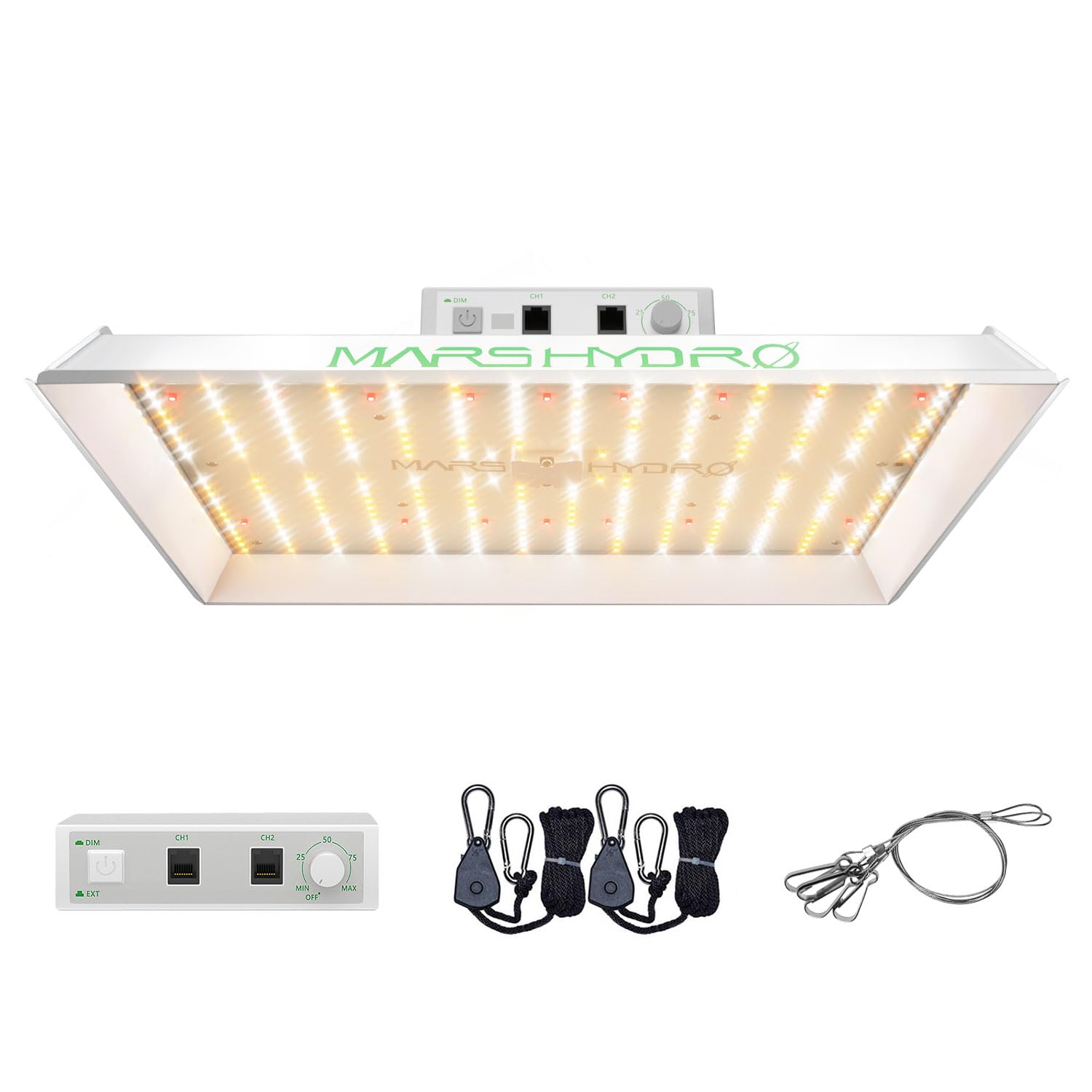
1. MARS HYDRO 150W TS1000 LED Grow Light
Our pick — over 4.5★ from 20,000+ verified ratings; the strongest balance of quality and price.
The silent quantum board (a flat LED panel with evenly spaced diodes) that dense-bud growers trust for frosty results.
This is the fan-favorite for good reason. It pulls only 150W from the wall, but buyers report it smokes two old-style 1500W LEDs in both coverage and intensity, all while running completely fanless and silent. Over a thousand owners single out its quality as a top point. A buyer using it in a 2×2 tent called it a “budget starter light” that still delivered “super bright full-spectrum” results with fast seedling growth and healthy veg.
It comes with a dimmer that lets you go from 0 to 100%, and you can daisy-chain (connect multiple lights together with one power cable) these lights. The upgraded white reflector increases light utilization, and the 120-degree beam angle spreads light evenly across a 2.5×2.5ft footprint. It runs cool enough that you don’t need an extra fan pointed at it, though a few owners note that the power supply can fail within the first year — owners mention the manufacturer’s support team typically steps in with a replacement.
One grower summed it up: “Great Quantum Board LED Light — 20-30% higher PPFD and 150W less power than two 1500W LEDs.” That real-world efficiency is why it is the top pick.
What Wins People Over
- Completely silent operation — fanless design with aluminum heat sink.
- 0-100% dimming on the external driver (the power unit), adaptable to every growth stage.
- Daisy chain multiple lights for a large tent setup.
The Honest Trade-Off
- Mixed reliability on the power driver — some units need a warranty claim within 6-12 months.
- Slightly heavier on one side causing a tilt; a counterweight fixes it.
Reach for this if: you want the gold-standard 2×2 tent light with excellent coverage, a silent driver, and a dimmer that takes you from seedling to flower.
Look elsewhere if: you need a plug-and-play complete kit with a timer and sensor — those are not included from the start.
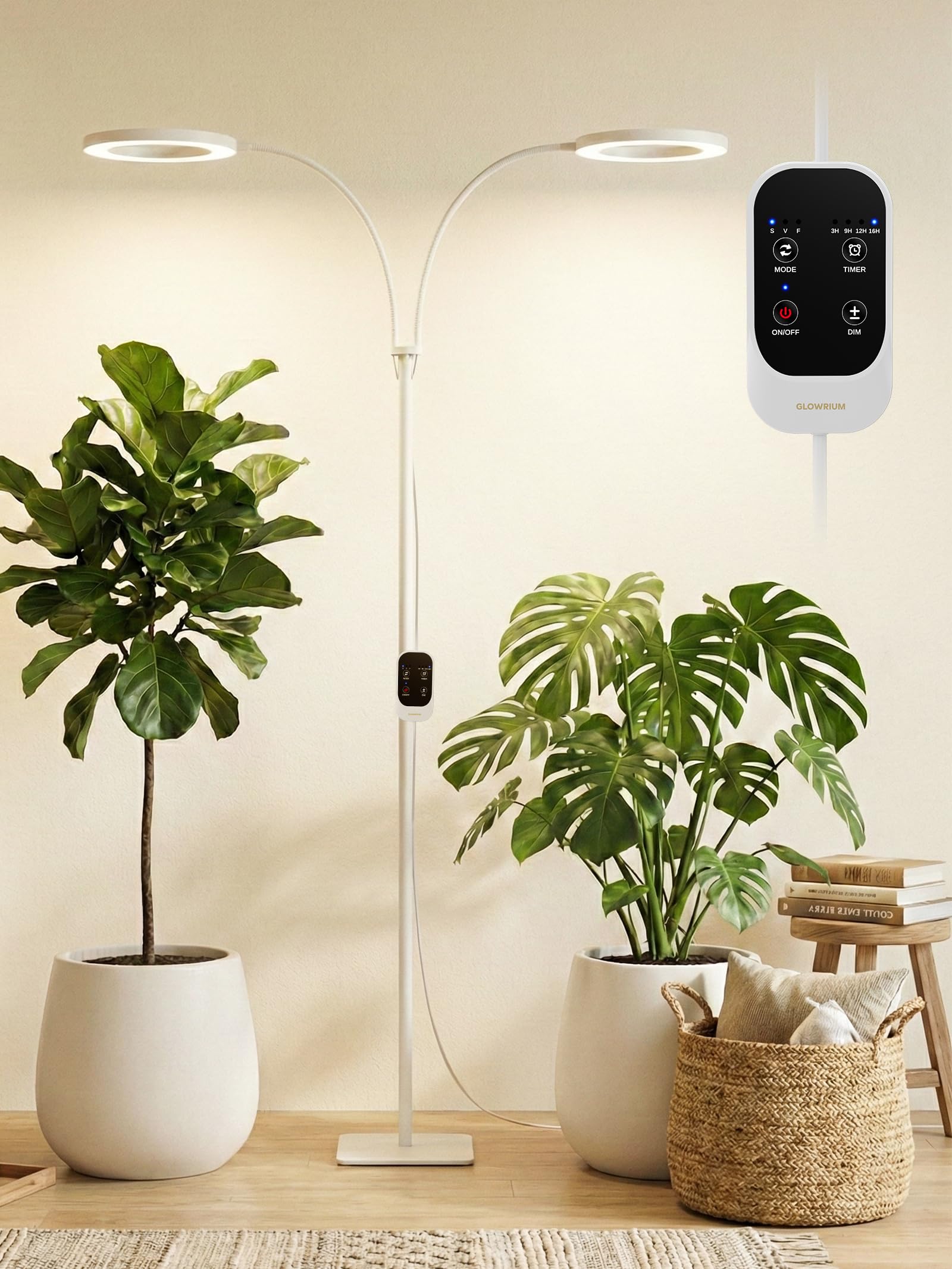
2. GLOWRIUM Tall Plant Grow Light (Dual Head, 48W)
The six-foot-tall light that brings a fiddle-leaf fig back from the brink.
If you have a tall houseplant that spends winters sulking in a dim corner, this floor lamp is the solution. It reaches over 70 inches and has two separate 7.87-inch heads on flexible goosenecks, so you can point one beam at a monstera and the other at a bird of paradise. The heavy steel base provides stability (over five pounds), and the build quality earns a solid 33 mentions from buyers as a high point.
It delivers 48 watts across 268 LEDs with a PPFD of up to 280 μmol/m²/s (Photosynthetic Photon Flux Density, a measure of usable light intensity) at six inches. You get three spectrum modes (Seedling, Veg, and Flower) plus a smart timer with 3, 9, 12, and 16-hour cycles. The stepless dimming lets you hold the button for a smooth brightness sweep from 10% to 100%. Assembly takes under five minutes and requires no tools. One owner reported that after just a month, “struggling plants show improvement” — less leaf damage and visible new growth.
The catch is a minor one: the timer resets each day if you unplug it, so you may want an external outlet timer if your routine is rigid.
Who This Fits: Anyone with tall potted plants or a multi-tier plant shelf who wants a single, attractive, freestanding fixture that blends into a living room.
The Fine Print: At 48 watts, it is not strong enough to be the sole light for high-demand flowering plants like tomatoes in a tent — treat it as a supplemental boost for houseplants.
3. VIPARSPECTRA XS1500 Pro (150W)
Optical lenses (tiny lens covers over each LED) focus every photon where it counts — edge-to-edge PAR (photosynthetically active radiation, the light plants use) is its a neat extra.
Instead of a flat board of LEDs, the XS1500 Pro uses individual optical lenses over each diode. That design directs light downward without spilling it onto your tent walls, giving you among the most uniform PPFD maps in this class — more consistent than the MARS HYDRO TS1000. A reviewer measured a “high PAR level of 747 at 50% power and 13 inches,” with consistent readings across the canopy that helped cherry tomatoes and beets thrive.
It pulls 150 actual watts and features a full spectrum with white 3000K (warm white), 5000K (daylight white), red 660nm, and IR (infrared) 730nm LEDs. You can daisy-chain up to 20 of these for a unified dimming setup. The aluminum heatsink keeps temperatures manageable — no active fan means it stays silent. The dimmer knob lets you adjust intensity, with the light turning off completely at the zero setting, which owners appreciate.
On the downside, a few customers note that it lacks a dedicated on/off switch and is heavy at about 6 pounds, so the included ratchet hangers are essential.
Best if: uniform light spread across your canopy is your priority — for a 2×2 flowering tent, this gives you dense, consistent coverage without hot spots.
Think twice if: you need a lightweight light for a flimsy shelf mount, or if you prefer a simple on/off toggle.
4. VIVOSUN AeroLight Wing AW200SE (200W)
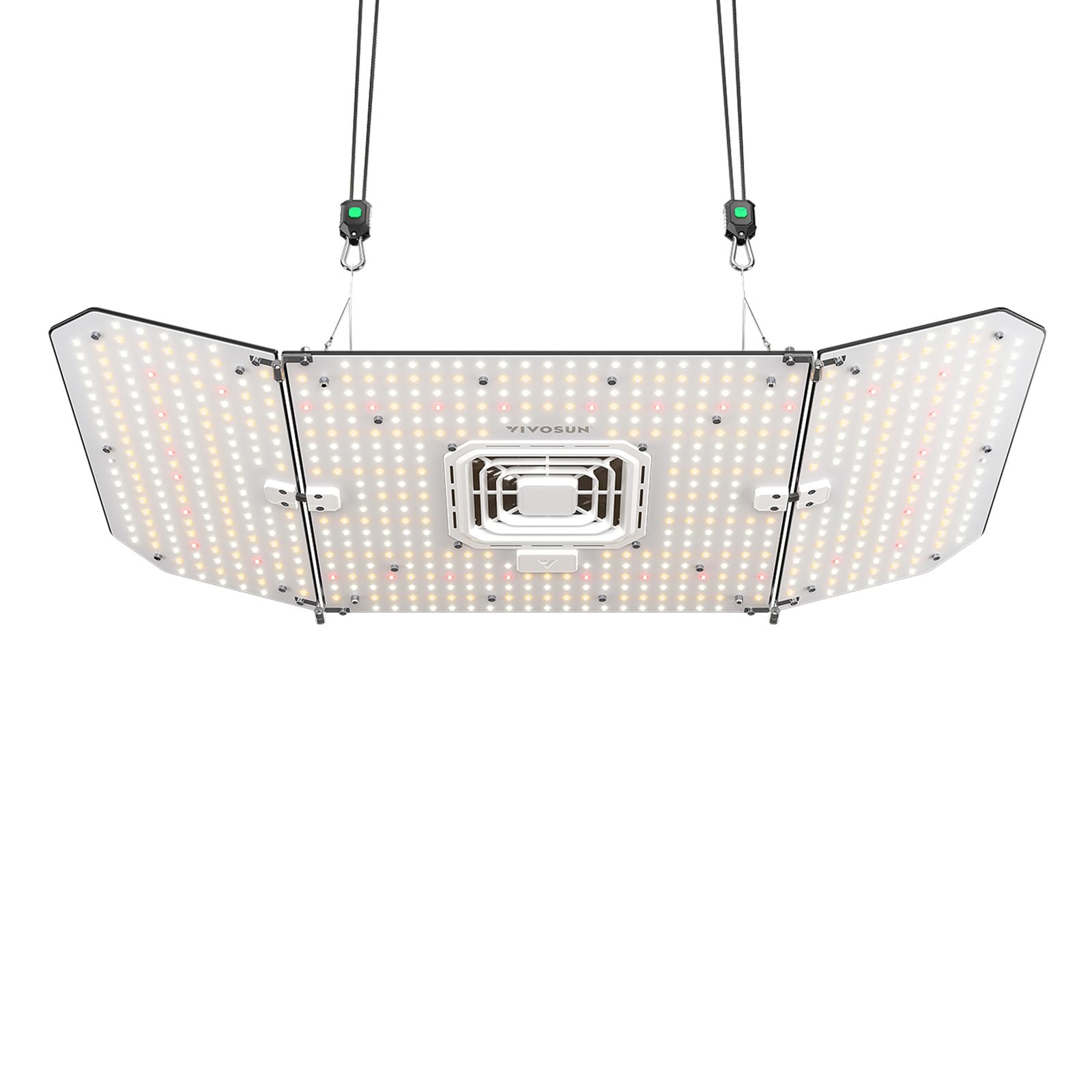
A hollow grow light with a fan that pushes air straight down through the canopy.
This light is shaped like a ring with a fan mounted dead center — a clever design that moves air through the open middle and directly into the plant canopy, where oscillating tower fans struggle to reach. The wings fold out to adjust coverage, making it easy to tune for a 2×4 or 3×3 tent. Brightness gets the most mentions from buyers (57 owners call it out), and the built-in fan earns a strong 13 mentions for improving airflow without drying plants out.
It uses full-spectrum Samsung 301B diodes covering 380-780nm (the full range from UV to infrared), pulling 200 watts from the wall. The fan has industrial-grade dual ball bearings for quiet operation, and the aluminum heatsink is designed for a lifespan beyond 50,000 hours. For smart control, you need to pair it with a Vivosun GrowHub Controller (sold separately), which open up additional features. Without the hub, it is a straightforward manual light.
A word of caution: the separate hub requirement is not always obvious at first glance. Also, several units arrived without the screws for the H-brackets — a minor assembly inconvenience.
Reach for this if: you want a dedicated tent light that eliminates the need for a separate oscillating fan and offers app control for automation.
skip it if: you prefer an all-in-one package with a controller included, or if you are on a tight budget.
5. MARS HYDRO SP3000 (300W)
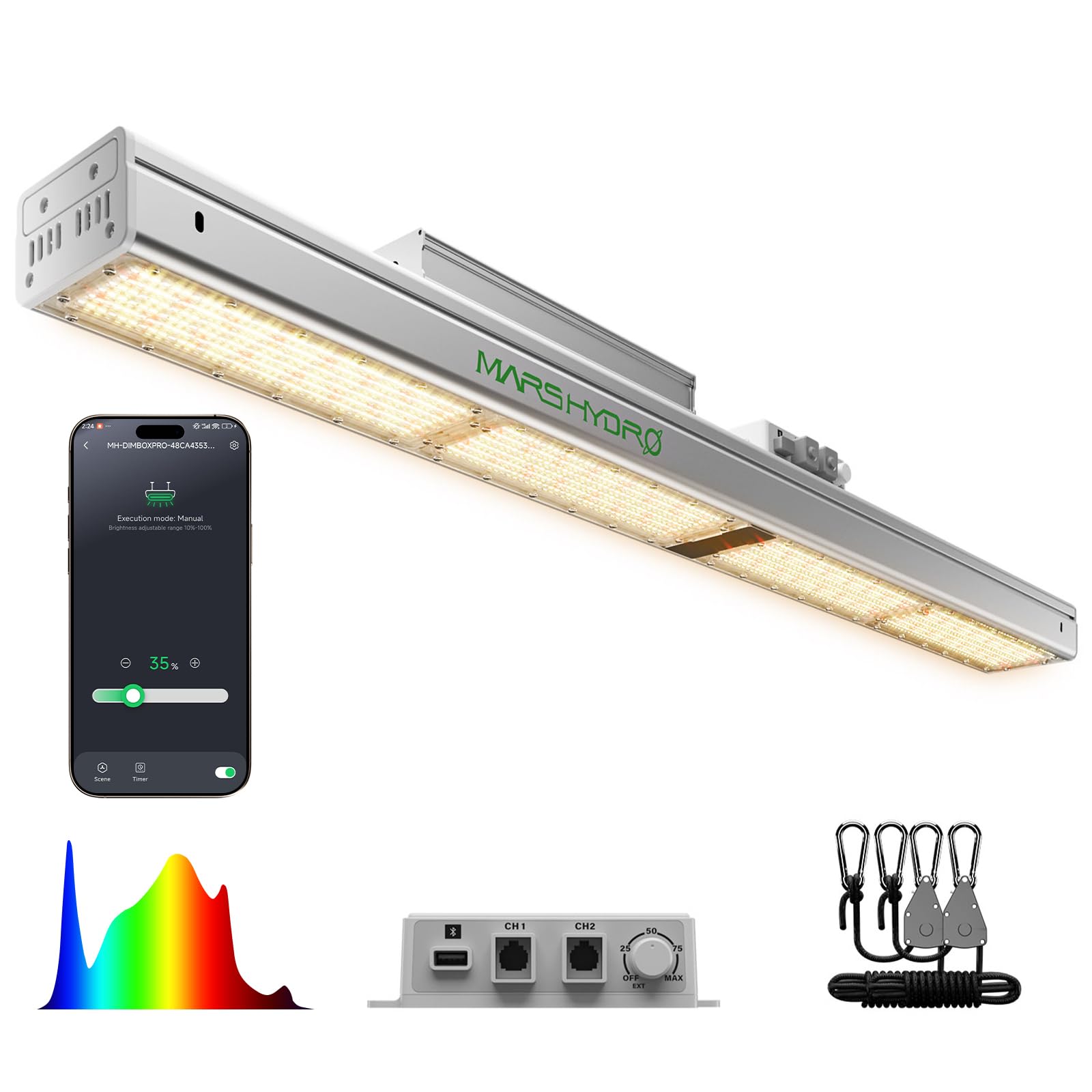
The 300W bar light that fills a 2×4 tent with unbelievably even PAR and WiFi scheduling.
This is the step-up choice for a dedicated 2×4 grow tent. By wide consensus, it offers among the most balanced light patterns available, with a PPF output of 727.2 μmol/s (Photosynthetic Photon Flux, the total usable light particles emitted each second) and an efficiency of 2.8 μmol/J (how many light particles it produces per joule of electricity). The elongated bar format spreads light across the entire 2×4 footprint without a weak center, which is a common problem with square panels like the TS1000. Reviewers point out it penetrates deep into the canopy, hitting lower bud sites that other lights miss.
It pulls 300 actual watts and features a 5-year manufacturer warranty. You can daisy-chain up to 50 units for commercial setups. For smart control, you add a separate Iconconnect USB dongle to link it to Mars Hydro’s app, giving you remote dimming, auto-timing, and sunrise/sunset modes. The aluminum housing and ultra-thick heatsinks provide excellent cooling and are sealed against moisture splashes.
One owner noted it draws 286 watts at max setting (close to the rated 300W), and the even PAR is why they upgraded from a Spider Farmer SF-4000. The only assembly hiccup is the narrow hanging openings — they take a bit of fiddling.
Perfect for: any grower who wants premium, dimmable strip lighting for a 2×4 tent and is willing to invest in smart controls for automation.
Keep in mind: the WiFi dongle and the dimmer box are sold separately, so factor that into your total setup cost.
6. Spider Farmer SF1000 (100W)
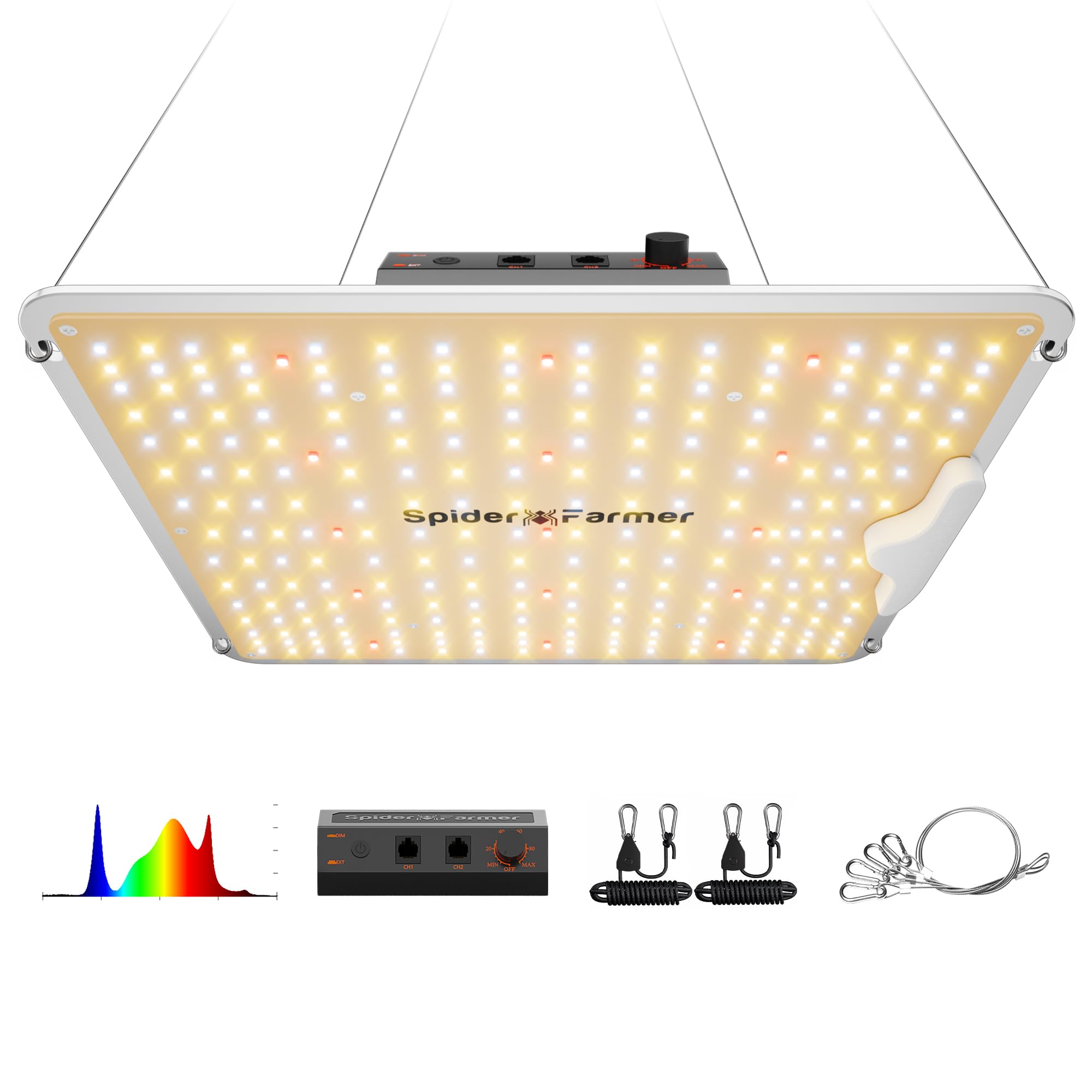
The 100W quantum board that runs whisper-quiet and brightens a 2×2 tent with confidence.
For a smaller tent or a dedicated seedling station, the SF1000 is a reliable workhorse. It consumes 100 actual watts and uses new-gen high-efficiency diodes with a system PPE (Photosynthetic Photon Efficacy, how efficiently it creates usable light) of 2.5 μmol/J. Buyers consistently call it “very bright” and note that it works well at a distance of 12 to 30 inches above the canopy, which gives you more headroom in a short tent. It runs quieter than the VIPARSPECTRA XS1500 Pro because both are fanless, but the SF1000’s lower wattage means even less heat to dissipate. The fanless design means zero noise, making it a favorite for bedroom or office setups.
The spectrum includes white 3000K, 5000K, red 660nm, and IR 760nm, tuned to support both veg and bloom cycles. The dimming knob lets you dial intensity up or down easily. The aluminum heatsink is thick and sturdy, and the brand backs it with a 5-year warranty. Owners have bought four of these to fill a 4×4 tent, and most rate it highly for consistency and longevity.
On the heat front, reviews are mixed — some say it stays cool, others note it can get warm at full power. A few owners also found that a single unit alone is not quite powerful enough to fill an entire 4×4 space, so it works best as part of a multi-light setup or in a 2×2.
Best for: growers who prioritize silence and a proven 5-year warranty for a compact 2×2 footprint.
Trade-off: the 100W output means it is best for smaller tents or as a supplemental light in larger spaces.
7. GE 24-Inch LED Grow Light Fixture (72 PPF)

A simple, reliable strip light that is a proven champion for starting seeds and overwintering plants.
This is not a sexy panel with a dimmer and app — it is a utilitarian 24-inch fixture that does one job exceptionally well: giving seedlings a strong head start. It delivers 72 PPF (Photosynthetic Photon Flux, the total usable light particles emitted) and produces a natural white light that does not look offensive in a living room. The light spectrum includes high-quality blue and red wavelengths, even though it appears white to your eyes, so it works for all growth stages from seed to flower.
It comes with hanging chains and S-hooks, and the integrated cords let you daisy-chain up to 8 fixtures. GE rates the lifespan at 25,000 hours. Buyers praise the brightness and connectivity — one user has four units running daily for years without issue, and others report that succulents regain their color and stop stretching under these lights. The grow light also got a nod in Good Housekeeping’s top 9 best grow lights list.
The main gripes are the short 3-foot power cord and a notable price hike from past years. For simple seed starting, though, few fixtures match its track record of reliability.
Reach for this if: you need a straightforward, reliable light for a seedling shelf or to overwinter plants, and you want the ability to link multiple units.
pass on it if: you need adjustable brightness or timers built in — this is a plug-and-play fixture with none of that.
8. GLOWRIUM 36W Dual-Head Floor Plant Light
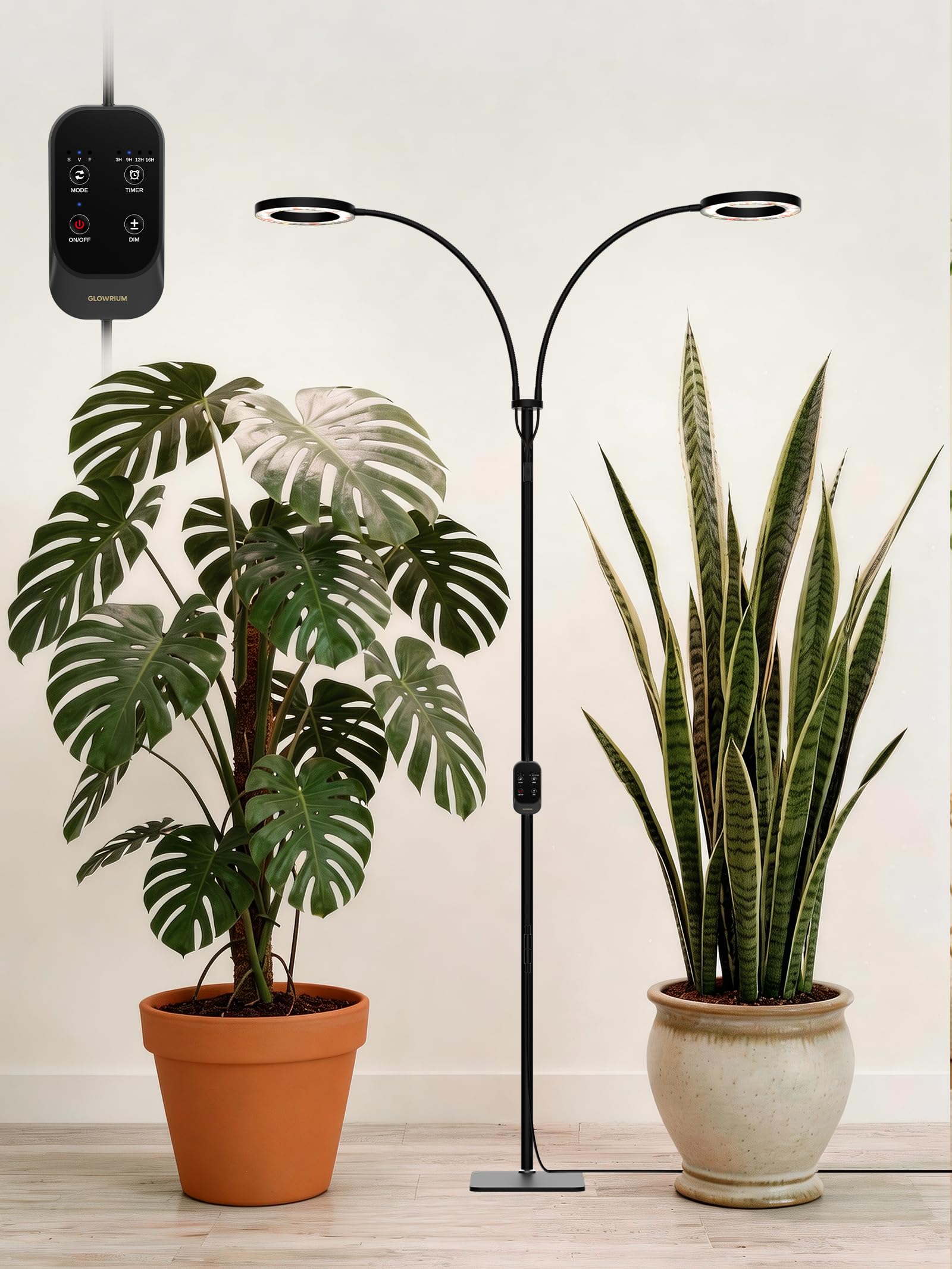
A good-looking dual-head floor lamp that discreetly saves plants in low-light apartments.
If your main goal is giving a few medium-to-large houseplants a boost without installing a tent-like rig, this floor lamp is the answer. It has a three-section aluminum pole that adjusts to 32, 47, or 63 inches in height, and two separate heads on 360-degree goosenecks. You get 66 LEDs producing a full spectrum (white 3000K, 5000K, plus red), with three preset lighting modes for rooting, flowering, or the full cycle. The 6-level dimming ranges from 10% to 100%.
The timer options are 3, 9, or 12 hours, and the 13-foot power cord gives you plenty of placement flexibility. Quality is the top praise from buyers, and the stability of the base gets a lot of mentions — the powder-coated aluminum stand is well-balanced. Owners note that it supports two large and three small plants in a single corner, and that new growth appears within weeks.
A minor downside: the built-in timer resets daily, so owners recommend pairing it with an external outlet timer for a truly set-and-forget schedule.
Best if: you want an attractive, freestanding light that blends with your decor while giving a few houseplants meaningful supplemental light.
Consider the limits: at 36 watts, this is not powerful enough for high-light fruit or cannabis plants — it is designed for houseplant maintenance.
9. SANSI 5V Pot Clip Grow Lights (4-Pack)
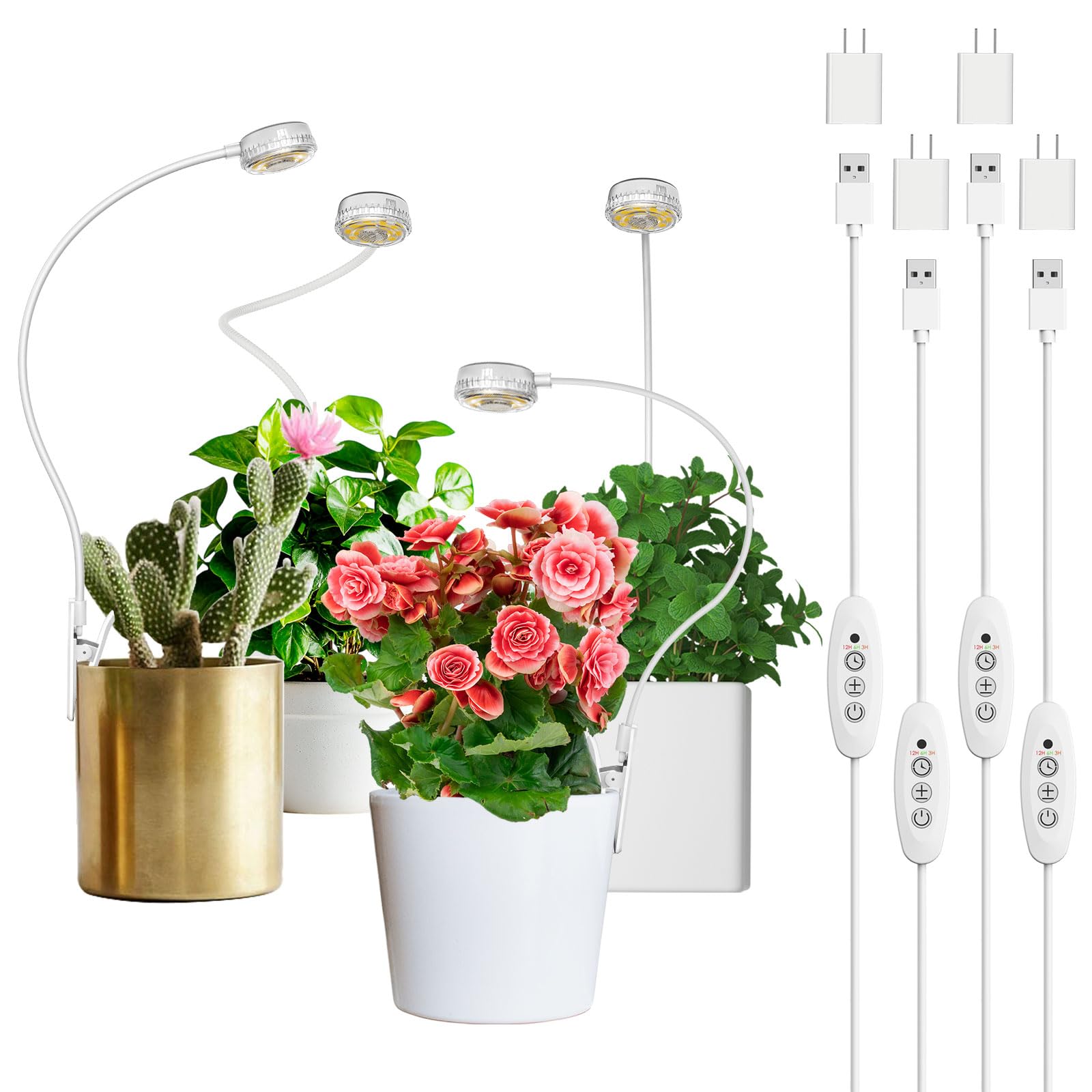
The tiny 5V clip-on that doubled a plant’s size in weeks, shoppers say.
If your plants are scattered across shelves and windowsills rather than grouped in a tent, this 4-pack of clip-on lights is the simplest solution. Each light uses SANSI’s ceramic technology to squeeze 5 watts of output from a low 5V USB connection — you can power them from a laptop, a power bank, or any USB port. The light includes a 360-degree flexible gooseneck and a sturdy clip that fastens directly onto the plant pot.
It offers four brightness levels (25%, 50%, 75%, 100%) and three timer settings (3, 6, or 12 hours). The auto on/off timer runs on a 24-hour cycle, so you set it once and it repeats daily. Buyers love the functionality — one owner called it “absolutely perfect” for a no-light apartment and noted it “doubled a plant’s size in weeks.” The clip and compact size get strong praise, and the natural white light (4000K) makes it easy on the eyes in a living room.
The main weakness is the clip itself, which a few find too tight or prone to slipping on thin pot rims. Also, these lights are not rechargeable — they need a constant USB power source.
Reach for this if: you have a few single pots scattered around the home and want a low-profile clip-on with a reliable auto timer.
it’s not for you if: you need a light for a large plant or you want a rechargeable battery-free option that does not tie up a USB port.
Understanding the Specs
Actual Wattage & PPFD
Actual wattage is the real power the light draws from your wall — ignore any “equivalent to 1000W” claims. PPFD (Photosynthetic Photon Flux Density) measures how many usable photons (light particles in the right spectrum) actually reach a square meter of your plant canopy per second. Higher PPFD means more light energy for photosynthesis. Dimmable lights let you lower intensity for seedlings and crank it up for blooming, which prevents light burn and saves electricity.
Spectrum and Color Temperature
Plants use blue light (400-500nm) for vegetative growth and red light (600-700nm) for flowering. A full-spectrum light covers both, including some infrared (around 730nm) to encourage flowering. White-spectrum LEDs (3000K-5000K) naturally include these wavelengths but look normal to your eyes, letting you spot leaf issues and making the light blend into a home environment better than red-blue “blurple” lights.
FAQ
How close should my LED grow light be to my plants?
Can I use an LED grow light in a regular socket?
What is the difference between a “full spectrum” and a “blurple” grow light?
Do LED grow lights use a lot of electricity?
Can I use a grow light for decorative houseplants?
Will LED grow lights burn my plants?
What coverage area do I need for a 2×2 grow tent?
Should I get a light with a timer?
What does “daisy chain” mean on a grow light?
Is the VIVOSUN AeroLight controller required for the fan to work?
Final Thoughts: The Verdict
For the majority of shoppers, the good led grow lights winner is the MARS HYDRO TS1000 because it strikes the best balance of proven quality, silent fanless operation, and a dimming range that handles everything from tender seedlings to dense flowering — all at a price that has made it the most-bought model on the market. If you want a dedicated 2×4 tent setup with even PAR and smart control, grab the MARS HYDRO SP3000. And for a good-looking freestanding light that revives tall houseplants in a dim living room, the GLOWRIUM Tall Dual-Head is the one to reach for.
How We Picked
We do not accept paid placement. Every pick is matched to a real buyer and a real use-case; we do not hands-on test units.
Sources & Methodology
Specifications: manufacturer listings and product documentation. Review insights: verified customer reviews, as of July 2026. Pricing: not shown on this page (it changes often); check the current price via the retailer link.
As an Amazon Associate, Lawn Gear Lab earns from qualifying purchases. This does not affect which products we feature.