
Specs are compiled from manufacturer listings and verified buyer reviews and can change over time — please confirm the key details on the product page before buying.
Trying to grow tomatoes on a basement shelf or lettuce in a spare closet can either be a revelation or a slow-motion disaster — and the difference is almost always the lamp above them. You need a light that mimics the sun closely enough that a seed thinks it’s July, but runs cool enough that you don’t cook the seedlings. This guide breaks down the eight strongest candidates for indoor vegetable gardens, sorted by the real specs and the real owner experiences that separate a lush harvest from a leggy failure.
I’m Rikta — the founder and writer behind Lawn Gear Lab. This guide is built by comparing the manufacturers’ published specifications and the patterns across verified customer reviews, so you get each pick’s real strengths and trade-offs instead of marketing spin.
Whether you are sowing herbs for your kitchen windowsill or managing a multi-tent setup, you need grow lights for indoor vegetable gardens that deliver the right wavelengths without running up your electric bill or your thermostat.
Our Picks at a Glance

How To Choose The Best Grow Lights For Indoor Vegetable Gardens
Picking the wrong light usually costs you in one of two ways: weak harvests because the plants didn’t get enough usable light, or a bigger electric bill than you planned because the fixture was inefficient. Focus on a handful of specs and you sidestep both.
Full Spectrum vs Blurple
Full-spectrum lights look white to the eye and cover the entire range your vegetables need, from the blue end for leafy growth to the red end for flowering and fruiting. Blurple lights (which only emit red and blue) can work but make it hard to spot nutrient problems because everything looks weird under the purple glow. For an indoor vegetable garden, stick to full spectrum — it is easier on your eyes and better for the plant.
PPFD and PPE — the two numbers that actually matter
PPFD measures how many photons hit the canopy in a given second (µmol/m²/s), which tells you if your lettuce is getting enough light to bulk up. PPE measures how efficiently the fixture turns wall power into those photons (µmol/J). A higher PPE means more growth per watt on your electric bill. Aim for a PPE of 2.5 µmol/J or above for a modern LED, and match the PPFD to the crop — leafy greens need around 200-300 µmol/m²/s, while tomatoes and peppers want 400-600 µmol/m²/s.
Wattage and coverage area
Wattage tells you the power draw, not the light output, but it is a rough guide to coverage. A 150W fixture typically covers a 2×2 ft veg area well, while a 300W unit can handle 3×3 ft or even 4×4 ft depending on the reflector design. Check the manufacturer’s recommended coverage for both veg and flower, because the flower footprint is always smaller — the plant needs more intensity to fruit than it does to grow leaves.
Quick Comparison
| Model | Best For | Wattage | Coverage (Veg) | Dimming | Amazon |
|---|---|---|---|---|---|
| MARS HYDRO TS1000★ Best Overall | Best Overall | 150W | 2.5×2.5 ft | 0-100% | Amazon |
| LED Grow Light SP1500Best Value | Best Value | 100W | 2×2 ft | 0-100% | Amazon |
| Spider Farmer SF1000Compact & Quiet | Compact & Quiet | 100W | 2×2 ft | 0-100% | Amazon |
| VIPARSPECTRA XS1500 Pro | Optical Lens Precision | 150W | 3×3 ft | 0-100% | Amazon |
| BESTVA BP2000 | Budget Large Coverage | 200W | 3×3 ft | Yes | Amazon |
| VIVOSUN AeroLight AW200SE | Smart Automation | 200W | 3×3 ft | App Control | Amazon |
| FARMLITE 260W Bar Light | Commercial-Scale Efficiency | 260W | 4×4 ft | 0-100% | Amazon |
| Spider Farmer G3000 | Highest Total Output | 300W | 3×3 ft | App + Display | Amazon |
In‑Depth Reviews
1. MARS HYDRO 150W TS1000 LED Grow Light
Our pick — over 4.5★ from 20,000+ verified ratings; the strongest balance of quality and price.
The panel that turns a shelf of tomato seedlings into a full harvest without buzzing you out of the room.
You want a 150W light that works for basil, peppers, and tomatoes without the fan noise that makes a living room unbearable. This fixture uses a fanless aluminium body — no moving parts, so it runs totally silent — and its patented white reflector, according to the manufacturer, boosts usable PPFD by 20-30% over standard reflectors. Buyers report that it replaces old 1500W LEDs while drawing only 150W, producing denser growth on vegetables without the heat stress of older lights. At 14.2″ x 13.2″ x 1.4″, it is thin enough for a tight shelf, yet its 354 SMD LEDs (surface-mount diodes) pack enough intensity that owners mention tomato plants stretch significantly after switching from weaker panels. The 0-100% dimming knob lets you soften light for seedlings and crank it up for fruiting, and you can daisy-chain (connect) up to 50 units with a separate RJ12 connector if you scale up. Quality is the most-mentioned positive in reviews, but reliability is mixed — some units fail between 6-12 months, so hold onto warranty details.
What Owners Love
- Silent, fanless operation — zero noise in a living space
- 354 LEDs at 150W replace old 250W HPS (high-pressure sodium) lights
- Reflector spreads light 25% better, so corners stay bright
What You Should Know
- Some units stop working within the first year, per owner reports
- Daisy-chain cable sold separately, which catches some people off guard
Grab this if: you want a proven, quiet 150W panel that satisfies everyone from herb starters to tomato veterans without breaking your budget.
Think twice if: you need built-in app control or plan to run lights 24/7 without a quick warranty backup in your area.
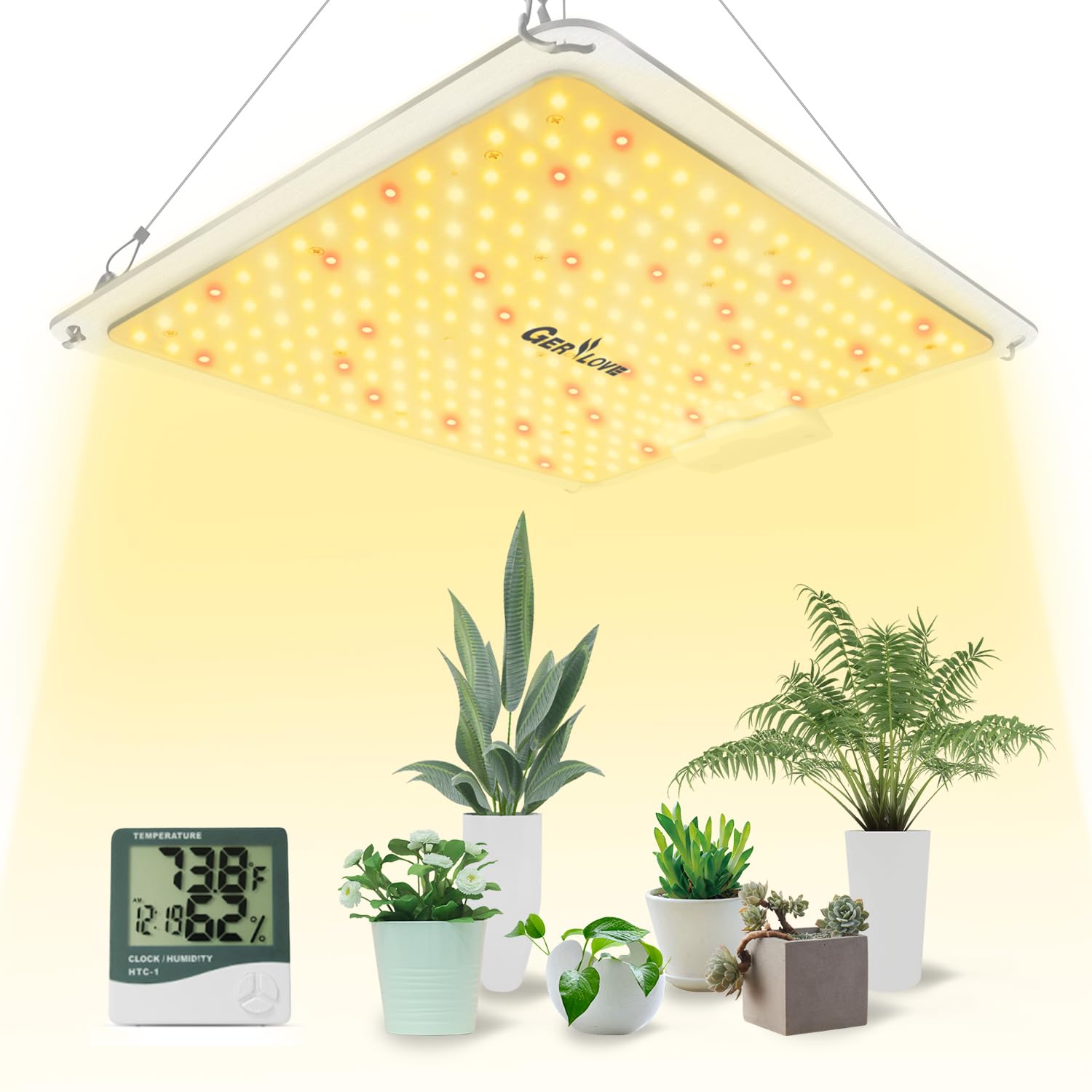
2. LED Grow Light, SP1500 Sunlike Full Spectrum Dimmable Plant Lights
The 100W panel that saved a Kratky shelf from leggy despair without emptying your wallet.
For a hydroponic shelf or seedling station on a tight budget, this 100W fixture costs less than most but still produces uniform growth. Customers note it is “excellent for Kratky hydroponic shelf garden” — a Kratky setup is a no-pump hydroponic method — because it eliminated leggy growth and produced compact plants with fuller leaves, even at 50% intensity just 8-10 inches above the canopy. The stepless dimmer (0-100%) is essential because at full power the light can wilt tender seedlings; owners say dialing it back to 50-75% instantly fixed the problem. The IP65 waterproof rating means splashes from a misting bottle or humid grow tent won’t kill it — rare at this price. It covers a 2×2 ft veg area comfortably, though some owners note that ten tomato seedlings plus cannabis seedlings stretch it to the limit; coverage is fine for a small shelf, not for a 4×4 tent. A digital thermometer/hygrometer is included, saving you an extra purchase. Low heat is a consistent praise point: reviewers point out tent temps stay around 70.8°F when the basement is 68°F.
Where It Shines
- IP65 waterproof rating protects against humidity and splashes
- Includes a digital thermometer/hygrometer in the box
- Low heat keeps tent temps within a couple degrees of ambient
Its Limitation
- Coverage is tight for more than ten seedlings or any tent bigger than 2×2 ft
- Full intensity can cook young plants — you must dim it carefully at first
Pick this for: a waterproof, cost-effective light for a small hydroponic shelf or seedling starter that won’t heat up your space.
skip it if: you plan to fill a 3×3 tent or grow multiple large fruiting plants at once.
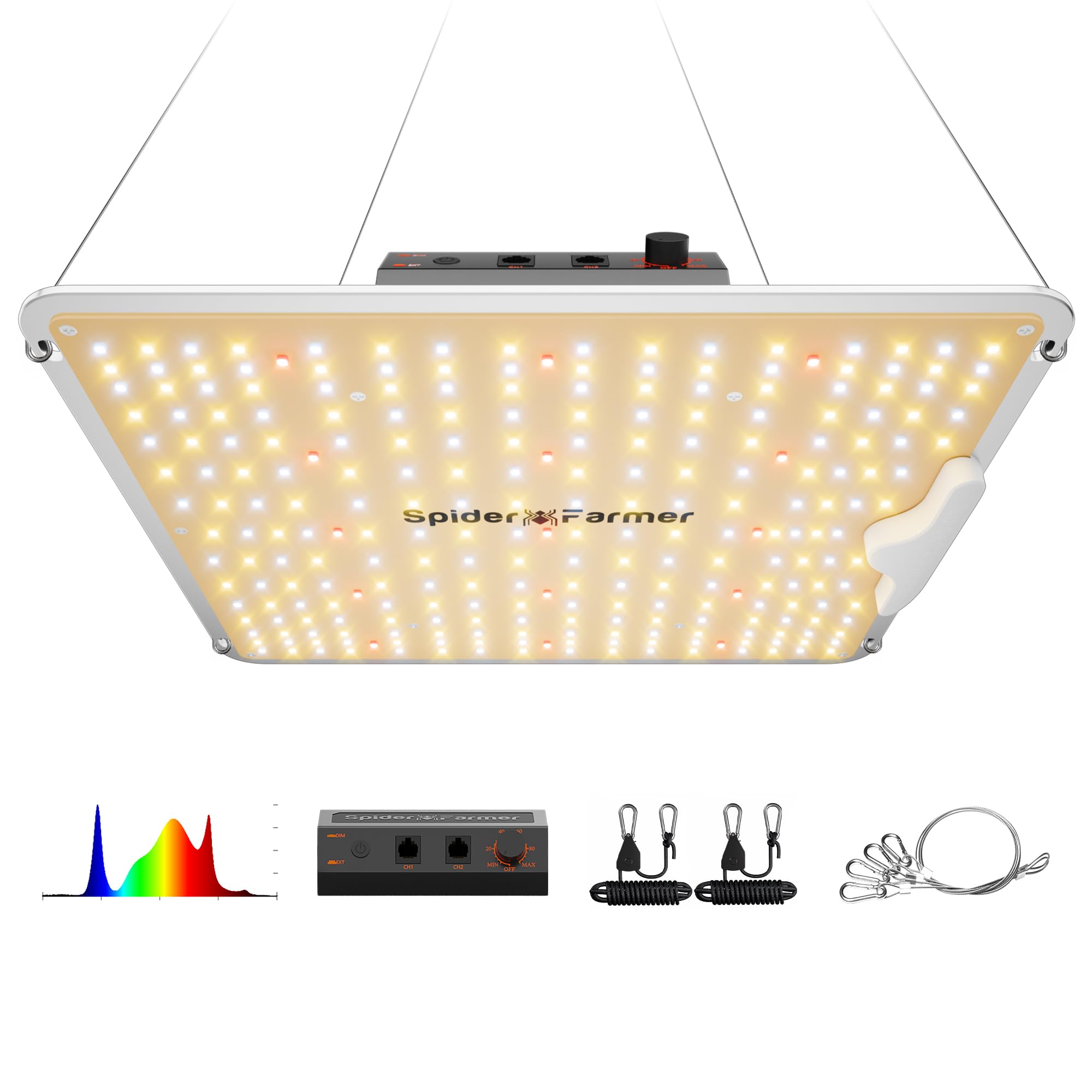
3. Spider Farmer SF1000 LED Grow Light 100W
The 100W that makes 400W HPS look outdated — silent and efficient enough for a bedside grow.
At just 100W of draw, this fixture delivers a 2.5 µmol/J PPE (photosynthetic photon efficacy, or how efficiently it turns electricity into usable light) that rivals units twice its wattage. Shoppers say it beats their old 400W HPS (high-pressure sodium) systems while using 177W less and running much cooler. The fanless design means zero noise — perfect for a bedroom or home office. The 90° beam angle focuses light straight down, working best in a 2×2 tent at a hanging height of 12-30 inches. Buyers report it is “almost too strong for the 2×4” and you would need a pair for a 4×4 space. The 2026 version rearranges the LED layout for more uniform PPFD (photosynthetic photon flux density, or light particles hitting the canopy) at the edges, and the dimming knob now works with GGS controllers (third-party automation devices) for automated scheduling. Build quality gets frequent praise: the aluminium heat sink is thick and sturdy, and Spider Farmer backs it with a 5-year warranty through a U.S.-based service center — uncommon at this price. The light pulls only 0.36A, so it runs easily on a standard circuit, but some owners wish a wireless controller came included instead of just a manual knob.
High Points
- 2.5 µmol/J PPE makes it among the most efficient 100W fixtures
- Fanless and silent — ideal for a quiet bedroom or office
- 5-year warranty with local U.S. service support
Consider This
- 90° beam angle is narrower than the VIPARSPECTRA XS1500 Pro’s 120°; requires correct hanging height
- At 100W, you need multiple units for a 4×4 tent
This is for the grower who wants maximum efficiency per watt and dead-silent operation in a small tent. pass on it if you need a single fixture to cover a large 4×4 space from the start.
4. VIPARSPECTRA XS1500 Pro 150W LED Grow Light

The lens-fitted panel that delivers 747 PPFD at 50% from just 13 inches — no bare-diode panel here.
Unlike most lights that use bare diodes, the XS1500 Pro uses optical lenses to focus light with minimal loss, achieving uniform PPFD across the whole canopy. Owners mention PAR (photosynthetically active radiation, the range of light plants use) levels of 747 at just 50% power from 13 inches away, covering a 3×3 ft veg area or a 2×2 ft flowering footprint exceptionally well. The dimming knob works from fully off to 100%, and you can daisy-chain up to 20 units for unified control — a strong bonus if you plan to expand. The 120° beam angle is wider than the Spider Farmer SF1000’s 90°, so edge plants in a 3×3 get more light. It runs cool enough that one owner runs it 12 hours a day on succulents with zero heat issues. The main drawback: there is no power switch — you need an external timer to turn it off, which a few owners found annoying. At 2.55 kg (roughly 5.6 lbs), it is not the lightest, but included ratchet straps make hanging straightforward. Reviewers consistently call the PAR levels “excellent” and say it is “ideal for tomatoes and beets.”
Why It Stands Out
- Optical lenses concentrate light for better edge-to-edge PPFD uniformity than the Spider Farmer SF1000
- Daisy-chains up to 20 units with a single dimmer control
- Full spectrum includes 730nm IR (infrared) for flowering stages
Watch Out For
- No built-in on/off switch — you must add a separate timer
- Heavier than some 150W panels at roughly 5.6 lbs
Choose this if: even canopy light for a 3×3 veg space matters most and you don’t mind using a timer. Pass if you want a simple plug-and-play fixture with a physical power switch.
5. BESTVA BP2000 200W LED Grow Light
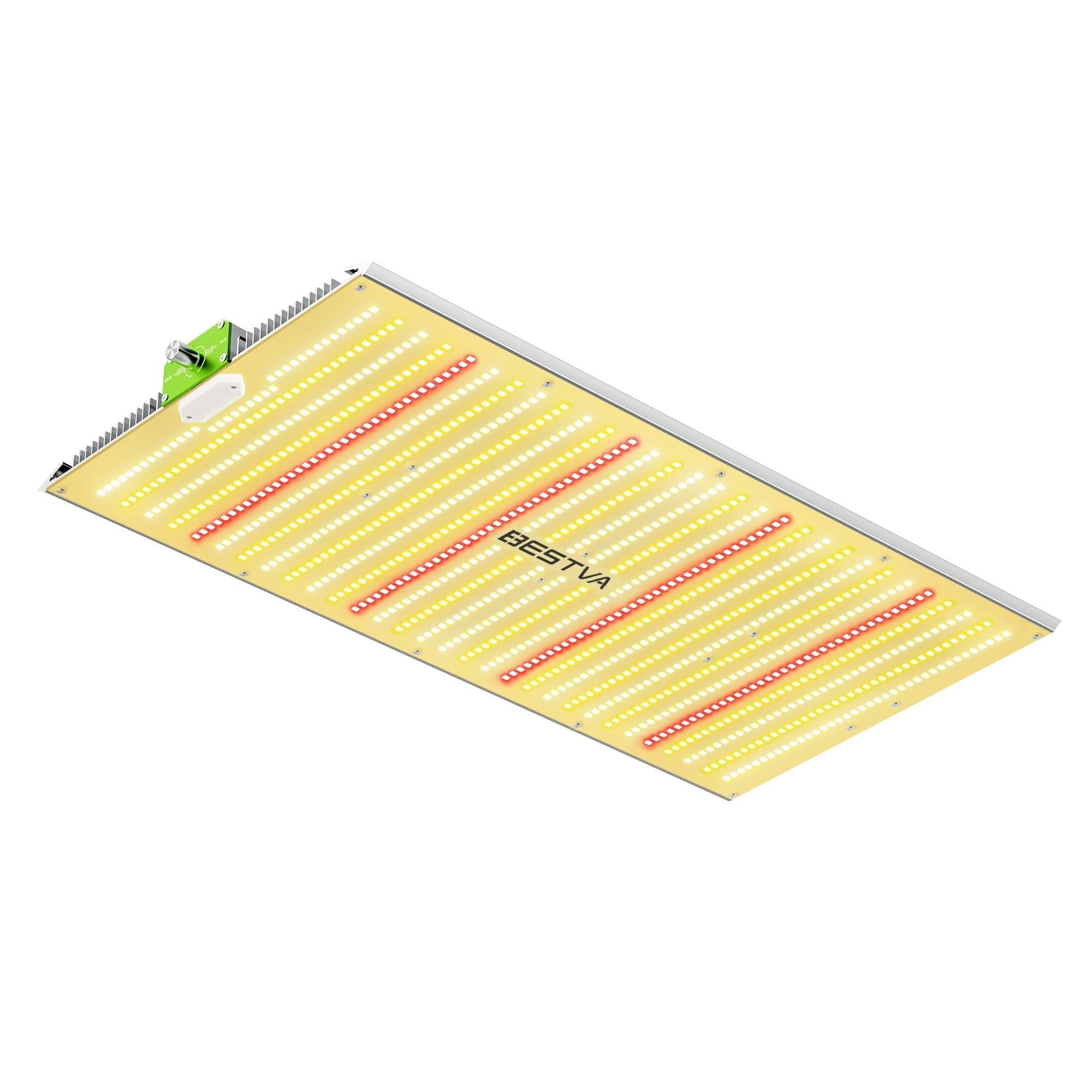
The 200W panel that covers a 3×3 footprint for about the same cost as smaller 150W lights.
The BP2000 gives you broader coverage (3×3 ft veg) for roughly the same investment as smaller panels, making it smart for a closet or greenhouse shelf rather than a dedicated tent. Its fanless design means zero noise — fine for a living room or sunroom. The 200W of actual power (some earlier units drew 205W; newer versions draw around 160W) is enough to prevent leaf drop on indoor citrus, according to owners, and the 660nm red spectrum helps fruiting vegetables set flowers. The dimmer knob adjusts intensity through all growth stages, and the detachable driver (the power supply box) keeps heat off the fixture — useful because some customers note the light runs hotter than expected, especially at 100%. Quality is the top-mentioned positive aspect in reviews, with performance and brightness close behind. A minor coverage issue: under a 2ft x 4ft shelf, seedlings at the tray ends may lag, requiring rotation. BESTVA backs it with a 3-year local service center warranty.
What Works
- 200W output covers a 3×3 ft area without costing premium prices
- Fanless and quiet, suitable for living areas
- Detachable driver keeps the light bar cooler
What To Watch
- Runs hotter than some competitors; needs good air circulation
- Coverage drops off at the ends of a 2×4 ft shelf; rotate trays regularly
Reach for this if: you need a big, quiet light for a 3×3 area without paying premium prices.
Skip if: you are cramming into a small 2×2 tent where the broader footprint is wasted and heat is a concern.
6. VIVOSUN AeroLight Wing AW200SE 200W LED Grow Light
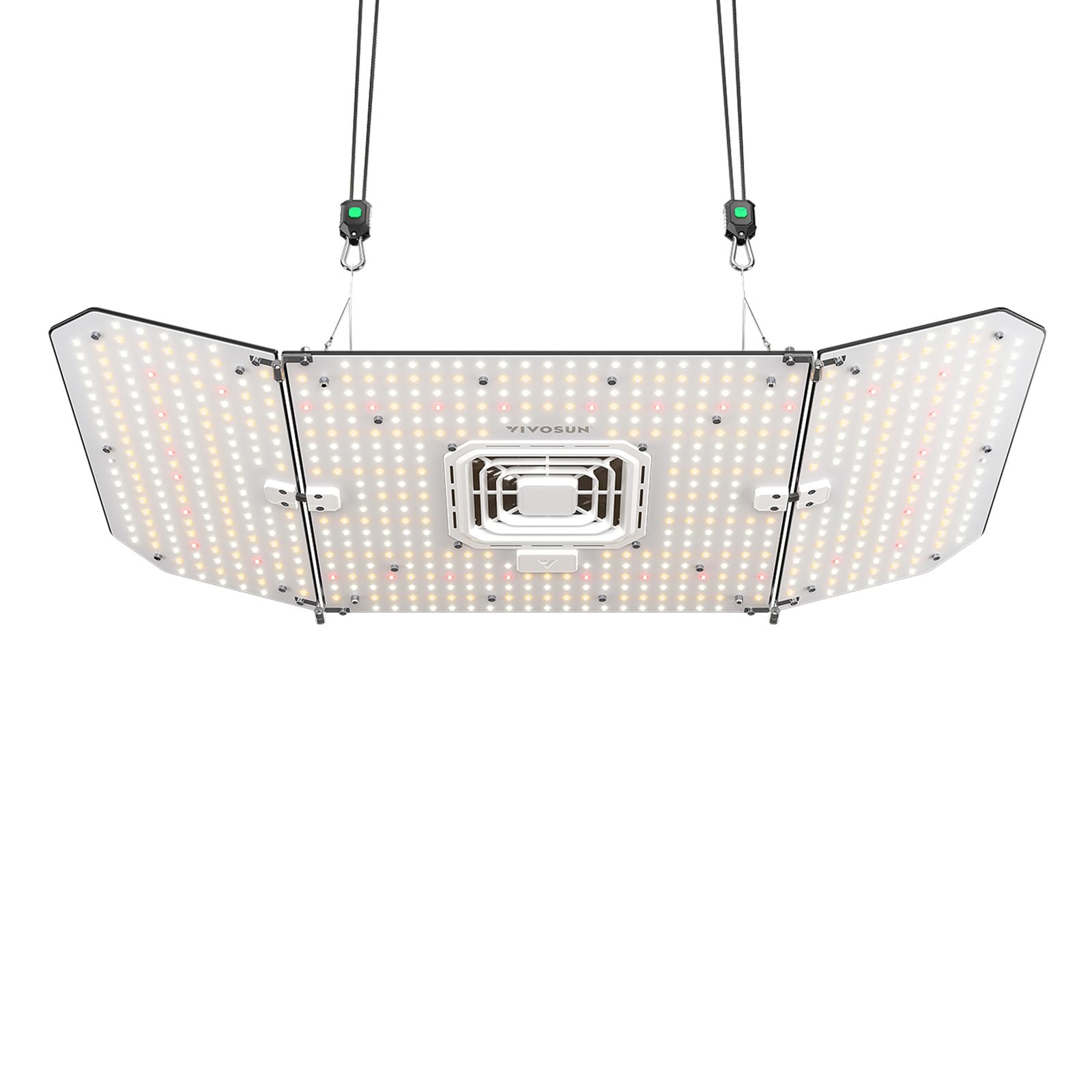
The only grow light here with a built-in fan that blows air through the canopy while it shines.
This 200W light is genuinely different: a circulation fan sits right in the center of the panel, pushing air down through the plant canopy where a separate oscillating fan would miss. The hollow “wing” design lets air pass through the light itself, which owners say improves air circulation and strengthens stems. Reviewers in 3×3 and 4×4 tents say the built-in fan “eliminates the need for oscillating fans” and provides gentle airflow that keeps leaves dry and reduces pest risk. The light output is full spectrum (380nm-780nm with 660nm red) and delivers maximum PAR at various distances, with adjustable wing angles to tweak coverage. However, the smart features — app scheduling, sunrise/sunset simulation — require a separate VIVOSUN GrowHub Controller, not included, and several owners say this should be clearer on the box. Without the hub, the light works manually, but you lose the main selling point. The fan uses dual ball bearings for durability, and the aluminium heatsink pushes lifespan past 50,000 hours. Compared to the fanless MARS HYDRO TS1000, this has the advantage of built-in airflow, but with added complexity.
Innovation That Matters
- Built-in fan eliminates the need for separate oscillating fans
- Wing design allows adjustable coverage and air circulation
- Full spectrum up to 780nm covers the far-red range
Important Fine Print
- App control requires a separate GrowHub controller (not included)
- Reliability feedback is mixed — some reviewers point out early failures
This suits the tech-savvy grower who already owns or plans to buy a VIVOSUN controller and wants automated scheduling plus airflow. It is not for anyone who just wants a simple plug-and-play light without buying extra controllers.
7. FARMLITE 260W LED Grow Light Bar

The bar-style 260W fixture that owners compare to Gavita units costing twice as much.
For a 4×4 ft area — like a full shelf of tomatoes or a greenhouse bench — this 260W bar light delivers 26,000 lumens of output with an IP65 waterproof rating that shrugs off greenhouse humidity. Owners compare it to Gavita 1700E units that cost twice as much, saying “they are just as good and don’t require an external controller.” At 12 inches and 75% power, the PPFD hits 706, which pushes into fruiting territory for peppers and eggplants. The daisy-chain dimming supports master/slave mode for over 100+ units — meaning one master light controls all the others — so you can scale a commercial rack without buying individual controls. Heat dissipation uses lightweight aluminium bars with no fan, so it stays silent. However, “heat is definitely more than expected” is a recurring owner note, so keep ambient temps in check. The cable length is another frequent complaint: at roughly 3 meters, it may not reach a distant outlet without an extension cord. Durability is mixed — some shoppers say failures around the three-month mark, though customer service has been responsive for replacements.
Big Win
- 260W with 26,000 lumens for a full 4×4 area
- Master/slave mode lets you control over 100 lights from one unit
- IP65 waterproof for high-humidity greenhouses
Trade-Offs
- Runs warmer than some bar lights; requires ventilation
- Cable length is short — plan outlet placement carefully
Choose this if: you are outfitting a greenhouse or a 4×4 tent and want bar-style even coverage with master/slave scaling.
Pass if: you are working in a small 2×2 space where the 260W output and heat are overkill.
8. Spider Farmer G3000 300W LED Grow Light

The 2.75 µmol/J monster that covers a 3×3 with edge-to-edge PAR — the most efficient light on this list.
This is the most powerful light here at 300W, and it earns its spot with the highest PPE of any fixture in this lineup: 2.75 µmol/J. That means you get more plant growth per dollar of electricity than anything else here — about 10% more than the Spider Farmer SF1000’s 2.5 µmol/J for the same power cost, buyers report. The extended light bar uses 896 high-efficiency diodes to produce 824 µmol/s (total photon output) spread across a 3×3 ft area, and owners consistently praise the even PAR across the tent — no dark spots at the edges. The Spider Farmer App (on Apple Store and Google Play) lets you set custom light schedules, simulate sunrise and sunset, and adjust brightness remotely, so you can leave for a vacation without worrying about your greens. The built-in digital display shows the current brightness level, and daisy-chaining lets you control up to 50 units from one master light. Assembly takes under four minutes, according to owners, and the 5-year warranty with U.S.-based service is a strong safety net. Heat output is minimal because the controller is external, and the light stays cool — one owner calls it “cool light for its wattage.”
Top Perks
- Best efficiency in the list: 2.75 µmol/J PPE and 824 µmol/s output
- App control with sunrise/sunset simulation for natural cycles
- 5-year warranty with local U.S. service support
Consider This
- Premium price may be outside a casual grower’s budget
- Reliability is still unproven after only two crops by some owner accounts
This is for the serious indoor vegetable grower who wants maximum efficiency, smart controls, and the headroom to grow anything from lettuce to full-sized tomato plants. It is not for a beginner on a tight budget who just needs a simple light for a few herb pots.
Understanding the Specs
PPFD (Photosynthetic Photon Flux Density)
PPFD is the number of light particles (photons) that land on a square meter of your plant canopy every second, measured in µmol/m²/s. Think of it as how much usable food the light is delivering to your vegetables. Leafy greens like lettuce and spinach are happy with 200-300 µmol/m²/s, while fruiting plants like tomatoes and peppers need 400-600. If your light’s PPFD at canopy height is too low, stems get leggy and yields drop; too high and you risk light burn. Check the manufacturer’s PPFD chart for your specific hanging height.
PPE (Photosynthetic Photon Efficacy)
PPE tells you how efficiently the light turns electricity into photons, expressed in µmol/J. A higher PPE means more growth per watt on your bill. Older blurple lights struggle to hit 1.5 µmol/J, while modern white-LED panels routinely deliver 2.5 to 2.75 µmol/J. The difference is real: a fixture with 2.75 µmol/J will produce about 10% more light for the same electricity cost as one with 2.5 µmol/J. For a 300W light running 12 hours a day, that efficiency gap adds up over a full growing season.
FAQ
Can I use these lights for both seedlings and flowering vegetables?
How far above my plants should I hang the light?
Will a 150W light cover a full 3×3 tent for tomato plants?
What is the difference between daisy chain and master/slave dimming?
Do these lights work without a grow tent?
What does the IP65 waterproof rating mean for a grow light?
How much will my electricity bill increase with a 150W grow light?
Should I buy a light with a built-in fan or a fanless model?
Final Thoughts: The Verdict
If you want one dependable pick, the grow lights for indoor vegetable gardens champion is the MARS HYDRO TS1000 because it balances proven reliability, 150W of silent output, and a price that does not punish a first-time veggie grower. If you want app-based automation and the highest efficiency per watt, grab the Spider Farmer G3000. And for a waterproof, value-focused seedling station, the SP1500 is the one to reach for.
How We Picked
We do not accept paid placement. Every pick is matched to a real buyer and a real use-case; we do not hands-on test units.
Sources & Methodology
Specifications: manufacturer listings and product documentation. Review insights: verified customer reviews, as of July 2026. Pricing: not shown on this page (it changes often); check the current price via the retailer link.
As an Amazon Associate, Lawn Gear Lab earns from qualifying purchases. This does not affect which products we feature.