
Specs are compiled from manufacturer listings and verified buyer reviews and can change over time — please confirm the key details on the product page before buying.
Thatch — that spongy layer of dead grass and roots between the soil and your lawn — can choke your yard if it builds up. A dethatcher removes thatch so water, air, and nutrients can reach the roots.. But with rakes, spreaders, aerators, and edgers all calling themselves lawn tools, Choosing the right tool depends on your yard size and soil type..
I’m Rikta — the founder and writer behind Lawn Gear Lab. This guide is built by comparing the manufacturers’ published specifications and the patterns across verified customer reviews, so you get each pick’s real strengths and trade-offs instead of marketing spin.
Matching the tool to your turf type and yard size determines success.. For small lots, a manual rake or walk-behind spreader works fine. For compacted clay or heavy thatch, a powered dethatcher saves hours. Here is your shortcut to the best grass lawn tools for every yard and budget.
Our Picks at a Glance


How To Choose The Best Grass Lawn Tools
Not every lawn job needs the same tool. A dethatching rake targets dead thatch without damaging live grass. A lawn leveler spreads topsoil to fill low spots. A core aerator pulls plugs from compacted earth to let air and water in. And a spreader distributes seed or fertilizer evenly. Pick the tool that solves your specific lawn problem rather than buying a one-size-fits-all gadget.
Understand your yard size and soil
A small front lawn of 4,000 square feet works fine with a manual spreader or a hand-push aerator. Owners of half-acre lots usually prefer a powered dethatcher because it covers more ground faster. Soil type also matters — a stand-up weeder performs best in moist, soft soil and struggles in hard clay or rocky ground. Always match the tool’s capacity and effort level to your actual yard conditions.
Quick Comparison
| Model | Best For | Primary Task | Head/Width | Weight | Amazon |
|---|---|---|---|---|---|
| Scotts Turf Builder EdgeGuard Mini★ Best Overall | Small‑yard spreading | Fertilizer & seed broadcast | 5,000 sq ft capacity | Light | Amazon |
| BlumeTrec Thatch RakeTop Performer | Manual dethatching | Thatch & dead grass removal | 15″ head / 74″ handle | 2.1 kg | Amazon |
| YRTSH Loppers & Shears ComboBest Value | Shrub & branch trimming | Pruning & hedge cutting | 1.75″ cutting width | 2.86 kg | Amazon |
| Grampa’s Weeder | Stand‑up weed pulling | Root extraction (dandelions etc.) | 4‑claw steel head / 45″ handle | 2.3 lb | Amazon |
| BlumeTrec Lawn Leveling Rake | Leveling & topdressing | Soil, sand, compost spreading | 30″x10″ plate | Heavy duty | Amazon |
| LawnVigor Manual Core Aerator | Small‑yard aeration | Soil plug removal (3 hollow tines) | 3‑tine / 3″ plugs | 3.52 lb | Amazon |
| Fiskars Stand‑Up Weed Puller | Chemical‑free weeding | Weed root extraction (serrated claws) | 4‑claw / 39″ handle | 2.5 lb | Amazon |
| WEN 15‑Inch Electric Dethatcher | Large‑lawn dethatching | Thatch removal & scarifying | 15″ path | — | Amazon |
| WORX Cordless Lawn Edger | Edge trimming & trenching | Clean edges along driveways & beds | 7″ blade | 7 lbs (w/o battery) | Amazon |
In‑Depth Reviews
1. Scotts Turf Builder EdgeGuard Mini Broadcast Spreader
Our pick — over 4.5★ from 23,000+ verified ratings; the strongest balance of quality and price.
A small spreader that handles big jobs without the backache of a full‑size unit.
This spreader holds enough product to cover up to 5,000 sq. ft., making it a perfect match for a typical 4,000 sq ft front-and-back lawn. Buyers report it throws seed and fertilizer just as far as larger broadcast units, so you are not trading coverage for compact size. The EdgeGuard side shield keeps product off your driveway and landscaping — a feature that gets called out repeatedly as a real time-saver.
No assembly is required, and the fold-down handle makes storage simple. The hopper and agitator are designed to funnel product smoothly for even coverage. The design is rust-proof thick plastic that hoses clean easily.
A few owners note the plastic wheels feel a bit wobbly, but the consensus is clear: this little spreader eliminates the need for a lawn-care service on small-to-medium yards. The thing everyone raves about is the functionality — it simply works every time you push it.
Why owners love it
- EdgeGuard keeps product off hardscape
- Fold-down handle for easy wall storage
- Even broadcast with adjustable settings
Fair caveat
- Plastic wheels feel less sturdy than metal
Your best buy: If you have a yard up to 5,000 sq. ft. and want a one‑step, no‑battery spreader that works with seed and fertilizer, this is it.
Think twice if: You need to cover multiple acres — the mini size will mean more refill trips.
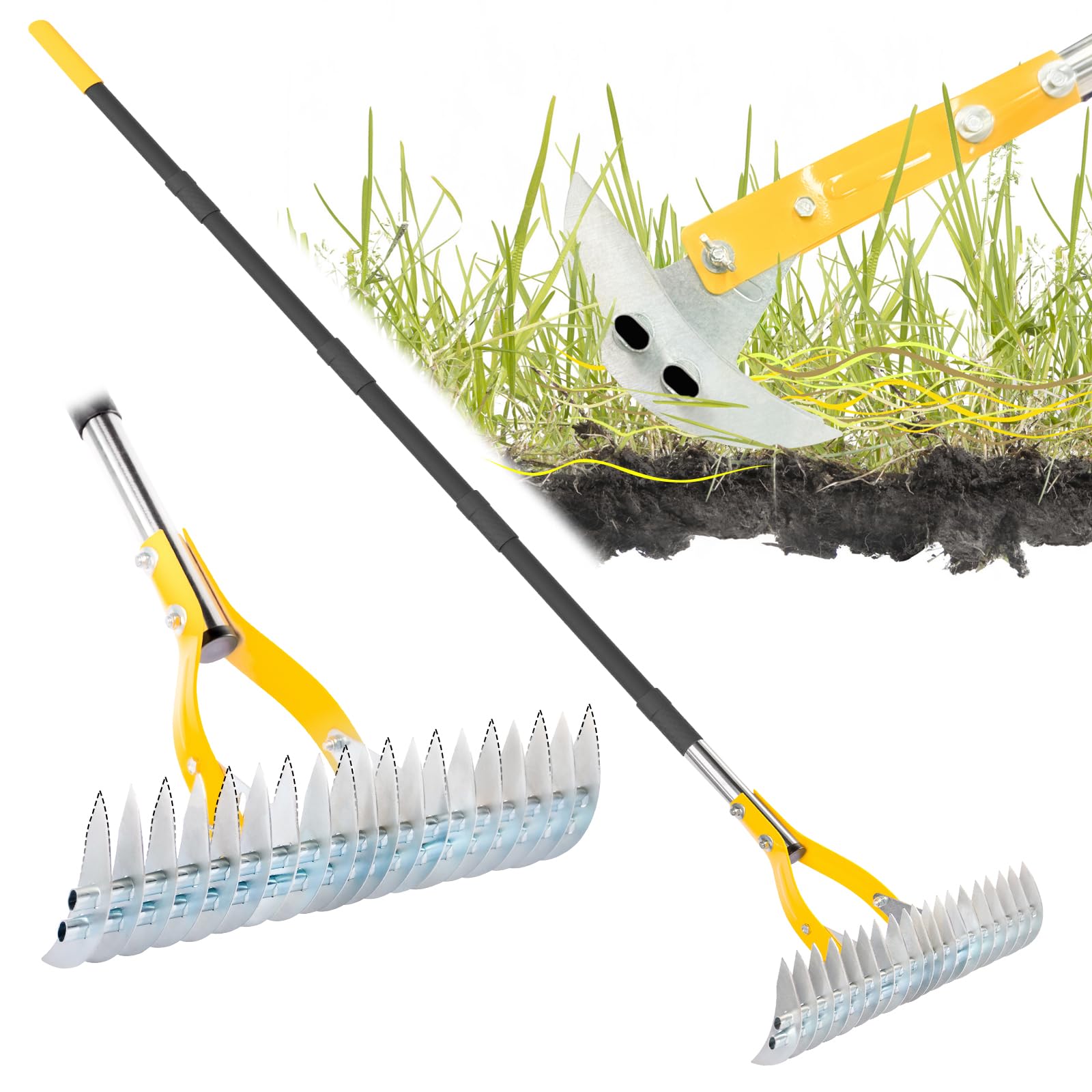
2. BlumeTrec Thatch Rake with 74-Inch Handle
A long‑handled thatch rake that grabs dead grass without yanking out live turf.
The total length of 74 inches lets you stand upright while dethatching, saving your lower back. The 15-inch head carries 19 curved tines. One side is designed for dethatching; the other side loosens soil for better airflow. The angle of the tines adjusts — shallow for light surface combing, deeper for thorough thatch removal.
The tines are made from manganese steel that has been heat-treated through quenching for hardness and wear resistance. A powder-coated finish fights rust. The handle is stainless steel and comes in sections that twist together, so you can adjust the length or take it apart for compact storage. A cushioned, non-slip grip adds comfort during extended use.
Owners consistently say the effectiveness is the standout trait. One review sums it up: “I was impressed with how easily this rake removed thatch from our lawn. It grabs the thatch but not the grass — very effective.” Assembly takes minutes, and the head attaches with screws. The dethatching performance gets mixed feedback — some owners find it easy, others say it demands effort on dry, compacted ground. Wet soil makes the job noticeably easier.
Real‑world verdict: A well‑built manual thatcher that saves your back and pulls serious thatch. Best for small to medium lawns where you want control without a motor.
3. YRTSH Loppers Hedge Shears & Pruners Combo Set
Three sharp tools that give you up to 4x more cutting power without the fatigue.
This kit includes a 26-inch compound action lopper, a 23-inch hedge shear, and an 8-inch professional pruning shear. The compound action technology makes pruning easier on hands and wrists. The blades are made of high-quality alloy steel with a low-friction coating that slices through branches cleanly.
The lopper handles a cutting width of 1.75 inches, which is enough for most shrub and small tree branches. The hedge shears and pruners handle finer trimming on bushes and hedges. The handles have a soft rubber grip designed for comfort and anti-fatigue during long trimming sessions.
Quality is what owners praise most. They describe the tools as well-built and sharp right from the start. One owner says they “cut wet plants cleanly.” The durability side is mixed — a small number of owners mention that the large pruners broke at the limb lock within days. For most buyers, though, the set delivers reliable performance for regular yard pruning and The set delivers reliable performance that offsets its cost within a season..
Bottom line: A strong value for anyone who needs loppers, shears, and pruners in one box. Just be gentle with the limb lock mechanism.
4. Grampa’s Weeder — The Original Stand Up Weed Puller

A century‑old design that pulls weeds roots‑and‑all while you stand tall.
This weeder has been in production since 1913, and the design has barely changed. The 45-inch handle is made from real bamboo, and the head uses four steel claws that grip the weed and its root system. You simply push the claws into the ground around the weed, step on the foot platform, and tilt back — the weed comes out whole, roots intact. No bending, no kneeling.
It works best on softer soil types, especially after a good watering or rainfall. On hard clay or rocky surfaces it struggles, which the maker notes honestly. The tool controls weeds without chemicals, making it safe for children and pets. The American company is family-owned in the Pacific Northwest and backs the tool with a lifetime guarantee.
Owners call it a back-saver, especially for seniors or anyone with joint pain. It handles dandelions, thistles, and crabgrass well. A small trade-off: on thin-stalked weeds or in dry, hard ground, the claws may not grip effectively. One owner found it “great for thistles” and says the simple design just works. The handle is sharp at the end and comes with protective covers.
Who it’s for: Gardeners who want a chemical‑free, stand‑up solution for dandelions and broad‑leaf weeds in moist soil. Not for rock‑hard clay or tiny grass‑like weeds.
5. BlumeTrec Lawn Leveling Rake (30″x10″)
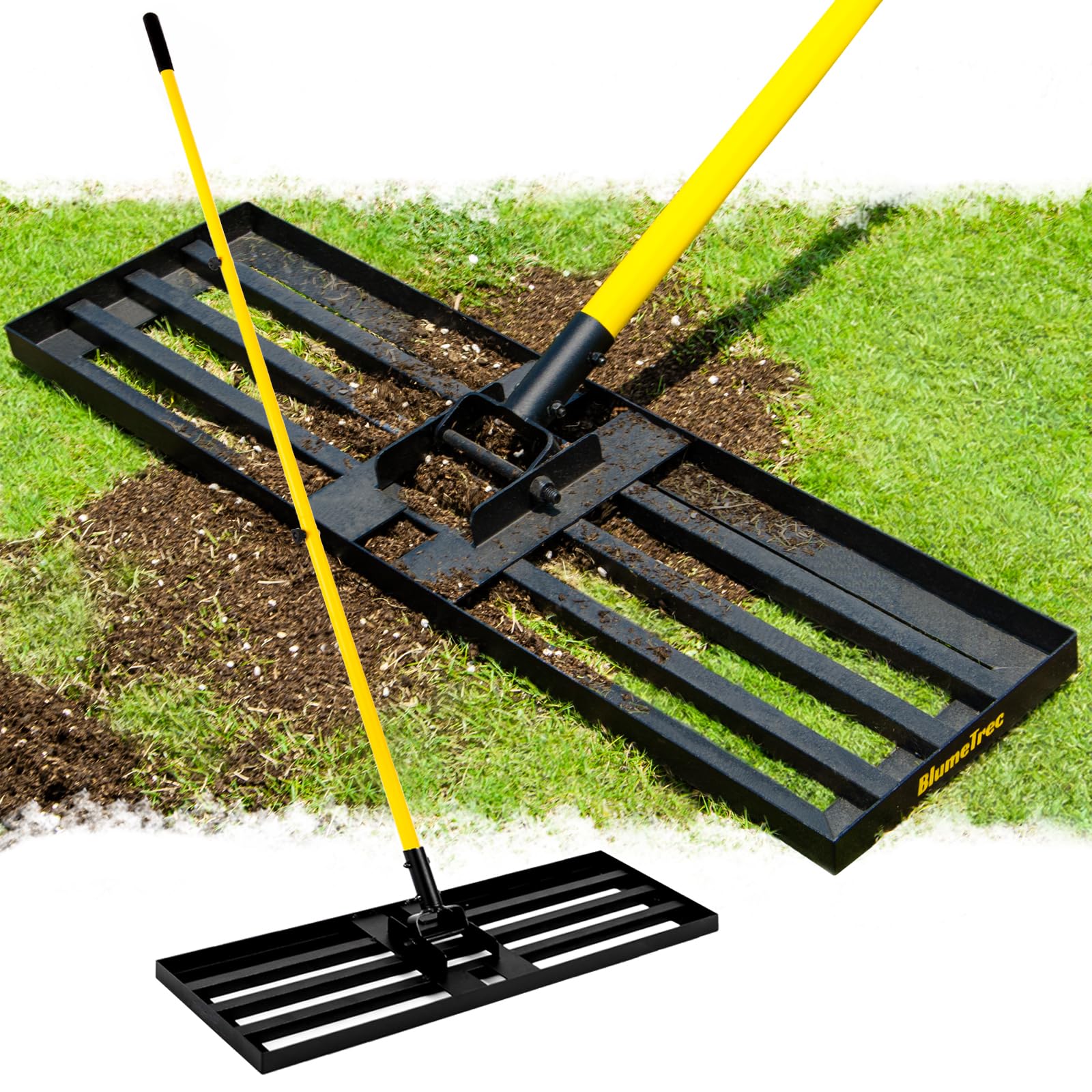
A big‑plate leveler that spreads sand and topsoil flat with one pass.
The 30-inch-wide by 10-inch-deep steel ground plate drags material evenly across the lawn to fill low spots. The head angle adjusts from 0° to 90°, letting you switch from spreading to scraping without swapping tools. The handle extends up to 7 feet, reducing the need to bend during long leveling sessions.
The head is made from high-grade steel with full welding technology at the joints to prevent loosening over time. A powder-coated finish adds rust resistance. The rake works on common grass types including Bermuda, Kentucky Bluegrass, Ryegrass, St. Augustine, and Fescue. It disassembles into sections for compact storage.
Owners say the functionality is the biggest win — it flattens soil, sand, and compost effectively. Some find it a little heavy, and a few mention the handle could be shorter for their height. One owner says the 30-inch size is great for larger areas but advises homeowners to go with the smaller 17-inch version for better maneuverability in tight spots. The assembly is simple with included tools.
Use it for: Leveling a bumpy lawn, spreading topdressing, or smoothing a gravel path. The 30″ plate covers ground fast but demands some upper‑body strength to drag.
6. LawnVigor Manual Core Aerator with 3 Hollow Tines
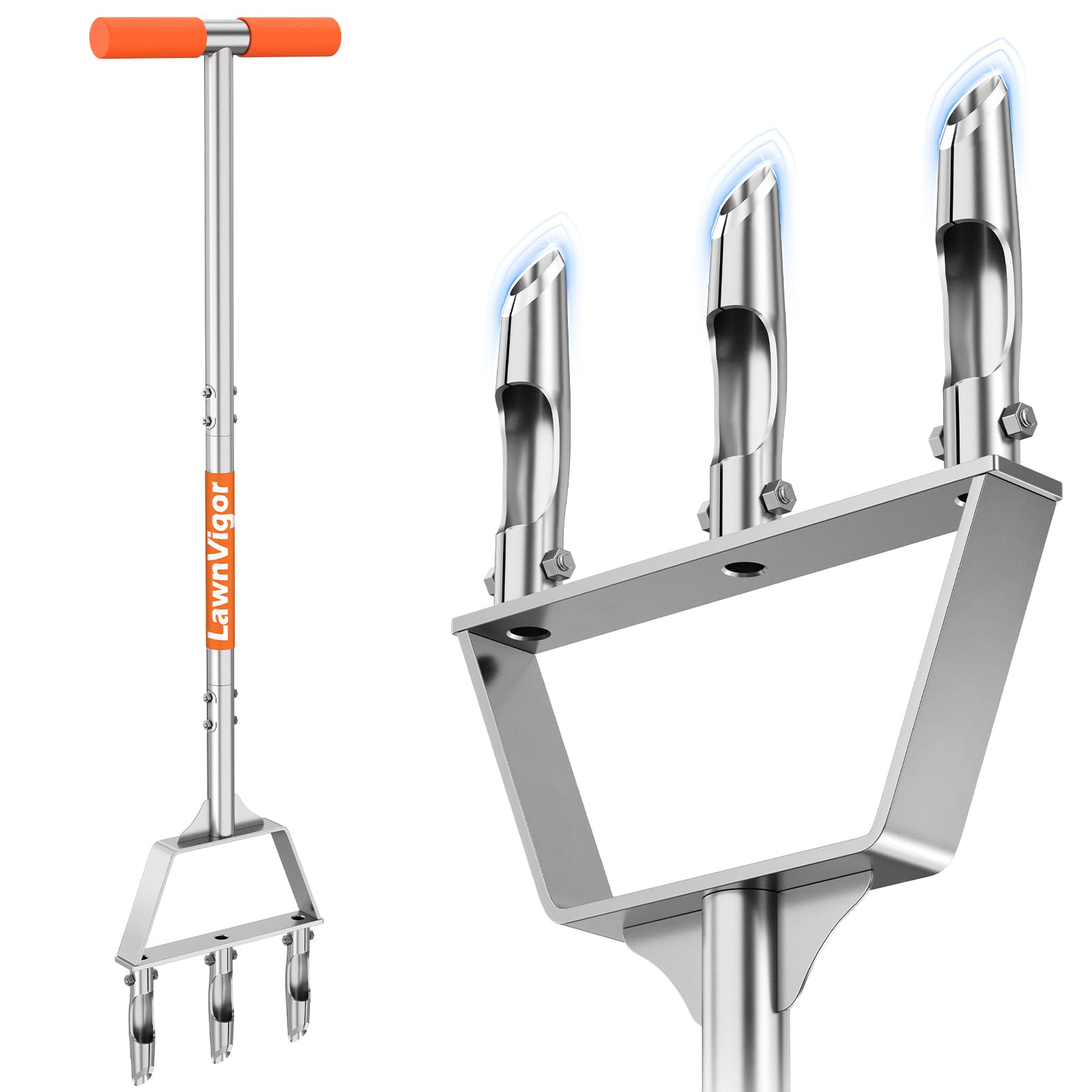
A sturdy step‑aerator that pulls clean 3‑inch plugs out of compacted soil.
This manual aerator uses three hollow tines made from heat-treated metal. When you step on the foot bar, the tines penetrate the soil and pull out a core plug. The key detail is the white plastic inserts in the tine openings — they help release soil plugs cleanly instead of clogging. The manufacturer advises keeping those inserts in place and not rocking or twisting the tool side-to-side once it’s in the ground.
The handle is ergonomically designed with a non-slip grip to reduce strain during use. It comes semi-assembled, and owners say setup takes about five minutes. The tool is built from heavy-duty powder-coated steel that holds up well to repeated use.
Functionality is what wins owners over — the aerator consistently pulls uniform plugs without clogging, even on compacted Bermuda grass. One owner says it worked “10x better than the first manual core aerator I purchased.” The tool is best for small areas or small yards; tackling a large lawn with this would be a workout. A few owners note the handle covers can loosen and spin, and the tool can cause blisters even with gloves.
Reach for this if: You have a compacted garden or small lawn and want a manual aerator that actually pulls plugs instead of just poking holes. The non‑clog tines make a real difference.
7. Fiskars Stand-Up Weed Puller Tool (39″)

Serrated stainless claws that grip dandelion roots so you never have to bend.
The four stainless steel claws have serrated edges that grab the root system of weeds like dandelions and thistles. The 39-inch aluminum handle has an offset design to reduce wrist strain, plus an integrated viewing window so you can see the weed as you position the claws. The easy-eject mechanism releases the weed without you having to touch it.
The tool performs best in soft to moderately firm soil. For hard, compacted, or clay-heavy ground, the manufacturer suggests watering the area 30–60 minutes before use to soften the earth. The steel blades are designed to stay sharp through heavy use and are backed by a lifetime warranty.
Owners consistently describe it as easy — “pulling weeds is easy. Poke it in the ground and then rock it back. It pulls up everything, root and all.” The tool is excellent for large, established roots but less effective on tiny or sprawling weeds. One trade-off is that it leaves noticeable holes in the lawn. The plastic parts have drawn some durability concerns, but the overall verdict is that it beats hand-pulling and chemicals hands down.
Best for: Dandelion patrol in moist soil. The 4‑claw grip and ergonomic handle make it a back‑saver for regular weeding. Not ideal for tiny weeds or rock‑hard clay.
8. WEN 15-Inch 13-Amp 2-in-1 Electric Dethatcher and Scarifier

A 13‑amp electric beast that spins 3300 RPM to rip thatch out fast.
The powerful 13-amp motor generates up to 3300 RPM across a 15-inch clearing path. That speed and width add up: customers note dethatching and scarifying a 2,000 sq ft yard in under an hour. The tool comes with two interchangeable heads — a dethatching head with 24 steel tines for heavy thatch pickup, and a 16-blade scarifying head that aerates the soil by cutting into it.
A 5-position height adjustment ranges from +1/4 inch to -1/2 inch raking depth, giving you precise control over how aggressively you remove thatch. A detachable 12-gallon collection bag catches the debris. An automatic overload shutdown protects the motor if it gets bogged down. The tool runs on a standard AC extension cord, so you need an outlet within range.
The dual functionality is what owners praise most — switching from dethatcher to scarifier takes one bolt and the included tools. The 15-inch width covers ground quickly, and the adjustable depth settings let you dial in exactly how much thatch to remove. The collection bag fills fast, and some owners find it too small, preferring to use a separate lawn sweeper for cleanup. Assembly is straightforward, and the build quality feels solid for the price point.
Your move: If you have a medium to large lawn with serious thatch, this powered dethatcher saves hours of manual raking. Just budget for a long extension cord and a separate cleanup method for the debris.
9. WORX Cordless Lawn Edger (WG898)
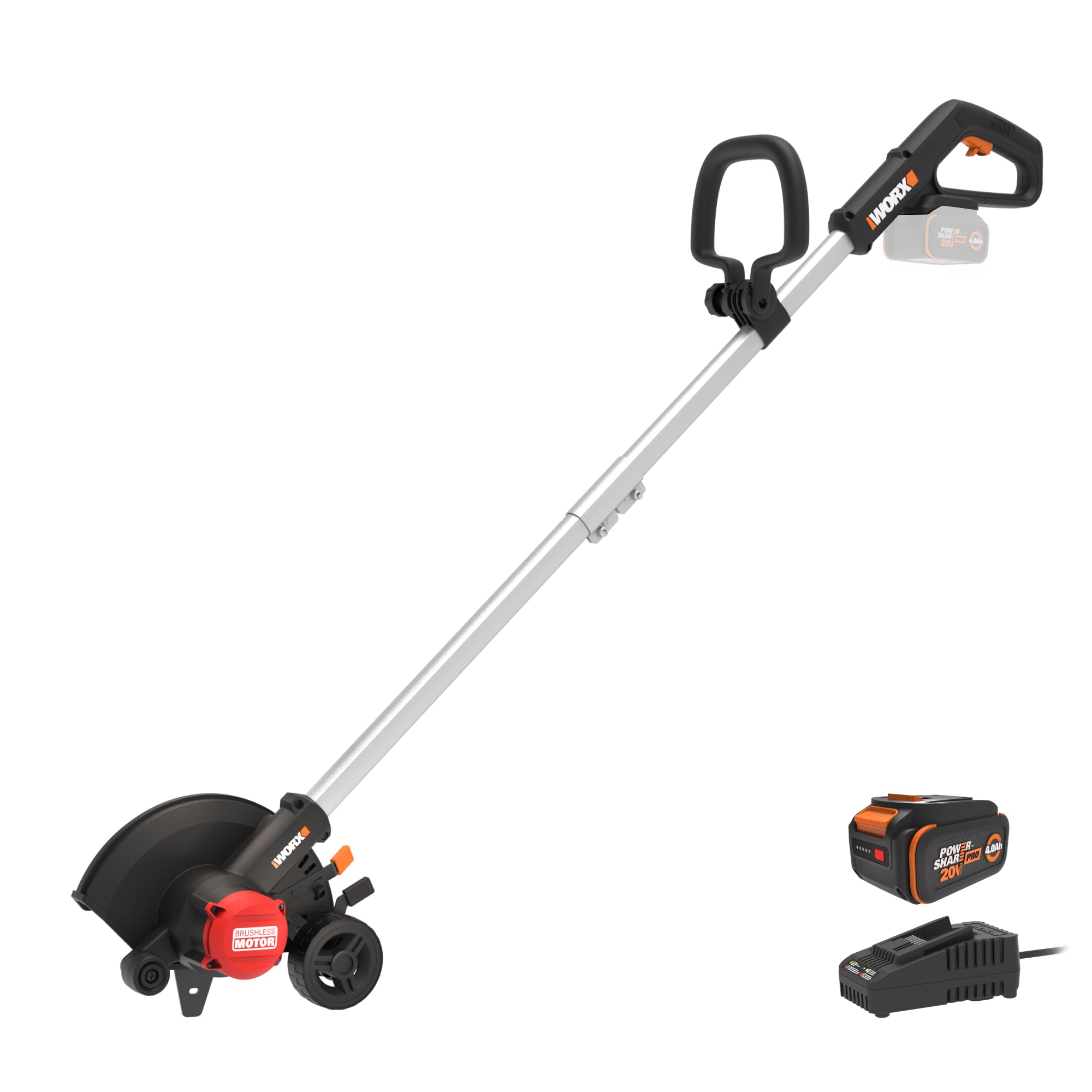
A 7‑inch cordless edger that cuts clean along driveways without tangling a cord.
This edger runs on a 20V brushless motor and comes with a 4.0 Ah battery and charger. The 7-inch blade creates a clean, crisp edge along concrete driveways, curbs, and flower beds. It weighs only 7 lbs without the battery, making it easy to maneuver. Dual wheels keep the tool balanced and tracking straight.
The edge guide and blade indicator help you follow the edge line precisely. Three depth settings let you adjust how deep the blade cuts into the turf. The brand’s PowerShare battery system means the same 20V battery works across other WORX tools, and you can combine batteries for 40V or 80V power if needed.
The manufacturer claims up to 2,800 ft of edging per charge. Owners generally confirm strong runtime for a typical yard, though a few note battery life is shorter than expected if you have over 500 ft of edging. The edger handles deep trenches easily and is light enough that an 81-year-old owner found it simple to use. The main complaints: a small number of units arrived with a dull blade, and the tool can struggle in very hard dirt. Starting the blade before making ground contact is recommended.
Best for: Homeowners who want cordless convenience for driveway edging and flower‑bed borders. The lightweight design and battery interchangeability are real pluses. Pick up a spare battery if your edging runs long.
Understanding the Specs
Dethatching vs. Scarifying
A dethatcher uses spring tines or steel blades to rake out dead grass (thatch) from the surface of the lawn. A scarifier uses sharper blades that cut into the soil to slice through moss and thatch, also aerating the ground. Many powered tools like the WEN DT1315 let you switch heads for both jobs.
Core Aeration vs. Spike Aeration
Core aeration physically removes a plug of soil (about 3 inches deep) so air and water reach the root zone. Spike aeration simply pokes holes, which can actually compact the soil around the hole. Manual core aerators with hollow tines — like the LawnVigor — pull real plugs instead of just poking.
Broadcast vs. Drop Spreaders
A broadcast spreader flings product in a wide arc, covering ground quickly but requiring careful edge control. A drop spreader releases product straight down, giving precise placement. The Scotts EdgeGuard Mini is a broadcast spreader but uses a side shield to keep product off driveways and landscaping, offering a middle ground.
Compound Action in Loppers
Compound action loppers use a gear or pivot mechanism that multiplies the force you apply. The YRTSH set cuts branches up to 1.75 inches thick with less hand strength. Standard loppers without compound action require more force for the same cut.
FAQ
Can I use a dethatcher rake on a wet lawn?
How often should I dethatch my lawn?
Will a stand‑up weeder work in hard clay soil?
What is the difference between a dethatcher and a lawn leveler?
How do I know if my lawn needs aeration?
Can I use a broadcast spreader for grass seed?
What size lawn leveling rake should a homeowner buy?
Are cordless edgers powerful enough for thick turf?
Final Thoughts: The Verdict
If you want one dependable pick, the best grass lawn tools winner is the Scotts Turf Builder EdgeGuard Mini Broadcast Spreader because it solves the daily headache of even fertilizer and seed distribution for small to medium yards with zero assembly and a fold-down handle. If you need to clear heavy thatch from a larger lawn, the WEN 15-Inch Electric Dethatcher is the powered pick that saves hours. And for chemical-free weed pulling without bending, the Grampa’s Weeder is the one to reach for — roots and all, every time.
How We Picked
We do not accept paid placement. Every pick is matched to a real buyer and a real use-case; we do not hands-on test units.
Sources & Methodology
Specifications: manufacturer listings and product documentation. Review insights: verified customer reviews, as of July 2026. Pricing: not shown on this page (it changes often); check the current price via the retailer link.
As an Amazon Associate, Lawn Gear Lab earns from qualifying purchases. This does not affect which products we feature.