
Specs are compiled from manufacturer listings and verified buyer reviews and can change over time — please confirm the key details on the product page before buying.
You want sturdy, productive vegetable seedlings and a full harvest indoors. But the specs — wattage, spectrum, coverage, timers — can sound like a foreign language. The right grow light for your vegetables makes the difference between a leggy seedling that falls over and a compact plant that yields fruit. This guide cuts through the noise by focusing on the real numbers that matter for leafy greens, tomatoes, and peppers grown inside your home.
I’m Rikta — the founder and writer behind Lawn Gear Lab. This guide is built by comparing the manufacturers’ published specifications and the patterns across verified customer reviews, so you get each pick’s real strengths and trade-offs instead of marketing spin.
You will find seven different setups here, from a compact 45-watt desktop unit for starting seeds to a 200-watt panel that can support a 4×4-foot garden through harvest. The best vegetable grow lights share a few key traits: full-spectrum LEDs that mimic sunlight, enough wattage to reach your plants, and a dimming or timer feature so you can adjust the light as your vegetables grow.
Our Picks at a Glance

How To Choose The Best Vegetable Grow Lights
Vegetables are among the most light-hungry plants you can grow indoors. A low-light succulent might survive with a desk lamp, but a tomato plant needs intense, full-spectrum light for at least 14 hours a day to produce fruit. Focusing on a few key specs will save you from buying a light that is too weak or covers the wrong area.
Full Spectrum vs. Blurple Lights
You will see two main types of grow lights: “full spectrum” (which looks white or daylight, around 5000 Kelvin) and “blurple” (which casts a pinkish-purple light from red and blue LEDs). For vegetables, full-spectrum lights are the better choice. They produce a white light that closely mimics natural sunlight, making it easy to inspect your plants for pests or deficiencies without a color distortion. Blurple lights can be slightly more efficient for flowering, but full spectrum is the hands-down winner for an all-stage vegetable garden from seedlings to harvest.
Wattage and Coverage Area
The wattage tells you how much electricity the light draws, and it is a rough proxy for how bright the light will be. For seed starting on a standard 10-by-20-inch tray, a light drawing 40 to 50 watts is plenty. If you are lighting a 2×2-foot grow tent through the flowering stage, you will want something in the 150-watt range. For a larger 4×4-foot tent, look for a fixture around 300 watts. Do not go by “equivalent wattage” numbers (e.g., “1000W equivalent”); always look at the actual power draw listed on the spec sheet. That real number tells you what the light pulls from the wall and how much heat it generates.
Dimmability and Timer Functions
Seedlings thrive under moderate light, while flowering plants need maximum intensity. A dimmable grow light lets you adjust the brightness as your vegetables grow, without needing to change the fixture. A built-in timer (12 or 16-hour cycles, for example) automates the day-night cycle so your plants get consistent light even when you are not home. These two features together make a light truly “set and forget” for the entire growing season.
Quick Comparison
| Model | Best For | Wattage | Coverage | Weight | Amazon |
|---|---|---|---|---|---|
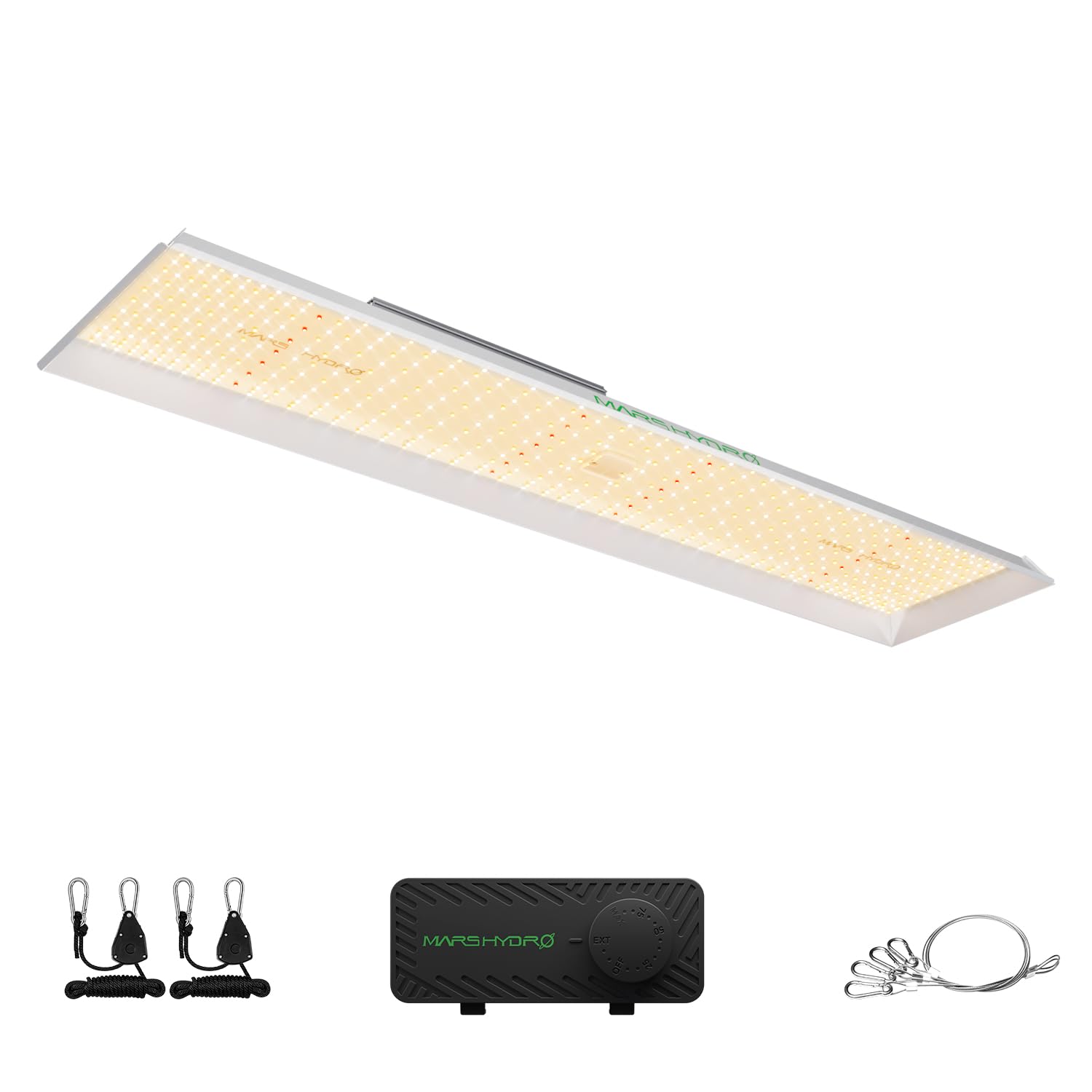
| MARS HYDRO TSL2000★ Best Overall | Large tents (4×2 ft flower / 3×5 ft veg) | 300W | 3×5 ft veg / 4×2 ft flower | 3.56 kg | Amazon |
| VIPARSPECTRA XS1500 ProBest Value | 2×2 tent growers (flower & veg) | 150W | 3×3 ft veg / 2×2 ft flower | 2.55 kg | Amazon |
| FECiDA 5-Head Table Top | Desktop seed starting & small plants | 45W | Desk / table top | — | Amazon |
| Barrina Vertical T10 | Tall potted plants & narrow spaces | 42W | Vertical side-lighting | — | Amazon |
| TYAGMAM T8 4-Pack | Shelves and greenhouse benches | 180W | Linear 4ft per tube | — | Amazon |
| Barrina CX83 Shelf | Multi-tier plant displays | 40W | 5 tiers, 15.7″ x 11.8″ each | — | Amazon |
| Barrina BU2000 Panel | Serious 4×4 tent & high-yield grow | 200W | 4×4 ft (high PPFD) | 2 lbs | Amazon |
In‑Depth Reviews
1. MARS HYDRO TSL2000 300W
Our pick — over 4.5★ from 20,000+ verified ratings; the strongest balance of quality and price.
The powerhouse that covers a full 3×5 foot veg area without breaking a sweat.
You need a light that keeps your tomato and pepper seedlings squat and stocky instead of stretching for a bulb. This MARS HYDRO draws 300 watts across 704 LEDs arranged in a unique pattern that is dense in the center and spread wide toward the edges. That layout produces an even PPFD distribution (a measure of how much usable light reaches your plants) across the whole canopy. Buyers report that their seedlings stay compact under this intensity — a clear sign the output is right for strong growth.
You get both dimming and daisy-chain capability here, which matters when you scale up. The dimmer lets you drop from 100% down to 0% brightness, which is perfect for hardening off seedlings before you move them outside. A single driver can chain up to 50 lights together — that is serious commercial-level control. The 120-degree white reflector is a patented design that increases light utilization by 25%, according to the manufacturer. At 3.56 kilograms, it is noticeably heavier than the VIPARSPECTRA XS1500 Pro below (which weighs 2.55 kilograms), so you will want a sturdy grow tent bar or hanging kit. One trade-off: at 300 watts and 3.56 kilograms, this is overkill for a single seed-starting tray on a desk.
For a 4×2 tent: This handles seedlings, leafy greens, and heavy fruiting crops in a 4×2-foot tent with a single fixture.
Who should skip it: Casual gardeners starting a few herbs on a countertop — the size and power are more than you need.
The verdict: Any indoor vegetable grower with a medium-to-large grow tent who wants one light that runs from seed to harvest without an upgrade.
2. VIPARSPECTRA XS1500 Pro 150W
A compact 150W panel that punches well above its price tag for a 2×2 tent.
This VIPARSPECTRA draws just 150 watts — half the power of the MARS HYDRO TSL2000 — yet the manufacturer says it replaces a traditional 250W HPS/MH light. The secret is the optical lens design, which focuses light with minimal loss to produce a uniform PPFD (usable light) across every corner of the canopy. For a 2×2-foot flowering tent or a 3×3-foot veg space, this gives your vegetables exactly the intensity they need without wasted spill.
The spectrum is a wide blend: white 3000K and 5000K LEDs along with red 660nm and infrared 730nm diodes. That combination pushes your vegetables from seedling all the way into flower with a single fixture, and the 3500 Kelvin color temperature leans warm-white (43% warmer than the TYAGMAM T8’s 5000 Kelvin), which is actually great for the flowering stage. Reviewers consistently mention how quiet and cool the unit runs thanks to the aluminum heatsink. You can daisy chain up to 20 units for unified dimming, which is a solid upgrade path if you eventually expand to a larger tent. The main limitation is that 150W is not enough for a full 4×2 tent — you would need two, and there is no built-in timer, so you will need an external outlet timer.
Where it shines
- Compact size (14.2″ x 11.4″ x 3.1″) fits easily in a 2×2 tent
- Optical lenses give even canopy light without hot spots
- Dimmable from 0-100% and daisy-chainable up to 20 units
Where it holds back
- 150W is not enough for a full 4×2 tent — you would need two
- No built-in timer; you will need an external outlet timer
Best for: The vegetable grower with a single 2×2-foot tent who wants a quiet, efficient light that covers from seed to flower without needing a big fixture.
Not ideal for: Anyone trying to light a 4×4-foot tent with one unit — you need a much higher wattage or a second unit.
3. Barrina Vertical T10 42W

The standing lamp that brings 5000K daylight down to the lower leaves of tall plants.
Most grow lights hang above your plants, which works fine for short trays but leaves the bottom of a tall tomato or pepper plant in shadow. This Barrina T10 flips the approach with a 4-foot-tall freestanding stand that shines light sideways onto your plants. The vertical design covers the whole height of a large potted vegetable, so lower leaves get light too instead of yellowing and dropping off. It operates with a simple foot control switch — tap it with your toe to turn it on or off.
The light itself is a full-spectrum 5000K LED tube with a CRI (Color Rendering Index) of 96. A CRI of 96 means colors look almost exactly as they would under natural sunlight, which is very helpful when you are trying to spot early signs of a pest or nutrient issue on your leaves. The fixture draws 42 watts, so it is not going to power a heavy-fruiting grow tent, but for a row of tall houseplants or a single large vegetable plant in a corner of the room, it delivers just the right spread. One reviewer noted that the base can feel unstable if the hex screws are loose, so make sure you tighten those with the included hex wrench during setup.
For side-lighting fans: The T10 shines brightest when you pair it with an overhead grow light for multi-directional coverage on a tall plant. The 5000K daylight also makes the plant corner of your living room look clean and bright, not like a purple alien spaceship.
Know before you buy: At 42 watts, this is a supplement or a light for a single large vegetable plant — not enough to drive a tray of seedlings through flower.
Reach for this if: You have a tall potted pepper or tomato plant on the floor and want to keep the entire stem producing leaves and fruit.
Look elsewhere if: You need to light a flat tray of 20 seedlings — a horizontal overhead light is far more efficient for that job.
4. TYAGMAM T8 4-Pack 180W

Four 46-inch tubes that snap together to turn any shelf into a full-spectrum greenhouse.
These T8 tubes are a modular solution for large shelving units. Each tube measures 46 inches long, 2.3 inches wide, and 1.5 inches tall — that is a 3.5x longer profile than the compact FECiDA desktop unit. Together, the 4-pack draws 180 watts (each tube is 45 watts), and the manufacturer claims that over 95% of the light energy can be absorbed by plants. The color temperature sits at 5000 Kelvin, which is a bright daylight white that tells your vegetables it is time to grow vegetatively.
Installation is straightforward. The reflector and tube arrive as one piece — no assembly required. You can link up to 4 lights in a series with the included 36-inch connecting cords, mount them to a ceiling with clips, tie them to a grow light stand, or hang them with the hang rings. The housing is 100% aluminum, which dissipates heat well and helps the LEDs last longer. Buyers on Amazon note that the pinkish-purple light (the “blurple” color) is not great for a living room but works perfectly inside a dedicated grow tent or a garage shelf setup where you do not care about the color of the light.
What works
- Linkable up to 4 tubes — easily scales to a full shelf rack
- Reflector integrated into the tube, so no extra parts to install
- 5000 Kelvin is the ideal veg-growing color temperature
What to know
- Pink light is not pleasant to look at in a living area
- Each tube is only 45W — they work best when grouped in a 4-pack
Who it suits: The indoor gardener with a multi-shelf setup who wants to put one tube per shelf and keep all their seedlings short and stocky under daylight-spectrum light.
Who should skip: The grower who wants a single fixture to light a deep tent — these are better as linear shelf lights.
5. FECiDA 5-Head Table Top 45W
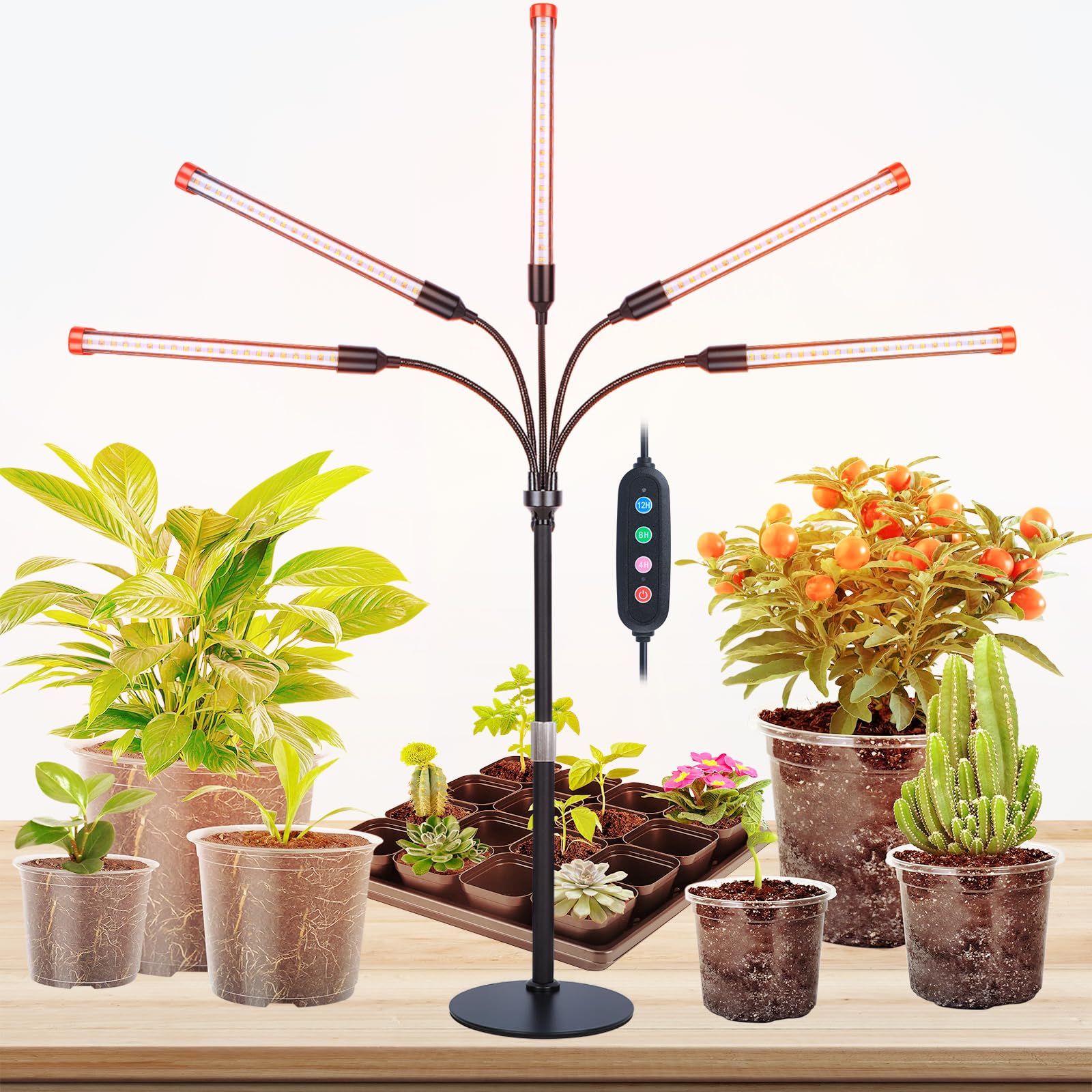
A desktop-friendly 45W light with a built-in timer that runs on auto-pilot for days.
If you are starting vegetable seeds on a kitchen counter or an office desk, this FECiDA unit is as close to plug-and-play as it gets. It draws 45 watts through 210 high-quality LEDs and puts out 5000 lumens of light. The key detail here is the timer: you can set it for 4, 8, 12, 16, or 20 hours daily, and it will automatically turn on and off at the same time every day. No extra outlet timers needed. To get 16 hours, you push the 4-hour and 12-hour buttons together, and for 20 hours, you push the 8-hour and 12-hour buttons together — a clever system once you learn the combo.
The five heads are mounted on adjustable goosenecks, so you can bend each one to cover a wider area than the unit’s small 13-inch by 8.7-inch base would suggest. The height also adjusts from 16 inches to 24 inches, which is plenty for seedlings that start close to the light and need room as they stretch. Note that at 45 watts, this is not a light that will drive a heavy-fruiting plant through to harvest — it is built for seed starting, bonsai, and small leafy greens. Reviewers mention that the base is stable enough to sit freestanding on a table top, and the full-spectrum light looks natural white, not purple or pink, so it blends into a home environment.
For the first-time seed starter: The built-in timer removes the biggest failure point — forgetting to turn the light off. At 45 watts with a 5000-lumen output, it gives seedlings the intensity they need for those first four weeks of growth.
The honest limit: This unit tops out at 45 watts. If you plan to grow a pepper or tomato plant all the way through flowering and fruit set, you will need a higher-wattage panel.
Best for: The beginner or the hobbyist who wants a tidy, self-timed desk light that gets seeds off to a strong start without any wiring or extra equipment.
Not right for: The grower who wants a single fixture to carry a plant from seed to fruit — wattage and coverage are too small.
6. Barrina CX83 5-Tier Shelf with Plant Stand 40W
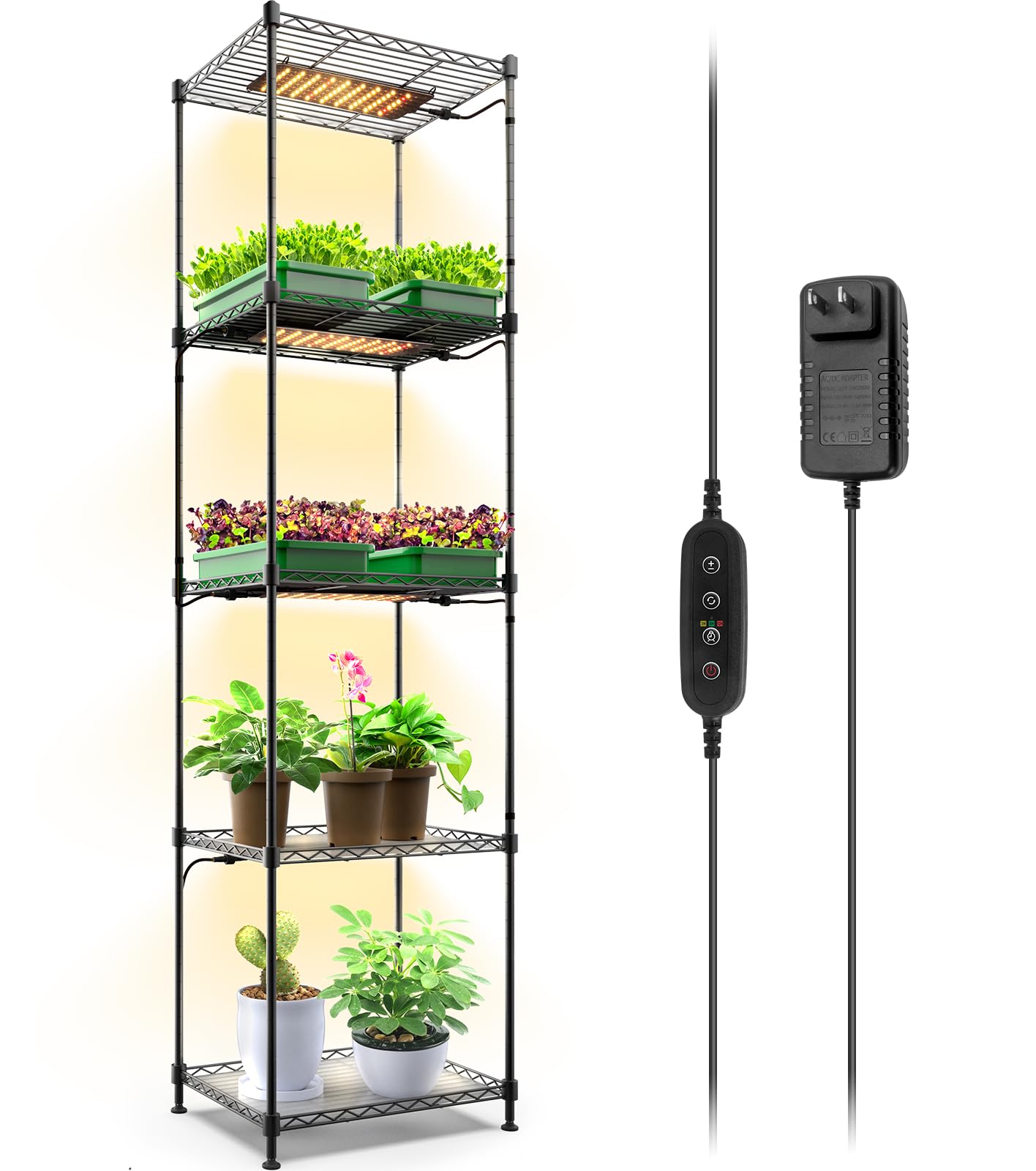
A 5-tier shelf with four ultra-thin light panels that turn a corner into a vegetable nursery.
This is the all-in-one solution for the gardener who has limited floor space but wants a lot of plants. The CX83 combines a 59.1-inch-tall metal shelf with four 10-watt light panels (40 watts total, 504 LEDs). Each panel sits above a shelf tier, so you can grow seedlings on the top, leafy greens in the middle, and succulents or flowers on the bottom — all with their own light. The unit stands 15.7 inches deep and 11.8 inches wide, which fits nicely into a corner of a living room or a home office.
You get serious control over the light. There are 3 spectrum modes (different color blends for veg, flower, or mixed), 8 dimmable levels ranging from 12.5% up to 100%, and 3 timer settings (3, 6, or 12 hours). That means you can give your seedlings 6 hours of blue-heavy veg light at 75% brightness and then switch the flowering plants to a red-heavy spectrum at 100%. The panels are linkable (they connect via cords), and each shelf layer comes with a PP (polypropylene) waterproof pad that protects the light panel below if you water a plant above. Owners mention that the shelf assembly is tool-free and takes about 20 minutes. The limitation is that each shelf tier only gets 10 watts — fine for seedlings, but too weak for heavy fruiting plants. The shelf is also narrow at 11.8 inches deep, so large pots may overhang the edge.
What stands out
- Complete all-in-one system — shelf and lights together
- 8-level dimming and 3 spectrum modes give fine control
- PP waterproof pads on each shelf protect the electronics below
What to note
- Only 10 watts per shelf tier — good for seedlings, low for heavy fruiting
- The shelf is narrow (11.8″ deep); large pots may overhang the edge
The bottom line: This is a space-efficient display shelf for the home gardener who wants to grow a variety of vegetable seedlings and herbs in one neat unit. skip it if you need to light a single large 2×4-foot tent — these small panels are spread across 5 shelves, not concentrated on one canopy.
7. Barrina BU2000 Panel 200W

A 200W adjustable panel with 816 LEDs that delivers 1600 PPFD in the center for heavy yields.
When you are serious about growing vegetables through to harvest indoors, you need a light that can push through a dense canopy. This Barrina BU2000 panel is built for exactly that job. It draws 200 watts through 816 LEDs, including blue 5000K, warm white 3000K, red 660nm, and infrared 730nm wavelengths. The 660nm red light is particularly important for triggering flowering and fruit development in plants like tomatoes and peppers. The manufacturer claims the PPFD (Photosynthetic Photon Flux Density — the amount of usable light that hits a square meter per second) reaches 1600 in the center area, which is a very high number that can produce dense, heavy buds and fruit.
The panel itself is adjustable. You can tilt the two halves of the light to become a spotlight (narrow beam) or a floodlight (wide beam). When you set the angle between the two panels at 60 degrees, the manufacturer says the efficiency in the central area increases by more than 25%. This means you can concentrate light on a single large plant or spread it over a wider 4×4-foot footprint. The brightness is controlled with a dimming knob — no noisy fans here, just silent operation. At just 2 pounds, it is surprisingly light compared to the VIPARSPECTRA XS1500 Pro (2.55 kilograms) and the MARS HYDRO TSL2000 (3.56 kilograms). Buyers on Amazon note that the included hanging chains and hooks make it easy to install, and the single power cord keeps the setup clean. One thing to note: there is no built-in timer, so you will need an external plug timer for day-night cycling. Also, the 60-degree beam angle is narrow, meaning you must hang it at the right height to cover a 4×4 area.
Strengths
- Adjustable panel angle (spotlight or floodlight) directs light where it is needed
- 816 LEDs with 660nm red and 730nm IR support full fruiting
- Center PPFD of 1600 rivals much higher-wattage commercial lights
Weaknesses
- No built-in timer — you will need an external plug timer for day-night cycling
- The 60-degree beam angle is narrow; you must hang it at the right height to cover a 4×4 area
Grab this if: You have a 4×4-foot grow tent and want a single 200W panel that can carry tomatoes and peppers from flower to heavy fruit set with commercial-level light intensity.
Pass if: You just need a simple desk light for a few seed trays — this is a powerful tool built for yield, not casual seedlings.
Understanding the Specs
Wattage (Actual Power Draw)
This is the number that tells you how much electricity the light pulls from the wall and, in general terms, how intense the light will be. Ignore “equivalent wattage” numbers like “1000W equivalent” because those are marketing estimates that compare an LED to an old incandescent or HPS bulb. Look for the “actual power draw” in watts (e.g., 45W, 150W, 300W). A 150W draw is roughly enough for a 2×2-foot flowering space, while 300W handles a 4×2-foot flowering tent.
Color Temperature (Kelvin)
Measured in Kelvin (K), this tells you whether the light looks warm (yellowish, around 3000K) or cool (bluish-white, around 5000K). For vegetable seedlings and leafy greens, a 5000K “daylight” light is best because it mimics spring sun and keeps plants compact. For the flowering and fruiting stage, a warmer 3000K to 3500K light (which contains more red wavelengths) can boost yields. Many full-spectrum lights blend both with added red (660nm) and infrared (730nm) diodes.
PPFD (Photosynthetic Photon Flux Density)
This is the most useful number for serious growers. It measures how many photons of usable light land on a given spot every second, reported in micromoles per square meter per second (µmol/m²/s). A PPFD of 200-300 is enough for seedlings, 400-500 for vegetative growth, and 600-900 or more for flowering and fruiting. High-end panels like the Barrina BU2000 claim a center PPFD of 1600, which is powerful enough to produce dense fruit, but you must hang the light at the correct height to avoid light-burning the leaves.
Coverage Area (Footprint)
This spec tells you how many square feet the light can effectively illuminate at a given hanging height. A 150W light might cover a 2×2-foot flowering area or a 3×3-foot veg area. A 300W light can cover a 4×2-foot flowering area or a 3×5-foot veg area. If you place a light that is too weak for the area, the plants in the corners will stretch and become lanky. Always match the coverage spec to the size of your grow tent or shelf rather than guessing.
FAQ
How close should I hang my grow light to my vegetable seedlings?
Can I use a regular LED light bulb to grow vegetables indoors?
What does full spectrum mean for a vegetable grow light?
How many hours a day should my vegetable grow light be on?
Is a grow light with a fan better than a fanless one?
Can I daisy chain multiple grow lights together?
How do I know if my grow light is strong enough for vegetables?
Can I leave my vegetable grow light on 24 hours a day?
Will a 45W grow light work for fruiting vegetables like tomatoes?
What is the difference between a grow light panel and a grow light bar?
Final Thoughts: The Verdict
For most vegetable growers, the best vegetable grow lights winner is the VIPARSPECTRA XS1500 Pro because it packs 150 watts of dimmable, full-spectrum light into a compact frame that covers a 2×2-foot tent from seed to harvest at a mid-range cost. If you need a larger-scale solution for a 4×2-foot tent, grab the MARS HYDRO TSL2000 for its powerful 300W output and da