
Specs are compiled from manufacturer listings and verified buyer reviews and can change over time — please confirm the key details on the product page before buying.
Spreading mulch across flower beds or a whole yard is one of those jobs that looks simple until you are hunched over with a sore back, fighting a flimsy rake that clogs or flips every few feet. The right tool changes that entirely — it moves the material smoothly, saves you time, and keeps you standing upright so you can finish the whole project in one go without the next-day regret. This guide breaks down the six best options for spreading mulch so you can pick the one that matches your yard size, your body, and your budget.
I’m Rikta — the founder and writer behind Lawn Gear Lab. This guide is built by comparing the manufacturers’ published specifications and the patterns across verified customer reviews, so you get each pick’s real strengths and trade-offs instead of marketing spin.
if you need a wide leveling rake for covering large beds fast or a sturdy fork for turning and aerating piles, the right tool for spreading mulch keeps the work efficient and your back happy, and this guide lines up the best performers in each category.
Our Picks at a Glance


How To Choose The Best Tool For Spreading Mulch
Spreading mulch is a physical job, so the tool you pick has a direct impact on how fast you finish and how your body feels afterward. The three most important factors to weigh are the design of the head (is it a leveling plate, a bow rake, or a fork?), the total weight you will be maneuvering, and the handle length that keeps you standing instead of bending. Each factor changes the feel of the job in a specific way.
Rake Head Design: Leveling Plate vs. Bow Rake vs. Fork
A leveling rake, with a wide flat stainless steel plate (like a 30×10 inch model), is built for dragging and smoothing heavy loads of mulch, soil, or sand across large areas in a single pass. A bow rake uses curved metal tines (often 14 or 16 tines) that dig into the material, making it great for breaking up clumps of mulch or spreading gravel, but it takes more passes to get an even finish. A pitch fork or mulch fork with long tines (typically 5 tines) is best for lifting and turning deep piles of mulch, but it is not designed for spreading a thin, even layer over a wide bed. For pure spreading, a leveling rake generally gets the job done faster because it treats the whole width at once.
Weight Matters for Stability and Fatigue
The weight of the tool is a trade-off. A heavier rake head (around 8 to 12 pounds) hugs the ground naturally, preventing it from flipping over when you push into a pile of wet mulch, which is a common frustration with lighter models. That same weight, however, adds to your fatigue during a long afternoon. Lighter tools (around 3 to 4 pounds) are easier to lift and maneuver, but they may require extra downward force or added weight — some users report placing bricks on top — to keep them from skipping across the surface. Your choice depends on whether you prioritize stability or maneuverability for the particular load you are moving.
Handle Length Protects Your Back
Handle length is the single biggest factor in how your back feels the next day. A handle between 58 and 72 inches allows you to stand mostly upright while pushing and pulling, shifting the load to your legs and core. Shorter handles force you to hunch over, which puts strain on your lower back during repetitive motions. Look for an adjustable handle if multiple people in the household will use the tool, or if you want the flexibility to switch between a wide-open lawn and tighter garden beds where a long handle feels clumsy.
Quick Comparison
| Model | Best For | Head Width | Handle Length | Weight | Amazon |
|---|---|---|---|---|---|
| Dremmt Lawn Leveling Rake★ Best Overall | Large area spreading, pro results | 30 inches | 72 inches | 10.2 lbs | Amazon |
| Bully Tools 14-Tine Level Head RakePremium Pick | Leveling & gravel spreading | 16 inches | 60 inches | 3.35 lbs | Amazon |
| Bully Tools Bow Rake | Breaking clumps, commercial jobs | 16 inches | 58 inches | 3.45 lbs | Amazon |
| EUIJOIP Heavy Duty Leveling Rake | Mid-size yards, easy storage | 27 inches | 70 inches | 12.5 lbs | Amazon |
| Forcolid Pitch Fork | Lifting and turning mulch piles | 8.5 inches | 57 inches | 4.09 lbs | Amazon |
| cogardenshower Leveling Rake | Small DIY projects, budget buy | 17 inches | 28–60 inches | 8.5 lbs | Amazon |
In‑Depth Reviews
1. Dremmt Professional-Grade Lawn Leveler
Our pick — over 4.5★ from 950+ verified ratings; the strongest balance of quality and price.
The wide 30-inch plate that covers ground fast while saving your back on long spreading sessions.
The Dremmt is the tool you reach for when you want to smooth a whole bed of mulch or topsoil in as few passes as possible. Its 30-inch wide stainless steel head is nearly double the width of a standard bow rake, and the 72-inch handle lets you stand fully upright while you work — no bending, no hunching. The 2mm thick steel plate gives it a “dead weight” stability that stops it from flipping over when you hit a lump of compacted material, which is a common headache with lighter rakes.
At 10.2 pounds, it is noticeably heavier than the Bully Tools bow rake (3.45 pounds), but users report that the weight is what makes it effective — buyers report it “works great and the build quality is also remarkable.” A reviewer specifically noted “this leveling rake works great and the build quality is also remarkable,” and another mentioned the weight “naturally presses down high spots.” The trade-off is that the extra heft can be tiring for smaller users or very long sessions, but the 72-inch leverage helps offset that by distributing the pull across your legs and core rather than your lower back.
If you are prepping a large lawn for sod or spreading mulch across multiple beds, this is the one that gets the job done in half the trips. It comes with assembly tools and gloves, and buyers consistently rate it 4.7 out of 5 stars across nearly 1,000 reviews.
Why It Wins
- 30-inch wide head covers ground efficiently, saving time on large areas
- 72-inch handle keeps you standing upright, reducing back strain
- Stable, anti-flip plate design works well on uneven terrain
The Trade-offs
- At 10.2 pounds, it is heavier than most bow rakes
- Wide head can feel clumsy in narrow garden beds or tight corners
Best for the job: Homeowners and landscapers tackling medium to large lawns or flower beds who want professional-grade smoothness in fewer passes.
Hold up, though: If you have a small yard with tight spaces, the 30-inch width might be more than you need — a 17-inch leveler could work better.
2. Bully Tools 14-Tine Level Head Rake
The 100% USA-made level rake that shifts mulch, gravel, and soil without getting bent out of shape.
The Bully Tools level head rake is a 14-tine commercial-grade tool that trades the wide plate of the Dremmt for a 16-inch steel head with wide tine spacing — a design that lets material pass through without clogging. It is lighter at 3.35 pounds, so you can lift and maneuver it all day without tiring, yet it still has the bite to break up compacted soil and the even edge to smooth out a layer of mulch. The 60-inch fiberglass handle is a bit shorter than the Dremmt’s 72-inch, but it still keeps your posture upright enough for comfortable use.
The standout feature here is the build quality. This rake is made in the USA with a limited lifetime warranty, and buyers frequently call it “the best quality rake I have ever owned.” One reviewer who used it to remove several tons of crushed stone across an entire summer said the rake “never bent, never broke.” It is less effective for spreading over very large flat areas than a 30-inch leveling plate because you have to make more passes, but its versatility across different materials — mulch, gravel, thatch, dirt — makes it a stronger all-around workhorse.
Compared to the Dremmt’s 4.65 kilograms (10.2 pounds), the Bully level head is 7.2 pounds lighter, which is a big difference if you are switching between spreading and raking debris in one session. On the other hand, the shorter handle means you will bend a bit more.
Strengths
- 14-tine alloy steel head with wide spacing prevents clogging with wet mulch
- Lightweight 3.35-pound build is easy to handle for hours
- Limited lifetime warranty and American manufacturing
Limitations
- 16-inch head means more passes on large beds compared to a 30-inch leveling plate
- Some users prefer a longer 70-inch+ handle for full upright posture
Reach for this if: You need a rugged, do-everything rake that handles mulch, gravel, and thatch without breaking.
Look elsewhere if: Your main job is spreading over very large flat surfaces — a 30-inch leveler will be faster.
3. Bully Tools 16″ Bow Rake
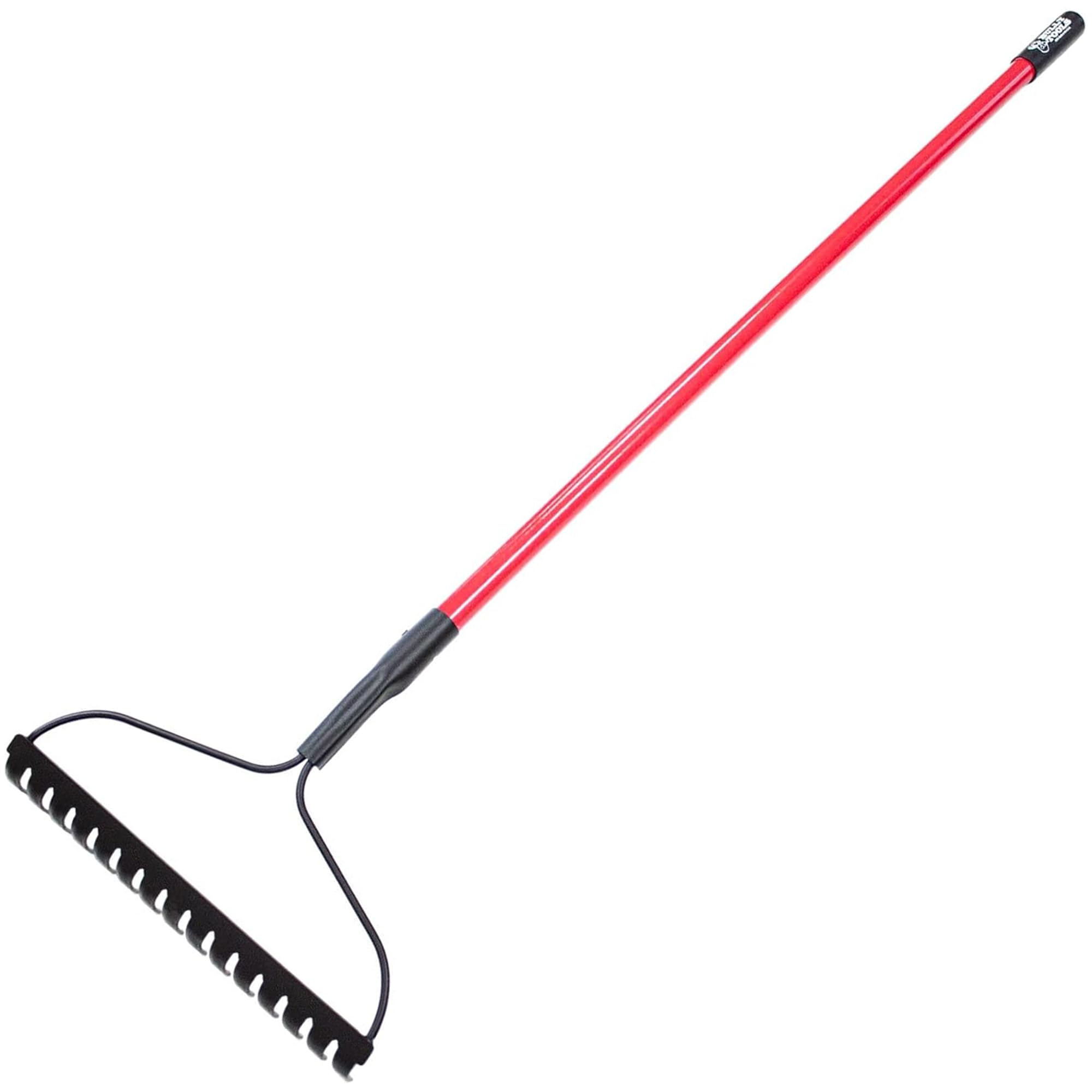
The award-winning bow rake with 16 thick tines that dig into tough soil and spread heavy mulch on command.
Selected as the Best Bow Rake by Business Insider, the Bully Tools bow rake uses a 10-gauge American steel head that is up to 30% more durable than imported competitors, according to the manufacturer. Its 16 tines are ribbed and reinforced for extra digging power, so when you need to break up a clump of hardened mulch or level out a rocky patch of soil, this rake bites in and gets it done. The 58-inch fiberglass handle and rubber grip reduce hand fatigue, and at 3.45 pounds, it is easy to control.
Buyers praise its durability — one reviewer who replaced two wood-handled rakes called the fiberglass handle and American manufacturing the key selling points, noting the fiberglass “won’t splinter.” However, because it is a bow rake (curved tines) rather than a leveling rake (flat plate), it does not smooth material as evenly in a single pass. For spreading mulch, you will use the back of the tines to push material before finishing with the tines forward to break clumps. It is also a narrower 16-inch head, so covering a 50-foot bed takes more trips than the Dremmt’s 30-inch plate.
The Dremmt leveler excels at smoothing, the Bully level head rake excels at versatility, and the Bully bow rake excels at raw breaking power. Pick this one if your mulch is often compacted or mixed with small rocks.
What Makes It Great
- 10-gauge steel head with ribbed tines for superior digging and breaking power
- Fiberglass handle resists weather and splintering
- Lightweight at 3.45 pounds for easy control
Keep in Mind
- Curved tine design requires more effort for a smooth, even spread compared to a leveling plate
- 58-inch handle is shorter than competitors; may be uncomfortable for taller users
Perfect for: Breaking up rough, compacted mulch piles and spreading material on a construction site or gravel driveway.
Not ideal for: Achieving a perfectly smooth, carpet-like finish on a flower bed — a leveling rake does that better.
4. EUIJOIP Heavy Duty Leveling Rake
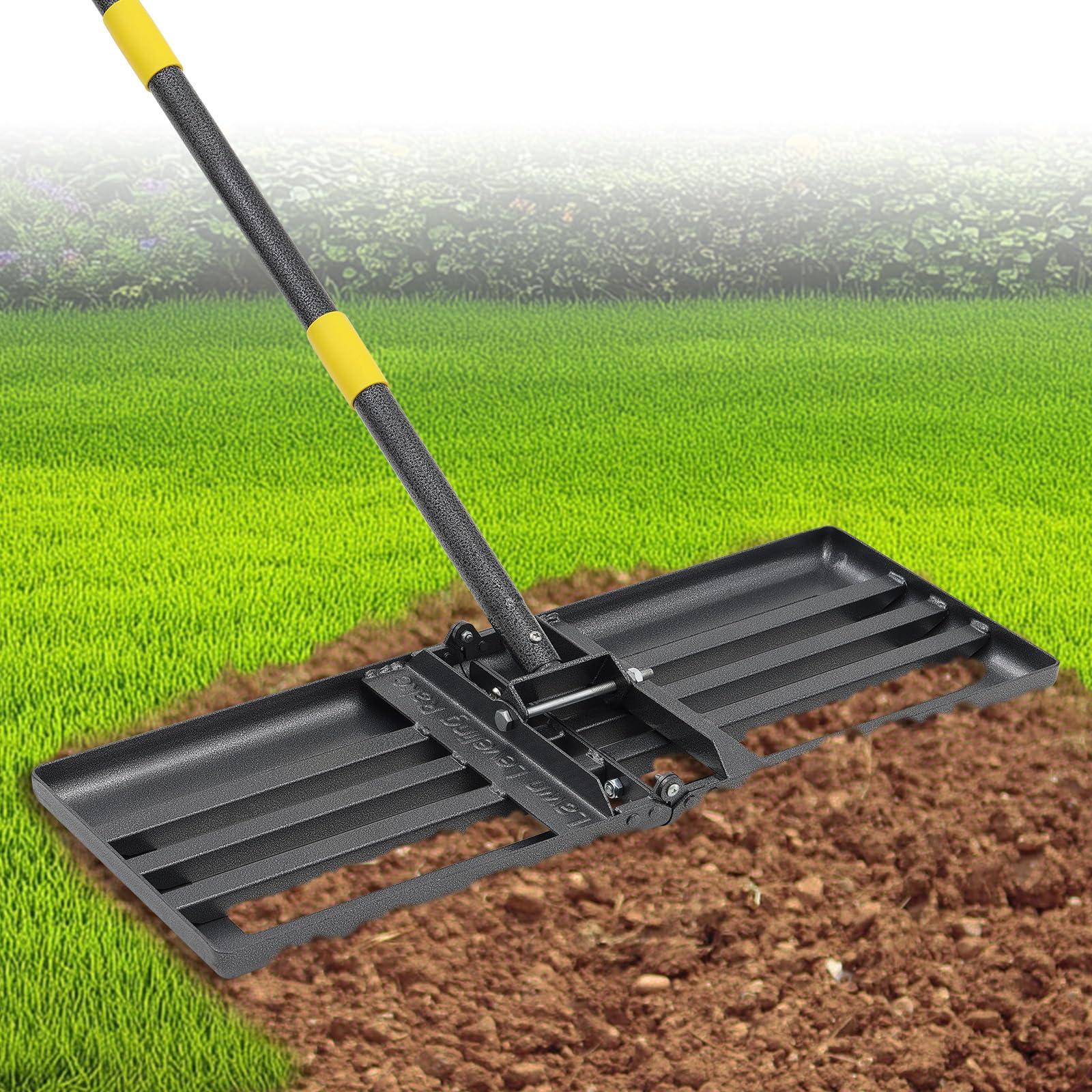
The 27-inch leveling rake that folds flat for garage storage and still spreads mulch with commercial heft.
The EUIJOIP leveling rake splits the difference between the Dremmt and the budget pick: a 27-inch wide head (smaller than the Dremmt’s 30 inches but much bigger than the bulb tools’ 16-inch) paired with a 70-inch adjustable handle. Its defining trick is a patented folding design — the head folds down to 10 inches wide, making it easy to hang on a wall or stash in a carport. At 12.5 pounds, it is the heaviest tool in this lineup, which gives it outstanding ground-hugging stability but also makes it the most fatiguing to lift and maneuver for small users.
Owners mention that the 30×10 inch size is “perfect for spreading soil” with a solid, heavy-duty build. One reviewer noted that the 80-inch handle “provides great leverage” and that it “efficiently spreads topdressing for a smooth finish.” However, some users mention it works better with added weight (like bricks on top) for heavier spreading tasks, and the folding hinge could be a potential wear point over many years. The 999-day return window from EUIJOIP provides good confidence.
If garage or shed space is tight and you spread mulch across a medium-sized yard, this folding design saves you the hassle of leaning the rake against a wall where it could fall. Just be prepared for the 12.5-pound heft.
The Highlights
- 27-inch wide head covers ground faster than a 16-inch rake
- Patented folding design shrinks to 10 inches for easy storage
- 70-inch adjustable handle fits users from 5’2″ to 6’5″
The Drawbacks
- At 12.5 pounds, it is the heaviest of the six options, tiring for extended use
- Folding mechanism may not withstand decades of hard use
Grab this for: A medium-sized yard where you need good coverage and the ability to stow the rake flat without wall hooks.
skip it if: You have a large yard and need to spread for hours — the extra weight will wear you down faster than the Dremmt.
5. Forcolid 57-Inch Pitch Fork
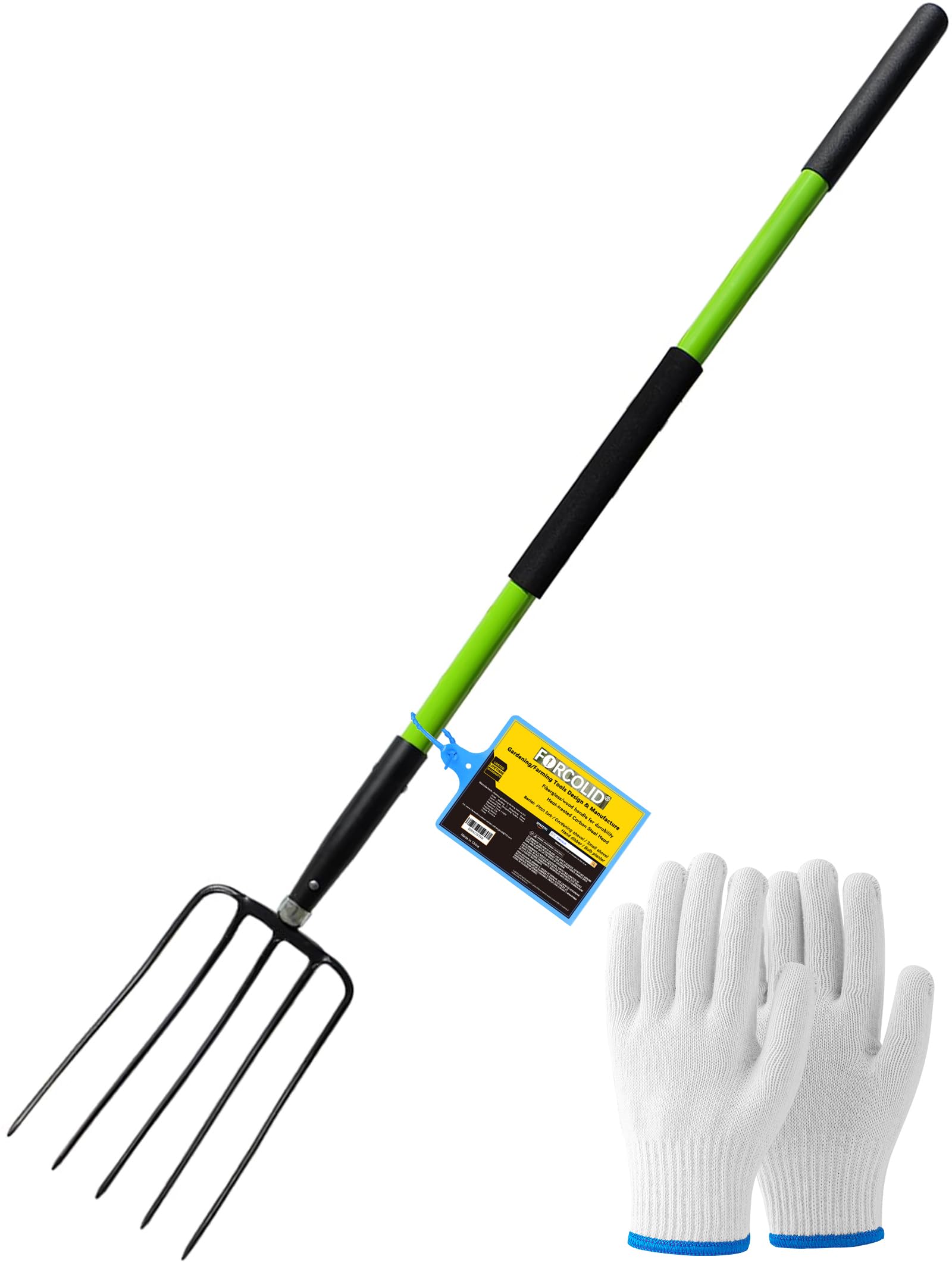
The five-tine pitch fork that lifts and fluffs heavy piles of mulch with a cushioned grip to protect your hands.
This pitch fork from Forcolid serves a completely different purpose than the leveling rakes above. Instead of dragging and smoothing material across the ground, it is built for lifting and turning — essential if you have a large pile of bagged or bulk mulch that needs to be moved into a wheelbarrow or fluffed up before spreading. The five steel tines are treated with an anti-rust coating to hold up in damp conditions, and the 57-inch fiberglass handle gives you good leverage. The NBR rubber sponge grip is designed to reduce vibration and protect your wrist, which is helpful when you are repeatedly plunging the fork into a dense pile.
Buyers describe it as “very good quality” and note it works well for prying up stubborn roots and rocks, calling it “well made and sturdy.” It is noticeably lighter than any leveling rake at 4.09 pounds (compared to the Dremmt’s 10.2-pound build), making it easy to swing and control. The trade-off is that it is useless for spreading — you cannot smooth a layer of mulch with five tines the way you can with a flat plate. The handle length of 57 inches is also about 26% shorter than the Dremmt’s 72-inch handle, meaning less upright posture and more back bending.
If your mulch comes in bags and you just need to break them open, lift, and turn the material before a partner spreads it with a leveling rake, this fork is a solid budget-friendly addition to the team.
Why It Fits
- 5-tine steel head with anti-rust coating is great for lifting and aerating piles
- Cushioned grip reduces hand fatigue during heavy lifting
- Lightweight at 4.09 pounds for easy control
Shortfalls
- Not designed for spreading — the tines leave grooves and uneven coverage
- 57-inch handle is shorter than most leveling rakes, requiring more bending
Best use: As a companion tool for lifting, turning, and moving bulky mulch piles before a leveling rake does the final smoothing.
Not the tool for: Anyone hoping to spread a thin, even layer of mulch directly — stick to a leveling rake for that task.
6. cogardenshower 17×10 Leveling Rake
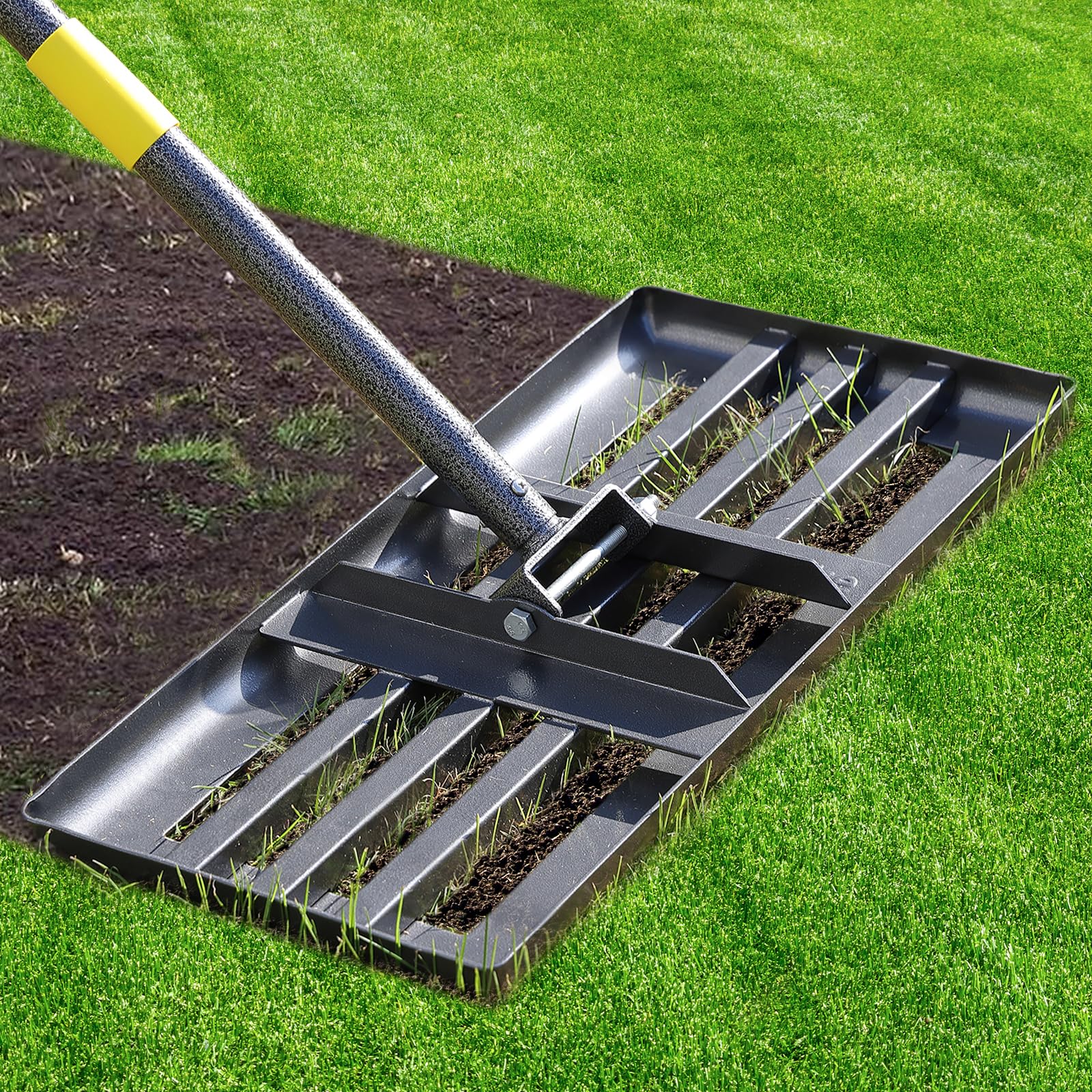
The compact 17-inch leveler that handles small beds and light spreading without eating up your budget.
The cogardenshower leveling rake is the smallest and most affordable of the leveling rakes here, with a 17×10 inch stainless steel head. That compact size makes it a perfect match for small flower beds, narrow garden paths, or anyone who just needs to touch up a few patches rather than cover an entire yard. At 8.5 pounds, it is middleweight: heavier than the Bully tools but lighter than the EUIJOIP.
Customers note it is “great for small DIY yard projects like leveling ground for pavers” and praise its heavy-duty feel for the price. However, one buyer mentioned it fails on wet dirt or sand because “material clumps in slits,” so wet mulch may cause similar clogging issues. The curved bottom design helps prevent jamming on uneven ground. Compared to the Dremmt’s 30-inch head, the 17-inch head means twice as many passes to cover the same area, so factor in your time if you are working on a larger space.
This is a solid entry-level buy if you are not sure how much you will use a leveling rake. The adjustable handle and compact storage make it low-commitment, but the small head and shorter handle mean it is not the tool for a big weekend project.
Why It Appeals
- 17-inch head is nimble for tight beds and garden paths
- Adjustable handle (28 to 60 inches) accommodates different user heights
- Budget-friendly price without sacrificing stainless steel construction
The Catch
- Small head requires many more passes on a medium or large lawn
- Wet mulch can clump and stick in the slits of the head
Best for: First-time buyers or anyone with a small garden who needs a capable leveler without spending much.
Look elsewhere if: You have more than a few hundred square feet to cover — the 17-inch width will cost you significant time.
Understanding the Specs
Head Width
The width of the leveling plate or the set of tines determines how much material you move per pass. A 30-inch wide head, like the Dremmt uses, covers roughly two feet of ground in a single drag, making it efficient for large areas. A 16-inch head (Bully Tools level rake) is more precise for small beds but takes nearly twice as many passes to finish the same spot. Wider is faster for open lawns; narrower is easier in tight spaces.
Handle Length & Leverage
A long handle (70 to 72 inches) keeps your back straight by letting you hold the tool at waist height while the head drags on the ground. Shorter handles (58 to 60 inches) require you to lean forward, which transfers strain to your lower back over time. Adjustable handles, like the cogardenshower’s 28-to-60-inch range, are helpful if the tool will be used by people of different heights, but they often have a slightly looser feel than a fixed-length handle.
FAQ
Can I use a bow rake for spreading mulch?
What is the ideal handle length for spreading mulch?
How much does a good mulch-spreading tool weigh?
Is a pitch fork or a rake better for mulch?
Can a leveling rake handle wet or heavy mulch?
How do I store a long-handled leveling rake?
What size head is best for spreading mulch in flower beds?
Are expensive mulch-spreading tools worth it?
Do I need to assemble a leveling rake?
Can I use a leveling rake on gravel or crushed stone?
Final Thoughts: The Verdict
For most buyers, the best tool for spreading mulch is the Dremmt Lawn Leveling Rake because its 30-inch head and 72-inch handle deliver pro-grade smoothness with less bending and fewer passes. If you need a lighter, more versatile tool that also handles gravel and thatch, grab the Bully Tools 14-Tine Level Head Rake. And for lifting and turning heavy piles before spreading, the standout is the Forcolid 57-Inch Pitch Fork as a budget-friendly companion.
How We Picked
We do not accept paid placement. Every pick is matched to a real buyer and a real use-case; we do not hands-on test units.
Sources & Methodology
Specifications: manufacturer listings and product documentation. Review insights: verified customer reviews, as of July 2026. Pricing: not shown on this page (it changes often); check the current price via the retailer link.
As an Amazon Associate, Lawn Gear Lab earns from qualifying purchases. This does not affect which products we feature.