
Specs are compiled from manufacturer listings and verified buyer reviews and can change over time — please confirm the key details on the product page before buying.
If you have a riding mower and a patchy lawn, you already know the problem: dead grass (thatch) builds up underneath, blocking water and air from reaching the roots. A pull-behind rake attaches to your tractor or ATV, rips out that layer, and does the job in a fraction of the time a walk-behind rake would take — but choosing the wrong one leaves you wrestling with flimsy hardware or a tool that cannot dig deep enough.
I’m Rikta — the founder and writer behind Lawn Gear Lab. This guide is built by comparing the manufacturers’ published specifications and the patterns across verified customer reviews, so you get each pick’s real strengths and trade-offs instead of marketing spin.
if you need to dethatch a 10,000 square foot lawn or resurface a gravel driveway, finding the right pull behind rake for lawn mower depends on matching the design — dethatcher tines versus drag-harrow bars — to the actual surface you are working on.
Our Picks at a Glance

How To Choose The Best Pull Behind Rake For Lawn Mower
The two main types here are dethatchers (with rows of spring steel tines that flick out matted dead grass) and drag harrows (with angled steel bars that scrape and level loose material like gravel or soil). Knowing which one your yard needs is the first decision.
Working Width vs. Your Yard Size
Wider means fewer passes. A 40-inch model covers nearly double the ground of a 24-inch per lap. For a half-acre lawn, a 48-inch dethatcher can cut the job by about a quarter compared to a 40-inch — check the product data to see the inches listed.
Ballast Capacity
The tray on top of the frame lets you add weight (cinder blocks, paver stones) so the tines dig deeper. Models range from a 70 lb limit to a 150 lb limit. If your thatch is thick or compacted, you want the higher number.
Tine Material and Durability
Look for heat-treated spring steel — it bends without snapping and springs back into shape. Some cheap bolts strip under pressure, as a few customer reviews note, so a well-reviewed frame and hardware kit matter.
Transport Mode (Wheels)
If your lawn has a paved driveway or sidewalk between sections, a model with lockable transport wheels lets you lift the tines off the ground from the driver’s seat. Models without wheels work fine on open fields but can drag or scratch concrete.
Quick Comparison
| Model | Best For | Working Width | Ballast Capacity | Weight | Amazon |
|---|---|---|---|---|---|
| Brinly DT-402BH-A★ Best Overall | Aggressive dethatching on large lawns | 40 in | 70 lb | 30.8 lb | Amazon |
| BlumeTrec 40-InchDeep Ballast | Deep-ballast dethatching for compacted soil | 40 in | 100 lb | 32.7 lb | Amazon |
| Suchtale 40-Inch | Heavy thatch removal at a mid-range price | 40 in | 70 lb | 32.8 lb | Amazon |
| AugFir 48-Inch | Wide-area coverage on large properties | 48 in | 150 lb | 33.9 lb | Amazon |
| VEVOR 4 ft Drag Harrow | Leveling gravel driveways and fields | 4 ft | — | 44.5 lb | Amazon |
| 4 Ft Drag Harrow (Vlaeng) | Light lawn grading with easy storage | 47.2 in | — | 31.9 lb | Amazon |
| 6 FT Drag Harrow (Toriexon) | Wide-path grading for UTVs and tractors | 6 ft | — | — | Amazon |
In‑Depth Reviews
1. Brinly DT-402BH-A Tow Behind Dethatcher
Our pick — over 4★ from 100+ verified ratings; the strongest balance of quality and price.
This dethatcher switches from light thatch lifting to deep soil-scarifying in seconds, thanks to a built-in transport lever you can reach from the driver’s seat.
It weighs 30.8 pounds and spans a 40-inch working width, making it about 13.7 pounds lighter than the VEVOR drag harrow, yet it carries 20 individually flexing 3/16″ diameter spring steel tines. Those 20 tines (two rows of 10) comb thatch up and out. The transport lever lowers the 6″ never-flat wheels so you can cross a driveway without scraping the tines — unlike the BlumeTrec, which lacks that feature. Buyers report it covered a half-acre in 45 minutes and filled about 50 baskets of thatch.
The 70-pound ballast tray lets you stack weight for aggressive operations. One catch: a few reviewers found the control-arm linkage tricky to assemble without watching an online video first. The steel frame is made in the USA, and the tines come pre-assembled to cut setup time.
Heavy lifter: The Brinly pulls up dense thatch fast, and the transport wheels mean you do not have to disengage tines by hand every time you hit concrete.
Assembly patience: The linkage can be finicky — set aside an hour and watch the YouTube assembly video before starting.
Grab it if: You want an American-made dethatcher that handles light cleaning and deep soil-scarifying without needing a second tool.
Pass if: You only need a surface-level rake and do not want to spend time on setup.
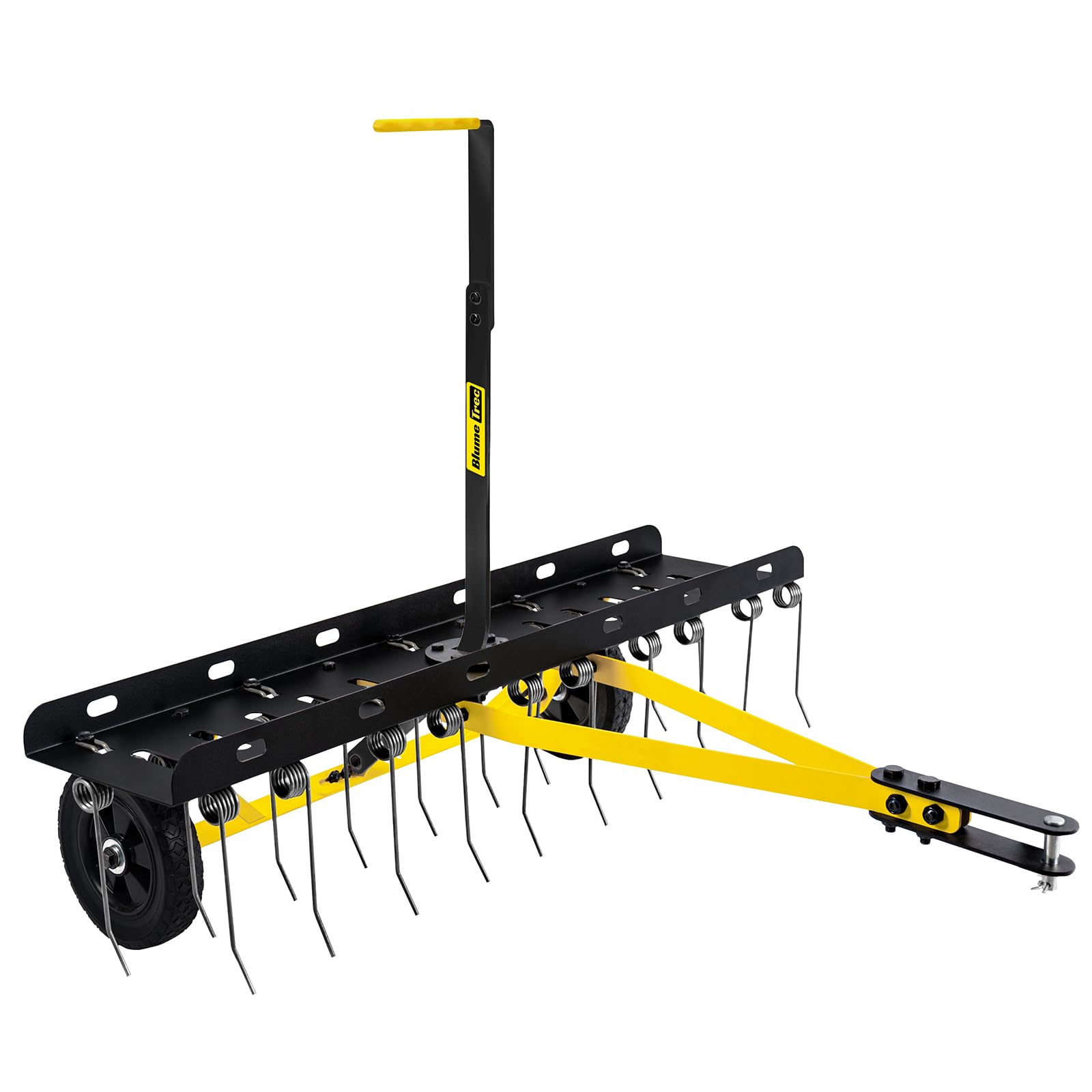
2. BlumeTrec 40-Inch Tow Behind Dethatcher
Stack two cinder blocks on the 100 lb tray and this one sinks into compacted soil that lighter dethatchers bounce over.
Where the Brinly tops out at 70 lb, the BlumeTrec’s tray holds up to 100 lb of extra weight for aggressive dethatching. That extra capacity matters when you are fighting years of matted thatch or hard-packed dirt. It uses 20 heat-treated, rust-proof spring steel tines across a 40-inch working width, and the adjustable handle lets you raise or lower the tines to protect them on hard surfaces.
The universal pin-style hitch fits riding lawn mowers, tractors, ATVs, or UTVs without extra adapters. Owners mention the instructions are “terrible” and the assembly takes time, but once together it “works great.” At 32.7 pounds, it is very close in weight to the Suchtale (32.8 lb) but offers 30 lb more ballast capacity, meaning you can dig deeper without switching machines.
Why it stands out
- The 100 lb ballast tray is the highest capacity among the 40-inch dethatchers here
- Adjustable handle keeps tines off pavement without needing transport wheels
- Weighs only 32.7 lb — easy to lift onto a trailer
Know before you buy
- Assembly instructions are extremely unclear; customers note to rely on photos and video
- No transport wheel lever — you adjust the handle manually to lift tines
Best for heavy thatch: Pair this with two cinder blocks and it chews through compacted soil that lighter dethatchers bounce over.
Not for quick setups: If you want to pull it from the start and tow in 20 minutes, this is not that tool.
3. Suchtale 40-Inch Tow Behind Dethatcher

A powder-coated frame with bolt-in tines that undercuts most big-box models while rating over 545 reviews — reviewers report it pulls up surprising amounts of dead grass even without added weight.
It packs the same 20 spring tine layout and 40-inch coverage as the Brinly, but the frame is entirely powder coated — a step up from the glossy paint that flakes off store-brand units, according to one reviewer. The tines are bolted in rather than held by spring pressure, so replacements are straightforward when they eventually wear out.
The 70 lb ballast platform is standard for the category, and the pin-style hitch clicks onto most riding mowers and ATVs without extra tools. The main trade-off reported is assembly takes over two hours because the included illustrations lack text warnings about exact part orientation.
Solid construction: The powder coat resists chipping, and the bolt-in tines mean the whole unit lasts longer than cheap painted alternatives.
Assembly frustration: Many reviewers point out the instructions are vague — a socket set and patience are required.
Reach for this if: You want a durable, well-rated dethatcher that works out of the gate once assembled, without overspending.
Look elsewhere if: You need transport wheels or hate fiddling with hardware for more than an hour.
4. AugFir 48-Inch Tow Behind Dethatcher
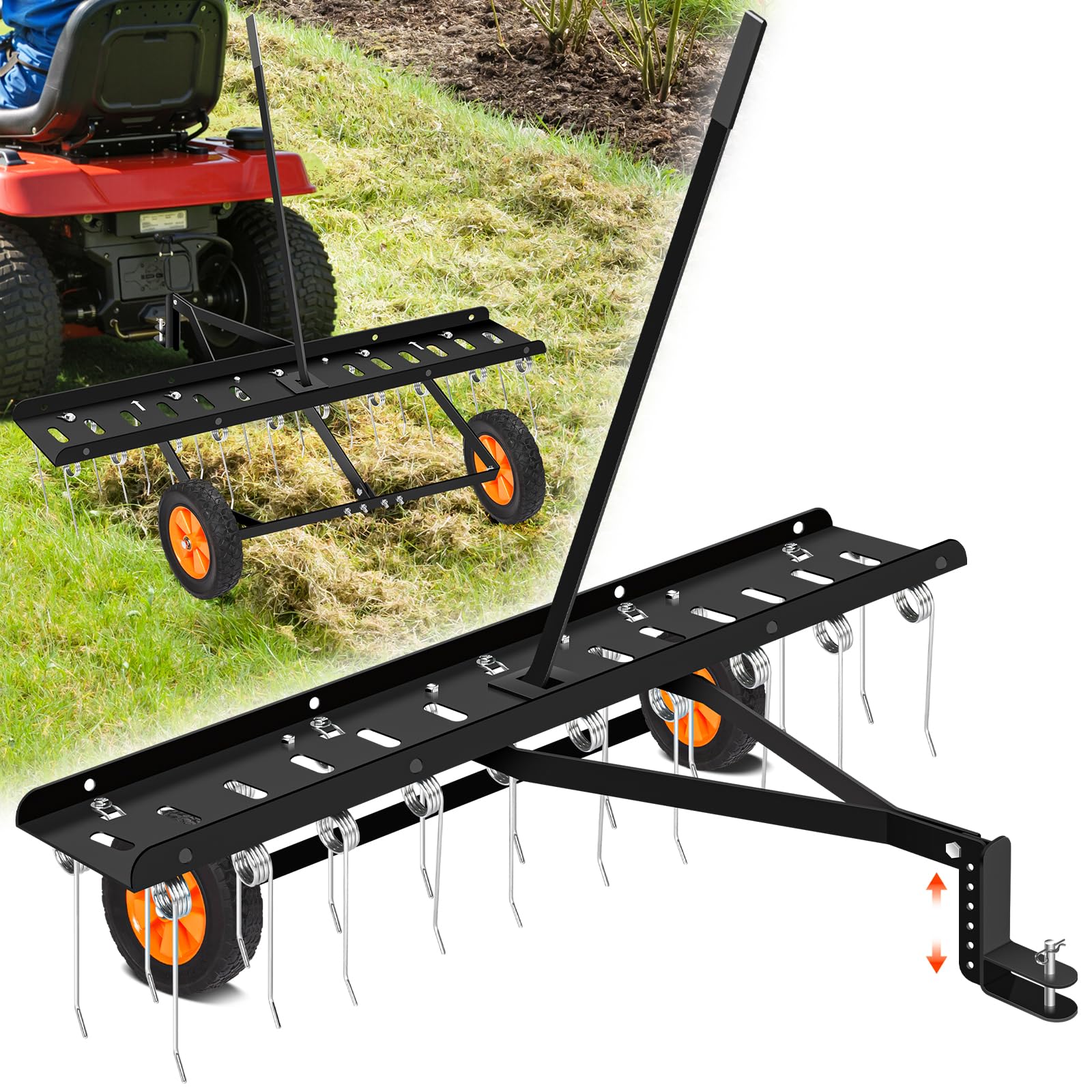
Cover 20% more ground per pass than a 40-inch dethatcher thanks to the 48-inch working width — and pack up to 150 lb of weight for deep soil penetration.
While the Brinly and Suchtale top out at 40 inches, the AugFir stretches to 48 inches, covering about 20% more ground per lap. That difference adds up fast on an acre-plus property. It also holds the highest ballast capacity of any dethatcher on this list — up to 150 lb — so you can load several cinder blocks and really drive the 20 spring steel tines into tough soil.
The adjustable hitch adapts to ATVs, UTVs, tractors, and mowers with a quick height change, and the 8-inch semi-pneumatic wheels roll smoothly over bumps. However, buyer reports flag a weak point: the bolts are “really cheap and made of really crappy metal” — reviewers strongly warn against using power tools during assembly because the bolts strip easily. At 33.9 pounds, it is similar to the others, but the combination of width and ballast capacity makes it the right pick for clearing large courtyards, golf courses, or farm fields.
Big area advantage
- 48-inch working width is the widest dethatcher in the roundup
- 150 lb ballast tray lets you add serious weight for deep penetration
- Adjustable hitch works with most vehicles without adapters
Known weakness
- Bolts are low-quality and strip easily — use hand tools only
- Control handle feels “a little flimsy” according to one reviewer
Best for acreage: If you need to cover a wide-open lawn or field quickly and have space to store a 48-inch attachment, the AugFir saves you passes.
Skip for small yards: The width is overkill on a 5,000 sq ft lot, and the bolt quality is a real headache.
5. VEVOR 4 ft Drag Harrow
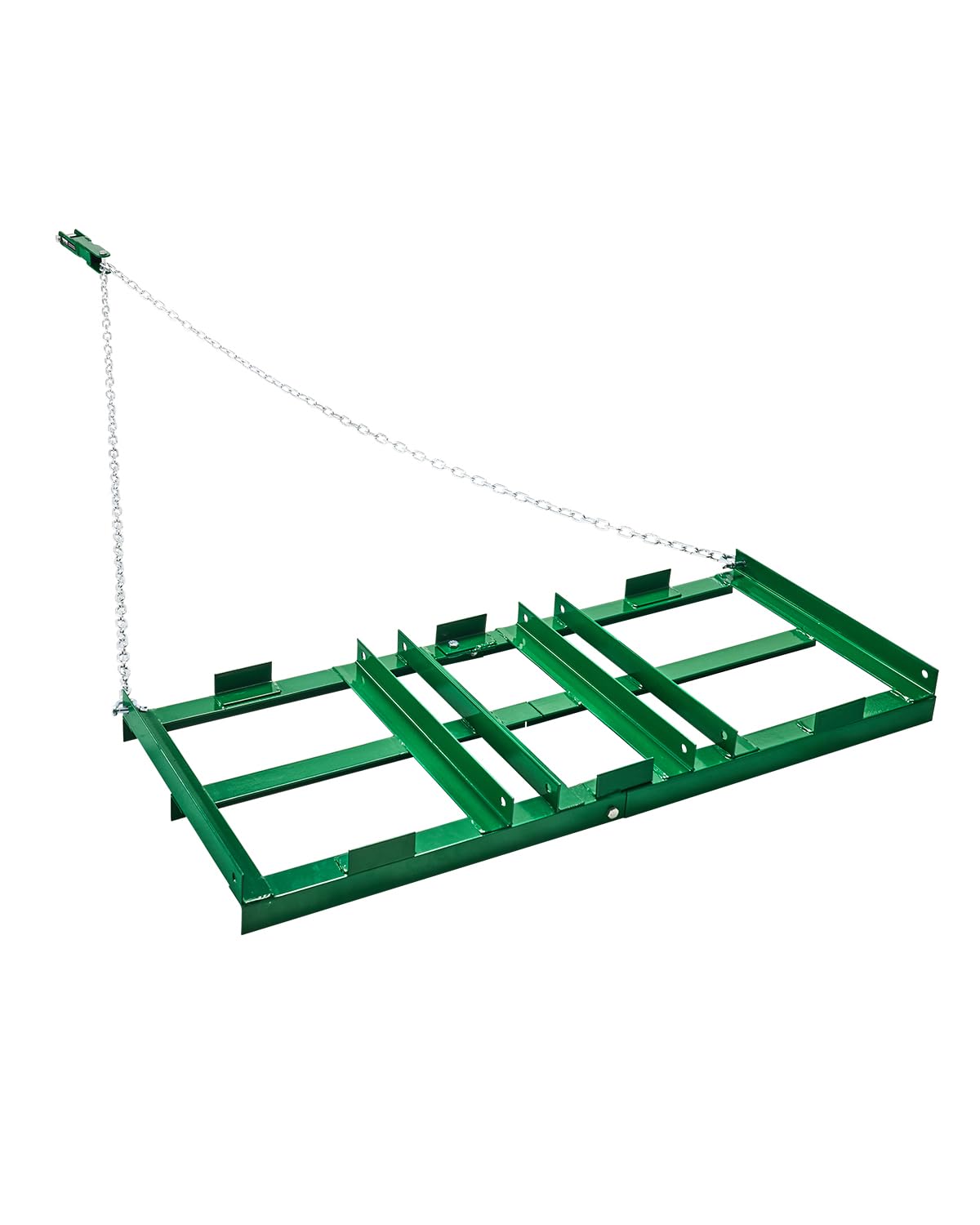
This is a drag harrow, not a dethatcher — it uses thickened angle iron bars instead of spring tines to scrape and spread gravel, sand, or soil. At 44.5 pounds, it is the heaviest non-electric rake here, and that weight comes from solid steel and a green powder coating that resists rust. The 48 x 19.7 inch frame, with adjustable crossbars, lets you pile on extra concrete blocks for deeper grading.
The 72-inch chain attaches to ATVs, UTVs, trucks, or lawn tractors. Shoppers say it works well for leveling old mulch and gravel, but one noted their “lawn mower did have some trouble pulling it in deep loose gravel” — so match it to a heavier tractor for that use. The paint finish is not showroom quality, but the steel and welds are solid for the price.
Built for drag work: The thickened angle iron and chain system handle gravel, sand, and soil with no moving parts to break.
Paint wears fast: Several buyers mention the powder coating chips off during use — the steel underneath is fine, but it will not stay pretty.
Grab it if: You are maintaining a gravel driveway or leveling a field and want a no-frills steel tool that gets the job done.
Pass if: You need a dethatcher for lawn thatch — this will not lift dead grass like tines do.
6. 4 Ft Drag Harrow (Vlaeng)
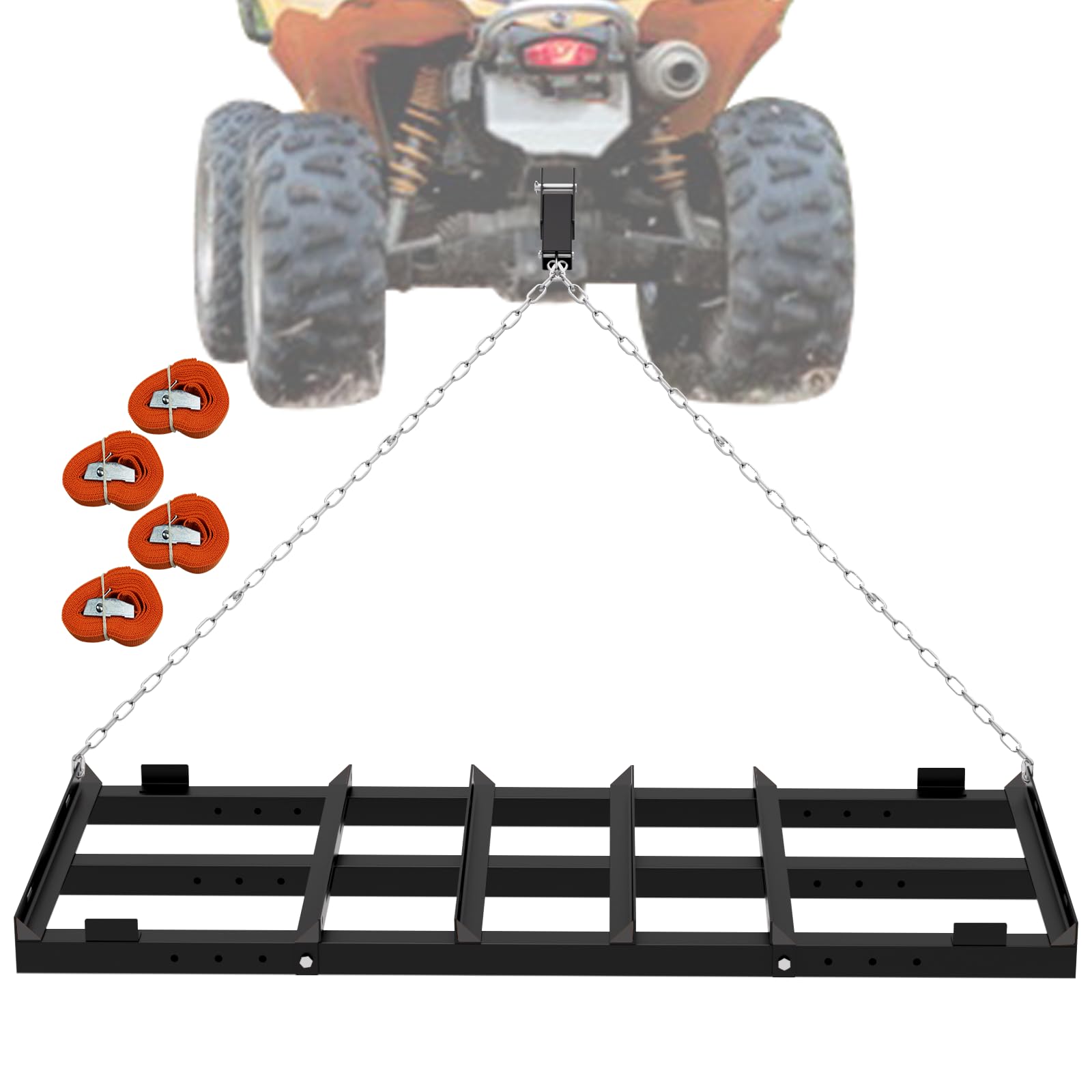
At 31.9 pounds, this 47.2-inch drag harrow is about 12.6 pounds lighter than the VEVOR — you can carry it one-handed, but deep gravel needs added weight. The carbon steel frame, with a black powder-coated finish, uses two 5 ft long heavy-duty chains that attach to most ATVs, UTVs, and mowers. The center bar adjusts width to fit different concrete block sizes, and four included safety straps keep the blocks stable during use.
Buyers report it works “great for leveling out my yard” behind a riding lawnmower and feels “sturdy enough for lawn renovation.” A couple of owners mention there is no depth control, so soft soil can build up on the bars, requiring stops to dump it. The flat bottom square tubing struggles on hard clay — one owner had to weld on an iron modification to improve raking.
What works
- Light enough to pull behind a standard riding mower without straining the engine
- Assembly takes just a few minutes — four screws and attach the chains
- Adjustable width lets you fit different block sizes for added weight
What does not
- Flat bottom bars are not effective on hard-packed clay without modification
- No depth control — material can pile up and stall progress
Ideal for loose soil: If you are spreading topsoil or dressing a sandy lawn, this is the easy-to-store tool for the job.
Avoid for heavy clay: Hard-packed dirt will just slide under the square bars unless you weld on a more aggressive edge.
7. 6 FT Drag Harrow (Toriexon)
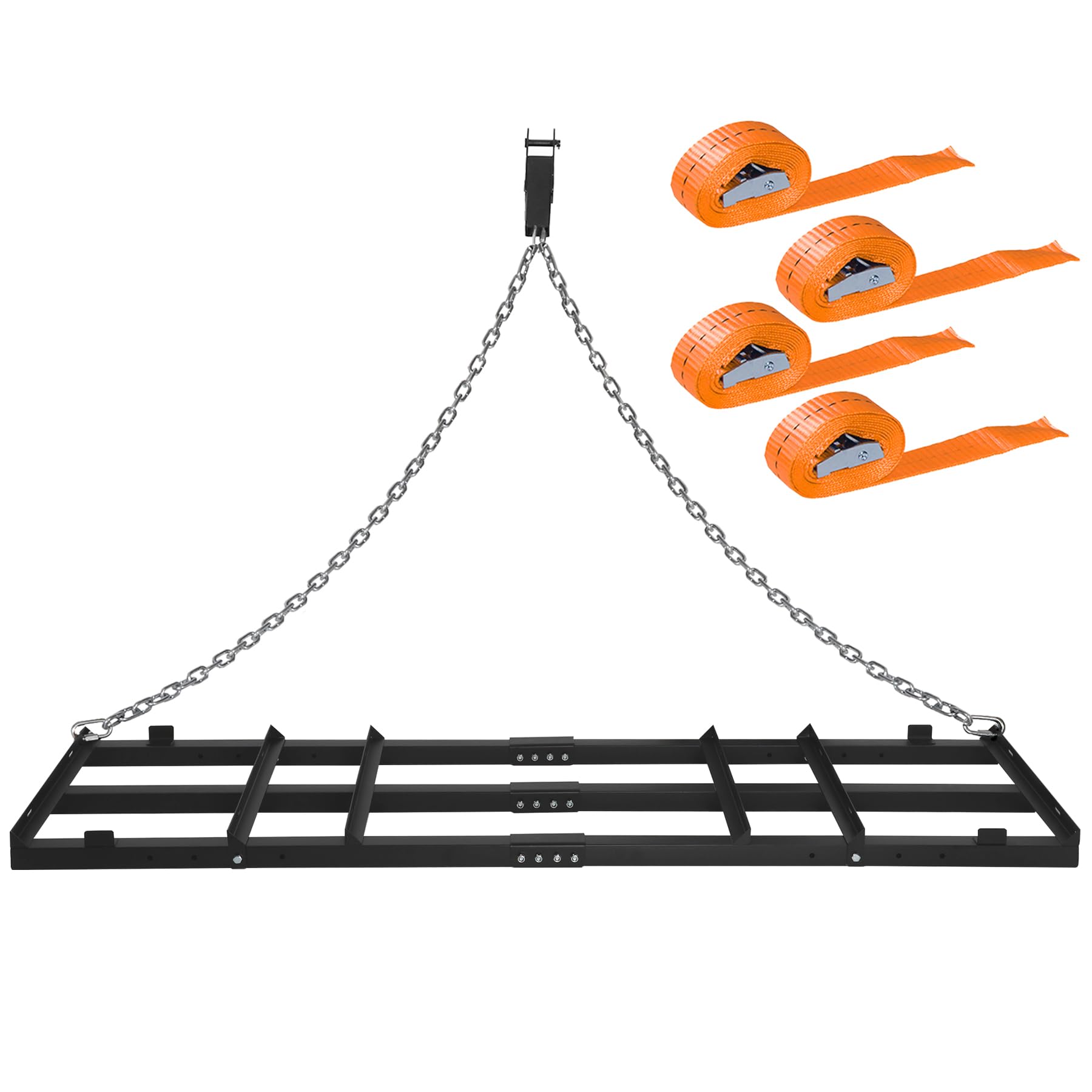
Cover 6 feet of ground per pass — roughly 50% more width than the 4-foot drag harrows — but plan to replace the chain hardware immediately.
This is the widest pull-behind rake in the group, covering 6 feet of ground at once. The heavy-duty alloy steel frame and black powder coating aim for long life, and the adjustable-width bars accommodate concrete blocks weighing up to 50 pounds for added leverage. The 5 ft chain lets you adjust traction and makes turning easier by preventing connection damage.
The major warning from buyers: chain hardware is sub-par. Multiple reviewers report that the included carabiners and C-clips bent or broke within minutes. One owner replaced them with heavy-duty M10 carabiners and had no further issues. Others note the steel itself can peel apart under stress in sand arenas. For light driveway grading behind a UTV or tractor, it works surprisingly well — but plan to upgrade the attachment hardware before the first pull.
Massive coverage: A single 6-foot pass equals two passes of a 3-foot drag harrow — huge time savings on long driveways.
Hardware is the weak link: The chain and carabiners need immediate replacement; budget extra for heavy-duty connectors.
Best for UTV owners: If you have a utility vehicle and a long gravel driveway, the 6-foot width and 50 lb block capacity make quick work of grading.
Not for mower-only users: A standard lawn tractor may struggle to pull 6 feet of steel plus ballast — you want a heavier vehicle.
Understanding the Specs
Working Width
This is the overall width of the tines or drag bars — measured in inches or feet. A wider tool covers more ground per pass, but it also puts more drag on your mower. For a typical 1-acre lawn, a 40-inch dethatcher needs about 16 passes per 100 feet, while a 48-inch model needs about 13. Match the width to your tractor’s horsepower and the size of your gates.
Ballast Tray Capacity
Most dethatchers include a flat steel tray on top of the frame where you can stack weight — typically cinder blocks, paver stones, or sandbags. Adding weight forces the spring tines deeper into the soil. The number in the spec (70 lb, 100 lb, or 150 lb) is the maximum load the tray can safely carry. Go higher if your thatch is thick or your soil is compacted.
Spring Steel Tines
Dethatchers use rows of curved, flexible metal tines that scrape through the grass. “Spring steel” means the tine returns to its original shape after bending, so it does not stay bent after hitting a rock or root. Replaceable tines extend the life of the tool — look for models where tines are bolted in rather than pressed in.
Transport Mode (Wheels)
Some dethatchers include a lever that lowers wheels to lift the tines off the ground, so you can tow the attachment across pavement or gravel without scratching. Models without wheels require you to manually tilt or lift the tool — fine for open fields but inconvenient if your lawn has a driveway through the middle.
FAQ
Can I pull a dethatcher behind any riding lawn mower?
What is the difference between a dethatcher and a drag harrow?
How much weight should I add to the ballast tray?
Will a 48-inch dethatcher fit through my garden gate?
How often should I dethatch my lawn?
Can I tow a drag harrow behind my riding mower?
Do I need to remove the cutting deck to use a pull behind rake?
How do I clean and store a pull behind rake?
What size pull behind rake do I need for a 1-acre lawn?
Are the tines replaceable on these dethatchers?
Final Thoughts: The Verdict
For most buyers, the pull behind rake for lawn mower winner is the Brinly DT-402BH-A because it combines a 40-inch working width, 70 lb ballast capacity, and built-in transport wheels in a single American-made package that tackles everything from light dethatching to deep scarifying. If you need the widest dethatcher possible and have a large property, grab the AugFir 48-Inch for its 150 lb tray and 48-inch coverage. And for maintaining gravel driveways or fields, the VEVOR 4 ft Drag Harrow is the simple, heavy steel tool that does not overcomplicate the job.
How We Picked
We do not accept paid placement. Every pick is matched to a real buyer and a real use-case; we do not hands-on test units.
Sources & Methodology
Specifications: manufacturer listings and product documentation. Review insights: verified customer reviews, as of July 2026. Pricing: not shown on this page (it changes often); check the current price via the retailer link.
As an Amazon Associate, Lawn Gear Lab earns from qualifying purchases. This does not affect which products we feature.