
Specs are compiled from manufacturer listings and verified buyer reviews and can change over time — please confirm the key details on the product page before buying.
If you have a yard, you already know the cycle: the grass grows, you cut it, the edges get rough, the soil gets hard, and next weekend it starts all over. The real question is not which tool looks the shiniest on the shelf — it is which machine actually saves you time, cuts cleanly, and does not leave you sore the next morning. Whether you are edging a driveway, aerating a compacted patch, or mowing a sloped half-acre, the best lawn equipment boils down to how well a tool matches the actual ground you are working on, not the specs on the box.
I’m Rikta — the founder and writer behind Lawn Gear Lab. This guide is built by comparing the manufacturers’ published specifications and the patterns across verified customer reviews, so you get each pick’s real strengths and trade-offs instead of marketing spin.
In this guide, you will find a range of proven performers for every part of yard work, from a gas push mower that starts on the first pull to a battery-powered robotic mower that maps your lawn without a single wire. This is your practical, no-fluff rundown of the best lawn equipment available right now.
Our Picks at a Glance


How To Choose The Best Lawn Equipment
Walking into the lawn equipment aisle — or scrolling through the endless options online — can feel overwhelming because the specs all look similar on paper. But the deciding factors are actually simple once you focus on three things: what you are cutting, how big your yard is, and how much maintenance you want to do yourself.
Power Source: Gas or Battery
Gas engines still deliver the most raw torque for thick, overgrown grass and heavy-duty tasks like brush cutting. If you have a large property and do not mind mixing oil and storing fuel, a gas mower or edger will never leave you waiting for a charge. Battery-powered tools, on the other hand, have become genuinely competitive. They start instantly, run much quieter, and produce zero exhaust fumes. The trade-off is runtime: a 4.0Ah battery on a mower might cover 3/4 of an acre, but a 2.0Ah battery on a trimmer could die before you finish the backyard if the grass is wet and thick.
Cutting Width and Deck Size
This is the single number that tells you how fast you will finish. A 21-inch mower deck covers about 30 percent more ground per pass than an 18-inch deck, which is huge when you are pushing it across a quarter-acre lawn. For edgers, an 8-inch blade gives you a much wider, more consistent path than a standard 6-inch blade, meaning fewer passes along the driveway. The catch is that larger decks are heavier and harder to turn around tight flower beds, so think about your yard’s layout before you just grab the biggest width you see.
Weight and Maneuverability
A lightweight tool is easier to lift, push, and store, but it can feel tippy or unstable on slopes. A heavier machine digs in better and stays planted on hills, but it will wear you out faster if you have to wrestle it around corners. The middle ground is a self-propelled mower with rear-wheel drive, which lets the machine do the hard work while you just steer. Edgers and trimmers typically weigh between 10 and 14 pounds with the battery installed — anyone should be able to handle that for a full session, but a 39-pound mower is a different story entirely.
Quick Comparison
| Model | Best For | Power Source | Cutting Width | Weight | Amazon |
|---|---|---|---|---|---|
| Greenworks 80V Edger★ Best Overall | Crisp, professional-grade edging | Battery (80V) | 8 Inches | 10.3 lbs | Amazon |
| EGO Power+ ME0820 EdgerTop Value | Versatile multi-head system | Battery (56V) | 8 Inches | — | Amazon |
| WeGofly 4-in-1 TrimmerMost Versatile | Lightweight multi-task trimming | Battery (21V) | 13 Inches | 5.2 lbs | Amazon |
| Walensee Rolling Aerator | Manual soil aeration | Manual | 42 Spikes | 12.1 lbs | Amazon |
| Agri-Fab Tow Spreader | Broadcast spreading behind a tractor | Manual (Tow) | 10 ft spread | — | Amazon |
| SENIX Gas Push Mower | Budget-friendly small-lot mowing | Gas (144cc) | 20 Inches | 39.3 lbs | Amazon |
| PowerSmart EasyCut Mower | Reliable gas mower for small lawns | Gas (144cc) | 18 Inches | 55 lbs | Amazon |
| Greenworks 60V Self-Propelled Mower | Large-lot battery mowing | Battery (60V) | 21 Inches | 65.04 lbs | Amazon |
| ANTHBOT M9 Robot Mower | Hands-off automated mowing | Battery | 7.9 Inches | 21.6 lbs | Amazon |
In‑Depth Reviews
1. Greenworks 80V All-Terrain Brushless Edger
Our pick — 4.5★ from 800+ verified ratings; the strongest balance of quality and price.
The closest thing to gas-powered edging without the noise, fumes, or pull-cord hassle.
If you want a crisp, professional-looking line between your lawn and the driveway, the Greenworks 80V edger is the tool to beat. It uses an 8-inch military-grade steel blade — that is 34 percent wider than the standard 6-inch blades on many competitors — so it carves a clean path in fewer passes. The brushless motor delivers the equivalent of a 27cc gas engine, but at 68 percent lower noise, so your neighbors will not hear you working.
The depth adjustment is tool-free, letting you set the cut anywhere up to 2.25 inches deep with five different positions. Buyers report that this edger “produces ruler-straight, 2.5″ deep, 0.25″ wide edges in under 10 minutes for a front yard.” The unit weighs just 10.3 pounds — noticeably lighter than the 12.1-pound Walensee aerator — and the tri-grip handle design helps reduce forearm fatigue during longer sessions.
Keep in mind that the battery and charger are sold separately, and you will need Greenworks 80V batteries to run it. The 8-inch steel blade also wears down over time from friction against concrete, but replacement blades are easy to find and inexpensive.
Edging Perks
- Cuts 8″ wide, 34% wider than standard 6″ edgers, so you finish faster
- Tool-free 5-position depth adjustment (up to 2.25″) for precise control
- Brushless motor gives gas-like power at a fraction of the noise
The Fine Print
- Battery and charger not included — must buy separately
- The metal blade will wear down against concrete over time
- Heavier with battery installed (13.8 lbs total)
Reach for it: if you edge regularly and want a clean, deep cut without fighting a gas engine. Look elsewhere: if you are not already invested in the Greenworks 80V battery system, because the upfront cost of the battery adds up.
2. EGO Power+ ME0820 Multi-Head Edger
A premium edging head that turns your existing EGO power head into a manicuring machine.
The EGO ME0820 is not just an edger — it is an edger attachment that fits the EGO POWER+ Multi-Head System, meaning it can share a power head with your trimmer, pole saw, or cultivator. The shaft is made of lightweight carbon fiber, which reduces fatigue during extended use, and it comes with a limited lifetime warranty on the shaft itself. The 8-inch steel blade and guide wheel let you dial in a cutting depth up to 3 inches.
Buyers who already own EGO products praise the ecosystem, noting that “the edger attachment makes edging much easier than a weedeater.” The high-efficiency brushless motor delivers long runtimes with low vibration, and the IPX4 weather-resistant rating means a little rain or sprinkler splash will not damage it. If you are comparing it directly to the Greenworks 80V edger, the EGO offers a slightly deeper maximum cut (3 inches vs. 2.25 inches) and the carbon fiber shaft, but it also costs more and requires a separate power head and battery.
The battery and charger are not included, so factor that into your decision if you are starting from scratch. However, if you are already in the EGO ecosystem, this edger is a no-brainer addition that makes your yard look finished.
System Strengths
- Carbon fiber shaft is lightweight and covered by a lifetime warranty
- Edges up to 3 inches deep, deeper than most competitors
- IPX4 weather-resistant construction for wet conditions
System Catch
- Requires separate EGO power head and 56V battery — significant upfront cost
- 8-inch blade is sturdy but replacements cost extra
Grab it if: you already own EGO 56V tools and want to add a precise, deep-cutting edger to the family. Pass if: you are buying your first edger and want a complete tool with battery included.
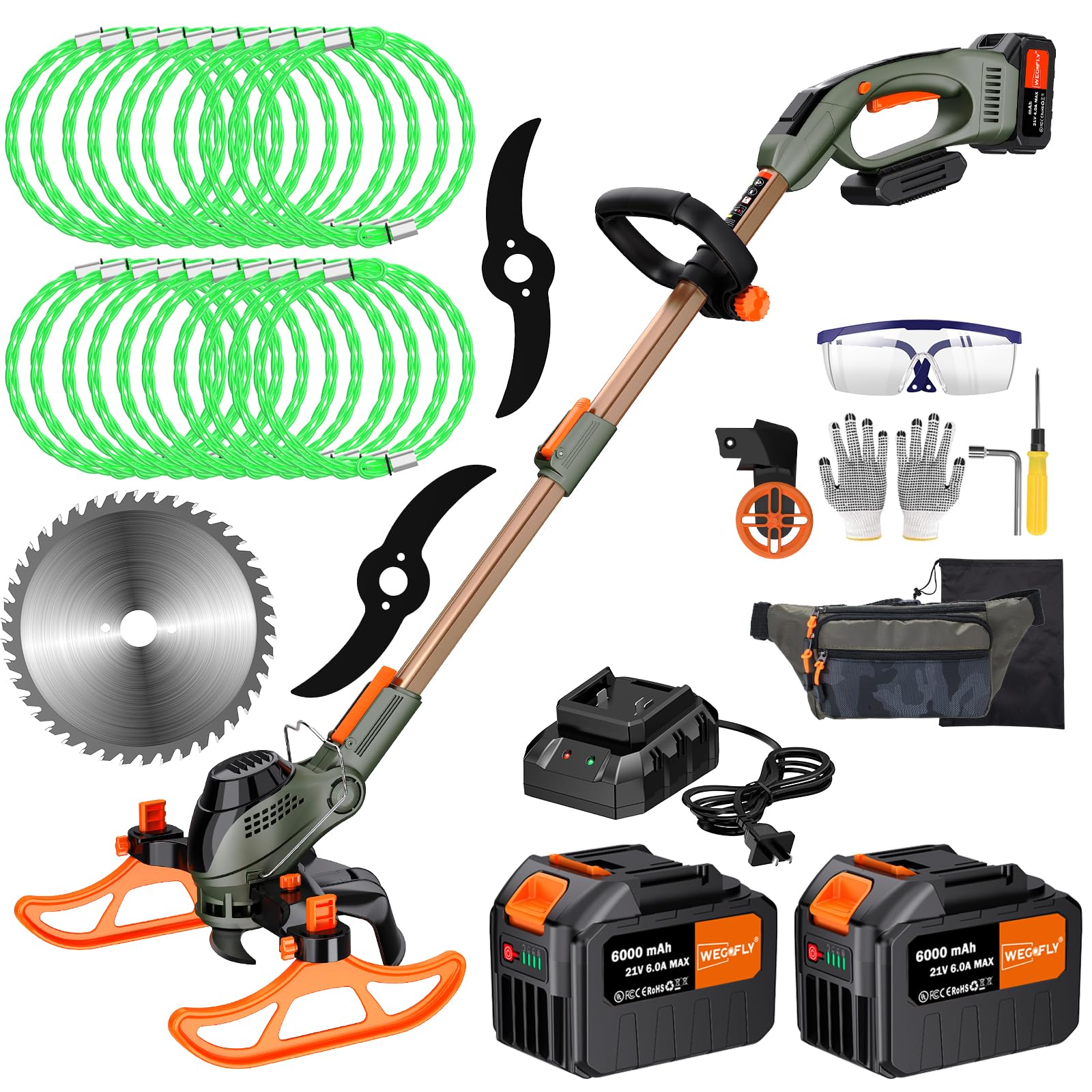
3. WeGofly 13″ 4-in-1 Cordless String Trimmer
One tool that trims, edges, mows, and brush-cuts — perfect for the yard with a little bit of everything.
The WeGofly 4-in-1 is the Swiss Army knife of lawn equipment for small to medium yards. It switches between a string trimmer, lawn edger, mini lawn mower, and brush cutter by swapping the head. The 13-inch cutting width on the trimmer mode is noticeably wider than the 8-inch edger blades on dedicated tools, meaning you cover more ground when clearing weeds along a fence line. It comes with two 21V 6.0Ah rechargeable batteries, so you can keep working while one charges. A buyer who faced a city fine for overgrowth said, “I finished the job within 2 days!” because the tool was lightweight and the batteries lasted.
Weight is a huge advantage here: at just 5.2 pounds, this is far lighter than the 39.3-pound SENIX mower or the 65-pound Greenworks self-propelled mower, making it ideal for seniors, women, or anyone who wants to avoid arm fatigue. The 15,000 RPM brushless motor and steel gears give it enough power to handle thick grass and brush without stalling. The adjustable cutting head and telescopic pole mean you can reach under bushes and along slopes without bending.
A few buyers noted that the auxiliary pull screws can come loose during use, so you may want to tighten them periodically or add thread-locker. The included three types of cutting blades (nylon line, metal blade, saw blade) cover most typical yard tasks, but the tool is not meant for heavy-duty brush clearing or large properties.
Multi-Tool Wins
- Only 5.2 lbs — extremely easy to handle for extended sessions
- Two 6.0Ah batteries included for long runtime
- 4 modes cover trimming, edging, mowing, and brush cutting
Multi-Tool Trade-Offs
- Not as powerful as a dedicated gas edger for heavy overgrowth
- Some users report loose screws on the auxiliary pulley
Best for: the homeowner who wants one tool for weeding, edging, and light brush work without dragging out a gas machine. Not for: large acreage where you need a dedicated, high-power trimmer.
4. PowerSmart EasyCut 18-Inch Gas Lawn Mower
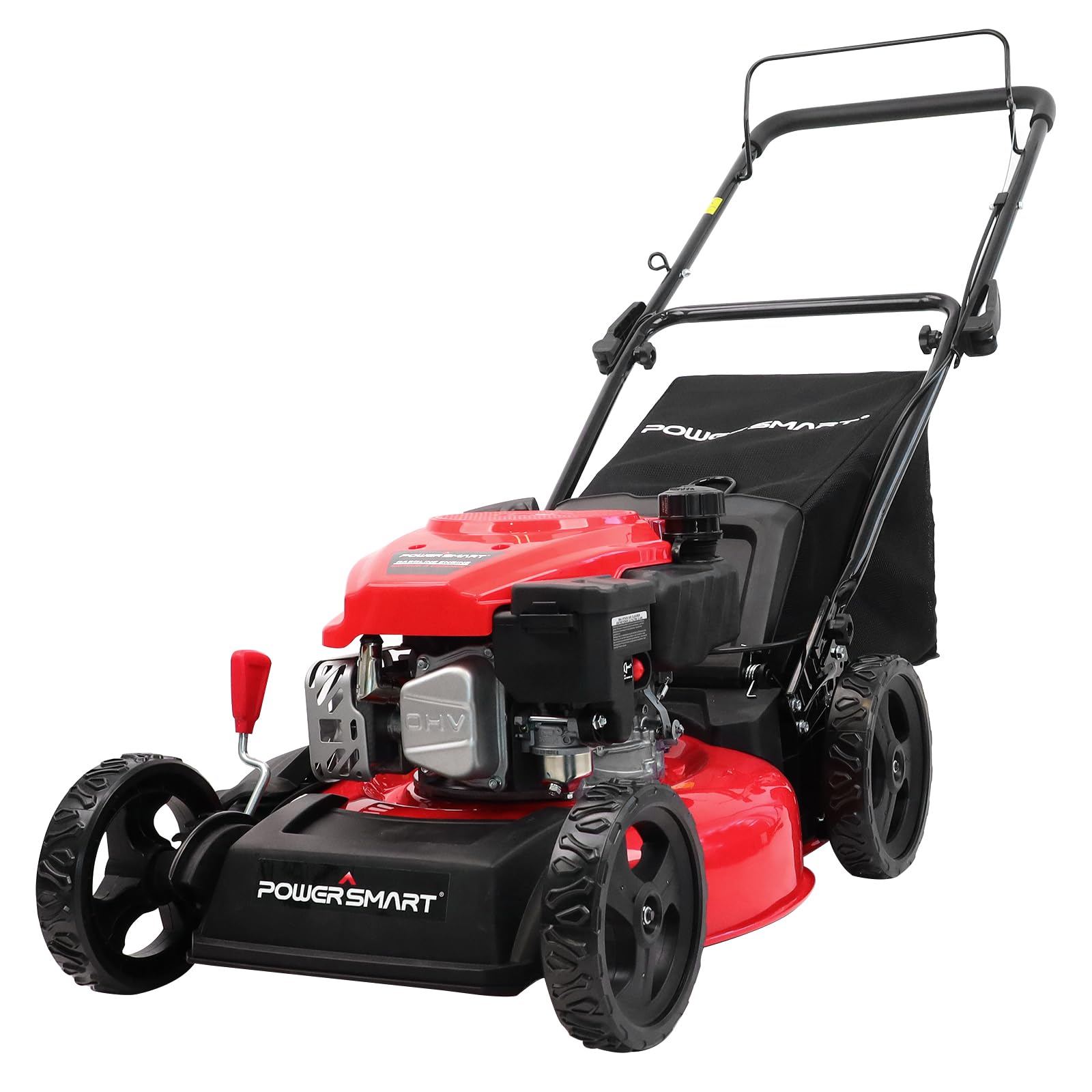
A gas mower that starts reliably, cuts evenly, and does not cost a month’s rent.
The PowerSmart EasyCut proves you do not need to spend premium money to get a reliable gas mower. The 144cc 4-stroke OHV engine fires up in 1 to 2 pulls thanks to the auto choke system, and buyers consistently mention that it cuts through thicker patches of grass without bogging down. The 18-inch steel deck is smaller than the 21-inch deck on the Greenworks self-propelled mower, but that makes it easier to maneuver around tight corners and flower beds. You get six height adjustment positions to dial in the cut exactly as you like it.
At 55 pounds, it is noticeably heavier than the 39.3-pound SENIX mower, so you will feel the weight on slopes. But the steel deck feels durable, and the 3-in-1 system (mulch, bag, or side discharge) gives you flexibility depending on the season. Assembly is tool-free, and the handle folds for compact storage. The key advantage over the SENIX is the six height positions and the consistent positive feedback on the engine’s reliability — the SENIX only offers three height positions.
The honest trade-off is fit and finish. Some buyers mention small cosmetic issues, and the plastic components are not as sturdy as on more expensive brands. But for a quarter-acre lot and under, the EasyCut delivers the best value-to-performance ratio in the gas mower category.
Why It Wins
- Auto choke and recoil starter mean it fires up in 1-2 pulls
- 6-position height adjustment for a tailored cut
- Lightweight for a gas mower at 55 lbs, easy to push
Honest Gripes
- 18″ deck is smaller than many competitors, so you need more passes
- Plastic components feel less premium than pricier models
Perfect for: budget-conscious homeowners with a small, flat lawn who want gas reliability without a high price tag. skip it if: your yard has steep slopes or you want a larger cutting deck.
5. Greenworks 60V 21″ Self-Propelled Cordless Lawn Mower

Battery power that rivals a gas engine, with self-propelled ease for larger lawns.
The Greenworks 60V self-propelled mower is the choice for anyone who wants gas-level performance without the maintenance. It runs on two 4.0Ah batteries and can handle up to 3/4 of an acre on a single charge, which is more than most battery mowers can claim. The rear-wheel drive self-propelled system gives you traction on slopes and thick grass, and you can adjust your pace on the fly with a paddle control. The 21-inch steel deck is the same width as the most popular gas mowers, so you cover ground efficiently.
Buyers consistently highlight the quiet operation — this thing runs three times quieter than a gas mower, so you can mow early on a Saturday without waking the house. The 4-in-1 cutting system offers mulching, bagging, side discharge, and a turbo leaf pickup mode. The LED headlights let you mow at dusk, which is a surprisingly useful feature when summer evenings get short. The mower weighs 65.04 pounds with the batteries, which is heavier than the 55-pound PowerSmart, but the self-propelled system does most of the pushing for you.
The common complaint from owners is that the variable speed control on the self-propel system can drift over time — the slider vibrates and changes speed on its own. Also, the automatic battery-swapping feature sometimes fails to engage, leaving you with a weak cut until you manually swap the batteries. But for the price, the range of features and the quality of the cut are impressive.
Battery Mowing Upside
- Runs 3x quieter than gas — no earplugs needed, no fumes
- Self-propelled rear-wheel drive handles slopes easily
- LED headlights allow mowing in low light
Battery Mowing Downside
- Self-propel speed slider can vibrate and shift during use
- Auto battery swap feature can fail, requiring manual intervention
- Heavier than many gas mowers at 65 lbs
Choose it for: a large, sloped yard where you want gas-like power without the gas smell or engine maintenance. Consider something else if: your yard is very flat and small — you can save money with a lighter, non-self-propelled model.
6. ANTHBOT M9 Robot Lawn Mower
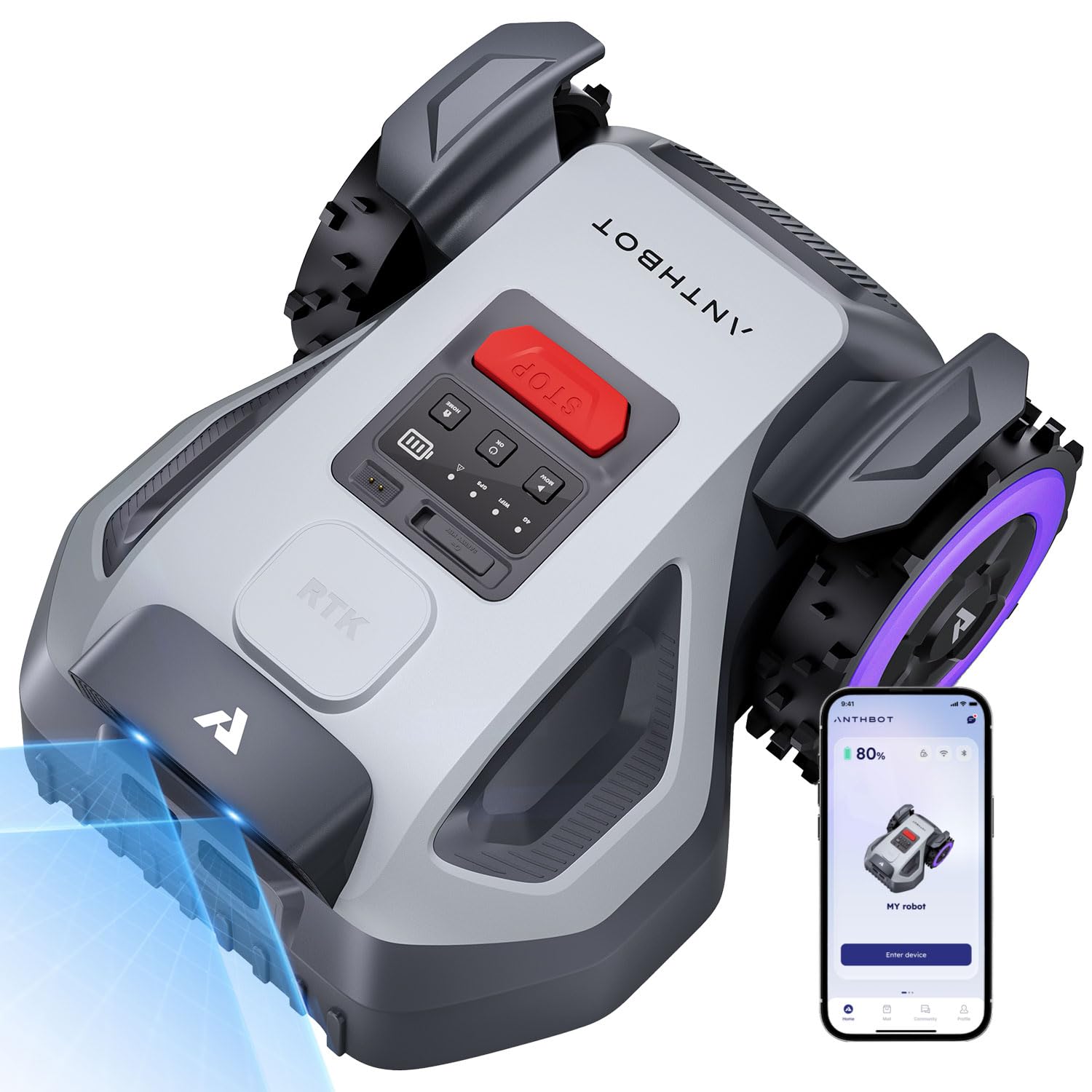
A robot mower that maps your lawn in 10 minutes and cuts without a single boundary wire.
The ANTHBOT M9 is built for the homeowner who wants to outsource mowing entirely. It uses a dual AI vision system combined with RTK (Real-Time Kinematic) satellite positioning — no perimeter wire to bury around your yard. The robot maps your property in about 10 minutes by itself, then gets to work. It can handle slopes up to 45 percent, which covers over 99 percent of residential properties, and it navigates around obstacles by recognizing over 1,000 types of garden objects, from trees to kids’ toys.
The cutting width is 7.9 inches, and the height adjusts between 1.2 and 2.7 inches. It manages up to 30 separate work zones, so you can have it mow the front yard, skip the garden, and handle the side strip — all controlled through the app. The noise level is ≤58 decibels, which means it is quiet enough to run at night without disturbing anyone. A buyer who returned a more expensive brand said the M9 “easily outperforms much more expensive competitors.”
The biggest caveat is reliability. Several owners mention network and communication errors that cause the robot to spin in circles or fail to return to its charger. The setup is also more involved than the “10 minutes” marketing suggests — one owner estimated it took about an hour to get everything positioned and calibrated correctly. But when it works, it is genuinely hands-off.
Automation Wins
- No perimeter wire needed — a huge time saver during setup
- Handles up to 45% slopes, suitable for nearly any home yard
- Runs at ≤58 dB, quiet enough for nighttime mowing
Automation Hitches
- Some units suffer from network errors and navigation issues
- Realistic setup time is closer to 1 hour, not 10 minutes
Ideal for: tech-savvy homeowners with a medium-sized, reasonably flat yard who want to reclaim their weekends. Better to skip if: you want absolute reliability and are not willing to troubleshoot occasional GPS errors.
7. SENIX 20″ 144cc Gas Push Mower
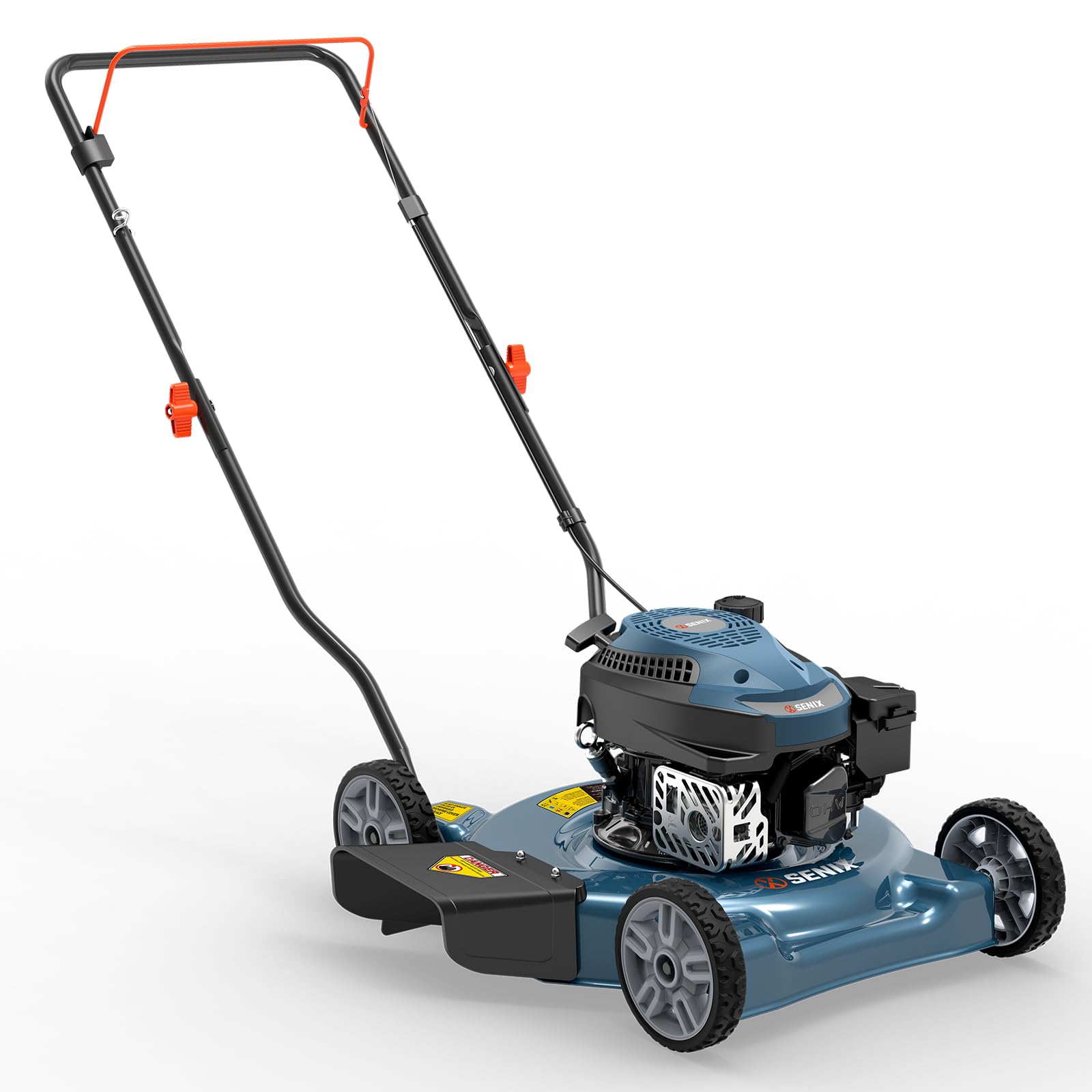
A lightweight gas mower that starts on the first pull and handles hills without drama.
The SENIX is a no-frills gas mower that focuses on the basics: easy starting, lightweight handling, and a clean cut. It uses a 144cc 4-cycle engine, and real customers confirm it fires up on the first pull almost every time. At 39.3 pounds, it is significantly lighter than the PowerSmart EasyCut at 55 pounds, making it one of the lightest gas mowers you can buy. The 20-inch cutting width is a balance — bigger than the PowerSmart’s 18-inch deck, but not as wide as the Greenworks 21-inch self-propelled mower.
Where this mower really shines is on hills and uneven terrain. The 7-inch front and rear wheels provide reliable traction, and buyers who use it on ditches and slopes where a zero-turn mower would be unsafe say it performs well. The 3-position height adjustment (1.35″, 2.3″, and 3.15″) is somewhat limited compared to the 6-position system on the PowerSmart, but it covers the most common grass heights. Oil and tools are included in the box, so you do not need to buy anything extra to get started.
The most common complaint is that the assembly instructions are tiny and poorly labeled — some buyers could not find where to put the gas and oil because the mower was not clearly marked. If you are a first-time gas mower owner, you may need to watch a video to get it right. But once it is assembled and running, it is a reliable machine for a small yard.
Hill-Ready Strengths
- Starts on first pull consistently, backed by buyer reports
- Lightweight at 39.3 lbs, easy to push up slopes
- 20″ deck covers ground efficiently for a small mower
Assembly Frustrations
- Poorly labeled gas and oil fill points confuse first-time users
- Only 3 height adjustment positions, less versatile than competitors
- 7″ wheels are fine for slopes but not great for very bumpy ground
Great for: homeowners with a hilly, small-to-medium lawn who want a simple, lightweight gas mower that starts every time. Not ideal if: you want detailed height adjustments or need a larger deck for a bigger property.
8. Agri-Fab Tow Behind Broadcast Spreader
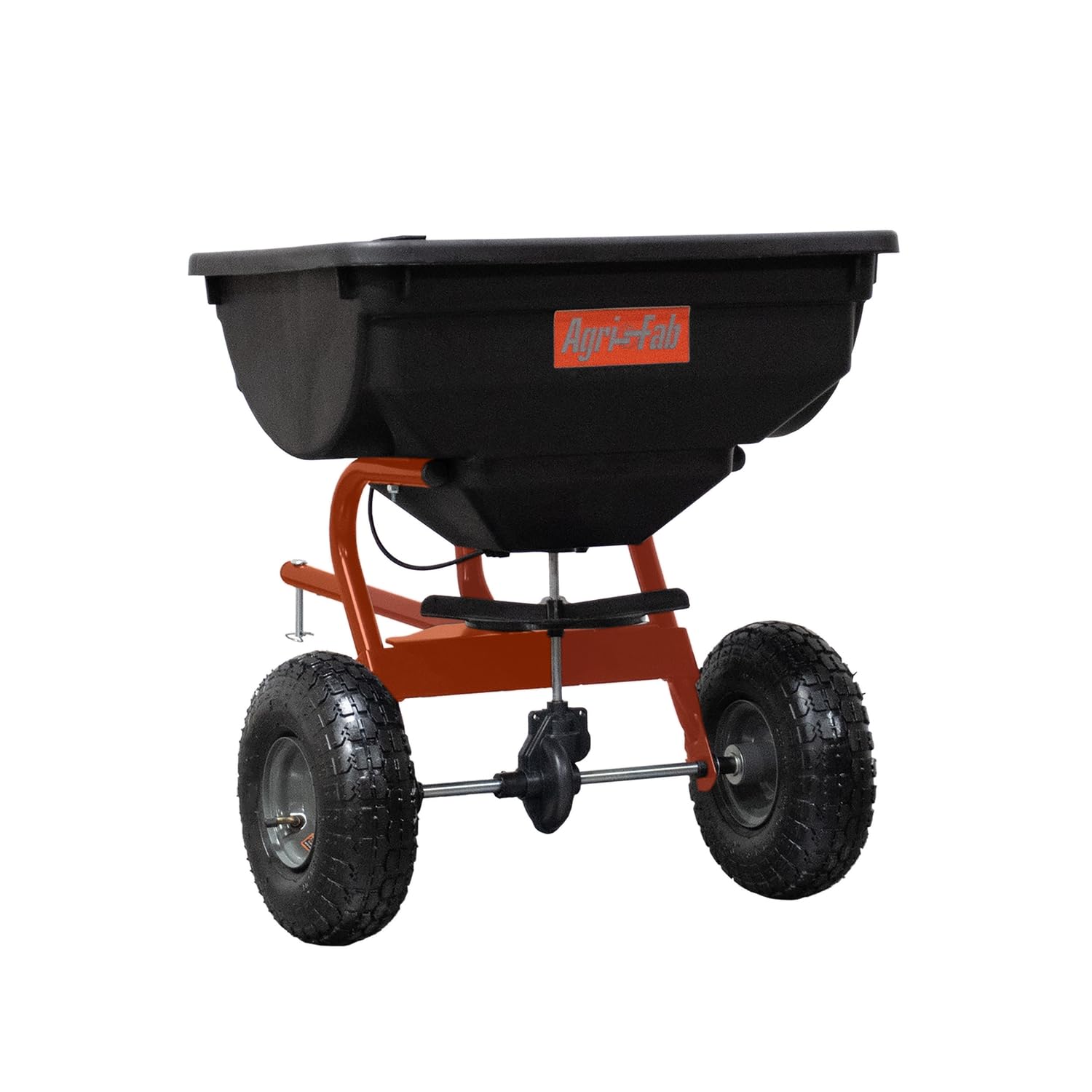
A no-electricity-required spreader that hooks to your riding tractor and covers 14,000 sq ft per fill.
The Agri-Fab tow-behind spreader is built for the person who already uses a riding mower or garden tractor to maintain their property. The 85-pound poly hopper holds enough seed or fertilizer to cover up to 14,000 square feet (about a quarter of an acre) per fill, and the broadcast spread pattern reaches up to 10 feet wide. The cable flow control attaches to your tractor seat, so you open and close the material gate without climbing off the machine.
The 10-inch pneumatic tires roll smoothly over grass and uneven ground, which is a big upgrade over plastic-wheeled push spreaders. The enclosed gearbox is designed to keep debris out and keep the spreading mechanism working season after season. It is made by Agri-Fab in Sullivan, Illinois, and carries a 3-year limited warranty. Buyers who use it behind zero-turn mowers say it fits the bill perfectly and the rubber-tubed wheels feel more durable than plastic alternatives.
The assembly process is the main stress point. Several customers note that the instructions are unclear — one noted that “no clear written assembly instructions” made the build frustrating, and another had to call Agri-Fab for missing parts. The controller cable was also shipped separately for some buyers, which delayed setup. For a yard smaller than half an acre, a push spreader is simpler and cheaper; for yards over one acre, many buyers recommend spending more on a heavier-duty unit.
Spreading Strengths
- 85 lb hopper covers 14,000 sq ft without refilling
- Seat-mounted cable control lets you operate without dismounting
- 10″ pneumatic tires roll smoothly over rough lawn terrain
Spreading Weaknesses
- Assembly instructions are vague — expect a trial-and-error process
- The gearbox housing is fragile on bumpy ground
- No hopper cover or U-shaped hitch clamp included
Suits: owners of riding mowers or tractors with a quarter-to-one-acre yard who want to spread seed or fertilizer efficiently. Not for: anyone without a tow vehicle, or anyone who wants a quick, frustration-free setup.
9. Walensee Rolling Lawn Aerator
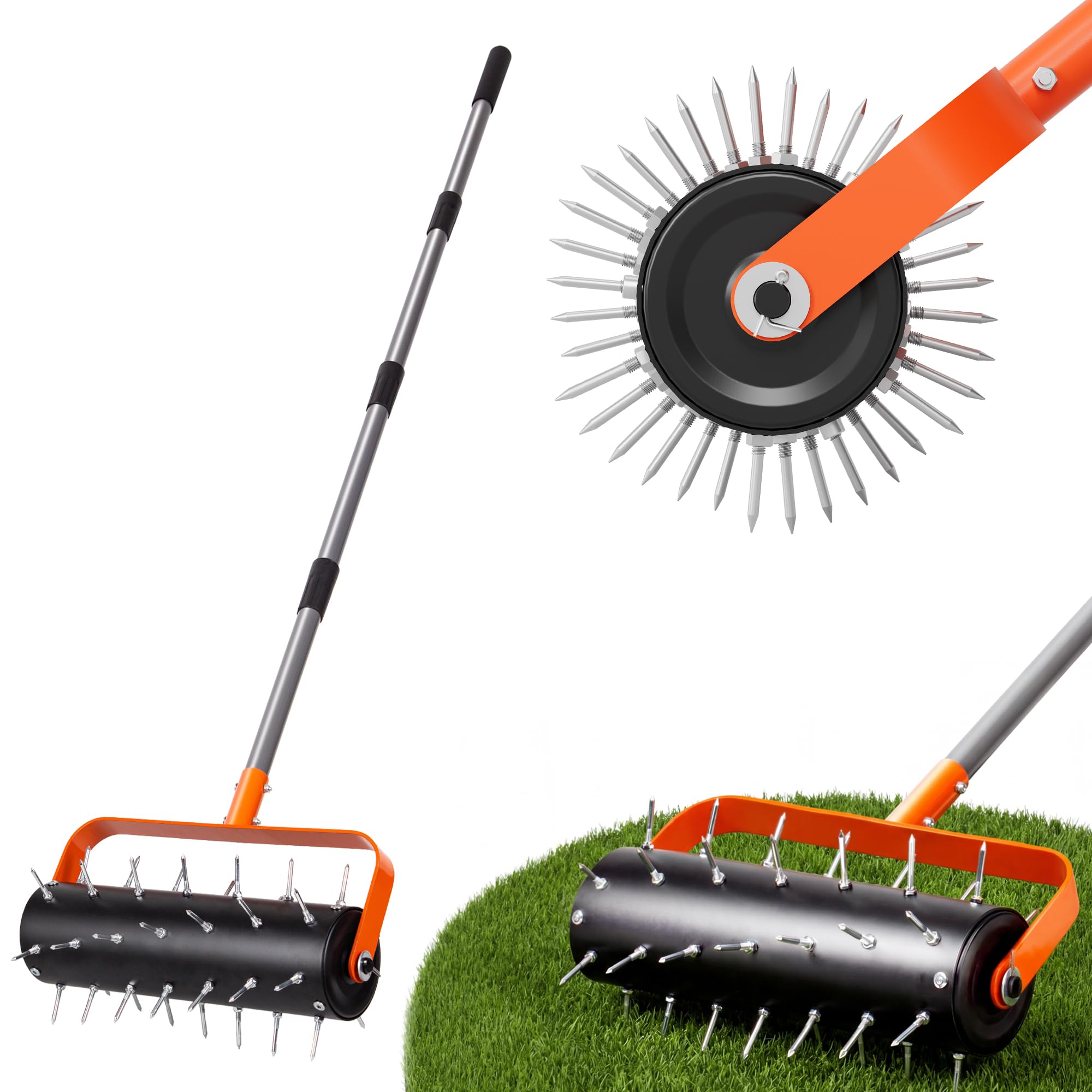
A simple, rugged spike aerator that wakes up compacted soil without gas or electricity.
The Walensee rolling aerator is a manual tool that solves among the most overlooked lawn problems: compacted soil. It uses 42 heat-treated steel spikes arranged in a spiral pattern, which helps the roller stay smooth and stable as you push it across the yard. The spikes penetrate about 2 inches deep when the soil is moist, creating channels for air, water, and nutrients to reach the grass roots. At 12.1 pounds, it is heavier than the 10.3-pound Greenworks edger, but that weight helps the spikes dig in.
The handle adjusts to four different heights, so you can stand upright and walk naturally rather than bending over. Buyers with a 2,000-square-foot lawn say it is the “best bang for the buck” and that the build is sturdy. To get the best results, you need to water the lawn thoroughly before rolling — hard, dry soil will not let the spikes penetrate properly. One buyer filled the roller with river rocks after a soaking rain and said “this worked really well!”
The limit of a spike aerator versus a core aerator is that spikes can compact the soil around the hole instead of removing a plug. For very hard-packed clay soil, a scarifier or powered core aerator might be more effective. The handle is made of four sections that need to be bolted together, and some buyers noted a gap between the roller and end caps that caused sand (used as weight) to spill out.
Aeration Benefits
- 42 heat-treated spikes provide good soil penetration when moist
- Adjustable handle (4 sections) lets you walk upright while working
- No fuel, no electricity — just push and go
Limits to Know
- Spike aeration can compact soil around holes instead of removing a core
- Handle sections can feel less sturdy than a single-piece frame
- Not effective on hard, dry, or clay-heavy soil without pre-watering
Perfect for: owners of small-to-medium lawns (under a quarter acre) who want to improve soil drainage cheaply without power tools. Better to upgrade if: your soil is heavy clay — you will get better results from a core aerator.
Understanding the Specs
Cutting Width
This is the single measurement that determines how fast you finish. A wider cutting width on a mower (say 21 inches vs. 18 inches) means you cover more grass with each pass, which saves time on a larger lawn. For edgers and trimmers, a wider blade or head also reduces the number of trips you need to make along a driveway or sidewalk. The trade-off is that wider decks are heavier and harder to turn in tight spaces, so think about your yard’s layout before you just grab the biggest number.
Battery Voltage and Amp-Hours
Battery-powered tools are rated by voltage (how much power the motor can draw) and amp-hours (how long the battery lasts). A higher voltage, like 80V or 60V, generally delivers more torque — meaning it cuts through thick grass more easily. Amp-hours (Ah) tell you the runtime: a 6.0Ah battery lasts roughly twice as long as a 3.0Ah battery under the same load. If you have a large yard, look for tools that come with two batteries or a fast charger, so you can swap and keep going.
Engine Displacement (Gas Mowers)
Gas mowers are measured by their engine displacement in cubic centimeters (cc). A 144cc engine is common for push mowers and provides enough power for regular residential lawn care. Higher displacement means more raw cutting torque, which helps when the grass is wet, thick, or overgrown. The trade-off is fuel consumption, noise, and weight — a larger engine is usually heavier and louder.
Self-Propelled vs. Push
A self-propelled mower uses a drive system (often rear-wheel drive for better traction on slopes) to move the mower forward while you just steer and walk behind. This is a major help on hilly or large lawns because the machine does the heavy work. A push mower relies entirely on your muscle, which is fine for flat, small yards but can be exhausting on anything bigger than a quarter acre. If your yard has slopes thicker than moderate, a self-propelled model is worth the extra cost.
FAQ
Is a gas mower or battery mower better for a typical suburban lawn?
Can I use a string trimmer as an edger?
How often should I aerate my lawn?
What does “self-propelled” mean on a lawn mower?
How long do robotic lawn mower batteries last?
Can I use a tow-behind spreader on a zero-turn mower?
Is the Greenworks 80V edger compatible with other battery brands?
What is the difference between spike aeration and core aeration?
What size gas mower do I need for a 1/4 acre lawn?
Final Thoughts: The Verdict
For the majority of shoppers, the lawn equipment winner is the
Final Thoughts: The Verdict
For most users, the lawn equipment winner is the Greenworks 80V Edger because it delivers professional-grade edging with gas-level power and no fumes. If you want a single tool that handles trimming, edging, and light brush work, the WeGofly 4-in-1 is the most versatile pick at a budget-friendly price. And for anyone with a large, sloped lawn who wants to ditch gas entirely, the Greenworks 60V Self-Propelled Mower offers the best combination of power, battery range, and convenience.
How We Picked
We do not accept paid placement. Every pick is matched to a real buyer and a real use-case; we do not hands-on test units.
Sources & Methodology
Specifications: manufacturer listings and product documentation. Review insights: verified customer reviews, as of July 2026. Pricing: not shown on this page (it changes often); check the current price via the retailer link.
As an Amazon Associate, Lawn Gear Lab earns from qualifying purchases. This does not affect which products we feature.