
Specs are compiled from manufacturer listings and verified buyer reviews and can change over time — please confirm the key details on the product page before buying.
You want strong, stocky seedlings, not pale, stretched-out stems that flop over. The problem is that most window sills simply do not deliver enough light, especially in late winter and early spring. A good grow light fixes this by giving your plants the right mix of blue and red light (3400K to 5000K range with deep red at 660 nm) from just a few inches above the leaves. This guide covers seven options, from compact desktop sticks to expandable panel systems, so you can find the one that fits your shelf and budget.
The right grow light can mean the difference between a frail stem and a stocky transplant ready for the garden. This roundup of the best grow lights for seedlings is built by comparing the manufacturers’ published specifications and patterns across verified customer reviews, so you get each pick’s real strengths and trade-offs.
Our Picks at a Glance
How To Choose The Best Grow Lights For Seedlings
Seedlings are light-hungry from the moment they break the soil. Without enough intensity, they reach for the nearest window and become leggy within days. Focus on three things: light spectrum, power output, and how you mount or position the fixture over your trays.
Full Spectrum and Color Temperature
Look for lights that combine cool white (around 5000K, which gives you lots of blue light) with some deep red (660nm). The blue end keeps seedlings compact and prevents them from stretching. The red wavelengths support root and leaf development. A “full spectrum” label means the fixture tries to mimic natural sunlight, which helps a wide range of vegetables, herbs, and flowers all at once.
Light Output and Coverage Area
Raw wattage is only part of the story. Check the lumen rating (more lumens usually means more usable light) and how the fixture spreads that light. A long, rectangular panel tends to cover a standard seed tray better than a small circular bulb. For a 10-by-20-inch tray, you generally want a fixture that puts out at least 1000 lumens and can sit 2–4 inches above the canopy without scorching leaves.
Timer and Ease of Use
Consistency matters. Most growers run lights 14–16 hours a day. Built-in timers (4, 8, 12, 16, or 20 hours) let you set a schedule and walk away. A daisy-chain or linkable feature (which means you plug one light into the next using a short cable) is useful if you plan to expand across multiple shelves later, because you can power several panels from one outlet.
Quick Comparison
| Model | Best For | LED Count | Wattage | Light Output | Amazon |
|---|---|---|---|---|---|
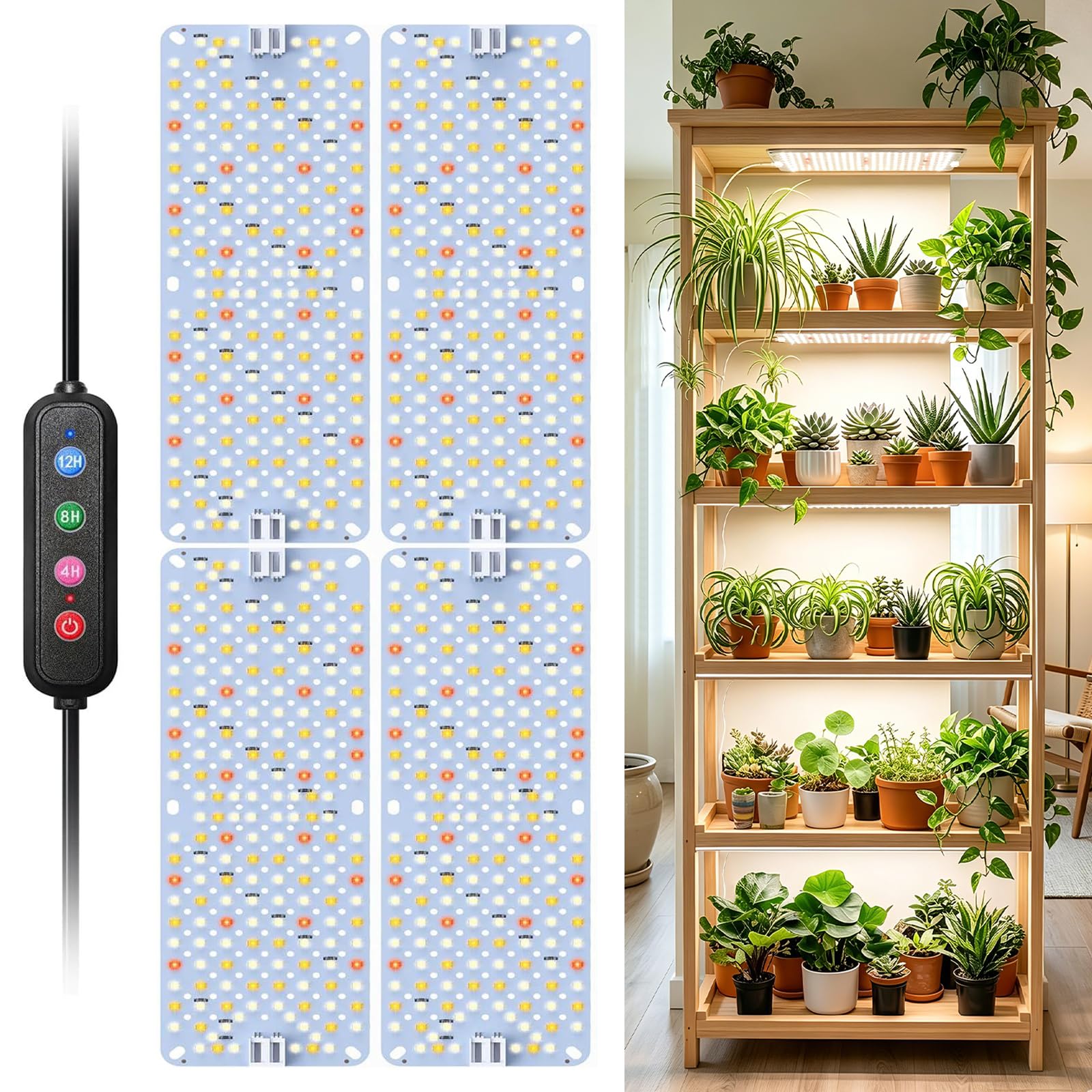
| SDOVUERC Full Spectrum 768 LEDs (Pack4)★ Best Overall | Max coverage per panel | 768 | 36W | 4000 Lumens | Amazon |
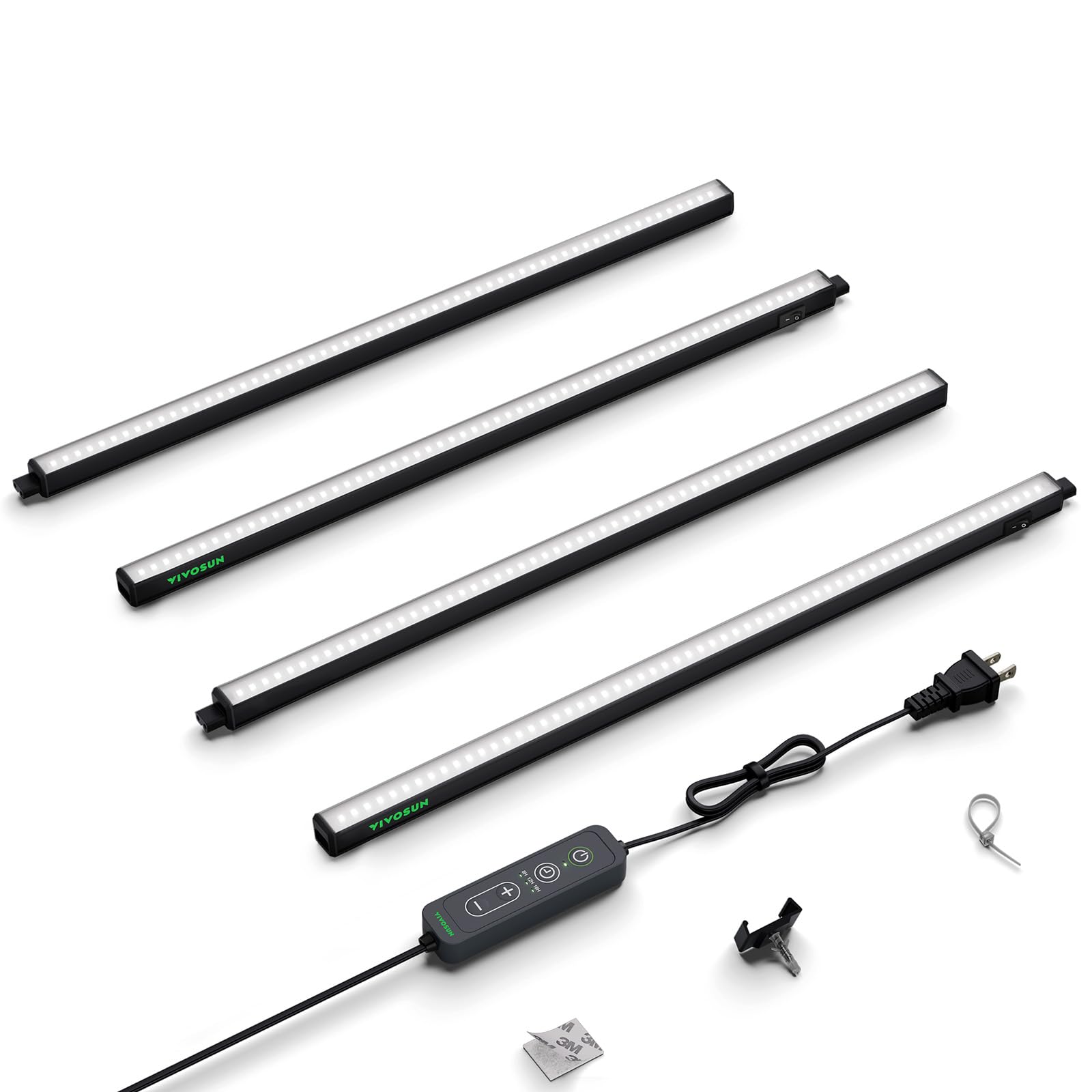
| VIVOSUN T5 4-PackPremium Scale | Large multi-shelf setup | 60 | 60W (4x15W) | 7800 Lumens | Amazon |
| FRGROW 2026 Tabletop | Single desk or bonsai | — | 25W | — | Amazon |
| Aumtrly Desktop 2-Pack | Adjustable desk setup | — | — | — | Amazon |
| FOXGARDEN Grow Light Stand | Freestanding tabletop use | 108 | — | — | Amazon |
| SDOVUERC Tri-Heads (Pack2) | Targeted clip-on feeding | — | 15W | — | Amazon |
| FECiDA 4-Pack Panel | Budget under-cabinet | 192 | 12W | 1200 Lumens | Amazon |
In‑Depth Reviews
1. SDOVUERC Full Spectrum 768 LEDs Grow Lights (Pack4)
Our pick — over 4.5★ from 400+ verified ratings; the strongest balance of quality and price.
This panel delivers more than triple the light output of the 1200-lumen FECiDA panels below, making it the best choice for anyone with multiple seed trays on one shelf.
Why it earns the best overall spot: It puts out 4000 lumens from 36W of power, which is enough to cover several trays of tomatoes, peppers, and basil at the same time. Each of the four panels packs 768 LEDs total (that’s individual light chips), and you can daisy chain (connect one to the next with a short cable) up to ten units in series or parallel from a single outlet. This means you can expand to a whole multi-shelf rack without needing extra power bricks.
The spectrum mixes 3000K warm white, 5000K cool white, and 660nm deep red, which mimics natural sunlight closely enough to push seedlings from germination straight into vegetative growth. Buyers report fast germination—within 24 hours for some plants when paired with heat mats (seedling warming pads). Established houseplants also thrive under these panels. The downside: the 18-hour timer setting is not available (you get 4, 8, 12, 16, and 20-hour options instead), and the panels run slightly warm after 30 minutes of use.
What Lifts It
- Highest lumen count in this lineup (4000 Lumens) for dense, multi-tray setups
- Daisy-chain and parallel linking expands without extra power bricks
- Includes zip ties and 3M adhesive tape for quick under-shelf mounting
The Trade-Offs
- Not dimmable—just on or off, no intensity control
- Some users found the panels less bright than expected for high-light carnivorous plants
- Box packaging felt under-protected during shipping, according to buyers
Best for serious seed starters: If you run a multi-shelf operation, this is the one to buy. It handles trays of tomatoes, peppers, and basil at the same time.
Who might look elsewhere: If you only need a single desk lamp for two or three pots, a simpler desktop fixture saves money and space.
2. VIVOSUN T5 Grow Lights for Indoor Plants (4-Pack)
The brightest option in this entire lineup, and it runs cool enough to hang inches above seedlings without heat stress.
This kit delivers 7800 lumens across four linked strips. It is brighter than the SDOVUERC 4000-lumen panels and the FECiDA 1200-lumen panels, which makes it the pick for serious propagation. Each 2-foot bar draws 15W, and the total 60W system runs cool enough to hang inches above seedlings without heat stress (buyers confirm this works for everything from succulents to tomatoes). The 5000K daylight spectrum is rich in blue light, which keeps seedlings short and stocky. The 130 lm/W efficiency means you use less electricity to get light output.
The included controller gives you 8H, 12H, and 18H timer settings and four brightness levels, so you can dial down intensity for sensitive starts or max it out for heavy-feeding crops like tomatoes. A power-outage safety feature means the fixture remembers your previous brightness setting even if the timer resets. Owners mention that the mounting brackets can slip on some surfaces and the plastic housing gets noticeably warm, but the fast growth results and durable build earn high marks. These T5 strips are designed for grid-style shelving in a grow tent or greenhouse, unlike the SDOVUERC panels that fit under standard shelves.
Why It Stands Out
- Highest total lumen output (7800 Lumens) for serious multi-shelf propagation
- Four brightness levels give you fine control over light intensity for different seedling stages
- Three mounting methods (hang with chains, screw to wood, stick with tape) fit almost any rack
What Holds It Back
- Mounting brackets are not zip-tie-friendly and slip on some smooth surfaces, per reviewer reports
- Plastic body gets warm to the touch during extended use
- Incompatible with UPS (uninterruptible power supply) PWM sine-wave power sources, according to one buyer
Perfect for a dedicated grow tent: If you already have a shelving unit or a small greenhouse cabinet, this linkable T5 system fits like it was made for the job. It gives you more brightness control than the SDOVUERC panels.
Not for a cluttered desk: The long strip form factor and required mounting hardware make it less practical as a simple desktop lamp.
3. FRGROW 2026 Tabletop Grow Lights for Indoor Plants
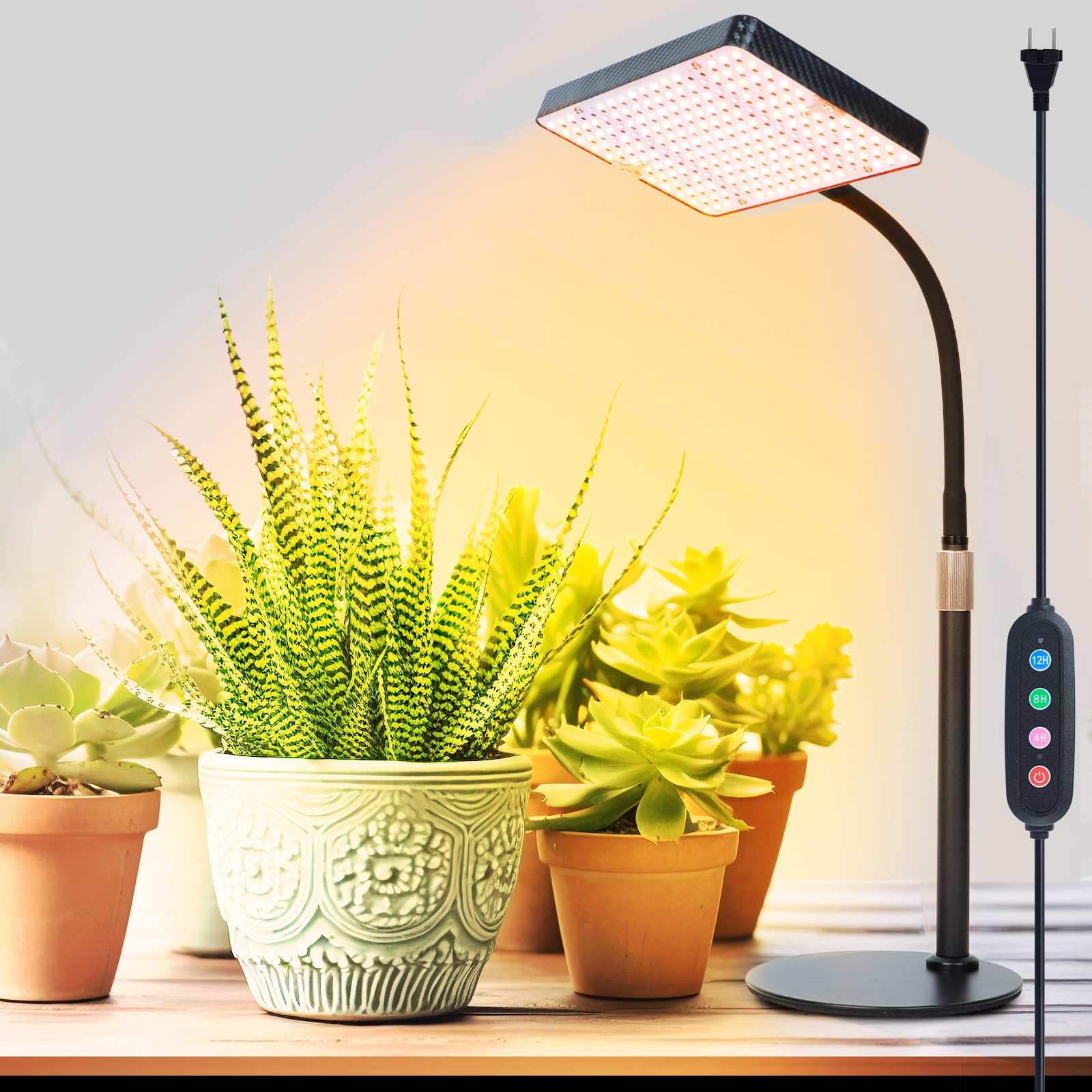
Its real 25W power draw is a strong punch for a single seed pan, more than the 12W FECiDA panels deliver per unit.
This freestanding light covers a standard seed tray without needing shelf space. The base is sturdy metal, and you can adjust the arm from 16 to 24 inches tall as seedlings grow. Customers note that peppers, eggplants, and basil grow well when the light is set at 12 inches for 16 hours a day. But tomatoes can turn purplish if placed too close, so you have to watch leaf response and adjust the height.
The timer offers 4, 8, 12, 16, and 20-hour options (you press 4 + 12 together for 16 hours). One reviewer noted the light turns purple only when the timer runs, which is a visual cue that the cycle is active. Unlike the FECiDA panels that spread wide and thin, this FRGROW concentrates its output in a smaller footprint. It also daisy-chains up to three units, so you can pair two for a wider tray if needed.
What Works
- True 25W output delivers concentrated brightness for a single seed pan, more than the 12W FECiDA panels
- Adjustable 16-24 inch height accommodates seedlings to mature plants
- Set-and-forget timer up to 20 hours requires no daily attention
The Catch
- Some users found tomatoes turned purple when placed too close to the light, indicating light stress
- Limited to three lights in a daisy chain, which may constrain larger setups compared to the SDOVUERC’s ten-light limit
Great for a single tray or a desktop bonsai: If you start one flat of vegetables or keep a single houseplant alive on your desk, this provides focused light without an oversized fixture.
Not for wide shelves: The 8-inch-long base covers a narrower area than the FECiDA or SDOVUERC panels, so multiple trays would need extra units.
4. Aumtrly Grow Light, Full Spectrum Desktop 2-Pack
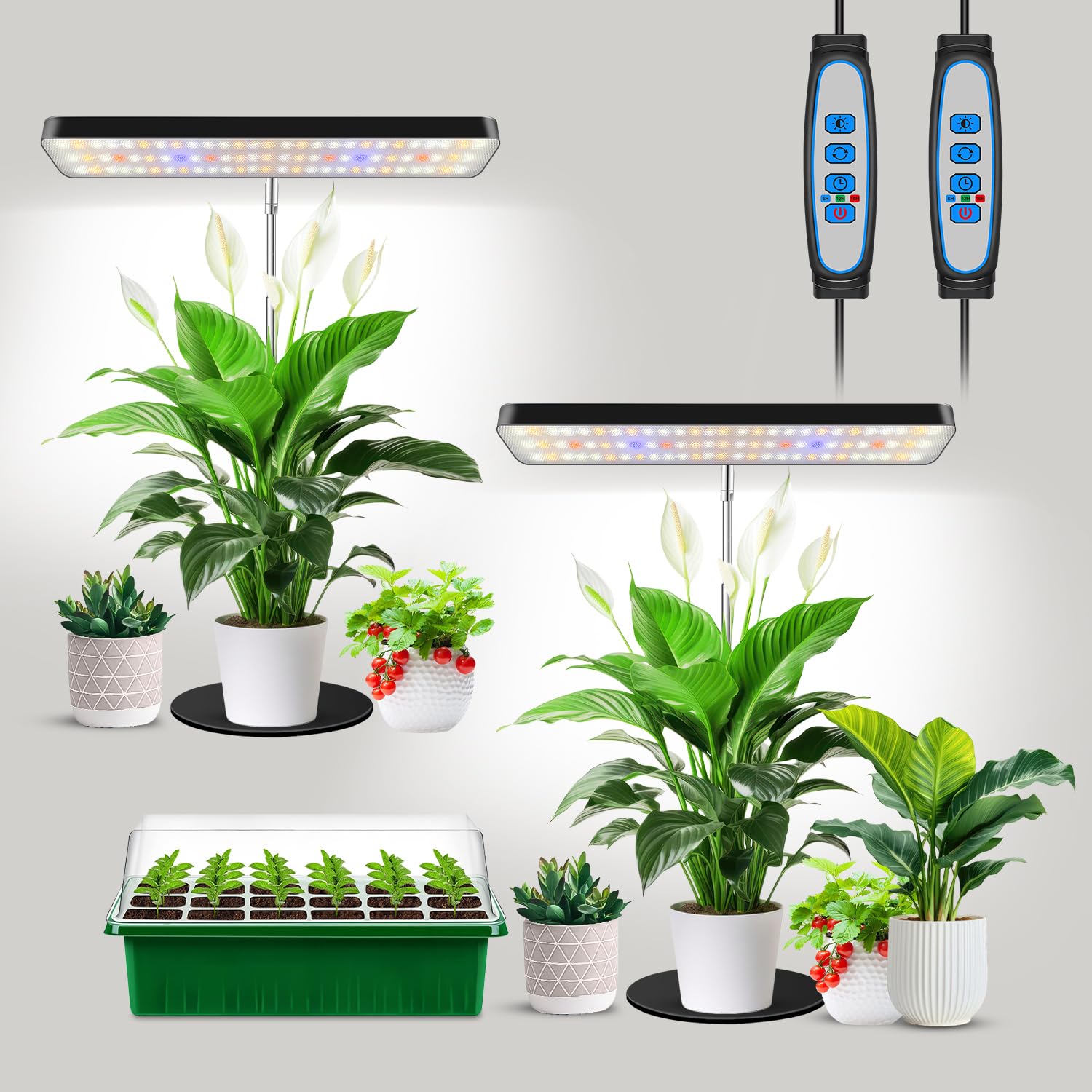
Its 3 lighting modes and 5 dimming levels give you more customization than any other light here for different seedling stages.
Each unit extends from 7.8 to 26 inches, and the rectangular head throws wide, even light over several pots at once. The 5-inch metal base stays put on a desk without wobbling. The 3 lighting modes (cool blue-heavy for seedling structure, warmer tones for flowering) plus 5 dimming levels let you adjust intensity for each tray. Buyers confirm the timer runs 6, 12, or 16 hours accurately and remembers the schedule even when you are away.
Reviewers highlight the impressive LUX (a measure of light intensity as you perceive it) reading at just 3 inches away—much stronger than typical clip-on lights. The included PC cover and reinforced power interface are small touches that suggest Aumtrly paid attention to durability. One buyer grew tomatoes successfully and appreciated the auto on/off feature for workday schedules. The main trade-off versus the SDOVUERC panel system is raw intensity: the Aumtrly is excellent for a couple of trays on a desk but would struggle to light an entire multi-shelf rack.
Strengths
- Three lighting modes and five dimming levels give class-leading customization for seedling stages, more than the simple on/off of the SDOVUERC panels
- 7.8-26 inch height range adapts as plants grow taller
- Reviewers point out excellent LUX output at close range, outperforming clip-on designs
Limitations
- Not linkable or daisy-chainable, so each light plugs into its own outlet
- Light output is moderate compared to the 36W SDOVUERC panels
Ideal for a home office seedling station: If you want a good-looking, adjustable light that sits on your desk and covers two to four pots per unit, this twin pack delivers with more control than any other fixture here.
Skip it for large racks: Without daisy-chain capability, covering a full shelf would mean multiple outlets and extra cords.
5. FOXGARDEN Grow Light Stand

No mounting required: you just plug it in, adjust the height, and it covers two cafeteria trays.
This unit uses 108 LED beads (60 cool white, 32 warm white, 16 red) and packs a timer with 4, 8, and 12-hour settings plus six dimmable levels from 10% to 100%. That means you can set it to 10% for delicate lettuce starts or crank it to full power for heavy-feeding tomato seedlings. The height adjusts from 11.02 to 21.65 inches, and the iron base with a foam pad protects your desktop from scratches.
Shoppers say the fixture evenly lights two cafeteria trays holding roughly twenty 4-inch pots, which is plenty for most home gardeners. The reflector boosts brightness and coverage, so less energy is wasted. One reviewer who bought in August 2023 noted the LEDs lasted about 2.5 years until February 2026, giving a real-world durability data point. The catch is that the timer resets after a power outage, and some users found the 12-hour max timer shorter than the 16-hour cycles many seedlings prefer. Still, for a freestanding lamp that requires zero mounting, this is a convenient pick.
Pros
- Freestanding design with no installation needed—just plug in and adjust height
- Six dimming levels from 10% to 100% let you match intensity to seedling stage
- Buyers confirm even coverage across two full cafeteria trays
Cons
- Max timer is 12 hours (not 16 or 18), which may require manual intervention for long-day plants like tomatoes
- LED lifespan appears to be roughly 2.5 years based on real user reports
Perfect for a tabletop greenhouse or desk: If you want a self-contained stand that fits neatly over a seedling flat without attaching to a shelf, this is the simplest option.
Not for long-day plants: If you need 16-hour light cycles (common for tomatoes and peppers), the 12-hour max timer means you have to supplement or override manually.
6. SDOVUERC Tri-Heads Grow Lights for Indoor Plants (Pack 2)
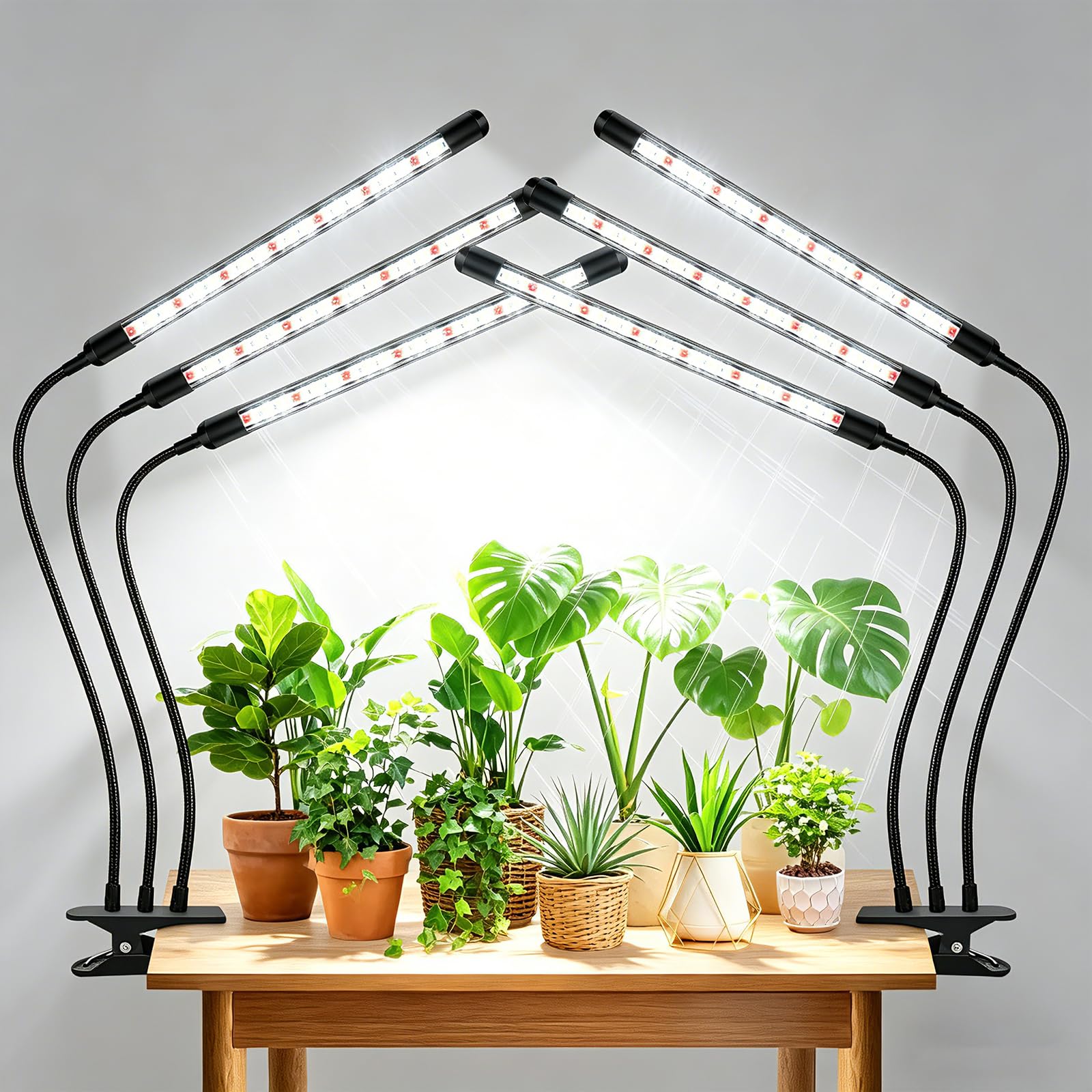
You can aim each of its three adjustable goosenecks at a different pot, giving precision that panel lights cannot match.
Each unit in the two-pack has three adjustable goosenecks and a foam-padded clip that grips shelves, tabletops, or the edge of a seed-starting tray without slipping. The 15W output is modest compared to the 36W SDOVUERC panel system, but the concentrated heads let you put light exactly where it matters—good for a small propagation area or a few succulent pots on a kitchen counter. Buyers love the color options and timer, which cycles through 6, 12, and 18-hour settings and remembers your choice.
A compelling buyer story: one customer lost seedlings by relying only on window light, which produced 1-2 inch tall seedlings that then stalled. After switching to this light, they achieved easy success with new seeds. That real-world testimonial underlines how even a 15W clip light can rescue a failing seed-starting attempt. The foam padding on the clip protects surfaces, and the USB plug means you can power it from a laptop brick if needed.
Highlights
- Three 360° goosenecks allow you to aim light at multiple pots independently
- Foam-padded clip holds firmly without scratching surfaces
- Timer with 6, 12, and 18-hour settings covers most seedling schedules
Drawbacks
- 15W total is lower power—not enough for large seed trays, unlike the 36W SDOVUERC panels
- Some users wish the manual explained which mode to use for seedlings versus established plants
Best for tight spaces: If you are starting just a few seedlings on a windowsill or a crowded desk, the flexible goosenecks and low profile give you precision targeting other fixtures cannot match.
Not for whole-tray coverage: The 15W output is insufficient for a full 10×20 flat; you would need multiple units or a stronger panel.
7. FECiDA 4-Pack Panel Grow Lights for Indoor Plants
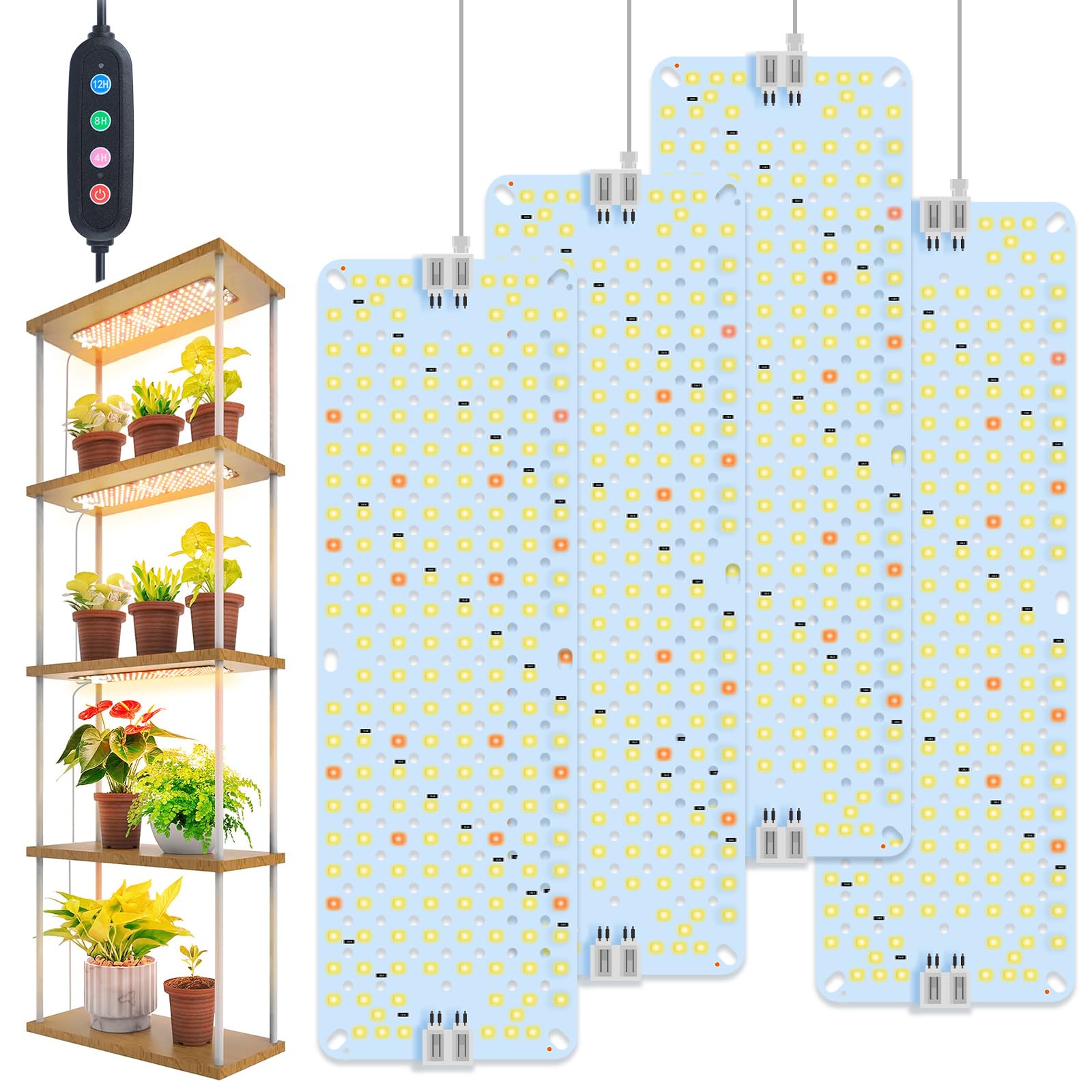
This four-pack is the most affordable way to get light over several seed flats, but it has one-third the intensity of the SDOVUERC panels.
Each panel has 192 LEDs and draws 12W, putting out 1200 lumens. That is one-third the intensity of the SDOVUERC 768-LED panels, so this set works best for lower-light seed starting and small herb trays rather than heavy-feeding tomatoes. The real advantage is the size: each panel measures 16 inches long but only 4 inches wide and 3.2 inches tall, so they tuck under cabinets or fit across a standard 10-gallon tank top. Buyers confirm they work well in isopod and beetle tanks (enclosures for small crustaceans and insects), with plants thriving under the full-spectrum glow.
The timer offers 4, 8, 12, 16, and 20-hour settings (push 4 and 12 together for 16 hours), and the daisy-chain function lets you run all four panels from one outlet. One reviewer pointed out the adhesive pads are not very strong, which is the most common complaint. The wiring options (series or parallel) and the compact profile make this a solid entry-level pick. Unlike the heavier FRGROW stand, these panels are designed to be mounted out of sight and left running.
What You Get
- Ultra-slim 16×4-inch panels fit under cabinets or rim of a fish tank
- 192 LEDs per panel, 1200 lumens – enough for healthy seedlings that are not heavy feeders
- Daisy-chain up to multiple panels from one outlet
Where It Falls Short
- Adhesive backing is weak; some users had to use alternative mounting methods
- 1200 lumens is significantly less than the 4000-lumen SDOVUERC panels – not for heavy-light crops like tomatoes or peppers
Smart for a tight budget and small footprint: If you need to light a few seed flats under a shelf or a vivarium (a terrarium for small animals or plants), the slim size and low price make this a practical starter set.
Skip it for heavy feeders: Tomatoes, peppers, and cannabis starts need higher light intensity (closer to 4000 lumens per tray, which the SDOVUERC panels deliver) to avoid legginess.
Understanding the Specs
Lumens vs Watts
Lumens tell you the total visible light the fixture emits. A higher lumen number means more usable energy hitting your leaves. Watts measure power draw, but LED technology varies—so a 12W panel can feel dim compared to a 36W panel even if the bulb count is similar. For seedlings, look for at least 1000–1500 lumens per standard 10×20 tray, and more if you are growing tomatoes or peppers.
Full Spectrum and Kelvin (K)
A “full spectrum” grow light includes both cool white (around 5000K) and red wavelengths (often 660nm). The 5000K side keeps seedlings short and stocky (prevents stretching), while the deep red supports root development and later flowering. If a light only has warm 3000K, it may produce taller, weaker seedlings. Most of the lights here balance both.
Timer and Auto Cycle
Seedlings need consistent day length, typically 14–16 hours. A built-in timer saves you from flipping the switch daily. Some fixtures (like the FOXGARDEN) max out at 12 hours, which is fine for low-light starts but may not be enough for long-day crops. The best timers offer multiple intervals (4, 8, 12, 16, 20 hours) and remember settings after a power cut.
Daisy-Chain and Linkable Design
If you plan to scale up later, choose a fixture that can link to others without extra outlets. “Daisy chain” means you plug one into the next using a short cable. Some systems (like the SDOVUERC 768-LED) allow series or parallel wiring, so you can expand across a multi-shelf rack while only using one wall outlet. Standalone desks lamps lack this feature.
FAQ
How close should a grow light be to seedlings?
Can I leave a grow light on 24 hours for seedlings?
What is the difference between 3000K and 5000K grow lights?
Do I need a grow light if I have a sunny window?
How many hours should I set the timer for seedlings?
Can I use regular LED bulbs as grow lights?
What does daisy chain mean?
How do I know if my seedlings are getting too much light?
Are clip-on grow lights good for seed starting?
How long do LED grow lights last?
Final Thoughts: The Verdict
For the majority of shoppers, the best grow lights for seedlings winner is the SDOVUERC Full Spectrum 768 LEDs (Pack4) because it combines the highest lumen count (4000 Lumens), linkable expansion up to ten units, and a sunlike spectrum that covers everything from germination to transplant stage. If you want a dedicated T5 strip system for a grow tent that runs cooler and gives you four brightness levels, grab the VIVOSUN T5 4-Pack. And for a single desk setup where you start herbs or a couple of tomato plants, the FRGROW 2026 Tabletop gives you focused 25W power without taking over your counter.
How We Picked
We do not accept paid placement. Every pick is matched to a real buyer and a real use-case; we do not hands-on test units.
Sources & Methodology
Specifications: manufacturer listings and product documentation. Review insights: verified customer reviews, as of July 2026. Pricing: not shown on this page (it changes often); check the current price via the retailer link.
As an Amazon Associate, Lawn Gear Lab earns from qualifying purchases. This does not affect which products we feature.