
Specs are compiled from manufacturer listings and verified buyer reviews and can change over time — please confirm the key details on the product page before buying.
You waited years for that first apple, and instead your tree has yellow leaves and no fruit. The fix is almost always the same — your tree needs a specific blend of nutrients, applied at the right time, in a form the roots can actually reach. This guide matches you with the fertilizer for fruit trees that fits your trees, your schedule, and your level of hands-on care.
I’m Rikta — the founder and writer behind Lawn Gear Lab. This guide is built by comparing the manufacturers’ published specifications and the patterns across verified customer reviews, so you get each pick’s real strengths and trade-offs instead of marketing spin.
The right fertilizer can turn a meager handful of fruit into a harvest you share with neighbors. The best fertilizer for fruit trees starts with matching the NPK ratio (the three numbers on the bag that stand for Nitrogen, Phosphorus, and Potassium) to what your trees actually need at their stage of growth.
Our Picks at a Glance


How To Choose The Best Fertilizer For Fruit Trees
Picking a fertilizer is not complicated once you understand a few basics. The biggest mistake is grabbing a general-purpose lawn food and assuming a tree will like it. Fruit trees need different nutrients at different times, and the format you choose — spike, granule, or liquid — changes how often you have to think about it.
Understanding the NPK Ratio
Every fertilizer label shows three numbers, like 6-2-4 or 16-4-4. These stand for Nitrogen (N), Phosphorus (P), and Potassium (K). Nitrogen grows leaves and stems, phosphorus supports roots and blossoms, and potassium builds strong wood and helps fruit ripen. A young tree needs more nitrogen to grow, while a mature tree you want fruit from benefits from higher phosphorus and potassium. The ratio tells you the balance at a glance.
Spikes vs Granules vs Liquid
Spikes are the most hands-off option — you push them into the soil and they release nutrients slowly over weeks or months. Granules (sometimes called powders) are sprinkled on the ground and either watered in or left to break down naturally. Liquids are mixed with water and applied directly to the soil or sprayed on leaves (called foliar feeding). If you want to low-maintenance for a season, spikes win. If you want to adjust feeding month to month, go with granules or liquid.
Organic Certification and Soil Health
An organic fertilizer like one listed by the Organic Materials Review Institute (OMRI) uses natural ingredients such as feather meal, bone meal, and kelp. These break down slowly and feed the soil microbes along with the tree. Synthetic fertilizers give a faster green-up but can burn roots if over-applied and do little for long-term soil structure. Both can grow great fruit, but organic options are gentler on the soil food web.
Quick Comparison
| Model | Best For | NPK Ratio | Item Form | Weight | Amazon |
|---|---|---|---|---|---|
| Down To Earth Fruit Tree 6-2-4★ Best Overall | Organic revival & general feeding | 6-2-4 | Powder | 5 lb | Amazon |
| Espoma Organic Tree-ToneAlso Great | Large trees & organic orchards | 6-3-2 | Granules | 36 lb | Amazon |
| Jobe’s 16-4-4 Tree Spikes | Hands-off feeding all season | 16-4-4 | Spikes | 30 Count | Amazon |
| FoxFarm Happy Frog Fruit & Flower | Blooms & container trees | — | Granules | 4 lb | Amazon |
| Nelson NutriStar Citrus & Avocado | Citrus, avocado & stone fruit | 12-10-10 | Granules | 4 lb | Amazon |
| Jobe’s Organics Fruit & Citrus Spikes | Container citrus & small trees | 3-5-5 | Spikes | 6 Count | Amazon |
| TPS Nutrients Fruit Tree Liquid | Quick boost & foliar feeding | Liquid (2 tbsp/gal) | Liquid | 32 oz | Amazon |
In‑Depth Reviews
1. Down To Earth Organic Fruit Tree 6-2-4
Our pick — over 4.5★ from 750+ verified ratings; the strongest balance of quality and price.
The all-natural powder that revived a struggling crabapple tree, according to buyers.
This 5 lb box uses ingredients you can pronounce — feather meal, fish bone meal, kelp meal, and alfalfa meal — blended to a 6-2-4 NPK ratio. It is OMRI-listed for organic production and includes added calcium from calcium carbonate (a mineral compound), which helps prevent blossom-end rot (a fruit disorder) in pears and plums. Unlike the 30-count Jobe’s spikes (16-4-4, synthetic), this is entirely natural and works by feeding the soil microbes that feed the tree.
Owners mention impressive results: one reviewer noted it revived a struggling crabapple tree. After two years of use, the tree now has healthy leaves, abundant berries, and stronger roots, allowing stake removal soon. That long-term soil building is what organic powders do best. The powder is easy to work into the top few inches of soil around the drip line. The box weighs 5 lb, one pound more than the 4 lb FoxFarm bag, and is far more manageable than the 36 lb Espoma bag.
The honest downside is you must apply it every 6-8 weeks during the growing season because the powder breaks down faster than spikes. But for trees needing a true organic revival, this is the formula buyers consistently praise.
Why It Shines
- All-natural ingredients, OMRI-listed for organic gardening
- Added calcium supports proper fruit development
- 5 lb box is easy to handle and store
The Trade-Off
- Powder requires manual application every 6-8 weeks
- Not as instantly potent as a high-nitrogen synthetic spike
Reach for this if: You have a single in-ground tree you want to nurse back to health organically and you enjoy a little hands-on soil care.
Look elsewhere if: You need a low-maintenance solution — the Jobe’s spikes last longer between applications.
2. Espoma Organic Tree-Tone 6-3-2
The 36-pound bag that feeds a dozen trees for a full season without harsh chemicals.
This granular fertilizer gives you the most organic material per dollar you can get in this lineup. At 36 pounds with a 6-3-2 NPK ratio and 5% calcium added to strengthen cell walls, you can feed a dozen standard-sized trees from spring to fall. The Espoma brand has been making natural fertilizers since 1929, and it is OMRI-listed (certified for organic use), so you do not worry about burning roots or dumping synthetic salts into your soil.
Buyers report spectacular results on mature trees — one reviewer used 160 pounds (four-plus bags) on an 80-year-old White Oak and said it leafed out three weeks early. The catch is the weight: at 36 lb it is 31 lb heavier than the Down To Earth 5 lb powder bag, so you need storage space and some muscle. Apply it twice a year (spring and fall) by working it into the soil at the drip line (the area under the outermost branches) and watering it in. Effects last 4-6 weeks per application.
Compared to the liquid TPS Nutrients option, Tree-Tone works far slower but far longer — you feed twice a year instead of every two weeks. This is your pick if you want organic confidence and do not mind carrying a heavy bag once or twice a year.
What Works Well
- 36 lb bag covers large areas and multiple trees
- Organic with Bio-tone formula plus 5% calcium for fruit quality
- Approved for organic gardening — no synthetic chemicals
What to Consider
- Heavy bag needs storage space and some muscle to move
- Slow results, may take 4-6 weeks to see change
Perfect for: The organic orchardist with several established trees who wants the most product per dollar and is fine with seasonal application.
Not your bag if: You have a single potted citrus indoors — the bag is simply too big and the formula is better for in-ground trees.
3. Jobe’s Tree Fertilizer Spikes 16-4-4

The high-nitrogen spike that drives fast leaf growth with zero measuring.
If you hate mixing powders or measuring liquids, this 30-count box of spikes is your answer. Each spike has a 16-4-4 NPK ratio (the highest nitrogen count in this list — compare that to the 6-2-4 of Down To Earth), which pushes heavy leaf and branch growth. You simply pound them into the soil around the drip line of any deciduous tree (a tree that loses leaves each year), and a time-release mechanism delivers nutrients below the surface for months.
Customers note these work well even on drought-stressed trees. One reviewer shared that a tree recovered well after a dry spell once these spikes were installed. The 30-count package has 24 more spikes than the 6-count Jobe’s Organics Fruit & Citrus box, making this a much better value for anyone with multiple trees. The spikes are formulated to not burn roots, and there is no runoff or smell — unlike a granular or powder that can wash away in heavy rain.
The catch is this is a synthetic-style product (not OMRI-listed organic), so you miss the soil microbe benefits you get from the Down To Earth or Espoma options. But for pure growth power and convenience, nothing here beats it.
Greatest Strengths
- 30 spikes cover many trees for an entire season
- 16-4-4 ratio drives fast leaf and branch growth
- No mixing, no mess, no measuring
What to Watch For
- Not organic — synthetic formulation, not OMRI listed
- Requires pounding into the ground, which can be tough in dry soil
Go for it when: You have several trees or shrubs and want the easiest, longest-lasting feeding with zero effort after installation.
skip it if: Organic certification matters to you, or if your trees are young and you prefer a gentler, lower-nitrogen formula.
4. FoxFarm Happy Frog Fruit & Flower Fertilizer

The granule that boosts blossoms and fruit by feeding the roots with beneficial soil fungi.
FoxFarm is famous among serious gardeners, and this 4 lb bag of Fruit & Flower fertilizer earns that reputation with a phosphorus-rich formula designed to boost blossoms and fruit development. It also contains mycorrhizal fungi (beneficial soil fungi that form a partnership with tree roots, helping them pull more water and nutrients from the soil). This is a granular product you can sprinkle on the soil surface — no mixing required — making it almost as easy as spikes.
Reviewers point out that it revived struggling banana trees after a cold winter, and one reviewer simplified their whole gardening routine to a monthly sprinkle application combined with their sprinkler schedule. It works for in-ground trees, containers, and raised beds alike. The 4 lb bag is one pound lighter than the Down To Earth 5 lb box, but the inclusion of mycorrhizae makes it a stronger choice for trees that need help with root efficiency.
The main limitation is the bag size: 4 lb goes fast if you have more than two or three medium trees, especially compared to the 36 lb Espoma bag. For a small orchard or a few container citrus trees, though, this is an exceptional choice that buyers consistently rate at 4.6 out of 5 stars.
Why It Stands Out
- Mycorrhizal fungi improve root efficiency for better nutrient uptake
- Designed to support abundant flowering and fruit development
- Easy sprinkle-on application, no mixing needed
A Minor Drawback
- 4 lb bag is modest — may need multiple bags for large trees
- Granules need to be watered in or rained on to activate properly
Pick this for: Gardeners who want a phosphorus boost for bigger blooms and a root-friendly fungi additive, especially for container trees.
pass on it if: You have a large in-ground orchard — you will go through the bag too quickly and the price per pound adds up.
5. Nelson NutriStar Citrus Fruit & Avocado 12-10-10
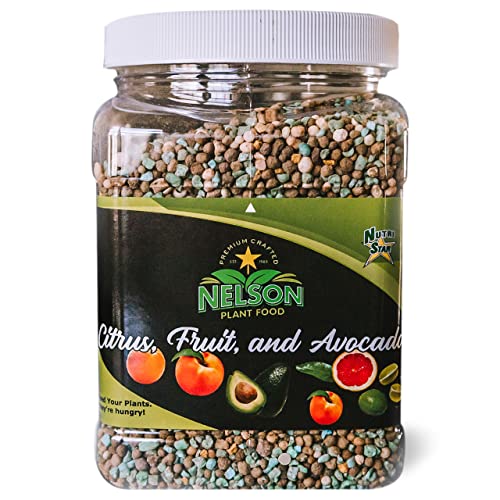
The granular feed built for citrus, avocado, and stone fruit that needs extra winter protection.
This 12-10-10 NPK formula from Nelson NutriStar focuses on what citrus and avocado trees crave most: a higher potassium level to help them survive colder weather and produce sweeter, firmer fruit. It also includes calcium to strengthen trunks and limbs, which matters for heavy-bearing trees like lemons and plums. The 4 lb bag targets a specific group — oranges, lemons, limes, avocados, grapefruits, kiwis, and even figs and persimmons — making it far more specialized than the all-purpose Espoma or Down To Earth options.
Shoppers say that an orange tree “took off and grew a full batch of new leaves” within two months of starting this fertilizer. That is impressive speed for a granular product, which usually works slower than liquids. The recommended application is every 30 days during the growing season, which is more frequent than the twice-a-year schedule of the Espoma bag but still manageable. At 4 lb, you get the same weight as the FoxFarm bag, but with a very different nutrient profile built for subtropical fruits.
One limitation is that the 12-10-10 ratio is too hot (too much nitrogen) for young trees or those planted in containers with limited root space. If you have potted citrus, the Jobe’s Organics Fruit & Citrus Spikes at a gentler 3-5-5 NPK ratio is a safer bet.
Key Strengths
- High potassium (10%) helps trees survive cold and improves fruit quality
- Added calcium strengthens trunks and limbs
- Fast visible results on citrus trees according to buyers
Consider This
- Not organic — synthetic granular formulation
- Requires monthly reapplication during growing season
Best suited for: Owners of in-ground citrus and avocado trees who want a targeted, high-potassium formula for cold-hardiness and heavy fruit production.
Not ideal for: Small potted trees or beginners — the strong ratio can burn delicate roots if over-applied.
6. Jobe’s Organics Fruit & Citrus Tree Fertilizer Spikes 3-5-5

The gentle organic spike that gives potted citrus exactly what it needs.
If you own a single Meyer lemon or a small container fig tree, this 6-count box of organic spikes is the perfect match. The 3-5-5 NPK ratio is deliberately low in nitrogen and higher in phosphorus and potassium, which supports root development and fruit production without overwhelming a small root system. Unlike the 30-count Jobe’s spikes (16-4-4, synthetic), these are OMRI-listed for organic gardening and contain Jobe’s Biozome — a proprietary blend of microorganisms including archaea (a type of microbe) that the brand claims breaks down material faster for quicker results.
Buyers confirm these are particularly effective on citrus. One reviewer with three potted Meyer lemon trees reports “an abundance of juicy, sweet lemons every year.” Another owner of heritage apple trees noted that using the spikes as directed — late fall or early spring, placed a few inches from the trunk — produced noticeable growth improvement. The spikes prevent wasteful runoff and are almost simple to use for beginners because the pre-measured doses eliminate guesswork.
For a small container garden, this is exactly what you need.
What Makes It Great
- Organic, OMRI-listed with Jobe’s Biozome for faster results
- 3-5-5 ratio is gentle on container and small trees
- No mixing, no mess, no measuring
What Holds It Back
- Only 6 spikes per package — runs out fast for multiple trees
- Higher price per spike compared to the bulk Jobe’s 16-4-4 box
Grab this if: You have a few potted citrus or small fruit trees and want a simple, organic feeding routine that is hard to mess up.
Look elsewhere if: You have a large in-ground orchard — you would run through the spikes too quickly and the cost per spike is high.
7. TPS Nutrients Fruit Tree Liquid Fertilizer 32 oz
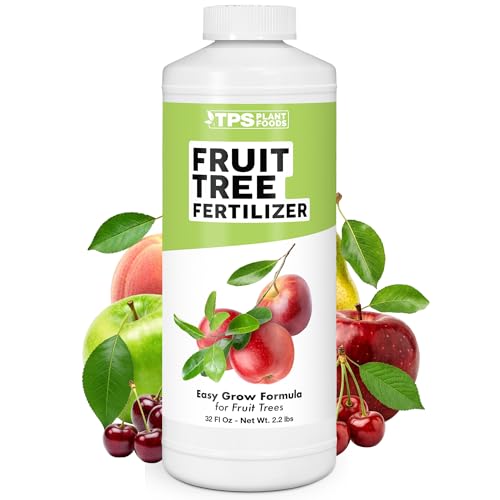
The concentrated liquid that delivers a fast boost through leaves or roots.
When a tree looks pale or you just want to push a quick growth spurt, nothing acts faster than a liquid fertilizer. This 32 oz bottle from TPS Nutrients concentrates down to a mixing ratio of 2 tablespoons per gallon of water, which buyers confirm mixes well and lasts a full spring and summer for a few trees. You can use it as a standard soil drench — pour the diluted mix around the base — or as a foliar spray (misting it onto the leaves), which gets nutrients into the tree’s system within hours instead of weeks.
Buyers report that it helped their peach, apple, and pecan trees bounce back, and one buyer mentioned the liquid “mixes well” and that a large bottle covers the entire growing season for apple and plum trees. It is versatile enough for backyard trees, containers, and small orchards. The liquid format also gives you total control over how much you feed each tree, unlike the pre-measured strength of spikes or granules.
The real trade-off is effort: compared to the set-and-forget simplicity of the Jobe’s 16-4-4 spikes, this requires mixing a fresh batch every time you feed. You also need to reapply every 2-4 weeks during the growing season for consistent results. It is not a lazy gardener’s tool, but for targeted rescue feeding or fine-tuning, it is class-leading.
Why It Works
- Fast-acting — nutrients are absorbed by leaves or roots immediately
- Versatile application: soil drench or foliar spray
- Large 32 oz bottle concentrates with a 2 tbsp/gal ratio
What Requires Patience
- Requires mixing and reapplication every 2-4 weeks
- Less convenient than spikes or slow-release granules for busy gardeners
Choose this if: You enjoy an active feeding routine and want a liquid solution that can rescue a struggling tree fast or be used as a foliar feed.
it’s not for you if: You want to feed once and forget about it until next season — go with the Jobe’s spikes or Espoma granules instead.
Understanding the Specs
NPK Ratio — The Three Numbers
The three hyphenated numbers on a fertilizer bag (like 6-2-4 or 16-4-4) are the percentages of Nitrogen, Phosphorus, and Potassium in the mix. Nitrogen (the first number) powers leaf and stem growth. Phosphorus (the middle number) supports root development and flower formation. Potassium (the last number) strengthens overall plant health, helps fruit ripen, and improves cold tolerance. A young tree you want to grow tall needs a high first number. A mature tree you want fruit from benefits from a more balanced ratio where the middle and last numbers are closer to the first.
Slow-Release vs Quick-Release
Slow-release fertilizers (like spikes or coated granules) break down gradually over weeks or months, so you apply them once and the tree gets a steady supply. Quick-release fertilizers (liquid concentrates) are absorbed almost immediately but require frequent reapplication. Spikes are the low-effort champion — push them in and forget them for a season. Liquids are the precision tool — mix, apply, and repeat every few weeks for a targeted boost. Most in-ground trees do fine with slow-release; containers and stressed trees sometimes need the speed of a liquid.
Organic vs Synthetic
Organic fertilizers use natural ingredients like feather meal, bone meal, kelp, or alfalfa meal. They feed the soil microbes that in turn make nutrients available to the tree. They work more slowly but improve soil structure over time. Synthetic fertilizers are manufactured to deliver pure nutrients in a fast-acting form. They give quicker green-up but can build up salts in the soil and burn roots if overused. Both can grow excellent fruit. The choice depends on whether you value long-term soil health (organic) or instant, measurable growth (synthetic).
Application Form — Spikes, Granules, Powder, Liquid
Spikes are solid sticks you hammer into the ground near the roots. They release nutrients over several months and are the easiest to use — no measuring, no mixing. Granules are tiny pellets you sprinkle on the soil and water in; they offer more control over dosage. Powders (like the Down To Earth product) are fine granules you mix into the top layer of soil. Liquids are concentrated syrups you dilute with water and pour onto the soil or spray onto leaves. The simpler your routine, the more you will appreciate spikes or granules. If you like tinkering, liquids give you total control.
FAQ
What is the best NPK ratio for fruit trees?
Are fertilizer spikes better than granules for fruit trees?
How often should I fertilize my fruit trees?
Can I use a general-purpose fertilizer on fruit trees?
What does OMRI listed mean?
How do I apply fertilizer spikes to my fruit tree?
Will liquid fertilizer burn my fruit tree roots?
What is Biozome in Jobe’s Organics products?
Final Thoughts: The Verdict
For most people, the best fertilizer for fruit trees winner is the Espoma Organic Tree-Tone 6-3-2 because the 36 lb bag gives you the most organic material per dollar, the calcium boost helps fruit quality, and the twice-a-year schedule fits any routine. If you want a completely hands-off feeding that drives fast growth, grab the Jobe’s Tree Fertilizer Spikes 16-4-4 with 30 spikes per box. And for a targeted organic revival of a single tree or a small container citrus, the Down To Earth Organic Fruit Tree 6-2-4 is the all-natural powder that buyers consistently report brings struggling trees back to life.
How We Picked
We do not accept paid placement. Every pick is matched to a real buyer and a real use-case; we do not hands-on test units.
Sources & Methodology
Specifications: manufacturer listings and product documentation. Review insights: verified customer reviews, as of July 2026. Pricing: not shown on this page (it changes often); check the current price via the retailer link.
As an Amazon Associate, Lawn Gear Lab earns from qualifying purchases. This does not affect which products we feature.