
Specs are compiled from manufacturer listings and verified buyer reviews and can change over time — please confirm the key details on the product page before buying.
You plant blackberry and raspberry canes hoping for buckets of sweet fruit, but a disappointing handful of sour berries is frustrating. The secret to a bumper crop is not luck — it is choosing the right balanced food that feeds the plants without burning them. This guide shows you the specific blends that berry growers rely on for a heavy harvest, not the marketing spin.
I’m Rikta — the founder and writer behind Lawn Gear Lab. This guide is built by comparing the manufacturers’ published specifications and the patterns across verified customer reviews, so you get each pick’s real strengths and trade-offs instead of marketing spin.
Finding the best fertilizer for blackberries and raspberries means matching the nitrogen, phosphorus, and potassium (N-P-K) balance to what your soil and plants need for root strength, flower set, and fruit flavor.
Our Picks at a Glance

How To Choose The Best Fertilizer For Blackberries And Raspberries
Berry plants need a lot of nutrients, but they are sensitive to too much nitrogen (the element that drives leaf growth). Too much nitrogen pushes leaves instead of fruit. A balanced ratio keeps the plant productive. For blackberries and raspberries, you want a formula that supports root development and flower production without creating a jungle of foliage.
The N-P-K Ratio That Matters
The three numbers on a fertilizer bag stand for nitrogen (N), phosphorus (P), and potassium (K). A moderate first number (nitrogen) prevents excessive cane growth. A higher third number (potassium) boosts sugar content and fruit size. Look for blends where the middle number (phosphorus) supports strong roots and flower set.
Granular vs. Water-Soluble
Granular fertilizers, like those from Espoma and True Organic, are dry pellets you sprinkle around the drip line (the area under the outermost branches where water drips off). They break down slowly and feed over several weeks. Water-soluble powders, like Greenway Biotech, dissolve completely and deliver nutrients immediately through the roots or leaves — useful for a quick boost or for hydroponic systems (growing plants in water without soil).
Organic Certification and Soil Impact
Many of the best berry fertilizers are OMRI-listed (approved for organic production), meaning they contain only natural ingredients. They often contain sulfur to lower soil pH (a measure of acidity or alkalinity), which helps blackberries and raspberries absorb iron and manganese. If your soil is already acidic, you can use a formula with less sulfur; if it is neutral or alkaline, a sulfur-containing blend is a smart choice.
Quick Comparison
| Model | Best For | Form | Weight | N-P-K Ratio | Amazon |
|---|---|---|---|---|---|
| Espoma Holly-Tone★ Best Overall | Acid-loving plants & general feeding | Granules | 4 Pounds (2 packs) | 4-3-4 | Amazon |
| True Organic Berry FoodRevival Pick | Reviving neglected patches | Granules | 4 Pounds | 5-4-4 | Amazon |
| Espoma Berry Tone | Maximum berry yield | Granules | 4 Pounds (2 packs) | 4-3-4 | Amazon |
| Greenway Biotech Strawberry | Sweetening fruit & hydroponics | Powder | 1 Pound | 8-12-32 | Amazon |
| Wellspring Gardens Mulberry Fuel | Slow-release care for fruit trees | Granules | 2 Pounds | 20-6-9 | Amazon |
In-Depth Reviews
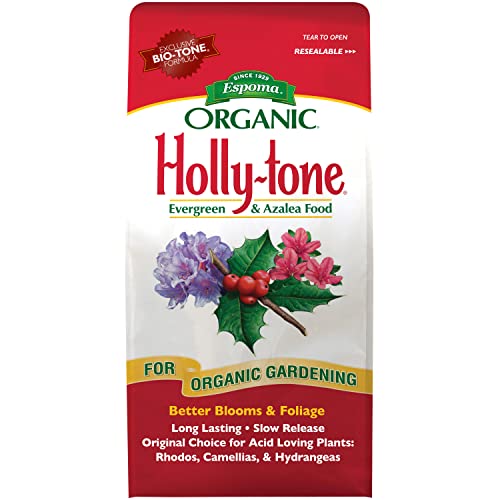
1. Espoma Organic Holly-Tone 4-3-4 (Pack of 2)
Our pick — over 4.5★ from 700+ verified ratings; the strongest balance of quality and price.
The classic acid-loving plant food that doubles as a solid trusty berry feeder.
This granular blend uses a 4-3-4 ratio (moderate nitrogen, balanced phosphorus, moderate potassium) and contains 5% sulfur to lower soil pH, so your blackberries and raspberries can access iron and other micronutrients (tiny nutrients the plant needs to stay healthy). You get two 4-pound bags per order, giving you 128 ounces total — enough for several established bushes or a new patch.
Its versatility sells it: it is labeled for azaleas, hydrangeas, blueberries, strawberries, and all acid-loving plants, meaning one bag covers your whole garden. Because it is a slow-release granule, there is no mixing required. You simply sprinkle it around the drip line of the plant in early and late spring and water it in. It is OMRI-listed (approved for organic gardening) and made in the USA.
Buyers report strong results on shrubs and evergreens, but some note that it is formulated more broadly than a dedicated berry fertilizer. If you already grow other acid lovers like hydrangeas or blueberries, this one bag handles everything. For a pure berry-specific focus, the Espoma Berry Tone below is a more targeted choice. If you have a neglected patch that needs revival, the True Organic Berry Food has more nitrogen (5-4-4) to give tired canes a fresh start.
Versatile feeder: A reliable organic granular option that covers all your acid-loving plants in one go, with two bags giving you solid coverage for the season.
Not berry-specific: Its general formula means it isn’t tune for the exact potassium boost that drives maximum berry sweetness.
Best if you: Want a single organic fertilizer that feeds your blackberries, raspberries, and your ornamental shrubs without buying separate bags.
Pick the Espoma Berry Tone instead if: You want a formula engineered specifically to boost berry sugar content and fruit size.
2. True Organic Berry Food 5-4-4 (4 lb)
The organic blend designed to revive worn-out berry patches with seabird guano and crab shell meal.
True Organic Berry Food uses a 5-4-4 ratio, delivering slightly more nitrogen (the first number) than the Espoma picks, which gives old or weak canes a gentle push. The 4-pound bag covers up to 58 square feet, and the manufacturer recommends monthly application during the growing season. Its ingredients include seabird guano (bird droppings rich in nutrients), shrimp and crab shell meal, and sulfur to help adjust soil pH naturally.
One reviewer noted that this product “revived neglected raspberry patch; older plants now producing beautiful berries.” The compost-like blend feeds the soil biology as well as the plant, making it a strong choice for gardeners focused on building long-term soil health. It is suitable for both in-ground and container berry plants. Compared to the Espoma Berry Tone’s berry-specific 4-3-4, this one has more nitrogen — so use it on plants that look weak, not on vigorous ones that already push lots of leaves.
Patch rescuer: The seabird guano and shell meal blend provides both quick and slow-release nutrients, and it has real reviews showing it revives older cane plants.
Higher nitrogen: The 5-4-4 ratio is less balanced for fruiting than the 4-3-4 formulas, so use it sparingly on plants that already produce lots of leaves.
Best for: Reviving a neglected raspberry or blackberry patch where the canes look weak and need a full-spectrum organic boost.
skip it if: Your berries are already putting out heavy foliage but small fruit — you need a higher-potassium formula instead, like the Greenway Biotech powder.
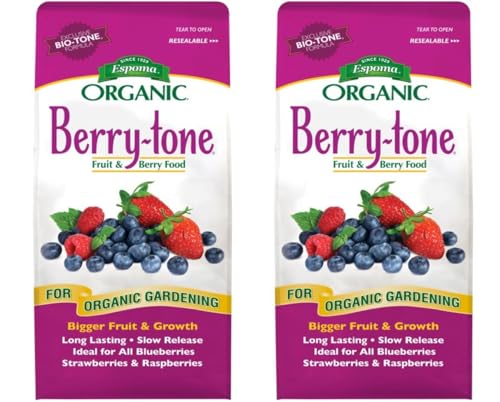
3. Espoma Berry Tone Plant Food 4-3-4 (4-Lbs., Pack of 2)
The berry-specific organic formula that gave one gardener “too many blackberries.”
This is Espoma’s dedicated berry blend, with a 4-3-4 analysis (nitrogen, phosphorus, potassium) and 5% sulfur, labeled specifically for blueberries, strawberries, raspberries, and blackberries. You get two 4-pound bags (128 ounces total) per order. One buyer mentioned they “used these for my blackberries last year and was shocked at how many I got from a single bush.” They described being “drowning in blackberries” and making syrups and desserts for most of the season.
The granules are ready to use — no mixing, no measuring fuss. You apply them in early and late spring around the drip line and water them in. The manufacturer claims the Bio-tone formula and organic ingredients feed the soil microbes while providing a steady release of nutrients. It is OMRI-listed for organic gardening and made in the USA since 1929.
Compared to the True Organic Berry Food, the Berry Tone has a lower nitrogen level (4 instead of 5), which is less likely to push excessive leafy growth at the expense of fruit. It is the closest thing to a set-and-forget berry fertilizer on this list, and the two-bag pack gives you plenty for a full season on multiple bushes. If you want maximum sweetness, the Greenway Biotech powder delivers a far higher potassium number (32) but requires mixing.
What berry growers love
- Specifically formulated for blackberries, raspberries, blueberries, and strawberries
- Two-bag pack provides 128 ounces of coverage for the season
- Approved for organic gardening with no mixing required
A small trade-off
- Potassium level (4) is modest compared to high-K fruiting formulas like Greenway Biotech’s 32
For most people, this is the one. If you want a simple, organic berry-specific granular that produces a heavy harvest without complicated mixing, this is it.
Consider the Greenway powder instead if: You want a water-soluble formula with high potassium for maximum sweetness.
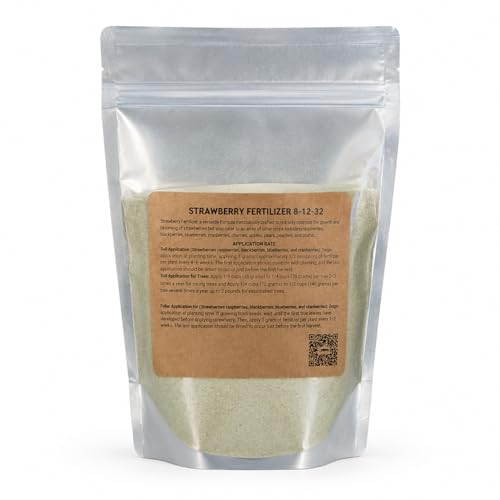
4. Greenway Biotech Strawberry Fertilizer 8-12-32 Powder (1 LB)
The high-potassium powder that turns sour berries into sweet, large fruit.
This is a water-soluble powder with an 8-12-32 analysis, meaning it delivers 32% potassium — a huge jump compared to the 4% in the Espoma Berry Tone. That high potassium is what drives sugar content and fruit size. The moderate 8% nitrogen prevents the excessive foliage that delays fruiting. It also includes chelated micronutrients (micronutrients pre-bound to a molecule so they stay available to plants) like iron, manganese, zinc, and copper that stay available across a pH range (a measure of acidity) of 4 to 9.
One owner reported, “My strawberry plants have grown stronger, and the fruits are larger and sweeter than ever before.” It is designed for soil drench (pouring the mixed solution onto the soil), foliar spray (spraying it on the leaves), drip irrigation (watering system that drips slowly), and hydroponics (growing in water without soil). The 1-pound bag contains 16 ounces, which is a fraction of the weight of the granular options, but because it is concentrated, it goes a long way.
The catch is that it is a powder requiring mixing with water at specific rates, and the 1-pound bag provides less total weight than the 4-pound granular bags. But for gardeners who want precise control over feeding and maximum berry sweetness, the Greenway powder is the only pick here with that level of potassium.
Sweetness specialist: The 32% potassium content directly increases sugar in the fruit, making it ideal if your berries taste sour or bland.
Requires mixing: Unlike the ready-to-use granules, you need to measure and dissolve the powder in water for each application.
Reach for this if: You want the sweetest possible berries and are comfortable mixing a water-soluble powder for targeted feeding.
Look elsewhere if: You prefer a no-mix granular that you can scatter and forget — the Espoma Berry Tone is a better fit.
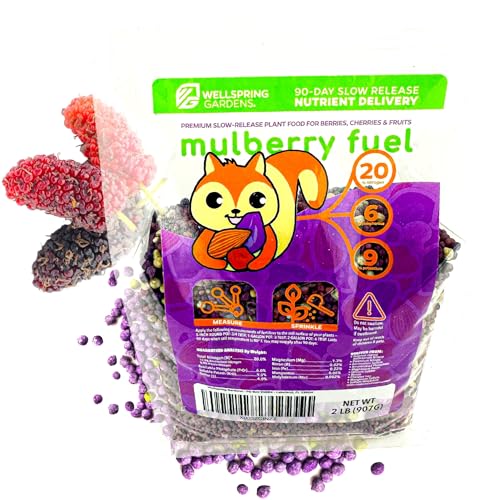
5. Wellspring Gardens Mulberry Fuel 20-6-9 (2 lbs)
The slow-release granular that feeds berry plants for 90 days with one application.
This is a 20-6-9 slow-release formula (the fertilizer is coated to release nutrients gradually) from Wellspring Gardens, designed for mulberries, berries, cherries, nuts, and fruit trees. The packaging is a resealable 2-pound bag. The key feature is the 90-day cycle of gradual nutrition release — you apply it once around the base, and it feeds steadily for three months. This is a markedly different approach from the monthly or twice-per-season schedule of the other granular picks.
One buyer who used it on kiwi vines called it “perfect for my prolific kiwi vines. Not only a fertilizer but a soil conditioner for plants that prefer a more acidic soil.” The higher 20% nitrogen means it is geared toward overall plant development and leaf canopy growth, which is useful for young or establishing plants that need structural strength before heavy fruiting.
The trade-off is clear: the 20-6-9 ratio is less ideal for berry production than the balanced 4-3-4 of the Berry Tone or the high-potassium 8-12-32 of the Greenway powder. Established blackberries and raspberries in their fruiting years will benefit more from those options. But for a new planting or a fruit tree that also needs strong root and branch development, the 90-day convenience is a real advantage.
Set-and-forget: One application covers 90 days, so you are not re-applying every few weeks during the growing season.
Nitrogen-heavy: The 20-6-9 ratio prioritizes leaf and cane growth over fruit sweetness and size.
Best for: New berry plantings or mixed fruit trees where you want a single slow-release application for the whole season.
pass on it if: Your berries are established and you want a formula that boost fruit production and sugar content — you are better off with the Espoma Berry Tone.
Understanding the Specs
N-P-K Ratio
The three numbers on a fertilizer label stand for nitrogen (N), phosphorus (P), and potassium (K). Nitrogen (first number) drives leaf and cane growth. Phosphorus (second number) supports root development and flower set. Potassium (third number) determines fruit size, sugar content, and disease resistance. For blackberries and raspberries, a moderate first number and a higher third number is the balance.
Granular vs. Water-Soluble
Granular fertilizers are dry pellets that release nutrients slowly as they break down, usually requiring one or two applications per season. Water-soluble powders dissolve completely in water and deliver nutrients immediately through the roots or leaves. Granules are easier for a quick scatter-and-go application; powders give you precise control for a targeted boost.
Sulfur Content and Soil pH
Blackberries and raspberries prefer slightly acidic soil with a pH (a measure of acidity or alkalinity) between 5.5 and 6.5. Fertilizers that contain elemental sulfur help lower soil pH, making iron, manganese, and other micronutrients more available to the plant. If your soil is naturally acidic, you can use a formula without added sulfur. If it is neutral or alkaline, a sulfur-containing blend prevents nutrient lockout (when the plant cannot absorb nutrients because the pH is wrong).
Organic Certification
OMRI-listed (Organic Materials Review Institute) fertilizers are approved for organic production, meaning they contain only natural ingredients and no synthetic chemicals. Organic blends often include composted materials, seabird guano (bird droppings), bone meal, or feather meal. They feed the soil microbes as well as the plant, improving long-term soil structure and moisture retention.
FAQ
What N-P-K ratio is best for blackberries and raspberries?
Should I use granular or liquid fertilizer for my berry bushes?
How often should I fertilize blackberry and raspberry plants?
Can I use a general-purpose fertilizer on my berries?
Do blackberries and raspberries need acidic soil?
Is organic fertilizer better for berry plants?
How much fertilizer do I apply per berry bush?
Can I over-fertilize my blackberry bushes?
What is the difference between Holly-Tone and Berry Tone?
Should I fertilize newly planted raspberry canes?
Final Thoughts: The Verdict
Across the board, the best fertilizer for blackberries and raspberries is the Espoma Berry Tone because it is a berry-specific organic granular that produces a consistently heavy harvest with no mixing and two bags per order. If you want sweeter, larger fruit with a targeted potassium boost, grab the Greenway Biotech Strawberry Fertilizer. And for reviving a neglected patch or building long-term soil health, the True Organic Berry Food is your best bet.
How We Picked
We do not accept paid placement. Every pick is matched to a real buyer and a real use-case; we do not hands-on test units.
Sources & Methodology
Specifications: manufacturer listings and product documentation. Review insights: verified customer reviews, as of July 2026. Pricing: not shown on this page (it changes often); check the current price via the retailer link.
As an Amazon Associate, Lawn Gear Lab earns from qualifying purchases. This does not affect which products we feature.