
Specs are compiled from manufacturer listings and verified buyer reviews and can change over time — please confirm the key details on the product page before buying.
Thin, browning arborvitae that look “tired” after winter are the number-one sign your soil is missing something. The right fertilizer does not just green things up — it builds deep root strength so your privacy hedge survives the next drought or deep freeze without losing needles by the handful.
I’m Rikta — the founder and writer behind Lawn Gear Lab. This guide is built by comparing the manufacturers’ published specifications and the patterns across verified customer reviews, so you get each pick’s real strengths and trade-offs instead of marketing spin.
Whether you are planting a new row of emerald greens or reviving an old staggered hedge, this roundup of the best fertilizer for arborvitae breaks down what each product actually delivers for your soil and your schedule.
Quick Picks
- Jobe’s Slow Release Evergreen Fertilizer Spikes — Best Overall
- Arborvitae Tree Fertilizer — Premium Organic
- TreeHelp Premium Fertilizer for Arborvitae — Targeted Feed
- Jobe’s 01661 Evergreen Fertilizer Spikes — High-Performance Spikes
- Espoma Organic Evergreen-Tone 4-3-4, 8 lb — Organic Granules
- Espoma Organic Holly-Tone 4-3-4, 36 lb — Large-Volume Feed
How To Choose The Best Fertilizer For Arborvitae
Arborvitae roots are shallow and wide-spreading — they do not dig deep like a taproot (a single, deep central root). That means a granular feed you sprinkle on top can get washed away before the plant ever absorbs it. The best approach delivers nutrients steadily just below the surface, where the fine feeding roots actually live.
NPK Ratio: What the Numbers Mean for Your Hedge
The three numbers on the bag (Nitrogen-Phosphorus-Potassium) tell you what the fertilizer prioritizes. Nitrogen pushes green foliage growth, which arborvitae need for that dense privacy screen. Phosphorus supports root development, and potassium helps overall plant health and stress resistance. Most arborvitae-friendly blends sit around a 4-3-4 or an 11-3-4 mix — high enough in nitrogen to green up fast without shocking the roots.
Form Factor: Granules, Spikes, or Liquid?
Granules you spread by hand or with a spreader work well for large hedges, but they need to be watered in and can run off on slopes. Spikes are pre-measured and hammer straight into the ground directly at the drip line (the circle below the outer branches), which puts food right where the roots are — no mess, no guesswork. Liquid concentrates mix with water and take effect fast, which is helpful for stressed or newly planted trees, but you have to reapply more often. Your choice really depends on how many trees you are feeding and how much time you want to spend.
Quick Comparison
| Model | Best For | Form | NPK Ratio | Item Weight | Amazon |
|---|---|---|---|---|---|
| Jobe’s Slow Release Spikes (9 ct) | Easy no-measure feeding | Spikes | 11-3-4 | 3.68 ounces | Amazon |
| Espoma Organic Evergreen-Tone 8 lb | Organic granular for established shrubs | Granules | 4-3-4 | 8 pounds | Amazon |
| TreeHelp Premium for Arborvitae | Targeted liquid feed for browning trees | Liquid | 1:1 | 1.5 Kilograms (approx 3.3 lb) | Amazon |
| Jobe’s 01661 Spikes (15 ct) | Long-season spike feeding | Spikes | 15-3-4 | 1 pound | Amazon |
| TPS Nutrients Arborvitae Liquid 32 oz | Quick liquid rescue for stressed trees | Liquid | 2 tbsp per gallon | 32 ounces | Amazon |
| Espoma Organic Holly-Tone 36 lb | Large-scale acid-loving plant feeding | Granules | 4-3-4 | 36 pounds | Amazon |
In‑Depth Reviews
1. Jobe’s Slow Release Evergreen Fertilizer Spikes, 9 Count

Hammer-and-forget feeding that puts a 11-3-4 mix directly at the root zone.
You never measure, spill, or guess with these Jobe’s spikes — each is a pre-measured dose of a 11-3-4 NPK (Nitrogen-Phosphorus-Potassium) slow-release formula that you drive into the ground at the drip line (the circle under the outer branches) twice a year. The spikes weigh just 3.68 ounces for a pack of 9, which makes them far lighter than the 8-pound Espoma bag, and they are designed for cypress, juniper, and magnolia trees as well as arborvitae, according to the brand. Buyers report that using a 1-inch old auger bit to pre-drill holes makes installation easy — one reviewer has used them for 12 years on blue spruce, citrus, and fruit trees with consistent results. Because each spike is a sealed dose, you cannot burn the roots by over-fertilizing, unlike with the granular Espoma products where you measure and spread.
Unlike the Espoma Evergreen-Tone granules that need spreading and watering in, these spikes release nutrients right at the root zone with no runoff risk. If you have 2 to 4 medium arborvitae, one pack handles the year. For a longer hedge of 20 trees, you will need multiple boxes, which gets less economical than one 36-pound Holly-Tone bag.
What works
- Pre-measured spikes eliminate guesswork and spill
- Slow-release design provides consistent nutrients below the surface
- No risk of over-fertilizing
- Easy to apply by hand or with a drill bit
Watch out for
- Only 9 spikes per pack — you may need multiple boxes for a long hedge
- Not the best fit for extremely large or newly planted trees that need a liquid boost
Reach for this if: you have 2-4 medium arborvitae or evergreens and want a low-maintenance feed that does not require mixing bags.
Look elsewhere if: you are feeding a long row of 20+ trees and need a more economical granular option.
2. Arborvitae Tree Fertilizer – Liquid Plant Food, 32 oz
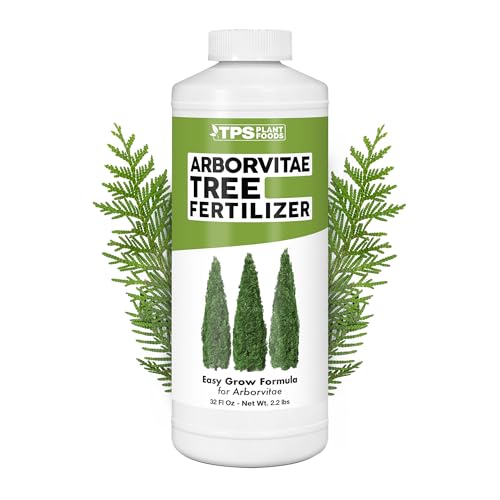
A concentrated liquid formula that rescues stressed arborvitae fast.
This TPS Nutrients liquid feed is formulated specifically for arborvitae and evergreens, and it delivers nutrients through the soil faster than the Jobe’s spikes or Espoma granules. You mix 2 tablespoons per gallon of water and apply it around the root zone (the soil area directly under the branches). The 32-ounce bottle of concentrate — the same volume as the TreeHelp but with a different application method — gives you many treatments. One reviewer noted this “kept newly planted arborvitae alive through a Chicago winter” while the neighbor’s unfertilized trees died, showing how a quick root-zone feed helps new transplants survive harsh conditions. Reviewers also mention that bi-weekly feeding on sandy soil revived dying branches and produced “fantastic green growth.” Another noted it restored brownish arborvitae near a pool area back to a healthy, green, soft, vibrant state, and it works easily with a sprayer or a sprinkling can.
Unlike the TreeHelp Premium that the brand describes as very slow-acting, this liquid gives roots an immediate nutrient boost — the best pick if your trees are yellowing or have dropped needles after a harsh winter. You do have to mix and apply every few weeks, which takes more hands-on time than the two-per-year Jobe’s spikes, so it is not a “set it and forget” solution.
Quick-acting rescue: Unlike the Jobe’s spikes that take weeks to release, this liquid gives roots an immediate nutrient boost — perfect for trees that are yellowing or have dropped needles.
Multiple uses: One 32-ounce bottle treats many trees over several applications, and it is easy to apply with a watering can or hose-end sprayer.
Best for: homeowners who notice their arborvitae are browning or have lost density and want to see improvement within weeks.
Consider skipping if: you prefer a “once or twice a year” approach and do not want to mix and apply every few weeks.
3. TreeHelp Premium Fertilizer for Arborvitae
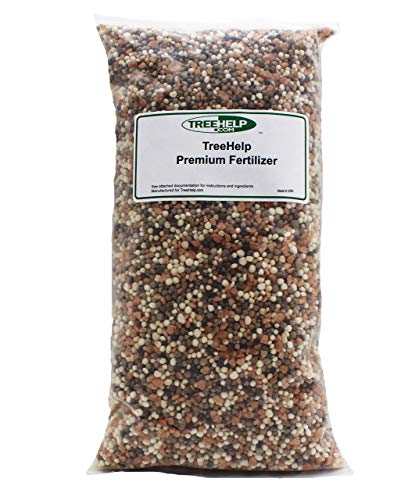
A liquid made specifically for arborvitae, aimed at long-term root strength.
TreeHelp markets this as specially formulated for arborvitae, and it puts its emphasis on root development rather than just quick green-up. The slow-release nitrogen (a type of nitrogen that feeds plants gradually over weeks) is designed to continue feeding through the entire growing season — one 52.91-ounce container treats one large tree or 2-3 smaller or newly planted trees. That is a larger volume (52.91 ounces) than the 32-ounce TPS liquid, so you get more volume per box if you are feeding a bigger hedge.
One buyer with 50 arborvitae planted in a row sprinkled this before a heavy rain and reported that the trees, which had been browning, greened up. Other owners mention it “looks like it’s working” on trees that needed help. The main caution from reviewers is that the feeding is very slow — one person said “it took awhile for the food to work in to the ground” — so do not expect overnight results, unlike the TPS liquid that is designed for fast relief. A few users also questioned whether the full 3-pound dose for one mature tree was too much, suggesting you might experiment with a lighter application.
Why it stands out
- Formulated specifically for arborvitae, not just general evergreens
- Larger 52.91 oz volume covers more trees than the 32 oz liquid competitor
- Slow-release nitrogen feeds across the entire growing season
- Easy to sprinkle and water in
Things to note
- Action is very slow — results may take many weeks
- Some users report no visible difference after application
- Dosing instructions may seem high for smaller trees
Who it fits: anyone with multiple arborvitae (10+ trees) who can wait a season for results and wants a dedicated arborvitae formula rather than a general evergreen feed.
Who should pass: if you need fast green-up for stressed trees or have only one or two small plants, the smaller liquid option above may be a better fit.
4. Jobe’s 01661 Evergreen Fertilizer Spikes, 15 Count

A higher-nitrogen spike for bigger, faster green growth on established trees.
You get 15 spikes — 6 more than the 9-pick Jobe’s pack — and each has a 15-3-4 formulation, compared to the 4-3-4 in the Espoma organic options. That much nitrogen pushes dense, lush foliage on trees that already have a solid root system, so your privacy screen fills in faster. Each spike feeds for up to 90 days, so two applications per year (spring and fall) cover the full growing season. The 15 spikes weigh 1 pound total, which is heavier than the 3.68-ounce 9-pack, reflecting the larger count and dose.
Customers note this product “does not break apart or crumble” when driven into the ground, unlike some softer spikes. One buyer mentioned their aloe grew rapidly with nutrients and that fruit trees yielded more, tastier, healthier fruit. Another called these the “absolute BEST fertilizing spikes for my green giant trees.” Unlike the Espoma organic granules that build soil slowly, these spikes are designed for a faster, more aggressive green-up — but because the nitrogen is much higher, they can burn sensitive or newly planted roots if you overdo it. The one consistent tip is to moisten the ground first — dry soil makes hammering hard, and a few users needed a hammer claw to retrieve the plastic cap.
Pros
- High-nitrogen 15-3-4 formula fuels dense foliage growth
- 15 spikes per pack, feeding up to 90 days each
- Spikes hold together well during installation
Cons
- Hard to insert into dry, hard soil — requires pre-soaking
- High nitrogen can burn sensitive or newly planted trees if overused
Ideal for: mature, established arborvitae and green giants where you want to push rapid, dense growth and have a few minutes to soak the ground first.
Not for: young transplants or trees in very compacted soil where hammering spikes may damage roots.
5. Espoma Organic Evergreen-Tone 4-3-4, 8 lb

A classic organic granular feed that conditions the soil as it feeds the tree.
This 4-3-4 organic fertilizer from Espoma has 5% sulfur (a mineral that helps lower soil pH), which keeps the slightly acidic soil (6.0-7.0 pH) that arborvitae prefer. The 8-pound bag is a medium size — easier to carry than the 36-pound Holly-Tone but enough for several established shrubs if you follow the twice-yearly schedule (early spring and late fall). It is approved for organic gardening, meaning no sludges or toxic ingredients, and it comes ready to use with no mixing required.
One owner reported “I applied it to my yard just before fall and the plants thrived well into November, the following spring everything in the yard grew so much stronger.” Another reviewer, who bought it specifically as “arborvitae fertilizer,” noted it was easy to apply but said they would need to wait several months to see how well it helped their arborvitae. Unlike the Jobe’s spikes that feed directly at the root zone, these granules need rain or watering to carry nutrients down, so they depend on moisture. The main complaint is the strong odor from the organic ingredients, which is common with natural fertilizers and may be noticeable near a patio.
Organic soil-builder: Unlike synthetic spikes that just feed the tree, the Espoma granules feed the soil microbiome (the beneficial organisms in the soil), which builds long-term root health — one buyer called it “the most effective fertilizer I have ever used.”
Best timing: Apply in early spring before new growth appears and again in late fall after leaf drop for a steady nutrient supply into winter.
Suits: gardeners who prefer organic products and want to improve soil quality, not just green up the foliage.
Avoid if: you have a very long hedge (20+ trees) — you will need multiple bags, and the 36-pound Holly-Tone below may be more economical.
6. Espoma Organic Holly-Tone 4-3-4, 36 lb

The original acid-loving plant food in a bag big enough for a whole hedge row.
Holly-Tone is the same 4-3-4 organic formula as the Evergreen-Tone above, but in a massive 36-pound bag designed for all acid-loving plants — hollies, azaleas, rhododendrons, blueberries, and evergreens like arborvitae. At 36 pounds versus 8 pounds, this is the obvious choice if you have a long row of arborvitae to feed in both spring and fall without running back to the store. The natural organics break down slowly in the soil, creating a long-lasting reservoir of nutrients that builds soil health season after season.
Buyers rave about this product — one called it “miracle level” and said the growth of their trees was “incredible” after using it, noting they will never use another fertilizer. Another buyer appreciated the price value on the 36-pound bag, saying it is enough for spring and fall feedings. A reviewer from the Bay Area said it works great for magnolias. Because the 4-3-4 ratio here matches the TreeHelp and Evergreen-Tone, this big bag saves you from buying multiple smaller containers. The trade-off is the 36-pound weight — you lug it once, then it lasts. It is also not a quick fix, so if you need immediate green-up, you get faster results from the TPS liquid.
What makes it great
- 36-pound bag covers a large hedge or many shrubs for a full season
- Organic Bio-tone formula conditions soil and feeds roots
- Ready to use — no mixing, just spread and water
- Approved for organic gardening
What to consider
- Heavy bag to carry and store
- Strong organic odor may be noticeable during application
- Not a quick fix — results build over several months
Best for: homeowners with a long privacy hedge (10+ arborvitae) who want a single bag to handle both spring and fall feedings with an organic product.
Too much if: you have only one or two trees — the 8-pound Evergreen-Tone or the Jobe’s spikes will be more practical and easier to store.
Understanding the Specs
NPK Ratio — the three numbers that control growth
The first number (Nitrogen) determines how green and dense the foliage gets — arborvitae hedges need a decent amount for that full privacy screen. The second number (Phosphorus) supports root development, which is critical when you first plant or transplant. The third (Potassium) helps the tree handle stress from drought, cold, or disease. A 4-3-4 or 11-3-4 ratio is typical for evergreens; a very high first number like 15-3-4 is best reserved for mature trees that you want to push hard.
Form factor — how you get the food to the roots
Granules (like the Espoma bags) are spread on the soil surface and need rain or watering to carry nutrients down. Spikes (like the Jobe’s products) are hammered directly into the ground at the drip line (the circle under the outer branches), so the nutrients release right where the feeding roots are — no runoff. Liquids (like the TPS and TreeHelp products) are mixed with water and applied quickly, making them ideal for a mid-season boost or for stressed trees that need fast relief, but they require more frequent reapplication.
FAQ
When is the best time to fertilize arborvitae?
What NPK ratio is best for arborvitae?
Can I use a general evergreen fertilizer on arborvitae?
How many fertilizer spikes do I need per tree?
Is liquid or granular fertilizer better for arborvitae?
Can I over-fertilize arborvitae?
How do I apply fertilizer spikes to arborvitae?
Do arborvitae need acidic soil?
Can I use fertilizer spikes on newly planted arborvitae?
Why are my arborvitae turning brown after fertilizing?
Final Thoughts: The Verdict
For most people, the best fertilizer for arborvitae winner is the Jobe’s Slow Release Spikes (9 ct) because they combine simple to use installation with a balanced 11-3-4 slow-release feed that works on established trees and new hedges alike. If you prefer a quick liquid boost that rescues stressed trees, grab the Arborvitae Tree Liquid Fertilizer (32 oz). And for organic gardeners with a long privacy hedge, the Espoma Organic Holly-Tone 36 lb bag gives you the most feed for your dollar in one box.
How We Picked
We do not accept paid placement. Every pick is matched to a real buyer and a real use-case; we do not hands-on test units.
Sources & Methodology
Specifications: manufacturer listings and product documentation. Review insights: verified customer reviews, as of July 2026. Pricing: not shown on this page (it changes often); check the current price via the retailer link.
As an Amazon Associate, Lawn Gear Lab earns from qualifying purchases. This does not affect which products we feature.