
Specs are compiled from manufacturer listings and verified buyer reviews and can change over time — please confirm the key details on the product page before buying.
If your lawn looks tired, water puddles instead of soaking in, or fertilizer seems to roll off the surface, the soil underneath is likely compacted. Core aeration (pulling actual plugs of soil out of the ground) is the fix. The right machine means the difference between a chore that works and one that just tears up your grass.
This guide is based on comparing manufacturer specifications and patterns across verified customer reviews. You get each pick’s real strengths and trade-offs instead of marketing spin.
Whether you tow behind a tractor or work a manual tool by hand, you need a machine that pulls clean plugs, handles your soil type, and does not fall apart mid-season. These picks cover the range. That is what this roundup of the best core aerators for lawns delivers.
Our Picks at a Glance

How To Choose The Best Core Aerators For Lawns
Every core aerator does the same basic job — it pulls small plugs of soil out of the ground so air, water, and nutrients can reach the roots. The way you get there depends on your yard size, your tractor (or lack of one), and your soil’s stubbornness.
Tow-Behind vs. Manual
Tow-behind aerators attach to a lawn tractor or ATV and cover ground fast. They typically have 24 plugging points (the metal tines that extract soil cores) and a weight tray you load with cinder blocks or sandbags to push the tines deeper. Manual core aerators are pushed or stepped on by hand — much slower, but they work on any size yard and cost less. If your lawn is under a quarter acre, a manual unit is fine. Over that, a tow-behind saves your back.
Plug Depth and Tine Quality
The best core aerators pull plugs at least 2 to 3 inches deep (depth measured from the soil surface to the bottom of the extracted core). Shallow plugs do not relieve compaction deep enough. Look for heat-treated (hardened through high-temperature processing) or galvanized (zinc-coated to resist rust) steel tines that stay sharp and resist rust. Stainless steel is also good, especially for manual tools that see wet soil often.
Weight Capacity
For tow-behind models, a weight tray that holds 125 to 150 pounds (the amount of extra ballast you can add, like cinder blocks or sandbags) lets you dial in how deep the tines go. Heavier soil like clay needs more weight. Lighter sandy loam needs less. A tray that accepts standard cinder blocks is a practical bonus because you probably already have some sitting around.
Build and Assembly
Look for all-steel frames and welded tine sections. Bolted assemblies that rattle loose are a common complaint in reviews. Assembly time on tow-behind units ranges from one to three hours. Models with clear instructions and pre-bagged hardware save frustration.
Quick Comparison
| Model | Best For | Plug Points | Item Weight | Weight Tray Capacity | Amazon |
|---|---|---|---|---|---|
| Brinly PA-403BH-A3★ Best Overall | Deep penetration on tough soil | 24 | 63.9 lb | 150 lb | Amazon |
| Xuperace GD0001-02Clog-Free Manual | Manual work with no clogging | 3 | 5.69 lb | — | Amazon |
| Agri-Fab 45-0474 | Budget tow-behind | 24 | 29 lb | — | Amazon |
| Landzie Original | Ready-to-use manual tool | 3 | 5.6 lb | — | Amazon |
| Suchtale LTA-005A | Mid-size yards on a budget | 24 | 55 lb | 125 lb | Amazon |
| Craftsman CMXGZBF7124213 | Heavy-duty yard work | 24 | 78.8 lb | 140 lb | Amazon |
In‑Depth Reviews
1. Brinly Tow Behind Plug Aerator with Universal Hitch, 40″ – Flat Black
Our pick — over 4★ from 950+ verified ratings; the strongest balance of quality and price.
The Brinly is the heavy lifter for anyone with a tractor and compacted clay soil. It pulls plugs up to 3 inches deep thanks to a 150-pound weight tray.
This tow-behind aerator uses 24 heat-treated, 16-gauge steel plugging spoons. The maker designed them narrower with sharpened ends for easier penetration, so you do not need a monster tractor to pull good plugs. It pulls cores up to 3 inches deep (the length of the soil extracted), and its fully-enclosed weight tray holds up to 150 pounds of any type of extra weight for maximum penetration in hard ground. At 63.9 pounds the frame itself is all steel, and the three independently rotating welded tine sections minimize turf damage on turns and follow uneven terrain.
Buyers report assembly took them about 2.5 hours, noting the directions were clear but extra parts were included. One owner on a 1-acre lot used 2 concrete blocks for ballast and got roughly 3-inch plugs on soft ground. The universal hitch (a single-pin connector that fits most lawn tractors and zero-turn-radius mowers) fits most lawn tractors and ZTRs. On the downside, the 40-inch width means it stores large — it does not fold.
If your soil is heavy clay that binds tight, the Brinly’s 150-pound weight tray and aggressive spoons pull plugs up to 3 inches deep while the Suchtale pulls up to 2 inches deep.
Why you want this one
- 24 sharpened-steel spoons pull plugs up to 3 inches deep
- 150-pound weight tray for serious soil penetration
- Three independent tine sections protect turf on turns
The trade-offs
- Assembly took some owners over 2 hours
- Large footprint makes storage tricky without wall space
Reach for this if: you have a lawn tractor, compacted soil, and want the most aggressive plugging action at this size.
Look elsewhere if: you lack a tractor or your yard is under a quarter acre — a manual unit costs less and stores easier.
2. Xuperace Lawn Aerator Tool, Core Aerator Lawn Tool with Alloy Steel Material
A manual aerator that actually sheds soil plugs instead of packing them solid — its side-eject design stops the clogging that ruins the Landzie’s momentum in sticky soil.
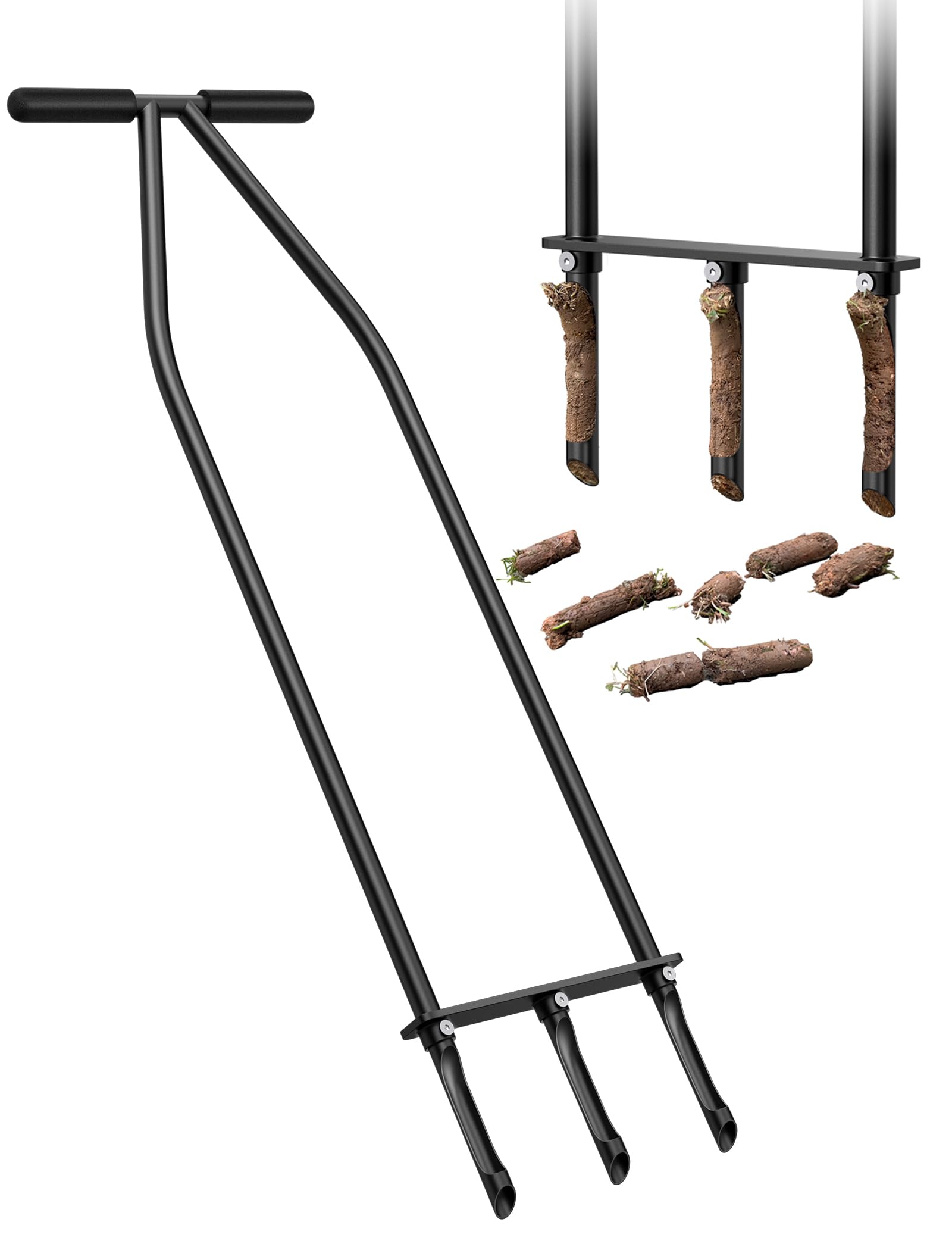
The biggest frustration with manual core aerators is clogging: soil jams inside the hollow tines and you stop every few steps to poke them clear. Xuperace solved this with a patented side-eject design (soil plugs slide out through a side ramp as you press the next one in). The tool has 3 hollow tines made of high-strength alloy steel, and the frame is integrally formed rather than bolted together. Weighing 5.69 pounds, its 42 x 11 x 1.9-inch dimensions mean a long handle for standing upright while you work.
The footplate has a central opening so your knee moves freely without banging the center bar — a detail one reviewer called out as perfect compared to other brands. Owners mention the tool works best in moist soil, and one 72-year-old female user said she could use it for about an hour at a time, recommending lifting with the legs to avoid arm fatigue. The middle tine can be removed for easier pressing in very hard ground, and replacement tines screw on.
Buy this if you want a manual tool that keeps working without constant unclogging. skip it if you have a large lawn — even the fastest manual aerator is much slower than a tow-behind.
What stands out
- Side-eject design stops clogging — soil pops out with the next dig
- Knee-friendly open footplate
- Removable middle tine for hard soil
What to watch for
- Screws can loosen after first use — keep the included Allen wrench handy
- Does not work well on bone-dry ground
3. Agri-Fab 45-0474 SmartLink Plug Aerator, 40 Inch

The lightest tow-behind on this list at 29 pounds, but it still pulls 3-inch soil plugs — a smart budget pick for smaller tractor owners.
It uses 24 rustproof aerator knives (tine-like tools that cut and extract plugs) to loosen 3-inch soil plugs. Its SmartLink system (a frame-locking design from Agri-Fab) lets you swap attachments on the same frame if you also use a dethatcher or spike aerator. The 3-year limited warranty adds confidence.
Customers note easy assembly in about 30 minutes with a video guide, and one owner used it on 3 acres of varying soil without issues — the plugs were clean and the aeration holes improved fertilizer uptake. A common complaint is packaging damage during shipping; some units arrived with missing hardware. The weight adjustment is trial-and-error, and there is no dedicated weight tray, so you have to get creative with ballast.
It works best on moist soil, and for the money it offers good build quality, though the Suchtale offers a built-in 125-pound weight tray for easier depth control.
Why it earns its spot
- Quick 30-minute assembly according to owners
- SmartLink system compatible with other attachments
- 3-year limited warranty
The catch
- No dedicated weight tray — you need to rig your own ballast
- Packaging damage during shipping is a recurring complaint
Go for this if: you want an affordable tow-behind that is easy to assemble and store, and you already own other SmartLink attachments.
pass on it if: your soil is heavy clay that needs serious weight — the Brinly or Craftsman dig deeper with less effort.
4. Landzie The Original Hollow Tine Lawn Aerator Tool, 42 Inch
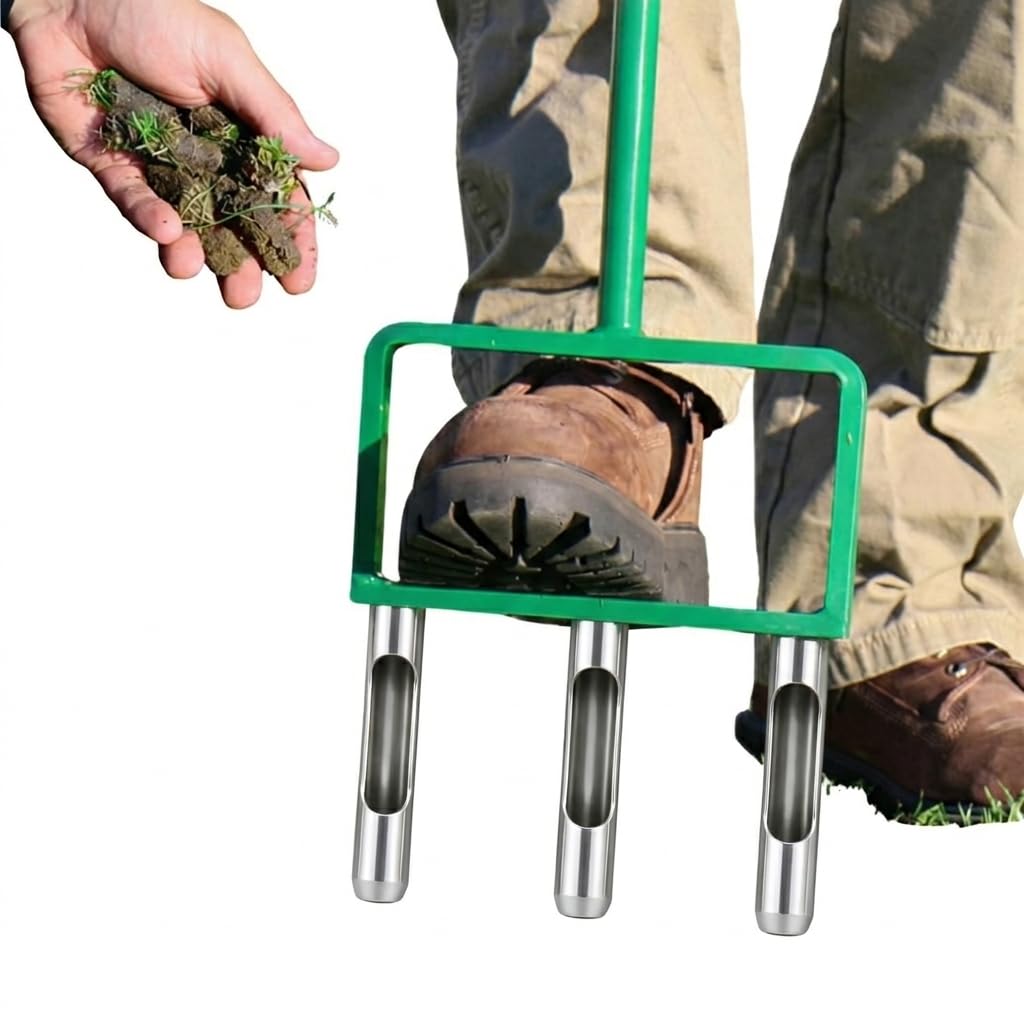
from the start and into the lawn with zero setup time — the Landzie’s 3 stainless steel tines are already fitted.
The Landzie arrives with its 3 stainless steel hollow tines already fitted to the frame — no assembly, no tools needed. This manual core aerator weighs 5.6 pounds and its dimensions are 9 x 1.5 x 42.38 inches. The tines are beveled (angled at the tip to slice through soil) to resist clogging, pushing old material up and out each time you press down. It is designed for landscapers and homeowners who want something durable that stores flat.
Reviewers point out it works well on damp soil — one 6-foot-tall, 225-pound user found a pogo-stick motion easier than stepping down hard. Another reviewer with dense clay soil recommended light watering morning and evening for easier plugging. The downside: it is physically demanding on large areas, and some owners reported that compacted or dry soil only let the tines reach about 2 inches instead of the full depth.
The Landzie and the Xuperace are close competitors; the Landzie offers no assembly while the Xuperace offers side-eject clog prevention.
The good stuff
- Ready to use from the start with no setup
- Replaceable stainless steel tines available
- Very sturdy build for dense soil
The hard truth
- Very physically demanding — one owner called it “brutal” on 1200 sq ft
- Tines can clog in certain soil conditions despite the beveled design
5. Suchtale 40-Inch Tow Behind Plug Aerator with Universal Hitch

A budget-friendly tow-behind with a real 125-pound weight tray and solid construction — it pulls plugs up to 2 inches deep, still effective for moderate compaction.
The Suchtale gives you 24 heat-treated coring plugs that penetrate compacted soil up to 2 inches in depth. Its all-steel weight tray holds up to 125 pounds of extra weight — cinder blocks, bricks, or sandbags — so you can adjust penetration for your soil type. The 55-pound frame is reinforced with thick side plates and a solid steel axle, and the maker used 6 mm steel for the adjust handle instead of the usual 4 mm to prevent bending. The 2-piece steel draw bar with a universal hitch pin connects to most lawn tractors and ATVs.
Shoppers say assembly is straightforward in 1 to 2 hours solo, and it works well on sandy topsoil with just 4 bricks. One owner with clay soil used 5 cinder blocks after a quarter-inch of rain and got good results. The structure has bearings in the wheels for a higher load capacity, and a transport handle makes crossing driveways easy. A few reviewers noted missing bolts in the box and that it is less maneuverable on hills due to its 40-inch width, but the value is strong for the price.
It weighs 55 pounds (the Brinly weighs 63.9 pounds and the Craftsman weighs 78.8 pounds) but it only accepts 125 pounds of ballast (the Brinly accepts 150 pounds and the Craftsman accepts 140 pounds). For mid-size yards with average soil, this is a capable budget pick.
What works
- Built-in 125-lb weight tray for adjustable penetration
- Reinforced steel construction resists bending
- Easy assembly in about 1-2 hours
Where it cuts corners
- Plugs only reach 2 inches deep vs. 3 inches on premium models
- Some units arrived with missing hardware
6. Craftsman 40 Inch Tow Behind Lawn Plug Aerator with 24 Galvanized Steel Coring Points

A heavy-duty machine built by Agri-Fab in Illinois. At 78.8 pounds, its extra mass helps the tines sink in.
The Craftsman uses 24 galvanized steel coring points that pull soil plugs up to 3 inches deep, and its wide weight tray supports up to 140 pounds of ballast for tough ground. At 78.8 pounds it is the heaviest unit on this list. The lift handle release system makes transport easy across driveways, and the frame stores vertically against a wall to save floor space. Flat-free tires mean no flats to fix mid-season.
Buyers report that assembly takes about 2 to 3 hours, but the results are worth it — the unit handles steep hills well and punches through hard, rocky soil that broke cheaper units on the first use. One owner did 1.5 acres without issues. The knives are not pre-installed for safety, which some reviewers found tedious, but the instructions are clear. A 3-year limited warranty backs the build.
It weighs 78.8 pounds; the Brinly weighs 63.9 pounds. The Brinly holds 150 pounds of ballast; the Craftsman holds 140 pounds. Both pull plugs up to 3 inches deep. The Craftsman also stores vertically, which the Brinly does not. This is the pick if you want a durable, upright-storing tow-behind for heavy yards.
What makes it worth it
- Heavy 78.8-lb frame helps penetration
- 140-lb weight tray for aggressive coring
- Stores vertically to save garage space
The fine print
- Assembly took some owners up to 3 hours
- At 78.8 lb it is heavy to maneuver by hand
Reach for this if: you want the heaviest, most durable tow-behind that stores upright and is built in the USA by Agri-Fab.
Look elsewhere if: you need to move the aerator around by hand often — the 78.8-pound frame is a workout to push.
Understanding the Specs
Plug Depth
This is the length of the soil core the aerator pulls out. Deeper plugs (2 to 3 inches) relieve compaction further down where roots grow. If the spec says “up to 3 inches,” expect that depth only in soft, moist soil — dry or clay ground will reduce it. Tow-behinds with weight trays let you add ballast to push deeper.
Tine Count and Material
Tow-behinds typically have 24 plugging points (the individual metal spikes that extract soil) to cover a wide path in one pass. Manual units have 3 tines because you supply the downward force. Heat-treated, galvanized, or stainless steel tines resist rust and stay sharp longer. Plain steel tines dull faster and may bend in rocky soil.
FAQ
What is the difference between a core aerator and a spike aerator?
How deep should a core aerator pull plugs?
Will a manual core aerator work on clay soil?
How much weight should I add to a tow-behind aerator?
Can I use a tow-behind aerator with a small lawn tractor?
How long does it take to assemble a tow-behind aerator?
Are replacement tines available for manual core aerators?
How often should I core aerate my lawn?
Can I overseed right after core aeration?
Do I need to remove the soil plugs after aerating?
Final Thoughts: The Verdict
For most people, the core aerators for lawns winner is the Brinly PA-403BH-A3 because it combines 24 sharpened steel spoons, a 150-pound weight tray, and proven depth on compacted soil. If you want a manual unit that does not clog, grab the Xuperace side-eject tool. And for a heavy-duty tow-behind built in the USA that stores upright, the standout is the Craftsman CMXGZBF7124213.
How We Picked
We do not accept paid placement. Every pick is matched to a real buyer and a real use-case; we do not hands-on test units.
Sources & Methodology
Specifications: manufacturer listings and product documentation. Review insights: verified customer reviews, as of July 2026. Pricing: not shown on this page (it changes often); check the current price via the retailer link.
As an Amazon Associate, Lawn Gear Lab earns from qualifying purchases. This does not affect which products we feature.