
Specs are compiled from manufacturer listings and verified buyer reviews and can change over time — please confirm the key details on the product page before buying.
You are staring at a yard buried in leaves and dreading the raking, bagging, and hauling. A cordless leaf vacuum flips that chore: you blow the piles, suck them up, and the machine mulches the mess down to a fraction of its size, all without a power cord tethering you to the wall.
I’m Rikta — the founder and writer behind Lawn Gear Lab. This guide is built by comparing the manufacturers’ published specifications and the patterns across verified customer reviews, so you get each pick’s real strengths and trade-offs instead of marketing spin.
Every model here fits the cordless leaf vacuum category, meaning it runs on batteries, includes a vacuum-and-mulch function, and is meant for the sort of cleanup where dragging a cord would drive you crazy. After reading this you will know exactly which best cordless leaf vacuum fits your yard size and how you prefer to work.
How To Choose The Best Cordless Leaf Vacuum
The two numbers that tell you whether a leaf vacuum can actually pick up a wet heap of leaves are air speed (measured in MPH, miles per hour) and air volume (measured in CFM, cubic feet per minute). Speed blasts the leaves loose, and volume keeps the air moving so the vacuum can suck them in. A tool with high CFM but low MPH will struggle to lift wet leaves, while one with high MPH but low CFM will move a small pile quickly but leave the rest of the yard untouched. Look for a balance above 350 CFM and at least 170 MPH for reliable pickup of wet fall leaves.
Battery Capacity and Runtime
Batteries are rated in amp-hours (Ah) — a 4.0Ah battery stores roughly 33% more energy than a 3.0Ah pack. More amp-hours usually mean longer runtime, but the number of batteries included matters too. A single 4.0Ah battery on full power may last 15–20 minutes, but a kit with two batteries doubles that window so you can swap without waiting for a recharge session. If your yard is larger than a quarter acre, a kit with two batteries is worth the extra spend.
Mulching Ratio and Bag Size
The mulching ratio tells you how much the impeller shreds the leaves. A common claim is “12 bags of leaves reduced to 1 bag”, which means you empty the collection bag far less often. A larger bag — usually 45 liters — also helps you work longer before a dump stop. Keep in mind that a full bag weighs more, so a shoulder strap (included on many models) makes a real difference when the bag starts to get heavy.
Quick Comparison
| Model | Best For | Air Volume (CFM) | Air Speed (MPH) | Battery Kit | Amazon |
|---|---|---|---|---|---|
| Greenworks 40V BVF444 | Heavy-duty yard cleanup | 505 CFM | 230 MPH | 1x 5.0Ah | Amazon |
| WORX WG583 | Versatile blowing & vacuum | 340 CFM | 210 MPH | 2x 4.0Ah | Amazon |
| MAXLANDER ML8A512-A | Budget-friendly 3-in-1 | 360 CFM | 170 MPH | 2x 4.0Ah | Amazon |
| SOYUS SY8A512 | Budget-friendly 3-in-1 | 385 CFM | 170 MPH | 2x 4.0Ah | Amazon |
| ZEGJAW ZJ8A512-S | Budget-friendly 3-in-1 | 360 CFM | 170 MPH | 2x 4.0Ah | Amazon |
| KIMO 6303-2025 | Light-duty tasks & inflation | 260 CFM | 190 MPH | 2x 4.0Ah | Amazon |
In‑Depth Reviews
1. Greenworks 40V BVF444

The only vacuum here that truly inhales wet leaves without a second pass.
The Greenworks 40V posts numbers that stand alone in this group: a cyclonic 505 CFM airflow and a 230 MPH top speed. You get the raw capacity to clear a wet pile of leaves off a driveway in seconds, with a turbo boost button that pushes the wind speed up to a hurricane-grade 185 MPH for the stubborn stuff. The brushless motor delivers 2X more torque and 30% longer runtime than a brushed motor, per the manufacturer, so power stays consistent as the battery drains.
Buyers report it is a beast for heavy work, but the trade-off lands on the battery — a single 5.0Ah pack lasts about 15–20 minutes on high, and several owners found it needs to be recharged mid-job. At 13.4 pounds it is one of the heavier units here, though the wheeled tube helps when you are vacuuming along a lawn edge. Owners mention that the vacuum mode drains the battery fastest and that the collection bag is relatively small, which means more trips to empty it.
What puts it ahead
- Highest air volume in the test at 505 CFM — clears wet, matted leaves no other cordless model here can
- 230 MPH top speed with a turbo boost button for stubborn debris
- 40% lighter than a gas-powered leaf blower, per the maker, so your arms last longer.
- Backed by a 3-year full tool warranty
The real-world limits
- Single 5.0Ah battery runs only about 15-20 minutes on high power; buyers recommend buying a spare pack for larger yards
- At 13.4 pounds, it is noticeably heavier than the KIMO or SOYUS units
- Vacuum mode drains the battery fast, and the bag is on the smaller side
Reach for this if: you have a medium-to-large yard with frequent wet leaves and want blower-level power in a cordless vacuum format.
Look elsewhere if: your yard is tiny, or you will not get through a job without a second battery — the runtime on high is tight.
2. WORX WG583

The one that shares batteries with 140+ other WORX tools — a platform play.
The WORX WG583 is a 3-in-1 blower, vacuum, and mulcher that runs on the brand’s PowerShare battery platform — meaning the same batteries work with everything from trimmers to chainsaws across 140+ WORX tools. It offers 340 CFM of air volume and 210 MPH top speed, numbers that sit below the Greenworks but above the lightweight KIMO. The brushless motor runs 50% longer and delivers 25% more power than a brushed motor, per WORX, balancing ECO-mode runtime with full-speed power for leaf piles.
A unique feature is the wheeled mulch-and-vacuum tube: you rest the tube on the ground and roll it over leaves, saving your back from holding the whole weight. The 2-stage impeller claims to reduce 12 bags of leaves into 1 — a common claim, but a real benefit for anyone who hates stopping to empty a bag. The collection bag itself has a shoulder strap so you can wear it like a backpack. The catch, as multiple customers note, is battery life: on full speed the two 4.0Ah batteries last about 20 minutes combined, and some reviewers point out as little as 10 minutes of full-power vacuum time before needing a recharge. WORX has strong customer service — several reviewers noted the company sent a replacement unit quickly — but the runtime is the limiting factor for larger yards.
Where it excels
- –
Where it straddles
- –
Stick with this if: you already own WORX PowerShare tools and want one battery ecosystem to handle your whole yard.
skip it if: you need sustained high-power vacuum for a yard larger than a quarter acre — the batteries run out fast and replacements are pricey.
3. MAXLANDER ML8A512-A
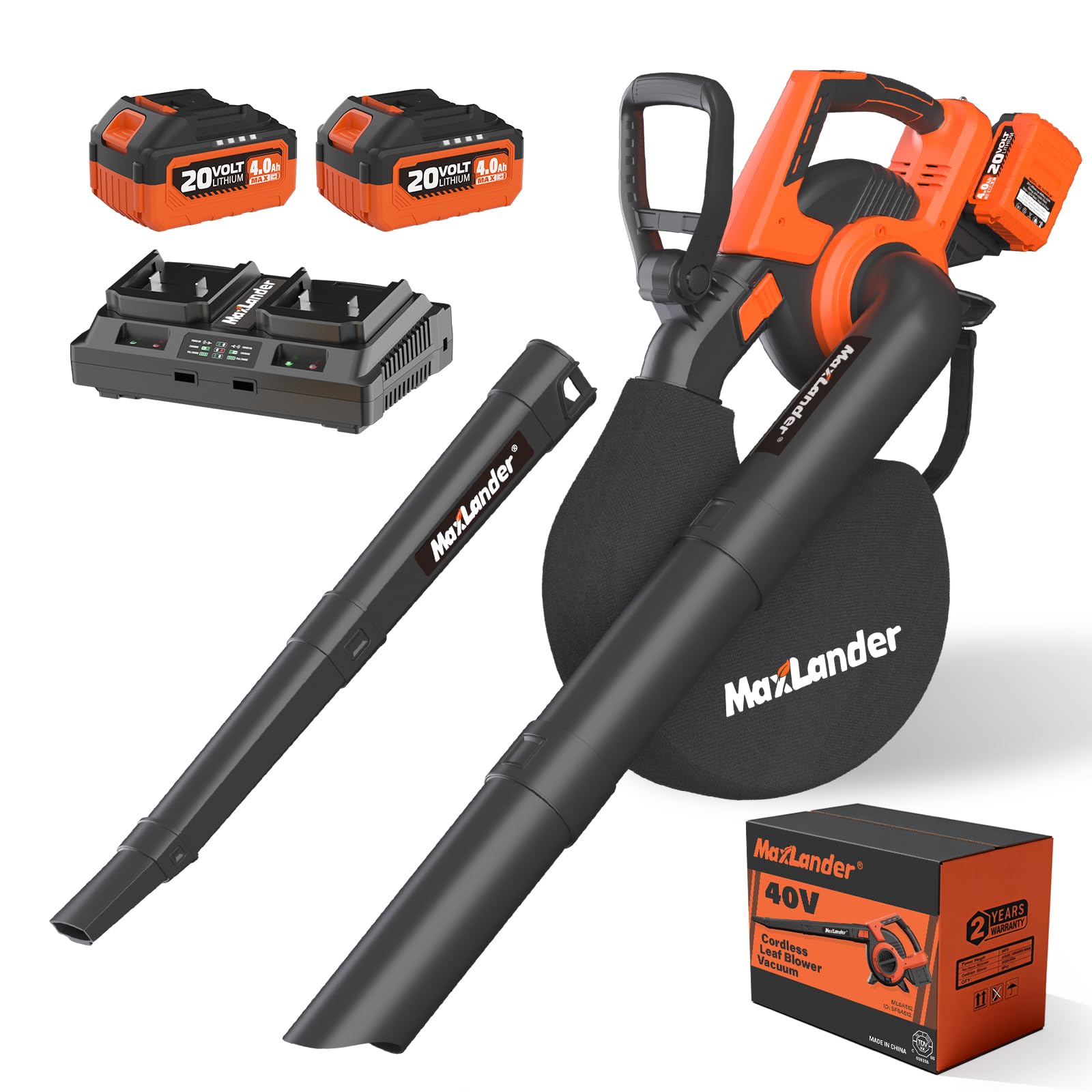
A 40V brushless 3-in-1 that matches the SOYUS numbers at a slightly lower price.
The MAXLANDER brings a 40-volt brushless motor, 5 speeds, a turbo mode hitting 360 CFM and 170 MPH, and a 45-liter non-woven collection bag with a bottom zipper for quick dumping. The design includes a steel impeller plate (a solid steel spinning disc that crushes leaves and small twigs) which, per the maker, reduces the chance of debris tangling inside the motor. In blowing mode the tool weighs 7.9 pounds, but in vacuum mode that jumps to 9.9 pounds — a noticeable difference if you are holding it for a full yard session. The included shoulder strap helps offset the hand fatigue.
The kit comes with two 4.0Ah batteries and a fast charger that fills one pack in 1.5 hours. The maker claims up to 36 minutes of runtime on high speed, though real-world reports vary widely. On the positive side, several shoppers say it is lightweight, easy to handle, and more powerful than they expected for the price. However, one reviewer noted the blower/vac failed after just 10 minutes and was dead within a month, with no response from the company after four attempts — a reliability concern you need to weigh against the low entry cost. At 7.2 pounds, the MAXLANDER is 64% heavier than the KIMO’s 4.4 pounds, making it more fatiguing over time.
What you get for the money
- Two 4.0Ah batteries and a fast charger in the box — enough to cover most small-to-medium yards
- 5-speed dial plus turbo mode gives you fine-grained control over battery consumption
- Large 45L bag with bottom zipper means quick dump without pulling the bag off the tool
What the reviews reveal
- 7.2 pounds is noticeably heavier than the 4.4-pound KIMO, so fatigue sets in sooner during longer sessions
- One buyer mentioned the unit failed completely after 10 minutes with no warranty response — a quality variance to watch for
Pick this for: a budget-conscious 3-in-1 that delivers decent power and a large bag for under.
Think twice if: you cannot risk a lemon — the negative reviews suggest inconsistent quality control and weak customer support.
4. SOYUS SY8A512
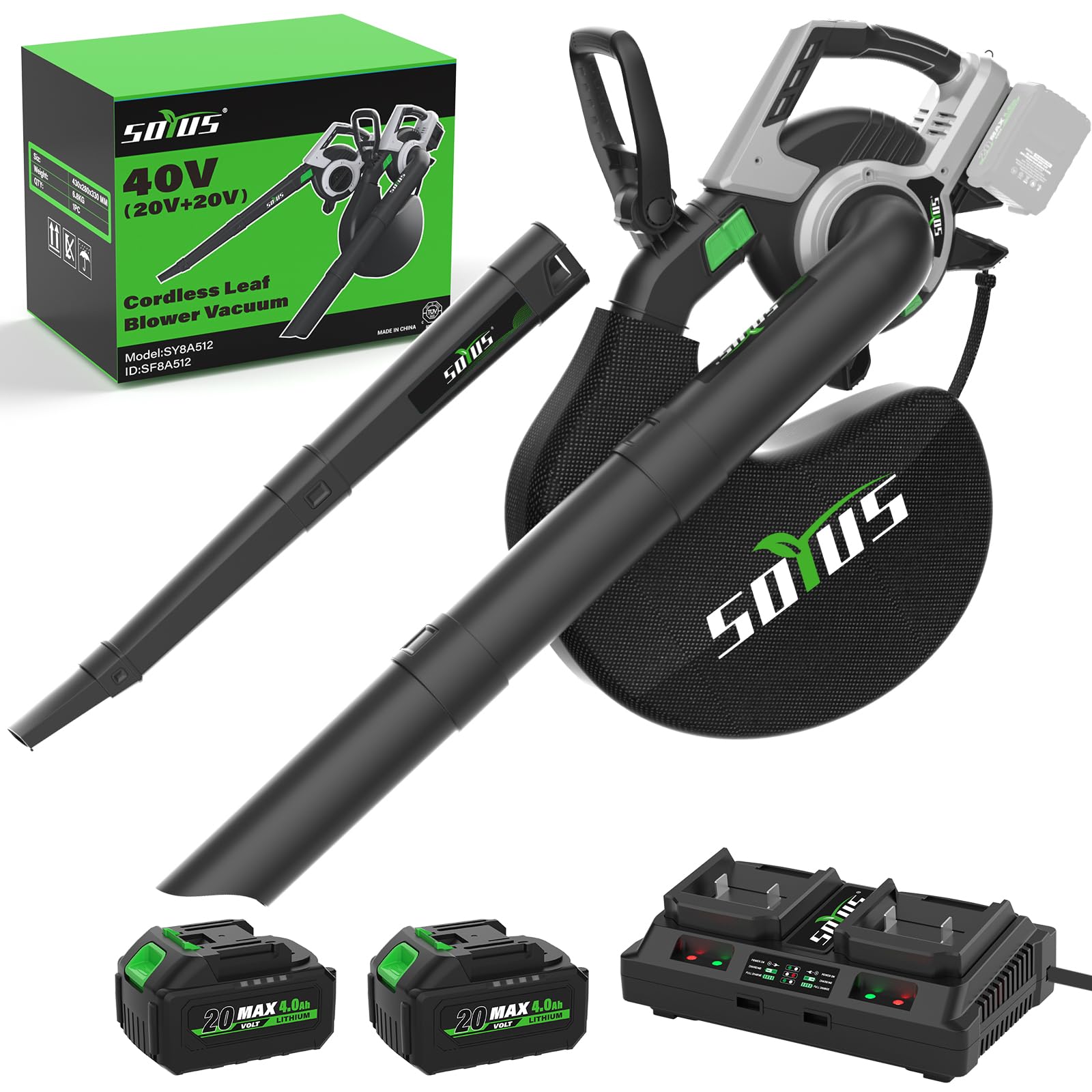
The highest CFM in the sub- tier — 385 CFM puts it surprisingly close to the Greenworks.
The SOYUS 3-in-1 runs on a brushless motor rated at 385 CFM and 170 MPH, and includes two 20V 4.0Ah batteries — a setup that buyers report lasts over 30 minutes at full speed and up to 90 minutes at low speed. The batteries are compatible with Makita’s 20V platform, so if you already own Makita tools you will have a spare power source. The 45-liter bag is the same generous size as the MAXLANDER, and the bottom zipper makes dumping leaves quick without detaching the bag from the tool.
Buyers consistently praise the power: one called it “surprisingly good” and noted that on turbo mode it clears wet leaves easily. The downsides are split between the battery and the vacuum performance. One owner said a battery died after 11 months of light use, which is a shorter lifespan than you would expect from a quality lithium-ion pack. Another reviewer gave it a 1-star rating, calling the vacuum “worthless” and saying the bag was useless for actual collection — though other positive reviews contradict that. The tool is lightweight and comfortable to handle, per most accounts, and the 5-speed control panel makes it easy to dial back power to conserve battery when you are just sweeping up porch dust.
Why it stands out
- 385 CFM is the highest air volume among the sub- models — closer to the Greenworks in raw capacity
- Batteries are cross-compatible with the Makita 20V platform, giving you a backup power ecosystem
- 45L collection bag with bottom zipper for fast, tool-on dumping
Where it falls short
- One owner reported a battery died after 11 months of light use — inconsistent battery longevity
- Mixed reviews on vacuum performance: some say it works great, others call it useless
Grab this if: you want the highest CFM available at this price point, especially if you already own Makita 20V batteries.
pass on it if: you need guaranteed battery longevity — the early battery failures are a real risk, and customer service seems limited.
5. ZEGJAW ZJ8A512-S
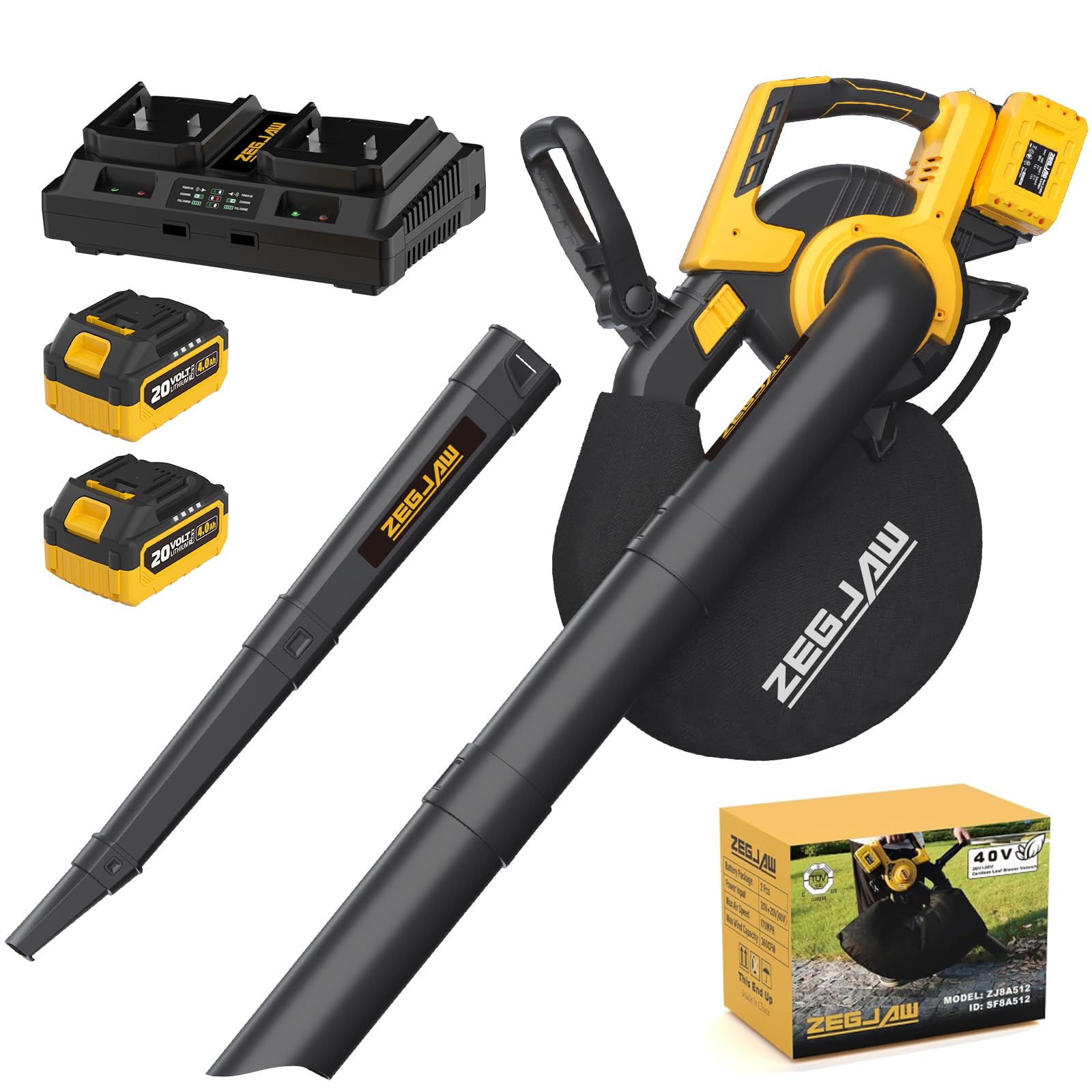
Another 360 CFM / 170 MPH contender with a 45L bag, priced to compete with MAXLANDER.
The ZEGJAW 40V 3-in-1 offers 360 CFM, 170 MPH, a brushless motor with 5 speeds plus a turbo mode, and two 4.0Ah batteries with a fast charger. The bag is a standard 45-liter non-woven unit with a bottom zipper and a detachable shoulder strap. The maker claims the impeller reduces 12 bags of leaves into 1 bag — a common figure across brands, but still a meaningful benefit to avoid constant bag-emptying interruptions. The 5-speed system lets you choose gears 1–2 for indoor dust or pet hair, and gears 3–4 plus turbo for yard leaves and light snow, giving you real control over how fast you drain the battery.
Owners mention it is powerful, lightweight, and easy to handle, especially for patio and driveway cleaning. One owner called it “a genuine little monster” and noted it moves gravel, pine needles, and cones without effort. The battery life on high speed is rated at 30–40 minutes, which is fairly standard for this class. A potential downside is that the 14-pound item weight is the highest among the sub- models, so it will feel noticeably heavier than the KIMO or SOYUS after 20 minutes of use. The ZEGJAW competes directly with the MAXLANDER, offering the same key specs but with slightly more positive early reviews on build quality.
Where it earns its place
- 360 CFM and a brushless motor at a sub- price — strong value for the core specs
- 5-speed dial plus turbo mode gives you real control over power and battery drain
- Positive early reviews on power and ease of use; buyers call it “lightweight” and “powerful”
Where it drops the ball
- At 14 pounds, it is the heaviest model in the budget tier — noticeable in longer sessions
- Limited long-term reliability data; it is a new entrant on the market
Consider this if: you want a full-featured 3-in-1 kit with good specs and the lowest entry price in the category.
Look elsewhere if: weight is your main concern — the 14 pounds will get tiring if you plan to use it for more than 20 minutes at a time.
6. KIMO 6303-2025

The lightest vacuum here at 4.4 pounds — a one-hand tool that does not wear you out.
The KIMO is a 4-in-1 tool that blows, vacuums, inflates, and deflates, all in a body weighing just 4.4 pounds. At 4.4 pounds, the KIMO is 64% lighter than the MAXLANDER’s 7.2 pounds, making it the clear choice for limited upper-body strength or quick grab-and-go use. The 20-inch extension tube means you can stand upright and still reach the ground — buyers specifically mention the 20-inch tube reduces bending, which helps your lower back during longer sessions. The smart panel display shows battery level and lets you pick between 3 speed modes (130 MPH, 160 MPH, and 190 MPH), and the wind speed locks automatically so you do not have to hold a trigger.
The trade-off is air volume: at 260 CFM and 190 MPH, the KIMO is fine for light leaves and porch dust but will struggle with a heavy pile of wet leaves that the Greenworks or SOYUS would blow clear. The inflation and deflation nozzles are a genuine bonus if you own inflatable pools, air mattresses, or yoga balls — they work with a 0.87-inch large nozzle, 0.63-inch medium nozzle, and 0.2-inch small nozzle. Customers note that the highest speed is very loud and that the wand may be too short for taller adults unless you use the extension tube, and the inflation nozzles attach only to the machine itself, not the wand.
What makes it worth a look
- 4.4 pounds — the lightest model in the entire review, comfortable for one-handed use by anyone
- Inflation/deflation nozzles included, turning a yard tool into a pool toy pump
- Smart panel with auto-lock speed means no trigger fatigue on longer jobs
What holds it back
- 260 CFM is the lowest air volume here — not enough for wet leaf piles or larger yards
- Inflation nozzles do not attach to the wand, only to the machine body, limiting reach
- Highest speed is very loud, per several reviewers
Ideal for: small patios, porches, and car interiors, plus anyone who wants a single battery tool that also inflates pool floats.
Not for: serious fall leaf cleanup in a yard with any wet or heavy debris — you need the CFM of a MAXLANDER or Greenworks.
Understanding the Specs
CFM vs MPH
CFM (cubic feet per minute) measures the volume of air the vacuum moves. MPH (miles per hour) measures the speed that air comes out of the nozzle. For a leaf vacuum you want both: enough speed to lift wet leaves from the ground, and enough volume to keep the airflow strong so the vacuum can suck them into the bag. A unit with high MPH but low CFM will blast leaves loose but cannot hold the current to pull them in. A unit with high CFM but low MPH lacks the force to lift heavy debris. Most cordless leaf vacuums strike a balance around 350–400 CFM and 170–200 MPH.
Battery Amp-Hours (Ah)
Amp-hours (Ah) tell you how much energy the battery stores. A 4.0Ah battery holds roughly 33% more runtime than a 3.0Ah pack at the same voltage. However, the tool’s motor and the speed setting dramatically affect real-world runtime — a 4.0Ah pack that lasts 20 minutes on low speed may drain in 8 minutes on turbo mode. The number of batteries included matters: two 4.0Ah packs let you swap and keep working while the first one charges, effectively doubling your continuous runtime for the cost of the kit.
FAQ
Can I use a cordless leaf vacuum on wet leaves?
How long does a battery last on a cordless leaf vacuum?
Is a cordless leaf vacuum as powerful as a gas model?
What is the mulching ratio and why does it matter?
Do I need a shoulder strap for the collection bag?
Will a cordless leaf vacuum work on pine needles or gravel?
Can I use the batteries from my cordless leaf vacuum in other tools?
Why do some models have a 20V battery pack and others a 40V battery?
Final Thoughts: The Verdict
For the majority of shoppers, the best cordless leaf vacuum winner is the Greenworks 40V BVF444 because 505 CFM and 230 MPH are genuine heavy-duty numbers that no other cordless model in this group matches — it clears wet, matted leaves that the others leave behind. If you want a battery platform that powers your whole yard, grab the WORX WG583. And for a budget-friendly kit with a second battery included and 385 CFM of power that holds its own against pricier units, the SOYUS SY8A512 delivers real value.
How We Picked
We do not accept paid placement. Every pick is matched to a real buyer and a real use-case; we do not hands-on test units.
Sources & Methodology
Specifications: manufacturer listings and product documentation. Review insights: verified customer reviews, as of July 2026. Pricing: not shown on this page (it changes often); check the current price via the retailer link.
As an Amazon Associate, Lawn Gear Lab earns from qualifying purchases. This does not affect which products we feature.