
Specs are compiled from manufacturer listings and verified buyer reviews and can change over time — please confirm the key details on the product page before buying.
The trick to growing a big crop of potatoes on a patio, balcony, or small yard is a container that does two things: gives roots plenty of vertical room and lets you peek at the tubers without uprooting the whole plant. Most standard flower pots are too short, and grow bags vary wildly in fabric thickness and handle strength—so picking the right one saves you a season of disappointment.
I’m Rikta — the founder and writer behind Lawn Gear Lab. This guide is built by comparing the manufacturers’ published specifications and the patterns across verified customer reviews, so you get each pick’s real strengths and trade-offs instead of marketing spin.
Whether you are starting your first potato crop or looking to upgrade from flimsy sacks, this breakdown walks you through the six best options to find a container for growing potatoes that actually fits your space, your soil budget, and your harvest expectations.
Quick Picks
- homeyeco 5-Pack 10-Gallon Potato Grow Bags — Top Performer
- BIJOKETTEN 6-Pack 10-Gallon Potato Grow Bags — Best Value
- RVZHI 6-Pack 10-Gallon Potato Grow Bags — Most Portable
- REMIAWY 6-Pack 10-Gallon Potato Grow Bags — Smart Pick
- RVZHI 6-Pack 15-Gallon Potato Grow Bags — Max Capacity
- kopotma 5-Pack 15-Gallon Potato Grow Bags — Deep Root Option
How To Choose The Best Container For Growing Potatoes
A potato plant sends roots deep and tubers spread sideways, so the container shape and volume matter more than you might think. A bag that is too shallow stunts the crop, and one made from thin fabric may tear halfway through the season. Here are the three things to check before you click “buy”.
Capacity and depth: more than just a number
A 10-gallon bag is the standard starting point for 3–6 seed potatoes, but height is the real deciding factor. A bag that is at least 17 inches tall gives you room to “hill” soil around the stems—a step that encourages more tubers to form. Shorter, wider bags work for other vegetables, but potatoes need that vertical space to produce a full yield.
Fabric thickness and handle strength
Wet soil is heavy, and a filled 10-gallon bag can easily exceed 50 pounds. Thin fabric (under 300G) stretches and may split when you lift the bag by the handles. Look for 350G or 400G felt or non-woven fabric with reinforced stitching on the handles. A load rating printed on the spec—like 150lb—is a safe sign that the bag will hold up through a full season of moving and watering.
Harvest window design: flap vs. clear panel
Almost every potato grow bag on the market has a side opening. A fabric flap lets you reach in and pull out mature potatoes at the bottom while the top of the plant keeps growing. A clear plastic window lets you see the size and color of the largest tubers, but several buyers report that the plastic can cause potatoes to turn green from light exposure. Weigh convenience against the risk of sun damage before choosing.
Quick Comparison
| Model | Best For | Capacity | Fabric Weight | Dimensions (DxH) | Amazon |
|---|---|---|---|---|---|
| homeyeco 5-Pack 10-Gallon | Durability-focused growers | 10 gal | 400G (2mm felt) | 13.8 x 17.7 in | Amazon |
| BIJOKETTEN 6-Pack 10-Gallon | Budget-conscious multi-plant gardens | 10 gal | — | 13.8 x 17.7 in | Amazon |
| RVZHI 6-Pack 10-Gallon | Color and portability in a 6-pack | 10 gal | 350G | 15.7 x 11.8 in | Amazon |
| REMIAWY 6-Pack 10-Gallon | Value with a dedicated harvest flap | 10 gal | — | 13.8 x 17.8 in | Amazon |
| RVZHI 6-Pack 15-Gallon | Large capacity for companion planting | 15 gal | 350G | 19.7 x 11.8 in | Amazon |
| kopotma 5-Pack 15-Gallon | Deep rooting in a compact footprint | 15 gal | — | 15.8 x 15.8 in | Amazon |
In‑Depth Reviews
1. homeyeco 5-Pack 10-Gallon Potato Grow Bags
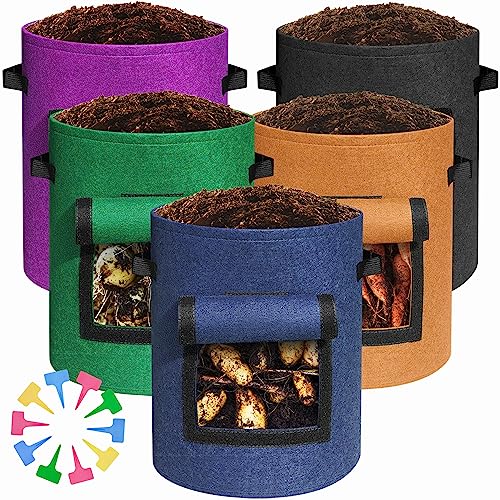
The thickest fabric bag here that holds its shape and survives multiple seasons.
The 2mm, 400G non-woven felt is noticeably heavier than most fabric pots you will find in this category. Owners mention these bags are “durable potato grow bags for 2 seasons,” which matches the material density—most competitors use 350G fabric that feels flimsier in hand. The handles are reinforced nylon straps rated at 150 lbs, so you can lift a fully-soaked bag without worrying about the stitching popping.
The harvest window is a fabric flap, and one reviewer noted the honest trade-off: “harvesting is difficult; easier to dump entire bag and sift.” That is the reality of any flap-style bag—you can still pull out the biggest potatoes through the opening, but a full root-bound crop may need a complete dump. The set comes with 8 plant label stakes, , making it easier to track different varieties.
At 13.8 inches in diameter and 17.7 inches tall, the bag gives you the vertical room to hill soil around the stems—a key step for boosting yield. It is a 5-pack rather than a 6-pack, so you get one fewer bag than some competitors, but the thicker material means each bag will likely outlast a thinner 6-pack by several growing cycles.
Built to endure: If you want a bag that won’t shred by the end of the season and can handle the weight of wet soil without the handles tearing, this is the one. The extra fabric thickness also means less soil drying out through the sides on hot days.
Not for gawkers: The fabric flap does not have a clear window, so you cannot see potato size through it—you have to open the flap and feel around. If you want visual confirmation before digging, look at a bag with a clear panel instead.
Reach for this if: you plan to reuse the same bags year after year and want the thickest material available at a mid-range price.
Look elsewhere if: you want a clear window to check tuber size without opening the flap, or you need exactly six bags and do not want a 5-pack.
2. BIJOKETTEN 6-Pack 10-Gallon Potato Grow Bags

A six-pack of 10-gallon black fabric bags that keeps the cost-per-bag low.
This set gives you six bags for roughly the same price as the homeyeco five-pack, which makes it a strong choice if you want to plant more varieties in one season. The dimensions are nearly identical to the homeyeco at 13.8 x 17.7 inches, so there is no meaningful difference in soil volume. Customers note the bags are “strong and durable” and that “potatoes are going great in there,” suggesting the non-woven fabric handles typical season-long wear well.
One catch: a reviewer noted the bags “leak throughout instead of from the bottom.” That is a downside of fabric pots that lack a waterproof bottom liner—water seeps out of the sides as soon as you pour it in. For outdoor use on a patio or deck, that means water stains or puddles underneath every bag. The X-shaped handles on both sides make moving easy, and the view window lets you check growth without pulling the plant.
At 1 lb per bag, these are light enough to store flat in a drawer when empty. The material does not have a published GSM thickness, so it is likely standard weight rather than the heavy-duty 350G–400G used on the top pick. If you are gentle with lifting and do not drag them across rough surfaces, they should hold up for a full growing season.
Best for beginners
- Six bags in one purchase gives maximum planting capacity
- View window lets you check root growth without uprooting
- Very lightweight when empty—easy to store between seasons
Watch for
- Side leakage reported by multiple buyers—not ideal for decks
- No published fabric weight means long-term durability is unknown
Perfect for: a first-time potato grower who wants six bags on a budget and does not mind a little side seepage on a grass or gravel surface.
Avoid if: you are growing on a wooden deck or balcony where water leaking from the sides could cause damage or a mess.
3. RVZHI 6-Pack 10-Gallon Potato Grow Bags
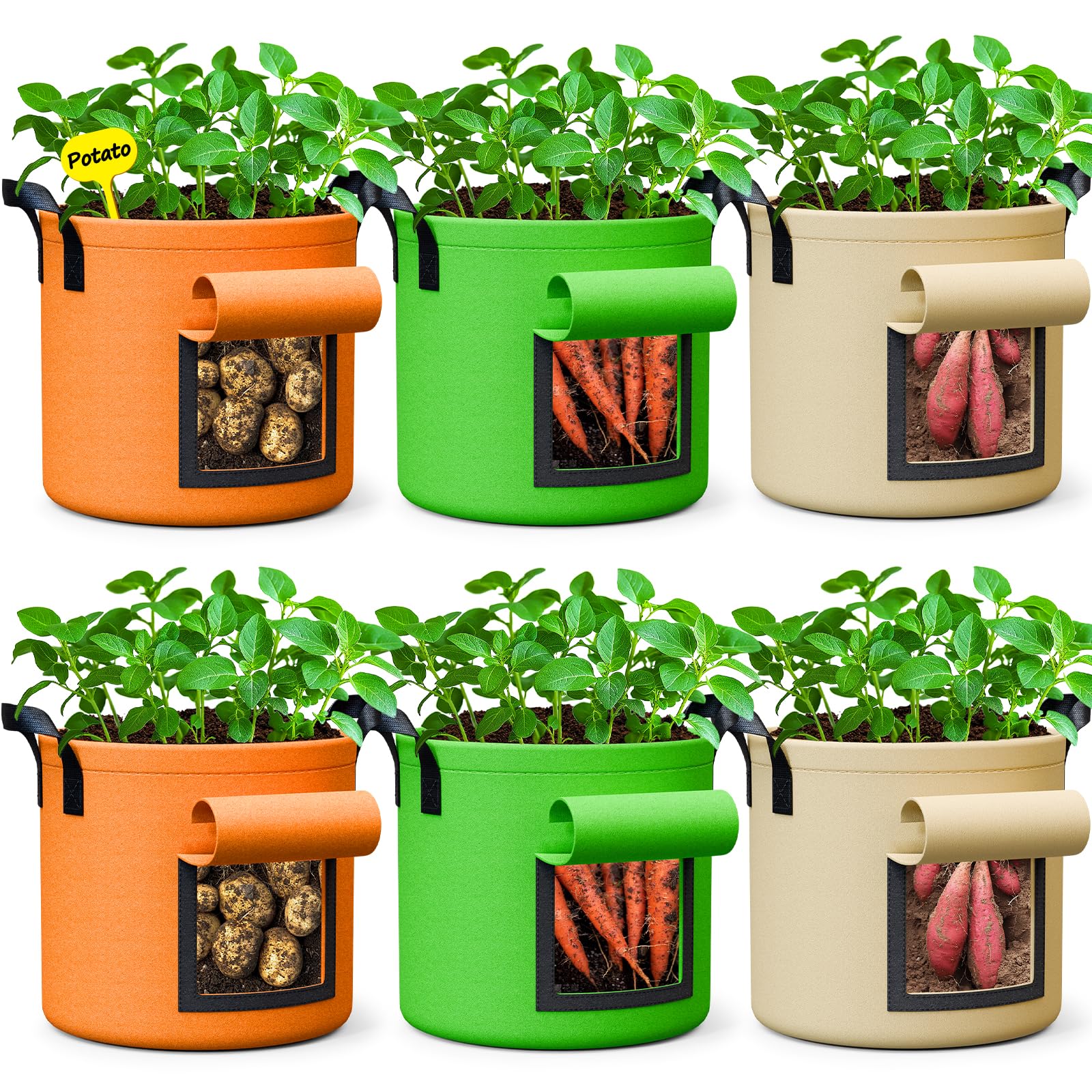
A wide-base bag that stays stable on a patio but is nearly 6 inches shorter than most competitors.
The 15.7-inch diameter makes this the widest 10-gallon bag here, which means it sits steadily without tipping over in wind. But the trade-off is obvious: at 11.8 inches tall, this bag is 5.9 inches shorter than the homeyeco or REMIAWY bags—a drop from 17.7 inches to 11.8 inches. That matters for potatoes because you lose deep-hilling space, which can mean fewer tubers per plant. If you are growing bush beans, peppers, or shallow-root flowers, the extra width is nice. For potatoes, the shorter height is a real limitation.
Buyers describe these bags as having “durable heavy woven fabric, vibrant colors, harvest doors at bottom, adequate drainage, easy to move, includes garden labels.” The 350G material is solid—thicker than commodity bags but thinner than the 400G homeyeco. One reviewer flagged a design issue: “side opening has no plastic or cover—dirt pours out when opened. Concern about leaking.” So the flap is literally a hole in the fabric; there is no Velcro or zipper to seal it shut. That is something to accept if you plan to open the window frequently.
The reinforced handles get praise for holding up during transport, and the 6-pack includes plant labels. If you need a bag that is easy to move around a sunny yard throughout the day, the lower height actually makes it easier to carry than a tall narrow bag.
Great for ground-level gardens: The wide footprint and short sides make this bag easy to tend without bending over too much. It also fits under low-growing trellises or in tight greenhouse shelves.
Not ideal for max potato yield: Losing nearly 6 inches of hilling depth means you will likely harvest fewer potatoes than from a 17-inch-tall bag of the same volume.
Grab it for: mobility—the short, wide shape and sturdy handles make it the most portable bag in this comparison.
skip it if: your primary goal is growing potatoes rather than shallow-root vegetables. The height sacrifice is too big for a serious potato crop.
4. REMIAWY 6-Pack 10-Gallon Potato Grow Bags
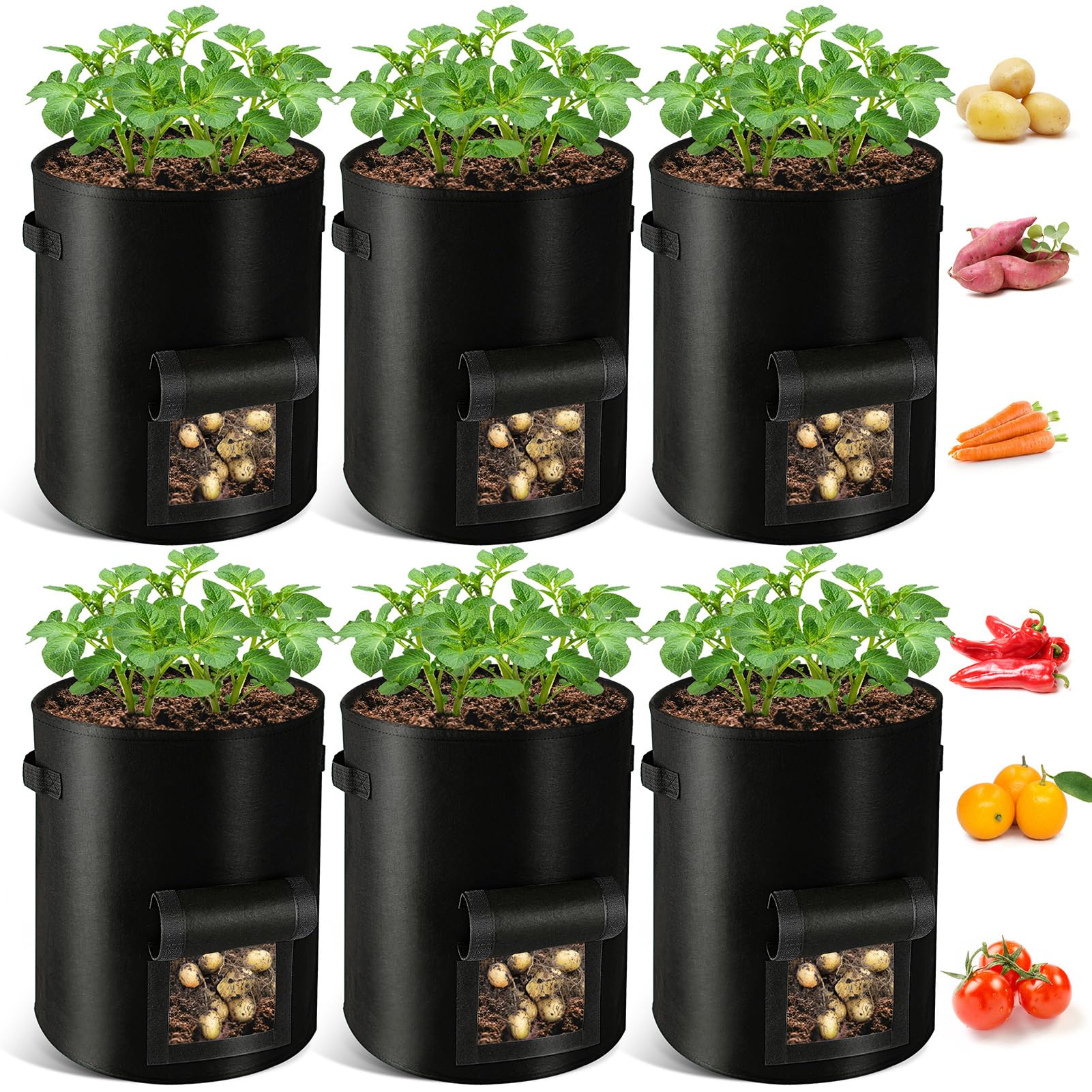
A tall 17.8-inch bag with a dedicated 7×7 inch flap for checking tubers without digging.
The key feature here is the 7-by-7-inch cut-out with a fabric flap—it is big enough to reach both hands into and pull out mature potatoes. REMIAWY specifically notes the bag does not have clear plastic because “they may cause the potatoes to turn green,” which is a smarter design choice if you want to avoid light damage to the tubers. The height of 17.8 inches is the tallest in the 10-gallon category here, matching the homeyeco within a tenth of an inch.
Buyers consistently rate this bag 5 stars, with comments like “the material is better than I expected very durable” and “they hold a bit more than 1cu of potting soil.” That soil volume check is useful: 1 cubic foot of potting mix fits neatly into each bag, so you can buy one large bag of soil per bag instead of guessing. The X-shaped handles on both sides make moving easy, and the non-woven material drains excess water without requiring drilled holes.
Compared to the RVZHI 10-gal above, the REMIAWY is 6 inches taller and has a better-designed flap that stays closed (no exposed hole). Compared to the BIJOKETTEN, it costs less per bag on the 6-pack and has no reports of side leaking. If you want the most straightforward, tall 10-gallon bag for potatoes without paying for 400G thickness you might not need, this is the balanced pick.
Well-thought design
- No clear plastic window means zero risk of green potatoes from light exposure
- Generous 7×7 inch flap allows easy partial harvesting
- Tall depth (17.8 inches) gives plenty of room for hilling soil
Standard fabric
- Material weight is not published, so long-term durability compared to 400G is unknown
- Black color only—no color-coded bags for different plant varieties
Best match for: someone who wants a tall, simple, affordable bag with a well-designed harvest flap and no risk of light-damaged potatoes.
Not for: anyone who wants colored bags to organize different plant varieties in a visible garden layout.
5. RVZHI 6-Pack 15-Gallon Potato Grow Bags
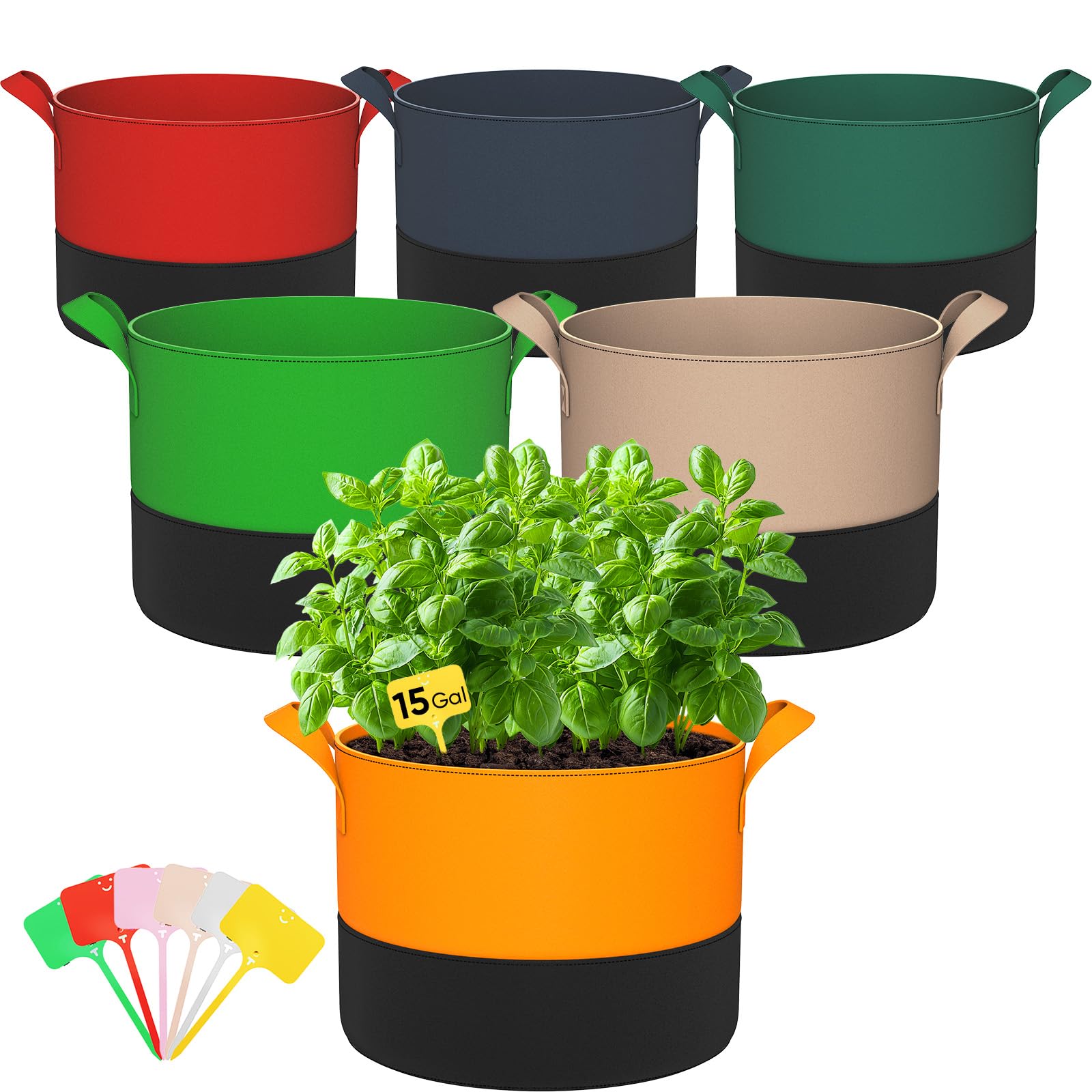
A 15-gallon bag that gives your root vegetables room to spread without competing.
If you want to grow more than four seed potatoes per container, this 15-gallon bag holds 15 gallons of soil, compared to 10 gallons for the 10-gallon models above. The dimensions are 19.7 inches in diameter and 11.8 inches tall, so it is very wide and shallow—think of it like a raised garden bed in bag form. That wide shape is excellent for potatoes grown in a hilled mound, but the short height of 11.8 inches means you have less vertical space to add soil as the stems grow.
Buyers use these bags for everything from potatoes to blueberry bushes to tomatoes, and the feedback is consistent: “sturdy, breathable… handles hold well for moving” and “they are large, sturdy, and nicely colored.” The 350G felt fabric is the same thickness as the RVZHI 10-gallon bag above, so you are getting similar durability in a larger format. The patchwork design—black at the bottom and multicolor at the top—is unique; the maker claims the black underparts “absorb and retain heat,” which could give a slight advantage in cooler climates.
One buyer mentioned these are “a lot wider than I thought,” so measure your patio or balcony space before ordering—19.7 inches across means six bags side-by-side take up nearly 10 feet of linear space. The handles are doubled-up at the stitching, so lifting a fully loaded 15-gallon bag (which can weigh 70+ lbs) is feasible with two hands.
Good for companion planting: With 15 gallons of space, you can plant potatoes in one half and a fast-growing crop like lettuce or radishes in the other half without crowding.
Not for tight spaces: The wide footprint is the least compact option here, so it does not fit well on a small balcony or in a narrow greenhouse aisle.
Choose this for: a serious gardener who wants the extra soil capacity and plans to grow multiple crops in each bag rather than just potatoes.
pass on it if: you have limited floor space or want the focused tall profile of a dedicated potato grow bag.
6. kopotma 5-Pack 15-Gallon Potato Grow Bags
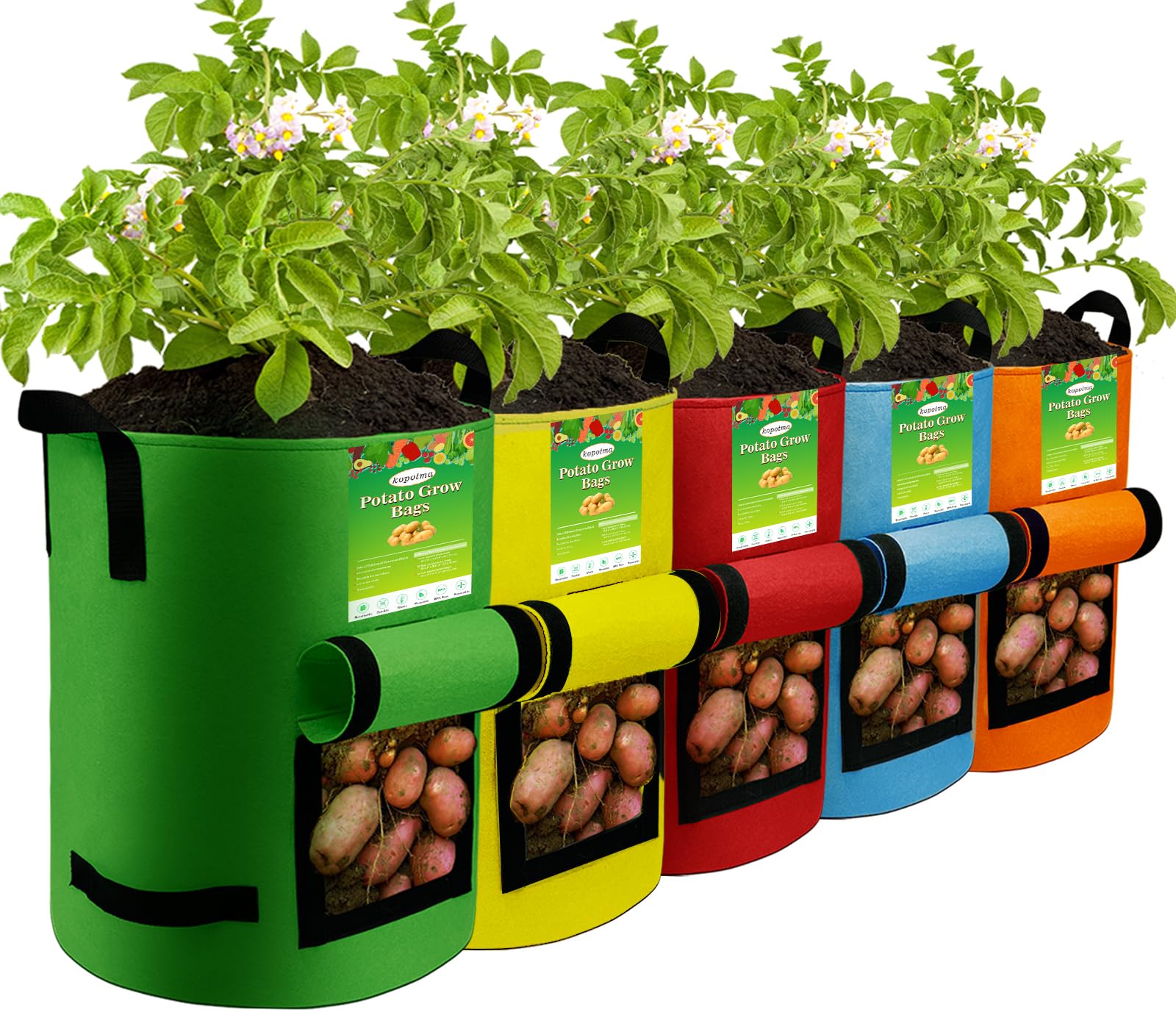
A tall 15-gallon bag that offers the best of both worlds—volume and depth.
Most 15-gallon grow bags are wide and shallow, but this kopotma set breaks the pattern at 15.8 inches tall with a 15.8-inch diameter—nearly a perfect cube. That shape is ideal for potatoes because you get generous soil volume plus the vertical height to hill the stems multiple times. The maker recommends 4–6 seed potatoes per 15-gallon bag, which is roughly the same as the RVZHI 15-gallon but in a more space-efficient footprint.
Reviewers point out “nice and sturdy once filled” and that the bags “hold a lot of dirt.” One reviewer used 4 bags last season and “got a good number of potatoes out of them.” The fabric is non-woven material with a harvest flap, though the flap details are not as clearly described as the REMIAWY bags. The multicolor set comes in 5 colors with 5 bags, which is one fewer bag than the 6-pack options but at a larger per-bag capacity. If you want the biggest single bag you can buy for a dedicated potato plant, this is the shape to beat.
That matters when you account for the fact that potatoes need consistent moisture—a bigger soil mass dries out more slowly on hot days, giving you a wider margin for watering mistakes.
Smart geometry
- Tall profile (15.8 inches) gives real hilling depth for potatoes, unlike most 15-gallon short bags
- 5 distinct colors help organize different plant varieties
- Compact footprint for a 15-gallon bag—fits 5 bags in a small space
Smaller pack
- 5 bags instead of 6 means fewer containers in the ground for the same total spend
- Fabric thickness is not published, so compare to 350G/400G standards is not possible
Perfect for: a potato grower who wants the soil capacity of a 15-gallon bag but needs the tall shape to boost yield per plant.
Not for: someone who needs an even number of matching bags—this is a 5-pack with mixed colors, so it does not pair symmetrically.
Understanding the Specs
Fabric weight (GSM vs G)
Manufacturers list fabric weight as a number like 350G or 400G, which refers to the grams per square meter of the material. A higher number means denser, thicker fabric that holds its shape better when filled with wet soil and resists tearing at handle attachment points. For potatoes, which take 70–120 days to mature, a bag with 350G or higher fabric is more likely to survive the full season without developing holes at the seams.
Harvest window vs visual window
There are two types of side openings: a fabric flap that you lift to reach inside and a clear plastic window that lets you see the tubers. A fabric flap keeps light out (preventing potatoes from turning green and toxic), but you have to dig by feel. A clear window lets you see potato size and color at a glance, but the light exposure can make the surface of the potatoes turn green—so you should harvest soon after you see them. Pick the type based on how often you want to check versus how long you plan to leave the potatoes in the ground.
FAQ
How many seed potatoes should I plant in a 10-gallon bag?
Can I reuse potato grow bags from last season?
Will a potato grow bag work indoors?
What is the difference between a fabric grow bag and a plastic pot for potatoes?
Do I need to cut drainage holes in these bags?
Why do my potatoes turn green in a grow bag with a clear window?
How do I hill soil in a tall potato grow bag?
Will 10-gallon bags work on a balcony without a drip tray?
Is a wider bag or a taller bag better for potatoes?
How do I clean and store fabric grow bags between seasons?
Final Thoughts: The Verdict
If you want one dependable pick, the container for growing potatoes winner is the homeyeco 5-Pack 10-Gallon because its 400G fabric thickness and 150 lb handle rating give you the best build quality for repeated use without paying for 15-gallon capacity you do not need. If you want the same tall depth but a 17.8-inch height and a simpler flap design, grab the REMIAWY 6-Pack 10-Gallon. And for a large-volume tall bag that boost yield per plant, the standout is the kopotma 5-Pack 15-Gallon for its near-cube proportions that give both width and depth.
How We Picked
We do not accept paid placement. Every pick is matched to a real buyer and a real use-case; we do not hands-on test units.
Sources & Methodology
Specifications: manufacturer listings and product documentation. Review insights: verified customer reviews, as of July 2026. Pricing: not shown on this page (it changes often); check the current price via the retailer link.
As an Amazon Associate, Lawn Gear Lab earns from qualifying purchases. This does not affect which products we feature.