
Specs are compiled from manufacturer listings and verified buyer reviews and can change over time — please confirm the key details on the product page before buying.
Blueberry bushes need acidic soil around pH 4.5 to 5.5 to thrive, but most garden dirt sits near neutral. That gap is the reason your bushes may look leafy but produce barely a handful of berries — the roots simply cannot open up the nutrients they need. An organic fertilizer designed for acid-loving plants is the fix, and this guide walks you through the five best choices that actually drop the pH while feeding the soil web.
I’m Rikta — the founder and writer behind Lawn Gear Lab. This guide is built by comparing the manufacturers’ published specifications and the patterns across verified customer reviews, so you get each pick’s real strengths and trade-offs instead of marketing spin.
What matters most is picking a formula with a balance of nitrogen, phosphorus, and potassium that matches your bushes’ growth stage, plus a reliable sulfur source to keep the soil acidic. Everything you need to know to choose the right organic fertilizer for blueberries is laid out in the product reviews and buying tips below.
Our Picks at a Glance

How To Choose The Best Organic Fertilizer For Blueberries
Picking the right bag means matching three things: the N-P-K ratio to what your bushes need at that moment, the sulfur content to keep the pH down, and the ingredient source so it fits your organic approach. Here are the specs that separate a good feed from a disappointing season.
The N-P-K Ratio
Blueberries need a fertilizer with a slightly higher nitrogen number relative to phosphorus and potassium. Look for a first number (nitrogen) near 4 or 5 and a second number (phosphorus) around 3 or 4 — that pushes leafy growth and fruit set without overloading phosphorus, which can interfere with micronutrient uptake in acidic soils.
Sulfur Content for pH Control
Sulfur is what gradually lowers the soil pH around your bushes. A formula with 5% sulfur or more will help maintain that 4.5–5.5 range through the growing season. Without enough sulfur, the soil may drift back toward neutral, and your blueberries will struggle to absorb iron and manganese.
Slow-Release Granular vs. Fast-Release
Most organic granular fertilizers for blueberries are slow-release — microbes in the soil break them down over weeks. That is ideal because it feeds steadily and will not burn the roots. A fast-release liquid may give a quick green-up but often lacks the sulfur and long-term pH management blueberries need.
Quick Comparison
| Model | Best For | N-P-K Ratio | Weight | Sulfur | Amazon |
|---|---|---|---|---|---|
| True Organic Berry Food (5-4-4)★ Best Overall | Versatile berry beds | 5-4-4 | 4 Pounds | — | Amazon |
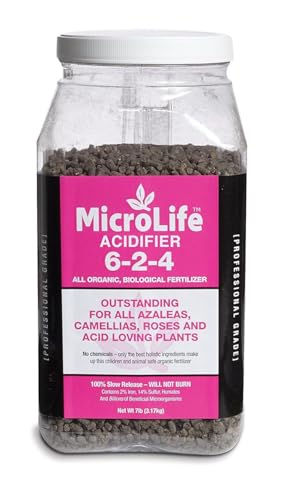
| MicroLife Acidifier (6-2-4)Also Great | pH correction + deep feeding | 6-2-4 | 7 Pounds | 14% | Amazon |
| Down To Earth Acid Mix (4-3-6) | Large berry patches | 4-3-6 | 25 lb | — | Amazon |
| Espoma Berry Tone (4-3-4) | Established blueberry bushes | 4-3-4 | 4 Pounds | 5% | Amazon |
| Espoma Holly-Tone (4-3-4) | Multi-purpose acid lovers | 4-3-4 | 4 lb. Bag | 5% | Amazon |
In‑Depth Reviews
1. True Organic Berry Food (5-4-4) – Organic Fertilizer for Acid-Loving Plants, 4lb Bag
Our pick — over 4.5★ from 800+ verified ratings; the strongest balance of quality and price.
A searbird-guano-and-shrimp-shell blend that revived one buyer’s entire neglected raspberry patch.
What makes this bag stand out is its ingredient profile: seabird guano, shrimp and crab shell meal, and sulfur to adjust pH. The 5-4-4 ratio is slightly higher in nitrogen than the Espoma formulas, which helps push early-season leaf and stem growth before fruit set. One buyer gave it a strong testimonial, saying it “revived neglected raspberry patch” and that older plants are producing beautiful berries again. The 4lb bag covers up to 58 sq. ft., and the maker recommends monthly application through the growing season.
Compared to the MicroLife, this one has a lower sulfur concentration and a lighter weight (4 Pounds vs. 7 Pounds), so it is better suited for maintenance on already-acidic soil rather than major pH correction. Another reviewer noted it revived struggling zinnias from near-death in two weeks, hinting at its broader garden utility — but its real strength is as a dedicated berry food.
What works
- Seabird guano and crab shell meal provide a unique organic nutrient profile
- 5-4-4 ratio has the highest nitrogen among the 4-pound bags here
- Monthly application schedule is simple to follow
What to know
- Lighter 4 lb bag means more frequent repurchases for large patches
- Sulfur content not listed, so pH impact may be modest
Great for mixed berry beds: Pick this if you grow blueberries alongside raspberries, blackberries, or strawberries — the 5-4-4 ratio supports all of them, and the natural ingredients keep your garden fully organic.
Not for alkaline soil: If your pH is above 6.5, go with the MicroLife for its 14% sulfur instead.
2. MicroLife Acidifier (6-2-4) Professional Grade Granular Organic Fertilizer
The highest acidifier content on the list — built for stubborn alkaline soil that refuses to budge.
This bag is the power play for anyone whose blueberries are yellowing from iron deficiency caused by soil that is too basic. The 6-2-4 ratio gives you a higher nitrogen kick than most competitors, while the 14% sulfur content, versus the Espoma formulas at 5% sulfur — so it is aggressive about dropping pH. Buyers report that their “cuttings rooted well” and that the formula produced visible results on roses and hibiscus late into summer. The 7-pound bag is also the heaviest among the picks in this comparison, giving you more feed per purchase than the True Organic or Espoma options.
The catch is the smell. A few reviewers mention that the pellets “smelly and grow mold very well when wet,” so storing it dry is important. The slow-release granules feed for about 3–4 months between applications, and the manufacturer says it will maintain a pH balance of 5.0–7.0. If your soil is neutral or alkaline, this is the most direct fix.
Why reach for it
- 14% sulfur tackles tough alkaline soil faster than any other pick here
- 6-2-4 ratio provides a higher nitrogen boost for leafy growth and fruit set
- Slow-release formula feeds for 3-4 months without burning roots
Know this first
- Strong odor when wet; needs dry storage
- Pellets can develop visible mold if exposed to moisture
The heavy hitter: Pick this if your soil tests above pH 6.5 and you need a serious acidifier — the 14% sulfur and 6-2-4 ratio make it the most potent organic option.
Better to skip: If your soil is already acidic and you just need a gentle maintenance feed, the 4-3-4 formulas below will be easier on your nose and your wallet.
3. Down To Earth All Natural Fertilizers Organic Acid Mix (4-3-6), 25 lb
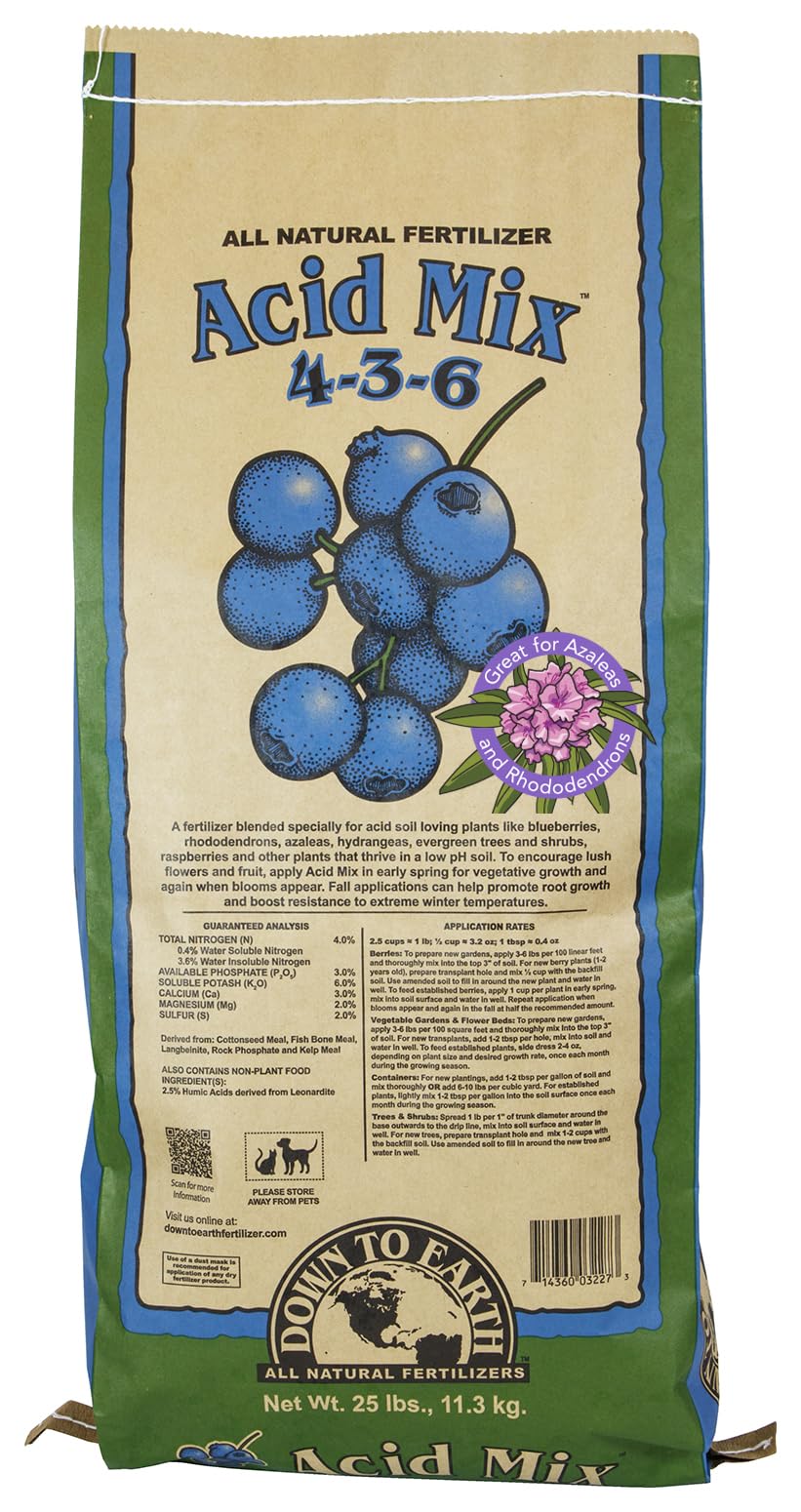
The 25-pound bag that feeds a whole berry patch for multiple seasons while staying affordable.
If you are managing several blueberry bushes, raspberry canes, and maybe some rhododendrons, this is the one-bag solution. The 4-3-6 formula has a notably higher potassium number than the others, which supports fruit ripening and winter hardiness — useful for northern growers. One buyer who has used it for years on “8 blueberry bushes” says it is “great stuff” and notes the larger bag lasts multiple seasons. The ingredient list includes cottonseed meal, langbeinite, fish bone meal, rock phosphate, humates, and kelp meal — a diverse organic base.
Unlike the MicroLife, this bag does not list a sulfur percentage on the label, so if your primary goal is a massive pH drop, you may need to supplement with an acidifier for the first year. A longtime user notes that first-time blueberry planters may need a “soil acidifier if it’s your first time planting as they want pH around 4.5.” The 25 lb package is larger than the 112-ounce MicroLife bag (25 lb versus 7 lb), so it is the clear choice for serious patches.
Strengths
- 25 lb bag delivers the most feed per purchase for large gardens
- 4-3-6 ratio with higher potassium supports fruit development and cold tolerance
- Diverse organic ingredient blend with kelp meal and fish bone meal
Trade-offs
- No listed sulfur content, so pH correction may need a separate product initially
- Large bag requires a dry, pest-proof storage bin
Best for big patches: Reach for this if you have more than a few bushes and want to buy once for the year — the 4-3-6 ratio paired with the 25 lb size beats the per-pound cost of all the 4-pound bags.
Not if you need heavy pH work: If your soil is alkaline, you will need a dedicated acidifier alongside this until the pH drops into range.
4. Espoma Organic Berry Tone Plant Food (4-3-4), 4 lbs
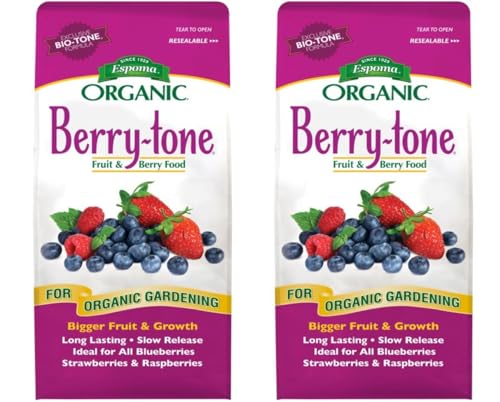
A berry-specific spin on the legendary Espoma formula with 5% sulfur built right in.
Espoma is the household name in organic acid-loving plant food, and Berry Tone is their version tuned specifically for berries — blueberries, strawberries, raspberries, and blackberries. The 4-3-4 ratio includes 5% sulfur to keep the soil acidic, plus their exclusive Bio-tone formula (a blend of beneficial microbes and mycorrhizae). One enthusiastic buyer who used it on blackberries last year says it “produced massive yield (syrups, desserts)” and noticed a dramatic drop-off in flowers the season they skipped it. Another reviewer who uses it on blueberry bushes “early spring late fall” reports “the most incredible amount of berries” on each bush.
The 5% sulfur here is the same as Holly-Tone but lower than the MicroLife’s 14%, so it is a better fit for maintenance than for transforming alkaline soil. Berry Tone is ready to use with no mixing required — just sprinkle around the drip line and water in. It is approved for organic gardening and registered as an Organic Input Material.
Why it stands out
- Specifically formulated for berries with 5% sulfur and Bio-tone microbes
- No mixing needed — apply dry around the drip line
- Proven results: dozens of 5-star reviews from berry growers
Limitations
- 4 lb bag is small; large patches need multiple bags
- 5% sulfur is sufficient for maintenance but weak for heavy pH correction
Perfect for established bushes: Grab this if your soil is already in the acidic range and you want a reliable, no-mix feed that keeps your blueberries productive year after year.
Look elsewhere if: You are starting fresh in alkaline soil — you need something with more sulfur, like the MicroLife, to get the pH down first.
5. Espoma Organic Holly-Tone (4-3-4) Natural & Organic Evergreen & Azalea Plant Food, 4 lb. Bag (Pack of 2)
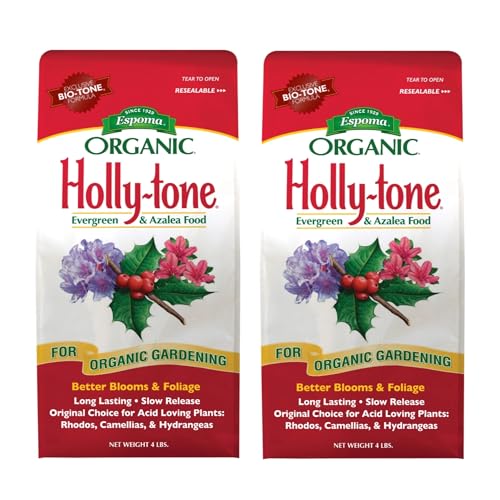
The original acid-lover’s food — designed for holly but trusted for blueberries, rhododendrons, and hydrangeas.
Holly-Tone has been around since 1929, and it earned its reputation by working across nearly every acid-loving plant in your yard. The 4-3-4 formula with 5% sulfur is nearly identical to Berry Tone, but this bag is marketed for a wider range: azaleas, rhododendrons, evergreens, and hydrangeas alongside blueberries. A reviewer described an older, struggling rhododendron that was “not doing so great” with dying leaves and branches — after feeding around the drip line, it “bloomed amazing” and looked great two months later. Holly-Tone is approved for organic gardening and registered as an Organic Input Material.
Compared to Berry Tone, the difference is really the label — both have the same N-P-K ratio and 5% sulfur. Holly-Tone makes the most sense if you are feeding a diverse acid-lovers bed (blueberries plus ornamental shrubs) and want one product for everything. The pack of two gives you 8 total pounds.
Strengths
- Proven formula since 1929 — works on blueberries, rhododendrons, hydrangeas, evergreens
- Pack of two provides 8 total pounds for medium-sized gardens
- No mixing; apply dry and water in
Weaknesses
- Same 4-3-4 ratio as Berry Tone, so not specialized for high-yield berry production
- 5% sulfur is maintenance-level only
Ideal for mixed beds: Choose Holly-Tone if your garden mixes blueberries with azaleas, rhododendrons, or hydrangeas — one bag feeds everything.
Not for heavy feeders: If your sole focus is maximizing blueberry harvest, Berry Tone or the True Organic Berry Food will serve you better.
Understanding the Specs
N-P-K Ratio
Those three numbers on the bag (like 4-3-4 or 6-2-4) stand for nitrogen, phosphorus, and potassium — the primary nutrients your blueberry bushes need. The first number (nitrogen) drives leaf and stem growth, the second (phosphorus) supports root development and flower formation, and the third (potassium) helps fruit ripening and winter hardiness. For blueberries, a first number around 4 or 5 and a second number around 3 or 4 is a balanced starting point. Too much phosphorus (a high middle number) can block iron uptake in acidic soil, which is why you rarely see a bloom-booster-style ratio for blueberries.
Sulfur Content
Sulfur is the ingredient that gradually lowers soil pH as soil microbes convert it into sulfuric acid. A formula with 5% sulfur (like the Espoma bags) is enough to maintain an already-acidic soil. A formula with 14% sulfur (like the MicroLife) is designed to lower pH in neutral or alkaline soil. If your blueberry leaves are yellowing between the veins (iron chlorosis), that is a sign your soil is not acidic enough, and you need a feed with higher sulfur.
FAQ
What N-P-K ratio is best for blueberry bushes?
How often should I fertilize my blueberries?
Can I use Holly-Tone on blueberries?
What is the difference between Berry Tone and Holly-Tone?
How do I apply granular fertilizer to blueberries?
Will organic fertilizer lower my soil pH?
Can I use a general organic fertilizer on blueberries?
How much does a 4 lb bag of fertilizer cover?
Is it safe to use organic fertilizer around pets and kids?
Should I fertilize blueberries in the fall?
Final Thoughts: The Verdict
For most people, the organic fertilizer for blueberries winner is the MicroLife Acidifier (6-2-4) because its 14% sulfur combined with a 6-2-4 ratio handles both pH correction and steady feeding better than any other bag here. If you want a proven berry-specific formula you can trust for maintenance, grab the Espoma Berry Tone. And for large patches or mixed berry beds where cost per pound matters most, the standout is the Down To Earth Acid Mix (4-3-6) in the 25 lb size.
How We Picked
We do not accept paid placement. Every pick is matched to a real buyer and a real use-case; we do not hands-on test units.
Sources & Methodology
Specifications: manufacturer listings and product documentation. Review insights: verified customer reviews, as of July 2026. Pricing: not shown on this page (it changes often); check the current price via the retailer link.
As an Amazon Associate, Lawn Gear Lab earns from qualifying purchases. This does not affect which products we feature.