
Specs are compiled from manufacturer listings and verified buyer reviews and can change over time — please confirm the key details on the product page before buying.
Pruning a tree should make you feel like a gardener, not a bodybuilder. The wrong lopper or saw turns a quick afternoon job into a sore-shouldered slog. The right tree cutting tool multiplies your strength, cuts clean so the tree heals fast, and gets you back to enjoying your yard instead of wrestling with it.
I’m Rikta — the founder and writer behind Lawn Gear Lab. This guide is built by comparing the manufacturers’ published specifications and the patterns across verified customer reviews, so you get each pick’s real strengths and trade-offs instead of marketing spin.
After digging through the specs and hundreds of genuine buyer experiences, this guide has separated the tools that deliver on their promises from those that fold under pressure. This is your honest, no-spin look at the best tree cutting tools for every kind of branch and yard.
Our Picks at a Glance


How To Choose The Best Tree Cutting Tools
A branch cutter is a simple tool, but the wrong one can turn a 30-minute cleanup into an hour of frustration. You want a clean cut and as little effort as possible. Here is exactly what to look for.
Bypass vs. Anvil: Match the Blade to the Branch
A bypass blade works like scissors — two blades slide past each other to make a very clean cut. This is your choice for live, green wood because the clean cut helps the branch heal faster and is better for the tree’s health. An anvil blade has one sharp blade that cuts down onto a flat, soft metal surface (the anvil). It crushes the branch slightly, which is fine for dead, dry, or thick wood but can damage live growth. If you are mostly cleaning up dead limbs, an anvil is a powerhouse. If you are shaping a living fruit tree, a bypass is the kinder option.
Ratchet Action: Why You Want the Click
A ratcheting lopper works in stages. You squeeze the handles, they click as the mechanism advances the blade a little deeper into the branch, then the handles spring back so you can squeeze again with fresh power. This multiplies your force easily by 2x or 3x without you having to be stronger. It is a standout for anyone with arthritis, smaller hands, or simply for those long pruning sessions where fatigue sets in.
Cutting Capacity and Reach: Knowing Your Limits
Check the “cutting width” spec — it tells you the maximum diameter branch a tool can cleanly sever. Most standard loppers cap out at 2 inches, which handles the vast majority of yard pruning (anything thicker usually needs a saw). For reach, the length of the handles dictates the leverage and height you can achieve. Longer handles (33 inches or more) give you more force and let you reach higher branches without a ladder, while shorter handles (around 18 inches) are better for tight spots and backpacking.
Quick Comparison
| Model | Best For | Blade Type | Cutting Width | Tool Weight | Amazon |
|---|---|---|---|---|---|
| Jardineer Ratchet Anvil Loppers★ Best Overall | Best Overall Value | Anvil | 2 Inches | 5 Pounds | Amazon |
| Corona Tools 33″ Bypass LoppersPremium Pick | Premium Bypass Cutting | Bypass | 2 Inches | 4.3 Pounds | Amazon |
| Kings County Tools Double Ratcheting Loppers | Extendable Reach | Bypass | 2 Inches | 3.75 Pounds | Amazon |
| SEESII 2-in-1 Pole Pruning Shears | Powered High Reach | Bypass | 1.6 Inches | 6.4 Pounds | Amazon |
| YRTSH Loppers Branch Cutter | Budget Extendable Lopper | Anvil | 2 Inches | — | Amazon |
| 14.5FT Pole Saw | Manual High Reach Saw | Saw | 3 Inches+ | 5.2 Pounds | Amazon |
| EZ Kut BranchCutter Anvil Loppers | Ultra-Portable Power | Anvil | 2 Inches | 1.75 Pounds | Amazon |
In‑Depth Reviews
1. Jardineer Ratchet Anvil Loppers
Our pick — over 4.5★ from 950+ verified ratings; the strongest balance of quality and price.
The workhorse that keeps clicking through thick wood long after others give up.
This lopper’s defining strength is its ratcheting mechanism. Each squeeze moves the anvil blade deeper into the branch so you do not have to overpower the cut in one go — a 2-inch hardwood branch becomes a series of manageable clicks. At 30.5 inches long, the handles give you the reach to get to those higher limbs without needing a ladder. The anvil blade (the blade that smashes down onto a flat base) is best for dead or dry wood, and buyers report this tool handles the tough, stubborn Florida Keys vegetation with “extra large jaws” that grab bigger branches than standard loppers can manage.
Unlike the YRTSH loppers, which some users found too bendy for overhead work, the Jardineer has a solid build with thick steel handles that resist bending under heavy force. You also get an extra SK5 spare blade and a small pruner in the box, which buyers specifically note is “real handy.” One reviewer noted they owned these for four years, using them year-round on a property with over 100 trees, and simply sharpened the blade on a grinder or file to keep it working.
What you are getting
- Ratchet mechanism multiplies cutting power, great for hands that tire easily.
- Extra SK5 spare blade included in the box.
- 30.5-inch long handles keep you safely on the ground.
The honest trade-offs
- Anvil design crushes live branches, so use it mainly for dead or dry wood.
- At 5 pounds, it is noticeably heavier than the sub-2-pound EZ Kut.
Reach for this if: you want a durable, everyday ratchet lopper for clearing dead thick branches without spending a premium — the included spare blade and four-year owner stories prove it earns its keep.
Look elsewhere if: you need a tool exclusively for live, green wood (a bypass blade is better) or need something ultralight to carry around the property all day.
2. Corona Tools 33″ Bypass Loppers
The bypass lopper that treats your tree as carefully as it treats your hands.
The Corona 33″ Bypass Loppers are the right choice for live wood. The bypass action (like a pair of scissors) severs branches cleanly, promoting faster healing in the tree, whereas the anvil style would crush the same limb. The secret is the DualLINK MAXFORGED mechanism — a gear system inside the pivot that multiplies your pulling force, making a 2-inch cut feel more like a 1-inch cut. Owners mention it cuts through big limbs and roots “very effectively,” with the ergonomic cushioned grips and fat handles making it easy to get a strong, comfortable hold.
One reviewer who has used many brands noted this tool cuts more easily than the inexpensive Fiskars they had used for years, though they did not find it to be a huge leap forward in overall smoothness. The build quality is high, however, with impact-reducing bumpers built into the handles to absorb shock at the end of each cut. At 33 inches, these loppers give you noticeably more leverage than the 30.5-inch Jardineer, and the steel blades are precision-ground and forged, so they hold up well.
What stands out
- DualLINK gearing cuts effort significantly for a bypass lopper.
- Clean bypass cut is healthier for living branches.
- Impact-reducing bumpers protect your hands and arms.
What to keep in mind
- No ratchet action — for some users, it is no easier to squeeze than a basic lopper.
- Heavier and more expensive than entry-level bypass loppers.
Go for this if: you are serious about your trees and want a clean, healthy cut on green wood without the crushing action of an anvil — this is the durable, ergonomic choice for regular pruning.
skip it if: your main job is cutting dead, dry branches; you can get the same 2-inch capacity for less money with an anvil ratchet lopper like the Jardineer.
3. Kings County Tools Double Ratcheting Bypass Loppers
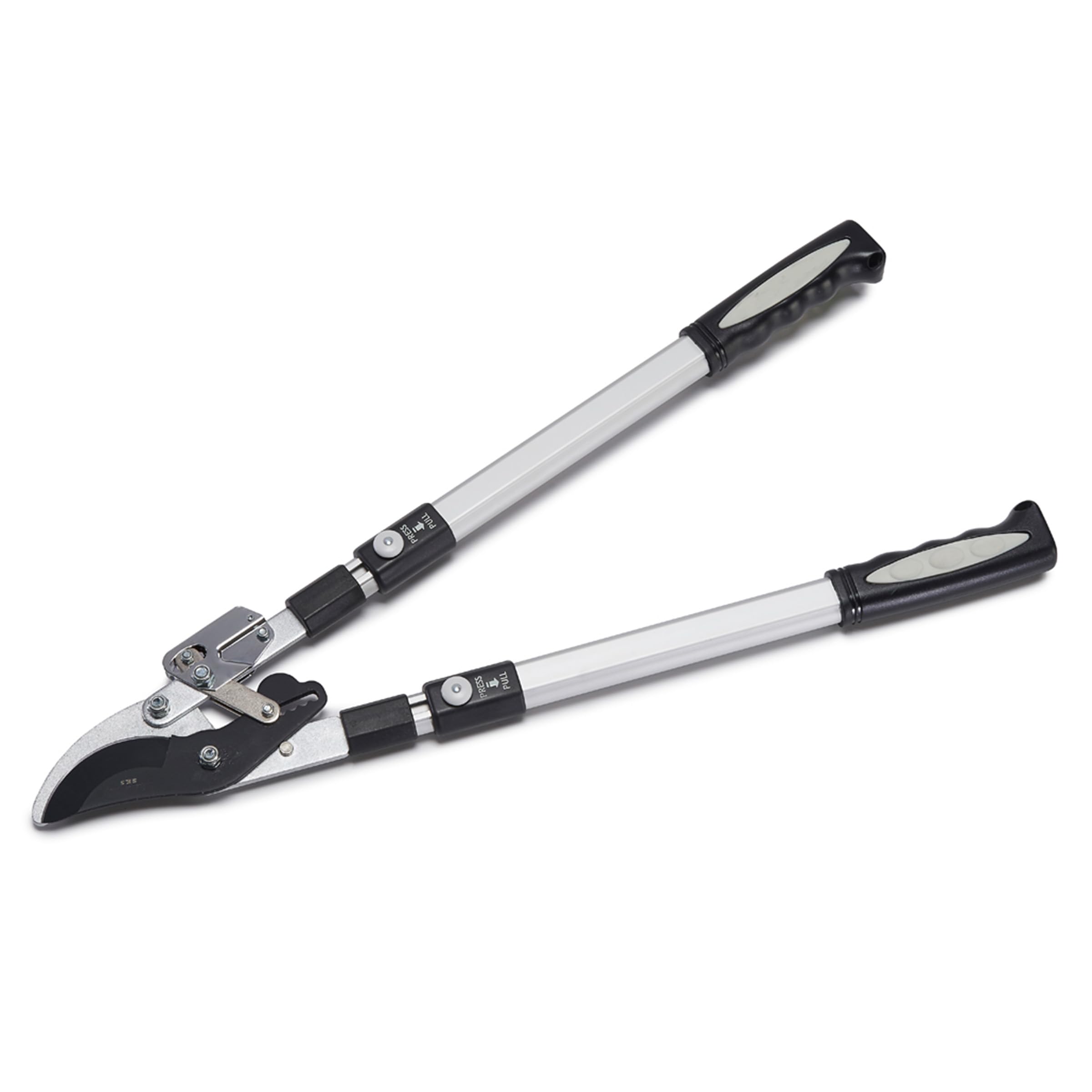
A double-ratcheting bypass lopper that extends to reach what other tools cannot.
This is a rare find: a bypass blade (good for live wood) combined with a double ratcheting mechanism (multiplication of force). The telescoping handles adjust from 26 inches up to 40 inches, which is a 14-inch range of motion. This lets you tuck the tool into a smaller workspace or extend it to reach higher branches overhead, unlike fixed-handle loppers such as the Corona 33″. The double ratchet applies extra pressure in two stages, so cutting a 2-inch green branch requires far less hand strength. Buyers call these “the real deal,” noting the substantial cutting head handles thick branches cleanly.
The big trade-off is weight and feel. One reviewer called it “heavy compared to other units” and mentioned it felt “pretty heavy.” At 3.75 pounds, it is lighter than the Jardineer but heavier than the lighter aluminum loppers some users prefer. Another reviewer noted the blade chipped on a 1-inch dead branch on the third use, although the manufacturer’s customer service replaced the entire tool quickly. The extendable handles use a push-button lock with pin stops, which customers note is easy to adjust.
What it delivers
- Bypass + double ratchet — a rare and effective combo for live wood.
- Telescoping from 26 to 40 inches gives you flexible reach.
- Substantial cutting head is a step up from flimsy brand-name loppers.
What you should know
- Some users find it noticeably heavy for overhead use.
- One report of a blade chipping on a 1-inch branch; good customer service is a safety net.
Best for: the gardener who needs one tool for both close work and overhead live-wood pruning, and who values the leverage of a double-ratchet bypass system over the weight savings of a lighter tool.
Not for: anyone who needs an ultralight tool for long overhead sessions — the weight will make your arms tired.
4. SEESII 2-in-1 Pole Pruning Shears
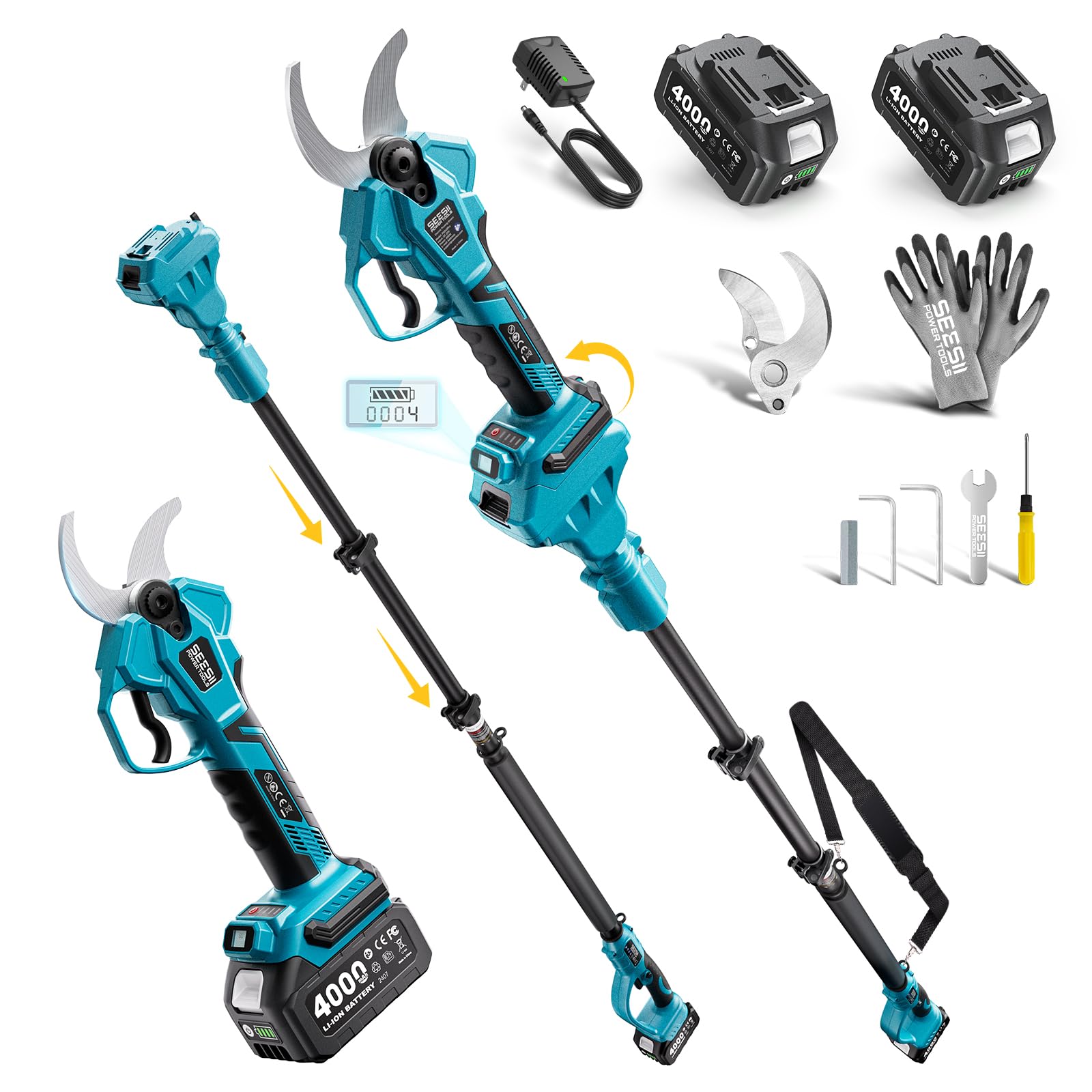
The electric pruner that snaps a 1.6-inch branch in a second, not a squeeze.
This is a different beast altogether — a motorized pole pruner that does the cutting for you. The brushless motor (a quieter, more efficient motor that lasts longer) drives the blade through branches up to 1.6 inches thick “in one second like butter,” as the brand states. You get a 2-in-1 tool: a handheld pruner and a pole mode that extends from 4.9 feet to 9 feet, with a 180-degree rotating head to handle vertical, angled, and side branches. It ships with two 4.0Ah batteries that the brand says provide over 2500 cuts per charge. Buyers confirm this is “powerful” and “cuts quickly and well” even on thicker wood, with one user calling it a purchase they “wish they had bought years ago” for pruning hibiscus, crepe myrtle, and small palms.
The obvious benefit is zero hand fatigue, but the trade-off is weight. At 6.4 pounds with the pole extended, some buyers found it “a bit heavy, but manageable.” You also get an extra SK5 replacement blade in the box. There is an LCD display on the tool that shows the cutting mode and battery level. One buyer mentioned that branches in the ⅞-inch to 1½-inch range may sometimes need a careful recut, suggesting the 1.6-inch capacity is a realistic limit rather than an overconfident claim.
Why it is a time-saver
- Brushless motor cuts with zero manual squeezing, saving your hands.
- Two 4.0Ah batteries give you hundreds of cuts per charge.
- Pole extends to 9 feet with a rotating head for overhead work.
What holds it back
- At 6.4 pounds, the pole mode is heavy for long sessions.
- 1.6-inch max cut is less than the standard 2-inch of manual loppers.
Choose this if: you have a large yard with many branches to trim and your hands hurt from squeezing manual loppers — the time and effort you save is worth the upfront cost.
Avoid if: your trees have mostly thick, 2-inch-plus branches, or you want a tool for a few quick snips where changing batteries feels like extra work.
5. YRTSH Loppers Branch Cutter
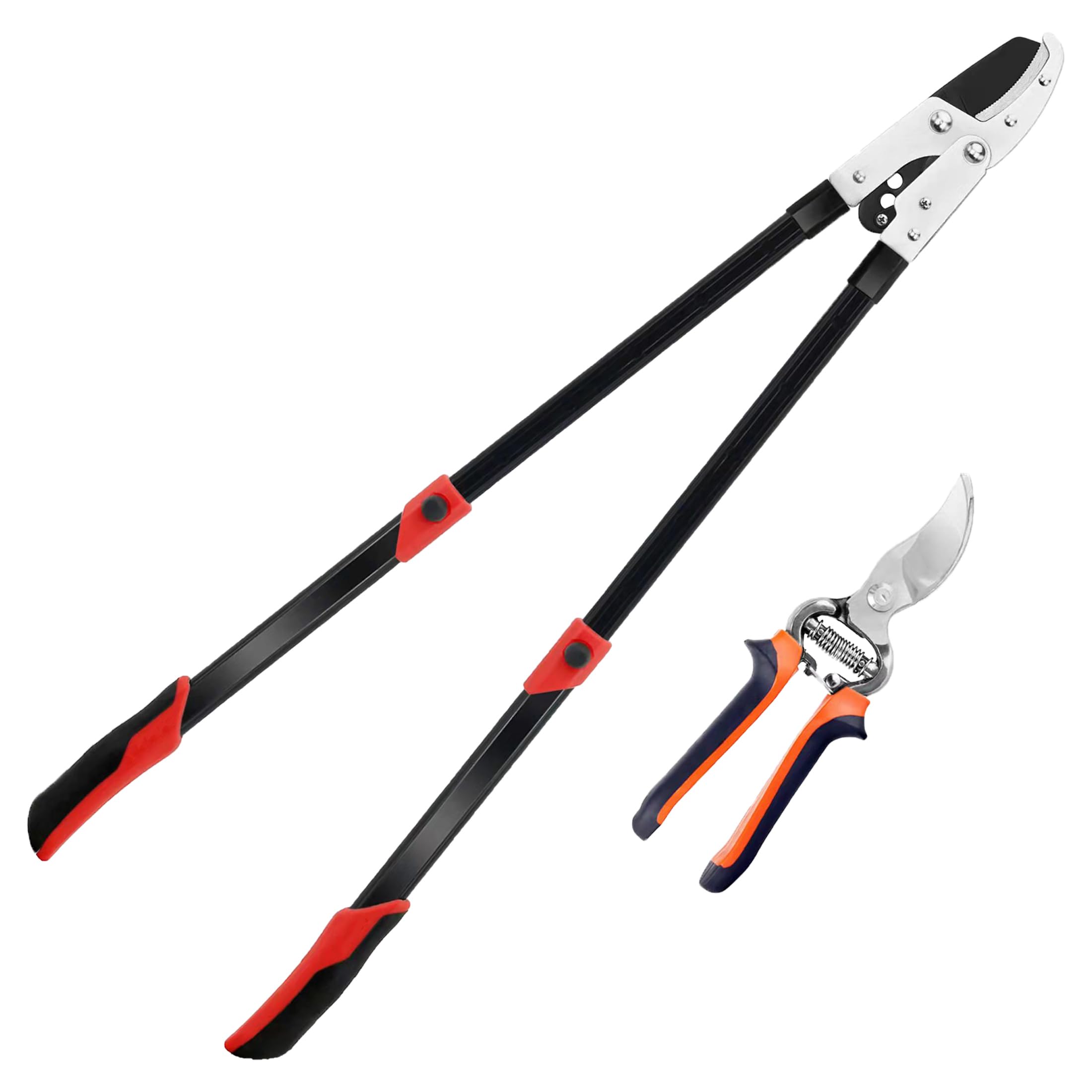
The budget lopper that extends your reach but has limits on strength.
For the price, this lopper gives you a lot of versatility. The handles adjust in six steps from 28 to 41 inches, giving you a wider range than the Kings County Tools loppers (26 to 40 inches). It uses compound action technology (a gear system similar to the DualLINK on the Corona, but at a lower price point) to boost cutting force. The alloy steel blade has a Teflon coating to reduce friction and resist rust. Small-framed users, including a 73-year-old reviewer in Hawaii, report it handles hibiscus and dry banana leaves “easily” and feels easy to handle.
The honest limitation is in the overhead heavy cutting. One buyer’s review is very clear: “Cannot cut 2″ green wood overhead; handles bend.” The tool could cut 1.25-inch live oak limbs without trouble, but the 2-inch claim only holds up in better conditions. The included small pruners are functional but one owner reported they “lock frequently after 3 cuts, requiring constant open up.” The handles are aluminum, which saves weight but sacrifices the stiffness of steel.
What you get for the money
- Extendable from 28 to 41 inches for a good reach range.
- Compound action makes cutting easier than a basic lopper.
- Teflon-coated blade for clean cuts on green and dry wood.
Where it falls short
- Handles may bend when cutting 2-inch wood overhead — stay within its comfort zone.
- Small included pruners can lock up and need manual resetting.
Reach for this if: you need a single, inexpensive extendable lopper for light to medium pruning and the budget is tight — for 1.25-inch branches it works well.
pass on it if: you regularly cut 2-inch branches overhead; the stronger steel handles of the Jardineer or the extra power of the Kings County Tools loppers will save you from the frustration of a bent tool.
6. EZ Kut BranchCutter Anvil Loppers

The sub-2-pound lopper that fits in a back pocket and still cuts 2-inch branches.
The EZ Kut is the most portable tool in this list by a wide margin. At just 18 inches long and 1.75 pounds, it is less than half the weight of the Jardineer (5 pounds) and short enough to fit in a backpack or even a back pocket. Unlike the longer YRTSH or Kings County Tools loppers, this one is built for tight spots — think thick bushes, overgrown shrubs, or reaching into a tangle of vines where a long handle cannot fit. It uses a ratchet action that lets you cut in stages, or you can use a single squeeze for quicker cuts on thinner wood. Reviewers point out it “works great for those that need a bit of extra strength help,” and that the ratchet cutting is “so easy compared to a looper that does not have a ratchet.”
The catch is the compact handle: you lose leverage compared to a 30-inch lopper, so cutting a hard 2-inch branch will require more effort from the ratchet mechanism. One buyer’s blade snapped on the “second outing,” but the company’s customer service sent a replacement part for a small processing fee. It uses an SK5 hardened steel blade with a non-stick coating, so debris slides off. For light-duty looping on the go, this is as easy as it gets.
What makes it unique
- Weighs just 1.75 pounds — incredibly easy to carry all day.
- Compact 18-inch size fits in tight spots and backpacks.
- Dual ratchet gives you extra power despite the small frame.
What you give up
- Short handle means less leverage for cutting tough 2-inch branches.
- One report of a blade snapping on heavy use, though customer service resolved it.
Grab this if: you are an outdoor enthusiast who needs a lopper to carry on a hike, or you are a senior looking for the lightest possible ratchet tool for small branch cleanup without fatigue.
Pass on this if: your property has many thick branches that need heavy leverage — you will be happier with the 30-inch Jardineer or the longer Kings County Tools.
7. 14.5FT Pole Saw
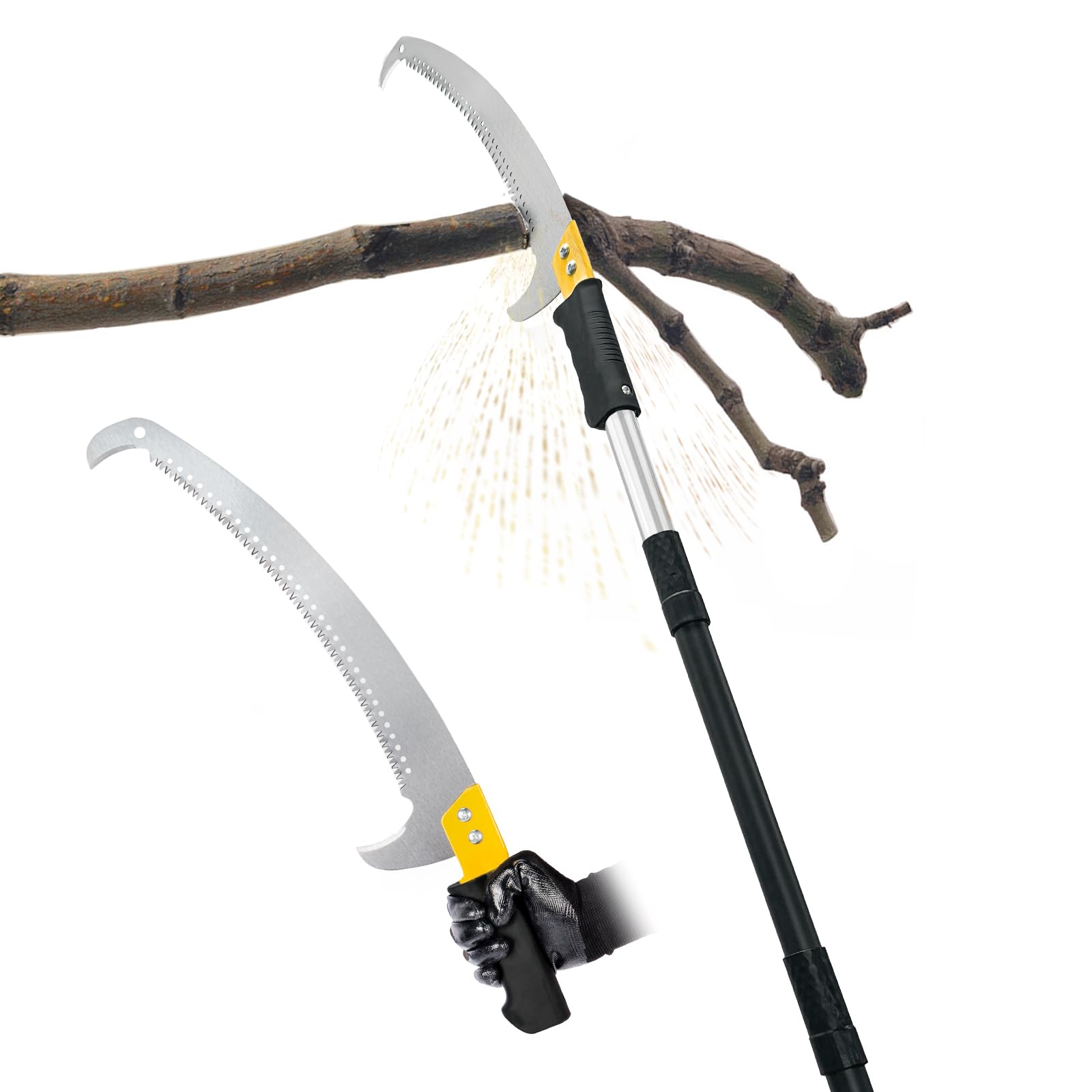
The manual pole saw that reaches 14.5 feet and chews through 3-inch branches without a battery.
When a branch is too high for a lopper and too small to justify a chainsaw, a pole saw is the perfect middle ground. This model assembles from 11 sections of stainless steel into a pole that extends up to 14.5 feet. The blade is Mn steel (manganese steel, a tough and wear-resistant alloy) with a three-sided edge and double-sided barb design that grips the branch and discharges sawdust so the cut does not clog. Shoppers say it “cuts like butter” and “cut several 3-inch thick branches and numerous smaller ones quickly with minimal effort.” It is entirely manual — no motor, no batteries, no charging — so it is ready whenever you grab it.
Assembly is simple, and the pole breaks down into 8.5-foot, 11-foot, or 14.5-foot configurations. The main complaint, mentioned by several buyers, is that the vendor does not sell replacement saw blades separately, so when the blade eventually dulls, you may need to replace the whole unit. Unlike the SEESII electric pole pruner, this one is much lighter and requires no charging, but it does need your arm strength to pull the saw back and forth. At 2.37 kilograms (about 5.2 pounds), it is lighter than the electric SEESII (6.4 pounds) and lighter than the Jardineer loppers.
What it does well
- Reaches 14.5 feet without a ladder, keeping you safe on the ground.
- Cuts branches up to 3 inches thick with a sharp, clog-free blade.
- Lightweight, manual, and needs no batteries or fuel.
What to watch out for
- Replacement blades are not sold separately — the whole saw needs replacing when dull.
- Requires manual sawing effort; not as easy as the SEESII electric pruner.
Best for: anyone who needs to reach high, thick branches without the cost and weight of an electric tool, and who values simplicity and safety (no ladders).
Not for: those who want a permanent tool — plan to replace the whole saw when the blade dulls, or look for a model with replaceable blades.
Understanding the Specs
Bypass vs. Anvil Blades
The blade type is the most important technical choice you make. A bypass blade works like a pair of scissors — two sharp blades slide past each other for a clean cut that is best for live, green wood because it helps the tree heal faster. An anvil blade has one sharp blade that cuts down onto a flat metal surface, crushing the branch slightly; this is better for dead, dry wood where a clean cut does not matter, and it is often more durable for thick, tough branches.
Ratchet and Compound Action
These are different ways of making the tool easier to squeeze. Ratchet action cuts in stages — you squeeze, the mechanism clicks and advances the blade, then you relax and squeeze again with fresh power. It is ideal for anyone with weak grip or arthritis. Compound action is a gear system inside the pivot that changes the leverage ratio, so each squeeze is stronger than it would be with a standard pivot. It helps, but does not multiply the force as much as a ratchet does.
FAQ
What is the difference between a pole saw and a lopper?
Can I use an anvil lopper on live tree branches?
How long does a tree cutting tool blade stay sharp?
What does cutting width mean and why does it matter?
Do I need an electric pole pruner or is a manual pole saw enough?
Will a lopper work for cutting roots?
How do I extend the life of my tree cutting tool?
Are extendable loppers as strong as fixed-handle loppers?
Final Thoughts: The Verdict
If you want one dependable pick, the best tree cutting tools winner is the Jardineer Ratchet Anvil Loppers because it combines a powerful ratchet mechanism, a proven four-year track record from real owners, and an extra spare blade at a price that does not hurt. If you want a clean bypass cut on live wood with maximum leverage, grab the Corona Tools 33″ Bypass Loppers. And for reaching high thick branches without a ladder, the standout is the simplicity of the 14.5FT Pole Saw.
How We Picked
We do not accept paid placement. Every pick is matched to a real buyer and a real use-case; we do not hands-on test units.
Sources & Methodology
Specifications: manufacturer listings and product documentation. Review insights: verified customer reviews, as of July 2026. Pricing: not shown on this page (it changes often); check the current price via the retailer link.
As an Amazon Associate, Lawn Gear Lab earns from qualifying purchases. This does not affect which products we feature.