
Specs are compiled from manufacturer listings and verified buyer reviews and can change over time — please confirm the key details on the product page before buying.
The secret to a clean yard isn’t killing weeds after you see them—it’s putting down a barrier *before* they sprout so you never have to pull them. Barrier weed killers (pre-emergents) create a chemical layer in the soil that stops weed seeds from germinating, saving you hours of bending, pulling, and spraying mid-summer.
I’m Rikta — the founder and writer behind Lawn Gear Lab. This guide is built by comparing the manufacturers’ published specifications and the patterns across verified customer reviews, so you get each pick’s real strengths and trade-offs instead of marketing spin.
Below are seven of the most effective options, from budget-friendly granules to professional-grade concentrates, to help you find the right barrier weed killer for your lawn and garden.
Quick Picks
- The Andersons Barricade 50 lb Bag — Professional Grade
- Dimension 2EW Herbicide – 0.5 Half Gallon — Best Overall
- DOW Snapshot 2.5 TG Granular Pre-emergent — Broad Spectrum
- Prodiamine 65 Wdg 5lbs Pre-emergent — Best Value
- Barricade 4FL Herbicide Concentrate – 4 Fl Oz — Tiny but Mighty
- Hi-Yield (33030) Turf & Ornamental Weed — Crabgrass Solver
- Roundup Landscape Weed Preventer 5.37 LB — Flower Bed Safe
How To Choose The Best Barrier Weed Killer
A barrier weed killer stops weeds from ever seeing the light of day, but picking the wrong one means wasted money and a yard full of crabgrass anyway. Here’s what actually matters when you are shopping.
Active Ingredient — Prodiamine vs Dithiopyr vs Isoxaben
The three most common active ingredients in barrier products serve slightly different purposes. Prodiamine (found in Barricade and generic equivalents like Quali-Pro) is a long-lasting general pre-emergent that stops many grass and broadleaf weeds. Dithiopyr (the active in Dimension) is unique because it offers some early post-emergent control of crabgrass that has already sprouted. Isoxaben (paired with trifluralin in Snapshot) is specifically strong against broadleaf weeds like chickweed and henbit.
Granular vs Liquid Form
Granules (like The Andersons Barricade and Hi-Yield) are easier to spread with a standard lawn spreader and require watering in to activate. Liquids (like Barricade 4FL and Dimension 2EW) must be mixed with water and sprayed, which gives you more even coverage on complex terrain but demands a sprayer and careful calibration. Your choice here is convenience versus precision.
Coverage Area and Unit Count
Check the bag or bottle for the exact square footage it treats. A 50 lb bag of The Andersons Barricade covers 14,200 square feet, which is a small property. Hi-Yield’s 12 lb bag covers only 5,000 square feet. Buying a product with too little coverage means returning to the store mid-season, while buying an industrial size for a tiny plot is just heavy to lug around.
Quick Comparison
| Model | Best For | Form | Active Ingredient | Size/Weight | Amazon |
|---|---|---|---|---|---|
| The Andersons Barricade | Pro-grade, long-lasting coverage | Granule | Prodiamine 0.48% | 50 lb (800 oz) | Amazon |
| Dimension 2EW Herbicide | Post-emergent + pre-emergent on crabgrass | Spray | Dithiopyr | 64 fl oz | Amazon |
| Snapshot 2.5 TG | Broadest weed spectrum control | Granule | Isoxaben + Trifluralin | 50 lb (800 oz) | Amazon |
| Prodiamine 65 WDG | Budget-friendly concentrate | Spray (wettable powder) | Prodiamine 65% | 5 lb (80 oz) | Amazon |
| Barricade 4FL | Small-area liquid control | Spray | Prodiamine | 4 fl oz | Amazon |
| Hi-Yield Weed & Grass Stopper | Crabgrass-heavy lawns | Granule | Dimension (Dithiopyr) | 12 lb (192 oz) | Amazon |
| Roundup Landscape Preventer | Gentle flower bed protection | Granule | — | 5.4 lb (86.4 oz) | Amazon |
In‑Depth Reviews
1. The Andersons Barricade 50 lb Bag
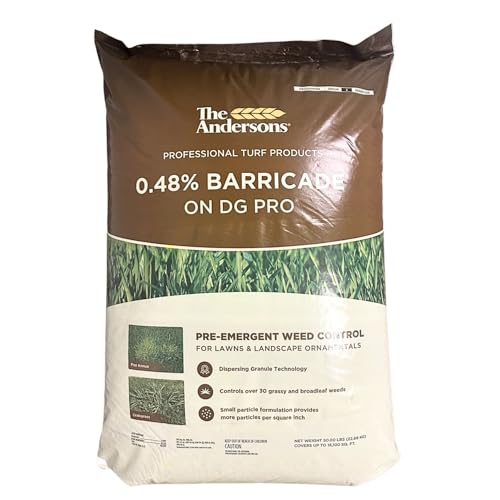
The pro-grade 50 lb sack that pros reach for when they want a season of zero weeds.
This is the big one: a full 50-pound bag of granules that treats 14,200 square feet—enough to handle a solid mid-size lawn without needing a second purchase. The active ingredient is prodiamine at 0.48%, the same stuff the pros use on golf courses. Buyers report it is “effective for 2 years, outperforms Preen,” meaning you may not even need to reapply the following season. One owner mentioned that after using it, the only weeds they saw were occasional dandelions.
The DG Pro formulation gives you more particles per square inch, which leads to a denser chemical barrier in the soil. Unlike the liquid concentrates, this is a granular spread-and-water product, so you just walk your spreader and then irrigate. Compared to the 800 oz unit count here, the Dimension 2EW is tiny at 64 oz—you would need many bottles of that to match this coverage.
The main catch is timing: you must apply it in early spring or fall, before weeds germinate. It will not kill existing weeds, and one reviewer noted that clover still appeared during their first summer of use.
Why It Leads the Pack
- Huge 14,200 sq ft coverage from a single bag
- Owners mention weed control lasting up to 2 years in some areas
- Pro-grade prodiamine formulation trusted by turf care professionals
Know Before You Buy
- 50 lb bag is heavy to transport and store
- Requires precise early-spring or fall application timing
- Not effective on existing weeds (pre-emergent only)
Ideal for homeowners who: have a large lawn and want a professional-grade solution that may work for two seasons without reapplication.
skip it if: you need to kill weeds that have already sprouted, or you have a small yard and do not want to store a 50 lb sack.
2. Dimension 2EW Herbicide – 0.5 Half Gallon (64 ounces)

The liquid ace in the hole that stops crabgrass before it sprouts and even right after it appears.
Dimension uses dithiopyr, which is rare among pre-emergents because it also offers early post-emergence control of crabgrass. If you missed your spring window by a week or two, this product can still save you—it kills young crabgrass that has already germinated. It is safe on over 440 ornamental plants and on both cool- and warm-season turfgrasses, which makes it a flexible choice for mixed yards.
At 64 fluid ounces (half a gallon), the liquid volume is modest, but you mix it with water for coverage. One buyer mentioned that applying it with a Chapin 15-gallon tow-behind sprayer provided even coverage. Note that the product may arrive in a CORTEVA white jug with a blue cap rather than the Dow bottle shown in the photo, as one owner reported.
It is registered in every state, so you do not have to worry about regional restrictions.
Top Strengths
- Unique dual action: pre-emergent + early post-emergent crabgrass control
- Safe on over 440 ornamental plant species
- Works on both cool- and warm-season turfgrasses
Things to Watch
- Liquid requires a sprayer and calibration effort
- Small bottle (64 oz) compared to granular sacks—repeats needed for large lawns
- Packaging may differ from product photos
Reach for this when: you need a pre-emergent but want the safety net of killing early-emerged crabgrass too.
Look elsewhere if: you prefer the simplicity of a granular spread-and-water product or are covering more than a standard suburban lawn with a single application.
3. DOW Snapshot 2.5 TG Granular Pre-emergent Herbicide
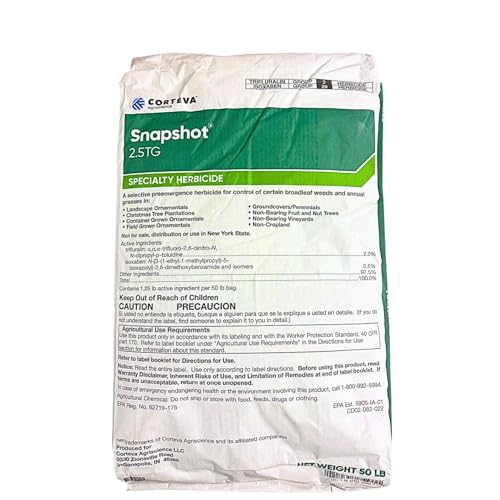
The granular behemoth that takes down 111 different weed types in one pass.
Snapshot boasts more control than any other pre-emergent on the market, covering 111 broadleaf and grassy weeds. The combination of isoxaben and trifluralin works broadly, targeting everything from chickweed to foxtail. It offers up to 6-8 months of control from a single application, which is a full growing season in most climates.
This 50 lb bag treats at an application rate of 2.3 to 4.6 lb per 1000 square feet, so you need to calibrate your spreader carefully. One buyer using it on St. Augustine grass reported switching from brand-name products and getting “a lot less is coming through.” Another noted you have to “keep at it” and follow up later in the season for best results in Florida, where aggressive warm-season weeds require multiple applications.
It is not the cheapest granular option, but it covers a vast weed spectrum compared to the Hi-Yield product below. The Hi-Yield focuses on Dimension (dithiopyr) and treats 5,000 sq ft, while Snapshot covers a much broader spectrum across a larger volume.
Biggest Advantages
- Controls the most weed species (111) of any pre-emergent here
- Lasts up to 8 months—a full growing season from one application
- Proven effective on St. Augustine grass without damage
Considerations
- Heavy 50 lb bag is a workout to haul and spread
- Requires accurate spreader calibration for even coverage
- May need multiple applications in warm climates like Florida
Go for this if: you have a mixed weed problem and want the broadest possible protection from a single product.
pass on it if: your primary target is crabgrass alone—simpler, cheaper options exist.
4. Prodiamine 65 Wdg 5lbs Pre-emergent (Generic Barricade)
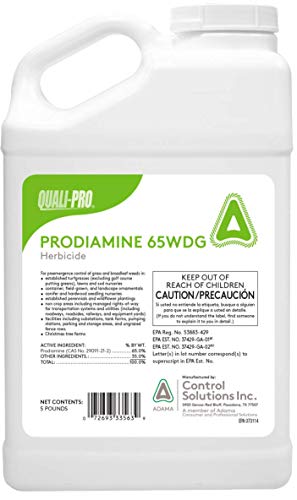
The concentrated generic that gives you the same active ingredient as Barricade at a fraction of the per-application cost.
This is Quali-Pro’s generic version of Barricade, using prodiamine at a high 65% concentration in wettable powder form. You mix it with water and spray, getting a tiny per-application cost compared to buying pre-mixed liquids or granules. One buyer put it plainly: “yes higher upfront cost, but long term way cheaper as per application cost is very low.” This is a smart buy for anyone maintaining a large property season after season.
The 5 lb container holds 80 oz of concentrated powder, which goes a long way when you mix it. Customers note applying it in late September and late March, and it has “GREATLY reduced weeds.” Another reviewer noted it kept everything out of their yard except Bermuda and St. Augustine grass, which is exactly what you want in a warm-season lawn. The Andersons Barricade at 50 lbs is heavier than the Prodiamine 65 WDG at 5 lbs, but the Prodiamine 65 WDG is more concentrated, so it actually goes further per pound of active ingredient.
The trade-off: mixing a wettable powder takes more effort than shaking a jug or spreading granules, and you need to water it in shortly after application. Avoid heavy rain immediately after spraying, or you risk washing the barrier away.
Why It Saves You Money
- 65% concentration means very low per-application cost over time
- Generic formulation matches brand-name Barricade performance
- Selective—allows Bermuda and St. Augustine grass to thrive
Be Ready For
- Requires mixing and a sprayer (not a spread-and-forget granule)
- Must be watered in quickly; cannot handle heavy rain right after
- Powder can be dusty during mixing—wear a mask and gloves
Ideal for the budget-conscious lawn geek: if you already own a sprayer and do not mind mixing, this is the most economical way to apply prodiamine season after season.
Not for you if: you want a ready-to-use granule that you just toss out of a bag with no measuring or mixing.
5. Barricade 4FL Herbicide Concentrate – 4 Fl Oz
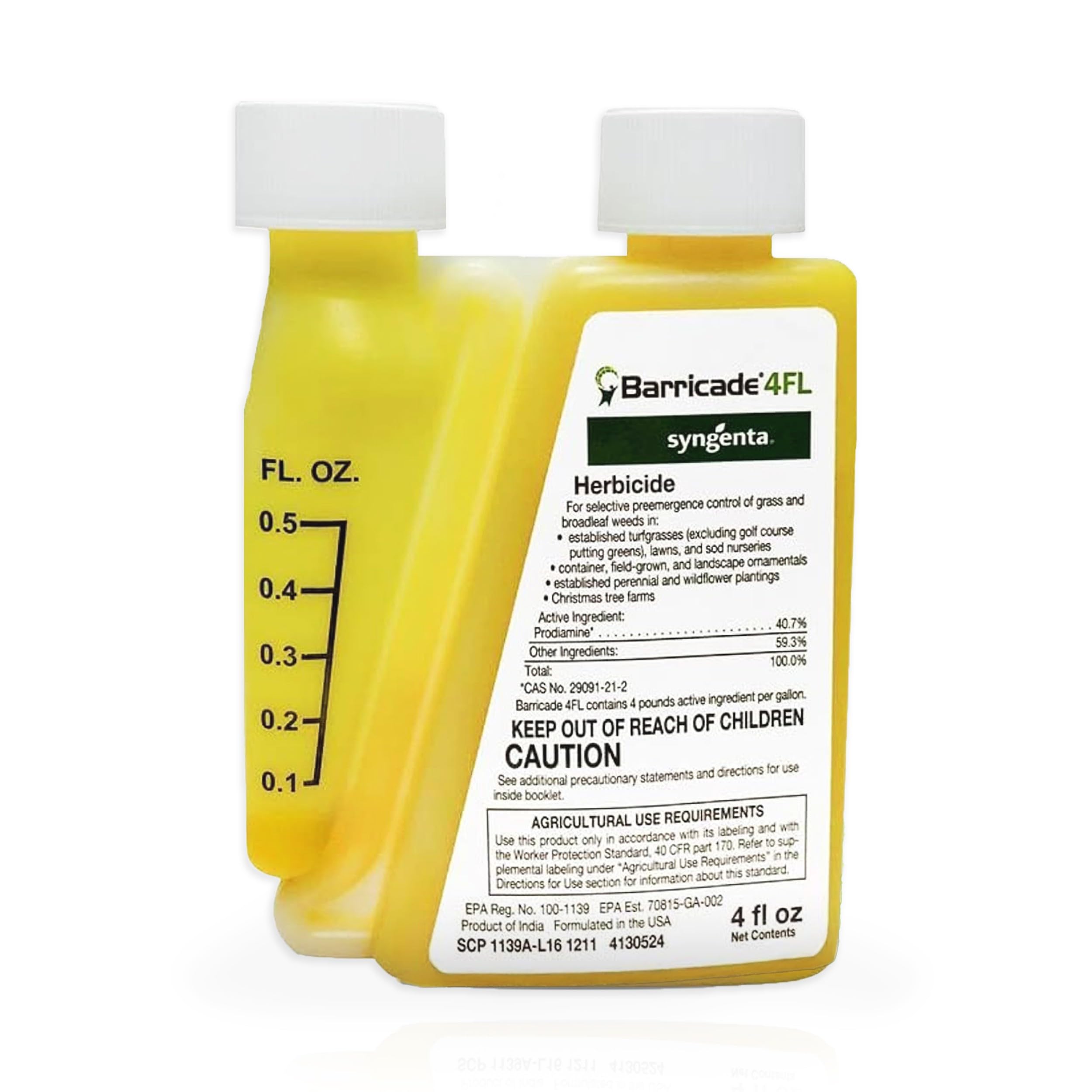
The pint-sized liquid that turns your sprayer into a season-long broadleaf barrier.
Syngenta’s Barricade 4FL is a liquid concentrate that packs prodiamine into a tiny 4 fl oz bottle. Do not let the size fool you—this stuff gets diluted with water and covers a lot of ground. It is labeled for use on turf, ornamentals, sod nurseries, and even Christmas tree farms, so it is versatile. One customer observed it “suppressed weeds almost entirely” on gravel landscaping, which is a tough environment for most products.
It targets up to 30 species of turf weeds, both summer and winter annuals. You can apply it several months before germination and expect it to last the whole season. Because it is a liquid, it is easier to get an even barrier on complex terrain with rocks, slopes, and flower beds compared to granules that can bounce or roll. One reviewer specifically called out that it “works great in landscaping beds” and even better with a dye marker to track where you have sprayed.
The catch is the tiny bottle looks expensive compared to a big 50 lb bag of granules. But the 4FL is concentrated, so you are paying for active ingredient, not filler. It is available under the Syngenta brand, which carries credibility in the professional turf world.
Highlights
- Concentrated liquid goes a long way despite the small bottle size
- Great for odd-shaped beds, gravel, and ornamentals where granules struggle
- Reviewers point out excellent suppression even on tough gravel landscaping
Downsides
- Small 4 oz bottle may feel expensive per unit compared to granules
- Requires a sprayer and careful mixing ratios
- Must apply before weeds germinate (no post-emergent action)
Perfect for the gardener who: has flower beds, gravel paths, or landscaping areas where granules would be messy or ineffective.
Avoid if: you want a simple spread-and-water solution for a flat, open lawn.
6. Hi-Yield (33030) Turf & Ornamental Weed & Grass Stopper (12 lbs.)

The granular secret weapon for anyone fighting a losing battle against crabgrass in their lawn.
Hi-Yield uses Dimension (dithiopyr) as its active ingredient, which makes it especially effective on crabgrass. One buyer confirmed it “works well to prevent crabgrass” in areas that were being overtaken. Unlike many pre-emergents, Dimension offers both pre- and post-emergence action on crabgrass, so you get some forgiveness if you are a few days late with your spring application.
The 12 lb bag treats 5,000 square feet, which is a typical suburban front lawn. You can apply it up to 4 weeks later than other pre-emergent crabgrass products, giving you a wider application window. One user highlighted that results require “2+ years for full results; not a one-use miracle,” so patience is required.
One buyer received a 9.6 lb bag instead of the advertised 12 lb bag, so check your package weight when it arrives. The product contains Dimension, not the Halts version, which is a distinction some buyers miss.
What It Excels At
- Specifically targets crabgrass and goosegrass
- Offers a wider application window (up to 4 weeks later than competitors)
- Granular ease of use—just spread and water
Watch For
- Reported weight discrepancies—verify you received the full 12 lbs
- Requires multiple seasons for best results, not a single application fix
- Covers only 5,000 sq ft, which may be small for larger properties
Choose this if: you have a crabgrass infestation and want a forgiving pre-emergent that works even if you apply it slightly late.
Think twice if: your lawn is larger than 5,000 sq ft or you want a product that works against a broad range of weeds, not just crabgrass.
7. Roundup Landscape Weed Preventer 5.37 LB
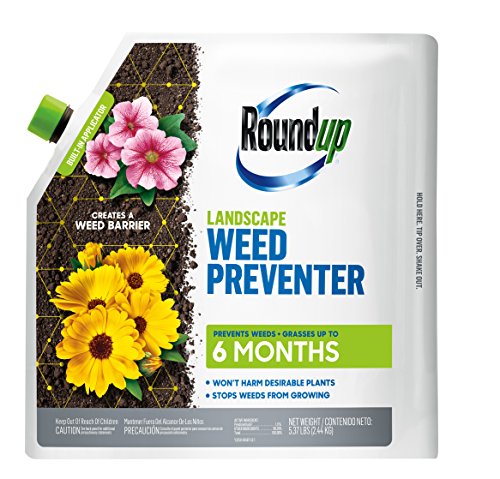
The entry-level granular protectant that won’t harm your flowers and keeps the weeding chores manageable.
Roundup’s Landscape Weed Preventer is a 5.4 lb bag of granules that is designed specifically to create a barrier without damaging desirable plants. It prevents weeds for up to 6 months. One shopper added it “works well in flower beds low odor helps keep weeds away for about 3 months,” which is still a solid chunk of the growing season. The built-in applicator makes spreading straightforward.
It does not kill existing weeds—you must pull them first, which one reviewer described as “a lot of work.” That is the nature of barrier products, but new buyers often miss that distinction. The small 5.4 lb size is easy to handle and store, unlike the 50 lb professional bags. It is also lighter than the Hi-Yield (12 lbs)—at 5.4 lb versus 12 lb.
The trade-off is coverage: because the bag is small, you may need multiple bags if you are covering a large property. And unlike some competitors, it does not appear to control tough perennial weeds like quack grass, as one reviewer noted.
Good For Starters
- Safe around flowers and ornamentals—won’t harm desired plants
- Low odor, which is nice if you are sensitive to chemical smells
- Small, easy-to-handle bag with a built-in applicator
Limitations
- Does not kill existing weeds—manual removal required first
- Not effective against quack grass and some tough perennials
- Shoppers say 3-month control, which is less than the claimed 6 months
Best for the flower bed gardener: who wants a gentle, low-odor barrier around their ornamentals without worrying about harming them.
Pass on this if: you need a heavy-duty solution for a large lawn or persistent weeds like quack grass.
Understanding the Specs
Prodiamine
The most common active ingredient in barrier weed killers. Prodiamine stops weed seeds from dividing and growing in the soil. It is used in products like Barricade and Quali-Pro. It lasts a long time in the soil but does nothing to weeds that have already sprouted—so timing your application is everything.
Dithiopyr (Dimension)
This is a pre-emergent that also kills early-emerged crabgrass. Most barrier products only prevent germination; dithiopyr gives you a small window after the weed sprouts where you can still kill it. This makes it more forgiving if you apply it a few days late in the spring.
Granule vs Spray Form
Granules are solid particles you spread on the lawn and then water in. Sprays are liquid mixtures you apply with a sprayer. Granules are easier for large open lawns, but sprays give you more precise coverage on irregular terrain, landscaping beds, and gravel. The choice is largely about your yard’s layout and your equipment setup.
Coverage Area (sq ft)
Every bag or bottle lists how many square feet it treats as directed. A smaller number like 5,000 sq ft (Hi-Yield) is fine for a typical front yard, but if you have a full acre (43,560 sq ft), you need a product that covers more ground per unit or you will need to buy multiple units. Always compare coverage before assuming one bag is enough.
FAQ
Can I use a barrier weed killer on a lawn that already has weeds?
When is the best time of year to apply a barrier weed killer?
Will a barrier weed killer kill my grass or flowers?
How often do I need to reapply a barrier weed killer?
Do I need to water in a granular barrier weed killer?
Can I use a barrier weed killer in vegetable gardens?
What is the difference between prodiamine and dithiopyr?
How do I calculate how much product I need for my lawn?
Can I use a barrier weed killer on gravel driveways or patios?
Will rain wash away a barrier weed killer before it works?
Final Thoughts: The Verdict
For most buyers, the barrier weed killer winner is the The Andersons Barricade because its pro-grade prodiamine formulation delivers the most coverage per bag and has buyers reporting control lasting up to 2 years. If you want a dual-action product that can also kill early-emerged crabgrass, grab the Dimension 2EW Herbicide. And for the budget-conscious applicator with a sprayer, the standout is the value per application of the Prodiamine 65 WDG.
How We Picked
We do not accept paid placement. Every pick is matched to a real buyer and a real use-case; we do not hands-on test units.
Sources & Methodology
Specifications: manufacturer listings and product documentation. Review insights: verified customer reviews, as of July 2026. Pricing: not shown on this page (it changes often); check the current price via the retailer link.
As an Amazon Associate, Lawn Gear Lab earns from qualifying purchases. This does not affect which products we feature.