
Specs are compiled from manufacturer listings and verified buyer reviews and can change over time — please confirm the key details on the product page before buying.
A mower blade is just a spinning metal bar, right? Not exactly—the wrong one leaves your lawn looking ragged, forces your engine to work harder, and needs replacing every few weeks. The right blade tackles tall wet grass in a single pass, stays sharp for seasons, and makes you wonder why you didn’t swap it sooner. This guide breaks down seven real options so you can find the one that actually matches the deck pattern on your mower and the type of grass you’re cutting.
I’m Rikta — the founder and writer behind Lawn Gear Lab. This guide is built by comparing the manufacturers’ published specifications and the patterns across verified customer reviews, so you get each pick’s real strengths and trade-offs instead of marketing spin.
Whether you ride a zero-turn to tackle an acre or push a 21-inch electric around a suburban lot, your mower needs a sharp blade that fits its specific mounting pattern — and the best mower blade for your yard depends on matching that pattern to the right steel, lift, and coating for the job.
Quick Picks
- Grasscool 21″ Mulching Blades (Troy-Bilt) — Best Overall
- EGO POWER+ 21″ Mulching Blades (2-Pack) — Premium Pick
- MaxPower 561139B 3-Blade Set (60″ Exmark) — Heavy-Duty Choice
- Grasscool 942-04053C Blades — Best for Zero-Turn
- Wadoy 2105300125A Blade (Hyper Tough) — Best Value
- Greenworks Replacement Blade (21″ Mowers) — Compatible Pair
- Oregon 91-626 6-Pack (Scag / Ferris) — Commercial Bulk
How To Choose The Best Mower Blade
Buying the wrong mower blade usually means ordering a second one — and waiting another week for delivery. The first thing to know is that blades are not interchangeable between mower brands or even between different models from the same brand. The center hole shape, blade length, and overall weight determine whether a blade bolts on without wobbling or leaves a strip of uncut grass down your lawn. Focus on these three factors and you will narrow your choices quickly.
Mounting Pattern and Part Number Matching
This is the single most common mistake in the category. Mower decks use different center-hole shapes: a standard round hole, an oval “S-hole”, a six-point star, or a bow-tie pattern. A blade that fits a Cub Cadet 50-inch deck with a six-star hole will not fit the same mower model if it shipped with the S-hole version. The easiest way to get it right is to remove the old blade and read the part number stamped into the metal, then match that number to the replacement’s compatibility list. Skipping this step is the top reason blades get returned.
Blade Length and Deck Size
Mower blade length is tied directly to the width of your cutting deck. A 21-inch blade matches a 21-inch deck, a 20-inch blade matches a 20-inch deck, and so on. Using a blade that is even a quarter-inch too long can cause the blade tip to hit the deck housing at full speed, which damages the spindle and the blade itself. A blade that is too short leaves an uncut strip in the middle of each pass. Measure your existing blade tip to tip (not the diagonal) or check your owner’s manual for the correct length before you buy.
Blade Type: Mulching vs High-Lift vs Standard
The shape of the blade determines what it does with the grass after it cuts it. A mulching blade has a curved, uneven edge that recirculates clippings inside the deck and cuts them into fine pieces that fall between the grass blades — ideal if you want to skip bagging and return nutrients to the soil. A high-lift blade has a pronounced upward curve near the tip that creates a strong suction, lifting the grass before cutting and throwing clippings into the bag or out the discharge chute. This shape is better for tall or wet grass but creates more drag on the engine. A standard lift blade is a middle ground that does either job adequately but excels at neither.
Steel Thickness, Coating, and Edge Reinforcement
A thicker blade resists bending when you hit a root or rock, but it also puts more load on the engine. Look at the blade thickness in inches — 0.203 inches as a reference point is common for heavy-duty zero-turn blades — and the steel type. A powder-coated finish stops rust during storage, and some blades have a tungsten carbide edge fused to the cutting surface, which buyers report stays sharp longer between sharpenings.
Quick Comparison
| Model | Best For | Blade Length | Blade Type | Item Weight | Amazon |
|---|---|---|---|---|---|
| Grasscool 21″ Mulching (Troy-Bilt) | Mulching on 21″ gas mowers | 21 inches | 3-in-1 Mulching | 3.59 pounds | Amazon |
| EGO POWER+ Mulching (21″) | EGO Select Cut electric mowers | 21 inches | Mulching | 2.59 pounds | Amazon |
| Grasscool Cub Cadet 50″ Deck | Zero-turn riding mowers (50″ deck) | — | 2-in-1 High-Lift | 4.95 pounds | Amazon |
| MaxPower 3-Blade Set (60″) | Exmark 60″ zero-turn mowers | 20.5 inches | Standard Lift | 5 pounds (set) | Amazon |
| Wadoy 2105300125A (Hyper Tough) | Hyper Tough 20″ push mowers | 20 inches | Standard Lift | 1.55 pounds | Amazon |
| Greenworks Replacement (21″) | Greenworks electric mowers | 21 inches | Standard Lift | — | Amazon |
| Oregon 91-626 (Scag / Ferris) | Commercial zero-turn mowers | 21 inches | Standard Lift | 20.1 pounds (6-pack) | Amazon |
In‑Depth Reviews
1. Grasscool 21″ Mulching Blades (Troy-Bilt)

A 3-in-1 blade set that covers mulching, bagging, and discharge in one swap.
This pair from Grasscool is built for 21-inch Troy-Bilt and Craftsman mowers with a bow-tie spindle pattern — a common mount that many gas mowers share. The 3-in-1 design uses a curved blade face that recirculates clippings into fine mulch while the high-lift edge increases bagging capacity by 50%.
The blades measure 21.5 x 3 x 1.6 inches in the package and weigh 3.59 pounds, giving them noticeable heft compared to thinner entry-level blades. Buyers also note they are “not super sharp but does the job,” so you may want to touch up the edge before the first install if you want a golf-course-finish right away. The paint on the cutting edges protects your hands during installation and wears off as the blade cuts grass.
Why it leads the list
- Three cutting modes (mulch, bag, side discharge) from one blade
- Two-pack gives you a backup blade at the same price as a single store-brand blade
- Strong airflow design reduces clogging in damp grass
The trade-off
- Only fits bow-tie spindle patterns — verify your mount before buying
- Buyers describe the factory edge as usable but not razor-sharp
Your next blade if: You own a Troy-Bilt or Craftsman 21-inch mower and want one blade that switches between mulching and bagging without compromises.
Look elsewhere if: Your mower uses a round-hole or star-pattern spindle — this bow-tie pattern will not fit your deck.
2. EGO POWER+ 21″ Mulching Blades (2-Pack)

OEM-grade mulching blades that slot right into the EGO Select Cut multi-blade system.
If you own an EGO POWER+ 56-volt mower like the LM2156SP or LM2135SP, these blades are the factory-recommended replacement. They are the lower blade in EGO’s Select Cut system — swap the old one out, keep the upper blade, and you are back to mulching in about five minutes with the existing hardware. At 2.59 pounds the set is noticeably lighter than a gas-mower blade, which is a good match for the lower torque of an electric motor.
The all-steel construction delivers a clean cut, and the blade measures 20.2 x 1.97 x 0.79 inches in the box. One long-term reviewer noted the blade “lasts about three seasons” with typical suburban use, while another who mows a third-acre twice a year reported needing two replacements per season and buys multiples to batch-sharpen. So if your yard is large or rough, plan to swap more often than a heavy-duty gas blade.
Why it earns the premium tag
- Exact OEM fit for EGO Select Cut mowers — no adapters or guesswork
- Five-minute swap using existing nuts and bolts
- Mulching action leaves fine clippings that fertilize the lawn
The caveat
- Does not include mounting hardware — reuse the bolts from your old blade
- Some owners mention the edge dulls faster than they would like on larger properties
Stick with these if: You have an EGO Select Cut mower and want genuine OEM parts that fit without modification.
Skip them if: Your mower is a different brand — the Select Cut bolt pattern is unique to EGO and won’t work on other decks.
3. MaxPower 561139B 3-Blade Set (60″ Exmark)

A three-blade set built to withstand commercial mowing on a 60-inch Exmark deck.
MaxPower uses thicker steel than the OEM Exmark blade, which buyers confirm: one writes that “thicker, heavier duty than most” and calls it “superior to Oregon blades.” The set includes three blades that measure 20.5 inches long and 2.5 inches wide, with a 15/16-inch center hole that fits Exmark models like the Laser Z, Turf Ranger, and Vantage. The blades are sharpened during manufacturing and powder-coated for rust protection — the coating comes off during the first cut to expose a precision edge.
At 5 pounds total for the set, each blade is heavier than the 1.55-pound Wadoy blade above, which makes sense given the commercial-grade duty. One small-business owner using them on a Laser Z says the thickness helps them hold up to daily mowing and “cuts grass even.” Unlike the Grasscool Cub Cadet blades at 4.95 pounds for a single blade, this 3-pack delivers a full deck set at a reasonable per-blade weight.
The strong points
- Thicker steel than the factory blade — better resistance to bending on rocks and roots
- Three blades in the box cover the full deck at once
- Made in the USA with US steel
The honest limit
- Fits only Exmark 60-inch models — does not adapt to other zero-turn brands like Scag or Ferris
- Heavier blade puts slightly more load on the spindle compared to a standard weight blade
Reach for this if: You run an Exmark zero-turn for commercial or large-property mowing and need blades that survive impact without bending.
Look elsewhere if: Your mower deck is not Exmark or your deck width is under 60 inches — the center hole and length are specific to this lineup.
4. Grasscool 942-04053C Blades for Cub Cadet 50″ Deck
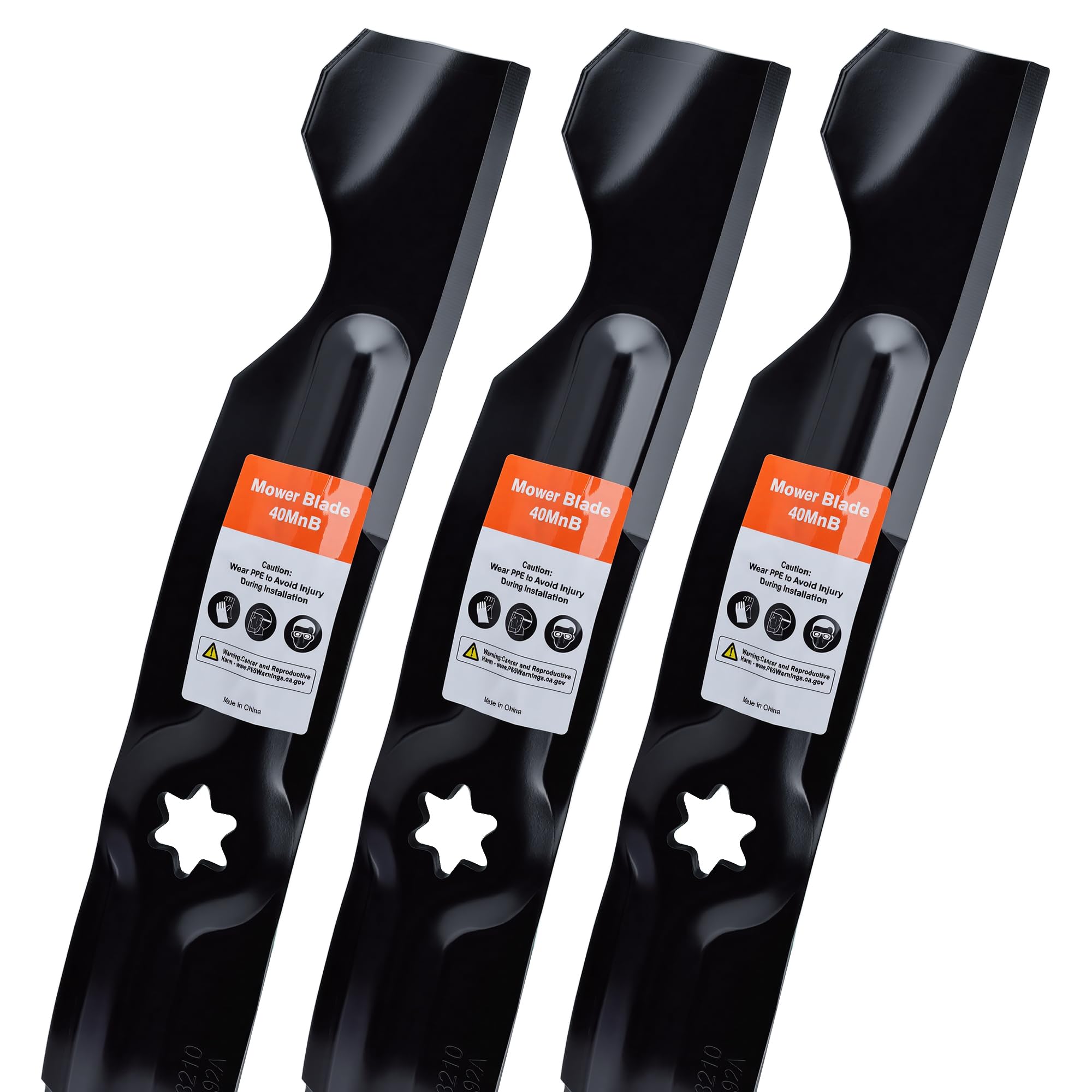
A high-lift blade for Cub Cadet RZT and LTX mowers that moves clippings fast.
This blade is designed for 50-inch Cub Cadet decks using a six-point star mounting hole — but Cub Cadet made four different blade specs for those same mower models, so you must check the part number on your old blade before ordering. If yours is stamped 942-04053C, this is the exact match. The high-lift design creates powerful suction that throws clippings through the discharge chute or into the bag, and the strong airflow reduces clogging when the grass is damp.
Buyers running this blade on a Troy-Bilt Mustang zero-turn report it lasts “two seasons with no issues” and comes “sharp and balanced well.” At 4.95 pounds, it is over three times heavier than a 20-inch push-mower blade like the Wadoy at 1.55 pounds, which matches the scale of a zero-turn mower. The package measures 18.7 x 2.91 x 2.44 inches — about 15% more compact in length than the 21-inch Grasscool mulching blades above, though the blade itself is sized for a larger 50-inch deck span.
Why it works
- High-lift design prevents clogging and throws clippings far into the bag
- Buyers confirm two-season durability on zero-turn mowers
- Includes correct star-hole hardware for Cub Cadet RZT50 and LTX1050 decks
The installation warning
- Only fits the 6-star hole variant — Cub Cadet used S-hole and circle-hole versions for the same deck
- High-lift design creates more drag, so the engine works a little harder than with a standard lift blade
This is your blade if: Your Cub Cadet RZT50 or LTX1050 has the six-star mounting hole and you want a durable high-lift blade for bagging and discharging.
Pass on it if: Your old blade has an S-hole or circle hole — those require a different part number and won’t align on the star pattern.
5. Wadoy 2105300125A Blade (Hyper Tough)
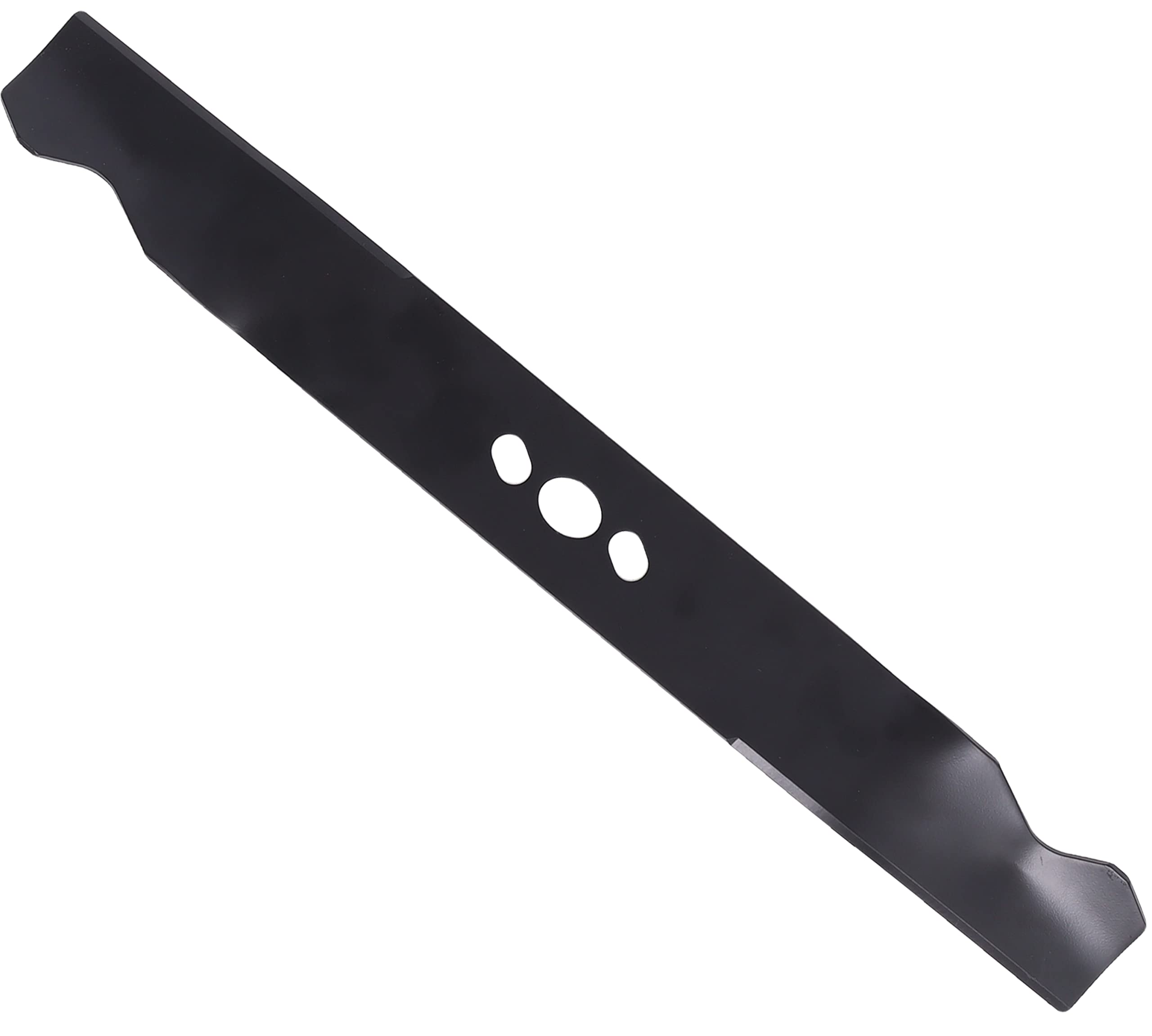
A 20-inch aftermarket blade with a fused tungsten carbide edge for longer sharpness.
This replacement blade is compatible with Hyper Tough mowers using part numbers 2105300125A, MNA152505, and MNA152701 — always remove your old blade and confirm the printed number before ordering. The standout feature here is the tungsten carbide fused to the cutting surface, which is unusual at this price point and customers note helps the edge stay sharp for longer intervals between sharpenings. The powder-coated finish adds rust protection during storage.
At 1.55 pounds, this is a lightweight blade compared to the 3.59-pound Grasscool mulching blades above — it is meant for a smaller 20-inch push mower, not a riding deck. One repeat buyer reports it “fits perfectly for rough use; second purchase from same seller,” but also warns to “verify blade connection holes match bolts to avoid returns.” The blade length is 20 inches, so it will leave a gap on a 21-inch deck.
The value angle
- Tungsten carbide edge should reduce sharpening frequency compared to standard steel
- Powder coat finish resists surface rust during off-season storage
- Reviewers point out consistent fit and cut quality across multiple purchases
The catch
- Only fits Hyper Tough models with the exact part number stamped on the old blade — not universal
- At 1.55 pounds, thin steel is less forgiving if you hit a rock or root
Buy this if: You own a Hyper Tough 20-inch mower and want an affordable upgrade that stays sharp longer between sharpenings.
skip it if: Your mower is not a Hyper Tough with one of those three part numbers, or your deck is 21 inches — this blade is too short.
6. Greenworks Replacement Blade (21″ Mowers)

An OEM-spec blade that fits dozens of Greenworks 40V, 60V, and 80V electric mowers.
Greenworks makes this blade for 21-inch electric mowers across three voltage families — the compatibility list includes over 30 models from the 80V 2550702 down to the 2x24V 2533202. The cutting width is exactly 21 inches, and the blade measures 20.08 x 1.97 x 0.67 inches. Buyers confirm it is a “perfect fit for 21-inch Greenworks mower” and the swap takes “a few minutes” with the mower tipped on its side.
One reviewer notes the blade is “not sharpest out of box, but sharpens well,” which matches the general pattern among replacement blades — they come usable but benefit from a quick touch-up with a file or grinder before installation. The brand includes a 3-year warranty, which is reassuring for an electric mower owner who might not expect the same durability as a gas-engine blade. Because the Egoy POWER+ blade above is an interchangable lower blade in a multi-blade system, these two serve different mower ecosystems entirely — your Greenworks mower will not take an EGO blade, and vice versa.
The fit and finish
- Covers nearly every Greenworks 21-inch mower across 40V, 60V, and 80V platforms
- 3-year manufacturer warranty included
- Shoppers say fast installations and clean, even cuts after mounting
The honest note
- Factory edge is not the sharpest — a quick hand-sharpening prior to first use improves the cut
- Only fits Greenworks mowers; will not adapt to other brands like Toro or Ryobi
Stick with this if: You own one of the three-dozen listed Greenworks mowers and want a drop-in replacement that comes with a warranty.
Look for an alternative if: Your mower is not a Greenworks with a 21-inch deck — the mounting pattern is brand-specific.
7. Oregon 91-626 6-Pack (Scag / Ferris)

Six blades from Oregon that fit 61-inch Scag and Ferris zero-turn decks in one box.
This is the bulk pack for commercial operators who need to outfit a full deck and keep spares on the truck. Each blade measures 21 inches long, 2.5 inches wide, and 0.203 inches thick — a thickness that buyers call “hard steel” that sparks dark orange when ground, a visual sign of a tougher alloy. The center hole is 5/8 inch with a 1-inch air lift built into the shape. The six-pack weighs 20.1 pounds total, so each blade averages about 3.35 pounds.
One buyer using them on a Scag Turf Tiger says they fit well and hold up to mowing a pasture, while another notes they are “not very sharp out of box, but sharpens well with grinding” and highlights that they are “made in France,” not China. If you buy a six-blade set like this instead of going through individual OEM replacements, you will have sharpened sets ready to swap without downtime. The blades are made by Oregon, a well-known manufacturer in commercial mowing circles, but they are not OEM Scag — they are a high-quality aftermarket replacement.
The bulk advantage
- Six identical blades in one box — enough for a full deck swap with spares
- 0.203-inch thick steel resists bending on rough terrain
- Made in France by Oregon, a trusted name in replacement blades
What to know before ordering
- Factory edge is not cutting-ready — plan to sharpen each blade before installation
- Only fits 61-inch Scag and Ferris decks; not compatible with Exmark or Cub Cadet decks
Buy this pack if: You run a commercial Scag or Ferris zero-turn with a 61-inch deck and want a six-blade supply that keeps your crew cutting without ordering for weeks.
Look for a different set if: Your deck is not a 61-inch Scag or Ferris, or you want blades that cut well right out of the package without pre-sharpening.
Understanding the Specs
Center Hole Shape and Size
The center hole is the part of the blade that sits against the spindle. A round hole fits many older mowers, a star hole is common on Cub Cadet and MTD zero-turns, and an S-hole (oval) appears on some newer decks. The hole diameter — anywhere from 5/8 inch to 15/16 inch — must match the spindle’s diameter exactly. If it does not, the blade will wobble at full RPM, which causes uneven cutting and can damage the spindle bearings over time. Always match the part number, not just the brand.
Blade Thickness and Material
Thickness ranges from around 0.15 inch on light push-mower blades to 0.203 inch (nearly 3/16 inch) on heavy-duty commercial blades. A thicker blade resists bending when you hit a hidden root or rock, but it also means more mass for the engine to spin. For a small electric mower, a thinner blade keeps the motor efficient. For a 60-inch zero-turn mowing rough field grass, the thicker steel stops you from bending a blade mid-job. The steel type matters too: some blades have a tungsten carbide edge fused onto the cutting surface, which buyers report keeps the edge sharp longer between sharpenings.
FAQ
Can I use a mulching blade on a mower that came with a standard blade?
How often should I replace my mower blade?
Should I sharpen a new mower blade before using it?
What is the difference between a high-lift and a low-lift blade?
Will a 21-inch blade fit a 20-inch deck?
Can a mower blade be too heavy for my mower?
What does the star hole pattern on a Cub Cadet blade mean?
Can I use the same blade for mulching and bagging?
How do I know the correct torque for tightening a mower blade?
What does the air lift measurement on a mower blade do?
Final Thoughts: The Verdict
For most people with a Troy-Bilt or Craftsman 21-inch mower, the best mower blade is the Grasscool 21-inch Mulching Blade because it gives you three cutting modes, a two-pack for the price of one store-brand blade, and buyers confirm it fits bow-tie spindles without hassle. If you own an EGO Select Cut mower, grab the EGO POWER+ 2-pack for genuine OEM fit and easy swapping. And for commercial operators running a 60-inch Exmark deck, the MaxPower 3-blade set delivers thicker-than-factory steel that stands up to daily mowing without bending.
How We Picked
We do not accept paid placement. Every pick is matched to a real buyer and a real use-case; we do not hands-on test units.
Sources & Methodology
Specifications: manufacturer listings and product documentation. Review insights: verified customer reviews, as of July 2026. Pricing: not shown on this page (it changes often); check the current price via the retailer link.
As an Amazon Associate, Lawn Gear Lab earns from qualifying purchases. This does not affect which products we feature.