
Specs are compiled from manufacturer listings and verified buyer reviews and can change over time — please confirm the key details on the product page before buying.
You can lose a whole row of seedlings overnight to a hard frost if your greenhouse cover tears. Many covers fail within one season, but the right one lets sunlight flood in, traps heat, and stays intact through the first storm. Here is how to pick the one that works for you.
I’m Rikta — the founder and writer behind Lawn Gear Lab. This guide is built by comparing the manufacturers’ published specifications and the patterns across verified customer reviews, so you get each pick’s real strengths and trade-offs instead of marketing spin.
Whether you are replacing a torn frame cover or starting a new hoop house from scratch, the right cover for greenhouse depends on your climate, frame size, and how many winters you expect it to survive — these picks cut through the guesswork.
Quick Picks
- Ansgery 16 Mil Greenhouse Cover (16x20FT) — Premium Pick
- Ansgery 16 Mil Greenhouse Cover (10x20FT) — Best Value
- chicarry Greenhouse Plastic Sheeting 24 x 25ft — Smart Choice
- chicarry Greenhouse Plastic Sheeting 10 x 50ft — Long Run Value
- Farm Plastic Supply Panda Film Light — Specialty Pick
- Doniks 14 Mil Clear Greenhouse Tarp — Budget Champion
- SHANGXING Walk-in Replacement Cover — Quick Fix
How To Choose The Best Cover For Greenhouse
Picking the right greenhouse cover depends on three things: the thickness of the plastic, how well it handles sunlight, and how you plan to attach it. Here is what you actually need to check.
Thickness (Mil) and Construction
A higher mil number means a thicker sheet, but it does not guarantee toughness. A 6 mil film with a 5-layer co-extrusion process can outlast a 14 mil tarp with weak seams. Look for the material type — polyethylene (PE) is the standard — and see if the edges are reinforced with rope or double-stitched hems. Single-ply tarps with no edge rope tend to tear where the grommet meets the plastic.
UV Protection and Light Transmission
UV inhibitors stop the sun from turning your cover brittle and yellow. A clear cover should let most natural daylight through while blocking the ultraviolet rays that degrade the plastic. Some films add an anti-drip coating, which makes water form a thin sheet instead of hanging droplets that can burn your plants on a sunny day. Note that anti-drip films are never perfectly clear — they have a slight haze.
Grommet Spacing and Attachment
Grommets (the metal rings in the edge) are how you tie the cover down. Wider spacing — every 35 inches in some models — means you need extra anchor points. Tighter spacing, such as every 18 inches, gives you more control in wind. If you are covering a frame, consider a replacement cover that slips over the whole structure; it needs no grommets at all.
Quick Comparison
| Model | Best For | Thickness | Dimensions | UV Protection | Amazon |
|---|---|---|---|---|---|
| Ansgery 16 Mil 16x20FT | Maximum durability & large frames | 16 Mil | 16′ x 20′ | Yes | Amazon |
| Ansgery 16 Mil 10x20FT | Premium medium-size coverage | 16 Mil | 10′ x 20′ | Yes | Amazon |
| Farm Plastic Supply Panda Film | 100% blackout & light deprivation | 6 Mil | 10′ x 25′ | UV Inhibitor | Amazon |
| Doniks 14 Mil Clear Tarp | Budget-friendly multi-purpose tarp | 14 Mil | 10′ x 20′ | Yes | Amazon |
| chicarry Greenhouse Plastic 24x25ft | Wide-span hoop houses & anti-drip | 6 Mil | 24′ x 25′ | Yes | Amazon |
| chicarry Greenhouse Plastic 10x50ft | Long runs for tunnels & raised beds | 6 Mil | 10′ x 50′ | Yes | Amazon |
| SHANGXING Walk-in Replacement Cover | Pre-sized pop-up frame replacement | — | 56″ x 56″ x 76″ | Yes | Amazon |
In‑Depth Reviews
1. Ansgery 16 Mil Greenhouse Cover (16x20FT)
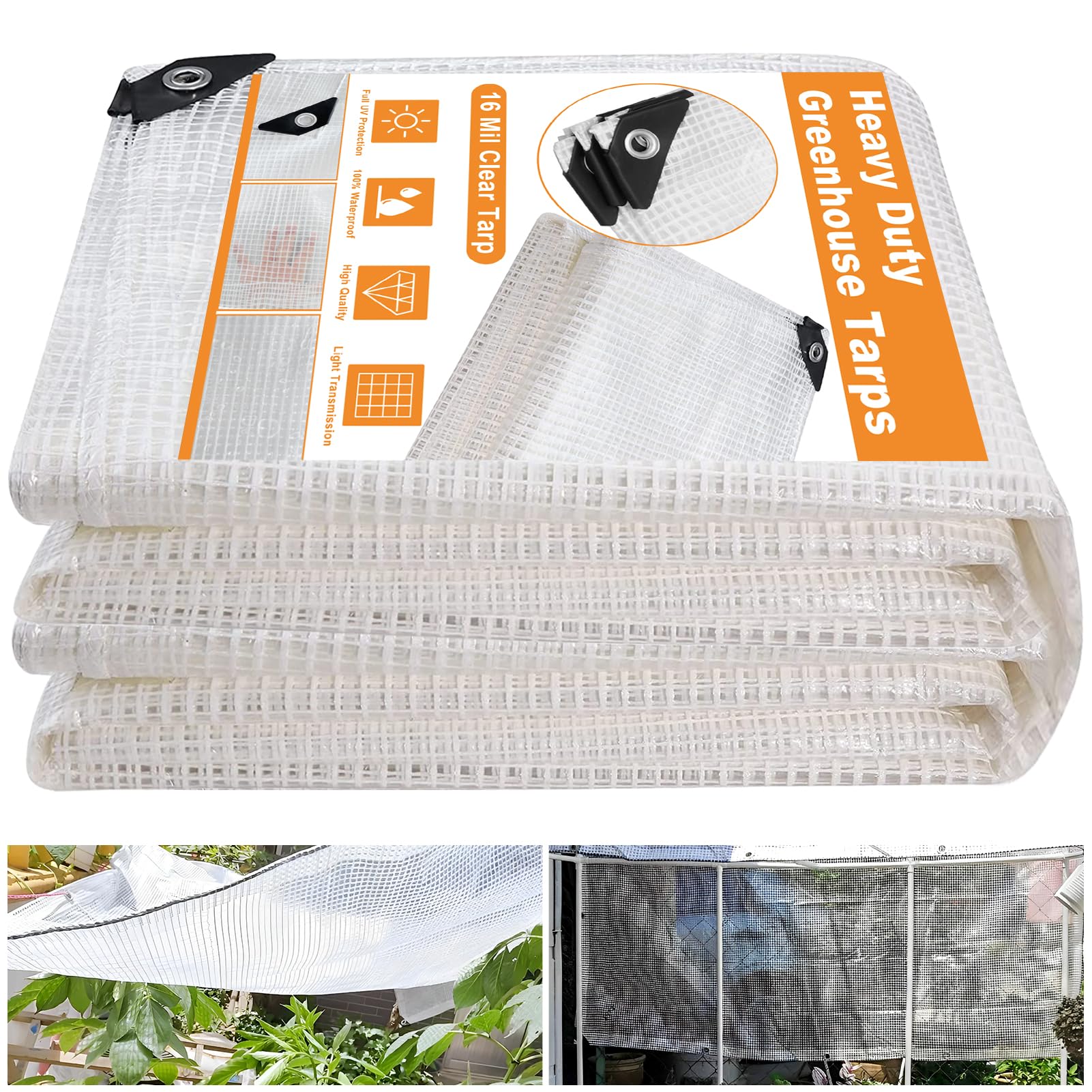
The thickest cover in the roundup, built to take on heavy snow and biting wind.
You get a 16 mil thickness — 16 mil thickness, while standard films are 6 mil — so it resists punctures and tearing from branches or tools. This tarp uses a three-layer woven polyethylene build, and the edges are folded with rope reinforcement and double-stitched corners, plus rust-proof grommets (metal rings) placed every 18 inches. That close spacing gives you an anchor point to strap it down tight in wind without the plastic pulling loose.
Buyers report this cover surviving an Upper Peninsula winter with heavy snow loads, noting only a small icicle at a top leak. One reviewer noted using a staple gun on it without tearing, which tells you the material can handle fastening methods beyond just grommets. The main trade-off is weight: at 5.18 kilograms, it is heavier than most, so you need a solid frame to support it.
Built to Last
- 16 mil thickness provides excellent tear and puncture resistance
- Grommets every 18 inches for secure wind anchoring
- Rope-reinforced edges prevent seam splitting
Hefty Trade-Off
- Heavy and may require a sturdy frame to support the full weight
- Some owners mention minor condensation pooling at the top
A confident verdict: the thickest, most storm-ready cover here. If you live in a snowy climate and have a permanent wooden or metal frame, this is the one you want — its 16 mil and 18-inch grommet spacing give it real winter chops the thinner films lack.
2. Ansgery 16 Mil Greenhouse Cover (10x20FT)

Same 16 mil toughness in a more manageable size for mid-frame setups.
If the 16x20FT version is too large for your space, this 10x20FT variant gives you the same woven three-layer construction and 18-inch grommet spacing in a lighter package. The material blocks UV rays (ultraviolet light that degrades plastic) but stays clear enough that your plants get full natural daylight. Customers note it handles a staple gun without ripping, making it easy to customize attachments on wooden frames.
One reviewer who used it as a duck pen cover in a harsh Upper Peninsula winter said it survived wind and snow while staying clear enough to see through. The minor catch: at 3.27 kilograms it is lighter than the larger 16×20 variant, but the manufacturer still warns that incorrect fastening in high wind can pop grommets — so use the dense anchor points.
A balanced performer: the 10x20FT size hits a balance for most home gardeners who want 16-mil durability without the weight of the largest sheet — just plan extra anchoring for exposed sides.
Who picks this over the #1 pick: you have a 10 x 20 foot frame and want premium thickness at a mid-range price. If your frame is smaller than 8 x 10 feet, you will waste material.
3. chicarry Greenhouse Plastic Sheeting 24 x 25ft
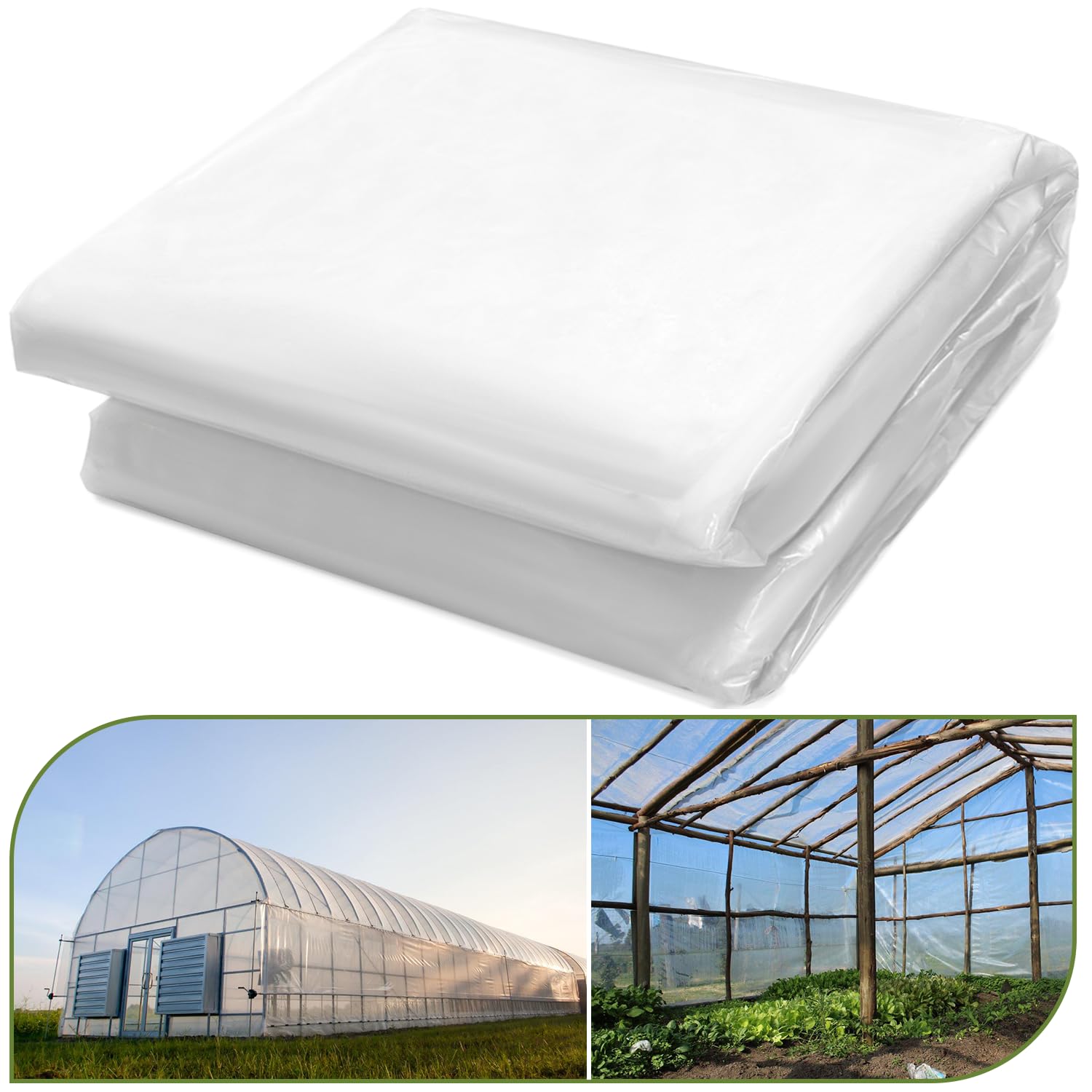
A wide, anti-drip film that spreads sunlight evenly across your whole growing area.
At 24 feet wide and 25 feet long, this chicarry film spans a wide hoop or tunnel without needing to join panels. It uses 5-layer co-extrusion technology (five layers pressed together) to balance strength and light diffusion, plus an anti-drip coating (a surface treatment that stops water from forming droplets). Droplets act like tiny magnifying glasses and can burn leaves — the anti-drip coating keeps that from happening.
Buyers confirm it handled several inches of snow and ice after a 2026 winter storm without tearing, which is impressive for a 6 mil film. At 6.35 kilograms (the 10x50ft roll weighs 5.13 kilograms), it is bulkier, so expect a bulkier install. The anti-drip coating makes the film slightly hazy, so do not expect perfectly clear visibility through the plastic. The Ansgery 16 Mil is much thicker for puncture protection, but this chicarry film gives you even light spread and leaf safety that the Ansgery does not.
Wide & Wise
- 24-foot width suits large hoop houses without joining panels
- Anti-drip coating prevents leaf burn from hanging water
- 5-layer construction adds mechanical strength at a modest 6 mil
Not crisp
- Anti-drip layer creates a hazy finish, not fully transparent
- Flimsier feel than a 16 mil tarp, so less puncture resistance
Standout spec callout: the anti-drip coating is the feature that sets this apart — it stops leaf burn that clear tarps can cause. If you run a wide tunnel and want even light, this is your film. For small frames or areas with falling branches, the 6 mil can be outmatched by the Ansgery 16 Mil.
4. chicarry Greenhouse Plastic Sheeting 10 x 50ft
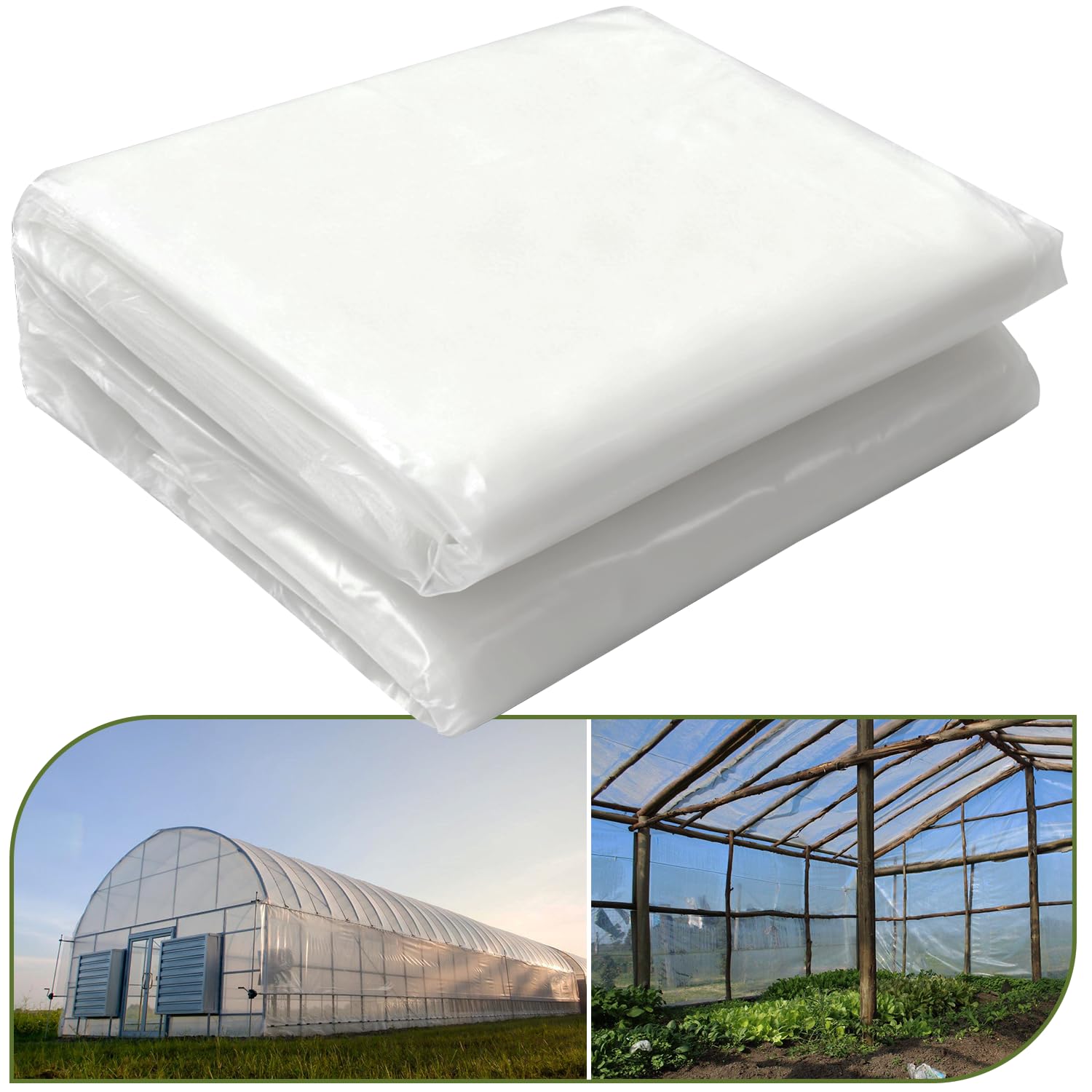
A long, narrow roll that feeds through low tunnels and raised bed covers without waste.
This is the same 6 mil polyethylene film as the 24x25ft chicarry sheet, but cut into a 10-foot-wide by 50-foot-long roll. That shape is perfect for covering long, narrow structures like a 10-foot-wide hoop tunnel or multiple raised beds in a row. It also has the same anti-drip hydrophobic coating and 5-layer co-extrusion, meaning you get the same light diffusion and droplet protection in a format that unrolls straight down your garden.
Reviewers point out cutting this film in half to cover a chicken run, then finding it kept the space noticeably warmer even in negative-degree weather. At 5.13 kilograms, this roll weighs 5.13 kilograms (the 24x25ft sheet weighs 6.35 kilograms), which makes solo installation easier. The trade-off is the same 6 mil thickness — great for light transmission but less armor against physical punctures than the Doniks 14 Mil tarp.
Custom-fit coverage: the 10x50ft format is ideal for long tunnels where a wide sheet would leave huge offcuts — just measure twice and unroll once.
Best for: you are covering a 10-foot-wide tunnel, or several beds inline, and value the anti-drip feature. For a wide span over 10 feet, get the 24x25ft chicarry instead.
5. Farm Plastic Supply Panda Film Light Deprivation Cover

The only cover that gives you total darkness on one side and light reflection on the other.
This is not a clear cover — it is a blackout tarp designed for light-deprivation growing, where you control the photoperiod (day length) your plants receive. One side is white (reflects heat and light away) and the other is black (blocks 100% of light). It is 6 mil thick with a UV inhibitor (chemical that slows sun damage) that prevents sun degradation. Buyers who used it for a 10×6 foot hoop house said it created complete darkness for their light-deprivation schedule without light leaks.
The versatility extends beyond greenhouses: several reviewers used it as a heavy-duty weed barrier, noting it lasted a full year with no rips or sun decay. One owner pointed out that the white side facing out kept things noticeably cooler under hot sun. The catch is that you cannot see through it, which means you lose passive solar heating and the ability to monitor plants without opening the cover. The Ansgery 16 Mil is better for winter frost protection because it lets sunlight in; this Panda Film is built for a completely different job.
Controlled Lighting
- 100% opaque blackout for precise photoperiod control
- Reversible: white side reflects heat, black side absorbs
- UV inhibitor extends lifespan in direct sun
Not for Every Setup
- Zero light transmission means no passive solar heating
- Uneven edge cuts reported by some buyers
- White side does get hot if facing inwards
Best for: growers who need to control day length for flowering plants — it is the only pick here designed for that job. For standard frost protection, skip this and get a clear cover.
6. Doniks 14 Mil Clear Greenhouse Tarp

A thick, wallet-friendly tarp with a waffle texture that diffuses light gently.
At 14 mil, this Doniks tarp is thicker than most budget sheet plastics, and it uses a 3-layer polyethylene build with aluminum grommets. The grommets are spaced 18 inches apart — wider than the 18-inch spacing on premium models — so you will need to supplement with washers or extra ties. The waffle-textured surface means the view through it is foggy, not crisp, but that texture does help diffuse sunlight evenly across your plants.
One buyer mentioned that after heavy winds some grommets pulled out, but the tarp itself held up fine after they switched to a different tie-down method. Another long-term user noted that after nine months their tarp developed holes and seam failures, which suggests the glue can degrade. Despite mixed durability, the 14 mil thickness gives you a genuine thick cover for a low entry cost — perfect if you need it for one growing season.
Thick & Affordable
- 14 mil thickness at a very accessible price point
- Waffle-texture diffuses light for even plant growth
- Aluminum grommets resist rust
Watch the Seams
- Grommets every 18 inches require additional anchor points
- Multiple reports of seam glue failing after 9-12 months
- Waffle texture creates a foggy, not fully clear, appearance
The budget buyer: if you need a thick cover for one season at a low cost, this is it. For year-round wind exposure, the Ansgery 16 Mil is the smarter long-term choice because the Doniks seam glue can degrade within a year.
7. SHANGXING Walk-in Replacement Cover

A drop-in replacement for 56-inch cube frames that improves on the original design.
This is not a roll of plastic — it is a pre-made, zippered cover sized at 56.3 x 56.3 x 76.8 inches for walk-in greenhouse frames. It is made from heavy-duty reinforced polyethylene, and the big upgrade over OEM covers is the roll-up zipper door with screened ventilation. No tools are needed to install it: you just slip it over the frame. Buyers who used it as a replacement noted the original cover lasted three years before breaking in an ice storm, and they called this one a big improvement with better fit, heavier material, and fold-over flaps for a tighter seal.
The weak point mentioned by several owners is the zipper, which can be damaged by freezing temperatures despite thawing. Also, this cover has no screened windows — one buyer had to cut and add screens from their old cover. If your frame is exactly 56 x 56 x 76 inches, this is the easiest way to replace a worn-out skin with zero cutting or measuring.
No-measure convenience: if your frame matches, you get a reinforced, zippered cover that is ready in minutes — just check your exact frame dimensions before ordering.
Reach for this if: you have a standard 56-inch walk-in frame and want an instant replacement that fits tighter than the factory cover. For a non-standard frame, get a roll plastic like the chicarry 10x50ft and cut to size.
Understanding the Specs
Mil Thickness
One mil equals 0.001 inches. A 6 mil film is standard for most greenhouse plastic and allows good light transmission while staying flexible. A 16 mil tarp is 16 mils thick, while a 6 mil film is 6 mils, offering much more puncture and wind resistance but weighing more and letting through slightly less light. Thicker is not always better — if your frame is lightweight, a heavy 16 mil sheet can sag or stress the structure.
Grommet Spacing
Grommets are the metal rings sewn into the edge of a tarp that you tie rope or bungees through. Spacing of 18 inches gives you close anchor points for tight wind-proofing. Spacing of 35 inches or wider means you may need to add fender washers or zip ties to prevent the plastic from pulling off the grommet in a storm. For replacement covers that slip over a frame, grommets are not needed at all.
UV Resistance and Anti-Drip
UV resistance means the plastic has added chemical inhibitors that slow sun damage, so the cover does not turn brittle and crack after a few months. Anti-drip coating is a surface treatment that makes water form a continuous sheet instead of hanging droplets; droplets magnify sunlight and can burn plant leaves. The trade-off is that anti-drip film is slightly hazy, not perfectly transparent.
Polyethylene (PE) vs Tarp Construction
Most greenhouse covers are made of polyethylene (PE), the same family of plastics used in grocery bags but formulated for UV resistance. A “film” is a single or multi-layer extruded sheet — common in 6 mil greenhouse films. A “tarp” is typically woven or has a scrim layer inside for tear resistance, then coated with PE on both sides. Tarps are generally tougher than film but are thicker, heavier, and less transparent.
FAQ
Will a greenhouse cover fit any frame?
How long does a greenhouse cover typically last?
Can I use a clear tarp as a greenhouse cover in winter?
What is the difference between 6 mil and 16 mil greenhouse plastic?
Is a clear tarp the same as greenhouse plastic sheeting?
Do I need UV protection on a greenhouse cover?
What does anti-drip mean on a greenhouse film?
Can I cut and trim a greenhouse cover to fit my frame?
What is the best way to secure a greenhouse tarp in high wind?
Which side of a Panda film faces out — black or white?
Final Thoughts: The Verdict
For most buyers, the cover for greenhouse winner is the Ansgery 16 Mil 16x20FT because it combines the thickest material in this roundup with rope-reinforced edges and dense grommet placement — a combination that genuinely survives winter storms. If you want the anti-drip coating for even light and leaf safety, grab the chicarry 24x25ft film. And for a walk-in frame that needs a fast, drop-in replacement, the standout is the SHANGXING Walk-in Cover.
How We Picked
We do not accept paid placement. Every pick is matched to a real buyer and a real use-case; we do not hands-on test units.
Sources & Methodology
Specifications: manufacturer listings and product documentation. Review insights: verified customer reviews, as of July 2026. Pricing: not shown on this page (it changes often); check the current price via the retailer link.
As an Amazon Associate, Lawn Gear Lab earns from qualifying purchases. This does not affect which products we feature.