
Specs are compiled from manufacturer listings and verified buyer reviews and can change over time — please confirm the key details on the product page before buying.
Aerating your lawn is the single best thing you can do for compacted soil, but doing it and feeding the grass in two separate passes wastes a whole afternoon. An aerator with a spreader lets you punch holes and drop seed or fertilizer in one trip, so the material lands right where the roots can use it.
I’m Rikta — the founder and writer behind Lawn Gear Lab. This guide is built by comparing the manufacturers’ published specifications and the patterns across verified customer reviews, so you get each pick’s real strengths and trade-offs instead of marketing spin.
Whether you have a half-acre lawn or several, the key is matching capacity, spike depth, and build quality to your tractor and soil type — and avoiding the models that break before the first bag of seed is empty. That is what this guide to the best aerator with spreader delivers.
Quick Picks
- Brinly Tow Behind Combination Aerator Spreader — Top Performer
- EarthWay Products T150 150lb Towable Broadcast — Best Value
- Agri-Fab Tow Behind Spiker Seeder Drop Spreader — Drop Spreader Pick
- Suchtale Upgrade 40-Inch Tow Behind Spiker — Broadcast Specialist
How To Choose The Best Aerator With Spreader
An aerator with a spreader is a heavy, multi-function tool you will drag over every inch of your lawn. Getting the wrong one means wasted time, poor aeration, or a broken machine mid-project. Here is what to check before you buy.
Spike depth and tine design
The whole point of aerating is to get holes deep enough to relieve compaction. Look for spike disks that can penetrate at least 2 inches into the soil. Steel tines resist bending and rust far better than plastic or thin stamped metal — pay attention to whether the manufacturer uses galvanized steel or standard steel with a coating.
Hopper capacity and material
A bigger hopper means fewer trips back to the shed to refill. Capacities range from around 100 lb to 150 lb. Steel hoppers resist twisting and flexing better than poly hoppers when you load them heavy, but a well-braced poly unit can still hold up for years. Match the capacity to the size of your lawn — a 150 lb hopper covers more ground before you stop.
Frame strength and tow weight
These units are heavy. The lightest model on this list weighs around 30 pounds, and the heaviest is 77.8 pounds. A heavier frame usually means thicker steel and longer life, but it also means your tractor or riding mower needs to handle the tow weight plus a full hopper. Check the weight tray option — adding up to 75 pounds of extra weight helps the spikes dig into hard, dry soil.
Flow control precision
You want a spreader that drops seed or fertilizer at a consistent rate across your entire lawn, not a model that clumps, jams, or dribbles. Look for a flow control plate with an adjustable stop — a calibrated stop lets you set the opening once and trust it. Side-shutoff ability is a bonus if you need to keep material off flowerbeds or driveways.
Quick Comparison
| Model | Best For | Hopper Capacity | Item Weight | Working Width | Amazon |
|---|---|---|---|---|---|
| Brinly AS2-40BH-P | Heaviest build & best soil penetration | 100 lb / 1.74 cu. ft. | 77.8 lb | 40 in | Amazon |
| Agri-Fab 45-05431 | Drop spreader accuracy | 100 lb | 45.9 lb | 32 in | Amazon |
| Suchtale Upgrade | Broadcast coverage & 9-tine design | 100+ lb | 59.4 lb | 32 in | Amazon |
| EarthWay T150 | Largest capacity & side-shutoff | 150 lb | 30 lb | — | Amazon |
In‑Depth Reviews
1. Brinly Tow Behind Combination Aerator Spreader with Weight Tray, 40-Inch, Flat Black

The brute-force machine that sinks spikes deep into the hardest soil.
It uses Brinly’s patent-pending 3-D galvanized steel tines, with 132 tine tips across 8-inch diameter stars that perforate the soil up to 2 inches deep. The included rigid steel weight tray holds up to 75 pounds of extra weight, so you can add ballast when clay or drought-hardened ground fights back. The all-steel hopper holds 100 lb (1.74 cu. ft.), and the calibrated flow control has an adjustable stop to prevent waste.
The 40-inch working width is wider than both the Agri-Fab and Suchtale at 32 inches, which means broader coverage per pass. Transport mode with 10-inch pneumatic wheels lets you cross driveways without dragging the spikes. The manufacturer says 30-minute assembly, though buyers report taking closer to 1.5 hours — still reasonable for a machine this size. However, a few owners note the chain broke within 100 feet due to a chain guard issue (the company eventually replaced parts). Others mention that the seed broadcast lever moves too freely, requiring constant hand adjustment on the move.
Owners mention the unit survived a full season stored outdoors, with the protective finish holding up well. Unlike the lighter Agri-Fab, the Brinly’s steel frame and weight tray mean you can actually penetrate compacted soil without having to add improvised weights.
Built for heavy soil: The Brinly earns its position as top performer because the combination of a steel hopper, weight tray, and 132 tine tips provides the most reliable deep aeration in this class. skip it if you have a small lawn or a narrow gate — at 77.8 pounds, this is a unit for acreage and a mid-size tractor.
Verdict: The best choice if you have tough, compacted clay soil and a medium-to-large lawn. The weight tray and 3-D tines give you depth that lighter units cannot match.
The catch: The chain and spreader lever have minor quality inconsistencies that you may need to adjust or replace early on.
2. EarthWay Products T150 150lb Towable Broadcast Fertilizer Spreader, Pull Behind Aerator/Seeder
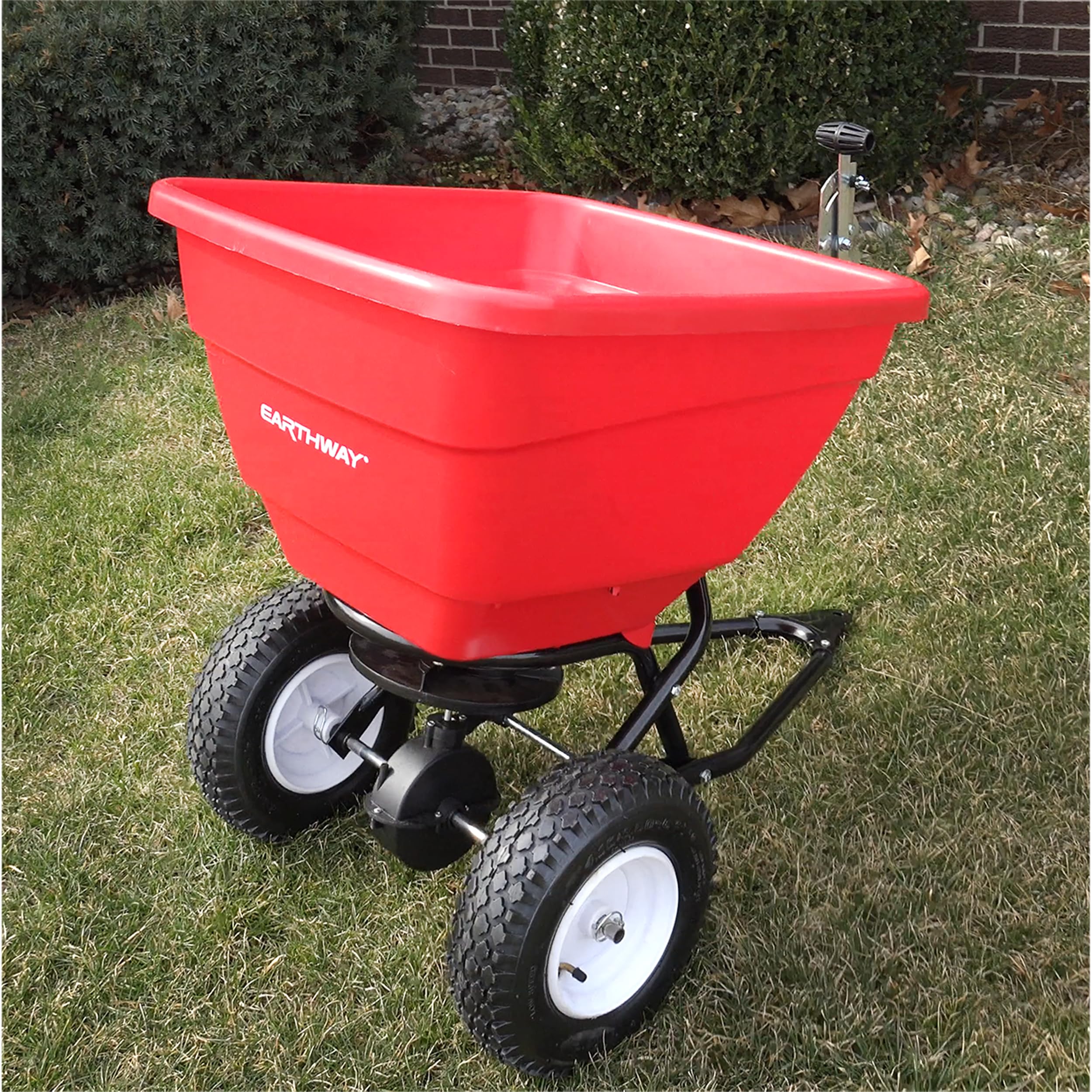
The largest hopper you can tow, with a clever shutoff for flowerbeds.
The EarthWay T150 is the lightest unit in this lineup at just 30 pounds, yet it holds the biggest load — a 150 lb hopper that offers a 50% larger capacity than the Agri-Fab’s 100 lb limit. That means fewer refill trips across a large property. It is a broadcast spreader, meaning it flings material in a wide arc rather than dropping it straight down like the Agri-Fab and Brinly. The patented Side Spread Control lets you block flow to the left side, so you can run right along a sidewalk or flowerbed without wasting seed on concrete.
Customers note the assembly is straightforward at under 15 minutes, and the unit rolls smoothly on uneven ground thanks to non-skid tires. One owner spread fertilizer over 12,000 square feet and grass seed over 25,000 square feet without clogging or uneven patches. But the opening adjuster mechanism draws real frustration — one reviewer calls it “the worlds worst setting apparatus,” noting it is sloppy and imprecise to dial in. The narrow wheelbase means a full load can tip the unit over ruts, and a few reviewers point out the propeller shaft ate through its plastic bearing within 300 yards. Unlike the steel-hopper Brinly, this is a lighter-duty machine best suited for loose soil or already-prepared seedbeds.
Large-area specialist: The T150’s 150 lb capacity and side-shutoff are unique in this category — no other pick here lets you skip one side of the spread pattern to protect your landscaping. But the light frame and finicky adjuster mean it is better for spreading than hard-core aeration.
Reach for this if: You have a large, open lawn and want to cover ground fast with the biggest hopper in the class. The side-shutoff is a genuine time-saver near flowerbeds.
Look elsewhere if: Your soil is hard-packed clay — the narrow wheelbase and lightweight frame will struggle to penetrate without improvised ballast.
3. Agri-Fab Tow Behind Spiker Seeder Drop Spreader, 100 lb Capacity with 32 In Working Width

The drop spreader that places seed exactly where you aim it.
The Agri-Fab is one of the few drop spreaders in this category — instead of broadcasting material in a wide arc, it drops seed or fertilizer straight down in a 32-inch band. That precision matters if you are overseeding a specific section, applying near garden beds, or using expensive grass seed you do not want wasted on the driveway. It has 8 galvanized steel spike disks, a 100 lb poly hopper, and large 10-inch flat-free tires that roll smoothly over uneven ground. At 45.9 pounds, it is 31.9 pounds lighter than the Brinly, making it easier to maneuver but less capable on hard soil.
Shoppers say the hardware is sturdy and well-manufactured, with one owner saying it works well for fertilizing and seeding after adding weights on top to force the tines into compacted soil. However, a critical review states the “seeder failed immediately: chain sprocket warped, locked up, no seed spread,” and notes the hopper only holds 50 lb of seed rather than the advertised 100 lb. Others point out that assembly takes several hours and requires careful bolt alignment. Unlike the EarthWay’s broadcast spread, the Agri-Fab’s drop pattern gives you total control but covers a narrower path — you will make more passes to cover the same acreage.
Precision over speed: The Agri-Fab is the right call if you need exact placement near flowerbeds, walkways, or during overseeding. For broad-acre broadcasting or deep aeration in tough soil, the Brinly or EarthWay will get the job done faster.
Best for: Homeowners who value accurate placement over speed — the drop spreader design is ideal for overseeding and fertilizing along borders.
pass on it if: You need broadcast coverage or your lawn has heavy compaction. The lightweight frame and chain durability concerns make it a gamble for hard terrain.
4. Suchtale Upgrade 40-Inch Tow Behind Spiker Seeder, Combination Tow Spike Aerator, Broadcast Spreader
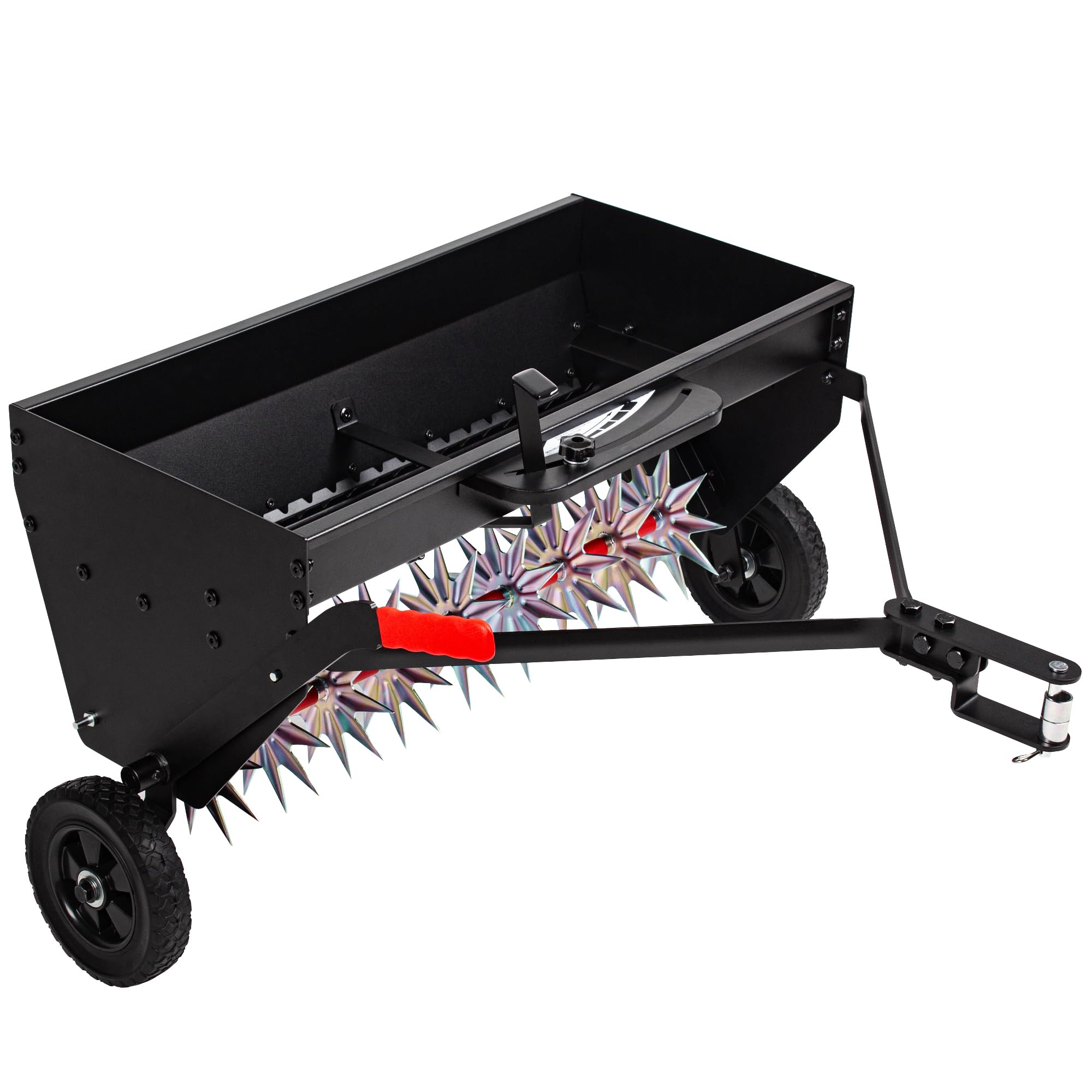
Nine star-shaped steel tines and a broadcast spreader in one affordable package.
The all-steel hopper resists twisting and holds over 100 lb of material, and the broadcast spreader flings seed or fertilizer in a 32-inch swath to cover ground faster than a drop spreader. The flow control plate uses an infinitely adjustable stop device, meaning you can fine-tune the opening precisely instead of settling for preset notches. At 59.4 pounds, it sits between the light Agri-Fab and the heavy Brinly in heft.
Buyers warn that assembly is a serious project — one owner says “please be prepared to spend 2-3 hours to assemble this unit,” reporting the need to drill out holes and manipulate metal parts to get a proper fit. Another reviewer flags a recurring issue where the chain falls off the sprocket every time you hit a bump, requiring reinstallation. On the positive side, owners who pushed through the setup say the unit works well once assembled, with the tines rotating independently for good soil penetration. The upgraded parts kit separates screws and bolts for easier sorting, but the overall assembly experience is clearly the main trade-off.
Features for the patient builder: The nine-tine design and all-steel construction are compelling on paper, but the demanding assembly and chain reliability issues mean this pick rewards a buyer who does not mind tinkering.
Who it works for: A DIY-minded owner who wants the extra tine and a steel hopper at a reasonable price, and has a full afternoon to assemble it.
Who should pass: Anyone who wants a quick setup or a unit that runs without tweaking — the chain and fitment issues are real according to multiple verified buyers.
Understanding the Specs
Spike depth and tine count
Spike depth — usually 1.5 to 2.5 inches — tells you how deep the tines punch into the soil. Deeper penetration relieves compaction better and lets water and fertilizer reach roots. More tines (8, 9, or 132 tips like the Brinly) mean more holes per square foot, but only if the machine has enough weight to drive them in.
Hopper capacity and spreader type
Hopper capacity is measured in pounds (100 lb, 150 lb). A bigger hopper covers more ground without refilling. Drop spreaders drop material straight down in a narrow band — precise but slow. Broadcast spreaders fling material in a wide arc — fast but less accurate near edges. Some units offer side-shutoff to block one side of the broadcast pattern.
Tow weight and frame material
Item weight includes the machine itself; add hopper load and any weight-tray ballast to get the total your tractor pulls. Heavier units (77.8 lb) typically have thicker steel frames and better penetration. Steel hoppers resist flexing under load better than poly hoppers. Pneumatic tires absorb bumps better than flat-free tires on uneven terrain.
Flow control and calibration
Flow control adjusts how fast material leaves the hopper. A calibrated stop with an adjustable lever lets you set the opening and reproduce the same rate next time. Some units have a sloppy mechanism that is hard to read — that means guessing the setting each trip. Side-shutoff capability lets you block flow on one side to keep material off flowerbeds, driveways, or sidewalks.
FAQ
Can I use an aerator with spreader on wet or soggy lawn?
How often should I aerate my lawn with this equipment?
Can I tow an aerator with a riding mower or do I need a garden tractor?
What is the difference between a drop spreader and a broadcast spreader?
How do I know if my lawn is compacted enough to need aeration?
Will the spikes damage underground sprinkler lines or cables?
Can I add extra weight to the hopper for better aeration?
How do I clean and store an aerator with spreader after use?
Is a 100 lb hopper big enough for a one-acre lawn?
Why does the chain fall off some aerator models during use?
Final Thoughts: The Verdict
For the majority of shoppers, the best aerator with spreader winner is the Brinly AS2-40BH-P because its heavy steel frame, weight tray, and 132 tine tips provide the deepest, most reliable aeration for compacted soil. If you want the largest hopper and side-shutoff for precise coverage, grab the EarthWay T150. And for exact drop placement near flowerbeds during overseeding, the Agri-Fab drop spreader is the most accurate option in this lineup.
How We Picked
We do not accept paid placement. Every pick is matched to a real buyer and a real use-case; we do not hands-on test units.
Sources & Methodology
Specifications: manufacturer listings and product documentation. Review insights: verified customer reviews, as of July 2026. Pricing: not shown on this page (it changes often); check the current price via the retailer link.
As an Amazon Associate, Lawn Gear Lab earns from qualifying purchases. This does not affect which products we feature.