
Specs are compiled from manufacturer listings and verified buyer reviews and can change over time — please confirm the key details on the product page before buying.
Your prize Mandevilla or butterfly bush needs a different fuel than your lawn. Too much nitrogen—the first number on a fertilizer bag—gives you a lush green bush with zero blossoms. The real trick is the middle number, phosphorus (P), which pushes buds and flowers. Get that ratio right, and you turn a season of green disappointment into a yard full of color.
I’m Rikta — the founder and writer behind Lawn Gear Lab. This guide is built by comparing the manufacturers’ published specifications and the patterns across verified customer reviews, so you get each pick’s real strengths and trade-offs instead of marketing spin.
Whether you grow roses, plumerias, zinnias, or hibiscus, choosing the right food for flowering plants depends on matching the NPK ratio (the three numbers on the label standing for nitrogen, phosphorus, and potassium) to your plant’s bloom cycle and your own gardening habits.
Quick Picks
- Carl Pool BR-61 Plant Food 9-58-8 3 Lbs — Top Performer
- Schultz Bloom Plus Water Soluble Plant Food — Proven Classic
- Jack’s Classic 10-30-20 Blossom Booster — Versatile Feeder
- True Organic Annuals & Perennials Food — Best Overall
- Miracle-Gro Performance Organics Blooms Plant — Compact Organic
- Alaska Morbloom Concentrate 0-10-10 Fertilizer — Liquid Power
How To Choose The Best Food For Flowering Plants
Not every bag labeled “bloom booster” delivers the same results. The NPK ratio (the three numbers on the front, standing for nitrogen, phosphorus, and potassium) determines whether your plant pushes out flowers or just leaves. For bloom-focused feeding, you want the middle number (phosphorus) to be the highest of the three, because phosphorus directly supports bud development and flower formation. The first number (nitrogen) should stay moderate—too much and you get all foliage, no flowers. Here are the three specs that matter most.
NPK Ratio — The Only Number That Matters
The three hyphenated numbers (like 10-54-10 or 4:4:6) tell you the percentage of nitrogen, available phosphate, and soluble potash. For flowering plants, a higher middle number (phosphorus, or P) signals a true bloom booster. A balanced ratio like 4:4:6 works as general flower food, while a high-P formula like 10-54-10 pushes maximum bloom production. Choose a high-P ratio if your plants are healthy but refuse to flower; choose a balanced organic option for steady, all-season color without forcing.
Form — Granules vs. Powder vs. Liquid
Granules (like the True Organic and Miracle-Gro Performance Organics options) are slow-release—you scatter them on the soil and they feed gradually over weeks. They are easiest for in-ground beds and container top-dressing. Water-soluble powders (Schultz Bloom Plus, Jack’s Classic, Carl Pool) dissolve in water and deliver nutrients instantly through roots or leaves; they give you precise control but require mixing each time. Liquid concentrates (Alaska Morbloom) are ready-to-dilute and absorb fast, making them ideal for a regular weekly watering routine. Your choice depends on how much hands-on mixing you want to do.
Organic vs. Synthetic Ingredients
Organic formulas (True Organic, Miracle-Gro Performance Organics) use natural inputs like fish meal, bone meal, and composted materials. They feed the soil microbes along with the plant, improving long-term soil health, and they are OMRI-listed (a seal from the Organic Materials Review Institute confirming the product is allowed for organic gardening). Synthetic formulas (Schultz, Jack’s Classic, Carl Pool) are engineered for precise, fast-acting nutrient delivery—you see results in days, but they do not build soil biology. If you grow vegetables alongside flowers or prefer a chemical-free garden, lean organic. If you want the biggest, fastest bloom show and do not mind mixing, a synthetic high-P powder is your tool.
Quick Comparison
| Model | Best For | NPK Ratio | Item Form | Item Weight | Amazon |
|---|---|---|---|---|---|
| Carl Pool BR-61 | Maximum phosphorus punch | 9-58-8 | Powder | 3 Pounds | Amazon |
| Schultz Bloom Plus | Proven bloom booster | 10-54-10 | Powder | 1.5 Pounds | Amazon |
| Jack’s Classic Blossom Booster | Versatile & precise feeding | 10-30-20 | Powder | 8 Ounces | Amazon |
| True Organic Annuals & Perennials | Organic gentle feeding | 4:4:6 | Granules | 4 Pounds | Amazon |
| Miracle-Gro Performance Organics Blooms | Organic & OMRI-listed | 5-7-10 | Granules | 0.5 Pounds | Amazon |
| Alaska Morbloom | Liquid fish-based feeding | 0-10-10 | Liquid | 128 Fluid Ounces | Amazon |
In‑Depth Reviews
1. Carl Pool BR-61 Plant Food 9-58-8 3 Lbs
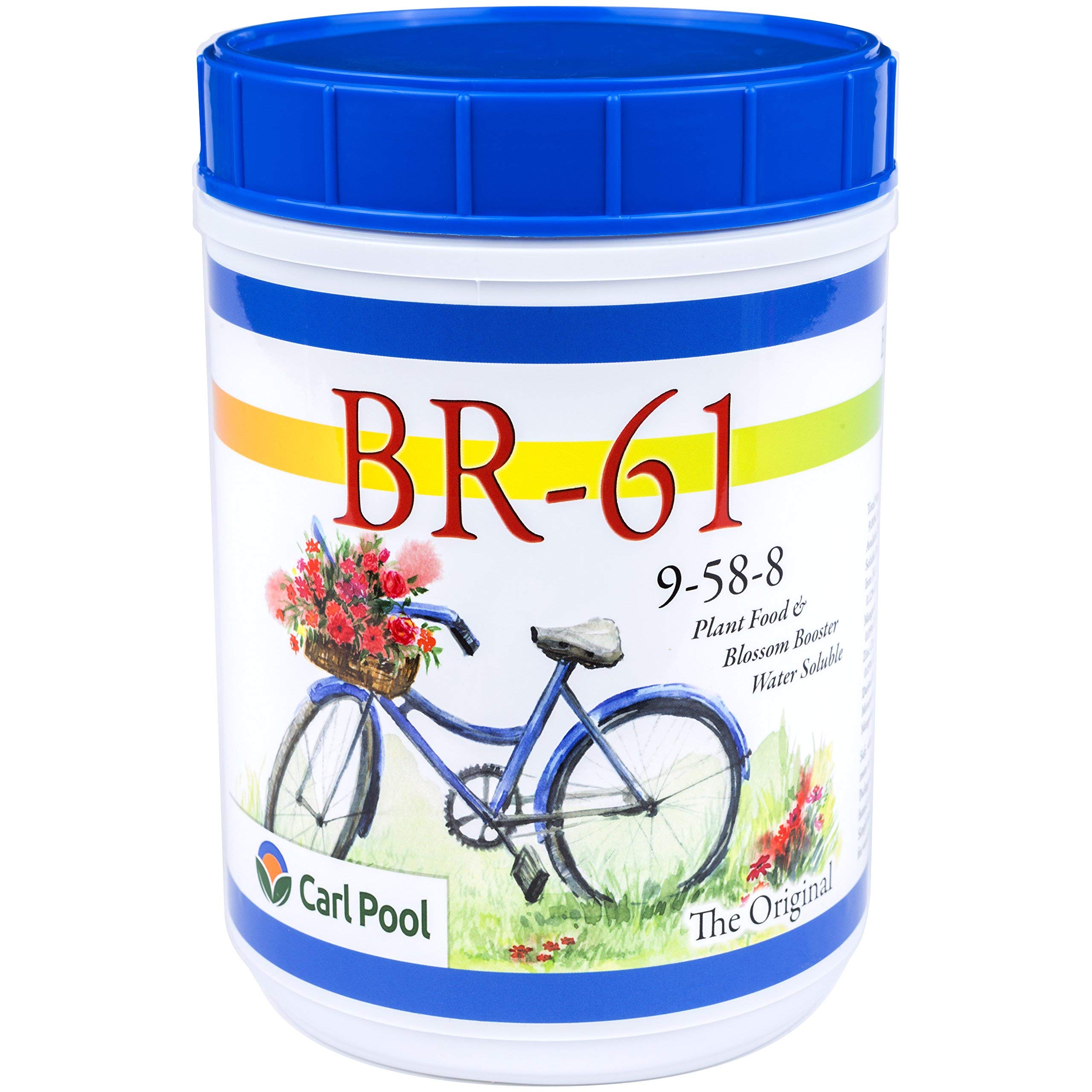
Plumeria growers have trusted this phosphorus bomb for years to force blooms on stubborn plants.
This powder has the highest phosphorus concentration in the lineup—a 9-58-8 ratio that puts nearly 58 percent of its formula into phosphate, the nutrient that drives flower formation so your plumeria or morning glory sets buds instead of just leaves. The powder mixes at 1 tablespoon per gallon of water, so you get precise control each time you water. Buyers report that plumerias, a famously picky bloomer, respond dramatically; one buyer who rotates BR-61 with fish emulsion reported that neighbors could not figure out what they were doing wrong. At 3 pounds, this bag lasts notably longer than the Schultz 10-54-10 (1.5 pounds) or the Jack’s Classic 10-30-20 (8 ounces), making it a better value for anyone with a large flower bed.
Unlike the balanced 4:4:6 organic formulas, this is a targeted bloom tool—not an all-purpose feed. Use it when plants are actively budding or when you need to jump-start a stubborn non-bloomer. The synthetic powder dissolves fully in water, so you can also use it as a foliar spray (a liquid mist applied directly to the leaves) for faster absorption.
Phosphorus champ: If you want the highest middle number you can buy for a specific bloom push, this is the pick. The 9-58-8 ratio provides 58% phosphorus, while the 5-7-10 ratio from Miracle-Gro Performance Organics provides 7% phosphorus—a huge difference when you are coaxing flowers out of a reluctant plant.
The caveat: Because it is so phosphorus-heavy, do not use it on young seedlings or leafy greens—it is formulated strictly for established flowering plants that need a bloom booster, not general growth.
Reach for this if: You grow plumerias, morning glories, or any plant that needs a serious phosphorus kick to flower. At 3 pounds, the bag lasts multiple seasons for the average home gardener.
Look elsewhere if: You prefer a single all-purpose feed for your whole garden—the high phosphorus will unbalance other plants like tomatoes or lettuce.
2. Schultz Bloom Plus Water Soluble Plant Food 10-54-10, 1.5-Pound

A 10-54-10 formula that enthusiasts have relied on for years to make underperforming plants bloom.
Buyers consistently report that this powder turns underperforming plants into showstoppers. One reviewer described how their flower garden produced “more of and larger blooms,” their vegetable garden grew larger plants with more vegetables, and houseplants that “have never flowered” suddenly surprised them. The concentrated mix dissolves evenly every time it rains, which Schultz calls “feeds like nature”—the nutrients are distributed into the soil with each rainfall, so you do not have to water it in yourself.
Unlike the Carl Pool BR-61 (9-58-8, 3 lbs), the Schultz comes in a 1.5-pound package with a 10-54-10 ratio—slightly less phosphorus but still very high. At 1.5 pounds, it is a compact tub that fits easily on a shelf, and the price is reasonable enough that many gardeners buy it year after year. Just be careful not to confuse the pink box with other brands, as one buyer warned.
What makes it work
- Very high phosphorus content (54) targets blooms effectively
- Dissolves on contact with water—no clumps or residue
- Works on houseplants, flowers, and vegetables (not trees or bushes)
The trade-offs
- 1.5 pounds (compared to 3 pounds for the Carl Pool option)
- Contains synthetic ingredients—not suitable for organic-only gardens
Best for: Anyone who wants a reliable, easy-to-mix bloom booster that works across flowers, vegetables, and houseplants—a classic for a reason.
skip it if: You need an organic or OMRI-listed feed, or you have a very large garden and want a bigger bag to reduce reordering.
3. Jack’s Classic 10-30-20 Blossom Booster Water-Soluble Fertilizer with Micronutrients, 8oz
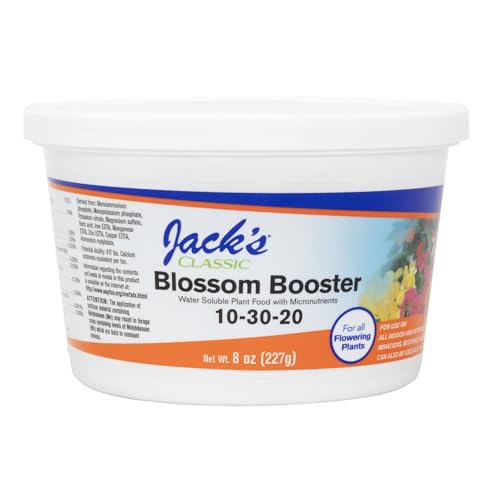
The precision tool for gardeners who want to feed through leaves, roots, or both with an included measuring spoon.
Jack’s Classic Blossom Booster uses a 10-30-20 analysis—moderate phosphorus compared to the 54 or 58 in the top two picks, but still clearly bloom-focused with a higher P than N. What sets this one apart is its versatility: you can mix it as a root drench (pour onto the soil) or as a foliar spray (mist directly onto the leaves), and it comes with an included measuring spoon so you do not have to guess the dose. Budding hyrdrangea and lilac growers report excellent results, and Hoya owners say their plants “bloom beautifully” with regular use.
The honest catch, as one buyer pointed out: the 8-ounce container is smaller than it looks. The powder comes in a plastic bag inside the tub, and the tub is only half-full—one reviewer used the entire container in a single day on their outdoor flower beds. That said, the added micronutrients (trace elements like iron, zinc, and manganese that plants need in tiny amounts) mean you do not need additional feeding—a nice simplification.
Reach for this if: You have a small collection of potted flowering plants (hoyas, hydrangeas, lilacs) and want the flexibility to foliar feed. The included spoon makes measuring simple to use.
Look elsewhere if: You have a large in-ground flower bed—the 8oz size will disappear fast, making the Carl Pool or Schultz bags a better value per application.
4. True Organic Annuals & Perennials Food – Organic Fertilizer for Stunning Blooms and sturdy Foliage – 4lb Bag Covers 70 Sq. Ft.
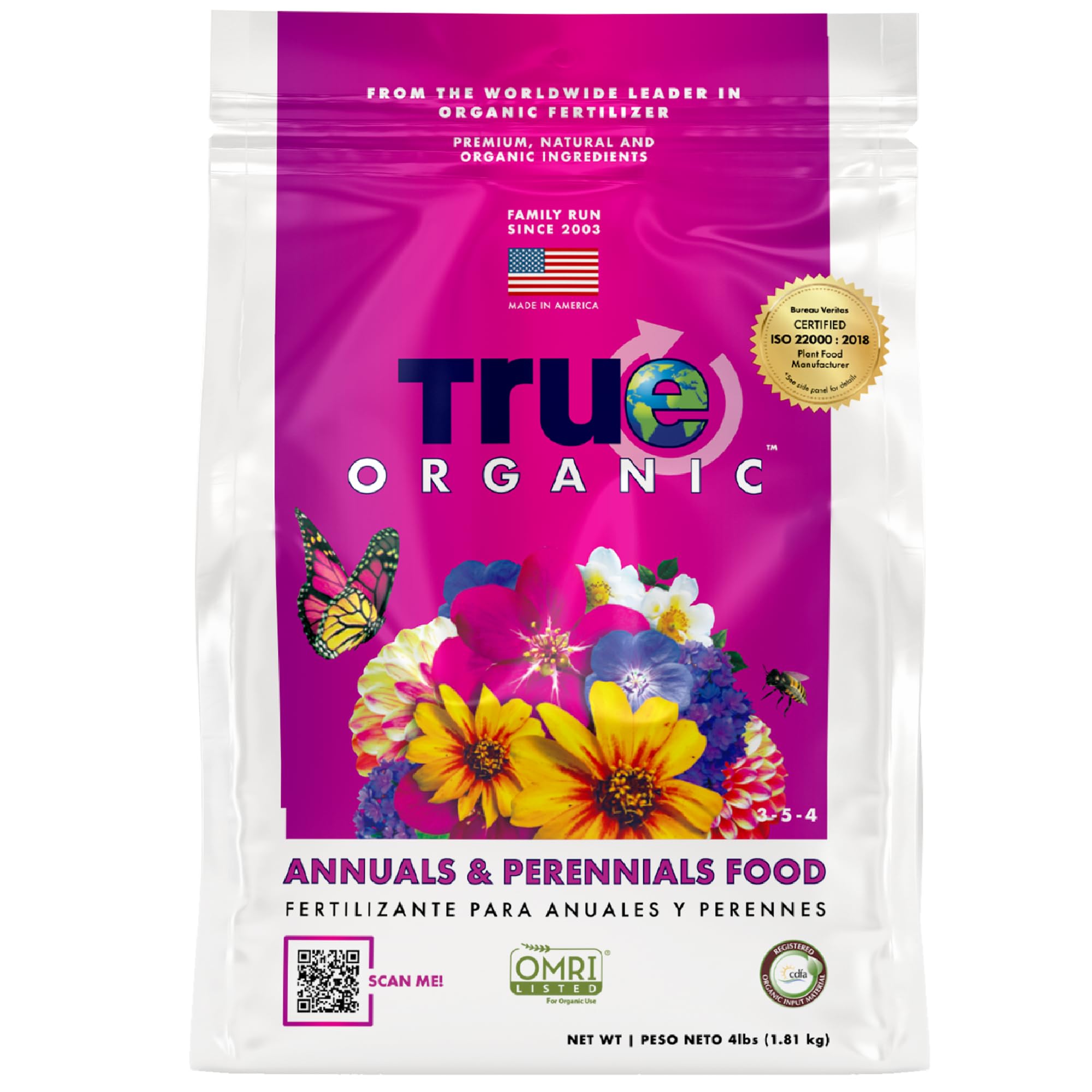
The 4-pound organic granule bag that revived a dying zinnia patch in two weeks, owners mention.
This is the only organic granule option in the lineup with a 4:4:6 ratio—meaning it has a balanced nitrogen and phosphorus profile with slightly more potassium. It is not a high-phosphorus bloom bomb like the synthetics; instead, it feeds the soil biology over time, creating conditions for steady, natural bloom production. One buyer described a dramatic turnaround: “My zinnias were doing so poorly, I almost yanked them out and called it quits.” After scattering the granules between rows without even working them in, the zinnias pushed to 4 feet tall with “the biggest blossoms ever, some with double blooms.”
At 4 pounds, this bag covers up to 70 sq. ft.; the Miracle-Gro Performance Organics covers 165 sq. ft. but weighs only 0.5 pounds—a much denser concentration. The organic inputs include fish-based ingredients, so the bag has an earthy, ripe smell—normal for natural fertilizer. Compared to the Schultz 10-54-10 (a synthetic powder), the True Organic delivers a much gentler 4:4:6 feeding that is harder to overdo, making it safer for beginners who are not sure how much to apply.
Why it stands out
- 100% made in the USA with organic inputs—no synthetic chemicals
- 4-pound bag covers 70 sq. ft., great for multiple beds
- Easy monthly application: just scatter on soil, no mixing
What to know
- Has a distinct earthy/fishy smell due to natural ingredients
- Not a fast-acting bloom booster—results build over weeks, not days
Reach for this if: You want an all-organic, low-maintenance granular feed that supports blooms through healthy soil. Perfect for in-ground flower beds where you can scatter monthly.
Look elsewhere if: You need immediate results on a plant that is refusing to bloom—the gentler 4:4:6 ratio may not provide the phosphorus punch a stubborn plant needs.
5. Miracle-Gro Performance Organics Blooms Plant Nutrition Granules – Plant Food with Natural & Organic Ingredients, for Flowering Plants, 2.5 lbs.

The OMRI-listed organic option that produced ginormous blooms on a butterfly bush, customers note.
This is the organic pick from a brand most gardeners already trust. The 5-7-10 ratio keeps phosphorus slightly higher than nitrogen, and the granules are OMRI-listed, meaning they meet the standards for organic gardening. One buyer described the results in no uncertain terms: “I started to have these ginormous blooms on all of my plants and flowers, But especially this butterfly bush!” Another reviewer noted that a slow-blooming Mandevilla “started to really pop” within a week or two of application. The granules are simple to apply—just sprinkle around the base of the plant every 4-6 weeks and water regularly.
Note that the 2.5-pound bag actually contains only 0.5 pounds of product (the listed item weight), and one reviewer noted the bottle did not look completely full under the lid—so expect a compact container. Despite the small physical size, the coverage is generous enough for multiple potted plants or a small bed. Compared to the 4-pound True Organic bag, this Miracle-Gro version has a more bloom-focused 5-7-10 ratio versus 4:4:6, so it leans slightly harder into flower production while staying organic.
Best for: Container gardeners who want an organic, easy-to-use granule with the Miracle-Gro brand name behind it. The 0.5-pound tub is ideal for a few large pots or a small raised bed.
pass on it if: You need a larger volume to cover a big in-ground garden—the True Organic 4-pound bag weighs 4 pounds, while the Miracle-Gro Performance Organics weighs 0.5 pounds.
6. Alaska Morbloom Concentrate 0-10-10 Fertilizer, 1 Gallon
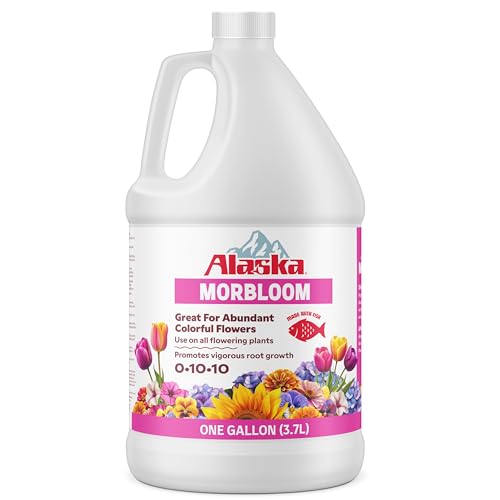
Zero nitrogen, so every drop goes to buds and roots—not leaves—making it the unique pick for bloom-phase feeding.
This is the only liquid concentrate in the roundup, and its 0-10-10 ratio is unique: there is zero nitrogen in the formula. That means all the energy goes into flowering and root development, not leafy growth. It is made with fish, so it has the characteristic fishy aroma that comes with natural marine-based fertilizers. One buyer who rotates between Alaska fish fertilizer and Morbloom each week reported their entire garden stays “happy and healthy,” while another noted it works best when you switch to it as plants begin flowering—using the higher-nitrogen Alaska Fish Food during the vegetative growth stage and Morbloom once buds appear.
The 1-gallon bottle (128 fluid ounces) is the largest volume in this guide, but it is important to know that liquid fertilizers generally get used up faster than powders or granules because you dilute them with water each time. The concentrated formula lowers pH in the soil, so one experienced buyer cautioned that you may need pH buffer to keep levels stable. Buyers also warn that the liquid can leak during shipping if the bottle is not taped—so check the packaging when it arrives. Unlike the granular picks, this one requires regular mixing and watering-in, which makes it a better fit for gardeners who already have a weekly feeding routine.
Nitrogen-free bloom focus: If you are already using a nitrogen-based feed for leafy growth and want to switch to a bloom-specific formula without adding more nitrogen, the 0-10-10 ratio is perfect. It is the only product here with absolutely zero N.
One thing to plan for: The fish smell is real and can be strong during mixing, and the pH-lowering effect means you should test your soil if you use it regularly. Not a grab-and-grow product—it rewards attentive gardeners.
Reach for this if: You have an established feeding schedule and want a dedicated bloom-phase liquid that will not encourage extra leaves. Great for rotating with a vegetative fertilizer.
Look elsewhere if: You prefer a dry product you can measure once and forget, or if you are sensitive to fish odors during application.
Understanding the Specs
NPK Ratio
The three numbers on every fertilizer label represent the percentage of nitrogen (N), available phosphate (P₂O₅), and soluble potash (K₂O). For flowering plants, the middle number (phosphorus) is your target—it promotes bud set, bloom size, and flower count. A ratio like 10-54-10 delivers a heavy phosphorus punch, while a balanced 4:4:6 gives steady all-round feeding. The higher the P relative to N, the more the plant prioritizes flowers over leaves.
Organic vs. OMRI Listed
Organic fertilizers use natural materials like fish meal, bone meal, or composted plant matter. OMRI listed means the product has been reviewed by the Organic Materials Review Institute and meets the standards for certified organic production. If you avoid synthetic chemicals in your garden, look for either “organic” on the label or the OMRI seal. Organic feeds tend to release nutrients more slowly and improve soil health over time, whereas synthetic formulas deliver faster, more measurable results.
Water-Soluble vs. Liquid Concentrate
Water-soluble powders (like Schultz, Jack’s Classic, and Carl Pool) are dry crystals or powder that you mix with water before applying. They are shelf-stable and you control the concentration each time. Liquid concentrates (like Alaska Morbloom) are already dissolved and just need dilution—they are faster to mix but heavier to ship and store. Both give faster absorption than granules because the nutrients are already in a plant-available form in the water.
Granular Slow-Release
Granules (True Organic, Miracle-Gro Performance Organics) are solid particles you scatter on the soil surface and water in. They break down gradually over weeks or months, feeding the plant with each watering or rainfall. This makes them ideal for “low-maintenance” gardeners—you apply once a month and let nature do the rest. The trade-off is slower initial results compared to liquid or water-soluble forms, but the feeding is gentler and harder to overdo.
FAQ
What does the middle number in NPK mean for flowering plants?
Can I use a general-purpose fertilizer on flowering plants?
How often should I feed my flowering plants?
Is organic or synthetic better for blooms?
Will too much nitrogen stop my plants from flowering?
Can I mix different bloom boosters together?
How do I apply water-soluble powder correctly?
Which pick works best for container plants vs. in-ground beds?
Do these fertilizers expire or lose potency over time?
What is the difference between Schultz Bloom Plus and other pink-box bloom boosters?
Final Thoughts: The Verdict
For most buyers, the food for flowering plants winner is the Carl Pool BR-61 because its 9-58-8 ratio delivers the highest phosphorus concentration in the lineup, it comes in a 3-pound bag that lasts, and plumeria growers have trusted it for years. If you want an organic, OMRI-listed granule that feeds soil health gradually, grab the True Organic Annuals & Perennials Food—the 4-pound bag covers 70 sq. ft. with a balanced 4:4:6 blend. And for gardeners who already rotate a vegetative feed and need a dedicated bloom-phase liquid with zero nitrogen, the Alaska Morbloom 0-10-10 concentrate is the logical choice.
How We Picked
We do not accept paid placement. Every pick is matched to a real buyer and a real use-case; we do not hands-on test units.
Sources & Methodology
Specifications: manufacturer listings and product documentation. Review insights: verified customer reviews, as of July 2026. Pricing: not shown on this page (it changes often); check the current price via the retailer link.
As an Amazon Associate, Lawn Gear Lab earns from qualifying purchases. This does not affect which products we feature.