
Specs are compiled from manufacturer listings and verified buyer reviews and can change over time — please confirm the key details on the product page before buying.
Picking the right soil for your planter box often feels like sorting through bags of dirt and hoping for the best. The real pain isn’t the planting — it’s a mix that turns into a brick, drains too fast, or invites a mystery fungus you have to Google at midnight. What you actually need is a blend that keeps roots aerated, holds just enough moisture, and delivers steady nutrition without you becoming a full-time chemist.
I’m Rikta — the founder and writer behind Lawn Gear Lab. This guide is built by comparing the manufacturers’ published specifications and the patterns across verified customer reviews, so you get each pick’s real strengths and trade-offs instead of marketing spin.
Whether you are starting a container vegetable garden or refreshing a row of window boxes, knowing exactly what is inside a bag of soil for planter box makes the difference between a season of thriving plants and a slow fade into droopy leaves.
Quick Picks
- Miracle-Gro Moisture Control Potting Mix — Best Overall
- Espoma Organic Potting Soil Mix — Premium Organic
- Coast of Maine Bar Harbor Blend Potting Soil — Best Value Organic
- Miracle-Gro Potting Mix (3-Pack) — Bulk Planting
- Brut Organic Potting Soil — Microbe Rich
- Midwest Hearth Premium Potting Soil Mix — Compact Starter
How To Choose The Best Soil For Planter Box
The single most common mistake beginners make is grabbing garden soil or topsoil from the yard and scooping it into a planter. That stuff compacts like concrete in a confined container, suffocating roots and trapping water. You need a potting mix — a soilless blend designed for the limited space and drainage demands of a box or pot.
Drainage and Aeration Are Non-Negotiable
Roots need oxygen, and a mix that stays soggy is a death sentence for most plants. Look for ingredients like perlite (a white volcanic rock that creates air pockets), vermiculite (a flaky mineral that holds water), or coarse sand — these create air pockets and let excess water escape. A bag that lists only “peat moss” without a structural component is a red flag for heavy containers.
Moisture Retention vs. Overwatering
A planter box dries out faster than ground soil, but you still do not want a mix that holds water like a sponge. Some premium blends use coir (coconut husk fiber) or a wetting agent to buffer moisture — great for busy schedules, but check if the product specifies “moisture control” so you don’t accidentally drown your roots on a rainy week.
Fertilizer: Is It Already in the Bag?
Many potting mixes come with a starter charge of plant food. Some feed for up to 6 months, which means you can skip liquid fertilizer for an entire growing season. If you prefer to control your own feeding schedule, pick an unamended organic mix — just know you will have to add nutrients yourself after the first few weeks.
Quick Comparison
| Model | Best For | Volume | Weight | Key Ingredient | Amazon |
|---|---|---|---|---|---|
| Miracle-Gro Moisture Control | Low-maintenance watering | 2 cu. ft. | 40.51 lb | AquaCoir Formula | Amazon |
| Espoma Organic Potting Soil Mix | Organic vegetable gardens | 2 cu. ft. | — | Myco-Tone | Amazon |
| Coast of Maine Bar Harbor Blend | Hanging baskets and window boxes | 16 QT | 14 lb | Lobster & crab shell meal | Amazon |
| Miracle-Gro Potting Mix (3-Pack) | Batch planting multiple boxes | 0.66 cu. ft. (total) | — | Feeds up to 6 months | Amazon |
| Brut Organic Potting Soil | Organic herb & flower containers | 21 QT | — | Worm castings & kelp | Amazon |
| Midwest Hearth Premium Potting Mix | Small indoor planters & seedlings | 8 QT | 1.25 kg | Peat moss, perlite, vermiculite | Amazon |
In‑Depth Reviews
1. Miracle-Gro Moisture Control Potting Mix

The bag that forgives a busy week of forgotten watering.
You get a single bag that handles flowers, vegetables, shrubs, and perennials in big containers with the widest safety net for watering mistakes. Its AquaCoir Formula (a mix of sphagnum peat moss, coir, and a wetting agent) absorbs up to 33% more water than basic potting soil — so plants stay hydrated even when you skip a weekend. At 40.51 pounds and 2 cubic feet, it fills two 14-inch containers, giving you a lot of coverage from one purchase.
The built-in feeding lasts up to 6 months, and the brand claims the mix grows plants twice as big as unfed plants. Buyers report that the moisture control genuinely protects against both over- and under-watering, making this a solid pick for anyone who tends to water on autopilot. Compared to the Coast of Maine Bar Harbor Blend at 14 pounds, the Miracle-Gro is nearly three times heavier, signaling its ability to hold moisture deep into the pot without compacting.
The trade-off? It is not an organic mix. If you want a certified organic option for edibles, you would want the Espoma below — but for general container gardening where convenience trumps certification, this is the reliable workhorse.
Why it works
- AquaCoir technology protects against over- and under-watering
- Absorbs up to 33% more water than basic potting soil
- Feeds plants for up to 6 months without extra fertilizer
The honest limit
- Not an organic or OMRI-listed product
- At 40.51 lb, the bag is heavy to carry around the yard
Reach for this if: you want the widest safety net for watering mistakes in a large planter box.
Look elsewhere if: you need a certified organic blend for your vegetable container garden.
2. Espoma Organic Potting Soil Mix

Organic roots powered by a proprietary blend of beneficial fungi.
Espoma brings something unique to the table: Myco-Tone, a proprietary blend of endo and ecto mycorrhizae (beneficial fungi that attach to roots and help them absorb nutrients). This is not just marked “organic” on the label; the bag is packed with sphagnum peat moss, humus, perlite, earthworm castings, alfalfa meal, kelp meal, and feather meal. It is essentially a full nutritional regimen mixed in at the factory — meaning you do not need to add synthetic fertilizers for strong early growth.
With a 2 cubic foot volume — matching the Miracle-Gro Moisture Control — this bag is ideal for larger containers. But unlike the Miracle-Gro, Espoma contains no synthetic plant foods or chemicals, making it a great choice for herbs and vegetables where you want the cleanest start. It is listed as a 2-count unit, but owners mention that each bag is substantial enough for multiple medium planter boxes.
The catch is that the Myco-Tone living component requires proper storage — if the bag sits in direct sun or gets soaked before you open it, the beneficial fungi may not be as effective. If you are an organic gardener who wants more than just a basic peat-perlite blend, this is the premium route, but it is not for budget buyers or those without a cool, dry spot to keep the bag.
What stands out: Myco-Tone mycorrhizae give roots a biological head start that no synthetic mix can replicate.
Best for: organic vegetable growers and herb gardeners who want living soil biology without synthetic additives.
skip it if: you are on a tight budget or cannot guarantee cool, dry storage for the bag before use.
3. Coast of Maine Bar Harbor Blend Potting Soil
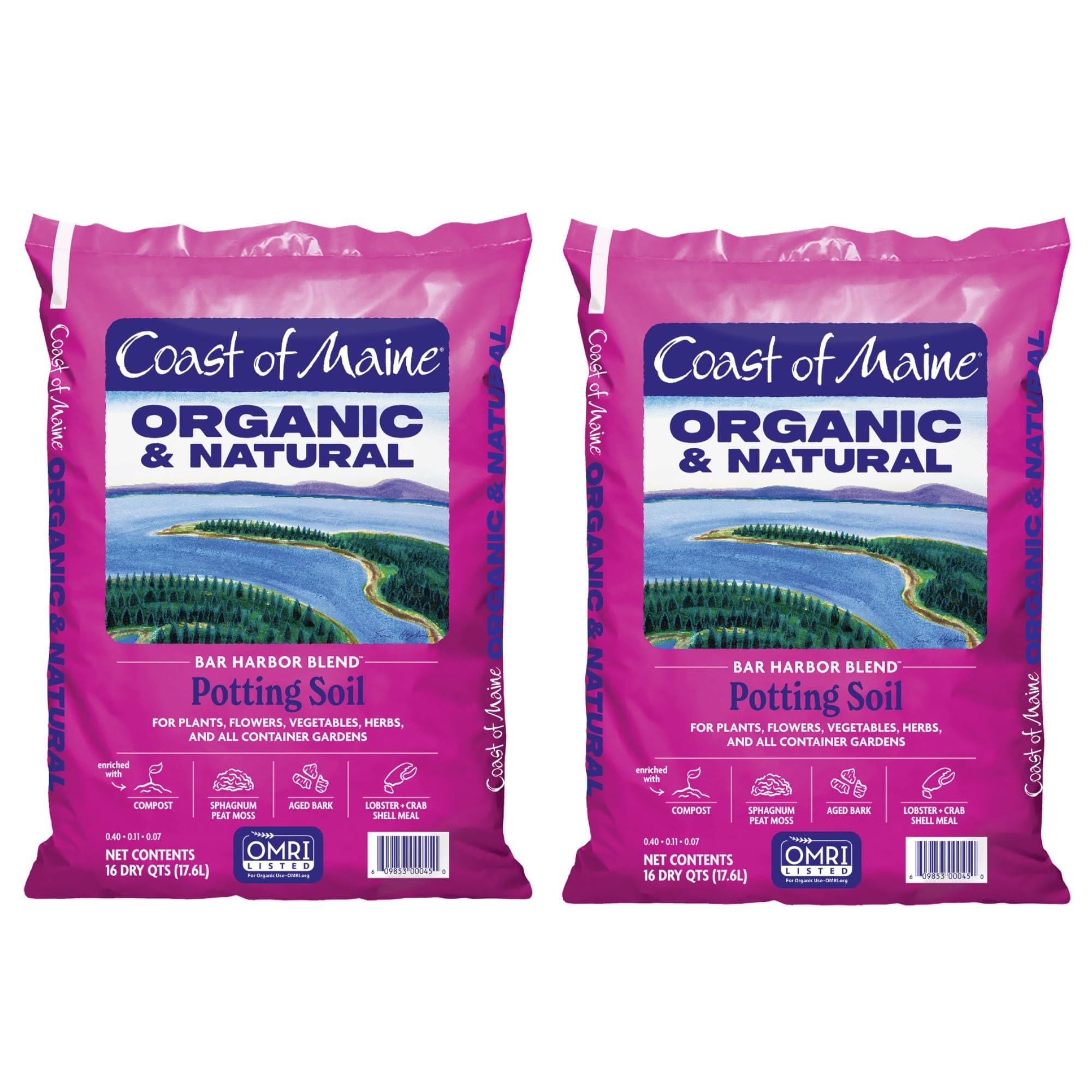
Seafood compost for your container garden — yes, really.
This mix makes a hanging basket or window box smell like the coast for a day and then feed your flowers and veggies for weeks. It uses lobster and crab shell meal, kelp meal, and sphagnum peat moss to amend soil structure from the inside. The blend retains moisture without getting soggy, and the slow-release nitrogen from the shellfish meal provides a steady organic feed — so your plants get nutrients gradually rather than all at once.
At 14 pounds for 16 quarts, this mix is noticeably lighter than the 40.51-pound Miracle-Gro Moisture Control — nearly a third of the weight for close to the same volume of soil. That weight difference signals better aeration, because the Bar Harbor Blend uses compost and perlite rather than heavy moisture-holding gels. It is ideal for hanging baskets or any container you need to lift and move.
Customers note that the texture is wonderfully crumbly and easy to work with. The catch is that if you fill a very large planter box, the 16-quart bag runs out fast — you may need two bags for a single deep box. But for its price, the organic certification and unique ingredient list make it a standout. This is the pick if you want organic, lightweight aeration and do not need to fill massive boxes.
Why it shines
- Contains lobster and crab shell meal for natural slow-release nitrogen
- Lightweight — 14 lb per 16 QT is easy to carry and aerates roots
- Approved for organic gardening
Keep in mind
- Volume runs out quickly for deep planter boxes
- Sea-based compost may attract curious pets or wildlife before it is buried
Take it home if: you want an organic, aerated mix for hanging baskets or window boxes where weight matters.
Pass on it if: you need to fill multiple deep 2-cubic-foot boxes on a budget.
4. Miracle-Gro Potting Mix (3-Pack)

Three bags for when you are planting every window box on the block.
This 3-pack bundles three 8-quart bags of standard Miracle-Gro Potting Mix, giving you a total of 0.66 cubic feet. Each bag fills two 8-inch containers, according to the manufacturer. The big selling point here is the feeding window — this mix feeds up to 6 months, so you can get your containers set in spring and not think about fertilizer until fall.
Unlike the Moisture Control version above, this standard mix does not have the AquaCoir technology, so you need to be more careful with your watering schedule. But if you are starting multiple planters at once and want a consistent, proven base mix, the three bags give you coverage without hauling one giant 40-pound sack. It is designed for outdoor container plants — flowers, vegetables, shrubs, annuals, perennials, herbs.
One thing reviewers point out: the bags are separate, so you do not have to worry about sealing a massive open bag. Use one and stash the other two in a dry shed. The trade-off is that per unit of volume, the 3-pack costs more than buying a single large bag of the same brand. If you are planting more than five or six medium containers, the 2-cubic-foot Moisture Control bag is a better value.
Smart convenience: three sealed bags let you plant in stages without the rest of the soil drying out.
Grab it for: batch planting smaller containers where you want each bag fresh and the feeding handled for half a year.
Consider the bigger bag if: you are filling one large planter box that needs more than 0.66 cubic feet total.
5. Brut Organic Potting Soil
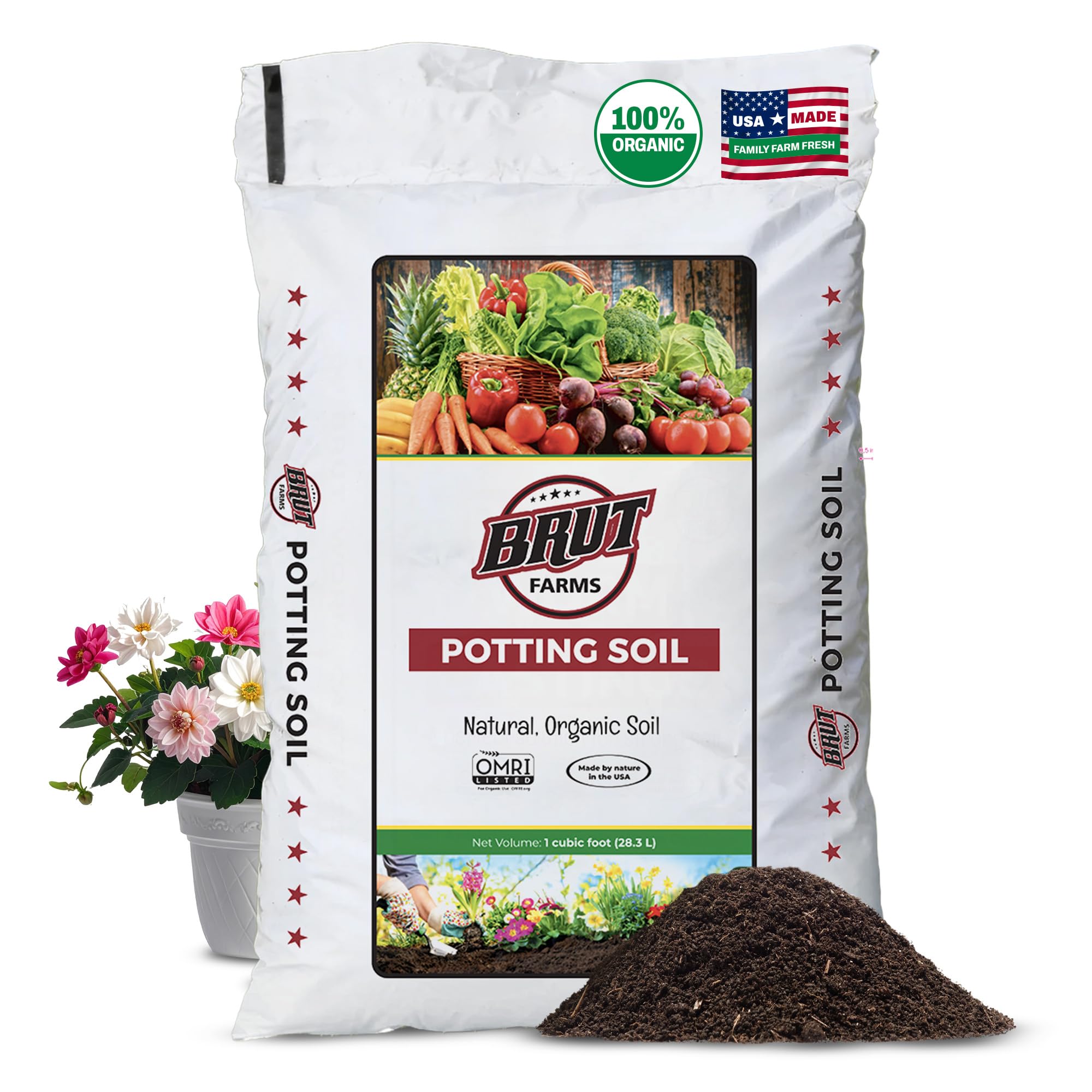
Certified organic and packed with worm castings for root-level feeding.
You get an OMRI-listed mix (meaning an independent third party has verified it meets organic standards) that combines microbe-rich worm castings, trace minerals like Azomite, and kelp, plus perlite for aeration. With 21 quarts in a single bag, it offers a 2.6x larger volume than the Midwest Hearth 8-quart mix, giving you substantially more coverage for the same type of organic commitment.
This is a filler-free mix — no sticks, wood chips, or artificial additives. The pH is naturally balanced between 6.3 and 6.5, which is in the balance for most vegetables, herbs, and flowers. It works equally well for indoor plant soil and outdoor containers, so you could use the same bag for kitchen herbs and a patio planter box. Reviewers highlight that the texture is light and fluffy, and the worm castings give plants a visible green-up within a week.
The downside is that because it is a living soil with worm castings, it can attract fungus gnats if you overwater. Keep the surface dry, and you should be fine. For the volume and the OMRI certification, this is a strong mid-range organic option that undercuts the premium Espoma on price while delivering comparable ingredients.
What you get
- OMRI-listed organic certification for clean growing
- 21 quarts — a 2.6x larger volume than the 8-quart basic mix
- pH balanced between 6.3 and 6.5 for broad plant compatibility
Watch for
- Living soil may attract fungus gnats if kept too moist on the surface
- Not as widely available at big-box hardware stores as Miracle-Gro
Choose this for: organic herb and flower containers where you want a certified living soil at a reasonable cost.
pass on it if: you are a beginner who tends to water frequently — the organic matter holds moisture and needs careful drying between waterings.
6. Midwest Hearth Premium Potting Soil Mix

A small-bag formulation that mimics what professional growers use.
This compact 8-quart bag contains peat moss, perlite, and vermiculite — the classic aeration-and-moisture trio — and the brand claims it uses the same formulation that professional growers rely on. The pH is controlled (balanced for a broad spectrum of plant types), and the mix is ready-to-use straight out of the bag. At 1.25 kilograms (about 2.7 pounds) for the whole bag, it is extremely lightweight, which is handy for small indoor planters or seedling trays.
This bag is 2.6x smaller than the Brut Organic 21-quart option, so it is clearly designed for small jobs: a single window box, a few herb pots, or starting seeds. The mix promotes root growth and provides aeration, but unlike the Miracle-Gro or Espoma options, it does not come with any added fertilizer. You will need to supplement with liquid feed after about two weeks.
Reviewers appreciate that the bag is from a smaller brand that actually uses the same formulation as commercial growers. The drawback is that for the price per quart, you pay a premium for the small bag size. If you have only a couple of small planters or you are testing a new mix before committing to a big bag, this works well. For a full raised bed or multiple large boxes, you would need several bags.
Best use: the exact blend for small containers and seed-starting where you do not want a warehouse-sized bag sitting around.
Ideal for: apartment dwellers with a few indoor or balcony planters who value a professional-grade, no-fertilizer mix.
Not for: anyone filling a deep planter box or a large raised bed — you will burn through several bags at a high per-quart cost.
Understanding the Specs
Perlite vs. Vermiculite
Perlite is the small white popcorn-like rock that improves drainage and aeration — critical in a planter box where roots cannot escape compacted soil. Vermiculite is the flaky golden mineral that holds water and nutrients like a sponge. A good potting mix uses both: perlite for air flow and vermiculite for moisture retention. If a bag lists one but not the other, the mix will either drain too fast or stay too wet.
Organic Matter and Mycorrhizae
Ingredients like worm castings, kelp meal, alfalfa meal, and feather meal provide a slow-release organic food source. Mycorrhizae are beneficial fungi that colonize roots and help them mine nutrients from the soil. A bag with Myco-Tone or a similar mycorrhizal inoculant gives your plants a biological advantage — they can access phosphorus and other minerals that would otherwise be locked in the soil particles. If the bag lacks these, you will need to rely on synthetic fertilizers for fast growth.
FAQ
Can I use garden soil in a planter box instead of potting mix?
How often should I water a planter box with potting mix?
Does organic potting soil really make a difference for vegetables?
How long does a bag of potting mix last once opened?
What is the difference between 1 cu. ft. and 1 quart?
Why does my potting mix have white mold on the surface?
Can I reuse potting soil from last year in a new planter box?
What is Myco-Tone and do I need it?
Final Thoughts: The Verdict
For the majority of shoppers, the soil for planter box winner is the Miracle-Gro Moisture Control Potting Mix because it combines a huge 2 cu. ft. bag, built-in 6-month feeding, and the AquaCoir buffer against both over- and under-watering. If you want an organic approach with living soil biology, grab the Espoma Organic Potting Soil Mix. And for lightweight window boxes or hanging baskets that need good aeration and organic certification, the Coast of Maine Bar Harbor Blend is a perfect fit.
How We Picked
We do not accept paid placement. Every pick is matched to a real buyer and a real use-case; we do not hands-on test units.
Sources & Methodology
Specifications: manufacturer listings and product documentation. Review insights: verified customer reviews, as of July 2026. Pricing: not shown on this page (it changes often); check the current price via the retailer link.
As an Amazon Associate, Lawn Gear Lab earns from qualifying purchases. This does not affect which products we feature.