
Specs are compiled from manufacturer listings and verified buyer reviews and can change over time — please confirm the key details on the product page before buying.
Killing ivy is rarely a one-and-done job. Whether it is poison ivy spreading through your flower beds or English ivy climbing your fence, the real challenge is getting the chemical down to the root system so the plant does not just leaf back out in a few weeks. That is where a focused herbicide makes the difference between finally winning the battle and spraying the same vines every season.
I’m Rikta — the founder and writer behind Lawn Gear Lab. This guide is built by comparing the manufacturers’ published specifications and the patterns across verified customer reviews, so you get each pick’s real strengths and trade-offs instead of marketing spin.
After digging through the formulas, active ingredients, and real-world results, these are the options that actually have the muscle to stop ivy. This is your focused, fact-based look at the herbicide to kill ivy that earns its place in your shed.
Quick Picks
- Bonide 332 Herbicide Poison Ivy & Brush — Best Overall
- Southern Ag Brush Killer, 8.8% Triclopyr — Top Performer
- Ortho GroundClear Poison Ivy and — Best Value
- Ortho GroundClear Poison Ivy and Tough — Easiest Application
- Scotts Ortho Max Poison Ivy Tough Brush Killer — Targeted Pick
- BioAdvanced Brush Killer Plus Concentrate 32 oz — Budget Champion
- Liquid Harvest Pro Brush & Poison Ivy — Cold-Weather Pick
How To Choose The Best Herbicide To Kill Ivy
The first thing to understand is that most general-purpose weed killers are not strong enough for ivy. Ivy has a thick, waxy leaf surface and a deep, spreading root system that laughs at surface-level sprays. You need a herbicide formulated with the right active ingredients and applied in a way that gets the chemical transported down to the roots.
Active Ingredient: Triclopyr Is the Standard
Nearly every effective ivy killer on the market lists triclopyr as its main active ingredient. Triclopyr is a systemic herbicide (meaning the plant absorbs it and moves it throughout its entire system, including the roots) that is specifically good at killing woody plants and broadleaf weeds. Some formulas add 2,4-D or dicamba for a broader weed-killing range, but triclopyr is the primary workhorse for ivy.
Form: Concentrate vs. Ready-to-Use
A concentrate requires you to mix the chemical with water in a sprayer, which gives you more control over the strength and lets you treat larger areas more economically. A ready-to-use product comes pre-mixed, usually in a spray bottle or a wand applicator, and is more convenient for spot-treating a few vines or for people who do not want to handle mixing. The trade-off is that ready-to-use bottles often cost more per gallon of mixed solution.
Speed of Results and Rainfastness
Most triclopyr-based herbicides advertise visible wilting within hours or a few days, but full dieback of the root system can take several weeks. Pay attention to the rainfast window — the time you need dry weather after spraying. A shorter rainfast window (like two hours) means you have less to worry about if an unexpected shower rolls through.
Quick Comparison
| Model | Best For | Active Ingredient | Size | Type | Amazon |
|---|---|---|---|---|---|
| Bonide 332 BK-32 | Maximum coverage & root kill | MCPA, Triclopyr, Dicamba | 128 oz | Concentrate | Amazon |
| Southern Ag Brush Killer | Strong 8.8% triclopyr concentrate | Triclopyr | 1 Gal | Concentrate | Amazon |
| Ortho GroundClear Concentrate | Balanced power & budget value | Triclopyr | 32 oz | Concentrate | Amazon |
| Ortho GroundClear Comfort Wand | Easiest spot application | Triclopyr, Pelargonic Acid | 1 Gal | Ready-to-Use | Amazon |
| Scotts Ortho Max Concentrate | Targeted poison ivy use | Triclopyr | 32 oz | Concentrate | Amazon |
| BioAdvanced Brush Killer Plus | Budget-friendly all-rounder | Triclopyr | 32 oz | Concentrate | Amazon |
| Liquid Harvest Pro Brush Killer | Dual-active cool-weather formula | Triclopyr, 2,4-D | 32 oz | Concentrate | Amazon |
In‑Depth Reviews
1. Bonide 332 Herbicide Poison Ivy & Brush Killer BK-32 Concentrate

The 8.6-pound concentrate that hits ivy with a three-chemical formula for deep root kill.
This is the big gun for anyone facing a serious ivy or brush infestation. The Bonide BK-32 combines triclopyr with MCPA and dicamba — three active ingredients working together — which gives it a wider weed-killing range than single-active formulas. The manufacturer claims it controls over 240 types of weeds, including poison ivy, poison oak, kudzu, and wild blackberries. One 128-ounce container is the largest volume in this lineup, so if you have a lot of ground to cover, this minimizes the number of refills.
The manufacturer says it is safe for use on several lawn grass types like Bluegrass, Fescues, Bermuda, and Zoysia, which is a big advantage if you are trying to kill ivy without torching the turf around it. You mix it with water and apply it with a tank or hose-end sprayer. For stumps, you can brush the undiluted concentrate directly onto a fresh cut. Buyers report that it kills poison ivy, oak, and sumac effectively, but some mention that on stubborn ground-cover ivy it can take two or three treatments to see full results. One reviewer noted it works well on heavy vines, though they cautioned that overspray can damage lawn spots.
Compared to the Ortho concentrates, the Bonide has the most complex active-ingredient profile and the biggest volume, making it the best value for large properties. It is slower acting than the Ortho ready-to-use formulas, but the root kill is more thorough once it works. The catch is that the chemical is extremely potent — buyers strongly advise wearing full protective gear, including an N-95 mask and gloves, because the smell is powerful and can feel overwhelming.
Where It Wins
- Covers over 240 types of weeds with three active ingredients (MCPA, Triclopyr, Dicamba).
- Largest container at 128 oz — fewer refills for big jobs.
- Can also be used on tree stumps for removal.
Where It Lags
- Requires mixing and a separate sprayer — not grab-and-go.
- Some users report needing 2-3 applications on persistent ground ivy.
- Extremely potent chemical requires careful handling and gear.
Ideal for: Property owners with large areas of poison ivy, brush, or invasive vines who want the most concentrated, multi-active formula available.
One real limitation: The strong chemical smell and handling requirements mean this is not a casual weekend spray — you need to gear up and plan the job.
2. Southern Ag Brush Killer, 8.8% Triclopyr

The 8.8% triclopyr concentrate that owners mention kills to the root with no regrowth after 8 months.
If you want a no-fuss, single-active ingredient that is well known for killing woody plants, Southern Ag delivers a high concentration of triclopyr (8.8%) in a 1-gallon jug. The coverage is listed at 4096 square feet, which is generous for a mid-sized property. You mix it with water in a sprayer — reviewers mention using 4 ounces per gallon for most ivy and brush, and up to 8 ounces per gallon for tougher stuff like yaupon.
Customers note that this product kills poison ivy, oak, sumac, and briars effectively, with visible results appearing in 2-3 weeks. One long-term user noted that after 8 months, there was no regrowth on treated areas, which is the kind of persistence you want from an ivy killer. It works best when applied in hot, dry weather, and it is slower acting than some of the Ortho products. Another reviewer successfully killed invasive yellow archangel after a month, noting that nothing else (vinegar or goats) had worked.
Compared to the Bonide above, the Southern Ag has a simpler formula (triclopyr only) but a higher single-active concentration. It is a good middle ground for someone who wants professional-level results without mixing three active ingredients. A minority of recent buyers have expressed concern that the formula may have changed, with one saying a recent purchase failed to kill driveway weeds. However, the majority of users are repeat buyers who have relied on it for years.
Best use case: Homeowners with established poison ivy patches or invasive vines who want a proven, high-concentration triclopyr that lasts for months.
Reach for this if: You need a gallon of concentrate you can mix at different strengths for different plants and you are patient enough to wait 2-3 weeks for full results.
Look elsewhere if: You want the fastest visible wilting or a ready-to-use sprayer — this is a mix-it-yourself product that takes time to work.
3. Ortho GroundClear Poison Ivy and Tough Brush Killer1 Concentrate
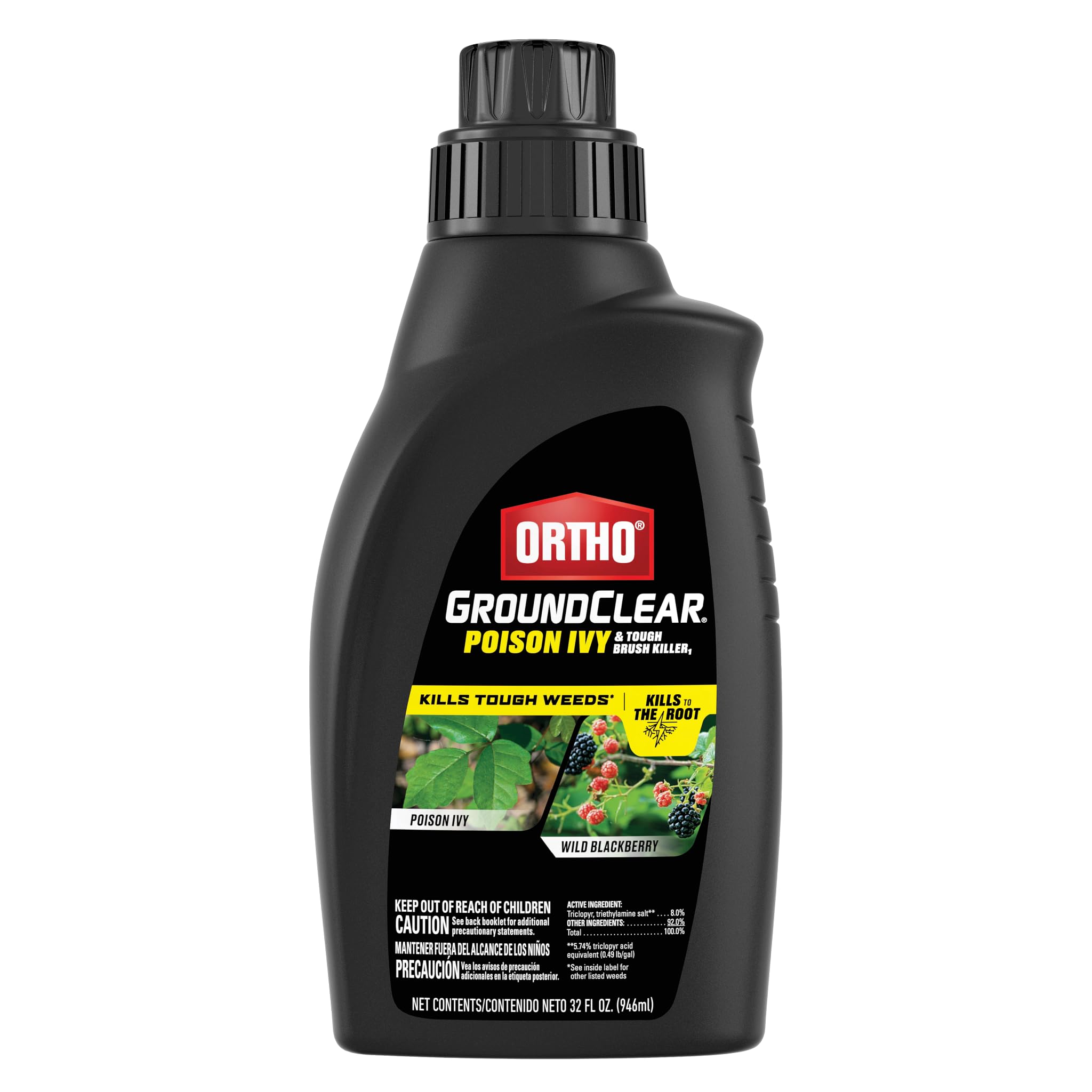
The 2.3-pound concentrate that treats up to 3200 square feet, giving you more coverage per bottle than the lighter Scotts Ortho Max.
This is the entry point into serious ivy killing for most homeowners. The Ortho GroundClear concentrate uses triclopyr as its active ingredient and treats 3,200 square feet of lighter brush when mixed into 8 gallons of solution. That is a solid coverage area for a 32-ounce bottle, putting it ahead of many similar-sized competitors on value per square foot. The manufacturer claims it kills over 60 listed tough weeds and brush, including poison ivy, poison oak, kudzu, and wild blackberry.
The manufacturer says it is rainproof in 2 hours, so you do not have to stress about afternoon showers ruining your work. It is not recommended for use in lawns or gardens where you have desirable plants, because it will kill broadleaf plants on contact. Reviewers point out that it kills poison ivy and invasive vines within a day, though one pointed out that the claim of results in 1 hour is exaggerated — it takes a day or two. The same buyer found that a second application about 3 days later sealed the deal. It is important to note that this concentrate requires a separate sprayer (like an Ortho Dial N Spray or a tank sprayer), so factor that into your total cost.
At 2.3 pounds, the bottle is significantly heavier than the Scotts Ortho Max concentrate (which weighs 1 pound). That extra weight is concentrated active ingredient, which translates to more coverage per bottle. Compared to the BioAdvanced below, the Ortho has a slightly faster rainproof window (2 hours vs. 4 hours), which is a meaningful advantage if you live in a rainy area.
Strong Points
- Treats 3,200 sq ft — best coverage per bottle in its price tier.
- Rainproof in only 2 hours.
- Proven effective on poison ivy, kudzu, and wild blackberry.
Weak Points
- Requires a separate sprayer — not ready to use.
- Results take 1-2 days, not the 1 hour advertised on the label.
- Not safe for use near desirable plants or lawns.
Your best bet if: You have a medium-sized property with poison ivy and brush, and you already own a sprayer. The coverage-to-price ratio is tough to top.
skip it if: You want a grab-and-go wand applicator — get the ready-to-use version instead.
4. Ortho GroundClear Poison Ivy and Tough Brush Killer3 with Comfort Wand

The ready-to-use gallon with a battery-powered wand for precise spot spraying without mixing.
This is the easiest option in the lineup for people who want to avoid the mess of mixing chemicals. The 1-gallon container comes with a battery-powered Comfort Wand applicator that lets you spray at the push of a button, targeting specific vines without dragging a hose or filling a tank sprayer. It contains triclopyr along with pelargonic acid (a fatty acid that helps burn through leaf surfaces quickly) and related fatty acids for faster visible wilting.
The manufacturer claims visible results in just 1 hour, and it is rainproof in 2 hours. Buyers generally confirm it kills poison ivy within a day, though one reviewer echoed the same sentiment as the concentrate: the 1-hour claim is optimistic, and it takes a day or two with a second application about 3 days later for best results. The wand system was praised by multiple users for being easy to use and effective for delivering spray exactly where needed, especially along fence lines and garden edges. A word of caution from reviewers: it can kill grass and desirable plants if you overspray, so aim carefully.
Unlike the Bonide and Southern Ag concentrates, this one is a single-use bottle: once it is empty, you buy a new one rather than refilling. Compared to the concentrate version above, this ready-to-use formula costs more per gallon of solution, but you pay for the convenience of the wand and zero mixing. It is also heavier to carry — 1 gallon of liquid plus the wand assembly — so it is best for smaller, targeted jobs rather than covering acres of brush.
Perfect for: Small-scale poison ivy spot treatments around the yard, fence lines, and trails where you want the easiest possible application method.
Reach for this: If you have a few poison ivy patches or vines to kill and you do not want to handle a measuring cup or sprayer.
Think twice if: You have a large property or dense brush — you will run through this gallon quickly and pay more per treatment than with a concentrate.
5. Scotts Ortho Max Poison Ivy Tough Brush Killer 32-Ounce Concentrate

The 1-pound concentrate that shoppers say makes vines wither within 24 hours with a systemic root kill, though it covers less ground per bottle than the Ortho GroundClear.
Scotts positions this as a step up in strength from the standard Ortho GroundClear, branding it as “MAX” for the toughest brush. It is a 32-ounce concentrate that you mix at a ratio of 4 fluid ounces per gallon of water to cover approximately 1,000 square feet. The manufacturer claims it kills over 60 types of listed tough brush and weeds, including poison ivy, poison oak, kudzu, and wild blackberries, and it is rainproof in 2 hours.
Buyers report that vines begin to wither within 24 hours after application, which is faster than many other concentrates. One reviewer who used it on blackberry vines in Southern Oregon said it was just as effective, if not more so, than other brush killers they had tried. They also mentioned you can spray it as a preventative dose. Another reviewer successfully used it to stop sumac tree sucker roots from sprouting after the main tree was removed. A few users note that it is slow to work on English ivy and that it works best when mixed a little stronger than the label directs (6 oz per gallon instead of 4 oz).
At 1 pound, this bottle is lighter than the Ortho GroundClear concentrate (2.3 pounds), meaning you get less concentrated active ingredient per bottle. The coverage per bottle is also lower — roughly 1,000 square feet per gallon of mixture compared to Ortho GroundClear’s 3,200 square feet. This makes it a more targeted, smaller-job product. It works systemically, so you only spray the ivy leaves and the chemical travels to the roots, which is ideal for people who do not want to broadcast chemicals broadly.
What Stands Out
- Owners mention visible withering within 24 hours.
- Systemic formula means you only need to spray the leaves.
- Can also be used as a preventative spray.
What Holds It Back
- Lower coverage than the Ortho GroundClear concentrate (1,000 sq ft vs 3,200 sq ft).
- Some users say it struggles with English ivy.
- Smaller bottle means more frequent repurchasing for large areas.
Best for: Homeowners with small to medium patches of poison ivy who want fast visible results and do not need to cover acres of land.
pass on it if: You are dealing with English ivy or have a large property — you will get more coverage per dollar from the Ortho GroundClear concentrate.
6. BioAdvanced Brush Killer Plus Concentrate 32 oz
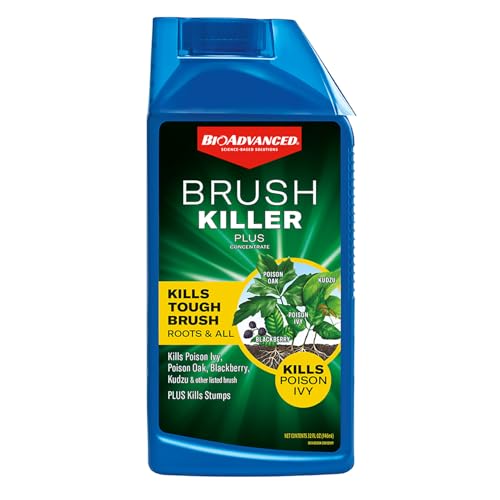
The budget-friendly concentrate that one buyer called “the ivy killer” after one application worked in two weeks, though its 4-hour rainfast window is 4 hours, compared to the Ortho GroundClear’s 2 hours.
BioAdvanced Brush Killer Plus is the most affordable option in this lineup, but it does not cut corners on the active ingredient — it is still triclopyr-based. The manufacturer claims it kills poison ivy, kudzu, poison oak, blackberry, and over 75 other listed weeds and brush. It is rainproof in 4 hours, and it works to kill the entire plant, including the root system.
Customers note solid results. One buyer mentioned they bought it specifically to kill a bunch of poison ivy growing around their trees, and it worked great in a couple of weeks with just one application. Another called it “the ivey killer” and said it works extremely well even on hard-to-kill ivy. Multiple reviews highlight that it is easy to mix and apply. A common theme is that applying it straight (undiluted) with a brush on cut stumps or small tree sprouts is extremely effective.
Compared to the Ortho GroundClear concentrate, the BioAdvanced has a longer rainfast window (4 hours vs 2 hours), meaning you need a longer period of dry weather after spraying. If you live in a climate where rain is unpredictable, that extra 2 hours could be the difference between an effective treatment and a washed-out one. It also covers fewer total weeds (75+ vs 60+) but that is a minor difference. The main advantage here is the lower entry cost — it is a solid performer for someone who needs to kill ivy on a tight budget or who is unsure if they want to commit to a larger, more expensive bottle.
Bottom line: A reliable, no-frills triclopyr concentrate that gets the job done for less. Perfect for first-time buyers or small-budget projects.
Reach for this if: You want to spend the least money possible on a triclopyr concentrate that still kills poison ivy and brush to the root.
Look elsewhere if: You need the fastest rainfast window — the 4-hour wait is longer than the Ortho competitors.
7. Liquid Harvest Pro Brush & Poison Ivy Killer Concentrate
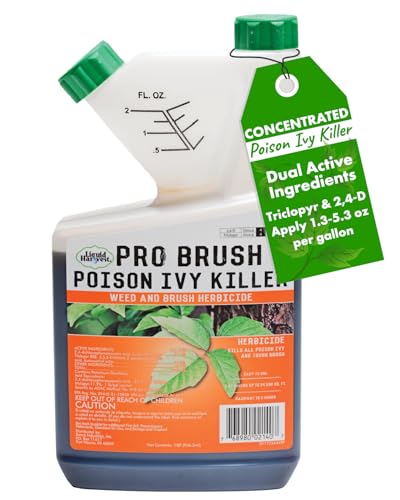
The dual-active concentrate (triclopyr + 2,4-D) designed to work in both cool and warm weather, giving you a spray window that single-active formulas lack.
Liquid Harvest Pro Brush Killer brings something different to the table by combining triclopyr with 2,4-D, a broadleaf herbicide (meaning it targets broadleaf weeds specifically) that is effective at lower temperatures. The maker says this dual-active formula provides control in both cool and warm weather, and it can even be applied during dormant periods. That is a meaningful advantage if you plan to spray in early spring or late fall when other herbicides lose effectiveness. The mix ratio is 1.3 to 5.3 ounces per gallon of water, or 2-4 pints per acre for large-scale applications.
Reviewers point out that it is effective on poison ivy and brush, with plants drooping within hours and full yellowing or browning in weeks. One owner reported that using a surfactant (a spreader-sticker additive that helps the spray cover the leaf evenly) improves the result, and that two treatments spaced a month apart are needed to reach the roots. Another buyer successfully used it to kill 3-foot-tall lilac bushes, Russian olive trees, and wild roses. A note of caution from reviewers: this is a toxic chemical, and they emphasize being careful where you spray and avoiding breathing the fumes.
Compared to the single-active triclopyr products above (like the Ortho and BioAdvanced), the Liquid Harvest has the advantage of a second active ingredient that works across a wider temperature range. The 32-ounce bottle is the same volume as the Ortho GroundClear concentrate, but the coverage information is given in acres rather than square feet, which suggests it is oriented toward larger property owners. It is also a newer brand on the market compared to the established Ortho and Southern Ag names.
Unique Strengths
- Dual-active formula (triclopyr + 2,4-D) works in cool weather and during dormancy.
- Can be applied in-season or during dormant periods for flexibility.
- Pint-per-acre coverage for large properties.
Trade-offs
- Newer brand with fewer long-term reviews than Ortho or Southern Ag.
- Buyers recommend a surfactant for best results, which is an extra purchase.
- One customer observed toxic fumes — requires protective gear.
Ideal for: Anyone who needs to spray ivy and brush in cooler months or wants a dual-active formula for more reliable year-round control.
Not the best fit if: You prefer a well-known, decades-proven brand name or you want a ready-to-use applicator.
Understanding the Specs
Why Triclopyr Matters
Triclopyr is a systemic herbicide that mimics a natural plant hormone called auxin. When ivy absorbs it through its leaves, the chemical is transported throughout the plant — stems, roots, and all — causing uncontrolled, rapid growth that the plant cannot sustain. The ivy essentially grows itself to death, which is why it is so effective on woody vines and brush. Products with higher triclopyr concentrations (like 8.8%) tend to work faster and on tougher plants, but they also require more careful handling.
Concentrate vs. Ready-to-Use
A concentrate is the raw chemical that you mix with water in a sprayer. It is more economical because you get multiple gallons of mixed solution from one bottle, and you can adjust the strength for different weeds. A ready-to-use product is pre-diluted and comes in a spray bottle or wand — you just aim and spray. The trade-off is that ready-to-use costs more per gallon of mixed product and is typically sold in smaller volumes, making it best for small, targeted jobs. If you have a large ivy patch, a concentrate will save you money and trips to the store.
FAQ
Will these herbicides kill English ivy or just poison ivy?
How long does it take to see results after spraying?
Is it safe to use these herbicides near trees and shrubs I want to keep?
Can I use these products on my lawn?
What is the rainfast window and why does it matter?
Do I need to wear protective gear when using these?
Can I use these to prevent ivy from growing back?
Which product works best in cold weather?
Will one application be enough to kill poison ivy permanently?
How do I dispose of leftover mixed herbicide?
Final Thoughts: The Verdict
For most people, the herbicide to kill ivy winner is the Bonide BK-32 because its three-active-ingredient formula covers over 240 weed types and the 128-ounce jug delivers the best long-term value for a large property. If you want the fastest, most convenient spot treatment, grab the Ortho GroundClear with Comfort Wand. And for a budget-friendly triclopyr concentrate that just works, the BioAdvanced Brush Killer Plus gets the job done while staying affordable.
How We Picked
We do not accept paid placement. Every pick is matched to a real buyer and a real use-case; we do not hands-on test units.
Sources & Methodology
Specifications: manufacturer listings and product documentation. Review insights: verified customer reviews, as of July 2026. Pricing: not shown on this page (it changes often); check the current price via the retailer link.
As an Amazon Associate, Lawn Gear Lab earns from qualifying purchases. This does not affect which products we feature.