
Specs are compiled from manufacturer listings and verified buyer reviews and can change over time — please confirm the key details on the product page before buying.
A fallen branch blocks a trail. You need firewood at camp. A limb is too high for a ladder. A hand chain saw—a sharpened chain with a handle on each end—lets you cut without a gas engine, fuel, or noise. The hard part is choosing one that actually cuts cleanly instead of jamming, snapping, or dulling after a few pulls.
I am Rikta, the writer behind Lawn Gear Lab. This guide compares manufacturer specs and patterns across verified customer reviews so you see each saw’s real strengths and trade-offs, not marketing claims.
The saws look almost identical in photos, so your decision depends on steel quality, tooth count, handle design, and how fast they cut real wood. That is what you will learn here about the hand chain saw.
Quick Picks
- Pocket Chainsaw with Paracord Handles — Best Overall
- High Limb Rope Saws 55 Inch – PANZHENG — High-Limb Specialist
- Nordic Pocket Saw 25.6 Inch — Best Value
- Roadfare 36 Inch Pocket Chainsaw — Two-Person Workhorse
- CAMPNDOOR 36 Inch Pocket Chainsaw (Orange) — Built Tough
- Homyall 24″ Pocket Chainsaw — Budget Champion
- ProSSS 36 Inch Pocket Chainsaw — Entry-Level Workhorse
How To Choose The Best Hand Chain Saw
A hand chain saw is simple, but the wrong one can break after a few cuts or leave you stuck mid-cut. Here is what to check before you buy.
Steel Type And Hardness
The steel decides if the teeth stay sharp through a dozen oak cuts or go dull on the first branch. Choose 65Mn manganese steel or high-carbon steel — these hold an edge longer than cheap carbon steel. Some brands state a hardness rating around HRC60+ (a measure of steel hardness), meaning the steel resists wear without cracking. Skip any model that does not name the steel type.
Tooth Count And Cutting Direction
More teeth cut faster because each pull engages more cutting points. Cheap models place teeth on every third link, while better models put a tooth on every link. Bidirectional teeth (angled to cut whether you pull left or right) save time because you do not waste a return stroke. Expect 30 to 48 teeth on a standard pocket saw, and up to 72 on a rope saw built for high branches.
Handle Material And Comfort
You pull this saw back and forth, sometimes for minutes, so handles matter. Nylon strap handles work fine with gloves. Paracord handles can be unbraided to give you 270 inches of cord for survival tasks, but they may dig into bare hands during long use. Large loop handles, like those on the Nordic Pocket Saw, let you grip more comfortably or let a second person pull on bigger logs.
Chain Length And Portability
A 24-inch to 36-inch chain covers most camp and trail work. Shorter chains (around 25 inches) are lighter and pack easier but may not wrap around thick trunks. A 55-inch rope saw trades some portability to reach high branches without a ladder. Weight matters too — a good pocket saw weighs 4 to 8 ounces, compact enough for a pack or glove box.
Quick Comparison
| Model | Best For | Chain Length | Tooth Count | Weight | Amazon |
|---|---|---|---|---|---|
| CAMPNDOOR 36″ Paracord | Survival / Prepper Kits | 36 Inches | 48 | 0.5 lb | Amazon |
| PANZHENG 55″ Rope Saw | High Limb Trimming | 55 Inches | 72 | 1.26 kg | Amazon |
| Nordic Pocket Saw 25.6″ | Trail Clearing / Emergency Kit | 25.6 Inches | 33 | 4.66 oz | Amazon |
| Roadfare 36″ Pocket Chainsaw | Two-Person Cutting | 36 Inches | 48 | 5.92 oz | Amazon |
| CAMPNDOOR 36″ Orange | Durable / Backup Saw | 36 Inches | 48 | 0.5 lb | Amazon |
| Homyall 24″ Pocket Chainsaw | Budget / Light Camping | 24 Inches | 30 | 5.64 oz | Amazon |
| ProSSS 36″ Pocket Chainsaw | Entry-Level / Casual Use | 36 Inches | 48 | 7.68 oz | Amazon |
In‑Depth Reviews
1. Pocket Chainsaw with Paracord Handles – CAMPNDOOR (Army Green)
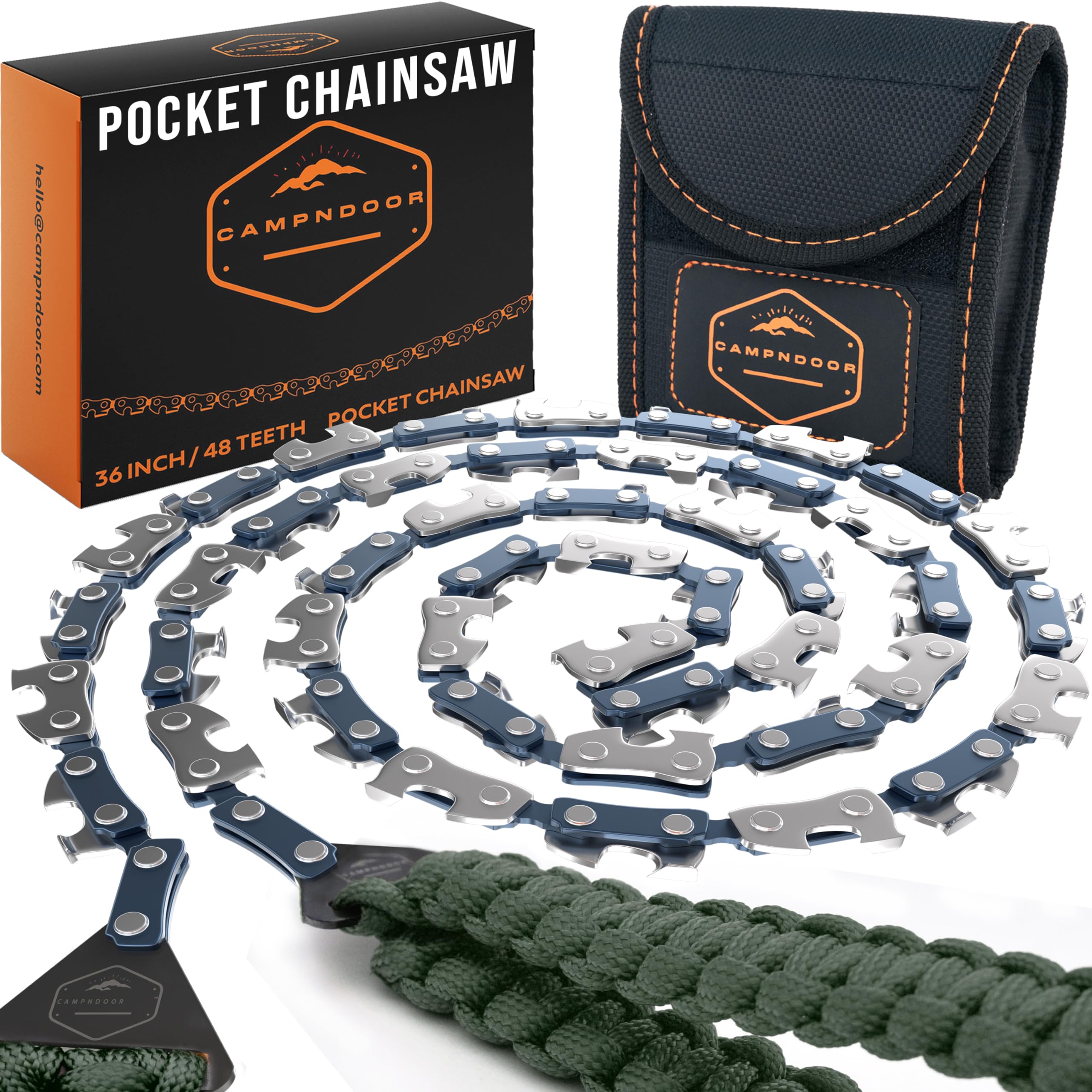
A 65Mn steel chain with 48 teeth and paracord handles that double as emergency cordage.
This saw earns the top spot because its paracord handles do more than just pull — you can unbraid them for 270 inches of rope when you need shelter lashing, a tourniquet, or a gear repair. The chain is 65Mn manganese steel, which naturally soaks up vibration so your hands feel less tired on long cuts. At 0.5 pounds, it clips to a belt loop and disappears into a pack. That is a weight and versatility the PANZHENG rope saw cannot match for general use.
Buyers report cutting through “4-8 inch dry limbs under 30 seconds” consistently. One reviewer noted the saw “handled everyone under 30 seconds with consistent pulling.” The 48 Tiger Claw teeth plus 48 clog-clearing bulldozer teeth — a tooth on every single link — make it one of the fastest cutters in this lineup. The same person says it works “effective up to 10-12″ diameter.” They also found the paracord handle “the most comfortable to use because of the back and forth pulling” compared to strap-style handles. The saw can get caught at the ends of branches when the chain wraps around itself, but that is typical of all hand chain saws.
The trade-off? The paracord may dig into bare hands more than the larger nylon loops on the Nordic Pocket Saw, and it weighs more than the ProSSS model. But with 65Mn steel, a 48-tooth count on every link, and reusable cordage, this is the most versatile pick for a survival kit or extended backcountry trips. If you mostly clear 2-4 inch branches alone, the lighter Nordic at 4.66 oz will suit you better.
what separates it
- 65Mn steel with shock-absorbing manganese reduces hand fatigue
- Paracord handles unbraid to 270 inches of rope for emergencies
- 48 bidirectional teeth on every link cut faster than saws with teeth on every third link
The trade-offs
- Paracord can dig into bare hands after extended use
- May bind at branch ends as the chain wraps around itself
Reach for this if: You want a do-it-all survival saw with backup rope built in and steel quality for regular use.
Look elsewhere if: You need the lightest saw for an ultralight pack — at 0.5 lb it is not the featherweight option.
2. High Limb Rope Saws 55 Inch – PANZHENG

A 55-inch rope saw with 72 teeth designed to reach high branches without a ladder.
This is built for a single job that pocket saws cannot handle: cutting limbs you cannot reach from the ground. The 55-inch chain swings over a branch, and the included 11 oz throw weight (a small weighted bag on a line) helps you send the saw up and over high limbs. One reviewer called it “a legit tool that works exactly as well as advertised” after using it on branches his pole saw could not reach. For that specific task, it beats the CAMPNDOOR Paracord model because the CAMPNDOOR’s 36-inch chain and lack of a throw system cannot reach those heights.
At 1.26 kilograms (about 2.8 pounds), this is the heaviest saw here, but the weight is necessary for the 55-inch chain and throw-weight system. Owners mention it cuts “4 inch and 2 inch branches” with clean cuts, though it can “jam time to time” — a common issue that eases with technique or a second person pulling from the other side. One reviewer flagged that the included sharpening file does not fit its own handle well, so you may want a 4mm round file for touch-ups. The plastic handles are functional but less comfortable than paracord or large nylon loops for long use.
This is the right saw for trimming high limbs without a ladder or a motorized pole saw. It is overkill and too heavy for backpacking, but for property maintenance and homestead work, the 55-inch reach and 72 teeth make it the best option for inaccessible branches. Unlike pocket saws, it works best when you stand on the ground aiming up, not crouched by a fallen log. If your main job is cutting firewood on the ground, the Nordic Pocket Saw at 4.66 oz will be easier to handle.
The reach advantage: At 55 inches with a throw weight, it reaches branches that a 36-inch pocket saw cannot — no ladder needed.
One heads-up: The 2.8-pound weight and 72-tooth chain make it heavy to pack; this is a yard tool, not a trail tool.
For anyone with high limbs to cut: The PANZHENG rope saw is the most effective non-motorized solution for reaching branches a standard pocket saw cannot touch.
skip it if: You need a saw to throw in a backpack — at 1.26 kg it is far too heavy for hiking or camping.
3. Nordic Pocket Saw 25.6 Inch

A 4.66-ounce pocket saw with oversized nylon handles that the manufacturer says can cut logs up to 18 inches thick.
At 4.66 ounces — under a third of a pound — this is the lightest saw in the review, yet its maker claims it cuts logs up to 18 inches thick. The 33 bidirectional teeth are on every link, so every stroke pulls through wood rather than wasting a return glide. The standout feature is the oversized nylon handle loops: they are big enough for two gloved hands, and they let a second person grab the other end for double the pulling power on big logs. That design is more comfortable for extended use than the strap-style handles on cheaper models.
Buyers praise its speed. One reviewer says it “tears through material with ease” and calls it “so much faster and more efficient than a silky saw.” Another notes it is “a workout to use” but “cuts super quick” and is ideal for off-grid camping where you process your own firewood. A California reviewer used it with tow straps to take down oak limbs above ladder height, saying “the blade will do its part” — though they note you “will get worn out before this product ever does.” The chain is thinner than a standard chainsaw chain to keep weight down, which means it can bind on smaller sticks; the manufacturer recommends a foldable saw for branches under 2 inches.
At its price, this is the best value for anyone wanting a proven, lightweight saw that does not give up cutting ability. The 25.6-inch chain is shorter than the 36-inch models like the Roadfare, so it will not wrap as easily around thick trunks, but for 2- to 12-inch logs — nearly all trail-clearing and firewood tasks — it “eats it up,” as one buyer wrote. The manufacturer says you need to sharpen it only 2-3 times a year with an 11/64″ round file if you use it a few times a month. If you need a longer reach for 18+ inch trunks, the 36-inch CAMPNDOOR models are a better fit.
Why it stands out
- 4.66 ounces — lighter than most pocket saws here
- Oversized nylon loops allow two-person operation on logs up to 18 inches thick
- Sharpens only 2-3 times a year with standard maintenance
Its limits
- 25.6-inch chain is short for very large trunks above 18 inches
- Can bind on sticks under 2 inches — a foldable saw works better for those
Best for: Hikers, mountain bikers, and emergency-kit builders who want the lightest reliable saw that still cuts fast through logs up to a foot thick.
Consider another if: You need a longer chain to reach around 18+ inch trunks — the 36-inch models are a better fit for that.
4. Roadfare 36 Inch Pocket Chainsaw

A 36-inch 65Mn steel saw with bidirectional teeth and reinforced nylon handles for two-person cutting.
This saw shares the 36-inch length and 48-tooth count with several others, but it stands out because of its well-shaped, soft-reinforced nylon handles and bidirectional teeth that cut on both strokes. At 5.92 ounces, it is slightly heavier than the Nordic but still ultralight for its length. The 65Mn high-carbon steel chain holds a sharp edge, and the 90-degree cutting angle (how the teeth are set to meet wood) digs in efficiently. The included tactical belt pouch clips to a loop without swinging around.
Buyers give the strongest evidence for this saw’s capability: “Cuts 12″ trees easily with two people,” one verified review says. The same reviewer advises to “avoid sharp bends to prevent sticking,” which applies to any hand chain saw. Another called it “sharp” and “feels solid,” noting they “looked forward to using it.” A third, testing in freezing conditions, cut “10” trees for fire” and raised the ambient temperature by 20-30°F — the saw did not dull on soft pine and mulberry. The 65Mn steel is strong enough that the handles and links fail on cheaper models, not this one. This makes it a better two-person option than the Homyall, whose carbon steel would dull faster on that workload.
The honest trade-off: it is “very tiring by hand” for a single person on large cuts, as one three-star reviewer put it. That is true for all hand chain saws, but the 36-inch chain on a single-pull setup demands more effort per stroke than a shorter chain. The manufacturer claims it cuts “3X faster than other rope chainsaws that have cutters on every third link,” and while no one can verify that exact multiple, the tooth-on-every-link design objectively removes less wood per stroke than the 72-tooth PANZHENG rope saw. It is a capable mid-range pick that does what you expect with no surprises. If you mostly clear 2-4 inch branches alone, the lighter Nordic at 4.66 oz suits you better.
Best use-case: Two-person trail-clearing teams who need a 36-inch reach and 48 teeth on 65Mn steel that will not snap on the first big log.
One note: At 5.92 oz it is midweight — lighter than the ProSSS but heavier than the Nordic — so it sits in the middle of the portability scale.
Grab this if: You expect to cut 10-12 inch logs regularly, especially with a partner — the 36-inch chain and reinforced handles handle that workload better than shorter models.
Pass if: You mostly clear 2-4 inch branches solo; a shorter, lighter saw like the Nordic would suit you better.
5. CAMPNDOOR 36 Inch Pocket Chainsaw (Orange)

A 36-inch saw with 48 Tiger Claw teeth and 48 bulldozer teeth, backed by a lifetime warranty.
This orange-handled version of the CAMPNDOOR design has 48 Tiger Claw teeth plus 48 clog-clearing bulldozer teeth — 96 cutting surfaces total — on a 65Mn steel chain. The manufacturer claims 4000 Newtons of testing strength (a unit of force), meaning the chain would only break under the pull of a 988+ pound person, a reassuring spec for anyone who has snapped a cheap chain mid-cut. At 0.5 pounds and 36 inches, it matches the Paracord version, but the orange handles are high-visibility nylon straps, easier to spot if you drop it in leaves or snow. This is a key difference from the Paracord model: no emergency rope here, but the warranty makes up for it.
Customers note it is “well built, easy to use, compact” and that it “handled everyone under 30 seconds with consistent pulling” on 4-8 inch dry limbs. One reviewer called it “much safer than swinging an axe, and easier and lighter weight” than a bow saw. The lifetime warranty is a notable differentiator — CAMPNDOOR says they will buy it back if you do not agree it is the best, which is rare for a tool at this price. The 48 bulldozer teeth are designed to clear sawdust and reduce clogging, which should help with binding issues common on single-tooth-per-link designs.
That said, the nylon strap handles lack the versatility of the paracord on the green version — you cannot unbraid them for emergency cordage. At 0.5 pounds with a 36-inch chain, it is not the most packable option; the Nordic at 4.66 oz is lighter and shorter. This saw is a solid backup or primary for car camping, homesteading, and anyone who values a lifetime warranty. If you need emergency rope, the green Paracord version is your pick over this one.
Its biggest selling point: The 4000 Newton breaking-strength claim and lifetime warranty remove the worry of a chain snapping mid-cut.
Where it falls short: At 0.5 lb it is not ultralight, and the nylon handles lack the multi-use function of paracord.
Choose this if: You want the highest confidence in build quality and a warranty that covers it long-term.
Opt for the Paracord version instead if: You need the handles to double as emergency rope — the orange model skips that feature.
6. Homyall 24″ Pocket Chainsaw

A 24-inch, 30-tooth saw at 5.64 ounces that the maker claims cuts faster with teeth on every link.
This is the shortest chain here at 24 inches with 30 teeth with 30 teeth compared to 48-tooth models, so it removes less wood per stroke. The manufacturer’s “3X faster” claim refers to having teeth on every link versus every third link: with no idle links, every pull does work. The industrial-grade heat-treated carbon steel is a step below 65Mn manganese steel, but reviewers point out it is “sharp, cuts trees easily” and call it “small, lightweight, strong, efficient.” At 5.64 ounces, it is only a gram heavier than the Nordic but 2 inches shorter.
Shoppers say it “works well for trail clearing” and fits easily in its pouch, but they note that “blades jam after center cut” and it requires “careful positioning” to avoid binding on small branches. One reviewer who used it on 6-inch branches says it is “quick” with “sharp teeth [that] cut both ways,” but estimates around 20 uses before noticeable wear. The binding issue is worse on this short chain because it has less length to flex around the branch; the Nordic at 25.6 inches and the 36-inch models handle that better. The nylon handles are functional but basic — no large loops like the Nordic or paracord like the CAMPNDOOR.
For its price, this saw does what you need for light camping, Christmas-tree cutting, and clearing small branches up to about 6-8 inches. It is not built for heavy or frequent use — the carbon steel dulls faster than 65Mn — but as a budget-friendly entry point, it is a capable tool with positive real-world feedback. One reviewer sums it up: “Great compact affordable alternative to expensive folding saws.” If you plan to cut oak, hardwoods, or logs thicker than 8 inches regularly, step up to a 65Mn model like the Roadfare.
What you get for the money
- Teeth on every link means no wasted return strokes
- 5.64 oz and compact pouch make it genuinely pocketable
Where it cuts corners
- 24-inch chain is short — less reach around larger trunks
- Carbon steel dulls faster than 65Mn; users estimate ~20 uses before wear
Smart pick for: Occasional campers and budget-conscious buyers who want a functional saw without spending more on premium steel.
Better options exist if: You plan to cut oak, hardwoods, or logs thicker than 8 inches regularly — step up to a 65Mn model.
7. ProSSS 36 Inch Pocket Chainsaw

A 36-inch, 48-tooth saw with 65Mn steel and military-grade paracord handles, at 7.68 ounces.
This is the heaviest pocket saw here at 7.68 ounces, but the weight gives you a 36-inch 65Mn steel chain, 48 teeth with a 90-degree serration structure (angled for clean cuts), and military-grade paracord handles that unbraid to 270 inches of rope. The fluorescent handles make the saw easy to spot if dropped in grass or leaf litter. The manufacturer claims a hardness of HRC60+, meaning the steel resists wear from repeated use on hardwood like oak. It rolls up to about the size of a cell phone and comes with a waterproof canvas storage bag.
Buyers report surprising performance: one wrote “this one worked like a charm, first try, on a five+ inch oak tree limb forty feet up” and noted they did not oil the chain. Another, a 68-year-old woman, said “I cut down four 2-3″ little trees in about 20 minutes” and called it “nice and sharp and not hard to do.” A reviewer testing it on an 8-inch diameter red oak said it “cut right through it in about 45 seconds” and after 10 two-foot logs it “has dulled about 15% but this is from oak! Very hard wood.” That is honest — oak is tough on cutting tools. The same reviewer said it gives “your lats a workout” and called it “way better than lugging an axe around.”
At 7.68 ounces, compared to the Homyall at 5.64 ounces, but it also has the longest chain (36 inches vs 24 inches) and the most teeth (48 vs 30) among the budget-tier picks. The paracord handles add survival versatility, similar to the CAMPNDOOR Paracord model. The steel is decent, but one reviewer noting “it has dulled about 15%” on a dozen oak cuts hints that edge retention is adequate, not exceptional. For the price, it is a solid entry-level saw that manages most camp and yard tasks. If you need the lightest possible saw for ultralight backpacking, the Nordic at 4.66 oz is a smarter choice.
Its best feature: The 36-inch length and 48 teeth give more reach and cutting surface than shorter budget models, and the paracord handles add versatility.
The honest limit: At 7.68 oz it is notably heavier than the 5.64 oz Homyall or the 4.66 oz Nordic, and the 65Mn steel may dull faster on very hard woods like oak.
Good fit for: First-time hand chain saw buyers who want a full 36-inch length and paracord handle bonus without spending premium money.
pass on it if: You need the lightest possible saw for ultralight backpacking — the Nordic at 4.66 oz is a better choice.
Understanding the Specs
65Mn Steel vs Carbon Steel
65Mn manganese steel has a small amount of manganese added, making the chain harder (often around HRC60+) and more wear-resistant than basic carbon steel. It also absorbs shock naturally, so less vibration reaches your hands during long cuts. Carbon steel is cheaper and easier to sharpen, but it dulls faster — especially on hardwoods like oak. For regular use, the 65Mn option is worth the small price bump.
Bidirectional Teeth
Most hand chain saw teeth cut only on one pull direction, wasting the return stroke. Bidirectional teeth face both ways along the chain, cutting wood on every stroke — forward and back. That roughly doubles your cutting speed for the same effort. Look for models that say “bidirectional” or “cuts both ways” to avoid wasting half your energy.
Chain Length
Chain length sets the maximum diameter of wood you can wrap the saw around. A 24-inch chain cuts logs up to about 8 inches thick, a 36-inch chain handles up to roughly 12 inches, and a 55-inch rope saw reaches around much larger trunks. Longer chains weigh more and take more packed space. Pick based on the log size you expect to cut.
Handle Types
Three common handle types exist. Nylon strap handles are simple, lightweight loops that work fine with gloves. Paracord handles are thicker rope loops that can be unbraided for several feet of emergency cord, but they may dig into bare hands. Large nylon loop handles, like on the Nordic Pocket Saw, are wide enough for two hands or a second person, reducing fatigue on long cuts. Choose based on comfort, multi-use need, or packability.
FAQ
Will a hand chain saw work on wet or green wood?
How do I avoid the saw getting stuck or binding?
Can one person use a hand chain saw, or do you always need two?
How do I sharpen a hand chain saw?
What is the difference between a hand chain saw and a wire saw?
How heavy is a typical hand chain saw?
Can a hand chain saw cut a tree down?
What safety gear do I need?
Final Thoughts: The Verdict
For most buyers, the hand chain saw winner is the CAMPNDOOR 36″ Paracord because it combines a 65Mn steel chain, 48 bidirectional teeth, and paracord handles that double as emergency rope — all at a price that balances performance with durability. If you need to reach high limbs without a ladder, grab the PANZHENG 55″ Rope Saw with its 72 teeth and throw-weight system. And for the ultralight hiker who prioritizes pack weight, the Nordic Pocket Saw at 4.66 ounces with oversized handles that let a second person help on bigger logs is the stand-out choice.
How We Picked
We do not accept paid placement. Every pick is matched to a real buyer and a real use-case; we do not hands-on test units.
Sources & Methodology
Specifications: manufacturer listings and product documentation. Review insights: verified customer reviews, as of July 2026. Pricing: not shown on this page (it changes often); check the current price via the retailer link.
As an Amazon Associate, Lawn Gear Lab earns from qualifying purchases. This does not affect which products we feature.