
Specs are compiled from manufacturer listings and verified buyer reviews and can change over time — please confirm the key details on the product page before buying.
Tired of an axe that bounces off logs instead of splitting them cleanly? You need the right tool for the job. The best axe for chopping wood matches head weight, handle length, and steel quality so every swing drives deep into the grain instead of shaking your arms.
I’m Rikta — the founder and writer behind Lawn Gear Lab. This guide is built by comparing the manufacturers’ published specifications and the patterns across verified customer reviews, so you get each pick’s real strengths and trade-offs instead of marketing spin.
After comparing seven axes with different head weights, handle materials, and cutting geometries, these are the picks that balance sharpness and durability for real-world splitting. Read on to find the axe for chopping wood that fits your frame and your workload.
Quick Picks
- Fiskars 36″ Super Splitting Axe — Best Overall
- Gransfors Bruks Small Forest Axe 19 Inch — Premium Craftsmanship
- Fiskars 28″ Chopping Axe — Best Value
- 1844 Helko Werk Germany Classic Scout Axe — Canoe-Ready Companion
- Husqvarna Wood Splitting Axe S2800 — Heavy Lifter
- LEXIVON V18 Chopping Axe — Compact Traveler
- Purple Dragon Camping Hatchet 14.7 Inch — Bushcraft Entry
How To Choose The Best Axe For Chopping Wood
Picking the right axe depends on matching three things to your own strength and the wood you regularly split. Head weight gives you momentum; handle length gives you swing speed; blade grind gives you bite. A too-heavy head on a short handle will tire you out fast, while a light head on a long handle lacks the mass to split dense grain. Know your wood size before you buy.
Head Weight and Steel Hardness
Heavier heads (over 4 pounds) drive deeper into large logs but demand more shoulder strength to control. Lighter heads (around 2.5 pounds) swing faster, making them ideal for limbing and kindling. Look for drop-forged high-carbon steel typically rated between 53 and 60 HRC (a scale that measures how resistant steel is to denting) — that hardness range keeps the blade sharp longer without becoming brittle and chipping.
Handle Length and Material
You want a handle that lets you choke up one-handed for detail work and still gives reach for a full two-handed swing. Handles under 24 inches are compact for camping and backpacking; 28 to 36 inches deliver more leverage for splitting medium to large logs. Hickory wood absorbs shock naturally but can crack if left wet. Fiberglass composite handles are nearly unbreakable and require less maintenance, though they transfer more vibration into your hands.
Blade Geometry
A convex grind (where the blade curves out from the cheek to the edge) reduces friction so the head slides out of the wood after each split. A splitting-wedge or felling head uses a thicker cross-section to force the grain apart rather than slice through it. For chopping wood, a head that is too blunt will bounce off round logs; one that is too thin may stick deep and be hard to rock out.
Quick Comparison
| Model | Best For | Weight | Handle Length | Head Weight | Amazon |
|---|---|---|---|---|---|
| Fiskars 36″ Super Splitting Axe | Large log splitting | 5.95 lbs | 36 in | Forged Steel Wedge | Amazon |
| Fiskars 28″ Chopping Axe | General yard & garden | 3.5 lbs | 28 in | Alloy Steel Felling | Amazon |
| Gransfors Bruks Small Forest Axe | Backcountry felling & limbing | 2.2 lbs | 19 in | 2.0 lbs (approx) | Amazon |
| 1844 Helko Werk Classic Scout Axe | Base camp & canoe trips | 3.5 lbs | 28 in | 2.5 lbs | Amazon |
| Husqvarna Wood Splitting Axe S2800 | Large firewood splitting | 6.2 lbs | 27.6 in | 5 lbs | Amazon |
| LEXIVON V18 Chopping Axe | Camping & brush | 1.04 kg (2.3 lbs) | 18 in | Grade-A Carbon Steel | Amazon |
| Purple Dragon Camping Hatchet | Bushcraft & garden | 1.1 kg (2.4 lbs) | 14.7 in | High Carbon Steel Wedge | Amazon |
In‑Depth Reviews
1. Fiskars 36″ Super Splitting Axe
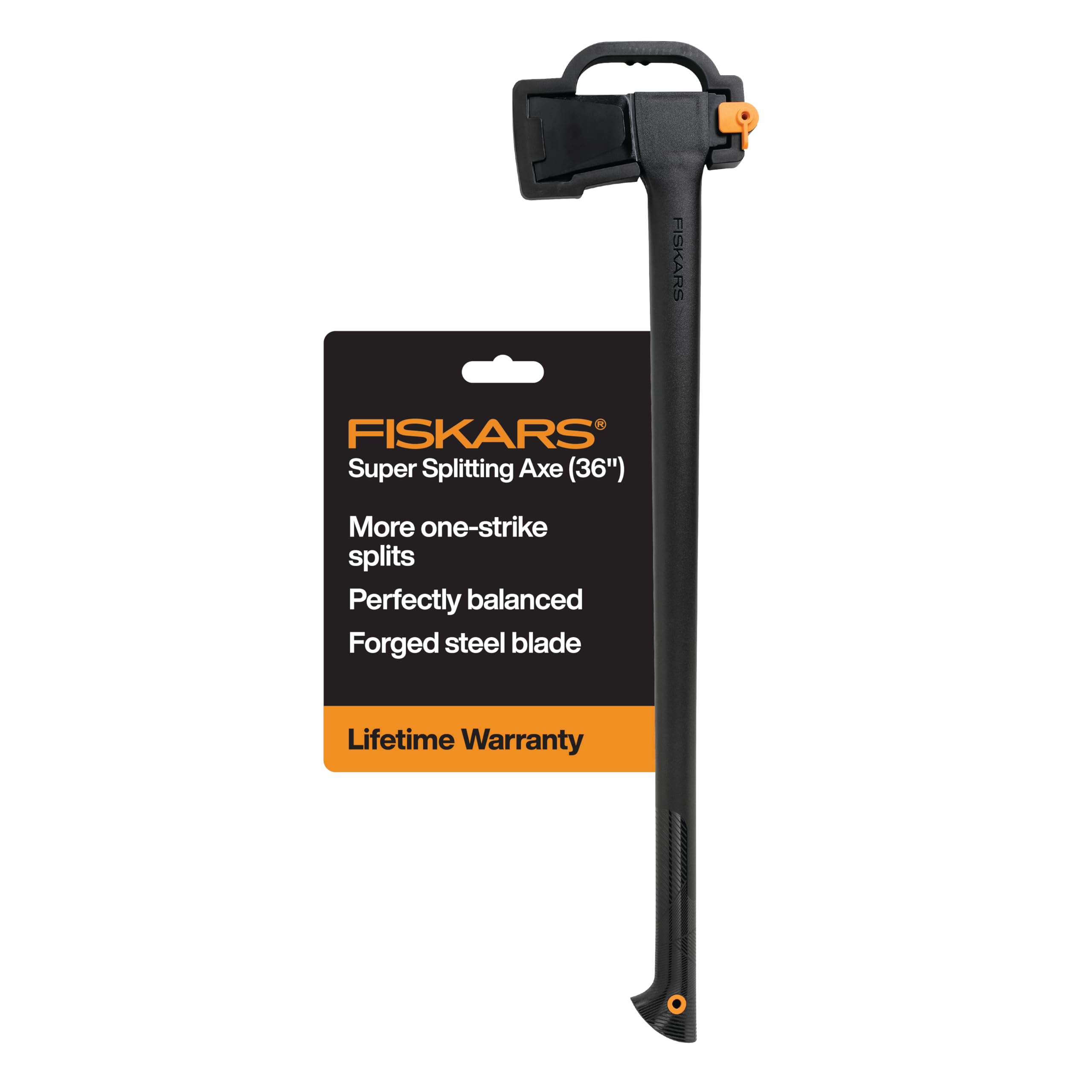
Each swing of this 5.95-pound axe drives deep into large logs, and the blade slides back out cleanly so you do not waste energy prying it free. The bevel convex blade design (a curved edge that wedges the grain apart rather than slicing through it) bites in deep, and the shape makes the head easy to rock free without prying. The FiberComp handle technology (a proprietary fiberglass-reinforced composite) absorbs shock noticeably better than solid steel or raw hickory, so your hands and elbows feel less jarring impact after a long splitting session.
At 5.95 pounds with a 36-inch handle, this axe puts serious mass behind every swing — ideal when you are facing seasoned rounds that smaller axes would just bounce off. It is markedly heavier than the Fiskars 28″ Chopping Axe (5.95 lbs vs. 3.5 lbs), but that extra weight is exactly what tall users or those splitting large firewood need to drive through thick grain in one strike. Buyers report that the ultra-sharp blade arrives ready to work and that the axe is well-balanced despite its size. The trade-off is that the 36-inch length is awkward for close limbing or one-handed detail work — this is a dedicated splitter, not a camp hatchet.
What It Does Best
- Bevel convex blade reduces friction and sticking
- FiberComp handle dampens vibration effectively
- Hardened forged steel retains edge for long stretches
Where It Falls Short
- Too long and heavy for one-handed or precision chopping
- Not ideal for smaller users who lack upper-body momentum
Reach for this if: you split medium to extra-large logs regularly and want the fewest swings per log with minimal vibration through the handle.
Look elsewhere if: you need a compact tool for camping, limbing, or lighter yard cleanup — the 28-inch version will serve you better.
2. Gransfors Bruks Small Forest Axe 19 Inch

Fit in a daypack yet fell small trees with authority — that is the promise of this 2.2-pound Swedish heirloom. The convex-ground blade (a smooth curve from the cheek of the axe head down to the cutting edge that reduces friction) arrives shaving sharp — owners mention it can slice paper straight from the factory. The 19-inch hickory wood handle is selected for straight grain orientation, which boost strength and reduces the chance of the handle snapping under a hard swing.
Where it really stands apart from heavier axes is its versatility. You can choke up on the short handle for one-handed hatchet work to carve tent stakes or split kindling, then use a full two-handed grip to fell a 4-inch tree with surprising speed. The vegetable-tanned leather sheath protects the edge in a pack without adding bulk. At 2.2 lbs it lacks the mass for splitting large, knotty logs — that is a job for the Fiskars 36″ above. One reviewer noted the anti-rust coating on the head was hard to clean off, requiring WD-40 and sandpaper, but after that the steel held its edge well.
Why It Excels
- Compact 19-inch length fits in most daypacks
- Convex edge stays sharp and slides through wood easily
- Hand-selected hickory handle with perfect grain alignment
The Cost of Quality
- Higher price point than most camp axes
- Too light for splitting large rounds
Best suited for: hikers, campers, and bushcraft enthusiasts who want one tool that fells, limbs, and splits in a small package.
Not for: anyone who needs to split a full rick of firewood at home — the head weight and short handle will make that job more work than it should be.
3. Fiskars 28″ Chopping Axe
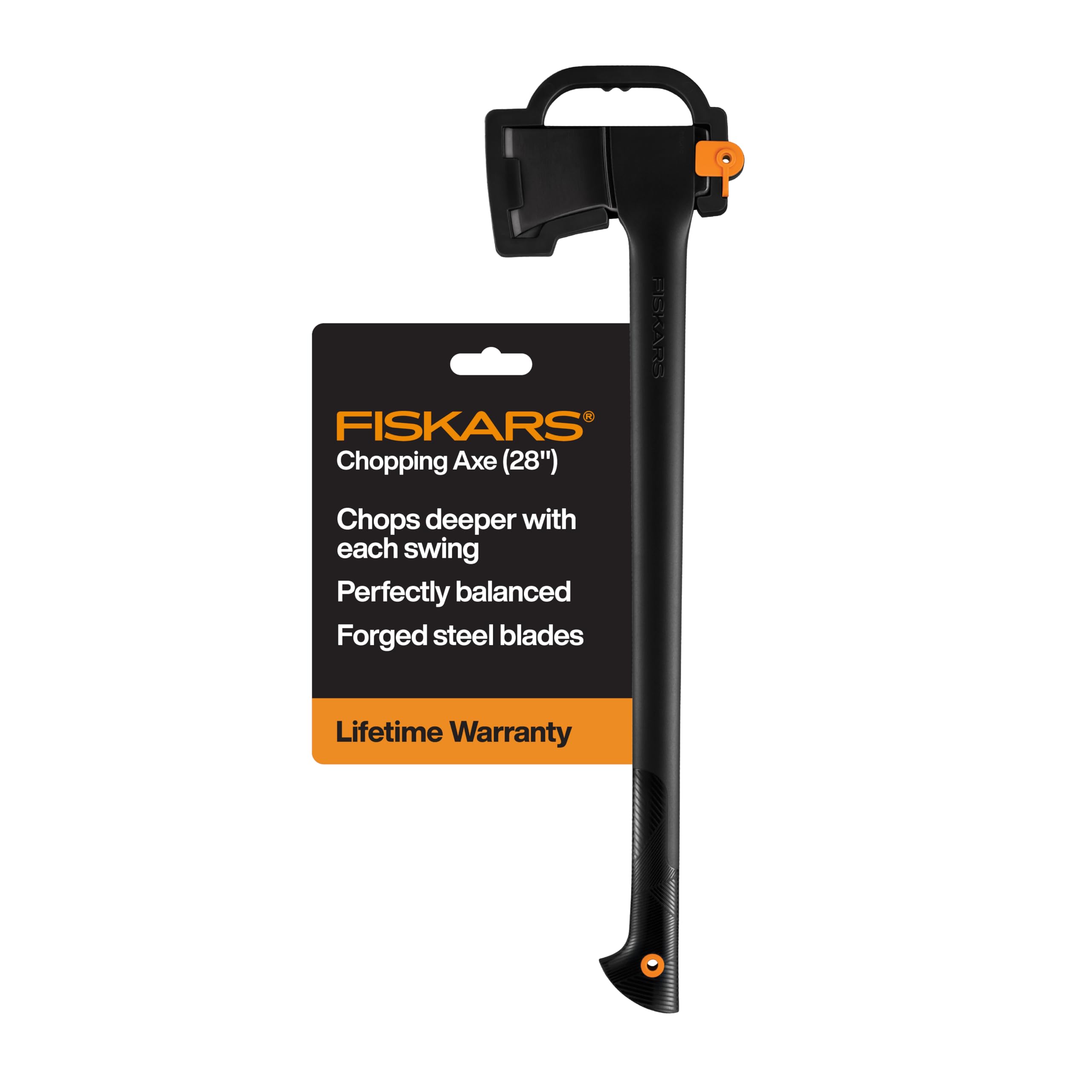
For most home users, this 3.5-pound, 28-inch axe is the “just right” size — heavy enough to drive through a 6-inch log in two swings, light enough to swing all afternoon without your shoulders screaming. The ultra-sharp blade is hardened with advanced sharpening technology (a proprietary heat treatment that produces a finer, longer-lasting edge than basic grinding), and the low-friction coating reduces drag so the head does not get stuck in green or sappy wood. The steel and wood handle is tucked inside the head, making the bond virtually unbreakable — customers note that even after hitting the handle repeatedly, it shows no damage.
One owner called it “the perfect size and weight (3.5 pounds) for general garden and outdoor tasks.” Compared to the 5.95-pound Fiskars 36″ above, this axe is far more maneuverable for mixed work: you can fell a small tree, split a few logs, and then carve kindling without switching tools. Where it falls short is on extra-large rounds — when the wood is over 12 inches thick, you will wish for the longer handle and heavier head of the 36-inch splitter.
Strong Points
- Low-friction coating prevents sticking in wet or sappy wood
- Light enough to carry in a pack for campsite prep
- Lifetime warranty adds confidence
Limits
- Not enough mass for splitting extra-large or knotty logs
- Handle shape may feel narrow for users with larger hands
Best for: homeowners who split kindling, fell small trees, and do general yard work without wanting a separate maul.
skip it if: you primarily split large rounds — step up to the 36-inch version for the weight and leverage.
4. 1844 Helko Werk Germany Classic Scout Axe

This hand-forged German axe has a polished finish that resists rust and slices through grain like a hot knife. The Scout is 28 inches long with a 2.5-pound head, putting it in the same size class as the Fiskars 28″ but with a traditional hickory handle and a higher-carbon steel head (C50 high carbon steel hardened to 53-56 HRC — the Rockwell hardness scale that tells you how well the edge resists rolling). It weighs 3.5 pounds total, matching the Fiskars 28″ exactly, so the weight comparison is neck-and-neck, but the Helko comes with a vegetable-tanned leather sheath and a small jar of Axe Guard protective oil. Reviewers point out the convex ground edge is razor sharp from the start and that the handle grain orientation — the direction the wood fibers run along the handle — is perfectly aligned for strength.
One buyer mentioned the anti-rust coating required WD-40 and sandpaper to clean off, but after that the steel held its edge well through a third of a cord of ash. At 28 inches it is too long for a daypack, and the polished finish needs maintenance if you leave it in a damp shed. This is a base-camp axe, not a backpacker — better for car camping or trips by canoe.
What You Pay For
- Drop-forged C50 high carbon steel holds a fine edge
- Linseed oil finished hickory handle feels smooth and comfortable
- Includes premium leather sheath and protective oil
What to Know
- Polished head requires routine oil to prevent rust
- Not for backpacking due to length
Perfect for: the camp cook or craftsman who wants a traditional wood-handled axe with premium steel that arrives sharp and stays sharp.
Not ideal if: you want a low-maintenance tool you can leave in the truck bed — the Fiskars composite handle and coated head require less care.
5. Husqvarna Wood Splitting Axe S2800

A 5-pound steel head on a fiberglass handle means this axe is built to make short work of the biggest firewood rounds. The fiberglass composite handle won’t warp, rot, or splinter like wood, and the total weight of 6.2 pounds gives you the momentum you need to split seasoned oak or maple in fewer strokes. With a 27.6-inch handle, it trades some swing speed for better control compared to the 36-inch Fiskars, which can feel unwieldy in tight spaces.
Shoppers say that the axe is well-balanced and splits straight-grained wood easily, though some wish the handle were six inches longer for added leverage — the 27.6-inch length sits short enough to be manageable but may force a taller user to bend slightly. One owner reported dropping a 40-inch oak branch on the handle with only a slight bend, suggesting the composite handle is genuinely tough. The wedge-shaped head is not designed for felling or limbing, and the weight (6.2 lbs) makes it tiring for lighter tasks.
Where It Dominates
- 5-pound head drives deep into large logs
- Fiberglass handle won’t warp or splinter
- Coated steel resists rust and slick surfaces
Where It Struggles
- Too heavy for limbing or precision work
- Handle length could be longer for tall users
Go for this if: you split large rounds of firewood regularly and want a tough, low-maintenance handle that won’t crack.
Pass if: you need a single axe for felling, limbing, and splitting — the Husqvarna is a splitter first, everything else second.
6. LEXIVON V18 Chopping Axe

This 18-inch chopper fits in a duffel bag and handles firewood prep at the campsite, with an edge that one owner reported “sharpens to paper-cutting in 30 min.” The forged Grade-A high carbon steel blade is heat-treated (a process that strengthens the steel structure) for a deeper cut, and the injected fiberglass handle has a TPR grip — a rubber-like coating that stays tacky even when your hands are damp. At 1.04 kilograms (about 2.3 pounds) the head is light enough for one-handed use on small logs, yet the 18-inch length gives you enough swing arc for two-handed power when you need it.
Buyers also report that the hollow composite handle keeps the weight down but can feel slightly unbalanced during extended use. The carrying sheath is functional though some call it flimsy. Compared to the Purple Dragon hatchet (1.1 kg vs. 1.04 kg — only a 6% weight gap), the LEXIVON is a touch lighter and has a longer handle, making it better for two-handed splitting of medium logs.
What Works
- Lightweight design ideal for hiking and camping
- Heat-treated blade takes and holds a good edge
- TPR grip stays secure in wet conditions
What to Watch
- Some arrive with a dull edge requiring initial sharpening
- Plastic carrying sheath can break early
Best for: campers who split kindling and small logs and want a lightweight hatchet that fits in a pack without weighing them down.
Not for: splitting large firewood rounds at home — the short handle and light head lack the momentum for big splits.
7. Purple Dragon Camping Hatchet 14.7 Inch
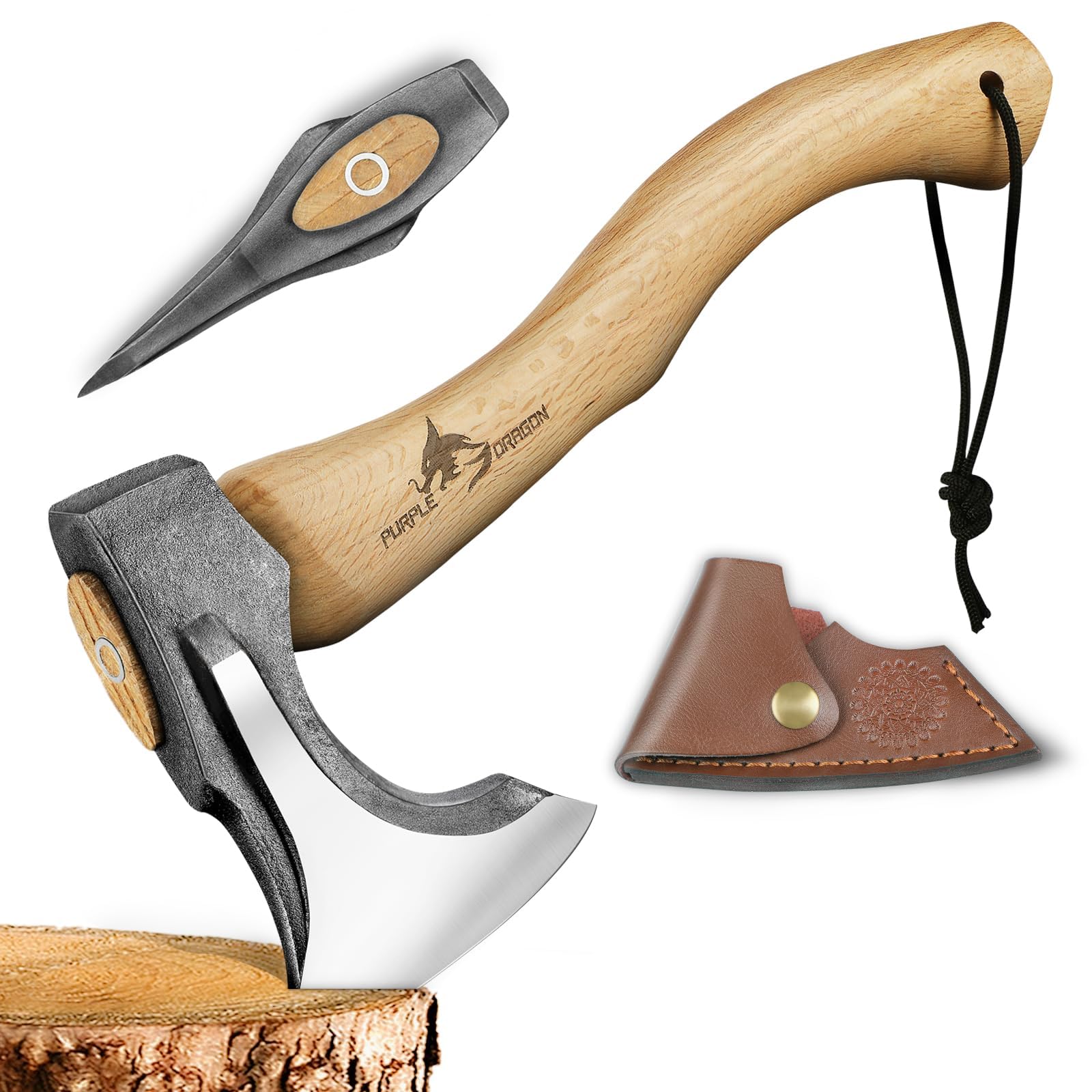
This compact bushcraft hatchet has a hand-forged head hardened to 56-60 HRC (harder than most budget axes, so the edge resists rolling on knotty wood) and a hickory handle that buyers report keeps it sharp through a weekend. The 14.7-inch S-curve hickory handle is designed to fit the natural curve of your palm, reducing hand fatigue when you are splitting kindling or carving feather sticks for a campfire. At 1.1 kilograms (about 2.4 pounds) it is nearly identical in weight to the LEXIVON V18 (1.04 kg — a roughly 6% difference), but the shorter handle means you swing more with your wrist than your shoulder.
Owners mention that the hatchet is “sharp out of box, holds edge through weekend,” which aligns with the higher HRC rating. The included leather sheath uses a snap closure to keep the blade secure inside a backpack, and rubber protective lips on the splitting face add a small safety buffer. The trade-off is that the 14.7-inch handle limits your swing speed and leverage — this is best for bushcraft carving and small splitting, not for breaking down 8-inch diameter logs. A few owners also note the handle gets slick when wet.
What Shines
- Hard steel (56-60 HRC) holds a sharp edge well
- S-curve hickory handle reduces hand strain
- Comes with a genuine leather sheath
What Disappoints
- Short handle limits leverage for larger splits
- Handle can become slippery when wet
Best for: bushcraft, carving, and splitting small kindling on a weekend camping trip where weight and packability matter.
Not for: home firewood duty — this is a hand-tool hatchet, not a splitting maul.
Understanding the Specs
HRC Hardness
Rockwell Hardness C scale measures how resistant steel is to denting. Axe heads in the 53–60 HRC range balance sharpness with durability: below 50 HRC the edge rolls too easily; above 60 HRC the steel becomes brittle and can chip on knotty wood. Hand-forged axes from Helko and Gransfors typically sit around 53–56 HRC, while high-carbon budget options like Purple Dragon reach 56–60 HRC for a harder, longer-lasting edge.
Drop Forging
Drop forging is a process where a blacksmith heats a steel billet and shapes it under a falling hammer, compressing the grain structure for denser, stronger steel. Cheaper axes use stamped or cast heads that can crack under repeated impact. Every axe in this guide, from the Purple Dragon to the Gransfors, uses a drop-forged head, which is the minimum standard for a tool that will see real splitting work.
Convex Grind
A convex bevel curves smoothly from the cheek of the axe head down to the cutting edge. This profile reduces friction so the blade does not get stuck in the log after a split — the edge slides out as easily as it went in. Flat or hollow grinds bite deep but often wedge tight, forcing you to wrestle the head free. The convex grind is standard on quality felling and splitting axes and is one reason Gransfors and Helko axes feel smoother in use.
FiberComp vs. Hickory
Fiskars uses FiberComp, a proprietary injection-molded fiberglass composite that is virtually unbreakable, won’t rot, and absorbs shock through its hollow core. Hickory wood handles, used by Gransfors, Helko, and Purple Dragon, naturally dampen vibration and feel warmer in the hand but require oiling and can crack if left exposed to rain. For a tool that lives in a dry shed, hickory is fine. For one that rides in a truck bed or kayak, composite is the safer bet.
FAQ
What is the best handle length for splitting firewood?
How often do I need to sharpen a chopping axe?
Can I use a splitting axe for felling trees?
What does HRC mean on an axe blade?
How do I prevent the axe handle from breaking?
What is the difference between a splitting axe and a maul?
Is a heavier axe always better for splitting?
Can I leave my axe outside in the rain?
What size axe do I need for camping?
How do I know if the blade convex is right for me?
Final Thoughts: The Verdict
For most buyers, the axe for chopping wood winner is the Fiskars 36″ Super Splitting Axe because it pairs a 5.95-pound head with a shock-absorbing composite handle that handles large logs in fewer swings. If you want a versatile tool for general yard and garden work, grab the Fiskars 28″ Chopping Axe — lighter at 3.5 pounds and coated to resist sticking. And for backcountry trips where weight and pack size matter most, the standout is the Gransfors Bruks Small Forest Axe at 2.2 pounds with a 19-inch handle and heirloom-quality Swedish steel.
How We Picked
We do not accept paid placement. Every pick is matched to a real buyer and a real use-case; we do not hands-on test units.
Sources & Methodology
Specifications: manufacturer listings and product documentation. Review insights: verified customer reviews, as of July 2026. Pricing: not shown on this page (it changes often); check the current price via the retailer link.
As an Amazon Associate, Lawn Gear Lab earns from qualifying purchases. This does not affect which products we feature.