
Specs are compiled from manufacturer listings and verified buyer reviews and can change over time — please confirm the key details on the product page before buying.
You do not need a degree in soil chemistry to figure out what your lawn or garden needs to grow well. The right do it yourself soil test kit shows you exactly which nutrients are low and which are plentiful, so you stop buying fertilizer you do not need and start feeding the plants that matter. The hard part is choosing between a fast at-home capsule test and a detailed mail-in lab analysis. The overall winner is the Soil Savvy, a mail-in lab test that scans pH plus 14 nutrients and sends back a custom fertilizer plan — giving you the broadest, most actionable data without requiring you to decipher chemical charts.
I’m Rikta — the founder and writer behind Lawn Gear Lab. This guide is built by comparing the manufacturers’ published specifications and the patterns across verified customer reviews, so you get each pick’s real strengths and trade-offs instead of marketing spin.
After sorting through capsules, strips, and lab-mailers, these seven picks cover every do-it-yourself soil test kit that delivers clear, usable data for your yard without confusing chemistry instructions.
Quick Picks
- Soil Savvy Soil Test Kit — Best Overall
- MySoil Test Kit PRO Pack — Precision Pack
- SoilKit Professional Soil Test Kit — Dashboard Depth
- NewTest 4 Parameter Soil Test Kit — DIY Full Panel
- Dewilde Trading Co 140-Test Soil Test Kit — High-Volume Tester
- Jonathan Green Soil pH Test Kit for Lawns — Quick pH Snapshot
- Pawfly 4 in 1 Soil Test Kit — Budget 4-in-1
How To Choose The Best Do It Yourself Soil Test Kits
Soil testing is not a one-size-fits-all task. A capsule kit that gives you a rough pH reading in ten minutes is a completely different tool than a mail-in lab test that scans for fourteen nutrients and provides a custom fertilizer plan. Here are the three decisions you need to make before you buy.
At-Home vs Mail-In Lab: Speed vs Depth
An at-home kit — whether it uses capsules, powders, or test strips — gives you a result in minutes. You mix a small soil sample with water and a reagent (a chemical that changes color), wait for the color to develop, and compare it to a printed chart. The trade-off is you only get a rough reading for pH and maybe a few major nutrients like nitrogen, phosphorus, and potassium. For a full picture that includes micronutrients like iron, zinc, and magnesium, you need a mail-in lab test. You send a dry soil sample in a prepaid envelope and get a PDF report back in about a week. The trade-off is cost and patience — you pay more and you wait longer.
What a Test Actually Measures: pH Alone vs Full NPK
A pH-only kit is the cheapest entry point, but it tells you nothing about nitrogen, phosphorus, or potassium — the three numbers on every bag of fertilizer you see at the store. If your grass is pale or your tomatoes are small, the problem is often a nutrient shortage, not just acidity. A 4-in-1 kit that tests pH plus nitrogen, phosphorus, and potassium gives you a much better starting point. A mail-in lab adds secondary nutrients like calcium, magnesium, and sulfur, plus trace elements that matter for specific plants like blueberries or roses.
Number of Tests: Do Not Overbuy
More tests sound like a better deal, but soil chemistry does not change that fast. Unless you are managing a large farm or multiple garden plots with very different soil types, a single mail-in test per year is usually enough. At-home kits with ten to forty test uses are really meant for spot-checking different areas of your yard or testing once per growing season. Buying a kit with over one hundred test capsules is often overkill for a typical suburban lawn.
Quick Comparison
| Model | Best For | Test Method | Parameters Tested | Number of Tests | Amazon |
|---|---|---|---|---|---|
| Soil Savvy | Lab-grade analysis at home | Mail-in lab | pH + 14 nutrients | 1 | Amazon |
| MySoil PRO Pack | Precision with a soil probe | Mail-in lab | 13 nutrients + pH | 2 | Amazon |
| SoilKit | Detailed lab report with online dashboard | Mail-in lab (Mehlich III) | pH + 13 macro/micronutrients | 1 | Amazon |
| NewTest 4 Parameter | DIY full NPK at home | At-home capsule/strip | pH, N, P, K | 40 | Amazon |
| Dewilde Trading Co 140-Test | Frequent at-home monitoring | At-home liquid | pH, N, P, K, Ammonia | 140 | Amazon |
| Jonathan Green pH Kit | Simple pH check for lawns | At-home capsule | pH only | 10 | Amazon |
| Pawfly 4-in-1 | Budget 4-parameter testing | At-home strip/tablet | pH, N, P, K | 40 | Amazon |
In‑Depth Reviews
1. Soil Savvy Soil Test Kit
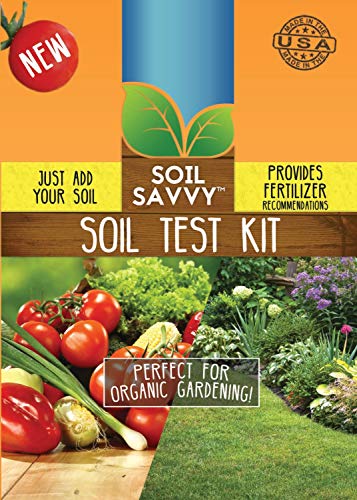
The mail-in lab test that removes all guessing from your fertilizer routine.
This is the kit for anyone tired of squinting at color charts and hoping the shade of green matches the pH scale. Soil Savvy turns soil testing into a simple mail-in process: you scoop a one-ounce (28-gram) sample using the included cup, seal it in the pre-paid envelope, and send it off. Within about a week, you get back an easy-to-read PDF report that covers soil pH plus fourteen nutrients including nitrogen, phosphorus, and potassium — the same testing technology used by agricultural producers and turf managers. The report does not just dump raw numbers; it provides a custom fertilizer recommendation in N-P-K format (the three numbers on a fertilizer bag) at a specific pounds-per-thousand-square-feet rate. Buyers report this is one of the biggest time-savers because you can walk into any garden center and match your results directly to a bag of fertilizer.
The trade-off compared to a 40-test at-home kit like the Pawfly is that you only get one test per purchase. You cannot spot-check different areas of your yard in a single afternoon. Owners mention that the analysis is more comprehensive than what most county extension offices offer, covering more than just nitrogen, phosphorus, potassium, and pH. One reviewer noted the kit “saved my blueberries which were badly in need of iron.”
This is the right pick if you want a single definitive answer for your lawn or garden and you are willing to wait a few days for lab-grade data instead of a quick guess.
Why It Leads the List
- Covers pH and 14 nutrients — far more than any at-home capsule kit
- Report includes a tailored fertilizer recommendation in N-P-K format with application rate
- Customers note it is very easy to use and results arrive within a week
One Limitation to Know
- Single-use only — cannot test multiple spots in your yard without buying multiple kits
- Costs more per test than a budget-friendly at-home strip kit
Who It’s For: Homeowners who want a professional-grade soil report without having to find or pay their county extension office — this is the closest you can get to a lab analysis from your mailbox.
The Honest Caveat: You are limited to one sample, so if your front yard soil differs from your backyard soil, you will need to buy a second kit to test both areas separately.
2. MySoil Test Kit PRO Pack

Two mail-in lab tests plus an eight-inch soil probe for sampling without digging by hand.
MySoil takes the mail-in lab concept and adds a practical hardware upgrade: an 8-inch (20-centimeter) soil probe that makes pulling a clean core sample far easier than using a trowel or your fingers. The PRO Pack includes two single-use test kits, so you can test your front lawn and your backyard garden separately and get a custom recommendation for each area. The lab measures 13 plant-available nutrient levels plus pH, and the results arrive in 6 to 8 days from the time you mail your sample. Instead of a dense spreadsheet, you get a clear report with both organic and non-organic fertilizer recommendations that tell you exactly what to apply, how much, and when.
Reviewers point out that the instructions are clear — one buyer mentioned the “small probe easily bypasses pebbles” — and that the turnaround is fast, with one sample received in under four days and results returned the next day. The kit works for any soil type including lawn and turf, vegetable gardens, flowers, trees, and even soil-less media like hydroponics (growing plants in water instead of soil).
Where it falls slightly short of the Soil Savvy is on micronutrient breadth: MySoil tests 13 nutrients plus pH, while Soil Savvy covers 14 nutrients plus pH. For most lawns and gardens, 13 is plenty, but if you are chasing a specific trace-element deficiency like iron for acid-loving plants, the extra coverage on the Soil Savvy may matter.
What You Get
- Two separate lab tests in one box — ideal for testing different areas
- 8-inch soil probe included for cleaner, faster sampling
- Results include both organic and synthetic fertilizer recommendations
Consider This
- Tests 13 nutrients vs Soil Savvy’s 14 — a minor gap for most gardeners
- One owner reported a lack of targeted recommendations for specific trace element deficiencies found
Best For: A homeowner managing two different growing zones — such as a sunny front lawn and a shaded side-garden — who wants a separate, accurate fertilizer plan for each.
The Catch: If you only have one patch of soil, the second test in the box may go unused, and the soil probe adds to the upfront cost compared to the single-test Soil Savvy.
3. SoilKit Professional Soil Test Kit

Uses the Mehlich III extraction method and gives you a personal online dashboard to track your results.
SoilKit leans hard into the digital side of soil analysis. It uses the Mehlich III method — a widely accepted lab extraction technique that uses a specific chemical solution to pull multiple nutrients out of your soil sample at once. The test covers pH, buffer pH (a measure of how resistant your soil is to pH change), organic matter, Cation Exchange Capacity (CEC — a measure of your soil’s ability to hold onto nutrients), Estimate Nitrogen Release, and key nutrients including phosphorus, potassium, magnesium, calcium, boron, zinc, manganese, and iron. That is a full panel of 13 macro and micronutrients. Instead of a simple PDF, you get access to a virtual dashboard called SoilKit365 where your results live. If you want to go deeper, you can upgrade to SK365+ for weed, disease, and pest suggestions or ask a soil expert a specific question.
Shoppers say the process is straightforward. One verified reviewer found it “easy to send,” though they noted that the results layout on the dashboard could be clearer — the printed format was described as “not very professional and easy to read.” Another reviewer appreciated the customer service, mentioning that when their first sample was lost, the company sent a replacement kit free of charge and the results came back the second time.
The kit is not intended for potting soil — only for native garden soil — so skip it if you are testing a container mix. And at just 0.2 ounces (5.7 grams) for the entire package, this is the lightest mail-in option on the list, which makes it convenient to send but does not change what is inside.
Strengths
- Broad panel using the professional-grade Mehlich III extraction method
- Online dashboard keeps your results organized and accessible
- Company replaced a lost kit free of charge — good customer support
Weaknesses
- Results dashboard layout is not as polished or intuitive as some competing reports
- Does not work for potting soil — garden soil only
Pick This If: You want a digital record of your soil’s fertility over multiple seasons and you like having your results accessible from a phone or computer rather than a printed page.
pass on it if: You prefer a clean, single-page PDF report you can print and file — the dashboard’s presentation was a common complaint among reviewers.
4. NewTest 4 Parameter Soil Test Kit

A detailed at-home kit that tests pH, nitrogen, phosphorus, and potassium ten times each.
NewTest tackles a common complaint about cheap at-home kits — vague instructions that assume you already know soil chemistry. The kit includes a quick guide plus a detailed step-by-step manual designed so even a beginner can follow along. You get 40 total tests: ten each for pH, nitrogen, phosphorus, and potassium. The results are read by comparing the tested liquid or test strip against a colorimetric card (a printed chart with colored dots), which translates to a level range for each nutrient. NewTest claims their specific reading methods for each element give you more accuracy than a generic all-purpose color chart.
This kit sits in a middle ground between the simplicity of a capsule kit and the depth of a mail-in lab. It gives you NPK numbers you can act on, which matters because the ratio of nitrogen to phosphorus to potassium is what drives fertilizer selection for lawns, vegetables, and flowers. Unlike the cheaper Pawfly 4-in-1, this kit is built around 40 tests rather than 40 tests worth of strips and tablets, and it is designed for all soil types including lawn turf, vegetable gardens, compost, and even hydroponics.
The main drawback is that you are still reading color charts yourself, which means lighting conditions and your own color perception can influence the result. It is not the same as a lab report with precise numeric values. But for a DIY option that covers the big four parameters without sending anything in the mail, this is the most thoughtfully designed option on the shelf.
What Stands Out
- 40 tests split evenly across four critical parameters — pH, N, P, and K
- Instructions are written for beginners, with both a quick guide and full manual
- Works on any soil type including hydroponic growing media
The Limitation
- Colorimetric reading still relies on your color perception — not as precise as a lab test
- No customer reviews available yet to confirm real-world ease of use
Who It Works For: A gardener who wants to test soil multiple times across a season without paying for a lab each time — the 40-test count gives you ten runs of each parameter.
What To Keep In Mind: If you are colorblind or your eyes struggle to distinguish subtle shades on a chart, a mail-in lab test may be a better choice for reliable results.
5. Dewilde Trading Co 140-Test Soil Test Kit
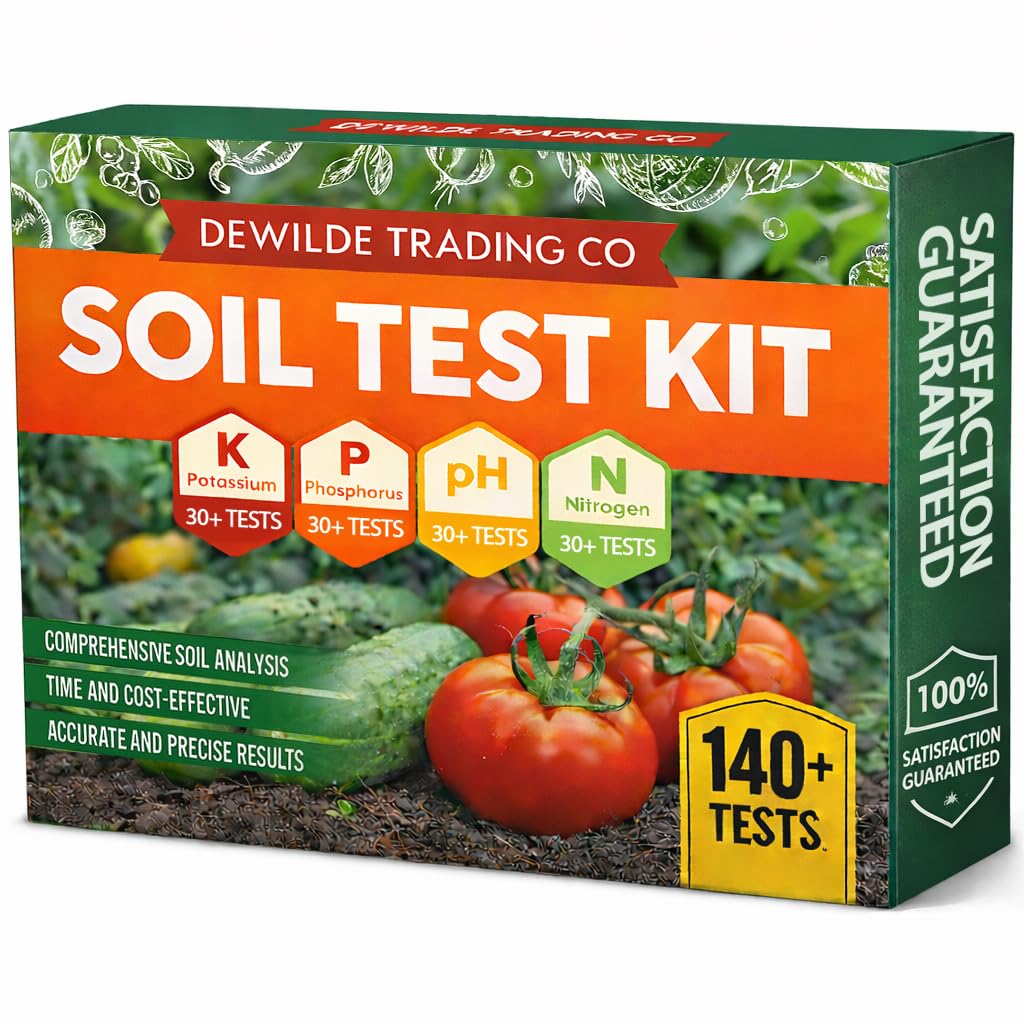
A huge 140-test kit that adds ammonia analysis to the standard pH-and-NPK lineup.
This kit from Dewilde Trading Co gives you the most test capacity of any option on this list — 140 tests spread across pH, ammonia, nitrogen, phosphorus, and potassium. The breakdown is roughly 40 tests per parameter with a few extra allocated to nitrogen. The test method uses liquid reagents (chemical solutions): you add a small amount of soil to a test tube, add water and a few drops of the reagent, shake it, and compare the color of the settled liquid against a chart. Because it measures ammonia alongside the usual four parameters, you get an early indicator of how much nitrogen is available in a form your plants can actually use.
At 3.52 ounces (100 grams) and measuring 3 x 1 x 4 inches (7.6 x 2.5 x 10.2 centimeters), this kit is about half the weight of the Pawfly 4-in-1 (which weighs 6.7 ounces or 190 grams) but it takes up significantly more space in your garage or shed. The bulk is due to the liquid bottles and multiple test tubes. It is not a test you want to carry around the yard — you will want a table and a clean workspace.
The big risk with any liquid-reagent kit is consistency. If you do not follow the instructions exactly — using distilled water, measuring the soil precisely, shaking for the right duration — the color match can be ambiguous. There are no customer reviews available yet for this specific product, so real-world feedback on ease of use is still unknown. Buy it for the test count, but understand that more tests does not mean easier results.
Why The High Count Matters
- 140 total tests — the highest capacity on the list by a wide margin
- Includes ammonia analysis, giving you a nitrogen availability snapshot
- Cost-effective if you plan to test multiple locations or test repeatedly through the season
Where It Gets Tricky
- Liquid reagent method is more sensitive to user error than capsule-based kits
- No customer reviews yet to verify the accuracy or ease of use in practice
Best For: A serious gardener or small-scale grower who manages several distinct beds and wants to monitor soil fertility weekly or monthly without running to the store for a new kit each time.
The Trade-Off: The liquid test process takes more precision and patience than a capsule test — if you want a quick answer, the 10-minute capsule kit from Jonathan Green is much simpler.
6. Jonathan Green Soil pH Test Kit for Lawns

A simple ten-minute capsule test that checks whether your soil pH is in the 6.2-to-7.0 balance for lawns.
Jonathan Green is a well-known name in the grass seed industry and this kit is strictly for one job: measuring soil pH. You get ten capsules, each in its own test tube. You add dry soil, drop in a capsule, add distilled water, shake it, and wait ten minutes. The color of the water tells you where your pH falls. The kit also includes a pH preference list for over 450 plants and instructions for how to adjust soil pH if you are outside the target range. This is a narrow-purpose tool — it does not test nitrogen, phosphorus, potassium, or any other nutrient.
Buyers report mixed experiences that highlight the inherent limitation of capsule color-matching. One reviewer who followed the instructions exactly — drying soil in the sun, using distilled water, not touching the sample with bare hands — ended up with a brown color that did not match any shade on the chart. They described it: “Color was brown…….not any color on the chart.” Another reviewer called it “ball park accuracy,” noting that more precise kits exist but cost more. A third reviewer got consistently useful results, calling it a “good little ph tester” that works.
Compared to the Soil Savvy or MySoil mail-in kits, the Jonathan Green kit is far cheaper and gives you a result in minutes, but it only answers one question and it answers it with approximate color matching. If your lawn is struggling and you need a broader diagnosis, you should jump straight to a mail-in lab test.
What It Does Well
- Ten tests for a low upfront cost — good for spot-checking a few spots
- Results in ten minutes without mailing anything
- Includes a plant preference list for 450+ species
Where It Falls Short
- pH only — tells you nothing about nitrogen, phosphorus, or potassium
- Several buyers reported the color match was too ambiguous to read
Reach For This If: You already know your soil’s nutrient situation and you just need a quick pH check before planting a specific crop or applying lime.
Look Elsewhere If: Your grass or plants have yellowing, stunting, or poor growth — the root cause is likely a nutrient deficiency that this kit cannot detect.
7. Pawfly 4 in 1 Soil Test Kit
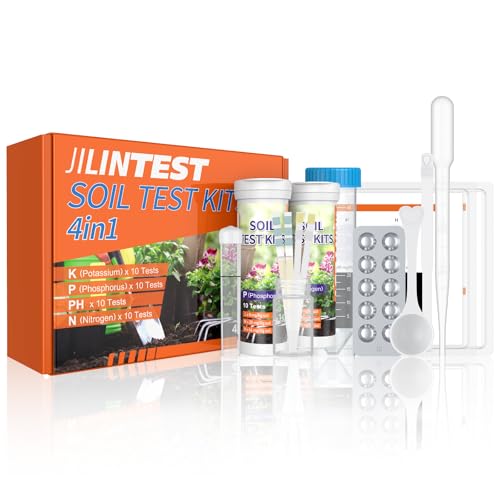
An entry-level four-parameter kit at a budget-friendly cost — but buyer results are inconsistent.
The Pawfly 4-in-1 covers pH, nitrogen, phosphorus, and potassium with 20 test strips and 40 tablets, giving you ten tests per parameter. It states precise test ranges: pH from 3.5 to 9, nitrogen from 40 to 320 mg per kg of soil, phosphorus from 8 to 64 mg per kg, and potassium from 40 to 160 mg per kg. The kit comes with two centrifuge tubes, a test tube, a glass vial, a dropper, a grinding rod, and a sample spoon — more physical accessories than the Jonathan Green kit, but less total test capacity than the Dewilde Trading Co 140-test kit.
At 6.7 ounces (190 grams) and measuring 2 x 2 x 0.5 inches (5.1 x 5.1 x 1.3 centimeters), this is the heaviest at-home test kit on the list (more than double the 3.52-ounce weight of the Dewilde kit), though still small enough to store in a drawer. The packaging is compact, but the instructions drew sharp criticism from buyers. One reviewer who has written consumer instructions for a living gave it a harsh assessment: “I got unusable results. The instructions were lacking, some things were assumed to be known.” Another reviewer, who did manage to get it working, called it “good for money” and confirmed it functions as advertised. A third reviewer found it “very complicated to understand” and noted it requires real soil and pH knowledge to use.
The Pawfly costs the same as the Dewilde 140-test kit but offers only 40 tests — a 3.5x gap in test count. For a similar upfront cost, the Dewilde kit provides far more testing capacity if you are willing to work with liquid reagents. The Pawfly is best seen as a cheap introduction to the world of DIY soil testing, not as your long-term solution.
What The Price Buys You
- Tests all four key parameters for a low entry cost
- Comes with all necessary accessories — tubes, dropper, grinding rod, spoon
- Compact dimensions (2 x 2 x 0.5 inches) for easy storage
The Real Cost
- Unusable results reported by multiple buyers due to vague instructions
- Only 40 tests total versus 140 from the similarly-priced Dewilde kit
- Several reviewers found the process too complicated for a homeowner
Who May Still Want This: A curious beginner who wants to dip a toe into soil testing at the lowest possible price and is willing to wrestle with unclear instructions.
Who Should Skip It: Anyone who needs reliable, actionable results the first time — the mixed buyer reviews suggest you may end up with muddy water instead of a clear answer.
Understanding the Specs
Colorimetric vs Lab Analysis
Colorimetric testing is what every at-home kit uses. You mix soil with a reagent (a chemical that changes color), a chemical reaction produces a color, and you compare that color to a printed chart. It is fast and cheap, but the accuracy depends on your eyesight, the lighting, and how precisely you followed the steps. Lab analysis, done through a mail-in kit, uses instruments like spectrophotometers (devices that measure light absorption to calculate exact nutrient levels). The result is a number, not a shade. For a one-time baseline test, the lab route gives you certainty that no color chart can match.
pH, N, P, K and Beyond
A basic soil test measures pH (acidity or alkalinity), nitrogen (leaf growth), phosphorus (root and flower development), and potassium (overall plant health and disease resistance). If a kit claims to test “4 parameters,” these are the four — sometimes with ammonia replacing one. A mail-in lab test expands to secondary nutrients like calcium and magnesium, plus trace elements like iron, zinc, and boron, which matter for specific plants like blueberries or roses. If you grow a variety of plants, the broader panel is more useful.
FAQ
Should I use tap water or distilled water with an at-home soil test kit?
How often should I test my soil with a do-it-yourself soil test kit?
Can I use a mail-in soil test kit for potting soil?
What is the difference between testing for nitrogen and testing for ammonia?
How do I know whether my at-home color chart reading is accurate?
Is a pH-only test kit worth buying if it costs less than a 4-in-1 kit?
How long does a mail-in soil test kit typically take to return results?
What is the Mehlich III method and does it matter for my soil test?
Can I test frozen or wet soil with a do-it-yourself soil test kit?
Why do some customers note they got unusable results from their soil test kit?
Final Thoughts: The Verdict
For most people, the do it yourself soil test kits winner is the Soil Savvy because it gives you the broadest lab-grade nutrient panel — pH plus 14 nutrients — in a simple mail-in format with a fertilizer recommendation you can actually use. If you need two separate tests and a soil probe included, grab the MySoil PRO Pack. And for budget-conscious gardeners who want to test frequently without mailing samples, the Dewilde Trading Co 140-Test Kit offers the most testing capacity per dollar, though you will need patience to master the liquid reagent process.
How We Picked
We do not accept paid placement. Every pick is matched to a real buyer and a real use-case; we do not hands-on test units.
Sources & Methodology
Specifications: manufacturer listings and product documentation. Review insights: verified customer reviews, as of July 2026. Pricing: not shown on this page (it changes often); check the current price via the retailer link.
As an Amazon Associate, Lawn Gear Lab earns from qualifying purchases. This does not affect which products we feature.