
Specs are compiled from manufacturer listings and verified buyer reviews and can change over time — please confirm the key details on the product page before buying.
You pick up a brick that looks like dried sawdust. Within an hour of adding water, it turns into a fluffy pile of soil that could fill half your raised bed. That is the magic of compressed coconut coir — but not every brand delivers the same expansion or purity. That difference matters when your seedlings or garden soil needs the right balance of moisture, oxygen, and nutrients. This guide walks you through the materials, the real expansion numbers, and the trade-offs between budget packs and premium options.
I’m Rikta — the founder and writer behind Lawn Gear Lab. This guide is built by comparing the manufacturers’ published specifications and the patterns across verified customer reviews, so you get each pick’s real strengths and trade-offs instead of marketing spin.
To find the right coconut coir for gardening, you need to know how much you actually get per brick, how clean the bricks are, and whether the water retention fits your plants’ needs. The MODELLOR 4-Pack wins because it delivers 9 gallons of expanded medium from a 5-pound pack, with triple-washed purity, at a lower cost per gallon than alternatives.
Quick Picks
- MODELLOR Coco Coir Bricks, 4-Pack (5 lb) — Best Overall
- MagJo Naturals 100% Pure Coco Coir 11 Pound — Biggest Block
- Plantonix Coco Coir 650gm Bricks — Pre-Screened
- Avalution Premium Organic Coconut Coir Bricks — Value 6-Pack
- GROW!T JSCPB – Coco Coir Mix Brick (Pack of 3) — Fine Texture
- Avalution 3-Pack Coco Coir Bricks — Budget Starter
- VIVOSUN Coco Coir Brick 1.4lbs 3-Pack — Compact Brick
How To Choose The Best Coconut Coir For Gardening
Coconut coir is a soil amendment made from the husk fibers of a coconut. You buy it as a dry, compressed brick, add water, and it expands into a fluffy medium that holds air and water better than peat moss in many gardens. But not all coir bricks are equal — the expansion volume, the salt content, and the fineness of the fiber all change how it behaves in your pots or beds.
Expansion volume vs. weight
The weight of the brick is not the story — the volume after expansion is. Two bricks weighing the same can expand very differently. A 1.4-pound brick might yield only 1 gallon, while a premium super-washed brick of similar weight could yield 9 gallons. Always check the stated expanded volume in gallons or quarts, not just the weight, so you know how many bricks you really need for that 50-quart potting mix batch.
Washing and EC (electrical conductivity)
Coconut husks naturally contain salts from the ocean in which the palms grow. If the coir is not washed thoroughly before being compressed, those salts linger in the brick and can raise the EC (electrical conductivity — a measure of soluble salts in the growing medium). High EC can scorch roots, especially for seedlings and delicate herbs. Look for “low EC” and “pre-washed” or “super washed” on the label — this means the manufacturer rinsed the fibers so your plants are not stressed.
Fiber texture and blend
Some bricks contain mostly fine coco peat (the soft, sponge-like part of the husk), which holds a lot of water. Others contain more coarse fibers and chips, which create air pockets that improve drainage and aeration. If you are starting seeds or mixing for moisture-loving houseplants, finer coir works well. For raised beds or container vegetables that need excellent drainage, look for a mix that includes visible fibers and chips — the texture makes the difference between soggy roots and a healthy root ball.
Quick Comparison
| Model | Best For | Expanded Volume | Item Weight | Unit Count | Amazon |
|---|---|---|---|---|---|
| MODELLOR 4-Pack | Best Overall Value | 9 Gallons | 5 Pounds | 4 Count | Amazon |
| MagJo Naturals 11 lb Block | Premium Single Block | 17 Gallons | 11 Pounds | 1 Count | Amazon |
| Plantonix Coco Bliss 6-Pack | Pre-Screened Purity | 12.5 Gallons | 8.4 Pounds | 6 Count | Amazon |
| Avalution 6-Pack | Budget Bulk 6-Pack | 2.3 Gallons | 1.4 Pounds | 6 Count | Amazon |
| GROW!T 3-Pack | Fine Coir for Aroids | 2 Gallons | — | 1 Count | Amazon |
| Avalution 3-Pack | Budget Starter Pack | 2.3 Gallons | 1.4 Pounds | 67.2 Ounce | Amazon |
| VIVOSUN 3-Pack | Compact Starter Pack | 1 Gallons | 1.4 Pounds | 3 Count | Amazon |
In‑Depth Reviews
1. MODELLOR Coco Coir Bricks, 4-Pack (5 lb)
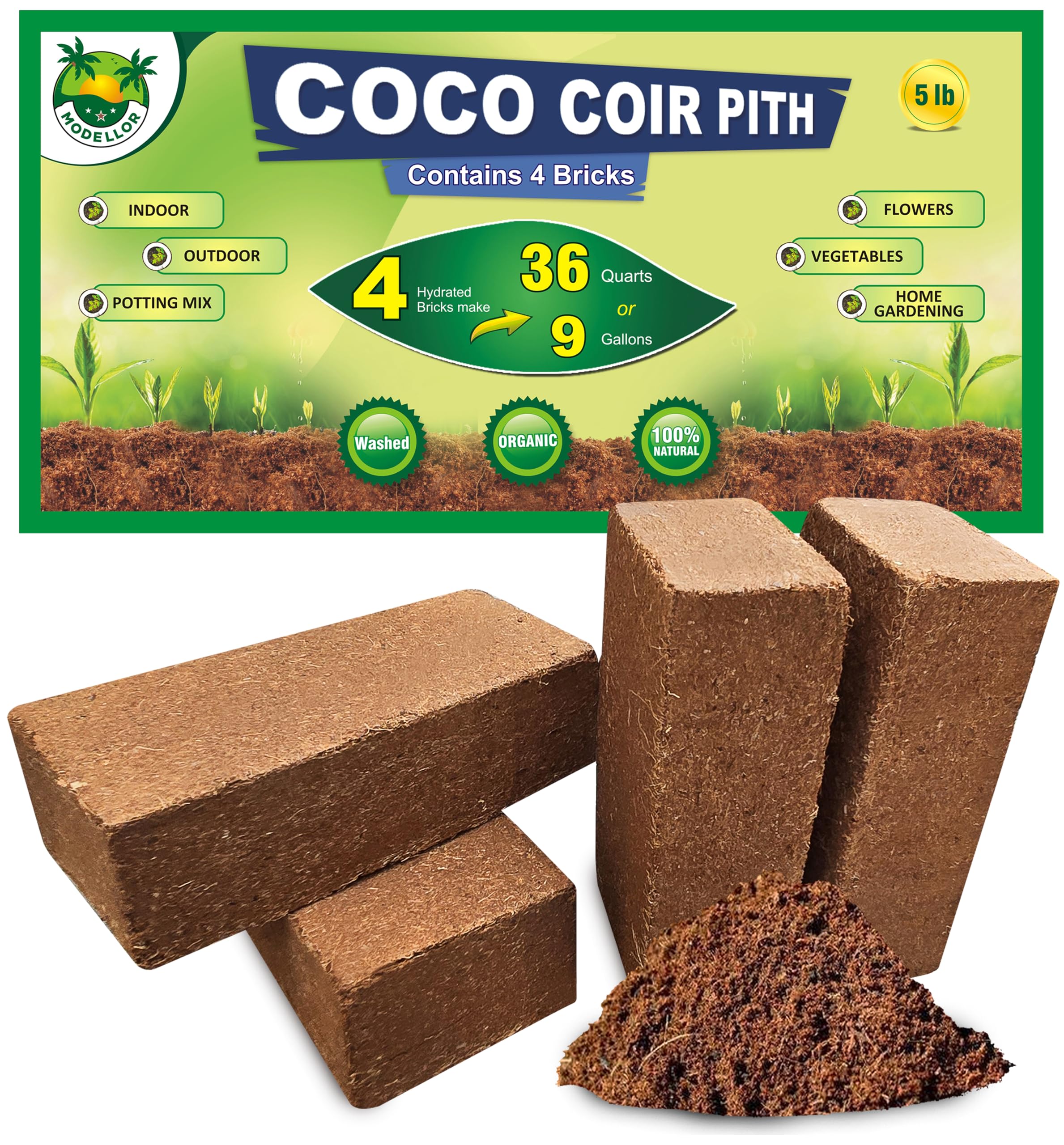
The 5-pound pack that gives you 9 gallons of fluffy growing medium, no guessing.
The MODELLOR 4-pack leads the list because it solves the central problem with coir: not enough volume for the money. Each brick in this pack is triple-washed (super washed in the maker’s words) to reduce salts, so the low EC and pH-balanced medium is ready for seedlings, containers, and even hydroponics without extra rinsing. Buyers report that “one brick expands to nearly 5 gallons,” which lines up with the stated 9-gallon total — a 3.6x weight-to-volume advantage over the 1.4-pound bricks that yield only 1 gallon each.
That expansion matters when you are filling a raised bed or mixing a batch of potting soil. The 5-pound total weight is 3.6x heavier than the 1.4-pound packs, but you get 9.0x the volume (9 gallons vs 1 gallon), making this the most efficient buy for anyone who uses coir regularly. The airy texture keeps roots oxygenated while holding moisture without sogginess, and one reviewer noted it hydrates fast and stays clean with no weird smells.
If you have pushed a small brick and felt short on material, this is the fix: four bricks that deliver the volume you actually need for seed starting, container gardens, or mixing into soil for beds. The only real trade-off is storage — the 5-pound total weight is heavier, but the bricks are compact until you hydrate them.
Volume champion: triple-washed, pH-balanced, and delivers a practical 9-gallon yield that outpaces every other brick in this list by a wide margin — easily the best value per gallon of expanded medium.
One caveat: the 4-pack costs more upfront than single-brick options, but if you use more than a few gallons of coir, the per-gallon cost here is lower.
Ideal owner: anyone who gardens regularly and wants a clean, pre-washed coir that expands enough for seed starting, raised-bed mixes, and potting soil without buying multiple packs. The efficiency per gallon is tough to top.
Less ideal if: you only need a small batch for a few houseplants — a single brick pack would waste less material.
2. MagJo Naturals 100% Pure Coco Coir 11 Pound Block

An 11-pound single block that expands to 17 gallons — the heavy lifter for big projects.
When you are filling a large raised bed or mixing soil for a season’s worth of container vegetables, the MagJo block feels like the grown-up option. This single 5kg (11-pound) compressed block expands to a claimed 17 gallons of coco peat, and reviewers confirm that the 11 lb block expands to fill a 5-gallon container easily. It is sourced from OMRI-registered manufacturers (that means the Organic Materials Review Institute has verified it is suitable for organic gardening) and the manufacturer specifies that the coir is washed to remove salt.
The real selling point here is the massive one-block format — no opening four or six individual bricks. One reviewer hydrated the entire block in a 20-gallon bin noted the low salt content (200 ppm from 40 ppm water) and slightly acidic pH, which works well for most soil blends. A buyer who uses it for turtle bedding also gave it a perfect rating, highlighting its versatility. The weight is 11 pounds, and compared to the MODELLOR 5-pound pack, this is more than double the weight for about 1.9x the volume — the trade-off is that you are committed to a very large amount at once.
For big projects this is efficient, but the block is dense enough that you should not try to break it into pieces — reviewers warn to just soak the whole thing. That means you need a large container for hydration, and you will have a lot of coir ready at once.
Best for heavy-duty use: one block replaces multiple smaller packs, with OMRI-listed organic certification and thorough salt washing that makes it suitable for sensitive plants.
Storage note: once hydrated, you cannot easily dry it back to brick form, so plan for the full 17 gallons.
Perfect for: gardeners with large raised beds, landscaping projects, or anyone who wants a single purchase that goes far. The 17-gallon yield is the highest raw volume of any single product here.
Not for: small-space gardeners or those who just need a few quarts for houseplant repotting — you would waste a lot of material.
3. Plantonix Coco Coir 650gm Bricks (6-Pack) – Coco Bliss

Six pre-screened bricks that yield 12.5 gallons of coir so clean you can use it for seed starting.
The Plantonix Coco Bliss pack appeals to gardeners who have opened a coir brick and found bits of fiber, sand, or even small rocks mixed in. The maker claims each 650gm brick has been screened multiple times through an extremely small filter to remove those impurities — and the 8.4-pound total weight suggests you are getting more usable medium per brick than the 1.4-pound budget bricks. The rated volume is 12.5 gallons across the 6-pack, and owners mention it yields more usable coir than other 1.4 lb blocks, filling more seedling trays.
The fine texture and high moisture retention make this a strong pick for seed starting mixes and houseplant soil. One buyer uses it for chicken dust baths and noted it is fluffy and fine enough to sift with a slotted litter scoop, plus it is non-reactive and does not alter pH when amended with sand or herbs. The pre-rinsed aspect means you are less likely to encounter salt burn on delicate seedlings. At 12.5 gallons in a 6-brick pack, it sits between the MODELLOR 9-gallon 4-pack and the MagJo 17-gallon single block in terms of total volume — a middle-ground option for moderate-to-heavy users who value purity.
The catch is the higher unit price compared to the MODELLOR pack on a per-gallon basis. You are paying for the extra screening and the convenience of six small bricks rather than four large ones or one massive block.
Why screening matters
- Multiple passes through an extremely small filter remove sand, rocks, and stray fibers that other brands leave in the brick
- Pre-rinsed and organic — ready to use for sensitive seedlings right out of the bag
The trade-off
- Higher per-gallon cost than the MODELLOR 4-pack
- Each brick is 650gm (roughly 1.4 lbs) so you need to hydrate multiple bricks for a large project
Ideal for: seed starters, microgreen growers, and indoor gardeners who want the cleanest possible coir with minimal impurities and a neutral pH. The screening separates it from budget bricks.
skip it if: you want the lowest cost per gallon for mixing into raised beds — the MODELLOR pack gives more volume for less money.
4. Avalution Premium Organic Coconut Coir Bricks 6-Pack
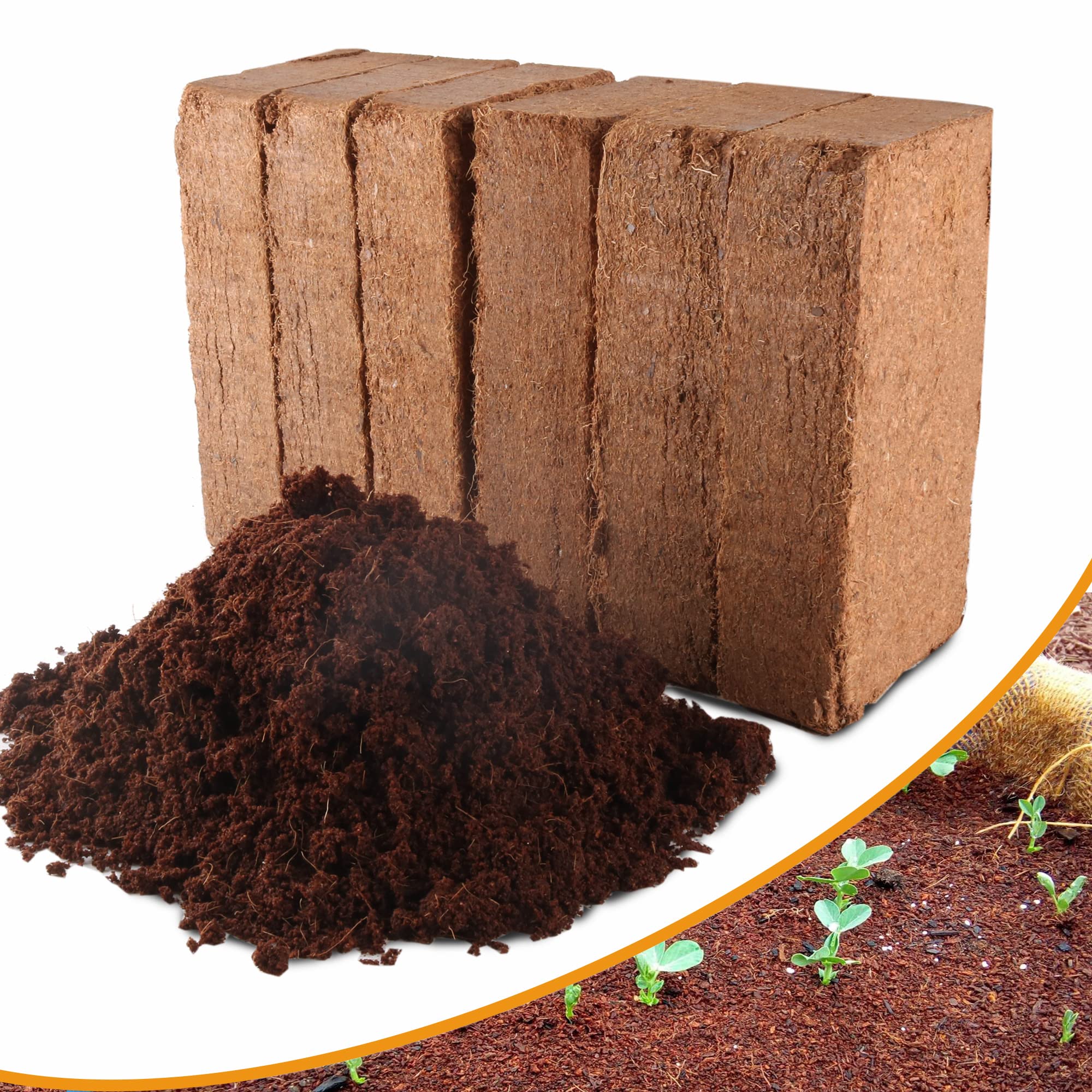
Six bricks for the price of four, but the total volume per brick is smaller than it looks.
The Avalution 6-pack gives you six bricks at a price that lands between the MODELLOR pack and the budget 3-packs, making it a volume play. Each 8 x 4-inch brick expands to about 36 quarts (9 gallons) total — so six bricks yield the same overall volume as the MODELLOR 4-pack. The bricks are made from 100% natural organic coconut husk with low EC and balanced pH, and the manufacturer says they absorb up to 8-10 times their weight in water.
If you compare it to the MODELLOR pack, the numbers reveal a clear difference: Avalution’s six bricks (each weighing roughly 1.4 pounds) expand to 9 gallons, while MODELLOR’s four bricks (total 5 pounds) also expand to 9 gallons. That means MODELLOR delivers the same volume with fewer bricks and less packaging. Avalution’s unit weight per brick is the same 1.4 pounds as the budget 3-pack, so you are essentially getting a larger quantity of the same basic brick format.
Customers note the bricks work perfectly for garden beds and seed starting, with one noting that three bricks fill a standard bucket and retain moisture very well. The trade-off is that each brick requires 4-5 quarts of water and takes a few hours to fully expand — and the larger pack means more bricks to open and hydrate individually.
Quantity-focused pick: six bricks at a reasonable price offer a decent amount of coir for the money, with low EC and organic credentials that support healthy root growth.
Volume reality: despite having six bricks, the total yield is the same as the MODELLOR 4-pack — you are carrying more bricks for the same volume.
Good match for: gardeners who want multiple small bricks for staggered use — open one brick at a time and store the rest dry. The 6-pack gives you flexibility without committing to a single large block.
Not the best if: you want maximum expansion per brick. The MODELLOR brick expands more per brick (9 gallons from 4 bricks vs 9 gallons from 6 bricks).
5. GROW!T JSCPB – Coco Coir Mix Brick (Pack of 3)

Three bricks that swell to about 30 quarts — a fine, pathogen-free blend ideal for aroid soil.
The GROW!T pack is a 3-pack of coir mix bricks from Hydrofarm, a brand well-known in the indoor gardening world. What stands out about this product is the texture: reviewers describe the coir as fine, with one buyer noting it worked perfectly for an aroid soil mix and repotted three large Monsteras plus a Rhaphidophora with one brick leftover. The same buyer said the coir retains more water than expected, so it helps keep moisture-loving plants hydrated without becoming sodden.
The manufacturer states the volume as 2 gallons, but real-world testing suggests the bricks surpass that. The coir is described as free from pathogens and seeds, giving you confidence that you are not introducing weed seeds or soil-borne diseases into your pots.
Compared to the VIVOSUN bricks (which also have a 3-count unit count), the GROW!T bricks expand more per brick. The fine texture and lack of lumps make it easy to break apart after hydrating, though reviewers mention a bit of sand at the bottom after washing. The brand does not disclose an item weight, so you are evaluating by volume rather than by pound.
Best for potting mixes: the fine, uniform texture blends smoothly with perlite, bark, and soil for a consistent potting medium that drains well and holds moisture.
Labeling frustration: the manufacturer is vague on measurements, so you rely on user reports rather than spec sheets to estimate actual yield.
Great for: houseplant collectors, especially aroid enthusiasts who mix their own chunky soil blends. The texture is fine enough for seed starting but structured enough for drainage.
Less ideal if: you need official spec numbers for planning a large project — the lack of published weight and vague volume make it harder to compare.
6. Avalution 3-Pack Coco Coir Bricks

Three bricks for the price of one and a half — a low-cost entry into using coir for soil mixes.
The Avalution 3-pack is the most economical way to try coconut coir if you are not sure your plants will like it. At 1.4 pounds total and 67.2 ounces (the unit count is listed in ounces), this pack expands to 2.3 gallons total, or roughly 0.77 gallons per brick. That is enough to fill a 10-inch pot a couple of times, or to amend a single raised bed section. The bricks are 100% natural organic, with low EC and balanced pH — the same material as the 6-pack version, just fewer bricks.
Reviewers give it consistent praise: one buyer says “3block will fill a standard bucket and it retains moisture very well,” another says it works perfectly for garden beds that are 2.5 feet deep. The water absorption claim of 8-10 times its weight in water is typical for coir, meaning each brick holds a surprising amount of moisture once expanded. Compared to the VIVOSUN 3-pack (which yields 1 gallon total), the Avalution 3-pack gives you 2.3 gallons — more than double the volume for a slightly lower price.
The main limitation is the per-brick size. At 0.77 gallons expanded per brick, you will need multiple bricks for any project larger than a couple of pots. The bricks also require 4-5 quarts of water each and a few hours or overnight soak to fully soften.
Why this works for beginners
- Low cost for three bricks lets you experiment with coir in your potting mix without a big investment
- Low EC and balanced pH mean you are less likely to damage seedlings or sensitive plants
Where it comes up short
- Per-brick yield is small (0.77 gallons), so the pack disappears quickly in a medium-sized garden project
- Item weight is 1.4 pounds, but the total volume is only 2.3 gallons — less efficient than larger blocks
Perfect starting point: if you have never used coco coir, this 3-pack lets you test its water retention and soil-lightening effect on a few pots before committing to a larger pack. The low price takes the risk out of the trial.
Skip it for: any serious garden expansion or raised bed filling — the volume just is not there. Move up to the MODELLOR pack or a single large block once you confirm coir works for your setup.
7. VIVOSUN Coco Coir Brick 1.4lbs 3-Pack

The pocket-sized brick that “expands like crazy” — but just 1 gallon per 1.4-pound block.
The VIVOSUN 3-pack is the smallest per-brick option here, with a stated volume of 1 gallon total for three bricks — that is about 0.33 gallons per brick. Each 1.4-pound brick is 100% natural organic compressed coconut coir fiber with low EC and pH balance, and the manufacturer says it has been rinsed multiple times with fresh water to prevent salt buildup. One reviewer says it “expands like crazy, so be ready,” illustrating that the hydration process is dramatic despite the small starting size.
Compared to the Avalution 3-pack (which yields 2.3 gallons total from the same 1.4-pound total weight), the VIVOSUN bricks fall short in volume. The Avalution pack gives you more than double the expanded material from the same weight, making VIVOSUN the least efficient pick on a per-brick basis. However, the bricks are compact with a carry handle bag, so they are easy to store and take to a community garden or allotment. The low EC and near-neutral pH are consistent with other pre-washed coirs, so this is still fine for seed starting and potted plants.
Where VIVOSUN does well is convenience for very small jobs — one brick expanded is enough for a few 6-inch pots, and the 3-pack means you can use one brick at a time without opening a larger bag. Reviewers praise it as a great seed starter and note the coarse fibers and chips settle firmly and drain well. But if you are comparing by volume, this is the smallest total yield of any product in this guide.
Compact and portable: the carry handle bag and small individual brick size make these easy to grab for trips to the garden or for packing in a car for a planting session elsewhere.
Volume drawback: at 1 gallon total from three bricks, this pack offers the smallest expansion of any product listed — you will go through it quickly if you are amending more than a few pots.
Best for: container gardeners with a few pots to fill, or anyone who wants to carry bricks to a community plot. The small bricks and bag design make transport straightforward, and the quality is good for the size.
Look elsewhere if: you need to fill a raised bed or mix a large batch of potting soil — the 1-gallon total from three bricks means you would need to buy multiple packs to get meaningful volume, and the per-gallon cost is higher than larger packs.
Understanding the Specs
Expanded volume (gallons or quarts)
This is the single most important number on a coir brick package. It tells you how much loose growing medium you will get after adding water. A 1.4-pound brick might yield anywhere from 1 gallon to 2.3 gallons depending on how densely it was compressed and the quality of the fiber. For reference, a standard 10-inch pot holds about 1.5-2 gallons of soil. If you are filling a 4×4-foot raised bed that is 12 inches deep, you need about 48 gallons of soil — so a pack that yields 9 gallons will cover about 19% of that volume, which tells you how many bricks to buy.
Low EC and pH balance
EC stands for electrical conductivity — a measurement of dissolved salts in the coir. Unwashed coir can have high salt content from the ocean environment where the coconut palms grew, and those salts can burn plant roots, especially for young seedlings. Low EC (typically under 1.0 mS/cm) means the manufacturer rinsed the fibers thoroughly before compressing them. Balanced pH for coir is usually 5.5 to 6.5, which falls in the balance for most garden plants and flowers. If you see “low EC” and “pH balanced” on the label, the coir is ready to use without extra rinsing.
FAQ
How much water does one coco coir brick absorb?
Can I use coco coir instead of peat moss?
How long does it take for a coir brick to expand?
Is coco coir good for seed starting?
Can I reuse coco coir after a growing season?
Does coco coir contain any nutrients for plants?
How do I know if my coco coir has too much salt?
Can coco coir be used for reptiles or animals?
What is the difference between coco coir and coco peat?
Will coco coir attract fungus gnats?
Final Thoughts: The Verdict
For most buyers, the coconut coir for gardening winner is the MODELLOR 4-Pack (5 lb) because it delivers the best balance of expansion volume (9 gallons from 5 pounds of bricks), triple-washed purity, and per-gallon cost — making it the most efficient buy whether you are starting seeds, mixing potting soil, or filling a raised bed. If you want a massive single block for big garden projects that yields 17 gallons of medium, grab the MagJo Naturals 11-Pound Block. And for the absolute cleanest, most finely screened coir that is ideal for seed starting and sensitive houseplants, the Plantonix Coco Bliss 6-Pack is the top choice.
How We Picked
We do not accept paid placement. Every pick is matched to a real buyer and a real use-case; we do not hands-on test units.
Sources & Methodology
Specifications: manufacturer listings and product documentation. Review insights: verified customer reviews, as of July 2026. Pricing: not shown on this page (it changes often); check the current price via the retailer link.
As an Amazon Associate, Lawn Gear Lab earns from qualifying purchases. This does not affect which products we feature.