
Specs are compiled from manufacturer listings and verified buyer reviews and can change over time — please confirm the key details on the product page before buying.
Your garden draws birds as much as it draws you — those ripe blueberries, tender lettuce leaves, and budding flowers are a buffet. The difference is you want to eat those vegetables, not watch them get pecked into shreds. Bird netting is a straightforward fix: a physical barrier between your hard work and hungry critters. But the wrong netting tangles on itself, tears in the sun, or traps animals instead of just blocking them.
I’m Rikta — the founder and writer behind Lawn Gear Lab. This guide is built by comparing the manufacturers’ published specifications and the patterns across verified customer reviews, so you get each pick’s real strengths and trade-offs instead of marketing spin.
From giant 100-foot rolls to ultra-fine mesh that blocks bugs alongside birds, the right choice depends on your garden’s size, pest pressure, and how much fuss you can handle during installation. This guide breaks down the best options for every scenario so you can buy once and stop replanting.
Quick Picks
- JUNKOGO Bird Netting 25×50 ft — Top Performer
- RIFNY Garden Netting, 2 Pack 10x33Ft — Best Value
- RIFNY Bird Netting 13 x 40 FT Heavy Duty — Extreme Weather Pick
- UWIOFF Garden Netting, 7 x 100 FT — Budget Champion
- SnugNiture Garden Netting 10x33FT Ultra Fine — Fine Pest Barrier
- GWHOLE 33 x13 Ft Bird Netting — Lightweight Multi-Use
How To Choose The Best Bird Netting
Picking the right netting starts with knowing what you are fencing out and what you are protecting. A net that stops a sparrow but lets a squirrel stroll right through is not a solution — it is a false sense of security. Focus on these three factors before you unroll anything.
Mesh Size: The Gap Determines the Gate
Bird netting typically comes in three mesh ranges. A 3/4-inch square mesh (like the UWIOFF roll) stops birds, squirrels, and rabbits, but small bugs can slip through. A 1-inch mesh (like the GWHOLE and JUNKOGO netting) is the standard for blocking full-sized birds and deer while letting pollinators access flowers — critical if you have fruiting crops. Ultra-fine mesh, measured at 0.04 inches per opening (the RIFNY 2-pack), blocks insects, aphids, and cabbage moths alongside birds, but you sacrifice airflow and ease of watering since the weave is tighter.
Material: How Many Seasons It Survives
Your netting sits outside in full sun, rain, and wind for months at a time. Polypropylene (the UWIOFF) and HDPE (the RIFNY heavy-duty netting) resist UV damage and rot without rusting. Nylon (the GWHOLE option) is tear-resistant and flexible but can degrade over a couple of years in direct sun. High-density polyethylene, or HDPE (the JUNKOGO netting), is the premium choice — heavier at 20g/m² versus the 6-8g/m² of cheap nets, and it stays flexible even in freezing temperatures without cracking.
Size and Coverage: Measure Before You Buy
The single biggest installation mistake is buying a roll that is too narrow or too short. A 7-foot-wide net is enough to drape over a single raised bed or a young fruit tree, but a 25×50-foot roll (the JUNKOGO) can wrap an entire berry patch or a small orchard. The data shows that buyers who underestimate width end up piecing together multiple sections, which creates gaps that birds find immediately. Measure the height and spread of what you are covering, then add at least 2 feet on each side for anchoring with soil or stones.
Quick Comparison
| Model | Best For | Mesh Size | Total Coverage | Material | Amazon |
|---|---|---|---|---|---|
| JUNKOGO 25×50 ft | Large gardens & orchards | 1 in | 25 ft x 50 ft | HDPE | Amazon |
| RIFNY 2-Pack 10×33 ft | Insect & bird protection | 0.04 in | 2 x 10 ft x 33 ft | Polyethylene | Amazon |
| RIFNY 13 x 40 ft | Extreme weather areas | 5/8 in | 13 ft x 40 ft | HDPE | Amazon |
| UWIOFF 7 x 100 ft | Large rows & long beds | 3/4 in | 7 ft x 100 ft | Polypropylene | Amazon |
| SnugNiture 10×33 ft | Fine pest exclusion | 0.1mm | 10 ft x 33 ft | Polyethylene | Amazon |
| GWHOLE 33 x 13 ft | Lightweight bird barriers | 1 in | 33 ft x 13 ft | Nylon | Amazon |
In‑Depth Reviews
1. JUNKOGO Bird Netting 25×50 ft

The heavyweight woven net that covers a small orchard in one unroll — no tangling, no tearing.
This is the netting you reach for when you have serious square footage to protect. The JUNKOGO 25×50-foot roll uses a woven HDPE (high-density polyethylene) construction that weighs 20g/m² — compared to the flimsy 6-8g/m² nets that fall apart after one season. Buyers report it supports over 100 pounds without tearing, so a falling branch or a determined raccoon will not punch through. The 1-inch mesh stops birds and deer while letting bees reach your blossoms — a critical distinction if you grow anything that requires pollination.
Reviewers specifically note that this netting is tangle-free, which is the single biggest quality-of-life improvement over the GWHOLE netting. One buyer who replaced a tangled net from a hardware store finished installation in 20 minutes instead of hours. The same reviewer highlighted that the JUNKOGO did not tear, while the old net had failed after three years. The included 120-foot length (from a 25×50 roll) covers rows, blueberry bushes, and even a small chicken coop roof with leftover material to spare.
The catch is the sheer size makes it harder to handle solo for a small raised bed — you will have excess corners to roll up. The diamond-shaped mesh also stretches differently in each direction, so you may need to adjust tension as you install. For a 10×10-foot tomato cage or one large blueberry patch, it delivers class-leading coverage per square foot.
what separates it
- Heavy woven HDPE at 20g/m² — far denser than bargain nets
- Tangle-free unrolling saves installation time
- Covers 25×50 ft in one piece, enough for an orchard or garden row
- Owners mention it survived chipmunks burrowing underneath without chewing through
One thing to know
- Diamond-shaped mesh shifts dimensions as you stretch it, needing adjustment during install
- Overkill for a single potted plant or tiny raised bed
Grab it if: you have a large garden, an orchard, or a berry patch and want a net that handles heavy weather and heavy animals without tangling.
Think twice if: you only need to cover a single 4×8-foot raised bed — the roll size will be more than you need.
2. RIFNY Garden Netting, 2 Pack 10x33Ft

Two ultra-fine rolls that block cabbage moths as easily as they block robins — and let you water straight through.
If your garden problem is not just birds but also aphids, cabbage worms, and flea beetles, the RIFNY 2-pack is the solution. Each of the two rolls measures 10×33 feet, giving you 660 square feet of netting total — enough to cover multiple raised beds, a row of tomatoes, and a strawberry patch. The mesh opening is 0.04 inches, fine enough to keep out insects while still allowing sunlight and rainwater through so your plants keep growing without you having to lift the cover. Customers note the tight weave keeps birds and bugs off vegetables effectively, and one reviewer noted it kept cabbage moths out entirely, vastly improving their broccoli and Brussels sprouts harvest. Unlike the JUNKOGO, which focuses on birds and deer, this net targets the full spectrum of small pests.
At 1.08 kilograms for the pair, the RIFNY nets are noticeably heavier than the GWHOLE netting (0.49 kg for a single roll), which reflects the denser polyethylene construction. That weight does mean the mesh is slightly less sturdy under clamps — one buyer found that pinch-style clips distorted the weave and created entry points for aphids, and they recommended placing fabric squares under the clamps to protect the mesh. The oblong hole design lets you water and apply liquid feed straight through the netting, saving you the hassle of removing it every time the plants need a drink.
Because the mesh is so fine, it slightly reduces airflow compared to a 1-inch bird net. For crops like kale, broccoli, and leafy greens that are susceptible to flying insects, that is a worthwhile compromise. For large fruit trees where you only need to stop birds, the ultra-fine weave is more mesh than you need.
Why it stands out
- Two 10×33 ft rolls included, covering 660 sq ft total
- Ultra-fine 0.04-inch mesh blocks insects plus birds
- Oblong hole design lets water and light pass through
- Reviewers point out it kept cabbage moths and aphids out of brassicas
Watch for
- Fine mesh distorts under pinch-style clamps; needs fabric squares for a tight seal
- Heavier weave at 1.08 kg may sag without proper support
Reach for this if: you grow leafy greens, broccoli, or any crop that gets attacked by flying insects and birds — the fine mesh handles both.
Look elsewhere if: you only need to stop birds from stealing fruit and do not want the slight airflow reduction of an ultra-fine mesh.
3. RIFNY Bird Netting 13 x 40 FT Heavy Duty
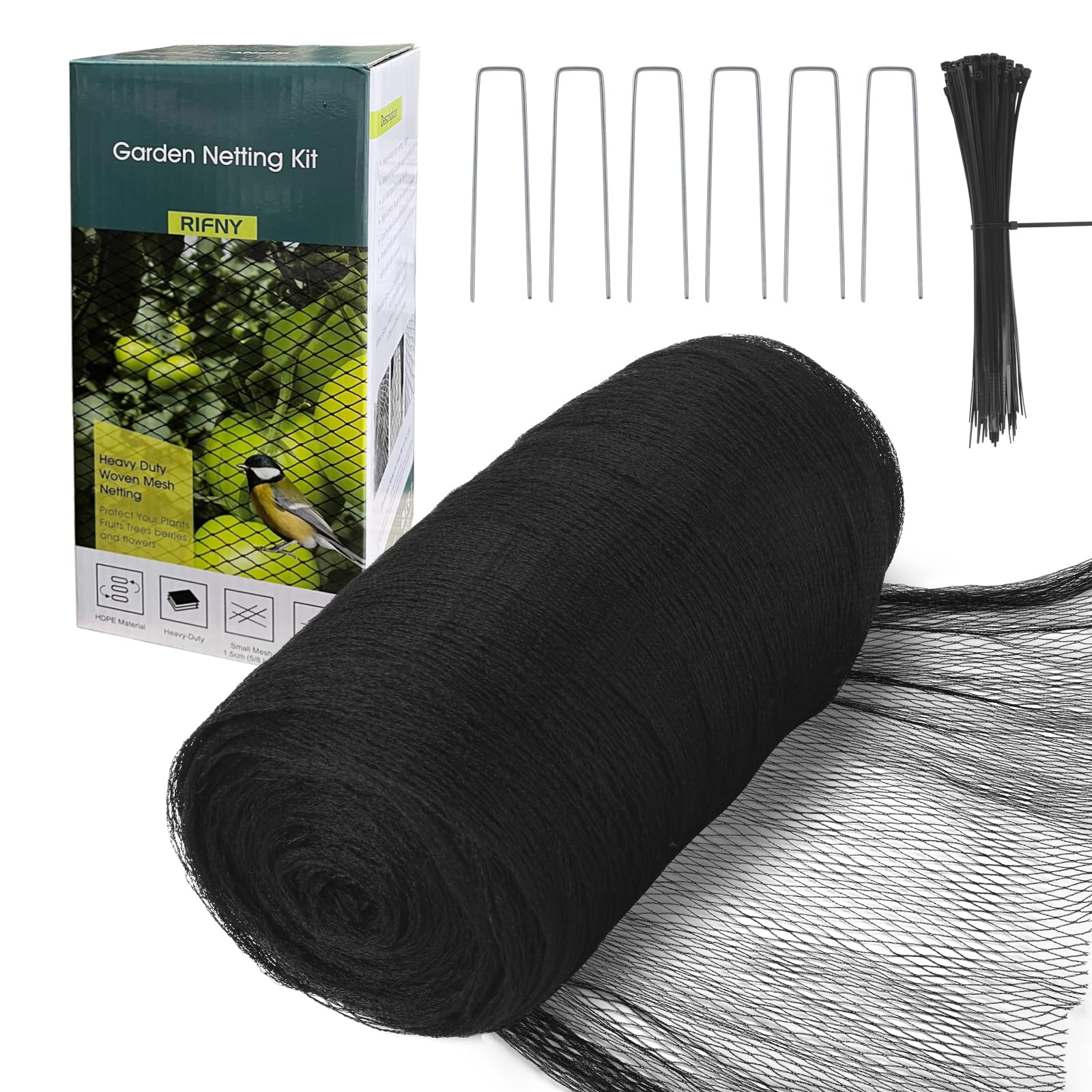
The net that stays flexible at subzero temperatures without cracking — rated from -58°F to 212°F.
Most garden netting turns brittle in freezing weather and snaps when you try to remove it. The RIFNY 13 x 40-foot heavy-duty net is built from HDPE (high-density polyethylene) that stays flexible across a rated range of -58°F to 212°F, so it survives both deep freezes and scorching summer sun without degrading. The 5/8-inch mesh is smaller than the standard 1-inch opening found on the GWHOLE or JUNKOGO nets, meaning small birds and even poultry cannot push through. The net weighs only 0.65 oz/yd², keeping it light enough that it will not break branches on mature fruit trees. Buyers consistently mention that this netting does not tangle or tear, making it easy to unroll on grape arches and raised beds.
The kit includes six 7-inch landscape staples and a pack of twist ties, so you have everything you need to anchor the edges without a separate trip to the hardware store. One reviewer with a grape arbor reported the netting was significantly higher quality than what they found at a local hardware store and held up well in direct sun. Another buyer who uses it to cover raised beds noted it effectively kept out birds, toddlers, and dogs, and that the netting is flexible enough to attach with simple clothespins. The black color makes it less visible against foliage, which is a bonus if you care about how your garden looks.
The limiting factor is the 13-foot width — generous for covering a long row or a fruit tree, but you cannot wrap a wide orchard block in a single pass. One buyer cut their netting too short and had trouble keeping it anchored on a fruit tree, so measure your tree canopy width and height before cutting. At 30 grams, it is the lighter-weight option here and needs good anchoring in windy spots.
Standout features
- HDPE material rated from -58°F to 212°F for year-round use
- Comes with 6 landscape staples and twist ties for immediate install
- 5/8-inch mesh stops poultry and small birds
- Shoppers say it does not tangle, tear, or trap animals
Know before you buy
- 13 ft width may not be enough for very large fruit trees in one piece
- Lighter weight at 30 grams means it needs good anchoring in windy spots
Best for: growers in cold-winter climates who need netting that survives snow, ice, and thaw cycles without cracking.
Not ideal if: your garden is a wide-open field that requires a single 25-foot-wide roll — you would need to seam two of these together.
4. UWIOFF Garden Netting, 7 x 100 FT

A 100-foot marathon roll that covers an entire row garden in one shot — and stops rabbits when buried 5 inches deep.
When you need netting by the hundred feet, the UWIOFF 7 x 100-foot roll is the most coverage you can get in a single package at this price point. The 3/4-inch square mesh is a practical middle ground — small enough to stop birds, deer, and rabbits from eating your vegetables, but large enough that you can still water and pollinate through the openings. The polypropylene material (a plastic that resists UV light and rot) is designed to handle bad weather, and buyers confirm it can be reused year after year. One gardener specifically noted the netting prevented rabbits from eating their flowers after they buried it 5 inches underground to stop digging — something the lighter GWHOLE netting may not resist.
The 7-foot width is perfect for draping over a standard 4-foot-wide raised bed with enough slack to tuck the edges under stones or soil. The square mesh design is noticeably easier to spread than the cheap diamond-shaped netting that keeps retracting into a tangled ball — you simply unroll, cut with scissors, and drape. A reviewer who used it as a portable chicken run cover said it worked easily to keep overhead predators away from their birds, proving the netting is sturdy enough for small animal enclosures, not just garden plants. The only downside is the 7-foot width means you cannot wrap a single large fruit tree; you will need to seam multiple widths together for a full canopy cover.
At 0.52 kilograms for the whole roll, this is a lightweight net that is easy to carry and handle, but that also means it can shift in strong wind if you do not anchor it well. Plan for extra stones or staple pins along the edges.
What you get
- 100 feet of netting in one roll, ideal for long rows or multiple beds
- 3/4-inch square mesh blocks birds, deer, and rabbits
- Lightweight at 0.52 kg and easy to cut with scissors
- Buyers confirm it stops rabbits when buried 5 inches deep
A few limits
- 7 ft width is too narrow for a single large fruit tree
- Lightweight material needs heavy anchoring in windy conditions
Choose this for: long vegetable rows, multiple raised beds in a line, or covering a portable chicken run on a budget.
Pass on this if: you need to wrap a single mature fruit tree — you will need a wider roll or multiple pieces.
5. SnugNiture Garden Netting 10x33FT Ultra Fine Mesh

A sheer white mesh that vanishes against the sky while keeping every fly out — buy it for 7 months of pest-free brassicas.
The SnugNiture 10×33-foot netting uses an ultra-fine mesh with openings so small they block worms, aphids, and other small pests without blocking airflow or sunlight. Buyers confirm the fine mesh effectively keeps insects away while allowing plants to thrive, and one reviewer used it for seven months straight in a brassica garden and reported a completely pest-free harvest. The white color is nearly invisible once installed, which matters if your garden is visible from the house or patio. The material is polyethylene (a waterproof, sun-proof plastic), and at 1.2 pounds for the roll, it is light enough to drape directly over plants without crushing stems.
The 10-foot width is significantly wider than the UWIOFF net (10 ft vs 7 ft), giving you better coverage for spreading shrubs or wide raised beds without piecing multiple strips together. One buyer used it to enclose a patio and noted you can barely see it when it is up, yet it stays strong against the weather. The trade-off is the ultra-fine mesh does not allow large pollinators like bumblebees to pass through, so you will need to lift it during flower bloom if you grow crops that require bee pollination — squash, melons, and cucumbers will not set fruit without access. The fine material also snags easily if you drag it across rough surfaces.
Compared to the RIFNY 2-pack, the SnugNiture offers a single large roll instead of two smaller ones, which simplifies covering one big area. At the 0.1mm mesh size, it is slightly coarser than the RIFNY’s 0.04-inch mesh, so it allows marginally better airflow while still blocking most flying insects. For growers focused on fine pest exclusion without the bulk of two rolls, this is the cleaner option.
Why it works
- Ultra-fine 0.1mm mesh blocks worms and aphids, not just birds
- 10 ft wide — covers wide beds in one piece
- Nearly invisible white mesh blends into the landscape
- Buyers report it kept a brassica garden pest-free for 7+ months
Note this
- Blocks large pollinators — lift netting during bloom for fruiting crops
- Fine material snags easily on rough edges or tools
Reach for this if: you fight constant insect pressure and need a barrier that stops flies, moths, and aphids while keeping the garden looking clean.
skip it if: your main problem is deer or squirrels — their chewing power will tear this fine mesh. You need a larger-hole netting for big animals.
6. GWHOLE 33 x13 Ft Bird Netting

The lightest nylon net (0.49 kg) that doubles as a cat barrier for guinea pig cages — but expect 2 years of life in full sun.
At 0.49 kilograms, the GWHOLE 33×13-foot netting is the lightest option in this lineup, which makes it the easiest to handle if you need to frequently move, cut, and reposition your barrier. The 1-inch square mesh is the standard for bird and deer exclusion — large enough to let sunlight and rain through without interfering with plant growth, but small enough to block full-sized birds from pecking your fruit. The nylon monofilament (a single-strand nylon fiber) construction is designed to be tear-resistant and UV-resistant, so it withstands harsh sun and storms through multiple seasons. One reviewer creatively repurposed it as a cat barrier for a guinea pig cage, noting that even with biting and clawing, the netting stretched but never broke.
Buyers who use it as a balcony screen to keep cats from jumping report it is much easier to install than traditional screening, provides an unobstructed view, and holds up well against rain and sun. The transparent mesh is nearly invisible when installed vertically, which is a major plus for situations where you do not want the netting to obstruct sightlines — such as around a patio, deck, or balcony railing. Unlike the heavier knotted nets that are visibly bulky, this one blends into the background. However, because it is nylon rather than HDPE or polypropylene, buyers do note it deteriorates after a couple of years in direct sun — one buyer mentioned they plan to replace the old mesh after about two years of use, which is shorter than the lifespan of the HDPE options like the JUNKOGO.
Compared to the UWIOFF net (1200″L x 84″W) the GWHOLE measures 396″L x 120″W, so you will use the entire roll on one small project rather than having leftover material for later. It is the best fit for a single fruit tree, a balcony, or a small animal enclosure where the netting needs to be removed and reinstalled regularly.
Key strengths
- Ultra-light at 0.49 kg — easy to handle, cut, and reposition
- Nylon monofilament resists tearing and UV damage
- Transparent mesh is nearly invisible when installed
- Buyers use it as a cat barrier, balcony screen, and garden cover
Trade-offs
- Nylon degrades faster than HDPE in full sun — expect 2 years of life
- Smaller 33×13 ft size limits large-scale garden use
Perfect for: small fruit trees, balcony enclosures, and lightweight animal barriers where easy handling matters more than maximum durability.
Not for: large vegetable gardens or permanent installations — the nylon will need replacement in a couple of years.
Understanding the Specs
Mesh Size
This is the opening between threads, measured in inches or millimeters. A 3/4-inch mesh stops birds and rabbits but lets insects pass. A 1-inch mesh blocks birds and deer while allowing bees to pollinate. Ultra-fine mesh under 1mm stops flying insects but also blocks pollinators, so you need to remove it during bloom for fruiting crops. The smaller the opening, the more protection — but the less airflow and pollinator access.
Material and Weight
Polypropylene and HDPE (high-density polyethylene) are the most UV-resistant and last multiple seasons. HDPE is denser and heavier, typically 20g/m², which resists tearing and supports more weight. Nylon is lighter and more flexible but degrades faster in sunlight. Heavier netting (over 1 kg per roll) tends to be more durable but harder to handle solo. Lighter nets (under 0.5 kg) are easier to drape but need better anchoring in wind.
FAQ
What mesh size stops birds but lets bees through?
Will bird netting hurt or trap birds?
How long does bird netting last outdoors?
Can I use bird netting to keep squirrels out?
Do I need to remove netting for watering?
How do I keep netting from tangling during installation?
Can bird netting protect a chicken coop?
What is the difference between polypropylene and nylon netting?
Should I get a net wider than my garden bed?
Will ultra-fine mesh netting work for deer?
Final Thoughts: The Verdict
For the majority of shoppers, the bird netting winner is the JUNKOGO 25×50 ft because its heavy woven HDPE construction covers a massive area without tangling and refuses to tear under animal pressure. If you battle flying insects as much as birds, grab the RIFNY 2-Pack 10×33 ft for its ultra-fine mesh that blocks cabbage moths and aphids. And for cold-winter growers who need netting that stays flexible in a deep freeze, the RIFNY 13 x 40 ft Heavy Duty handles -58°F temperatures without cracking.
How We Picked
We do not accept paid placement. Every pick is matched to a real buyer and a real use-case; we do not hands-on test units.
Sources & Methodology
Specifications: manufacturer listings and product documentation. Review insights: verified customer reviews, as of July 2026. Pricing: not shown on this page (it changes often); check the current price via the retailer link.
As an Amazon Associate, Lawn Gear Lab earns from qualifying purchases. This does not affect which products we feature.