
Specs are compiled from manufacturer listings and verified buyer reviews and can change over time — please confirm the key details on the product page before buying.
You want a pressure washer that can blast dirt off your driveway and soap your car without costing a mortgage payment. The real challenge in this price range is finding the machine that delivers enough cleaning power — measured in PSI (pound per square inch) and GPM (gallons per minute) — without falling apart after a few uses or making you wrestle with finicky connections.
I’m Rikta — the founder and writer behind Lawn Gear Lab. This guide is built by comparing the manufacturers’ published specifications and the patterns across verified customer reviews, so you get each pick’s real strengths and trade-offs instead of marketing spin.
The difference between a frustrating clean and a satisfying one depends on the machine’s true cleaning power and how easy it is to move around your property. Read on to find the budget pressure washer that actually matches the work you do.
Quick Picks
- Westinghouse WPX2300e Electric Pressure Washer — Best Overall
- Sun Joe SPX3000 Electric Pressure Washer — Best Value
- Kärcher K1800PS Electric Pressure Washer — Premium Pick
- LawnMaster LT506-2000A Electric Pressure Washer — Quiet Performer
- Worx WG602 13 Amp Electric Pressure Washer — Compact Traveler
- Greenworks 1800 PSI 1.1 GPM Electric Pressure — Budget Champion
- Ryobi RY141612 Electric Pressure Washer — Lightest Pick
How To Choose The Best Budget Pressure Washer
The best electric pressure washer for you is the one that has enough PSI for your dirtiest job, enough GPM to rinse it away quickly, and a long enough hose so you are not constantly unplugging and moving the unit. Here are the three specs to focus on.
Cleaning Power: PSI and GPM Work Together
PSI (pound per square inch) is the pressure of the water jet — think of it as the “punch” that knocks dirt loose. GPM (gallons per minute) is how much water flows through that jet — it is the “sweep” that washes the dirt away. A machine with high PSI but low GPM leaves you scrubbing slowly. A model with high GPM but low PSI might not break stubborn grime. Look for at least 1600 PSI and 1.2 GPM for most home jobs like car washing, patio cleaning, and vinyl siding.
Hose and Cord Reach: How Far You Can Go
A 20-foot hose is standard at this price, but a 25-foot hose (like on the Westinghouse model) gives you noticeably more coverage before you need to drag the machine. The power cord length matters just as much: most models have a 35-foot cord. Together, the hose and cord determine your total cleaning radius — add both numbers to see if you can reach your two-story siding or the far end of your driveway without an extension cord.
Motor Type: Axial vs Induction
Nearly all budget electric pressure washers use an axial cam pump (a pump that uses small pistons moving in a circle). It is lightweight and cheap to replace. The Westinghouse model stands out because it uses an induction motor (a motor with windings that runs cooler and lasts significantly longer than a brush-type motor). Induction motors are quieter and often carry a longer warranty.
Quick Comparison
| Model | Best For | Max PSI | Max GPM | Hose Length | Amazon |
|---|---|---|---|---|---|
| Westinghouse WPX2300e | Heavy Home Cleaning | 2300 | 1.76 | 25 ft | Amazon |
| Sun Joe SPX3000 | Versatile Detergent Use | 2030 | 1.2 | 20 ft | Amazon |
| Kärcher K1800PS | Back-Friendly Operation | 1800 | 1.2 | 20 ft | Amazon |
| LawnMaster LT506-2000A | Quiet Operation | 2300 | 1.4 | 20 ft | Amazon |
| Worx WG602 | Compact RV & Car Use | 1870 | 1.4 | 20 ft | Amazon |
| Greenworks 1800 PSI | No-Fuss Reliability | 1800 | 1.1 | 20 ft | Amazon |
| Ryobi RY141612 | Lightweight Home Tasks | 1600 | 1.2 | 25 ft | Amazon |
In‑Depth Reviews
1. Westinghouse WPX2300e Electric Pressure Washer
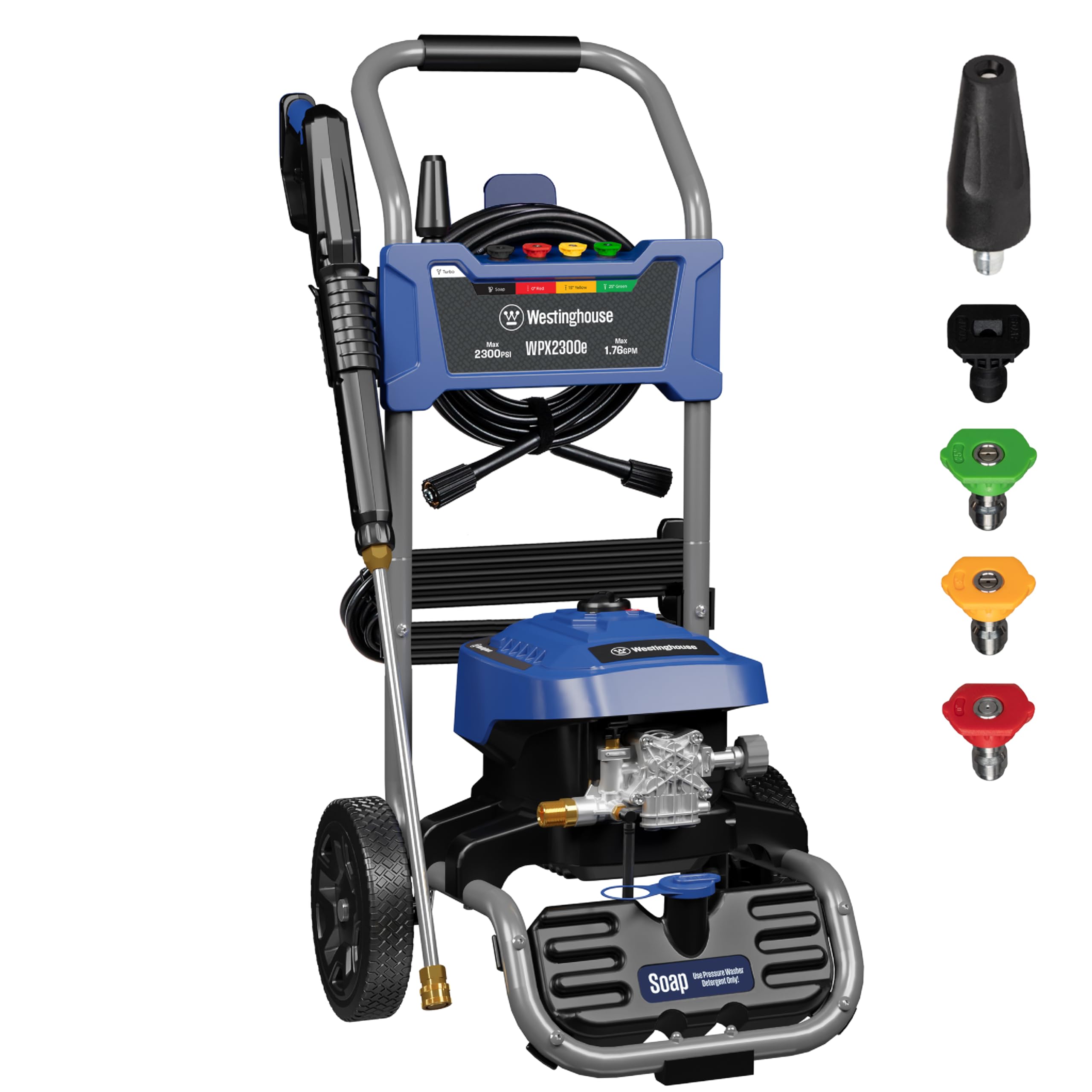
The heavy lifter that pairs gas-grade PSI with a motor that keeps running.
You get 2300 PSI (pound per square inch) and 1.76 GPM (gallons per minute) out of this blue machine — that is a 44% higher PSI than the Ryobi RY141612 (1600 PSI) and a 60% higher flow rate than the Greenworks 1800 PSI (1.1 GPM). At 27.5 pounds it is noticeably heavier than the 16.4-pound Ryobi, but the weight comes from a durable steel frame and an induction motor (a motor type that runs cooler and lasts longer than typical brush motors). The 25-foot hose is 5 feet longer than the standard 20-footer on many competitors, and buyers report the 8-inch never-flat wheels make it easy to roll over grass and gravel.
The.42-gallon onboard soap tank means you do not need a separate attachment for detergent. One reviewer noted the wand lacks a trigger lock and the hose feels stiff and twists, but praised the high pressure for cleaning decks, siding, and sidewalks. The 3-year limited warranty is stronger than the 2-year coverage on many rivals.
One buyer mentioned, “Simplicity at its finest. Well worth the price.” The only real catch is that you cannot turn off the soap flow independently — it keeps dispensing until the tank is empty, so you need to plan your rinse cycle.
The Muscle Behind It
- Highest PSI (2300) and GPM (1.76) among picks here — blasts concrete stains fast
- Induction motor is quieter and more durable than axial pumps
- 25-foot hose plus 35-foot cord gives a long reach
Minor Gripes
- Wand trigger has no lock-on feature; you must hold it the whole time
- Soap runs continuously until the tank drains, making rinse tricky
- At 27.5 pounds it is the heaviest pick — less portable than lighter models
The top pick if: You need to clean large concrete areas, siding, and driveways and want a motor built to last years.
Look elsewhere if: You need a lightweight machine to store in a small RV or carry up stairs — the steel frame is sturdy but heavy.
2. Sun Joe SPX3000 Electric Pressure Washer
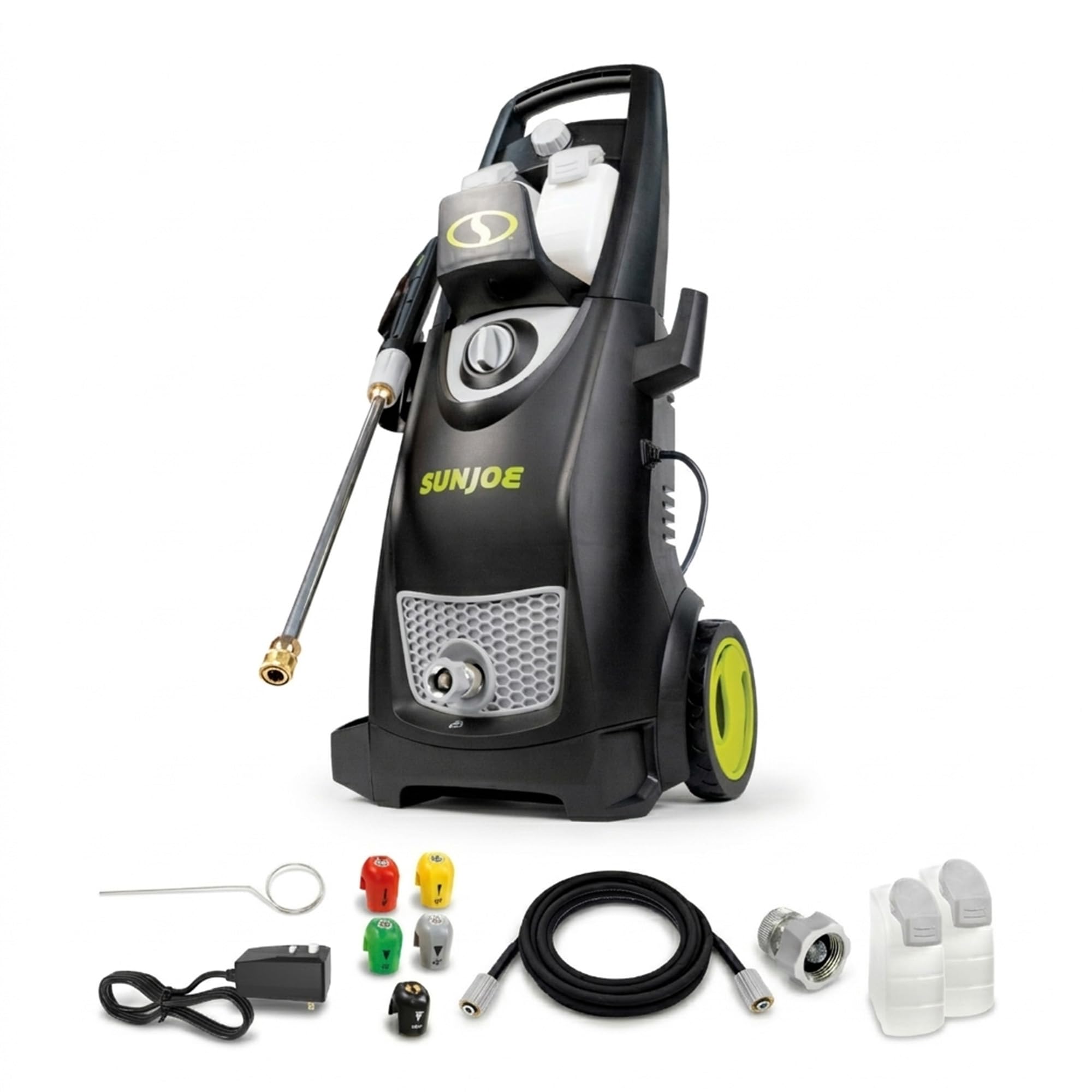
The two-soap-tank marvel that switches formulas without a messy swap.
The Sun Joe delivers 2030 PSI and 1.2 GPM — enough to clean concrete walkways and cars. Its standout feature is a pair of 0.9-liter detergent tanks that let you store car soap in one and deck cleaner in the other, then switch with a simple turn. The 34-inch stainless steel lance (the long wand) with brass fittings gives you a solid reach, and the five quick-connect nozzles (0°, 15°, 25°, 40°, and soap) cover every job from light rinsing to stubborn grime.
One owner reported “still running after 3 years,” which says a lot about build quality at this price. Another noted the front water connection can leak slightly and needs re-tightening each use. The 20-foot hose is standard length, and the stiff material makes it harder to coil back up. At 24.3 pounds it is lighter than the Westinghouse but still substantial.
The 2-year warranty is solid. For most homeowners who want two separate cleaning solutions ready to go, this is the best value on the list.
Two detergents, one machine: The dual-tank system is genuinely useful — you keep truck soap in one and house wash in the other.
The trade-off: The hose is noticeably stiff, and getting it to lay flat on the driveway takes effort.
Reach for this if: You clean both vehicles and outdoor surfaces and want to swap between soaps without refilling.
skip it if: You want the highest possible PSI — this peaks at 2030, not 2300.
3. Kärcher K1800PS Electric Pressure Washer

The German-engineered unit that starts and stops with a tap of your foot.
CETA certification (an independent test that verifies the stated PSI is real) means the Kärcher’s 1800 PSI and 1.2 GPM are honest numbers you can trust — not inflated marketing claims. The machine has an on/off foot switch so you can start cleaning without bending down, and it automatically stops when you release the trigger (a feature that saves wear on the pump). The 0.5-gallon detergent tank is built into the frame, and the three nozzles (15°, turbo, and 65°) give you enough variety for most jobs.
At 24.1 pounds with never-flat wheels, it rolls well across patios and pavement. One customer observed fast 5-minute assembly and a great performance at a sale price. Another noted the all-plastic build feels less sturdy than competitors, and the connector from the input water hose to the machine can leak. The 2-year limited warranty gives decent confidence.
Owners mention it runs hours straight without overheating, which makes it a good choice for bigger weekend projects like washing a two-story house or a long driveway.
CETA-certified power: You get verified 1800 PSI, not inflated numbers — buyers confirm it cleans patios and cars effectively.
Styled well, built lightly: The plastic frame keeps weight down but feels less premium than the steel-framed Westinghouse.
Best for: Buyers who trust an independent certification over marketing claims and want a foot-operated start.
pass on it if: You want a rugged metal frame — this unit is mostly plastic.
4. LawnMaster LT506-2000A Electric Pressure Washer

The low-noise entry that sneaks up on dirt while your neighbors sleep.
At in the data, this LawnMaster hits 2300 PSI and 1.4 GPM — matching the highest PSI on the list alongside the Westinghouse. The 20-foot hose is 5 feet shorter than the Westinghouse’s, but the 35-foot power cord gives you a generous 55-foot total reach. A hub brush for cleaning car wheels comes included, and the foam bottle lets you spray aerated soap directly.
One reviewer called it “quiet operation” and praised the adjustable wand and foam blaster. However, buyers also report that the 2300 PSI claim is deceptive — one measured actual pressure far below that number, and another noted that “pressure drops with 1/2″ hose; using a 3/4″ hose fixes it.” The quick-connect system only works with the included accessories, and swapping attachments takes too many steps for some users. At 22.55 pounds it is manageable.
It also lacks onboard storage for attachments, so you will need a bucket or bag for the nozzles. For light-duty work like cleaning car wheels and patio furniture, the quiet motor is a genuine plus.
Quiet & Packed
- Quiet motor that does not disturb neighbors
- Hub brush is a nice extra for car wheel cleaning
- 35-foot cord gives extensive reach beyond the 20-ft hose
Watch For
- Actual PSI is far below the 2300 rating per buyer reports
- Quick-connect only works with included accessories; non-standard fit
- No onboard storage for nozzles or wand
Go with this if: Quiet operation is your priority and you primarily need a light-duty washer for car wheels and outdoor furniture.
Choose something else if: You trust the PSI rating at face value and expect full pressure — you may be disappointed.
5. Worx WG602 13 Amp Electric Pressure Washer

The smallest unit here that hides in your RV cabinet until grime shows up.
Delivering 1700 PSI (max 1870) and 1.2 GPM (max 1.4 GPM), the Worx is built for portability. One reviewer called it a “compact RV-friendly design” and noted the 1700 PSI is “powerful yet gentle on paint” — important for washing a camper or vehicle without etching the clear coat.
The 20-foot hose is standard, but the integrated base with molded-in feet keeps it stable during use. Buyers praise the easy setup and the versatile turbo nozzle (a spinning jet that increases cleaning power) and 40° nozzle for gentle cleaning. A few note that the unit occasionally tips over on uneven ground, and the hose connections are leak-free from the start. The 13-amp motor provides good pressure for small areas like pool decks and concrete walkways.
The Worx is a solid companion for a larger gas washer — one buyer says it “complements larger gas washer” for small tasks.
RV-ready and car-safe: At 1700 PSI it is strong enough to strip road grime but gentle enough not to damage clear coats — a rare balance.
The downside: The small base makes it tip over if the hose pulls sideways; set it on flat ground.
Best for: RV owners and car enthusiasts who need a compact unit that stores easily and handles paint-safe cleaning.
Not for: Heavy concrete cleaning where you need sustained high pressure — the 1700 PSI is on the lower end.
6. Greenworks 1800 PSI 1.1 GPM Electric Pressure Washer

The no-maintenance worker that outlasts expensive rivals with a simple button press.
Greenworks’ 1800 PSI and 1.1 GPM is PWMA certified (the Pressure Washer Manufacturers Association verifies the ratings are accurate), so you get what the box says. The push-button start means no gas, no oil, no spark plugs, and no pull cord — just plug in and squeeze. The 35-foot GFCI cord (a cord with a built-in safety device that cuts power if it detects a short) is the longest on the list, and the 20-foot hose gives a 55-foot reach.
Customers note this unit “ran 3 hours straight without overheating” — proof of the motor’s cooling design. The included 40° nozzle for gentle cleaning, turbo nozzle for heavy-duty work, and soap applicator cover most home needs. At just 7.5 inches wide and 12.8 inches tall, it occupies very little shelf space. One reviewer calls it “small and amazing” and says it “works with 100ft hose” when needed.
The wand hose is thin and prone to kinking, and there is no lock-on trigger (you must hold the trigger the whole time). At 1.1 GPM, the flow rate is the lowest among picks here — the Westinghouse delivers 1.76 GPM, so rinsing takes longer.
Set-and-Forget Reliability
- No maintenance — no gas, oil, or filters to change
- Compact size takes up minimal storage space
- PWMA certified rating means honest specs
Slower Flow
- 1.1 GPM is the slowest flow rate among the picks — rinsing takes longer
- Thin wand hose kinks easily, slowing water flow
- No trigger lock; you hold the handle the entire time
Reach for this if: You want a set-and-forget machine that starts instantly and has verified honest pressure ratings.
Pass on it if: You need to rinse large areas quickly — the lower GPM means slower cleaning.
7. Ryobi RY141612 Electric Pressure Washer

The featherweight that climbs stairs with you and stows in a storage bin.
At 16.4 pounds and with a 25-foot hose (5 feet longer than many competitors), the Ryobi is the lightest unit here — a full 68% lighter than the 27.5-pound Westinghouse WPX2300e. It delivers 1600 PSI and 1.2 GPM, which is the lowest PSI on the list but still sufficient for washing a car, cleaning vinyl siding, and tackling a one-story house. One user highlighted it “removed mold/mildew on two-story house in 3 hours.”
The 1.2-gallon tank volume is listed as a spec, which is unusual for a pressure washer — likely a measurement of the water volume in the system. Unlike many competitors, this Ryobi accepts standard spray tips (universal quick-connect), so you are not locked into proprietary accessories. Reviewers point out the wand stem is about 2 feet long, which feels awkward for some, and the Ryobi website has problems registering the product for warranty.
For travel and light home tasks, the weight and size make it the easiest to carry up stairs or into a car trunk. One buyer stores it in a bin, calling it “good for travelers.”
Light enough to pack: At only 16.4 pounds you can easily carry it to the back patio or load it into an RV.
The catch: 1600 PSI is the lowest max pressure here — heavy concrete stains may need more passes or a longer soak time.
Grab this if: Portability is your top priority and you need a lightweight machine for one-story houses, cars, and light fence cleaning.
Upgrade if: You face thick driveway grime or need to clean large paved areas regularly — the Westinghouse has 44% more PSI.
Understanding the Specs
PSI — The Punch
PSI (pound per square inch) measures how hard the water hits the surface. Higher PSI blasts through mud, mildew, and set-in grease faster. For cars and decks, 1600-1800 PSI is usually enough. For concrete driveways with oil stains, 2300 PSI saves you time. Going over 1500 PSI on wood can gouge it, so use a wide-angle nozzle to spread the force.
GPM — The Sweep
GPM (gallons per minute) measures how much water flows through the nozzle each minute. A high-GPM machine rinses away the dirt you loosened with the pressure. More GPM means faster cleaning because you are not standing still waiting for the grime to wash off. Look for at least 1.2 GPM for efficient rinsing. The Westinghouse model at 1.76 GPM will finish a car wash noticeably faster than a 1.1 GPM unit.
FAQ
What does PWMA certification mean for a pressure washer?
Will a 1600 PSI pressure washer clean a concrete driveway?
Can I use a budget pressure washer to wash my car without damaging the paint?
How long do electric pressure washers typically last?
Do I need a special garden hose for a pressure washer?
Is a higher PSI always better for a budget pressure washer?
What is the difference between an axial pump and an induction motor?
Can I use an extension cord with my electric pressure washer?
Why does my pressure washer lose pressure after a few minutes of use?
How much detergent can I use in a budget pressure washer?
Final Thoughts: The Verdict
If you want one dependable pick, the budget pressure washer winner is the Westinghouse WPX2300e because it combines the highest PSI (2300) and GPM (1.76) with a durable induction motor and a 25-foot hose that gives you more reach than the standard 20-footer. If you want two separate detergent tanks without refilling, grab the Sun Joe SPX3000. And for a lightweight machine that packs easily in an RV, the standout is the Worx WG602.
How We Picked
We do not accept paid placement. Every pick is matched to a real buyer and a real use-case; we do not hands-on test units.
Sources & Methodology
Specifications: manufacturer listings and product documentation. Review insights: verified customer reviews, as of July 2026. Pricing: not shown on this page (it changes often); check the current price via the retailer link.
As an Amazon Associate, Lawn Gear Lab earns from qualifying purchases. This does not affect which products we feature.