
Specs are compiled from manufacturer listings and verified buyer reviews and can change over time — please confirm the key details on the product page before buying.
Picking the wrong spray for your tomatoes or kale can kill the bugs but also harm your plants or the good pollinators you want to keep around. The real challenge is finding a mix that actually strikes down the targeted pests—like aphids, caterpillars, or leaf miners—and stays gentle enough on the rest of your garden that you can spray right up until harvest day. This guide covers three proven, OMRI-listed concentrates, each with a clear strength and a trade-off, so you know exactly which one to reach for when your squash leaves start curling.
I’m Rikta — the founder and writer behind Lawn Gear Lab. This guide is built by comparing the manufacturers’ published specifications and the patterns across verified customer reviews, so you get each pick’s real strengths and trade-offs instead of marketing spin.
You will know exactly which organic pesticide for vegetables matches the bugs in your garden right now once you see the active ingredients, the pests each product targets, and what real buyers report after spraying their own beds.
Quick Picks
- Safer 5118-6 Insect Killing Soap Concentrate — Best Overall
- Fertilome (16076) Spinosad Soap Insecticide — Two-in-One
- Monterey Spinosad Insecticide Concentrate — Stomach Poison
How To Choose The Best Organic Pesticide For Vegetables
To pick the right organic pesticide for your vegetable garden, match the active ingredient to your pest type and garden size. Two main ingredients appear in the data: potassium salts of fatty acids (a soap that dissolves soft-bodied insects) and spinosad (a natural bacteria byproduct that targets chewing pests). Each works in a completely different way.
Potassium Salts of Fatty Acids — The Contact Killer
This is a soap-based formula that breaks down the outer shell of soft-bodied insects on contact. It works fast—owners mention seeing aphids and whiteflies die within a day—but it only kills what it directly hits. You need thorough coverage, especially on the undersides of leaves. It is safe on most plants when diluted correctly, and because it degrades quickly, you can use it right up to harvest day without affecting the taste or safety of your vegetables.
Spinosad — The Stomach Poison for Chewing Pests
Spinosad is a naturally occurring bacteria that insects must ingest to die. This makes it ideal for caterpillars, leaf miners, and other chewing insects that hide inside leaves. It works slower than a contact killer—insects stop feeding soon after application but take a day or two to die. Because it is systemic (absorbed by the plant), it reaches pests the spray missed. Customers note that it is effective against tough bugs like Colorado potato beetles and harvester ants, but some prefer to rotate it with a soap-based spray to prevent insect resistance.
Concentrate vs. Ready-to-Use
A concentrate (like the 16 oz Safer or the 8 oz Monterey) lets you mix your own spray and is more economical for larger gardens. A ready-to-use bottle (like the Fertilome) is more convenient for small patches or quick spot treatments, but you will pay more per ounce and get fewer total applications.
Quick Comparison
| Model | Best For | Active Ingredient | Formulation | Bottle Size | Amazon |
|---|---|---|---|---|---|
| Safer 5118-6 | Soft-bodied pests (aphids, whiteflies, spider mites) | Potassium Salts of Fatty Acids | Concentrate | 16.0 fl oz | Amazon |
| Fertilome (16076) | Chewing insects & quick spot treatment | Potassium Salts + Spinosad | Ready to Use | 32 oz | Amazon |
| Monterey Spinosad | Stubborn chewing pests & caterpillars | Spinosad | Concentrate | 8.0 fl oz | Amazon |
In‑Depth Reviews
1. Safer 5118-6 Insect Killing Soap Concentrate

The contact killer that brought a severe aphid siege to its knees in three days flat.
This is the go-to if you spot the tell-tale signs of soft-bodied insects—aphids curling your pepper leaves, whiteflies clouding up from your tomatoes, or spider mites making the undersides look dusty. The active ingredient, potassium salts of fatty acids, works by breaking down the insect’s outer shell on contact. Reviewers point out “highly effective against severe aphid infestation (90% dead day one, all by day three)” with no chemical burns on the plants. Unlike the other picks here, this one is a straight soap-based formula, which means it kills only what it directly touches and breaks down fast enough that you can still harvest vegetables the same day you spray.
You need to be thorough with coverage—shoppers say the key is spraying the underside of leaves with a pump sprayer that has an angled tip. The concentrate makes 16 fluid ounces of solution, at 16 fluid ounces versus the Monterey’s 8 fluid ounces, so it stretches further across a larger garden. One reviewer noted that the product may solidify in storage but easily remelts in the sun or warm water. Avoid spraying in direct, hot sunlight to prevent leaf burn, and use it sparingly—no more than six times per season in a healthy garden.
This pick leads on coverage: the 16-ounce bottle is twice the volume of the Monterey concentrate, making it the more economical choice for a big vegetable patch.
Why it earns the top spot
- Fast knockdown on aphids, whiteflies, spider mites — buyers saw 90% dead by day one
- Larger 16 oz concentrate bottle gives more mix per dollar than the Monterey
- OMRI listed and safe to use up until the day of harvest
- Does not kill beneficial insects like bees or ladybugs (no residual poison)
Things to watch
- Contact killer only — misses pests hiding in leaf folds or on the plant’s interior
- Over-application or too-strong mix can burn leaves; follow the 2-4 tbsp per gallon water
- Solid ingredients may separate; needs warm water or sun to remix
Reach for this if: aphids, whiteflies, or spider mites are visibly damaging your vegetables and you want a fast, contact-based solution that won’t linger on the plant.
Look elsewhere if: you are dealing with leaf miners, caterpillars that hide inside leaves, or harvester ants — this spray cannot reach them once they are inside the plant tissue.
2. Fertilome (16076) Spinosad Soap Insecticide Ready to Use

A ready-to-use dual-action spray that brings two active ingredients to fight chewing and soft-bodied pests at once.
If you are not sure whether you are dealing with chewing caterpillars or sap-sucking aphids, this pre-mixed bottle covers both. It combines spinosad (0.005%) with potassium salts of fatty acids (0.940%) in a single ready-to-use spray, so you do not have to mix anything. The spinosad component makes this effective against leaf miners—buyers confirm it is “effective against leaf miners” on vegetables—while the soap portion knocks down aphids and whiteflies on contact. That is a broader range than the Safer soap alone or the pure-spinosad Monterey bottle.
The trade-off is convenience cost: because it is ready-to-use, you are paying for water, and the 32 oz bottle will not stretch as far across a large garden as a concentrate would. Buyers report it works well but requires multiple applications, and some recommend rotating with a neem oil product to prevent resistance. The formulation sticks to leaves well, and one buyer mentioned it is “the only thing I’ve found that eliminates the orange and black caterpillars from eating my Oleander leaves.” Just be prepared to reapply after rain and follow up weekly for persistent infestations.
What makes it stand out
- Two-in-one formula (spinosad + soap) covers both soft-bodied and chewing pests out of the same bottle
- Ready to use — no mixing, no measuring, just spray directly from the 32 oz bottle
- OMRI listed for organic gardening
- Buyers confirm it is “effective against leaf miners,” a pest the Safer soap cannot reach
What to keep in mind
- Less economical than concentrates — you pay a premium for the pre-mixed convenience
- Needs multiple applications; not a one-and-done solution
- Buyers recommend removing damaged leaves first before spraying for best results
Best for the indecisive gardener: you have a mix of aphids and leaf miners on your vegetables and want one bottle that handles both without needing to measure anything.
skip it if: you have a large vegetable patch — you will run out fast and pay more per gallon than mixing a concentrate yourself.
3. Monterey Spinosad Insecticide Concentrate
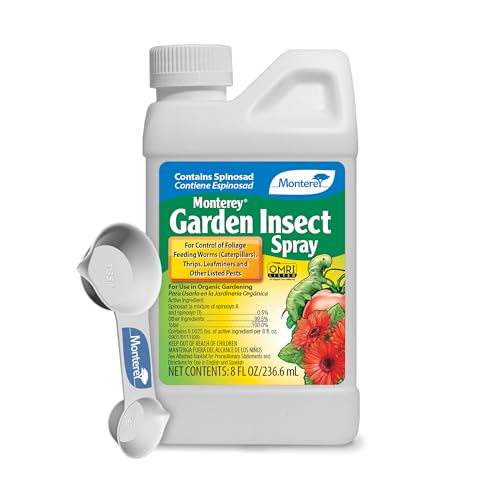
The heavy hitter for chewing insects that burrow inside leaves and resist soap-based sprays.
When caterpillars, leaf miners, or Colorado potato beetles have already tunneled into your vegetable leaves, a contact soap will not touch them. This is where spinosad excels. It is a naturally occurring soil bacteria that insects must ingest, and because the plant absorbs it systemically, it reaches pests hiding inside the leaf tissue. Owners mention it is “effective on harvester ants, not just fire ants,” meaning it reaches deep into nests and underground pests that other sprays miss. Unlike the Safer soap, which is a pure contact killer, this Monterey concentrate works as a stomach poison—the insect stops feeding soon after ingestion and dies over the next day or two.
The main difference from the other picks is the potency and the smaller bottle. At 8 fluid ounces (compared to the Safer 16 oz concentrate), this is more concentrated in effect but smaller in volume. You mix it at a lower ratio (about 1-2 tablespoons per gallon of water), so the small bottle still makes plenty of solution for a medium-sized garden. Buyers also note it is nearly odorless—”the smell is not too bad, it’s definitely bearable”—which is a perk when you are working around food plants. One reviewer called it “great stuff” for caterpillars on contact, and it is also effective on roses plagued with sawfly caterpillars.
Where it shines
- Systemic action reaches leaf miners, borers, and hidden caterpillars that soap misses
- Proven on harvester ants, not just fire ants — buyers confirm it works on tough ground-nesting pests
- Near odorless when mixed and applied
- OMRI listed and effective on a wide range: caterpillars, codling moths, thrips, and fire ants
Where it falls short
- 8 oz bottle is smaller than the Safer soap concentrate at 16 oz; higher cost per ounce
- Works slower than contact killers—insects stop eating but take a day or two to die
- Some buyers are uneasy using even an organic insecticide on food plants
Pull the trigger on this if: you have leaf miners, borers, or caterpillars that are already inside your vegetable leaves and a soap spray has not stopped the damage.
Pass if: your only pests are aphids or whiteflies on the leaf surface — the Safer soap kills them faster and costs less per bottle.
Understanding the Specs
Potassium Salts of Fatty Acids (Soap)
This is the contact killer you use when you see the bugs. It works by breaking down the waxy outer layer of soft-bodied insects like aphids, whiteflies, and spider mites on contact. Because it degrades fast (within hours), you can spray it right up to harvest day without worrying about residue on your vegetables. The catch: you have to hit every bug directly, and repeated use can damage the leaf surface if you over-apply or spray in direct sun. Mixing rates vary—Safer recommends 2-4 tablespoons per gallon of water for most vegetables.
Spinosad
Spinosad is a naturally occurring soil bacteria that insects must eat to die. It is systemic, meaning the plant absorbs it and carries it to the leaves, so it reaches pests like leaf miners and caterpillars that are hiding inside the leaf tissue. It works slower than soap—the insect stops feeding quickly but takes a day or two to die. Because it kills a broader range of chewing insects, it is often rotated with soap-based sprays to prevent resistance. It also lasts longer on the leaf than soap, so you get more protection between applications.
FAQ
Can I use these organic pesticides right up to the day I harvest my vegetables?
Will these sprays kill bees or other beneficial insects?
Which product is best for leaf miners on my tomato plants?
How do I mix the Safer 5118-6 concentrate correctly without burning my plants?
Can I use the Fertilome spinosad soap on my vegetable seeds or seedlings?
How long does it take for spinosad to kill caterpillars on my broccoli?
Should I rotate between soap and spinosad to prevent resistance?
Can I mix the Safer soap concentrate with the Monterey spinosad in the same sprayer?
Why does the Monterey spinosad bottle say “oil” as the item form?
Final Thoughts: The Verdict
For most vegetable gardeners, the best organic pesticide for vegetables is the Safer 5118-6 Insect Killing Soap Concentrate because its fast knockdown on aphids, whiteflies, and spider mites is backed by real buyer results (90% dead by day one) and the larger 16 oz bottle stretches further across a big garden. If you have leaf miners or caterpillars already inside your vegetable leaves, grab the Monterey Spinosad Concentrate for its systemic action (absorbed into the plant) that reaches hidden pests. And for the gardener with a bit of everything who wants one bottle without any mixing, the Fertilome (16076) Spinosad Soap gives you a convenient two-in-one solution that covers both chewing and soft-bodied insects.
How We Picked
We do not accept paid placement. Every pick is matched to a real buyer and a real use-case; we do not hands-on test units.
Sources & Methodology
Specifications: manufacturer listings and product documentation. Review insights: verified customer reviews, as of July 2026. Pricing: not shown on this page (it changes often); check the current price via the retailer link.
As an Amazon Associate, Lawn Gear Lab earns from qualifying purchases. This does not affect which products we feature.