
Specs are compiled from manufacturer listings and verified buyer reviews and can change over time — please confirm the key details on the product page before buying.
If your riding mower leaves grass that springs back underfoot, or puddles linger after a rain, your soil is packing down tight. A pull behind core aerator solves that by yanking out actual plugs of dirt, giving roots room to breathe and water a path down. That is the goal you care about — the rest is choosing the right rig for your tractor and your turf.
I’m Rikta — the founder and writer behind Lawn Gear Lab. This guide is built by comparing the manufacturers’ published specifications and the patterns across verified customer reviews, so you get each pick’s real strengths and trade-offs instead of marketing spin.
Down below I break down four models that do the yanking for you, from a value-minded 40-inch frame to a heavy-duty 48-inch workhorse that earns its keep on multiple lots. This is the best pull behind core aerator guide for homeowners who want pro results without renting a machine every spring.
Quick Picks
- Agri-Fab 48 In Tow Behind Lawn Plug Aerator — Best Overall
- Brinly Tow Behind Plug Aerator, 40″ — Premium Pick
- Suchtale 40-Inch Tow Behind Plug Aerator — Budget Friendly
- ouluu 40″ Lawn Aerator Tow Behind — Best Value
How To Choose The Best Pull Behind Core Aerator
Buying a pull behind aerator means looking past the price tag and focusing on your soil type, the size of your lawn, and how much weight your mower can tug. Here is what separates a one-pass wonder from a yard ornament.
Match Tine Count and Penetration Depth to Your Soil
Hard clay found in most backyards demands more tines digging deeper. A model that reaches a full 3 inches (the depth where root compaction starts) will deliver a visible difference. Models with fewer tines or shallower depth may scratch the surface without relieving the hardpan beneath. Look for 24 to 32 tines and a max depth of at least 2.5 inches if you have clay or loam.
Weight Tray Capacity Matters More Than You Think
The tray on top is where you place cinder blocks, sandbags, or steel plates to push the tines deeper. A tray cap of 150-220 lbs means you can dial in just enough weight for your conditions — low for sandy soil, high for dry clay. If the tray only holds 125 pounds, you might run out of payload halfway through a tough patch.
Hitch and Transport Leverage Save Your Back
A universal hitch connects to nearly any lawn tractor, ZTR, or ATV. The bigger deal is the transport lever — a handle that lifts the tines off the ground when crossing a driveway. Models that let you raise and lower the tines from the tractor seat (without dismounting) keep the job moving fast.
Quick Comparison
| Model | Best For | Working Width | Tine Count | Max Penetration | Amazon |
|---|---|---|---|---|---|
| Suchtale 40″ | Budget buy with good value | 40 in | 24 | 2 in | Amazon |
| Ouluu 40″ | Large weight tray capacity (220 lbs) | 40 in | 24 | 3 in | Amazon |
| Agri-Fab 48″ | Most durable frame and tine depth | 48 in | 32 | 3 in | Amazon |
| Brinly 40″ | Independent tine sections for uneven ground | 40 in | 24 | 3 in | Amazon |
In‑Depth Reviews
1. Agri-Fab 48 In Tow Behind Lawn Plug Aerator

A 92.5-pound steel frame with 32 self-sharpening knives that bite deeper than anything else here.
It pulls plugs a full 3 inches deep with 32 galvanized knives, beating the Suchtale’s 2-inch depth by 50%, so you get actual cores, not just scratches. The weight tray holds up to 175 pounds (a 26% gap vs the Suchtale’s 125-lb tray), meaning you can drop cinder blocks on top for clay soil that fights back.
Buyers report aerating “4 lots (each over 1/2 acres)” and praise the durability. The universal hitch hooks to nearly any lawn tractor, and the flat-free tires mean no punctures. The downside: at 48 inches wide and 60 inches long, it is a garage-space hog, and the transport lever often requires you to dismount the tractor to raise or lower it.
Why it earns the top slot
- 32 tines deliver a dense plug pattern in one pass
- 3-inch depth tackles hardpan where shallower rigs bounce
- Flat-free tires eliminate flat-spot worries during storage
What you trade off
- Heavy build (92.5 lbs) makes assembly tedious
- Storing upright is tough due to the long lever handle
- Center-heavy penetration on bumpy terrain; outer tines may ride shallow
Reach for this if: You have multiple lots or a single large yard with compacted clay, and you want a machine that will survive hitting a tree root.
Think twice if: You have a small garage or a lot of tight S-curves — the 48-inch width and bulky frame need room to maneuver.
2. Brinly Tow Behind Plug Aerator, 40″

Welded steel tine sections that rotate independently, so your bumpy yard gets even plugs side to side.
Unlike the Agri-Fab’s single rigid frame, the Brinly splits its three 24-tine sections on independent rotating axles. That means on a sloped or uneven lawn, each section follows the ground contour and pulls a consistent 3-inch plug instead of letting the center dig deep while the edges float. Builders report ~2.5-inch plugs from clay, and the heat-treated, 16-gauge steel spoons are narrower with sharpened ends for easier entry, requiring less weight on the tray.
The enclosed tray holds up to 150 pounds, and owners mention using a plastic tote filled with water for low-maintenance ballast. The universal hitch works with most ZTRs (zero-turn-radius mowers) and ATVs (all-terrain vehicles), and the transport lever lifts the tines for driveways. The trade-off: assembly has a reputation for being confusing (instructions cover multiple sizes), and the spoils are tedious to bolt on — expect about 2.5 hours.
Edge over the competition
- Three independently rotating sections track uneven ground evenly
- Sharpened, narrow spoons need less weight for full depth
- Semi-pneumatic rubber tires roll smoothly across asphalt
Speed bump
- Assembly instructions are generic and can cause head-scratching
- Tine spoils attachment is fiddly and time-consuming
- At 63.9 lbs, lighter than the Agri-Fab but still a two-person lift
Best suited for: Anyone with a rolling lawn, dips, or slopes — the independent sections make Brinly the smart choice for uneven terrain.
skip it if: You want a 48-inch swath or you need the absolute fastest assembly possible.
3. Suchtale 40-Inch Tow Behind Plug Aerator

A lightweight 40-inch frame that is easy to tow but only punches 2 inches deep, so it favors softer ground.
The weight tray holds up to 125 pounds, and customers note adding bricks or cinder blocks to improve bite.
Assembly runs about 90 minutes, and the 2-piece steel draw bar with a universal hitch pin connects easily. The trade-off is in the build: several reviews mention missing hardware (bolts E and G) and one described the unit as “built weak” after it fell apart. Unlike the Agri-Fab’s 32 tines, the 24 tines cover a narrower 40-inch path, so you will need more passes for the same area.
What works well
- Light 55-lb weight is easy to maneuver and store
- Universal hitch fits most garden tractors and ATVs
- Costs notably less than the premium picks
Where it falls short
- Only 2-inch max depth — shallow for clay soil
- Missing hardware reported in several boxes
- Some buyers questioned long-term structural integrity
Use it for: A small, already-loamy lawn where you want a light, affordable aerator that stores upright in a corner.
Pass on it if: Your ground is hard-packed clay or you plan to aerate more than a couple acres per season.
4. ouluu 40″ Lawn Aerator Tow Behind
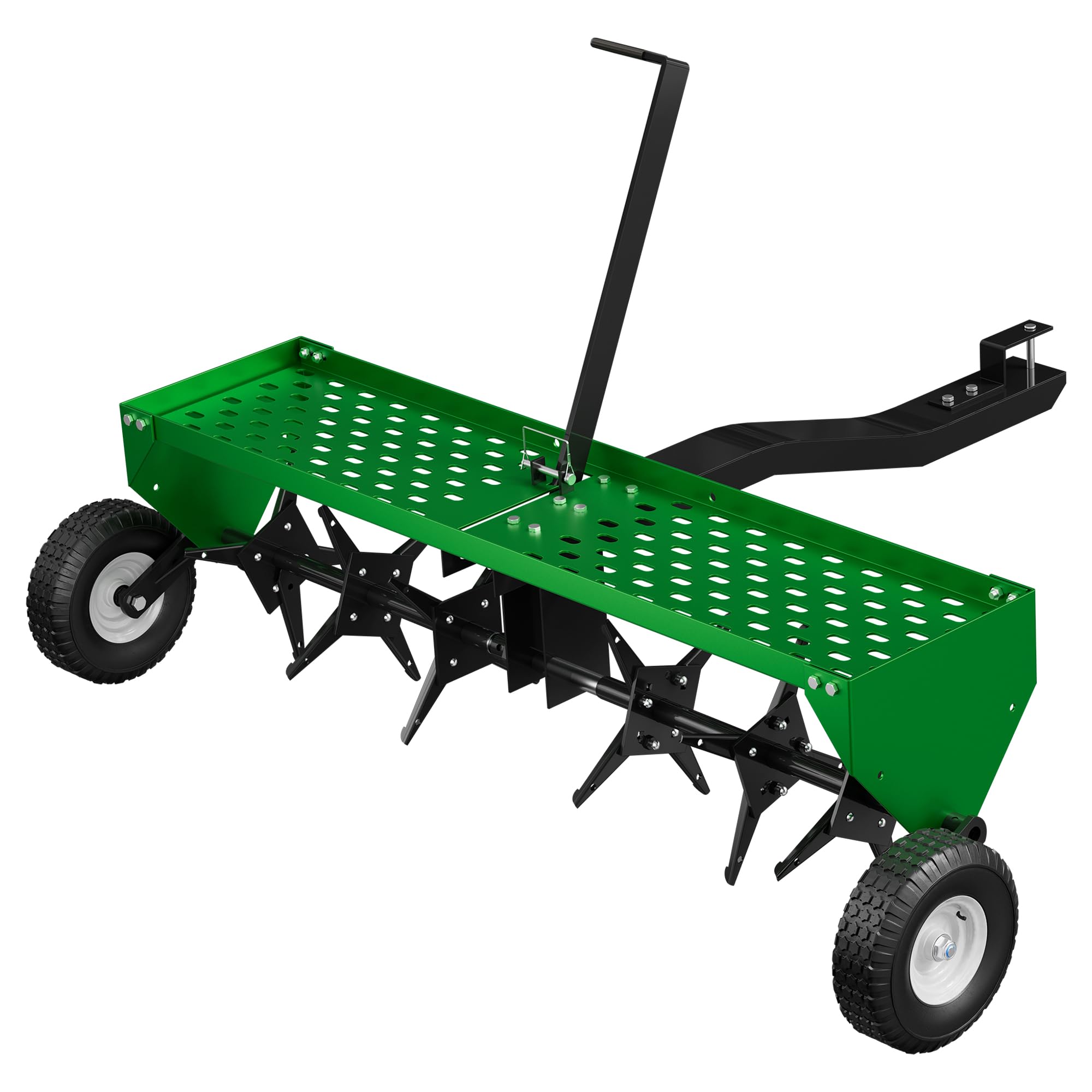
The biggest weight tray of the group at 220 lbs, letting you stack concrete on clay for a 3-inch bite.
That extra capacity is the key advantage: if your soil is dense, you can pile on cinder blocks or topsoil bags to push those 24 heat-treated tines down. The 40-inch working width is the same as the Suchtale, but the ouluu hits deeper, so you get real cores where the Suchtale leaves shallow holes.
Reviewers point out a serious assembly struggle — Some received missing parts, and one reported that “11 tines bent after two passes on rock-free yard,” raising durability concerns for heavy use. The universal hitch works with lawn tractors and ATVs, and the green rust-resistant coating keeps it looking clean. But the instructions are poor (One reviewer noted the instructions “are terrible with poor graphics; required multiple reassemblies.”), and the included wrenches are too flimsy to be useful.
Standout spec
- 220-lb tray capacity — the highest in this guide — for serious ballast
- 3-inch penetration matches the premium picks
- Pneumatic tires provide a smooth tow on pavement
Heads up
- Tines bent after light use according to several buyers
- Assembly is frustrating with unclear instructions
- Missing hardware common, and customer support is email-only
Ideal if: You have very heavy clay and need maximum tray capacity to force tines deep, and you are willing to spend extra time on assembly.
Not for you if: You want a trouble-free setup from the start or plan aerating rocky/sandy ground where thin tines could bend.
Understanding the Specs
Tine Count & Penetration Depth
The number of tines tells you how many plugs you pull per pass. More tines (32 vs 24) means more holes in a single row, so you can cover the same yard in fewer passes. Penetration depth is the real standout: 2 inches works for loose topsoil, but 3 inches is needed to break through the hardpan layer in clay. A 3-inch plug improves oxygen and water flow down to the feeder roots, not just the top inch.
Weight Tray Capacity
This is the platform on top where you place cinder blocks, sand tubes, or steel plates. The higher the capacity (measured in pounds), the more ballast you can add to drive the tines deeper into dry or compacted soil. If your tray only holds 125 pounds, you are limited in how much extra weight you can use. A 220-pound tray lets you stack enough mass to punch through stubborn clay without bouncing the aerator.
Independent vs Rigid Tine Sections
A rigid frame keeps all tines at the same angle, which can mean the center digs deep while the outer edges ride high on uneven ground. Independent rotating sections (like Brinly’s three welded sections) let each set of tines follow the ground contour individually. That gives you consistent plug depth across a bumpy lawn, reducing skipped spots and wasted passes.
Transport Lever & Hitch Type
The transport lever lifts the tines off the ground so you can cross a driveway or sidewalk without scraping asphalt. Some levers are reachable from the tractor seat (a big time saver); others require you to dismount. A universal hitch (pin style) attaches to nearly any lawn tractor, ZTR, or ATV without specialty adapters, making swap between aerating and mowing fast.
FAQ
How deep should a pull behind core aerator actually go?
Can I pull a core aerator with any lawn tractor?
What happens if I back up with the tines down?
How much extra weight should I put on the tray?
How long does it take to assemble a pull behind aerator?
Can I store a pull behind aerator upright in a garage?
How often should I aerate my lawn with a pull behind aerator?
What is the difference between core aeration and spike aeration?
Final Thoughts: The Verdict
For the majority of shoppers, the best pull behind core aerator winner is the Agri-Fab 48″ because it pairs the highest tine count (32) with a proven 3-inch penetration depth and a sturdy 92.5-lb frame that survives multiple seasons of abuse. If you have a bumpy yard with uneven terrain, grab the Brinly 40″ — its independent tine sections keep plugs consistent across dips. And for a budget-conscious entry that still pulls 3-inch plugs, the ouluu 40″ offers the biggest weight tray (220 lbs) if you are up for a challenging assembly.
How We Picked
We do not accept paid placement. Every pick is matched to a real buyer and a real use-case; we do not hands-on test units.
Sources & Methodology
Specifications: manufacturer listings and product documentation. Review insights: verified customer reviews, as of July 2026. Pricing: not shown on this page (it changes often); check the current price via the retailer link.
As an Amazon Associate, Lawn Gear Lab earns from qualifying purchases. This does not affect which products we feature.