
Specs are compiled from manufacturer listings and verified buyer reviews and can change over time — please confirm the key details on the product page before buying.
A cactus that stretches out, pale and thin, is the first sign that your light just isn’t strong enough. Most standard home lights don’t come close to the intense, direct sunlight a cactus evolved under. This guide cuts through the clutter to help you pick a grow light that delivers the kind of punch your spiky plants actually need to stay compact and colorful.
I’m Rikta — the founder and writer behind Lawn Gear Lab. This guide is built by comparing the manufacturers’ published specifications and the patterns across verified customer reviews, so you get each pick’s real strengths and trade-offs instead of marketing spin.
If you have ever wondered why your cactus looks more like a bean sprout than a desert dweller, the answer is almost always light intensity. This guide compares the top contenders for the title of best cactus grow light based on the specs that matter: actual power draw, number of LEDs, timer flexibility, and real-world coverage area.
Quick Picks
- FECiDA Desk Grow Light — Top Performer
- 4Head Tabletop Grow Light — Big Coverage
- SANSI Clip-on Grow Light — Precision Clip
- LBW Grow Light with Base — Smart Value
- bseah Desk Grow Lamp — Budget Champ
How To Choose The Best Cactus Grow Light
Before you buy, focus on three things: light intensity, coverage, and control. A cactus is not a fern — it expects full, punishing sun. A weak light (under 10 watts of actual LED power) will keep a cactus alive but never let it thrive, flower, or hold its natural shape. Look for a fixture that uses a full spectrum of LEDs, including red and blue wavelengths, and ideally UV or IR diodes that mimic the sun’s complete output.
Intensity and Power Draw
The raw wattage of the light is your first clue. A light that draws 10 watts is good for a single small succulent on a desk. A light drawing 25 or 36 watts begins to cover multiple pots and can reach deeper into taller plants. Don’t be fooled by “equivalent” wattage claims — the actual power draw from the wall is the honest number. Buyers report that lights below 10W are only useful for very low-light houseplants, not for cacti that demand high intensity.
Spectrum and Wavelengths
Look for a light that advertises “full spectrum” or includes specific red (around 660nm) and blue (around 450nm) wavelengths. Red light encourages flowering and fruiting, while blue light supports compact, stocky growth and prevents stretching. Some premium lights add UV and IR diodes — UV light can help cacti develop tougher skin and more vibrant coloration, mimicking their natural high-altitude or desert conditions.
Timer and Ease of Use
Cacti need a strict day/night cycle. An automatic timer is not optional — it is essential. The best models offer multiple preset durations (3, 6, 9, 12, or 16 hours) that repeat daily. You want to set it to 12-14 hours and walk away. Check if the timer holds its programming after a power outage; some cheaper lights reset and require you to set the schedule again.
Quick Comparison
| Model | Best For | Power Draw | Light Modes / Levels | Timer Options | Amazon |
|---|---|---|---|---|---|
| FECiDA Desk Grow Light | High-Intensity Coverage | 25 Watt | UV-IR Full Spectrum | Touch Control (use smart plug) | Amazon |
| 4Head Tabletop Grow Light | Broad Desk Coverage | 36 Watt | Sunlight Full Spectrum | 4/8/12/16/20 Hours | Amazon |
| SANSI Clip-on Grow Light | Targeted Single Plant | 10 Watt | 4 Levels (25-100%) | 3/6/12 Hours | Amazon |
| LBW Grow Light with Base | Compact Shelf Setup | LED Panel | 5 Levels (20-100%) | 6/8/12/16 Hours | Amazon |
| bseah Desk Grow Lamp | Budget Desktop Starter | 72 LEDs | 10 Dimmable Levels | 3/9/12 Hours | Amazon |
In‑Depth Reviews
1. FECiDA Desk Grow Light
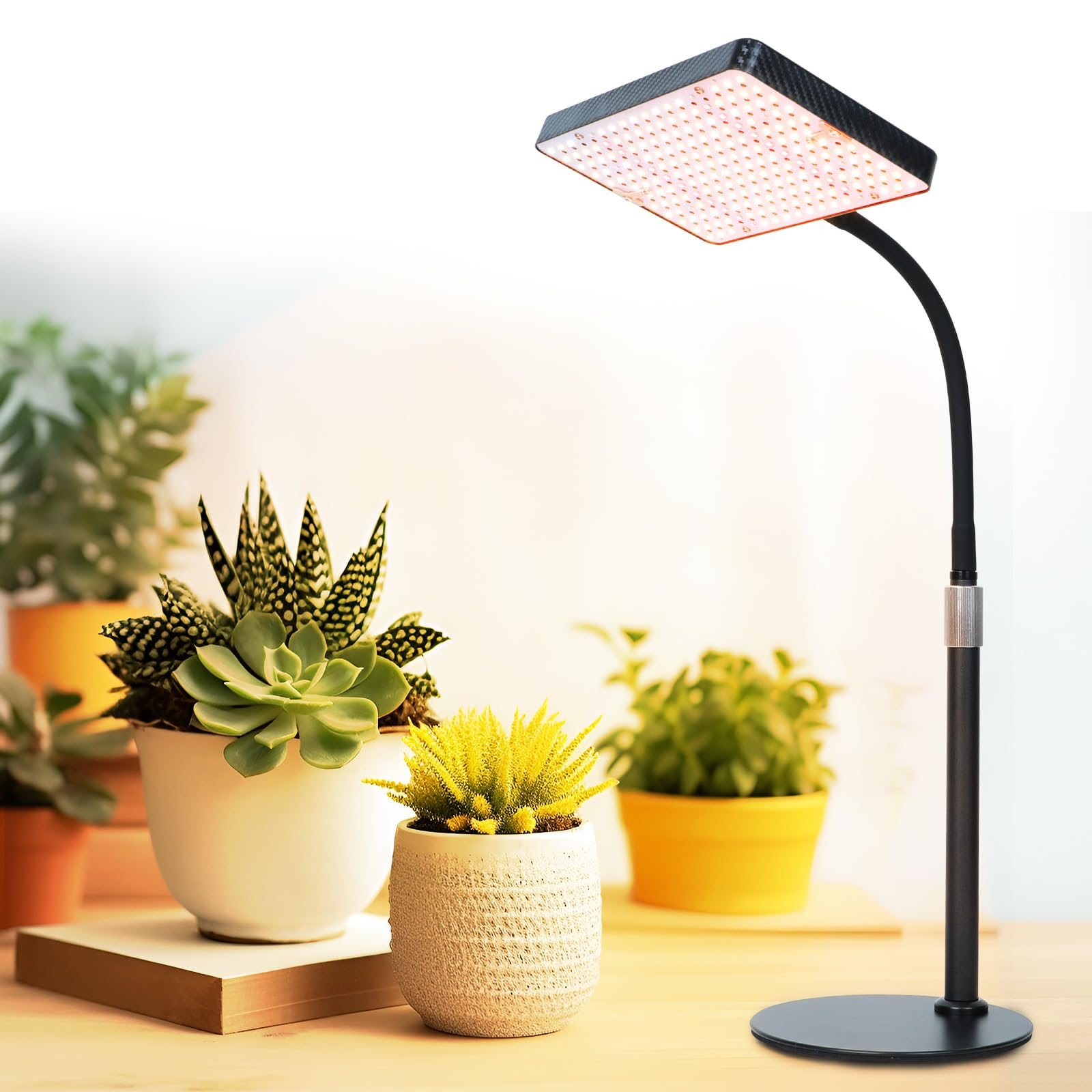
The powerhouse desk lamp that brings genuine sunlight spectrum to your desert collection.
This is the light to reach for when your cactus collection outgrows a single clip-on bulb. The FECiDA draws 25 watts of actual power and delivers 2,000 lumens of brightness through 208 high-quality LEDs. But the real advantage for cacti is the spectrum: it includes not just standard full-spectrum diodes (3,000K and 5,000K) but also dedicated 660nm red, UV, and IR LEDs. The 395nm UV light, in particular, helps cacti develop tougher skin and more vibrant coloring, much like what they would get under the high-UV desert sun they evolved under.
Owners mention the light is “extremely bright” and can “illuminate an entire room,” so you can cover several medium-sized cactus pots on a desk or shelf. The stand adjusts from 16 to 24 inches tall, and the simple touch control switch has fewer electronics to fail. For an automated schedule, plug it into a smart outlet — the daisy chain output lets you connect up to four units from one wall plug, so you can scale up as your collection grows.
At 25 watts, it is less powerful than the 36-watt 4Head below, but the inclusion of UV and IR wavelengths gives it an edge in spectral quality that serious cactus growers will appreciate. Unlike the SANSI clip-on, the FECiDA requires desk space and cannot clip onto a pot rim.
The real draw: 25W actual power draw, 2,000 lumens, and UV-IR full spectrum make this the most versatile and scientifically complete light for a serious desk setup.
The trade-off: No built-in timer — you will need an external smart plug for automated schedules.
Reach for this if: You have several cacti on a desk or shelf and want the spectral quality to encourage flowering and compact, colorful growth.
Look elsewhere if: You need a tiny clip-on for a single pot on a windowsill, or you refuse to buy an external timer.
2. 4Head Tabletop Grow Light
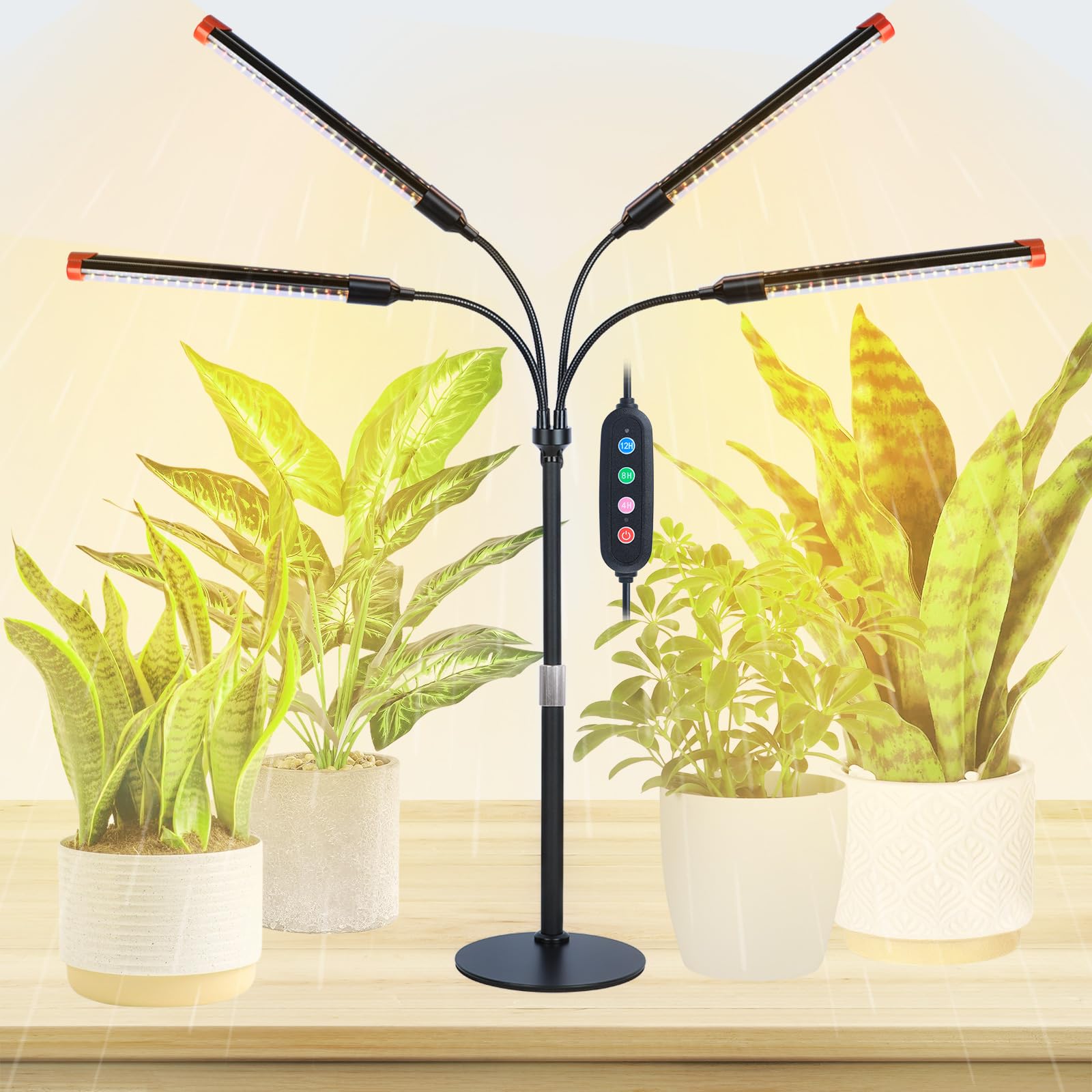
The widest net of light for a crowded bench of starter plants and seedlings.
If you are starting seeds or keeping a flat of small cacti happy under one beam, the 4Head is the brightest option here at a 36-watt actual power draw — a clear step above the FECiDA’s 25 watts. It packs 168 high-quality LEDs and uses a 60° spotlight design that concentrates the light downward without spilling wasted lumens onto your walls. The full spectrum is described as “natural sunlight,” which gives cacti the balanced red and blue wavelengths they need to stay compact and avoid etiolation (that telltale pale stretching).
A major win is the built-in timer, which offers five modes: 4, 8, 12, 16, and 20 hours. This is the most flexible timer set in this roundup — you can dial in exactly the photoperiod your species demands without plugging in an external smart plug. Customers note that the stand is “well-balanced” and “doesn’t tip,” and the flexible arms can be angled to position light closer to specific pots. Unlike the FECiDA, the 4Head does not include UV or IR diodes, but its raw power and broad coverage make it better suited for a propagation station or a multi-shelf tabletop.
The catch, noted by buyers, is that the light intensity is not adjustable — it runs at full power only. For a cactus that needs intense, direct light, that is actually a benefit, but if you also have sensitive ferns on the same desk, you might need to move them farther away.
What stands out
- Highest power draw at 36 watts for the most intense light output.
- Five timer modes (4/8/12/16/20H) for total schedule control without an external device.
- No adapter needed — plugs directly into a wall outlet for longer lifespan.
One limitation
- No dimming — the light runs at 100% output at all times, which may be too intense for non-cactus plants sharing the same space.
Grab this for: Seed starting and broad desk coverage where raw intensity and a flexible built-in timer are non-negotiable.
skip it if: You need a dimmable light that can serve both a bright-light cactus and a shade-loving houseplant on the same desk.
3. SANSI Clip-on Grow Light

The surgical-grade clip-on that packs surprising punch for a single pot.
When you need concentrated light on one specific cactus — not an entire desk — the SANSI is the most targeted tool for the job. It draws 10 watts using SANSI’s proprietary ceramic technology, which the company claims delivers 4.7 times higher output than other 10-watt lights. The practical result, verified by buyers, is that it “promoted new leaf growth on monstera in one month” — proof of the intensity concentrated through its small 2.64-inch wide head. At 6 inches, it delivers 169.7 μmol/s/㎡ of growing power, which is enough to keep a small barrel cactus or a succulent cluster compact and colorful.
The 360° gooseneck clips directly onto the rim of a pot, saving desk space and putting the light exactly where you want it. The built-in timer offers three modes — 3, 6, or 12 hours — and the four dimming levels (25%, 50%, 75%, and 100%) let you tailor intensity to the plant’s needs. For a single cactus on a deep windowsill or a bookshelf, this is a much cleaner solution than the bulkier freestanding stands of the FECiDA or 4Head. Reviewers point out the clip is strong and holds position well, though the gooseneck may be too short for tall columnar cacti unless you clip above the pot.
Compared to the LBW ring light, the SANSI is more intense at a closer range but covers a smaller area. It is the better choice for a single high-value specimen.
Perfect placement: The clip-on design and ceramic LED tech deliver high intensity right where a single cactus needs it, without lighting up an entire room.
The limit: 10 watts means coverage for only one or two small pots — it cannot replace a desk unit for a collection.
Best for: A single prized cactus on a desk or shelf where space is tight and you want the light right on the plant.
Not for: Covering a tray of seedlings or multiple large pots.
4. LBW Grow Light with Base

The ring-shaped workhorse that fits neatly into a shelf system without clutter.
This 3-pack of ring lights trades raw wattage for versatility and a space-saving form factor. The LBW design uses a telescoping pole that adjusts from 7.8 to 26 inches tall, with a 78-inch long cord for flexible placement. It offers three light colors (white, warm, and full spectrum) and five brightness levels from 20% to 100%, letting you dial in the exact look and intensity for your setup. The full spectrum emits wavelengths from 380nm to 800nm, covering the key red and blue bands cacti need for compact growth and flowering.
The base is unique: it requires a flower pot pressing down on it to stay stable. Buyers confirm this, saying to “tuck base under pot to secure” — without that weight, the stand is top-heavy. This makes it best for a shelf or a desk where you already have several small pots in a row. The timer has four settings (6/8/12/16 hours), and each light can be set independently. Unlike the SANSI clip-on, the LBW ring design wraps light around the plant from all sides, which some growers prefer for even coverage.
The catch is that the light panel itself is small, so it works best for short, squat cacti and succulents rather than tall columnar species. And while the stand is stable with a pot on it, shoppers say it is “slightly unstable without a pot on base.”
Why it works
- Three color modes and five brightness levels give you fine control over light quality and intensity.
- The telescoping pole (7.8″ to 26″) adapts to different plant heights on a shelf.
- 12-month warranty and 30-day satisfaction policy provide solid buyer protection.
Know this
- The stand needs a flower pot on the base to stay stable — it is not a self-contained freestanding unit.
- One reviewer noted the timer setup was unclear and the light may be too bright for a nightlight.
Ideal for: A shelf of small succulents and cacti where you want a low-profile ring light that doubles as a decorative piece.
Avoid if: You need a stable stand without a pot anchoring the base, or you have tall cactus species that exceed the 26-inch height.
5. bseah Desk Grow Lamp

A simple, affordable desk lamp that gets the job done without costing a fortune.
If you have a single cactus on your desk and you just want it to survive the winter without stretching, the bseah is the entry-level pick that works. It uses 72 high-performance LEDs in a full spectrum configuration and offers 10 dimmable brightness levels — more granular than the SANSI’s 4 levels or the LBW’s 5 levels. The timer has three options (3/9/12 hours), and the telescoping rod adjusts from 15 to 26 inches. The metal base has a sponge pad to prevent slipping and scratching your desk.
Buyers appreciate the timer feature, with one noting they “set it for 12 hours and it comes on each day” — exactly the kind of low-maintenance automation a cactus needs. The full spectrum includes the red and blue wavelengths that prevent leggy growth. However, multiple buyers report a significant flaw: the timer function “resets itself after a week or two of use,” which defeats the purpose of automation. If you can tolerate resetting the schedule every 10-14 days, the light hardware is solid for the price. At 72 LEDs, it is less powerful than the FECiDA’s 208 LEDs or the 4Head’s 168, so it is best for a single small pot.
Compared to the LBW, the bseah has a more stable self-contained base that does not require a pot for balance, but the LBW has a more reliable timer and a longer warranty.
The value pitch: 10 dimmable levels and a full spectrum at a truly budget-friendly price make this a low-risk entry point for a single desk cactus.
The weakness: The timer memory glitch reported by buyers means you cannot count on it for long-term automated schedules — expect to re-set it periodically.
Use it for: A single small cactus on your work desk where you are willing to reset the timer every week or two in exchange for a low upfront cost.
Pass on it if: You need a reliable, long-term automated schedule or if you want to cover more than one medium pot.
Understanding the Specs
Power Draw (Actual Watts)
This is the most honest measure of a light’s strength. A light that draws 10 watts from the wall is a different animal from one drawing 36 watts. Cacti are high-light plants — they thrive under the intense direct sun of a desert. For a single small pot, 10 watts can work if the light is close (within 6 inches). For a collection on a desk, aim for 25 watts or more. The “incandescent equivalent” rating you sometimes see (like “200W equivalent”) is a marketing comparison that inflates the perceived output — always check the actual power draw in the technical specs.
PPFD and Spectrum
PPFD (Photosynthetic Photon Flux Density) measures how many usable light particles reach your plant’s leaves per second per square meter. The SANSI, for example, lists 169.7 μmol/s/㎡ at 6 inches — a strong number for a clip-on. More important for cacti is the spectrum: full-spectrum lights mimic the sun by including a mix of cool white (blue-rich, 5000K) and warm white (red-rich, 3000K) diodes. UV light (around 395nm) adds stress that encourages cacti to produce protective pigments, resulting in the vivid reds, purples, and oranges that collectors prize. IR light aids flowering and seed development.
FAQ
Can a cactus get too much light from a grow light?
What color light is best for cactus growth?
How many hours a day should a cactus grow light run?
Will a grow light prevent my cactus from stretching?
Can I use a regular LED desk lamp for my cactus?
Is a clip-on or a desk stand grow light better for cacti?
How do I know if my cactus is getting enough light from a grow light?
How far should I place a grow light from my cactus?
Will a grow light work for cacti that do not get any natural sunlight?
What is the difference between a 10W and a 36W grow light for cacti?
Final Thoughts: The Verdict
For most people, the best cactus grow light winner is the FECiDA Desk Grow Light because its 25-watt power, UV-IR full spectrum (ultraviolet and infrared wavelengths that mimic sunlight), and daisy chain expandability give you the best balance of intensity, spectral quality, and scale for a growing cactus collection. If you want the widest coverage and the most flexible built-in timer, choose the 4Head Tabletop Grow Light at 36 watts — it covers a larger area than the FECiDA. And for a single desktop cactus that needs precise, targeted light, the SANSI Clip-on Grow Light delivers compact ceramic power with a simple clip-on setup, so you can aim it exactly where needed.
How We Picked
We do not accept paid placement. Every pick is matched to a real buyer and a real use-case; we do not hands-on test units.
Sources & Methodology
Specifications: manufacturer listings and product documentation. Review insights: verified customer reviews, as of July 2026. Pricing: not shown on this page (it changes often); check the current price via the retailer link.
As an Amazon Associate, Lawn Gear Lab earns from qualifying purchases. This does not affect which products we feature.