
Specs are compiled from manufacturer listings and verified buyer reviews and can change over time — please confirm the key details on the product page before buying.
The sight is heartbreaking: a perfect-looking tomato with a black, leathery bottom just as it starts to ripen. That is blossom end rot, and the missing piece is almost always calcium your plant can actually use. Getting the right calcium carbonate into your soil—without making the pH swing wildly or locking out other nutrients—is the single most important trick to getting plump, blemish-free fruit from every single vine.
I’m Rikta — the founder and writer behind Lawn Gear Lab. This guide is built by comparing the manufacturers’ published specifications and the patterns across verified customer reviews, so you get each pick’s real strengths and trade-offs instead of marketing spin.
Whether you are dealing with heavy clay, sandy loam, or raised beds, I have broken down three very different approaches to soil calcium into an honest comparison of calcium carbonate for tomatoes. Each one was chosen because it brings something genuinely different to the garden.
Quick Picks
- Espoma Organic Tomato-Tone 3-4-6 with 8% Calcium — Best Overall
- 5 Pounds Calcium Carbonate Limestone Powder by — Best Value
- Greenway Biotech, Inc. Dolomite Lime Plus — Magnesium Boost
How To Choose The Best Calcium Carbonate For Tomatoes
Before you buy, you need to know that not all calcium is the same for tomato plants. A calcium source that works wonders in one garden can actually create problems in yours if you ignore the starting pH and the other nutrients in the bag. Here are the three things that matter most.
Calcium Content vs. Magnesium Content
Some products deliver calcium alone, while others pair it with magnesium. If your soil already has enough magnesium (common in many loamy soils), adding more can lock up potassium and hurt fruit production. A pure calcium carbonate product gives you only what you are after without the extra baggage. If your soil is deficient in magnesium, a dolomitic lime that includes both nutrients is the smarter single-bag solution.
Particle Size and Speed of Action
Calcium carbonate works by dissolving into the soil solution, and finer particles dissolve faster. A very fine powder can start raising pH within weeks, while coarser rock dust may take several months to fully break down. For a quick-season crop like tomatoes, you want a product fine enough to become available to the roots during the growing window, not next year.
Application Method and Convenience
A soluble powder you mix into water lets you target individual plants precisely. A granular fertilizer you sprinkle around the drip line is easier for a large patch but works more slowly. Your choice depends on if you want to fix a specific deficiency this week or build long-term soil structure over the whole season.
Quick Comparison
| Model | Best For | Calcium Source | Calcium Content | Weight | Amazon |
|---|---|---|---|---|---|
| 5 Pounds Calcium Carbonate Limestone Powder | Fast soluble calcium for targeted treatment | Limestone Powder | Not listed | 5 Pounds | Amazon |
| Greenway Biotech Dolomite Lime Plus | Calcium plus magnesium for deficient soils | Dolomite Lime | 22.7% Calcium / 11.8% Magnesium | 5 Pounds | Amazon |
| Espoma Organic Tomato-Tone 3-4-6 | Complete feeding for sustained fruit production | Bio-tone Formula (8% Calcium) | 8% Calcium (included in NPK) | 18.1 Pounds | Amazon |
In‑Depth Reviews
1. Espoma Organic Tomato-Tone 3-4-6 with 8% Calcium

A complete feeding plan in a single bag that prevents blossom end rot while it feeds your whole patch.
This is not just a calcium source—it is a 3-4-6 fertilizer analysis (NPK, the ratio of nitrogen, phosphorus, and potassium) with 8% calcium blended in using Espoma’s Bio-tone formula (a proprietary mix of beneficial microbes). That means you are fixing the calcium shortage and feeding the rest of the plant at the same time. The low nitrogen number (3) means you will not get giant leafy plants with tiny fruits, a common mistake beginners make with generic all-purpose fertilizers. Reviewers report this is “the go-to, must have fertilizer for growing tomato plants” for exactly that reason.
At 18.1 pounds, this bag weighs more than 3.6 times as much as the 5-pound calcium carbonate powder from The Seed Supply. Buyers in the Southeast especially praise that “Espoma Tomato Tone outperforms other organic tomato fertilizers” in their region. The granules are ready to use straight from the bag, no mixing required, and you apply it every two weeks through the growing season by sprinkling it around the drip line and watering it in.
The catch is that this is not a quick emergency fix. Unlike a fine powder that dissolves fast, the granules work over time as soil microbes break them down. If your tomatoes already have blossom end rot, this product prevents future fruits from getting it—it will not fix the ones already on the vine.
Why it earns the top spot
- Delivers a precise 3-4-6 NPK ratio matched specifically to tomato growth needs
- Includes 8% calcium to stop blossom end rot while feeding the whole plant
- Enriched with Bio-tone microbes that feed the living soil, not just the plant
- Approved for organic gardening — meets all requirements for organic production
The trade-off to know
- Granular form works slowly — not an emergency treatment for existing rot
- Heavy 18.1-pound bag may be more than a small container garden needs
Reach for this if: You want one product that feeds your tomatoes from seedling through harvest while stopping calcium deficiency before it starts — perfect for in-ground patches with 6+ plants.
Look elsewhere if: You need a fast-acting calcium boost for a single plant showing symptoms right now.
2. 5 Pounds Calcium Carbonate Limestone Powder by The Seed Supply
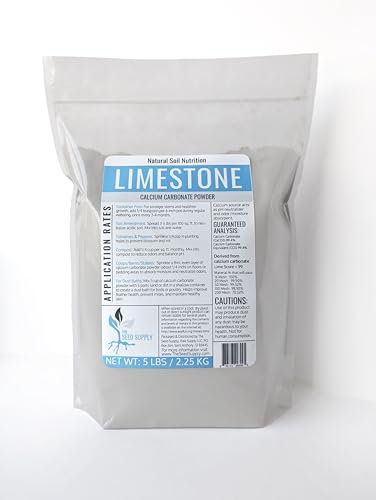
A bare-bones pure calcium powder that works fast but makes you do the blending yourself.
Unlike the Espoma granular fertilizer above, this is straight-up limestone powder with a mesh size up to 300 (a fine grind that dissolves quickly in moist soil). It has no added nitrogen, phosphorus, or potassium — it is calcium carbonate and nothing else. That makes it a precision tool if your soil already has enough organic matter and you just need to fix a calcium shortage or a low pH (acidic soil). The manufacturer recommends mixing 1/4 cup into each planting hole specifically to prevent blossom end rot on tomatoes and peppers.
Buyers have found uses beyond the garden, too. One reviewer noted using it “as a human calcium supplement” mixed with grape juice, noting it was “slightly fizzy, reminiscent of grape soda” and claiming it “immediately relieved pain from an exposed tooth nerve.” Another uses it for chickens to harden egg shells. For tomatoes, the clear advantage over the Greenway Biotech Dolomite Lime below is that you get pure calcium without the added magnesium — so you only raise the pH and add calcium, nothing else.
The main downside is the bag size. At 5 pounds, the bag is small — one reviewer was surprised: “It says 5 lbs but it was such a small bag I was surprised.” For a large garden, you will need several bags to cover the 3-5 lbs per 100 square feet the maker suggests for amending soil. This works best as a targeted plant-by-plant treatment rather than a whole-patch overhaul.
Pure calcium precision: A fast-acting, unblended powder ideal for treating individual planting holes or container pots where you do not want to alter magnesium levels.
Buy it for: Spot-treating a few tomato plants in containers or small raised beds where you already have good soil and just need a calcium lift.
skip it if: You are amending a large in-ground patch — you will need multiple bags and a separate fertilizer application.
3. Greenway Biotech, Inc. Dolomite Lime Plus

The calcium-magnesium combo for gardens where both minerals are running low.
This is the middle child that fills a specific gap neither of the other two products covers. It delivers 22.7% calcium and 11.8% magnesium, both in a single finely milled powder that buyers report “Raises pH effectively in soil and water.” The magnesium is what separates it from the pure limestone powder above — if your soil test shows a magnesium deficiency (common in sandy soils and in regions with heavy rainfall), this is the only product on this list that addresses that problem without a separate purchase.
Reviewers consistently mention how fine the powder is — “extremely fine powder” and “fine, evenly milled, non-caking powder” are common notes. One gardener reported “good results on tomatoes in clay soil” but went through the 5-pound bag quickly on an 8-foot by 8-foot patch. Another buyer uses it specifically to control pot worms in vermiculture bins, saying it “neutralizes acidity to control pot worms” by balancing the pH of the bin. The same user notes it “prevents pot worms from outcompeting earthworms for food.”
Compared to the Espoma Tomato-Tone, this powder works faster because of how fine it is, but it lacks the complete NPK (nitrogen, phosphorus, potassium) feeding that a full fertilizer provides. You will still need a balanced fertilizer alongside this to get good fruit set. And compared to the pure limestone powder from The Seed Supply, you are getting magnesium whether your soil needs it or not — so a soil test is strongly recommended before you reach for this bag.
The extra mineral advantage
- Guaranteed 22.7% calcium and 11.8% magnesium in one fine powder
- Extremely fine grind dissolves quickly for faster pH adjustment
- Non-caking formula stays pourable even in humid conditions
- Dual-purpose for pH buffering and nutrient supply in one application
The single-purpose catch
- Contains no NPK (nitrogen, phosphorus, potassium) — requires a separate fertilizer for complete plant nutrition
- Adds magnesium even if your soil already has enough, risking nutrient lockout
Best for gardeners who: Have a confirmed magnesium deficiency from a soil test or are working in naturally magnesium-poor sandy soil — the extra mineral is an asset, not a risk.
Not for you if: Your soil is already rich in magnesium and you just need the calcium — the pure limestone powder is the cleaner approach.
Understanding the Specs
Calcium Content vs. pH Adjustment
Calcium carbonate works by neutralizing acidic soil—it binds with hydrogen ions and raises the pH toward neutral (7.0). Tomatoes grow best between 6.2 and 6.8 pH, where calcium is most available to the roots. A product with a high calcium percentage like 22.7% (Greenway) will raise pH faster than an 8% calcium blend (Espoma), but too much too fast can lock up iron and zinc. Always test your soil pH before applying and aim to raise it gradually over two seasons, not all at once.
Pure Mineral vs. Complete Fertilizer
There is an important difference between a straight calcium carbonate powder and a fertilizer that happens to contain calcium. The pure limestone powder (The Seed Supply) and the dolomite lime (Greenway) only supply minerals—they add no nitrogen, phosphorus, or potassium. The Espoma Tomato-Tone, on the other hand, is a complete 3-4-6 fertilizer that also delivers 8% calcium. If your soil is already fertile and you just need calcium, the pure powder saves you from overfeeding nitrogen. If your soil is depleted, the complete fertilizer feeds everything at once.
FAQ
What is the best way to apply calcium carbonate to tomato plants?
Can calcium carbonate prevent blossom end rot completely?
How much calcium carbonate do I need per tomato plant?
Is dolomite lime the same as calcium carbonate?
Can I use too much calcium carbonate on tomatoes?
How long does calcium carbonate take to work in the soil?
Should I use calcium carbonate or gypsum for tomatoes?
What is the difference between the Espoma Tomato-Tone and the pure limestone powder?
Can I mix calcium carbonate with water and spray it on leaves?
Is calcium carbonate safe for organic gardening?
Final Thoughts: The Verdict
Across the board, the calcium carbonate for tomatoes winner is the Espoma Organic Tomato-Tone 3-4-6 because it combines a careful 3-4-6 NPK ratio with 8% calcium in one convenient bag — feeding both the soil and the fruit while preventing blossom end rot before it starts. If you need pure fast-acting calcium for a targeted spot treatment, grab the 5 Pounds Calcium Carbonate Limestone Powder by The Seed Supply. And for gardens where a soil test has confirmed a magnesium deficiency, the Greenway Biotech Dolomite Lime Plus solves two mineral shortages at once in a single fine powder.
How We Picked
We do not accept paid placement. Every pick is matched to a real buyer and a real use-case; we do not hands-on test units.
Sources & Methodology
Specifications: manufacturer listings and product documentation. Review insights: verified customer reviews, as of July 2026. Pricing: not shown on this page (it changes often); check the current price via the retailer link.
As an Amazon Associate, Lawn Gear Lab earns from qualifying purchases. This does not affect which products we feature.