
Specs are compiled from manufacturer listings and verified buyer reviews and can change over time — please confirm the key details on the product page before buying.
If your lawn feels more like a brick wall than a soft carpet, you likely have compacted soil—a layer so dense that water, air, and nutrients cannot reach the roots. Aeration tools fix this by punching holes into the ground, either by driving solid spikes through the dirt or pulling out actual plugs of soil (coring). Which method you choose, and how much effort you are willing to invest, decides whether your yard breathes again or stays suffocated.
I’m Rikta — the founder and writer behind Lawn Gear Lab. This guide is built by comparing the manufacturers’ published specifications and the patterns across verified customer reviews, so you get each pick’s real strengths and trade-offs instead of marketing spin.
This roundup cuts through the options to deliver the best aeration tools for everything from tiny garden patches to sprawling lawns, rated on build quality, coring depth, and how easy they are on your back.
Quick Picks
- Xuperace Lawn Aerator (GD0001-02) — Best Overall
- Dolibest Lawn Coring Aerator — Premium Pick
- EEIEER Manual Lawn Aerator (2025 Upgraded) — Top Performer
- Dolibest Lawn Coring Aerator (4-Corer Stainless) — Compact Pick
- LawnVigor Manual Core Aerator (LV-ALT4-ORANGE) — Best Value
- MEIIOFS Lawn Aerator (CTGJ-01) — Budget Champion
- Jardineer Lawn Spike Aerator (US1130) — Budget Pick
How To Choose The Best Aeration Tools
Picking the right tool means matching your soil type, yard size, and how much physical work you can handle. Here are the three things that matter most.
Spike vs. Core (Plug) Aerator
A spike aerator simply pokes holes with solid tines. This can actually compact the soil around the hole, working against your goal on dense clay. A core aerator uses hollow tines to pull out a plug of soil, creating a real channel for air and water. For seriously compacted lawns, a core/pulling aerator is the better choice. Spike tools are lighter and faster for occasional upkeep on already-healthy soil.
Number of Tines and Depth
More tines (4 vs. 3) mean each stamp covers more ground, but the tool also gets heavier and harder to push in. Depth is even more important—look for tines that reach at least 2.5 to 3 inches into the soil. Shallow holes (under 2 inches) do not relieve compaction deep enough for grass roots to spread freely.
Build Quality and Your Back
Steel foot plates and rubber grips reduce fatigue. A longer handle (around 36 to 38 inches) saves you from hunching over. A soil storage tray collects ejected cores so you are not raking them up afterward. Check the item weight: a heavier tool (around 6 pounds) is sturdier but harder to lift and move repeatedly across a large yard.
Quick Comparison
| Model | Best For | Aeration Type | Tines | Weight | Amazon |
|---|---|---|---|---|---|
| Xuperace GD0001-02 | Small to medium lawns (non-clogging) | Core (Plug) | 3 | 5.69 lbs | Amazon |
| Dolibest 4-Plug w/ Tray | Precision work with collected plugs | Core (Plug) | 4 | 6.19 lbs | Amazon |
| EEIEER 2025 Upgraded | Mid-sized yards (back-friendly) | Core (Plug) | 3 | 6.4 lbs | Amazon |
| Dolibest 4-Corer Stainless | General small yard work | Core (Plug) | 4 | 5.54 lbs | Amazon |
| LawnVigor LV-ALT4-ORANGE | Compacted clay soils (deep core) | Core (Plug) | 3 | 3.52 lbs | Amazon |
| MEIIOFS CTGJ-01 | Smaller areas (soil tray included) | Core (Plug) | 4 | 6.4 lbs | Amazon |
| Jardineer US1130 | Quick spike aeration on small yards | Spike | 12 (spikes) | 5.02 lbs | Amazon |
In‑Depth Reviews
1. Xuperace Lawn Aerator (GD0001-02)
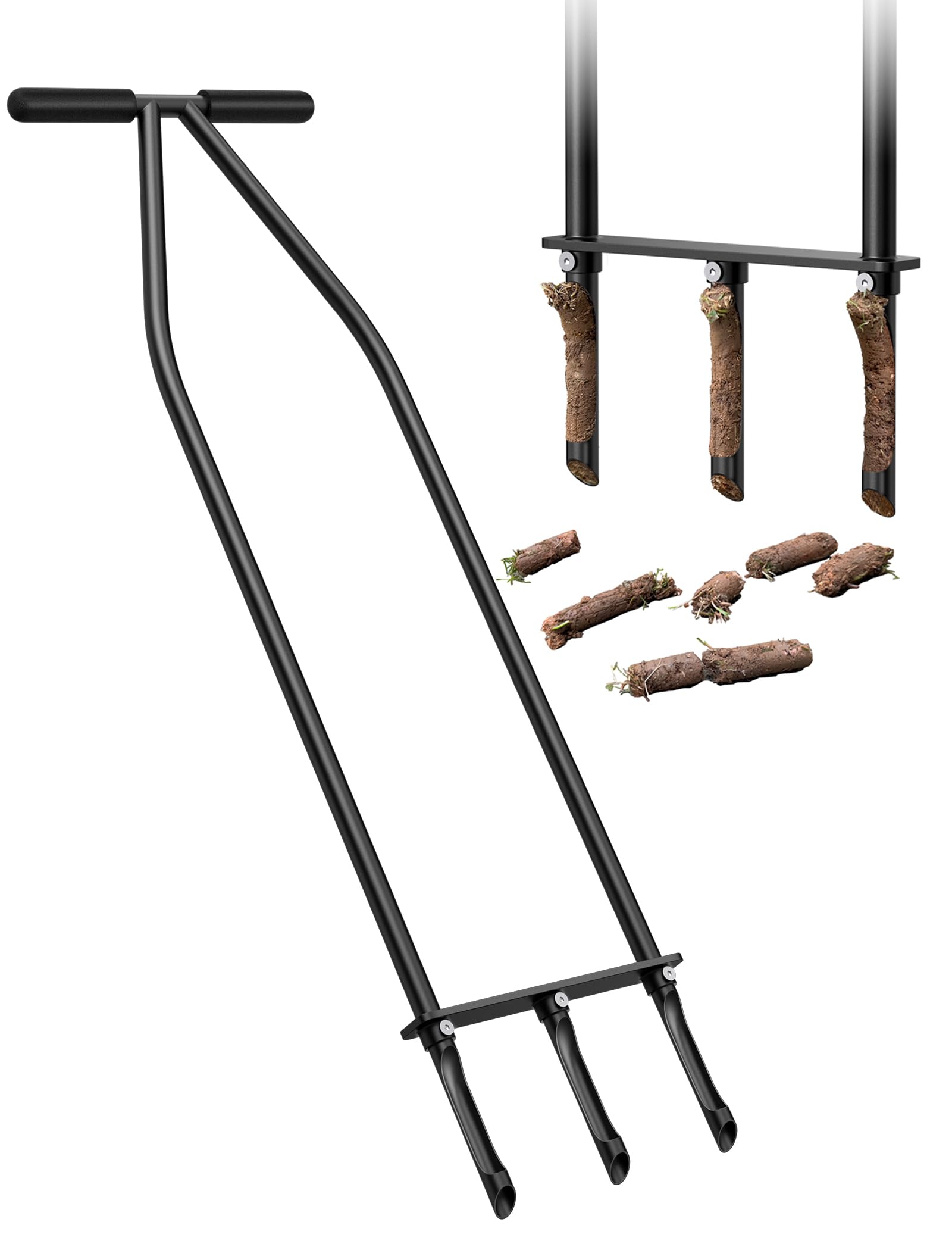
The smoothest core puller that banishes clogging for good with a side-eject ramp.
This tool solves the single most annoying problem with manual core aerators—the soil plug jamming inside the tine. The patented design ejects soil plugs out the side via a curved ramp, so you spend your time aerating, not unblocking. It uses 3 hollow tines made from high-strength alloy that the manufacturer says can handle the toughest jobs. At 5.69 pounds, it feels solid without being a backbreaker.
Buyers report the cores eject reliably through the large ported cutout, and the open center design—unlike the center bar on some other brands—lets your knee move freely as you step down. The two-bar steel handle is stronger than the single stainless steel bar found on cheaper models. However, a few buyers noticed the assembly screws loosen after the first use; the included Allen wrench solves that quickly. It is priced higher than many competitors, but reviewers call the quality justified.
The recommendation is to moisten the lawn beforehand. The tool is just 42 inches tall and a narrow 1.9 inches wide at the base, making it easy to store. If you are tackling really hard ground, you can remove the middle tine to reduce resistance. This is the best blend of engineering and durability for the person who wants to core aerate without wrestling with clogs.
Side-eject Genius: The curved ramp practically guarantees plugs slide out with the next stamp, so you almost never have to stop and poke a cleaning tool inside.
Knee-friendly Frame: Unlike some U-shaped frames that bang your kneecap, the open center lets your foot strike the plate squarely and your knee drift naturally.
Reach for this if: You want the most advanced clog-proof system in a manual core aerator and are willing to pay a premium for a solidly built tool that will likely outlast several lawn seasons.
Look elsewhere if: You are working on a massive yard (over 5000 sq ft) where the slow pace of a 3-tine hand tool would take days, or you need a budget-friendly option.
2. Dolibest Lawn Coring Aerator (4 Plug, Storage Tray)
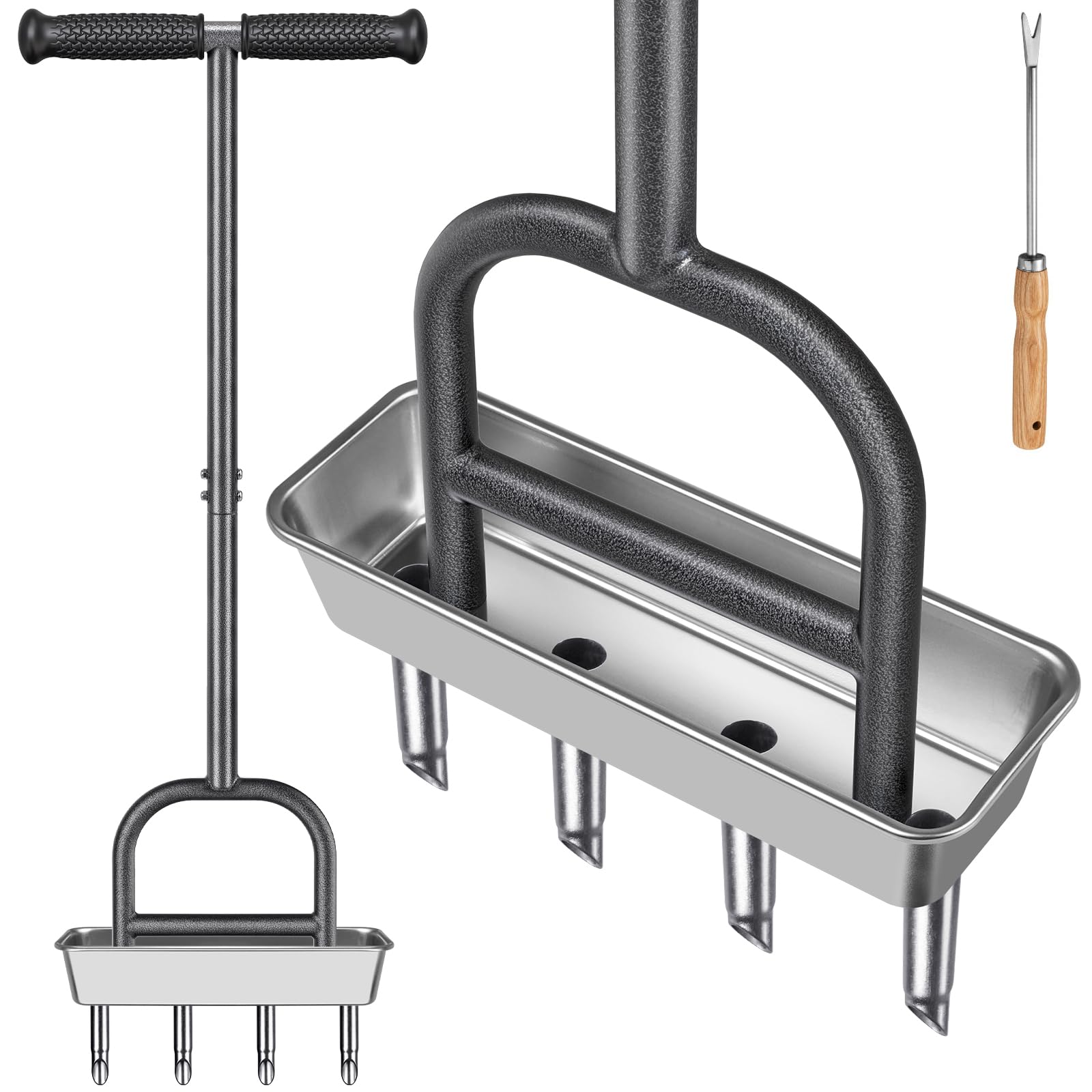
The 4-tine efficient machine that collects every plug so you do not have to rake.
This is the premium upgrade for the homeowner who wants a clean, fast job. It uses four SUS 304 stainless steel tines, each about 3.5 inches long and 0.5 inches in diameter, to pull deep, narrow plugs. The real star here is the stainless steel soil core storage tray that sits above the tines—when you eject the plugs, they land in the tray instead of scattering across the lawn. The tool comes pre-assembled in three parts and takes about two minutes to put together.
Reviewers mention it is the exact same product they saw at a big-box store , making it a fantastic value at the premium tier. The soft rubber grip helps prevent blisters, and the improve crossbar keeps your shoes off the ejection port. Owners mention that while it works beautifully on moist soil, the dirt can sometimes clog the bottom of the spikes, requiring the included 12-inch weeding tool to clean out. At about 6.19 pounds, you feel the weight of the 4 stainless steel barrels, but the extra coverage per stamp saves time on medium-sized lawns.
Unlike the Xuperace above, this Dolibest model has a traditional upward-eject system rather than a side ramp, so it is slightly more prone to clogging if you let the dirt dry out. But for the person who values a tidy lawn (no loose plugs to clean up) and wants 4 tines working per step, this is a top-shelf choice.
Clean-as-you-go Tray: The storage tray catches every ejected plug, saving you half an hour of raking and making the whole process far neater.
4 Tines for Speed: With four stainless steel corers, each stamp makes four holes per stamp, while a three-tine tool makes three, which makes a real difference on a yard over 2000 sq ft.
Best for perfectionists: If you hate the messy aftermath of core aeration and want a premium stainless steel tool that pulls deep plugs and collects them, this is your pick.
Be aware: The stainless barrels can clog in damp, sticky clay more often than the side-eject Xuperace; keep the included cleaning tool handy.
3. EEIEER Manual Lawn Aerator (2025 Upgraded)

A well-priced core puller with an integrated tray and a back-saving 38-inch handle.
The EEIEER cuts a smart middle ground between the premium tray-equipped models and the budget options. It features 3 sharp, thick-walled hollow tines (upgraded from 1.2mm to 2mm for extra durability) and a soil storage basket to keep the ejected cores contained. The 38-inch handle is noticeably taller than the 36-inch average, which reduces how much you need to bend, protecting your lower back during long sessions.
Customers note that the 4.3-inch heightened pedal makes it comfortable to use with work boots, and the one-piece bottom structure feels sturdier than welded alternatives. The included cleaning stick helps clear any clogs, though some reviewers found that the foam handles may wear out faster than the rest of the tool. One reviewer noted it caused back strain for a person who is 5’5”, so the extra height on the handle works best for taller users. The EEIEER weighs roughly 6.4 lbs, but the weight gives it a solid feel when pushing into tough soil.
Reviewers point out the tool works best on small to medium lawns up to about 3000 sq ft. For a mid-range price, you get a durable integrated structure, a storage tray, a cleaning tool, and thoughtful ergonomics—all without the premium price tag of the Dolibest tray model.
Tall Handle Advantage: At 38 inches, it is one of the tallest manual aerators available, letting taller folks stand upright while working.
One-Piece Bottom: The patented single-piece construction eliminates weld points that sometimes crack on cheaper models.
Smart for mid-sized yards: This is the right tool if you want the convenience of a soil tray and a tall handle without paying a premium price.
Note the fit: Shorter users (under 5’6”) might find the 38-inch handle less comfortable than a standard 36-inch one.
4. Dolibest Lawn Coring Aerator (4-Corer Stainless)
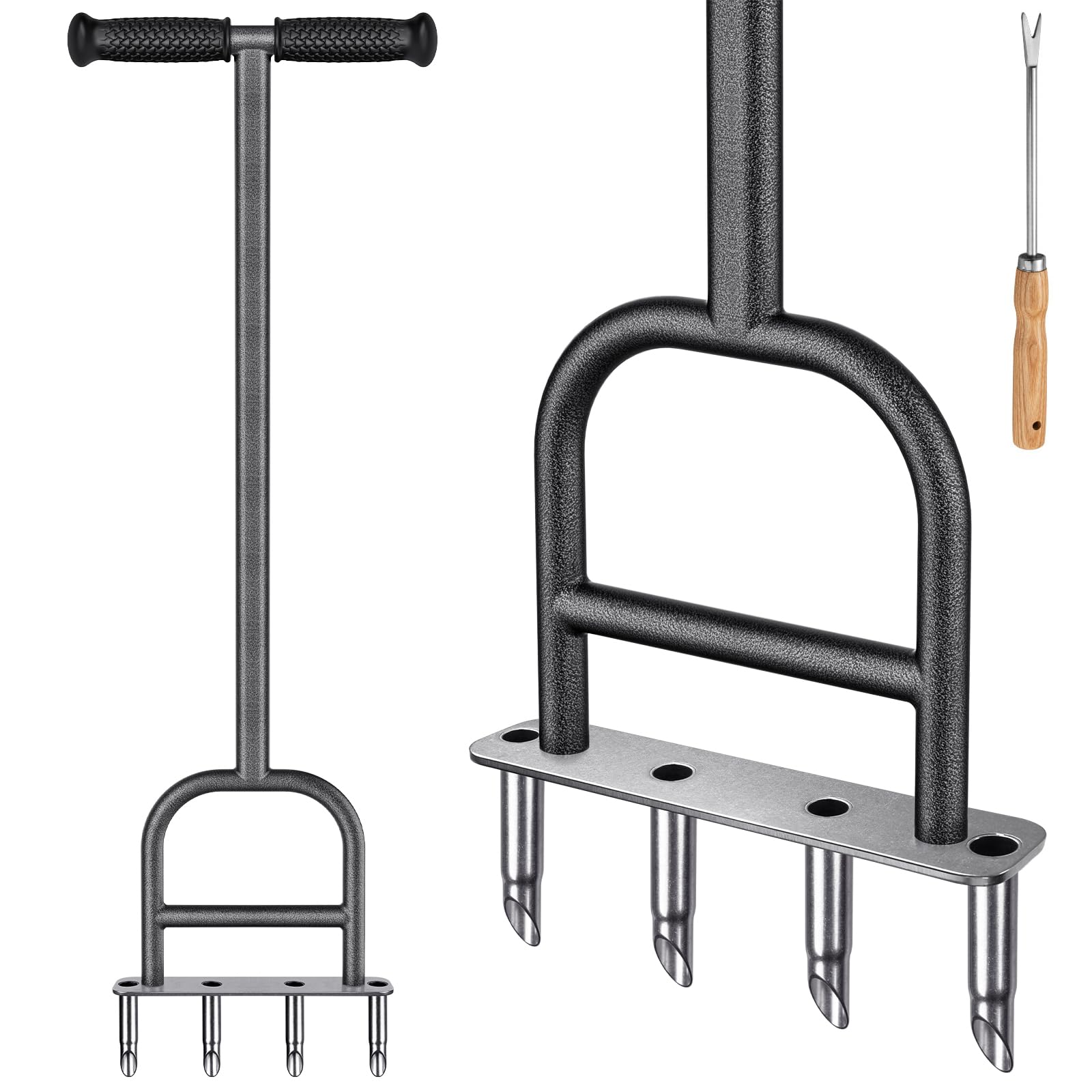
A rugged 4-tine hand tool with stainless steel barrels that simply does not rust.
This is a no-nonsense, manual coring tool designed for spot-treating compacted areas. It has 4 stainless steel corer plugs, each measuring 3.5 inches long, that you push in with your foot. The all-steel construction with a black powder-coated finish is tough, though the package dimensions (33 x 11.5 x 2.5 inches) are long because the top handle is pre-attached. The soft rubber grip prevents hand blisters, and a foot bar keeps your shoe sole from covering the ejection hole.
Shoppers say it “works as intended for large yard” when the soil is moist, and they appreciate the single welded construction. The major trade-off, according to one reviewer who compared it to a competing brand, is that the rounded foot tube reduces leverage and only sinks about 2 inches deep (vs. the full depth of the 3.5-inch barrel). Because of this, you may need a rocking motion to drive it in, and the soil must be “just right”—not too wet, not too dry—for the plugs to eject cleanly.
It weighs 5.54 pounds, while the tray-equipped Dolibest weighs 6.19 pounds but heavier than the LawnVigor. It is a strong choice for the garden enthusiast who wants a durable, 4-tine core tool with a comfortable grip and does not need a storage tray.
Solid Foundation
- Stainless steel bottom and corers resist rust
- Single welded construction feels very sturdy
- 4 tines give good coverage per stamp
- Soft rubber grip reduces hand fatigue
The Hard Truth
- Rounded foot tube reduces leverage and depth (around 2 inches on average)
- Soil must be perfectly moist to avoid clogs
- No storage tray for soil plugs
Choose this for spot work: Perfect for fixing dead patches and high-traffic areas where a few square feet of core aeration is all you need.
Skip if you need depth: If your lawn has deep compaction issues, the Xuperace or LawnVigor will penetrate closer to 3 inches.
5. LawnVigor Manual Core Aerator (LV-ALT4-ORANGE)
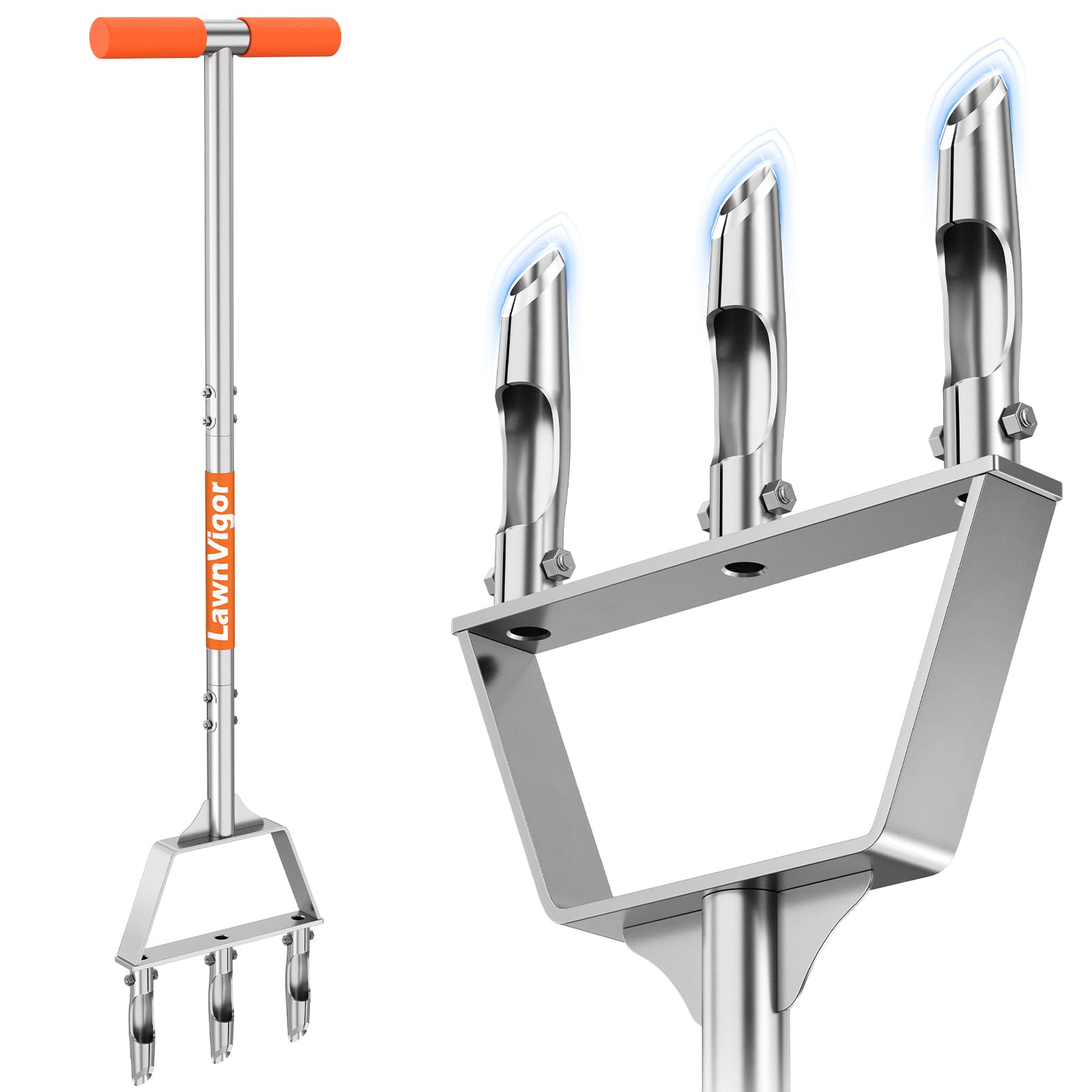
The lightest, deepest-pulling core aerator that outperforms pricier rivals.
You can lift, reposition, and carry the LawnVigor across your yard with far less effort because it weighs 3.52 pounds, while the MEIIOFS aerator weighs 6.4 pounds. Its 3 heat-treated hollow tines (metal tubes that cut and pull soil cores) are designed for deep penetration, and buyers report consistent 3-inch core pulls with reliable ejection that “rarely clogs.” This is the tool to grab if you have a small to medium lawn or want to aerate without your arms getting sore. The package dimensions (15.67 x 10.91 x 2.91 inches) are also the most compact in this roundup, so it stores easily on a shelf.
One buyer mentioned it “outperforms cheaper versions” thanks to its consistent plug extraction, though a few pointed out that grass and roots can get stuck in the tine gaps during cleanup. The foam grips on the wide T-handle are comfortable but may spin over time; some reviewers recommend using a dab of adhesive to keep them in place. Because of its lightweight design, you will need to use your body weight to push it into very hard soil.
For the price, you get a semi-assembled tool that sets up in minutes and a simple no-tray design that keeps the weight down. If you want the deepest core extraction with the least arm strain, this is the balance in the lineup.
Deep, Light, and Clean: The hollow tines reliably pull 3-inch cores without clogging, and the light weight means you do not exhaust yourself moving between spots.
Grip Issue to Know: The foam handle covers can rotate loosely; a drop of superglue underneath fixes the spin permanently, according to several buyers.
Best for the value-conscious: If you want the deepest possible core pull (3 inches) in a lightweight, affordable package, this is the one to beat.
Not for heavy clay: The lighter frame makes it harder to push into very hard, dry clay; you may need to water the lawn or add your full body weight.
6. MEIIOFS Lawn Aerator (CTGJ-01)

A budget-friendly corer that includes a tray and cleaning stick at a very approachable price.
The MEIIOFS gives you the two biggest convenience features (a soil core storage tray and a cleaning tool) at a cost that undercuts nearly every other tray-equipped model. The tray sits on top of the 4 high-density alloy tines and catches the soil plugs as they eject, so you are not left with a messy lawn. The T-handle has a cushioned grip, and the foot rod is non-slip to give you good leverage. It also comes with a small cleaning tool you can use to clear clogs or transplant seedlings.
At 6.4 pounds and with product dimensions of 16 x 11 x 4.9 inches, it is a sturdy tool that feels heavier than it looks. Owners mention it “pulls plugs effectively for reseeding and filling holes in lawn,” and they find the assembly straightforward with the included wrench and Allen key. One owner reported that it is “smaller than anticipated,” so it works best for smaller yards or precise spot treatments rather than an entire acre. The plastic bolt covers were deemed unnecessary by most users. Buyers also point out that it is small, so covering a large yard takes a while.
Compared to the Jardineer spike tool, this MEIIOFS is a core aerator, so it pulls real plugs instead of just poking holes. That makes it a better choice for compacted soil, even if it takes a bit more effort to use. For the money, this is the cheapest way to get a plug-pulling tool with a storage tray.
Why It Works
- Includes a soil storage tray to catch ejected plugs
- 4 tines for decent coverage per stamp
- Very easy to assemble with included Allen key and wrench
- Comes with a handy cleaning/weeding tool
Trade-offs
- Smaller footprint means more steps to cover a large area
- Can clog in very damp soil; cleaning tool needed occasionally
- At 6.4 lbs, not the lightest tool for long sessions
Good for budget buyers: If you need a core aerator with a tray and do not want to spend much, this tool gets the job done on small lawns and compacted patches.
Consider the size: The small working head means it is slow for large yards—you will be stepping down many more times than with a wider 4-tine tool.
7. Jardineer Lawn Spike Aerator (US1130)
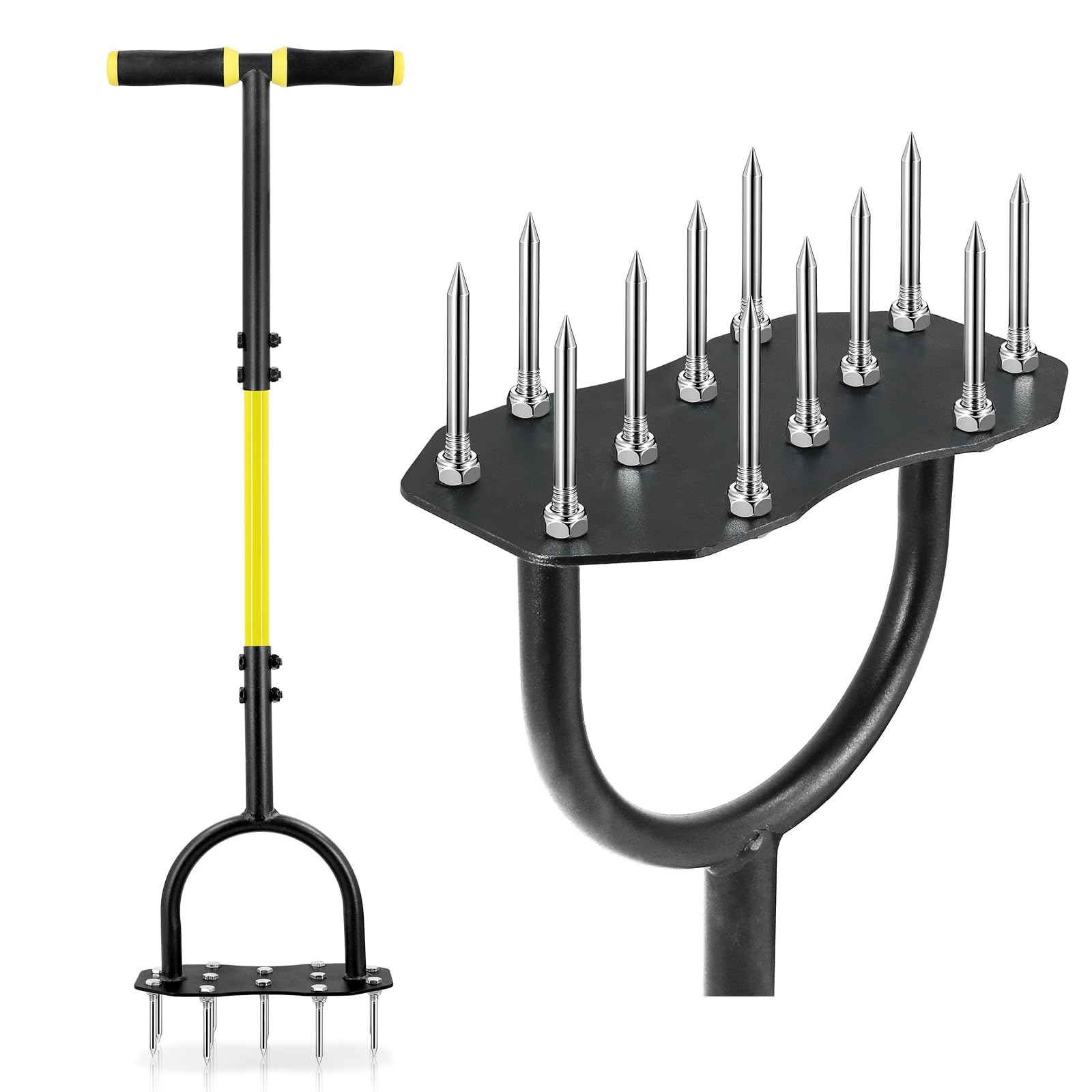
A straightforward spike tool that is ideal for light, regular maintenance on small lawns.
If your main goal is to prevent thatch buildup on already-healthy soil rather than fixing deep compaction, spike aeration is lighter and faster than core aeration. The Jardineer has 12 heat-treated steel spikes, each with a total length of 2.75 inches. The 36-inch handle is back-saving and has a comfortable rubber grip, while the thick steel foot plate bears your full weight to help the spikes penetrate. The tool comes pre-assembled with a wrench and manual for quick setup.
Customers note that the tool was “easy to use, especially in compact clay!” (though the reviews also mention it takes a bit of wiggling to get the spikes in on hard soil). It is best for small areas; one reviewer specifically warns it is “definitely not recommended for large areas” because the arm workout becomes too much. The spikes are solid and the construction feels sturdy, but spike aeration inherently does not remove soil—it just pushes it aside. For many homeowners, this is fine for a quick seasonal pass, but it will not fix a lawn that has severe compaction.
In size, the Jardineer measures 15 x 11 x 5 inches, making it compact for storage. It weighs 5.02 lbs, while the MEIIOFS core tool weighs 6.4 lbs, so it is easier to carry. This is the right pick if you want a simple, cheap maintenance tool for a small lawn and are not dealing with heavy clay.
Spike Simplicity: 12 spikes work simultaneously to poke holes quickly, and the foot plate is solid enough to take your full weight without bending.
Small-yard Only: Buyers are clear that this is for small areas only; tackling a big lawn with a 12-spike stamp will wear you out fast.
Choose this for light maintenance: If your soil is already decent and you just want to give it a quick seasonal pass so water drains better, this spike tool is fast and cheap.
Not for hard clay: Spike aeration can make compaction worse in dense clay soils; core aeration (like the LawnVigor above) is the better choice for serious compaction.
Understanding the Specs
Spike vs. Core (Plug) Aeration
A spike aerator drives solid tines into the soil, creating small holes but pushing the dirt to the sides—which can actually densify the surrounding area. A core aerator uses hollow tines to cut and remove a small cylinder of soil (a plug). This physically removes compaction and creates a channel for water, air, and nutrients. For heavy clay or compacted lawns, core aeration is far more effective.
Tine Count and Depth
The number of tines (usually 3 or 4) determines how many holes you make per stamp. More tines mean faster coverage but also more resistance when pushing. Depth is the critical spec: you want tines that can sink at least 2.5 to 3 inches deep to properly relieve compaction in the root zone. A tool that says “3.5-inch tines” may only sink 2 inches on hard soil if the leverage and weight are poor.
FAQ
What is the difference between a spike aerator and a core aerator?
How deep should a manual aerator go to be effective?
Will a manual aerator work on dry, hard clay soil?
How many tines should I look for in a manual aerator?
Is a heavier aerator always better?
Why do some aerators have a soil storage tray?
What does “hollow tine” mean?
How do I clean and maintain a manual coring aerator?
Can I use a manual aerator on a large lawn (over 5000 sq ft)?
What is a “side-eject” aerator and why is it better?
Final Thoughts: The Verdict
For most buyers, the aeration tools winner is the Xuperace Lawn Aerator because its side-eject design eliminates the most common frustration—clogged tines—while pulling deep, reliable cores. If you want a clean, tray-equipped tool that collects every plug, grab the Dolibest 4-Plug with Storage Tray. And for budget-minded buyers who need a deep 3-inch core while staying affordable, the LawnVigor Manual Core Aerator delivers that depth at the lowest price in this roundup.
How We Picked
We do not accept paid placement. Every pick is matched to a real buyer and a real use-case; we do not hands-on test units.
Sources & Methodology
Specifications: manufacturer listings and product documentation. Review insights: verified customer reviews, as of July 2026. Pricing: not shown on this page (it changes often); check the current price via the retailer link.
As an Amazon Associate, Lawn Gear Lab earns from qualifying purchases. This does not affect which products we feature.