
Specs are compiled from manufacturer listings and verified buyer reviews and can change over time — please confirm the key details on the product page before buying.
You stand at the top of your backyard hill, hand on the starter cord, hoping today isn’t the day you get dragged down a wet slope by a machine that won’t listen. The difference between a good Saturday chore and a frustrating battle depends on one thing: how well your mower’s engine, drive system, and deck work together on your specific terrain. This guide cuts through the noise to help you find the gas self-propelled lawn mower that actually matches the way your yard grows.
I’m Rikta — the founder and writer behind Lawn Gear Lab. This guide is built by comparing the manufacturers’ published specifications and the patterns across verified customer reviews, so you get each pick’s real strengths and trade-offs instead of marketing spin.
Whether you are fighting thick St. Augustine on a gentle grade or just need to finish a half-acre without stopping for a drink, the right self-propelled mower balances engine displacement, drive type, and cutting width so you move at your pace, not the machine’s. choosing the best gas self-propelled lawn mower means matching your terrain to a proven drive system and an engine that won’t choke on tall grass.
Quick Picks
- Yard Force Self Propelled Lawn Mower Briggs — Best Overall
- SENIX 22 Inch 3-in-1 Gas Lawn Mower — Power Pick
- PowerSmart 22-Inch Gas Lawn Mower — Leaf Mulcher
- BILT HARD 21″ Self Propelled Gas Lawn Mower — Precision Cut
- SENIX 21” Self-Propelled Gas Lawn Mower — Flat Yard Friend
- YARDMAX 22 in. 201cc Select PACE 6 Speed CVT — CVT Power
- PowerSmart 22 in. 170cc Self Propelled Gas Lawn — Budget All-Rounder
- 21” Self Propelled Lawn Mower Gas — 4-in-1 Flex
How To Choose The Best Gas Self-Propelled Lawn Mower
Picking the right self-propelled mower depends on understanding three things: your yard’s terrain, the thickness of your grass, and how much time you want to spend on maintenance. Every spec on the box translates directly into how the machine feels when you are pushing it up a hill or bagging clippings from an overgrown patch. Here is what actually matters.
Engine Displacement (cc) and Torque
The engine size, measured in cubic centimeters (cc), determines how much power the mower can deliver to the blade. A 170cc engine handles regular weekly cuts on a quarter-acre lot without breaking a sweat. Jump to a 201cc engine, and you get the extra torque needed to slice through tall, thick, or damp grass without stalling. The torque figure, measured in foot-pounds (ft-lb), tells you the twisting force the engine produces — higher numbers mean the blade keeps spinning even under a heavy load.
Drive System: Front-Wheel Drive vs. Rear-Wheel Drive
Front-wheel drive (FWD) pulls the mower forward, making it easier to turn and maneuver around flower beds and trees. It works best on flat or gently rolling lawns. Rear-wheel drive (RWD) pushes the mower, giving the rear wheels better traction on slopes and uneven ground. If your yard has a noticeable incline, RWD keeps the mower climbing instead of spinning its front wheels. Some models also offer variable speed control, letting you dial in the pace to match your walking speed.
Cutting Width and Deck Material
A 21-inch deck is the standard for maneuverability, easily fitting through gates and around tight corners. A 22-inch deck covers more ground per pass, which shaves time off larger lawns. The deck material matters for longevity — stamped steel decks are common and durable, while some budget options use lighter alloys. A steel deck withstands dings and corrosion better over several seasons.
Cutting Height Adjustment and Number of Positions
More height positions give you finer control over the grass length throughout the growing season. A range from about 1.25 inches to 4 inches covers everything from a tight golf-course cut in summer to a taller setting for spring and fall growth. Single-lever adjustments are more convenient than adjusting each wheel individually, especially on uneven terrain where you need to raise the deck quickly to avoid scalping a bump.
Quick Comparison
| Model | Best For | Engine | Cutting Width | Height Positions | Amazon |
|---|---|---|---|---|---|
| Yard Force YF22-3N1SP | Large sloped yards | 150cc B&S | 22 in. | 7 | Amazon |
| SENIX 22 in. 201cc RWD | Thick, overgrown grass | 201cc OHV | 22 in. | 6 | Amazon |
| PowerSmart B8622S | Mulching leaves | 150cc B&S | 22 in. | 6 | Amazon |
| BILT HARD 21 in. 201cc | Precision cutting | 201cc OHV | 21 in. | 8 | Amazon |
| SENIX 21 in. 170cc FWD | Flat, small-to-medium yards | 170cc OHV | 21 in. | 6 | Amazon |
| YARDMAX YG2860 | Power on flat terrain | 201cc | 22 in. | — | Amazon |
| PowerSmart V8622S2 | Small budget yards | 170cc | 22 in. | 6 | Amazon |
| GasXcel 21 in. 170cc | Versatile clean-up | 170cc OHV | 21 in. | 7 | Amazon |
In‑Depth Reviews
1. Yard Force Self Propelled Lawn Mower Briggs & Stratton 150cc Gas Engine 22-inch Steel Deck 3-in-1 Mulch, Bag, Side Discharge, 12-inch High Rear Wheels

The slope-tamer that pairs a proven engine with 12-inch rear wheels for serious traction.
This mower earns the top spot because it solves the two biggest pain points of a sloped yard: climbing power and wheel bite. The rear-wheel-drive system combined with 12-inch high rear wheels — the tallest in this lineup — gives you noticeably better grip on inclines than anything with smaller rear wheels. Buyers report the self-propelled function is “very strong,” and the 150cc Briggs & Stratton EX625 engine with ReadyStart technology fires up without priming, which is a real time-saver when you just want to get the job done. The 22-inch steel deck and 21-inch blade cover ground efficiently, and the 7-position single-lever height adjustment ranges from 1.25 inches to 3.75 inches, giving you fine control across the growing season. At 81 pounds, this is one of the heavier picks here, but that weight helps keep the rear wheels planted on a hill.
Owners mention that the assembly instructions are minimal — four pictures with no words — so you will rely on common sense to unfold the handle. A few customers note the mower did not start from the start, which points to occasional quality-control issues. The side vent is also easy to knock off on rough terrain, something to watch for if your yard has hidden rocks or roots.
Who it clicks with: Anyone with a yard that has a real slope — the 12-inch rear wheels and RWD system make this the most capable climber here.
One honest catch: The 81-pound weight can feel unbalanced on a steep side-hill, and the lack of written assembly instructions frustrates some buyers.
Your hill, your mower: Reach for this if you have a quarter-acre or more on a grade; look elsewhere if your lawn is perfectly flat and you prefer a lighter machine for nimble turns.
2. SENIX 22 Inch 3-in-1 Gas Lawn Mower, 201cc Rear Wheel Single Speed Self-Propelled Mower, 4-Cycle Engine, Steel Deck, 6-Position Cutting Height Adjustable
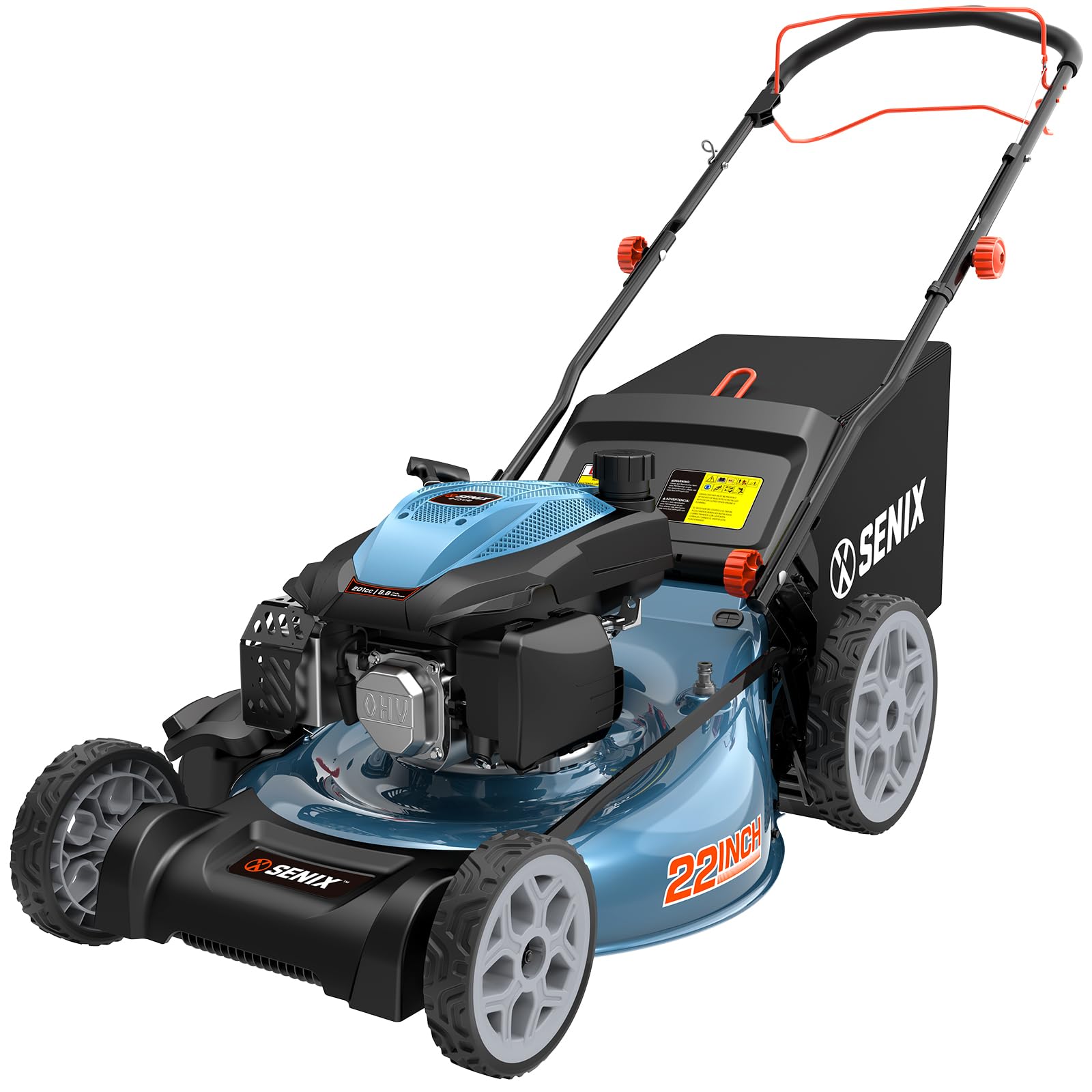
A torque monster that chews through overgrown patches without bogging down.
When your grass gets ahead of you — a week of rain, a vacation, or just a fast-growing lawn — the 201cc OHV engine on this SENIX is the difference between a clean cut and a frequent stall. It delivers 4.7 HP and 8.8 ft-lb of torque, which is noticeably more grunt than the 170cc mowers in this class. The rear-wheel single-speed drive reaches up to 2.9 MPH, which is a steady walking clip that helps you cover a half-acre without fighting the machine. The 22-inch heavy-duty steel deck uses a vortex tunnel airflow design that improves how clippings flow into the bag, reducing clogs in damp grass. Reviewers point out it “cuts through grass like a hot knife through butter,” which tracks with the higher torque and manganese steel alloy blade rated at 45–50 HRC hardness.
One reviewer noted the wheels fell off after the third use, held on only by tape, which is a serious assembly or design concern. The manual also lacks basic info like gas and oil capacity, forcing you to call customer service. The 72-pound weight is manageable but not light, and the single-speed drive means you cannot slow down in tight turns around flower beds.
Power advantages
- 201cc engine delivers 8.8 ft-lb of torque for thick, wet grass
- 22-inch steel deck with vortex tunnel reduces clogging
- RWD system handles uneven terrain well
Points to double-check
- Wheels reportedly fell off some units after a few uses
- No gas or oil capacity listed in the manual
- Single-speed drive limits maneuverability in tight spaces
Torque-first buyer: Choose this if your main problem is tall, overgrown grass; skip it if you value detailed documentation and a simple to use wheel assembly.
3. PowerSmart 22-Inch Gas Lawn Mower, 150cc B&S Engine, Self-Propelled, 3-in-1 Mulching System, 6 Cutting Heights, Rear-Wheel Drive
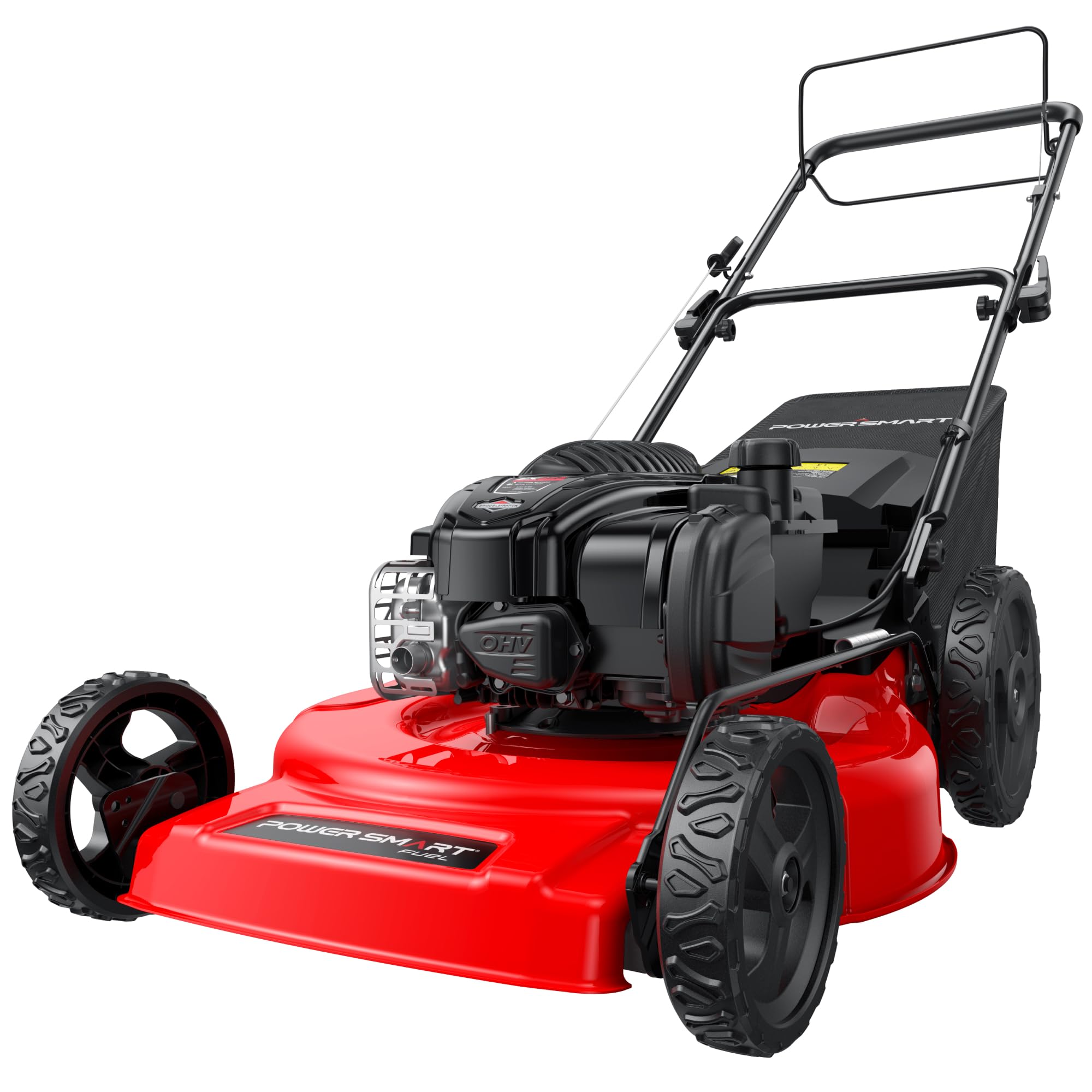
A Briggs & Stratton heart in a budget-friendly body that mulches leaves like a champ.
The USA-made Briggs & Stratton EX625 150cc engine is the headline here — it is a well-known powerplant with ReadyStart technology, meaning you pull the cord and it fires without fiddling with a choke or primer. This makes it among the most user-friendly mowers in the mid-range for someone who just wants to get mowing. The rear-wheel drive gives it decent climbing ability, though the 150cc displacement means it works best on regular weekly cuts rather than jungle-thick grass. The 22-inch steel deck and single-lever 6-position height adjustment range from 1.5 inches to 3.9 inches, giving you a solid range for seasonal changes. Buyers praise its mulching performance with leaves, calling it an “excellent mulching of leaves” machine which saves you from raking.
A few shoppers say the self-propelled speed is very slow with no adjustment, so you may end up walking faster than the mower on flat ground. The handle grip feels awkward to some, and it consumes oil faster than expected. One buyer mentioned a metal clip holding the engine start wire broke after about six mows, which points to a reliability concern on the cable routing.
Fall cleanup favorite: If you have trees that dump leaves on your lawn, the mulching system on this PowerSmart makes quick work of them.
The slow-go trade-off: The fixed slow drive speed and oil consumption are worth knowing about if you have a large, flat yard.
Grab it for leaves: Ideal for anyone with a tree-lined yard who wants to mulch instead of rake; not for you if you need variable-speed self-propulsion to match a brisk walking pace.
4. BILT HARD 21″ Self Propelled Gas Lawn Mower – Powered by a 201cc 4-Cycle OHV Engine, 3-in-1 Functions, 8-Position Cutting Height Adjustment
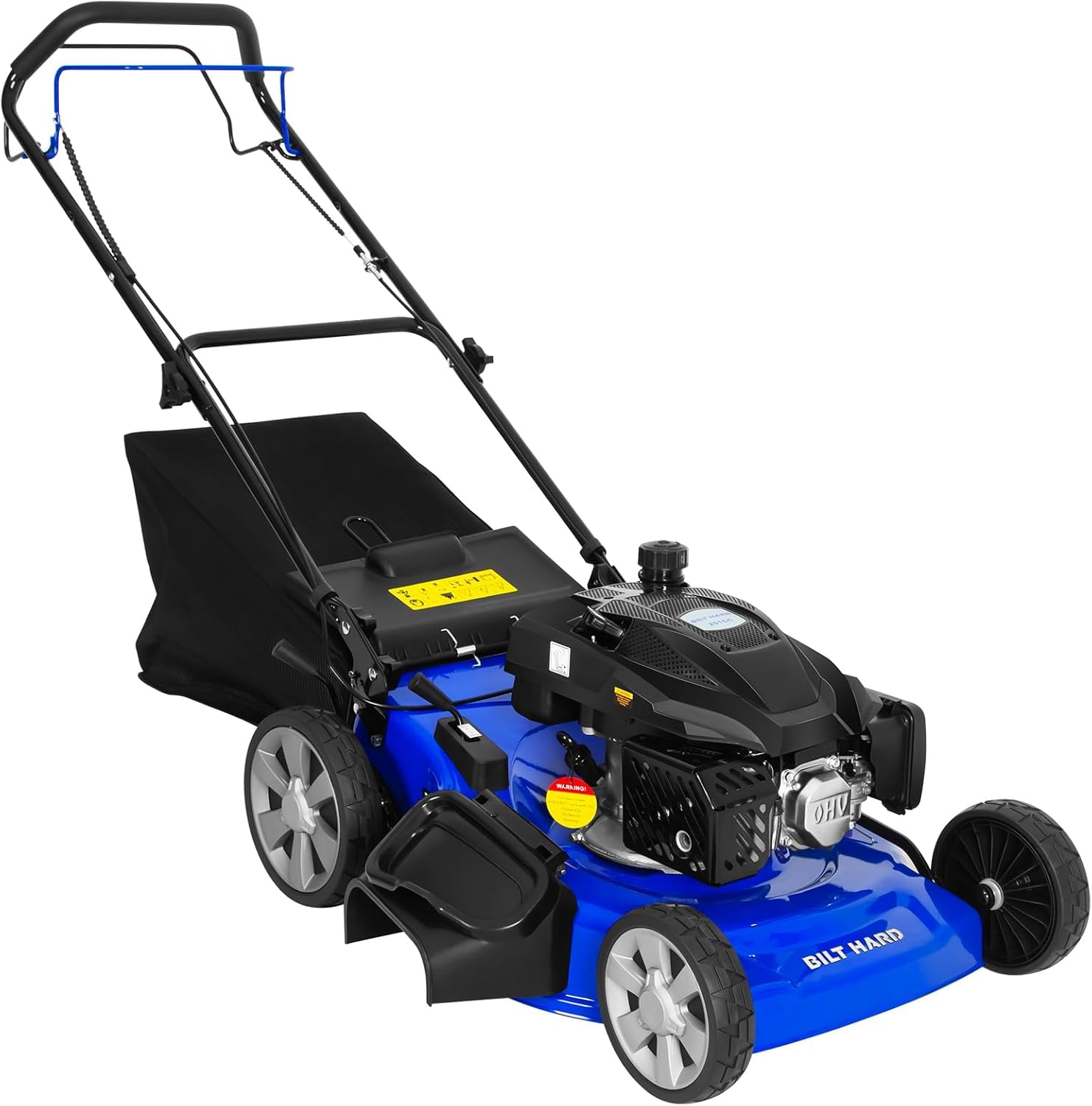
An 8-position height lever and a 201cc engine bring surgical precision to your lawn.
No other mower in this lineup offers 8 separate cutting height positions except this BILT HARD. That extra granularity, ranging from 1.2 inches to 3.75 inches via a single lever, means you can dial in the exact blade height for each season — a tighter cut in summer, a taller setting in spring — without guessing between notches. The 201cc OHV 4-stroke engine delivers 9.0 ft-lb of torque, which is the highest torque figure among the picks here, giving it the muscle to spin through dense grass without slowing down. The rear-wheel drive glides smoothly, and the no-choke, no-primer design makes starting as simple as pulling once. Buyers confirm it “starts on the first pull” and runs “flawlessly” after minimal assembly.
One owner reported a catastrophic failure: a bent drive shaft caused severe vibration that cracked the plastic motor cover, exhaust cover, and dipstick housing within 8 hours, with the dipstick housing breaking off and spraying hot oil. That single extreme review flags potential build-quality variation. The height adjustment lever also slips on some units, though one owner fixed it with a zip tie.
Precision benefits
- 8 cutting height positions offer the most fine-tuning in this guide
- 201cc engine with 9.0 ft-lb torque handles thick grass easily
- No-choke starting is genuinely low-maintenance
Risks to weigh
- One extreme review: drive shaft bent, causing hot oil spray and injury
- Height adjustment lever may slip and require a DIY fix
- Less established brand means limited local service options
Fine-tuner’s choice: Perfect for the lawn enthusiast who wants 8 height settings and top torque; only if you accept the risk of off-the-line quality variation.
5. SENIX 21” Self-Propelled Gas Lawn Mower (FWD), 170 cc 4-Cycle Engine 3.8 HP, 3-in-1, 6-Position Cutting Height Adjustment
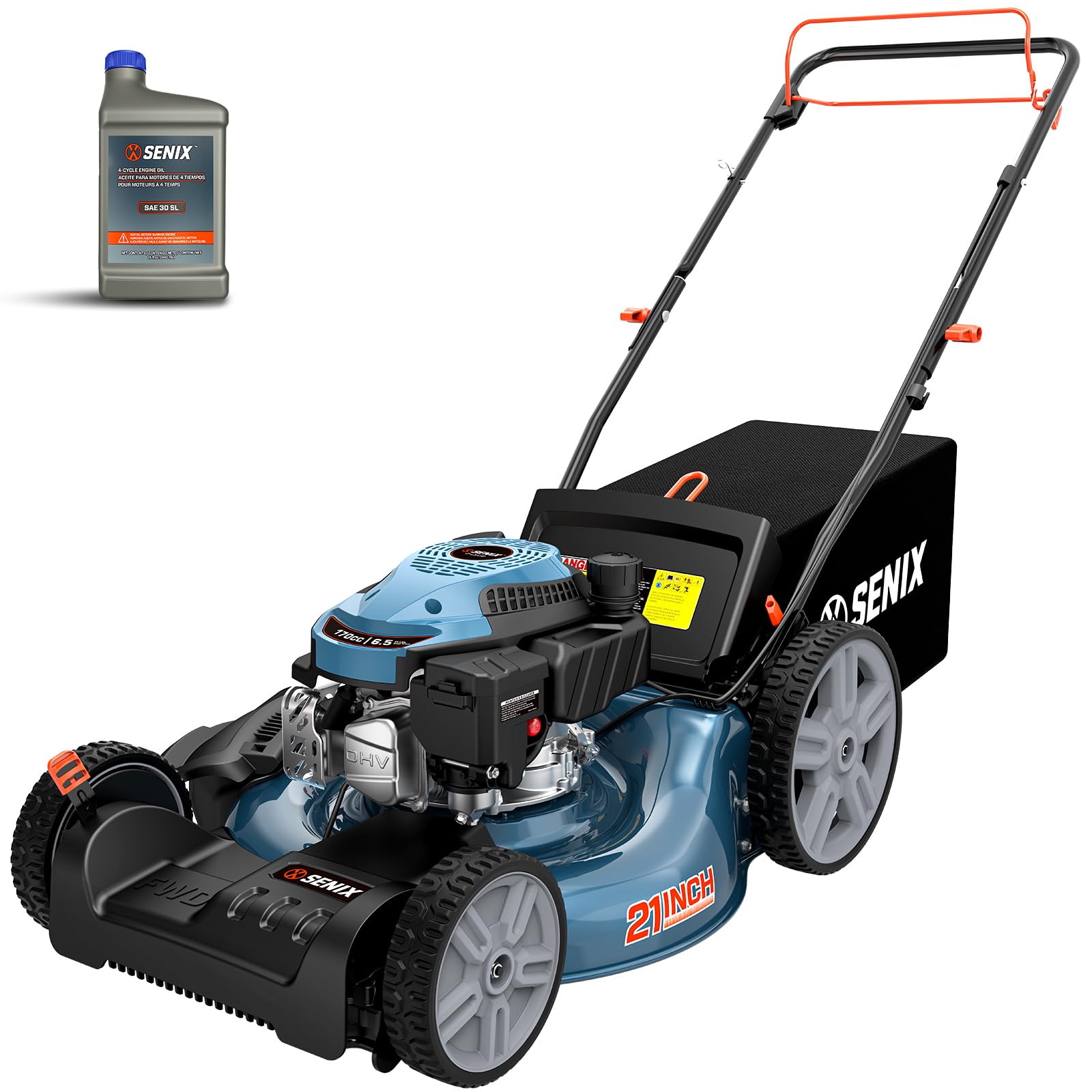
A lightweight, nimble front-wheel-drive mower that pivots around obstacles with ease.
At 61.7 pounds, this SENIX is the lightest self-propelled mower in the entire lineup — that is a full 23 pounds lighter than the YARDMAX, which weighs 84.9 pounds. The front-wheel drive lifts the front end easily, so you can pivot around trees, flower beds, and fences without wrestling the machine. The 170cc OHV engine delivers 3.8 HP and 6.5 ft-lb of torque, which is plenty for a weekly cut on a flat 1/3-acre lot. The 6-position height adjustment ranges from 1.25 inches to 3.75 inches, and the dual-lever system adjusts all four wheels at once from the right side, which keeps the left side clear for edging along a chain-link fence. Buyers report it starts on the first pull after priming three times and that it “managed about 1/2 an acre on one tank of gas.”
Owners mention that the gas tank seems larger than previous mowers, which means it burns through fuel faster, though the deck stays clean with hardly any clippings sticking. The minimum cutting height of 1.25 inches is lower than the 1.5 inches on the PowerSmart V8622S2 (a 20% more gap), so you can get a tighter cut if you prefer a short lawn. One buyer experienced a catastrophic breakdown — the engine threw a knocking sound then died with a loud pop — though multiple other buyers praise its reliability.
Light and quick: The 61.7-pound weight and FWD system make this the most maneuverable mower here for navigating around landscaping.
Fuel appetite: It goes through gas faster than some competitors, so budget for more fill-ups per acre.
Your flat-yard companion: Reach for this if your terrain is level and you prioritize easy handling and a low 1.25-inch cut; pass on it if you have a steep hill that demands rear-wheel drive.
6. YARDMAX 22 in. 201cc Select PACE 6 Speed CVT High Wheel FWD 3-in-1 Gas Walk Behind Self Propelled Lawn Mower, Black (YG2860)
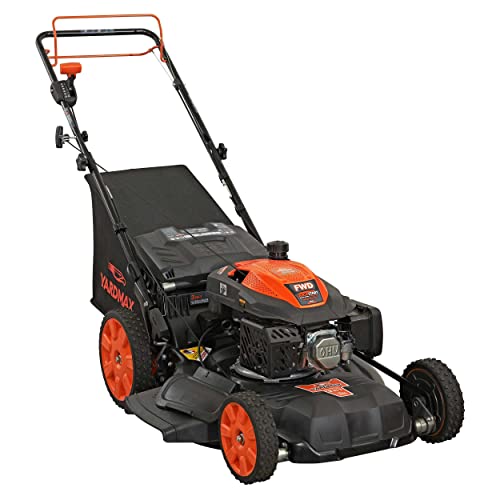
A continuously variable transmission lets you dial your exact walking pace.
YARDMAX brings something genuinely different to the table: a CVT (continuously variable transmission) with a 6-speed shift lever that lets you match the mower’s pace to your stride. Most self-propelled mowers offer a single fixed speed or a step-tranny, so this CVT is a real leg-saver if you like to walk at a consistent clip without the mower creeping ahead or lagging. The 201cc engine is the largest displacement in this group, giving it 201cc versus the 170cc engines in the GasXcel and PowerSmart V8622S2. The 22-inch cutting width is also the widest here, tied with the Yard Force and PowerSmart, so you cover more ground per pass. The automatic choke system means you skip the primer and choke lever entirely — just pull and go. Customers note it handles 3/4 of an acre easily and gets “excellent gas mileage” while being “quieter than average.”
The catch is weight and traction. At 84.9 pounds, it is the heaviest mower in this guide, and buyers confirm it feels even heavier with grass in the bag (around 90 pounds). The front-wheel drive can lose traction on wet grass, making it hard to steer, and the speed lever reportedly does not stay in place on some units. The plastic and stamped steel construction leaves some buyers doubting long-term durability, though the 2-year residential warranty offers some confidence.
CVT advantages
- 6-speed CVT lets you match walking pace perfectly
- 201cc engine provides strong power for thick grass and hills
- Automatic choke means no priming or choking
Heavy considerations
- 84.9-pound weight makes it a challenge on uneven terrain
- Front-wheel drive slips on wet grass and is hard to turn
- Speed lever may not stay in position on some units
Pace-setter for flat yards: Choose this if you mow a large, flat lot and want to set a comfortable walking speed; avoid it if your lawn has wet spots or steep grades where FWD struggles.
7. PowerSmart 22 in. 170cc Self Propelled Gas Lawn Mower Rear-Wheel-Drive, 3-in-1 Mulch/Bag/Rear Discharge, Steel Deck, 6 Height Adjustment

A lightweight RWD mower that packs surprising value for small yards on a budget.
Rear-wheel drive at this price point is a rare find, which makes the PowerSmart V8622S2 an interesting option for anyone with a modest slope who does not want to spend premium money. The 170cc engine with auto choke and recoil starter fires up easily, and the RWD system gives it noticeably better traction on inclines than front-drive mowers in the same price tier. The 22-inch stamped steel deck is the same width as more expensive models, so you cover ground efficiently. The 6-position height adjustment ranges from 1.5 inches to 3.9 inches, which is a good spread for basic seasonal mowing. Reviewers point out the assembly is “easy” and the mower “starts every time,” with one noting the self-propelled “takes off fast” — so be ready for the initial lurch.
The blade is not very sharp from the start, according to one reviewer, so you may want to sharpen it before the first cut. One customer observed a faulty safety switch that killed the spark, requiring a DIY fix to reform a contact arm. The grass catcher works well but lets some clippings eject from the top, which may annoy you if you prefer a clean bagging experience.
Value with RWD: This is among the most affordable ways to get rear-wheel drive and a 22-inch deck in a single package.
Sharpening required: Plan to spend 10 minutes with a file before the first mow — the blade works fine but is not razor-ready.
Small-yard saver: Perfect for a quarter-acre with a gentle slope and a tight budget; it’s not for you if you need a super-sharp blade from the first pull or premium build consistency.
8. 21” Self Propelled Lawn Mower Gas, 170CC 4-IN-1 Mulch/Rear Bag/Side Discharge/Rear Discharge, Walk-Behind Gas Lawnmower with 7-Position Cutting Height
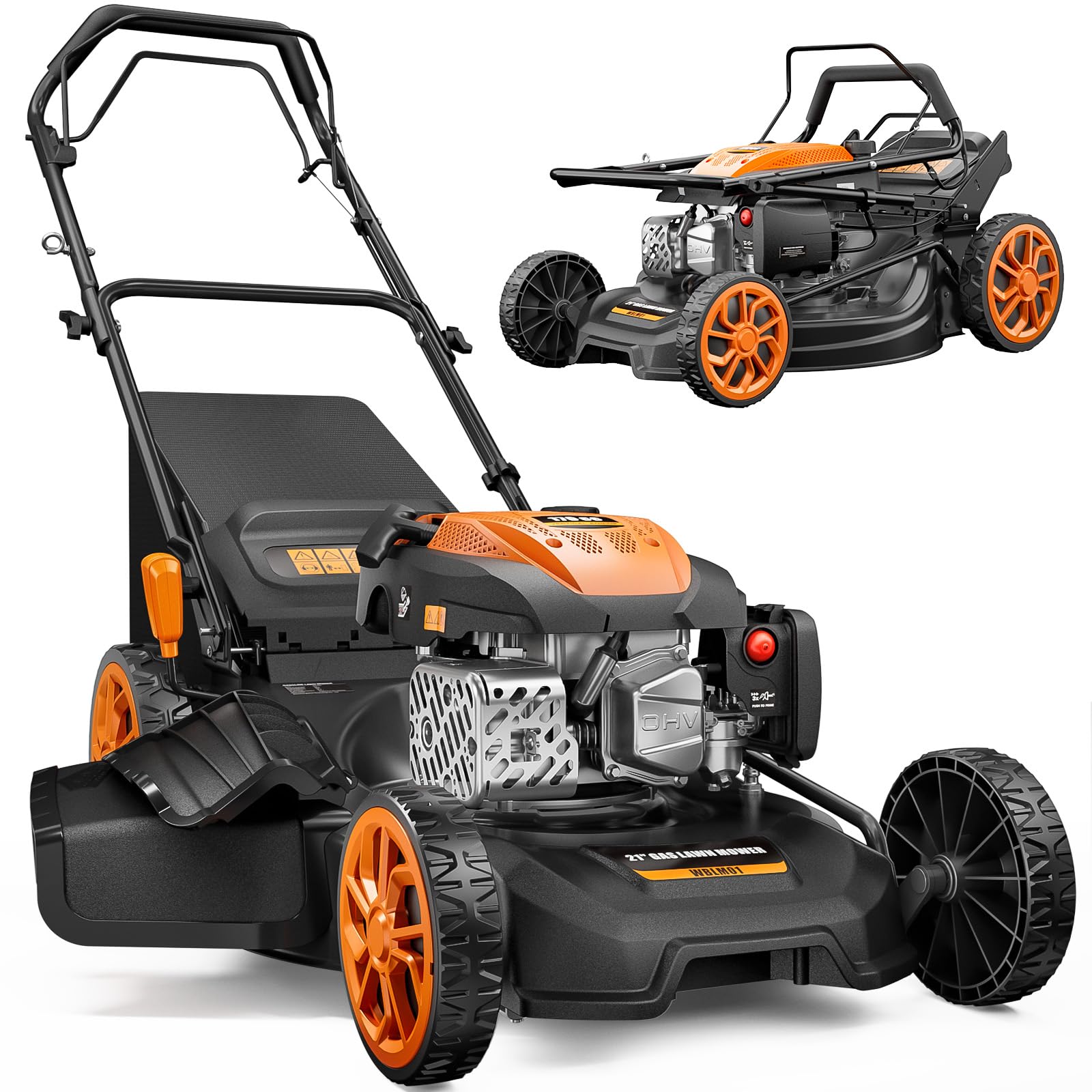
A 4-in-1 system and 7 cutting heights give you the most disposal options in the lineup.
Most mowers in this price range offer 3-in-1 cutting — mulching, rear bagging, and side discharge. This GasXcel adds a fourth option: rear discharge, which lets you drop clippings straight onto the lawn without sending them sideways into your flower bed. That extra flexibility makes a real difference if you switch between collecting clippings in spring and leaving them as natural fertilizer in summer. The 170cc OHV engine is fuel-efficient, running up to 1.5 hours on a full tank according to the manufacturer, and the 7-position height adjustment gives you one more notch than the 6-position PowerSmart V8622S2. The 8-inch front and 10-inch rear high-quality wheels provide smoother rolling on uneven ground than a standard 7/8-inch wheel setup. Buyers like that it comes “pre-assembled from the start” — you just attach the handle with twist-lock knobs in about 10 minutes.
One user highlighted the mower “locked up the first time using it the same day I received it,” which is a red flag for quality control. The 21-inch cutting width is standard, but at 170cc, it does not have the extra grunt of the 201cc models for tackling thick overgrowth. The single-speed self-propel with free-rolling wheels when pulled back is a nice touch for maneuvering, but the variable speed is not as refined as the YARDMAX CVT.
Flexibility first
- 4-in-1 system includes rear discharge — a rare feature at this price
- 7-position height adjustment offers fine seasonal control
- Quick assembly with no tools required, ready in about 10 minutes
Watch for
- First-use lockup reported by one buyer, indicating quality variance
- 170cc engine may struggle in very thick or overgrown grass
- Single-speed drive lacks the pace control of CVT models
Disposal-option seeker: Choose this if you switch between mulching, bagging, and rear discharge regularly; look elsewhere if you need 200cc+ power for dense, tall grass.
Understanding the Specs
Engine Displacement (cc) and Torque
The “cc” of a gas engine tells you its internal cylinder volume — more cc generally means more power. For a self-propelled mower, 170cc is the standard for regular weekly cuts on a quarter-acre. A 201cc engine gives you the extra torque (measured in foot-pounds) needed to spin the blade through thick, damp, or overgrown grass without stalling. Torque is the force that keeps the blade from slowing down when you hit a dense patch, so it matters more than raw speed for most mowing.
Drive System: FWD vs RWD
Front-wheel drive (FWD) pulls the mower forward, which makes it easier to lift the front and turn around trees and flower beds. Rear-wheel drive (RWD) pushes the mower, giving the rear wheels more weight and grip on slopes. If your yard has a noticeable incline, RWD prevents the front wheels from spinning helplessly. Some mowers also add a variable-speed transmission (CVT) so you can adjust the pace to your walking speed, rather than fighting a fixed gear.
Cutting Height Adjustment
A wider range of height positions means you can adapt the mower to different grass types and seasons without scalping the lawn. A range from around 1.25 inches (low, for a tight summer cut) to 4 inches (high, for spring and fall) covers everything you need. A single-lever adjuster is more convenient than adjusting each wheel individually, especially on uneven terrain where you need to raise the deck quickly to avoid digging into a bump.
Cutting Width and Deck Material
A 21-inch deck is nimble for gates and tight corners, while a 22-inch deck covers more ground per pass and shaves time off a larger lawn. Stamped steel decks are the standard for durability and impact resistance. Alloy steel decks are lighter but may not take a rock hit as well. The blade material also matters: hardened steel blades with a higher HRC rating (around 45–50) stay sharp longer through repeated cuts.
FAQ
Should I get a front-wheel drive or rear-wheel drive mower for a sloped lawn?
How much engine displacement (cc) do I actually need for a half-acre lawn?
What is the difference between 3-in-1 and 4-in-1 cutting systems?
Is a 22-inch deck too wide for my yard gates?
How often should I sharpen the blade on a gas self-propelled mower?
What type of oil does a gas self-propelled lawn mower need?
Can a self-propelled mower be used like a regular push mower if the drive system fails?
Why does my new mower smoke on the first start?
How long should a gas self-propelled mower last with regular maintenance?
Final Thoughts: The Verdict
If you want one dependable pick, the gas self-propelled lawn mower winner is the Yard Force YF22-3N1SP because its Briggs & Stratton engine, rear-wheel drive, and 12-inch rear wheels deliver reliable climbing power on slopes while the 7-position height adjustment keeps your cut consistent through the season. If you want a powerful engine for tackling thick, overgrown grass, grab the SENIX 22-inch 201cc RWD — its 8.8 ft-lb of torque cuts through dense patches without bogging down. And for a flat yard where nimble handling matters most, the standout is the light 61.7-pound SENIX 21-inch FWD, which pivots easily around trees and flower beds while offering a low 1.25-inch minimum cut.
How We Picked
We do not accept paid placement. Every pick is matched to a real buyer and a real use-case; we do not hands-on test units.
Sources & Methodology
Specifications: manufacturer listings and product documentation. Review insights: verified customer reviews, as of July 2026. Pricing: not shown on this page (it changes often); check the current price via the retailer link.
As an Amazon Associate, Lawn Gear Lab earns from qualifying purchases. This does not affect which products we feature.