
Specs are compiled from manufacturer listings and verified buyer reviews and can change over time — please confirm the key details on the product page before buying.
Standing in a yard covered in leaves, you grab a rake and a pile of plastic bags. That is the old way. A leaf mulcher vacuum changes the job: it sucks leaves off the ground, grinds them into tiny flakes, and packs a whole season into just a few bags.
I’m Rikta — the founder and writer behind Lawn Gear Lab. This guide is built by comparing the manufacturers’ published specifications and the patterns across verified customer reviews, so you get each pick’s real strengths and trade-offs instead of marketing spin.
The challenge is separating the real workhorses from tools that leave you crouching to empty a tiny bag every few minutes. This roundup of the best leaf mulcher vacuum options walks through the actual numbers — air speed, mulching ratio, weight — and what they mean the first time you clear your yard.
Quick Picks
- SENIX 3-in-1 Electric Leaf Blower — Best Overall
- BLACK+DECKER Leaf Blower Leaf Vacuum — Top Performer
- WORX Trivac 3 in 1 Electric Leaf Blower (WG509) — Versatile Pick
- WORX Trivac 3 in 1 Electric Leaf Blower — Metal Impeller
- SOYUS 3-in-1 Cordless Leaf Blower & Vacuum — Battery Powered
- Flowtron Electric Leaf Mulcher & Shredder — Heavy-Duty Shredding
How To Choose The Best Leaf Mulcher Vacuum
A leaf mulcher vacuum does three jobs in one tool. It blows leaves into piles, vacuums them up, and shreds them down to a fraction of their original volume. Which one you pick depends on your yard size, how many trees you have, and if you want to stay plugged into a power cord.
Air Speed vs Air Volume: What Actually Moves Leaves
Air speed in miles per hour (MPH) tells you how fast the air leaves the nozzle — this matters for blasting wet, matted leaves off the ground. Air volume in cubic feet per minute (CFM) tells you how much air moves, which matters for clearing a wide path. For leaf mulcher vacuums, a good rule of thumb is at least 200 MPH and 350 CFM to handle both dry leaves and the heavier clumps.
Mulching Ratio: How Much Reduction is Real
Manufacturers claim ratios like 16:1 or 18:1, meaning 16 bags of leaves shrink into one. In everyday use, you will get closer to 3:1 or 4:1 with the handheld units, as buyers consistently report. A freestanding shredder like a Flowtron can get close to its 30:1 claim because it is built for continuous throughput without a small bag clogging. Be honest about the ratio you will actually see before choosing the machine.
Metal vs Plastic Impeller
The impeller is the spinning blade that shreds leaves. A metal impeller will chew through twigs and small stones without cracking, while a plastic one may chip or break if you suck up a stray acorn. If your yard has a lot of sticks or debris, a metal impeller extends the machine’s working life significantly.
Corded vs Cordless
A corded electric tool runs as long as you do — no battery to recharge mid-job. The trade-off is hauling an extension cord around the yard. A cordless unit gives you freedom of movement, but you need enough battery capacity to finish the job. If you have a small yard or just a few piles, a cordless model with two 4.0 Ah batteries can handle it. For acres of leaves, a corded tool is the only reliable option.
Quick Comparison
| Model | Best For | Airflow (CFM) | Max Speed (MPH) | Weight | Amazon |
|---|---|---|---|---|---|
| SENIX 3-in-1 | Best Overall | 420 | 179 | 7 lbs | Amazon |
| BLACK+DECKER BV6000 | Top Performer | 400 | 250 | 8.1 lbs | Amazon |
| WORX WG509 | Versatile Pick | 350 | 210 | 9.3 lbs | Amazon |
| WORX WG505.2 | Metal Impeller | 350 | 210 | 9.7 lbs | Amazon |
| SOYUS 3-in-1 | Battery Powered | 360 | 170 | — | Amazon |
| Flowtron LE900 | Heavy-Duty Shredding | — | — | 17 lbs | Amazon |
In‑Depth Reviews
1. SENIX 3-in-1 Electric Leaf Blower, Corded Leaf Vacuum and Mulcher
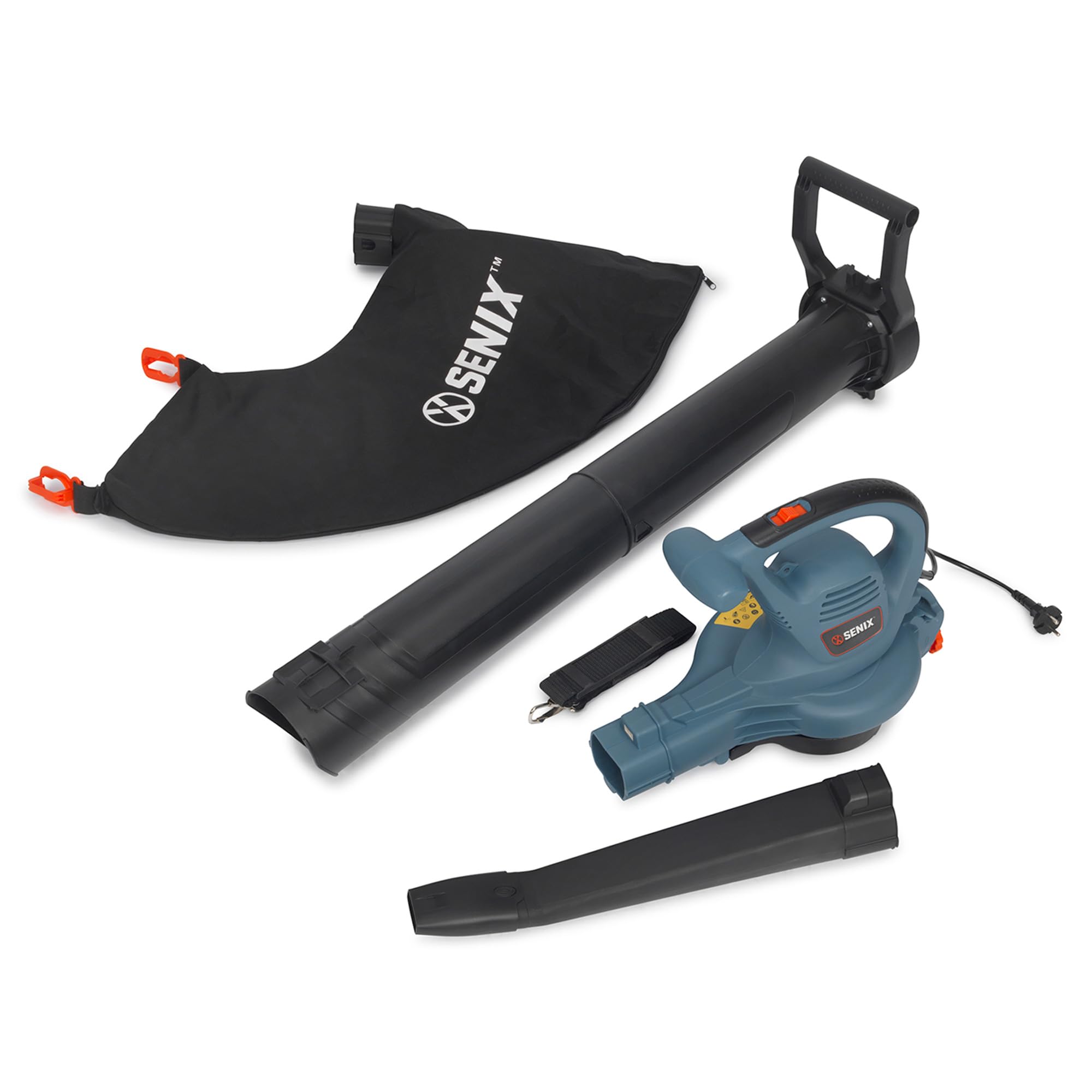
Light enough to hold one-handed, yet strong enough to suck up branches without grabbing rocks.
At just 7 pounds, this is the lightest corded unit in the lineup, so you can swing it around for a full afternoon without your arm going numb. The 420 CFM of airflow (the highest here) means it clears a wide path quickly, whether you are blowing leaves off the driveway or vacuuming a pile. Buyers report “it’s strong enough to suck up branches and twigs, without sucking up gravel,” which tells you the suction control is tuned well for real yards.
The variable speed control gives you 6 settings to dial in the power — low for dusting off a porch, high for matted leaves. One drawback: the 179 MPH maximum speed is lower than what you find on the BLACK+DECKER below, so it does not blast the heaviest wet leaves quite as easily. But for the weight, airflow, and the included 3-year limited warranty, it is the most balanced pick for most homeowners.
Why It Stands Out
- 420 CFM airflow is the highest in this group — clears a wide path fast.
- Weighs only 7 pounds, so fatigue is minimal during long sessions.
- 6-speed dial lets you match the power to the debris.
- 3-year limited warranty is better than the 2-year found on many competitors.
The Trade-Off
- Maximum speed of 179 MPH is noticeably lower than the BLACK+DECKER’s 250 MPH, making it less effective on wet leaves.
- Bag capacity is 1.24 bushels, which fills fast if you are vacuuming deep piles.
Best for most yards: Pick this if you want the lightest tool with the most airflow and don’t mind a slower top speed.
Look elsewhere if: You need maximum power to blast wet, heavy leaves — the BLACK+DECKER is better for that.
2. BLACK+DECKER Leaf Blower Leaf Vacuum and Leaf Mulcher 3-in-1, 12 Amp (BV6000)

The high-speed hammer that punches through wet leaves other vacuums just push around.
If you deal with wet, heavy leaves that hug the ground, this extra speed makes the difference between blasting them loose and just puffing at them uselessly. The 400 CFM airflow is nearly as high as the top unit, so you get both wide coverage and hard punch.
Owners mention it “mulched 1500sf yard leaves into one 40-gal bag,” which gives you a real-world benchmark for its efficiency. The high-impact metal fan (it is not a plastic impeller) handles twigs and small stones without cracking. However, the bag is a disposable-bag system, using black plastic bags you tie off and throw away. Some people prefer a reusable bag to reduce waste. Also, the cord is short, so you will need a heavy-duty extension cord for a normal-sized yard.
Why It’s a Powerhouse
- 250 MPH top speed is the highest in the lineup, ideal for wet leaves.
- 400 CFM airflow keeps the clearing path wide while moving debris fast.
- Metal fan means the impeller won’t crack on small twigs and stones.
- Customers note one bag handles the leaves from a 1500 sq ft yard.
Where It Falls Short
- Uses disposable bags, which create plastic waste compared to a reusable bag.
- Short power cord; a long, heavy-duty extension cord is mandatory.
- Weighs 8.1 lbs — gets heavy on long jobs, though it has a shoulder strap.
The wet-leaf specialist: Choose this if you deal with heavy, damp leaves and need the extra punch to move them.
Pass if: You prefer a reusable collection bag to avoid buying disposable ones every season.
3. WORX Trivac 3 in 1 Electric Leaf Blower (WG509)

A capable all-rounder that switches from blower to vacuum to mulcher in seconds.
This WORX hits a solid middle ground — 350 CFM airflow and 210 MPH top speed — which is faster than the SENIX but with slightly less volume. For a typical yard with mixed dry and slightly damp leaves, this balance works well. The 18:1 claimed mulching ratio sounds impressive, but reviewers point out the real-world ratio is closer to 3:1 or 4:1, not the advertised 18:1. Adjust your expectations and it is still a big reduction.
One notable thing is the weight: at 9.3 pounds, it is heavier than the SENIX by 2.3 lbs and heavier than its own premium sibling the WG505.2. However, the variable speed control (6 settings) lets you drop the power for light sweeping and crank it up for heavy debris. Shoppers say that the bag fills quickly — you will be emptying it often — and you need to clear rocks and branches beforehand to avoid jamming.
The Strengths
- 210 MPH is noticeably faster than the SENIX’s 179 MPH, especially for wet leaves.
- Variable speed dial (6 settings) offers fine control from light sweep to full blast.
- Easy switch between blowing and vacuuming with a simple lever.
The Drawbacks
- At 9.3 lbs, it is noticeably heavier than the SENIX (7 lbs) and can cause fatigue.
- Real-world mulching ratio is around 3:1 to 4:1, not the claimed 18:1.
- Bag needs constant emptying during heavy use.
For the price-conscious shopper: A good all-rounder if you want a balance of speed and airflow at a lower investment.
skip it if: Weight is your main concern — the SENIX is 2.3 lbs lighter.
4. WORX Trivac 3 in 1 Electric Leaf Blower (WG505.2)

The metal impeller model that chews through twigs without flinching.
This WORX is nearly identical to the WG509 above — same 350 CFM and 210 MPH — but it comes with a metal impeller and a LeafPro collection system. The metal impeller is a real upgrade if your yard is littered with small sticks and acorns, as plastic impellers can crack under that abuse. The LeafPro system lets you attach a hose directly to a trash can, so you skip the bag entirely.
At 9.7 pounds, it is the heaviest handheld unit here — 2.7 lbs heavier than the SENIX. That extra weight plus the metal impeller makes it feel built to last, but you will feel it after an hour. Buyers report it “reduced two 32-gallon cans to 1/4 of one,” which is a strong real-world performance metric. The trade-off is the weight and a slightly higher investment than the WG509.
Where It Excels
- Metal impeller means you can accidentally suck up twigs and small stones without damage.
- LeafPro system allows direct-to-trash-can vacuuming, which is faster than bagging.
- Buyers cite reducing two 32-gal cans to 1/4 of one — a major volume reduction.
Where It Struggles
- At 9.7 lbs, it is the heaviest handheld unit, making long sessions tiring.
- Higher price than the WG509 for essentially the same airflow and speed.
For the debris-heavy yard: Buy this if you have a lot of sticks and acorns on the ground and need a metal impeller to survive them.
Not ideal if: Weight is your primary consideration — the SENIX is 2.7 lbs lighter.
5. SOYUS 3-in-1 Cordless Leaf Blower & Vacuum
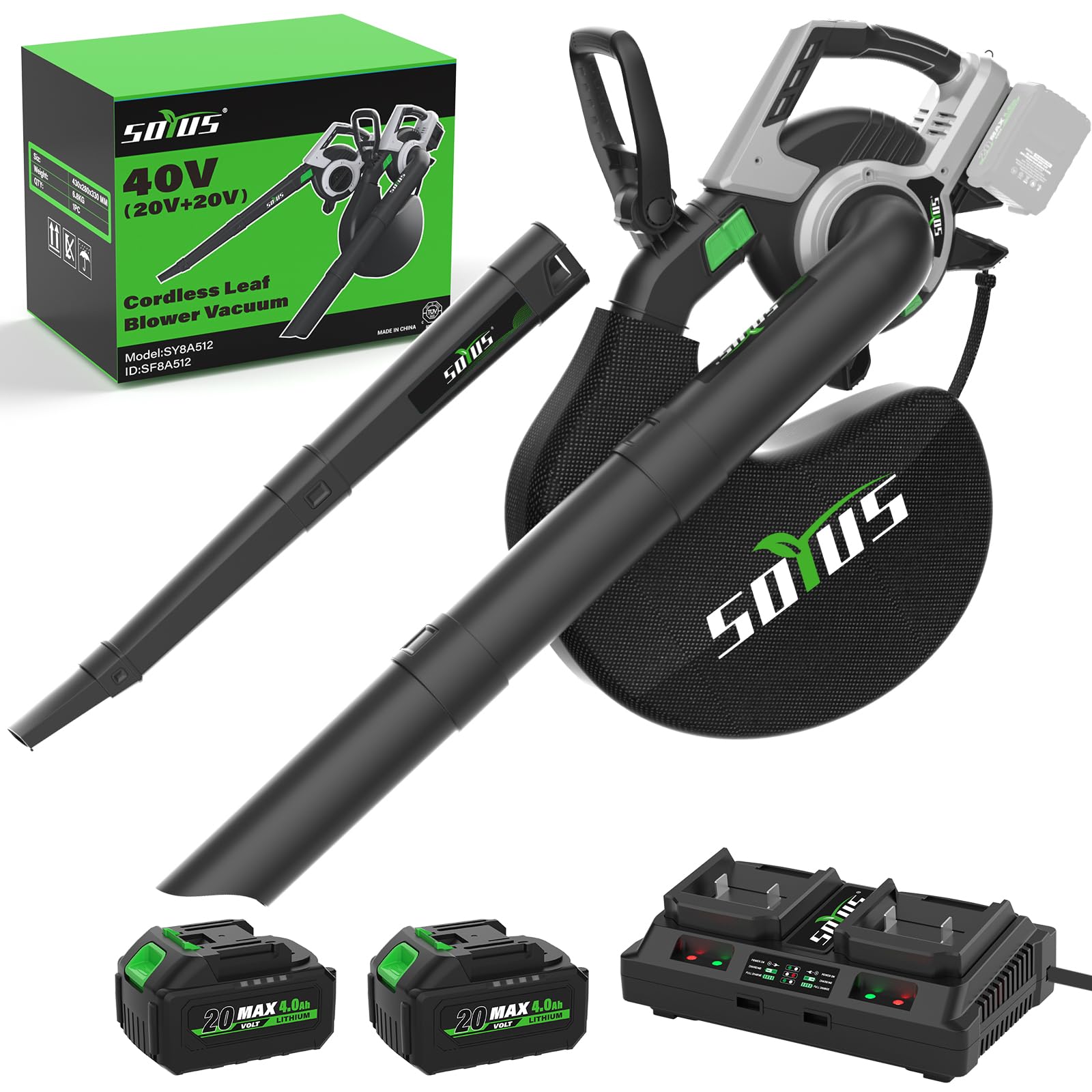
The cordless option that cuts the cord without cutting power — for small yards at least.
If you hate dragging an extension cord around, the SOYUS is your pick. It runs on two 20V 4.0 Ah batteries (compatible with Makita tools, the maker claims) and delivers 360 CFM — close to the corded models — with a top speed of 170 MPH. It has a turbo button for a burst of extra power when you need to move a pile of wet leaves, though owners mention the batteries drain fast on that setting.
The 45L collection bag is the largest in this lineup, which means fewer trips to empty it. With a brushless motor, the machine should last longer and run cooler than older brushed motors. However, the low top speed of 170 MPH (compared to 250 MPH on the BLACK+DECKER) means it will struggle with really heavy, wet leaves outside of turbo mode. A buyer also reported one battery died after 11 months, so long-term reliability is an open question.
The Cordless Advantage
- Two 4.0 Ah batteries are included, giving up to 90 minutes at low speed.
- 360 CFM is strong for a cordless unit — close to corded performance.
- 45L bag is the largest capacity, reducing emptying frequency.
- Brushless motor is more durable and efficient than brushed alternatives.
The Cordless Drawbacks
- 170 MPH top speed is the slowest here, limiting wet-leaf performance.
- Batteries drain fast on turbo mode, and a buyer reported one died at 11 months.
- Not ideal for large yards — you will run out of charge before you finish.
Best for small properties: This is the pick if you have a small yard with dry leaves and want the convenience of no cords.
Avoid if: You have a large yard with heavy, wet leaves — corded models are more reliable for that.
6. Flowtron Electric Leaf Mulcher & Shredder (LE900)

The freestanding monster that turns 30 bags of leaves into one, but demands dry conditions and sorting.
The Flowtron is not a handheld tool — it is a dedicated stationary shredder you set up on a trash can or its own legs. You feed leaves into a wide 21-inch funnel and it grinds them into a fine powder, with a claimed reduction ratio of up to 30:1. Customers note turning “30-40 bags into 15” with real-world use, which is a dramatic volume reduction — far more than any handheld unit can achieve. The sliding control lever lets you adjust particle size from coarse (8:1) to fine (30:1).
The catch is that it only works well with dry leaves. Wet leaves bog down the universal motor (a type of electric motor that runs on AC or DC power), causing it to overheat and reset repeatedly, as buyers in humid climates report. You also need to remove twigs, acorns, and pinecones first, as they can clog or damage the cutting lines. Assembly is straightforward but the plastic throat collar can be ill-fitting, and the metal frame is not the sturdiest. For dry leaf season, however, no other pick in this guide matches its volume reduction.
Why It Dominates Volume Reduction
- Up to 30:1 mulching ratio — far better than any handheld vacuum.
- Reviewers point out turning 30-40 bags of leaves into just 15 bags.
- Adjustable coarseness from fine (compost-ready) to coarse (garden mulch).
- Heavy-duty motor with circuit breaker and reset button for overload protection.
The Limitations
- Only works reliably with dry leaves — wet leaves cause overheating.
- Requires sorting out twigs, acorns, and pinecones beforehand.
- Plastic parts feel somewhat fragile; shoppers say cracking during assembly.
- At 17 lbs and 24″ x 40″ x 22″, it is large and not portable for everyone.
For the serious composter: Choose the Flowtron if you have a large yard full of dry leaves and need to produce fine compost-grade mulch in volume.
pass on it if: You live in a wet climate or want a tool that can handle a few wet piles without constant resetting. A handheld model is better for variable conditions.
Understanding the Specs
Air Speed (MPH) vs Air Volume (CFM)
Air speed in miles per hour (MPH) tells you how fast the air jet hits leaves. A higher MPH number (like 250 on the BLACK+DECKER) helps lift wet, matted leaves off the ground. Air volume in cubic feet per minute (CFM) tells you how much air moves each minute — this determines how wide a path you can clear in one pass. A higher CFM (like 420 on the SENIX) is better for covering large areas quickly. For most yards, you want at least 350 CFM and 200 MPH to handle both dry and damp leaves.
Mulching Ratio
This is a claimed reduction in volume — 18:1 means the maker says 18 bags of whole leaves would become one bag of mulch. In real use, handheld vacuums usually achieve between 3:1 and 4:1 because the bag fills with air and the impeller is small. Dedicated stationary shredders like the Flowtron can get much closer to their claimed 30:1 because they grind continuously with no bag restriction. Use the ratio as a rough guide, not a guarantee.
Impeller Material
The impeller is the spinning piece inside that shreds the leaves. A metal impeller (found on the WORX WG505.2 and the BLACK+DECKER BV6000) will chew through small sticks, stones, and acorns without cracking or chipping. A plastic or ABS impeller is lighter but more fragile — if you accidentally suck up a hard object, it may break. If your yard has a lot of twigs and debris, spend the extra for a metal impeller.
Bag Capacity and Type
The collection bag’s size (measured in bushels or liters) determines how often you must stop to empty it. A 1.24 bushel bag fits roughly three 13-gallon trash bags of leaves. A 45L bag holds about 12 gallons. Smaller bags empty more often but are lighter to carry. Some models use disposable plastic bags that you tie off and discard (BLACK+DECKER), while others use reusable fabric bags (SENIX, WORX, SOYUS) with a zipper at the bottom for dumping.
FAQ
Can a leaf mulcher vacuum handle wet leaves?
Will a leaf mulcher vacuum pick up small sticks and acorns?
Is a corded or cordless leaf mulcher vacuum better?
How much do these tools weigh, and does it matter?
What is a good real-world mulching ratio for a handheld vacuum?
How do I switch between blower and vacuum mode?
Can I use a leaf mulcher vacuum to clean my gutters?
Will a corded model require a heavy-duty extension cord?
What does the “LeafPro” system on the WORX WG505.2 do?
How loud is a leaf mulcher vacuum?
Final Thoughts: The Verdict
For most buyers, the best leaf mulcher vacuum winner is the SENIX 3-in-1 because it combines the highest airflow (420 CFM, or cubic feet per minute — enough to move heavy wet leaves) with the lightest weight (7 lbs) and a 3-year warranty at a mid-range investment. If you want maximum power for wet leaves, grab the BLACK+DECKER BV6000 with its 250 MPH speed and metal fan. And for achieving the highest leaf volume reduction in dry conditions, the Flowtron LE900 stationary shredder is the top pick.
How We Picked
We do not accept paid placement. Every pick is matched to a real buyer and a real use-case; we do not hands-on test units.
Sources & Methodology
Specifications: manufacturer listings and product documentation. Review insights: verified customer reviews, as of July 2026. Pricing: not shown on this page (it changes often); check the current price via the retailer link.
As an Amazon Associate, Lawn Gear Lab earns from qualifying purchases. This does not affect which products we feature.