
Specs are compiled from manufacturer listings and verified buyer reviews and can change over time — please confirm the key details on the product page before buying.
You watch your blueberries ripen to that perfect dusky blue, and the next morning they are gone — pecked, stolen, vanished. Bird netting is the only real defense, but the wrong mesh tangles, tears, or lets those clever beaks through anyway. This guide covers four proven options that actually keep birds off your bushes so you get to eat what you grew.
I’m Rikta — the founder and writer behind Lawn Gear Lab. This guide is built by comparing the manufacturers’ published specifications and the patterns across verified customer reviews, so you get each pick’s real strengths and trade-offs instead of marketing spin.
You need a mesh size that stops sparrows and robins but also a material that lasts through sun and storms. The right bird netting for blueberries does both, whether you cover a few bushes or a whole row.
Quick Picks
- POYEE 25x25ft Bird Netting — Best Overall
- POYEE 20x20ft Bird Netting — Best Value
- Vocray Bird Netting 15×40 FT — High Coverage Pick
- KLEWEE 10×50 FT Garden Mesh Netting — Ultra-Fine Pick
How To Choose The Best Bird Netting For Blueberries
Choosing netting for blueberries is simpler than you think once you focus on three things. You want a mesh opening small enough that birds cannot squeeze through — 1/2 inch is the standard that works for robins, sparrows, and even hummingbirds. You want material dense enough to shrug off a summer of UV rays without turning brittle. And you want a size that actually fits your blueberry patch without leaving gaps or buying a roll three times bigger than you need.
Mesh Size Is The Gatekeeper
A 1/2 inch mesh stops birds but still lets air flow and heat escape, so your blueberries stay cool. Some ultra-fine nets use a 0.8mm mesh that also blocks insects and tiny pests, but that dense weave can trap heat and overheat plants in hot climates unless you leave the sides open.
Material Weight Tells You How Long It Lasts
Cheap netting weighs around 6-9g/m² (0.02-0.03oz/ft²) and often rips the first time you stretch it over a bush. Stronger netting uses High Density Polyethylene (HDPE) at 25-30g/m² (0.098oz/ft²), which resists UV, rot, and tearing season after season. That weight difference is the single biggest predictor of whether you buy netting once or every spring.
Size And Coverage
Measure your blueberry bushes at their widest spread, then add a couple of feet on each side so the netting drapes to the ground. Most rolls are rectangular and can be cut with scissors. It is better to buy slightly larger than you think — you can always trim, but you cannot add material you do not have.
Quick Comparison
| Model | Best For | Mesh Size | Area Coverage | Material Weight | Amazon |
|---|---|---|---|---|---|
| POYEE 25x25ft | Large blueberry patches needing maximum coverage | 1/2 inch | 625 sq ft | 30g/m² | Amazon |
| POYEE 20x20ft | Mid-size gardens with strong all-season protection | 1/2 inch | 400 sq ft | 30g/m² | Amazon |
| Vocray 15×40 FT | Long narrow rows and chicken run covers | 1/2 inch | 600 sq ft | 25g/m² | Amazon |
| KLEWEE 10×50 FT | Ultra-fine protection against bugs and birds | 0.8mm | 500 sq ft | — | Amazon |
In‑Depth Reviews
1. POYEE 25x25ft Bird Netting
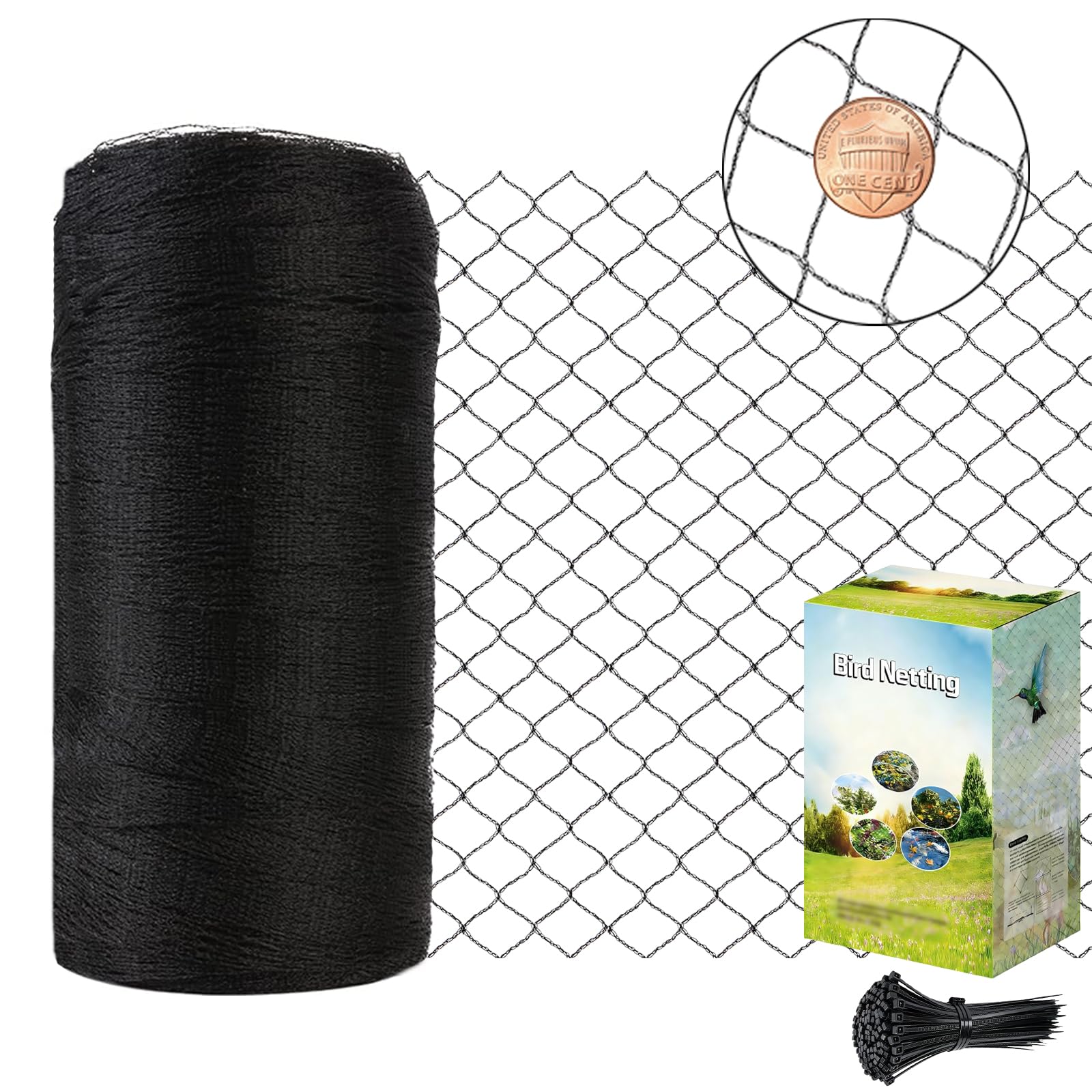
The heavyweight champion that covers your biggest blueberry patch in one shot.
You get the same POYEE build as the 20×20 but scaled up to 300″L x 300″W — that is 625 square feet of 1/2 inch mesh, so you cover a long blueberry row without taping scraps together. The material weighs 30g/m² (0.098oz/ft²), more than three times the 6-9g/m² (0.02-0.03oz/ft²) of typical netting, so you feel its heft as you unroll it. Made from UV-resistant, high-density polyethylene (HDPE), it resists rot and stays flexible through snow and heat.
Buyers report using this over a large asiatic jasmine bed through fall and spring, lifting it easily for leaf cleanup and reusing it the next season. At 1.69 kilograms, it is the heaviest pick here, but that weight gives you wind resistance and structural staying power that lighter nets lack.
For blueberries, the 1/2 inch mesh is exactly what you need: small enough to block sparrows and robins, large enough to let rain and sun reach every berry. The trade-off is simple — at 1.69 kilograms it is noticeably heavier than the 1.01 kilogram KLEWEE net, so installing it solo over a wide patch takes a second pair of hands.
Why It Earns The Top Spot
- Generous 300″x300″ coverage for 625 sq ft
- 30g/m² HDPE is far tougher than standard netting
- UV-resistant, rot-resistant, and reusable across seasons
One Thing To Know
- At 1.69 kg it is the heaviest option here; easier with a helper
Reach for this if: you have a large blueberry patch and want one single sheet that covers it entirely with the strongest HDPE build on this list.
Pass it by if: you only have a couple of bushes — the 20×20 version gives you the same material in a more manageable size.
2. POYEE 20x20ft Bird Netting
The same heavy-duty build as the big roll, sized right for a standard garden.
You get the same 30g/m² (0.098oz/ft²) HDPE material and 1/2 inch mesh as the 25×25 above, but in a 240″L x 240″W sheet covering 400 square feet — enough for a half-dozen blueberry bushes or a medium raised bed. The 30g/m² density versus the flimsy 6-9g/m² of budget nets means you can stretch it tight over a bush frame without it snapping mid-season.
Owners mention it keeps birds and critters out of fruit trees and gardens, and one reviewer used it over a chicken run with PVC arches and zip ties, noting it held up through two winters. One owner said the holes looked “larger than expected” but confirmed it still worked — something to consider if you have very small birds like finches that might squeeze through a 1/2 inch gap.
Compared to the larger 25×25, this one weighs less (1.69 kg vs this one’s unspecified but smaller roll) and is easier to manage alone. It gives you the same premium HDPE durability at a lower entry point, making it the smart mid-range buy for most backyard blueberry growers.
Why It Works
- Same tough 30g/m² HDPE as the larger POYEE roll
- 400 sq ft is enough for most home gardens
- Easy to cut and customize with scissors
A Minor Catch
- A few customers note the mesh looks slightly bigger than 1/2 inch
Solid pick for: anyone who wants the strongest material on this list without paying for the 25×25’s extra square footage.
Look elsewhere if: your blueberry bushes are widely spaced across a long row — the 15×40 shape would drape better.
3. Vocray Bird Netting 15×40 FT

A long 15×40 foot sheet built for rows and runs, not squares.
This Vocray netting measures 480″L x 180″W (that is 600 square feet in a long narrow rectangle), so it fits a row of blueberry bushes or a chicken run far better than a square sheet. The 1/2 inch mesh blocks birds including hummingbirds, and the maker claims a load-bearing capacity exceeding 100 pounds — meaning you can drape it over a tall frame without the center sagging into your bushes. At 25g/m² (0.9 oz/ft²), it sits slightly below the 30g/m² POYEE nets but still far above the 6-10g/m² (0.2-0.4oz/ft²) of fragile deer netting.
Buyers who used this as chicken netting report it survived brutal desert sun for 7 months with no wear and successfully prevented eagle attacks for 5 months. One reviewer received a roll with a small torn-and-repaired area but still said the netting was easy to install, had no tangles, and offered good stretch and strength. The black color helps it blend into garden backgrounds better than white mesh.
Compared to the POYEE 20×20, the Vocray gives you more total area (600 sq ft vs 400 sq ft) at the same price tier, but its material is 25g/m² instead of 30g/m² — a real trade-off if you need maximum long-term durability. For blueberries in a long row, the rectangular shape is actually more practical than a square sheet.
What Stands Out
- Long 15×40 foot shape matches rows perfectly
- Load-bearing capacity exceeds 100 pounds
- Proven durability in extreme heat and sun
A Real Trade-Off
- 25g/m² density is slightly lower than the 30g/m² POYEE nets
Best fit for: growers with a long row of blueberry bushes or anyone who also needs netting for a chicken run.
You might skip it if: your blueberry patch is a wide square bed — the 20×20 POYEE shape would lay out flatter.
4. KLEWEE 10×50 FT Garden Mesh Netting

A see-through barrier so fine it keeps bugs out along with birds.
The KLEWEE netting uses an 0.8mm x 0.8mm ultra-fine mesh that is far denser than the 1/2 inch openings on the other picks here. That means it stops not just birds but also insects, cats, and chickens — one reviewer noted it “keeps pests (cats, chickens, bugs) out” and holds up better than thinner brands. The 590.5″L x 118.1″W dimensions give you a long 10×50 foot strip that is easy to cut into custom lengths for raised beds or individual blueberry bushes.
It is made from polyethylene (PE) and weighs only 1.01 kilograms, making it the lightest option here by a wide margin — at 1.01 kg it is 67% lighter than the POYEE 25×25’s 1.69 kg. That lightness makes it easy to lay directly over plants without crushing stems, but it also means the material is less dense than the HDPE nets. Reviewers point out it lets rain and sun through perfectly and is reusable after drying and storing, though the ultra-fine weave can trap more heat in direct summer sun if not lifted off the plant canopy.
Compared to the POYEE nets, this KLEWEE is a different tool entirely: you trade sheer puncture resistance for insect-grade protection and lighter handling. If Japanese beetles or cabbage moths are a problem in your blueberry patch alongside birds, this is the netting that stops both. Just know the 0.8mm mesh will also block more airflow, so in humid climates leave some slack at the base for ventilation.
Why You Might Choose This
- 0.8mm ultra-fine mesh blocks bugs and birds
- Light at 1.01 kg — easy to handle and drape
- Cut-to-size for raised beds and small spaces
Consider This
- PE material is less durable than HDPE over multiple seasons
- Tighter mesh can trap heat without side ventilation
Reach for this if: you need insect protection plus bird protection in one net, or if your blueberry patch is in a raised bed where you can secure the edges easily.
Pass it by if: your main enemy is just birds and you want the toughest multi-season HDPE build — stick with the POYEE nets.
Understanding the Specs
Mesh Size
The mesh size (the opening between threads) determines what can get through. A 1/2 inch mesh stops robins, sparrows, and starlings while letting rain and sunlight through to your blueberries. An ultra-fine 0.8mm mesh — 80 openings per inch — also blocks insects and smaller pests but can reduce airflow in hot weather. For blueberries, 1/2 inch is the reliable standard; only step down to finer mesh if insects are also stealing your harvest.
Material Weight (g/m²)
The grams-per-square-meter number tells you how dense and strong the plastic netting is. Budget netting weighs 6-10g/m² (0.02-0.04oz/ft²) and often rips the first season. Good netting like the POYEE options uses 30g/m² (0.098oz/ft²) HDPE — roughly three times the material per square foot — which resists UV rot, stretching, and tearing across multiple seasons. The Vocray sits at 25g/m², still well above the fragile tier. Heavier material costs more upfront but saves you from buying replacement netting every year.
FAQ
What size mesh keeps birds out of blueberries?
Will bird netting damage my blueberry bushes?
How do I secure bird netting so birds do not get underneath?
Can I reuse bird netting next season?
Is 25g/m² netting strong enough for blueberries?
How much netting do I need for 4 blueberry bushes?
Can birds get tangled in 1/2 inch bird netting?
Will the netting keep squirrels out of my blueberries too?
What is the difference between HDPE and PE netting?
Should I choose white or black bird netting for blueberries?
Final Thoughts: The Verdict
For most blueberry growers, the bird netting for blueberries winner is the POYEE 25x25ft because it gives you the strongest 30g/m² HDPE material in the largest coverage area, so you cover your whole patch with one sheet that lasts season after season. If you want the same tough build in a more manageable size, grab the POYEE 20x20ft. And for anyone dealing with bugs alongside birds, the KLEWEE 10×50 FT brings an ultra-fine 0.8mm mesh that keeps every pest out of your harvest.
How We Picked
We do not accept paid placement. Every pick is matched to a real buyer and a real use-case; we do not hands-on test units.
Sources & Methodology
Specifications: manufacturer listings and product documentation. Review insights: verified customer reviews, as of July 2026. Pricing: not shown on this page (it changes often); check the current price via the retailer link.
As an Amazon Associate, Lawn Gear Lab earns from qualifying purchases. This does not affect which products we feature.