
Specs are compiled from manufacturer listings and verified buyer reviews and can change over time — please confirm the key details on the product page before buying.
You are staring down a yard buried in wet oak leaves or a driveway scattered with pine needles. A gas leaf blower turns hours of raking into minutes of walking, but you need one that starts easily, handles the load without vibrating your arms numb, and delivers enough air speed to move the heavy stuff without choking on dust.
I’m Rikta — the founder and writer behind Lawn Gear Lab. This guide is built by comparing the manufacturers’ published specifications and the patterns across verified customer reviews, so you get each pick’s real strengths and trade-offs instead of marketing spin.
On a suburban lot or a multi-acre property, matching the engine size and air-flow numbers to the work you do makes fall cleanup feel almost easy. The gas leaf blowers below are the ones that deliver on that promise.
Quick Picks
- PROYAMA 72CC Gas Backpack Leaf Blower — Best Value
- Husqvarna 560BTS Backpack Leaf Blower — Best Back-Saver
- Husqvarna 570BTS Backpack Leaf Blower — Top Performer
- PRORUN PBB3000 Gas Backpack Leaf Blower, 79.9cc — Commercial Beast
- PRORUN PBB2884 75.6cc Backpack Leaf Blower — Mid-Range Power
- Troy-Bilt Gas Backpack Leaf Blower — Best Budget
- Echo PB-580T 58.2 CC Back Pack Blower — Lightweight Pro
- Echo PB-9010T 79.9 cc X Series Backpack Blower — Top-Tier Echo
How To Choose The Best Gas Leaf Blowers
Choosing the right gas leaf blower means understanding three main specs: engine power (cc), air volume (CFM), and air speed (MPH). A big engine doesn’t help if the nozzle design restricts airflow, and a high MPH number won’t move a pile of wet leaves if the CFM is too low. Start by matching the blower’s power to the size of your property and the type of debris you typically clear.
Engine Displacement and Starting Features
The engine size, measured in cubic centimeters (cc), determines how much power the blower can produce. A 51cc engine is fine for a small yard, while a 79.9cc commercial-grade engine can clear acres of heavy debris. Look for features like SpringAssist or a spring-assisted starter handle, which reduce the effort needed to pull the cord, especially in cold weather or after storage.
Airflow and Comfort (CFM, MPH, and Harness)
You want a balance between Cubic Feet per Minute (CFM) and Miles per Hour (MPH) to handle both volume and distance. For wet leaves or heavy debris, aim for at least 600 CFM and 200 MPH. A good backpack harness with padded, wide-grip straps and anti-vibration technology (LowVib) makes a heavier blower feel much lighter over long sessions, reducing shoulder and back fatigue.
Quick Comparison
| Model | Best For | Engine (cc) | Airflow (CFM) | Speed (MPH) | Amazon |
|---|---|---|---|---|---|
| PROYAMA 72CC | Value Power | 72cc | 880 CFM | 275 MPH | Amazon |
| Troy-Bilt TB51BP | Budget Backpack | 51cc | 600 CFM | 220 MPH | Amazon |
| PRORUN PBB2884 | High Air Volume | 75.6cc | 1020 CFM | 240 MPH | Amazon |
| Echo PB-580T | Lightweight Reliability | 58.2cc | 510 CFM | 215 MPH | Amazon |
| PRORUN PBB3000 | Commercial Power | 79.9cc | 1125 CFM | 250 MPH | Amazon |
| Husqvarna 560BTS | Professional Balance | 65.6cc | 632 CFM | 232 MPH | Amazon |
| Husqvarna 570BTS | High-End Commercial | 66cc | 972 CFM | 236 MPH | Amazon |
| Echo PB-9010T | Max Blow Force | 79.9cc | 1110 CFM | 220 MPH | Amazon |
In‑Depth Reviews
1. PROYAMA 72CC Gas Backpack Leaf Blower
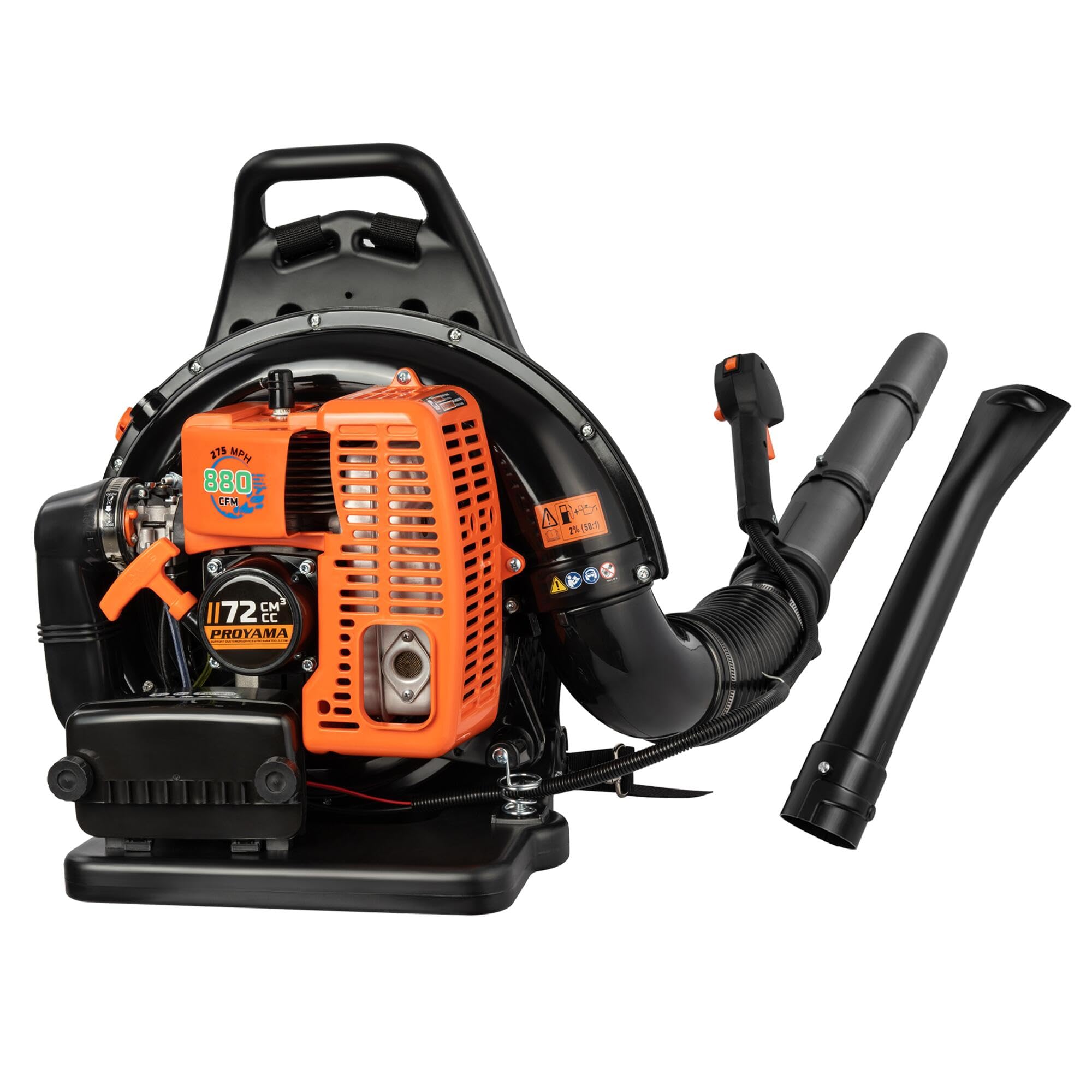
Delivers 880 CFM and 275 MPH at a price that leaves the PRORUN PBB2884 in its dust on value.
You get near-commercial CFM (cubic feet per minute — the volume of air the blower pushes) without the commercial price tag. The PROYAMA packs a 72cc 2-cycle engine (the kind that needs oil mixed into the gas) that cranks out 880 CFM and 275 MPH (miles per hour — the speed of that air), making it the most aggressive air mover in its price tier. The dual-tube design includes both a flat nozzle for wide swaths and a round nozzle for focused power, so you switch between clearing a lawn and blasting a sidewalk without stopping to swap tubes.
Buyers report that a certified mechanic called it “well-built with heavy-duty plastic/electronic ignition” and praised the value compared to a Stihl. The cruise control and self-throttle lock keep the engine at a consistent RPM (revolutions per minute), so you are not constantly squeezing the trigger. The shock-absorbing straps help spread the weight evenly across your shoulders.
The main trade-off is that some hose connections felt tricky during assembly. One reviewer also noted there is “a little more plastic than I would like,” but that keeps the 21-pound weight low and the price well below premium models.
Why It Earns Its Spot
- Strong 880 CFM and 275 MPH at a very competitive price point.
- Light 21-pound frame with well-padded, shock-absorbing straps for comfortable all-day wear.
- Cruise control holds steady RPM, reducing hand fatigue.
What to Watch For
- Some plastic components feel less premium than commercial-grade metal alternatives.
- Hose connections can be fiddly during first assembly.
Reach for this if: you want the highest CFM-per-dollar ratio in a lightweight backpack style for a large suburban yard or light commercial use.
Look elsewhere if: you need the absolute durability of a 33-pound commercial beast with a metal nozzle for daily professional abuse.
2. Husqvarna 560BTS Backpack Leaf Blower
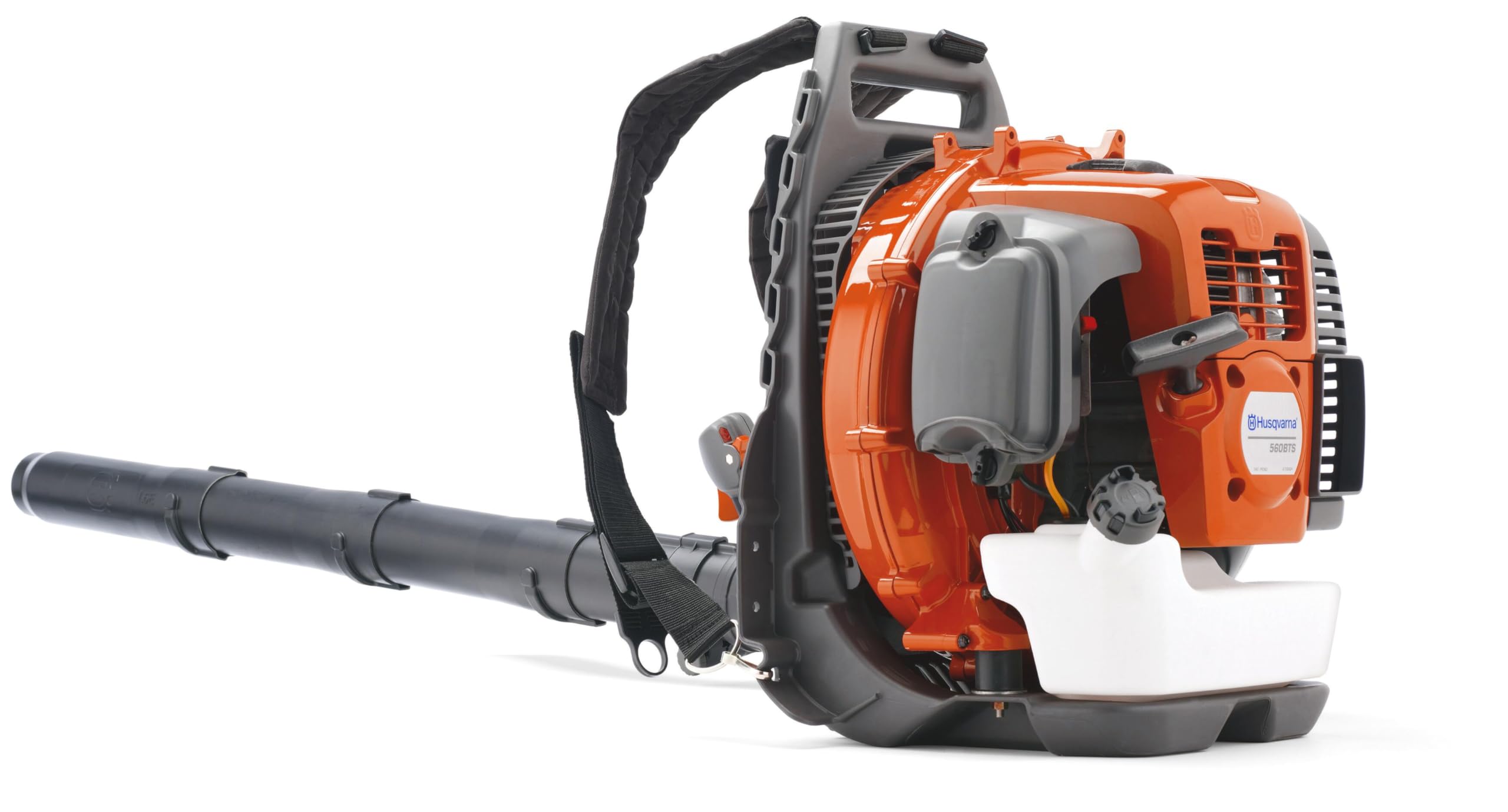
A balanced pro blower with a 2-stage harness that makes 23.2 pounds feel like much less.
The Husqvarna 560BTS is built around a 65.6cc X-Torq engine delivering 632 CFM and 232 MPH. It uses a 2-stage load-reducing harness (a padded system that spreads weight across your shoulders and hips) to make the 23.2-pound weight manageable for longer jobs. The tube-mounted throttle keeps control at your fingertips, and the air purge system removes air from the carburetor for easier starting. Owners mention it starts on the second or third pull consistently and has good fuel economy — one owner on 10-plus acres reported getting 2-3 weekends out of a single tank for a 1-acre lot plus a quarter-mile driveway.
The professional-grade air filter uses a two-stage intake that catches fine debris, so the engine stays protected in dusty conditions. Customers note it “reduces cleanup time by roughly two-thirds” compared to a handheld blower, and one called it “a workhorse” that handles dirt, sand, leaves, and twigs. The main complaints are that it is loud (ear protection is a must), and the tube fit is very tight during assembly — a little muscle and maybe some soapy water helps.
This makes the 560BTS a balance for professionals who need consistent, reliable power without the extra weight of a 66cc engine.
Pros from the Field
- Consistent 1-3 pull starts; users report it cranks every time.
- 2-stage air filter keeps fine dust out of the engine.
- Well-padded harness distributes the 23.2-pound weight comfortably.
Cons to Know
- Loud enough that you need hearing protection.
- Tube fit is tight during assembly.
Perfect for: homeowners and pros with 2+ acres who want a reliable, mid-weight blower that never leaves them stranded.
Not ideal if: every pound matters and you need the lightest possible kit for long commercial shifts.
3. Husqvarna 570BTS Backpack Leaf Blower
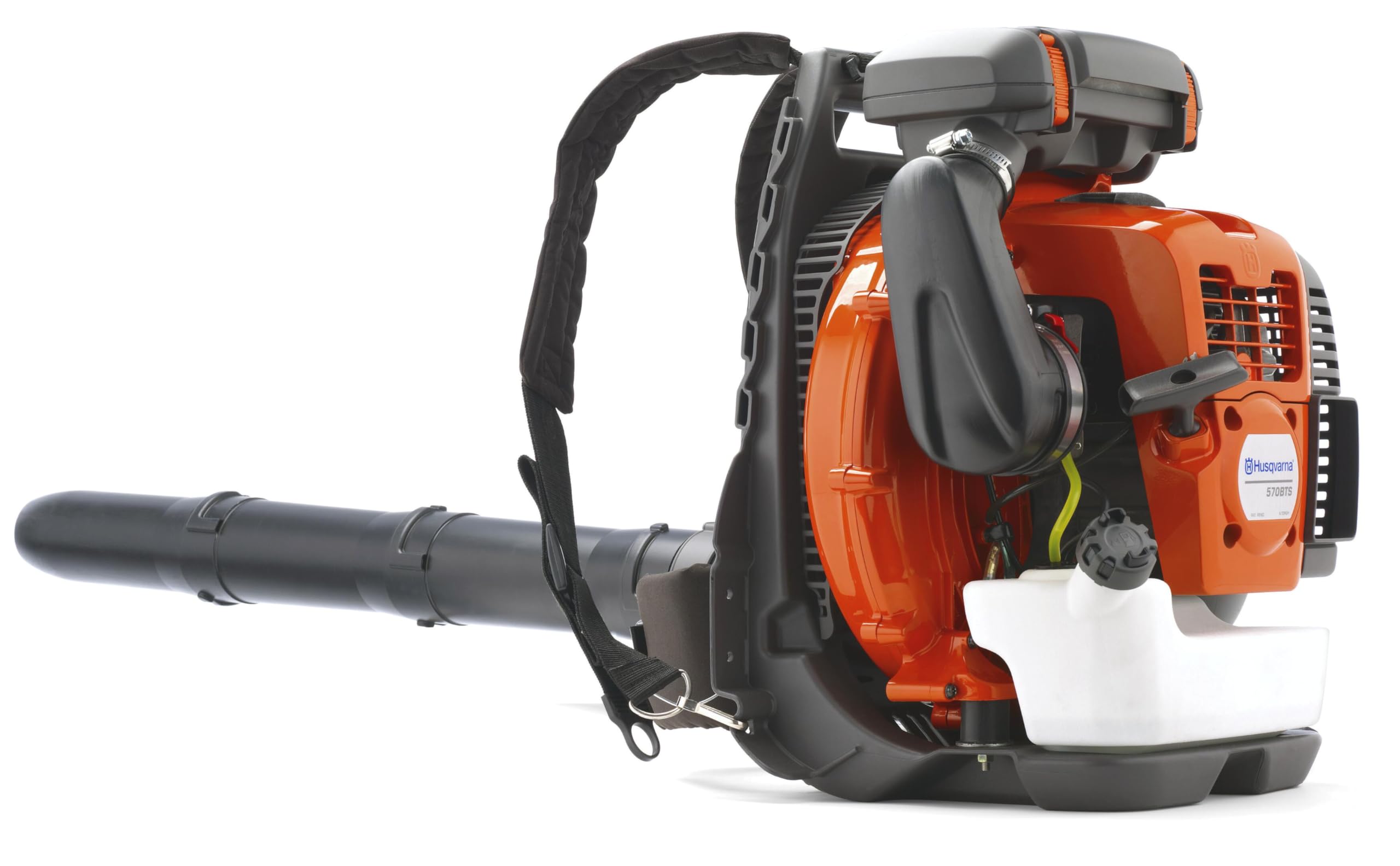
With 972 CFM, it offers 972 CFM versus the 560BTS’s 632 CFM, so wet leaves don’t stand a chance.
The Husqvarna 570BTS is the step-up choice for serious clearing capacity. Its 66cc X-Torq engine produces 972 CFM at 236 MPH and 37 Newtons of blow force (a direct measure of the air stream’s pushing power). The ergonomic design includes an adjustable offset handle, LowVib technology to reduce vibration, and a multi-speed throttle with cruise control so you lock in a consistent speed and focus on aiming the nozzle.
One reviewer who used it for five years of heavy use reported “excellent durability” and said the air filter rarely needed cleaning thanks to the commercial-grade filtration system. Another buyer upgraded from a Husqvarna 350BT and found the 570BTS “blows leaves uphill easily” and covers acres quickly. It is loud at about 71 decibels (though some users measured it around 110 db at ear level), and the 24.5-pound weight is noticeable, but the load-reducing harness with wide shoulder straps makes it manageable for long sessions.
A small number of users have reported starting issues with brand-new units, so it is worth running ethanol-free fuel and a synthetic 50:1 mix from day one to avoid carburetor problems. Spring-assist starting is a real help when you are stopping and starting repeatedly around trees and flower beds.
Where It Excels
- High 972 CFM and 37N force for wet leaves, sticks, and light snow.
- LowVib anti-vibration system and adjustable harness for comfort.
- Durable commercial air filter and X-Torq engine for low emissions.
Where It Falls Short
- Heavier than some alternatives at 24.5 pounds.
- A few units reported starting issues from the start.
Best for: professional landscapers or large-property owners who want maximum CFM and are willing to trade a bit of weight for serious pushing power.
skip it if: you want a lighter, more affordable blower for a small suburban yard where 600 CFM is plenty.
4. PRORUN PBB3000 Gas Backpack Leaf Blower, 79.9cc
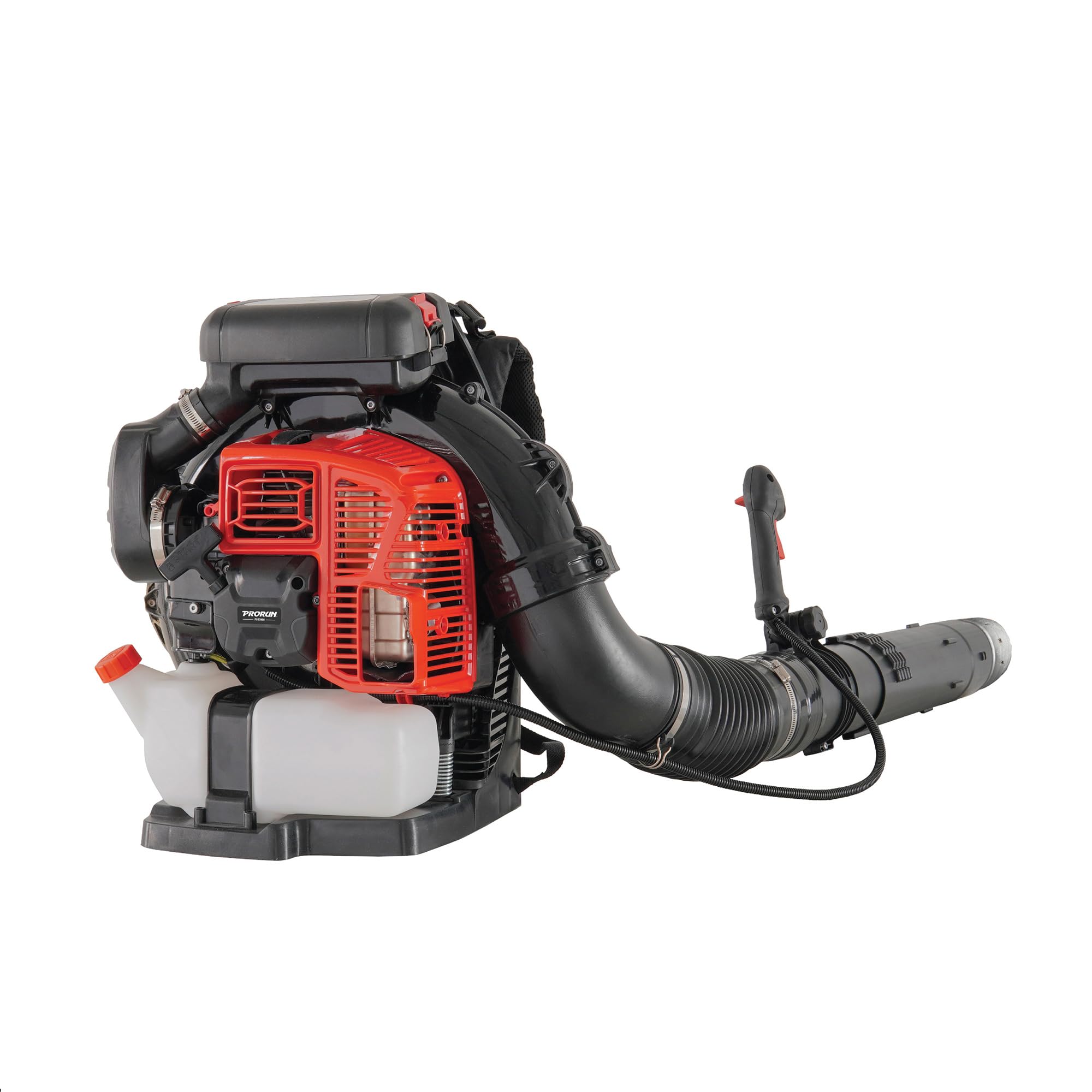
A 79.9cc engine pushing 1125 CFM makes this the biggest air mover here — 2.2 times the volume of the Echo PB-580T’s 510 CFM.
The PRORUN PBB3000 is the heaviest hitter in this lineup, with a 79.9cc 5.0 HP (horsepower) 2-cycle engine that delivers 1125 CFM and 250 MPH. That is 2.2 times the air volume of the Echo PB-580T (510 CFM) and 57% more engine displacement than the Troy-Bilt 51cc. The CoolFlow Tech provides a fan-powered back ventilation system that keeps your back cooler during long sessions, and the ScuffGuard nozzle has heavy-duty metal rings to protect the end of the tube from wear. One reviewer noted it “clears 3 acres of leaves, branches, rocks in under a day,” and another said it “blows wet leaves like dry.”
The downsides are real: at 33 pounds it is the heaviest blower on this list, and there are scattered reports of the recoil starter having rope retraction issues. However, the spring-assisted handle and the anti-vibration dampeners plus padded wide-grip straps make the weight more tolerable. Echo’s PB-9010T (1110 CFM) is a direct competitor, and the PRORUN beats it on price while offering slightly more CFM.
The dual-stage air filtration system is tool-less, making it easy to clean in dusty environments, and the 90-minute runtime at full throttle means you can tackle a large property without refueling mid-job. The 3-year residential or 1-year commercial warranty adds some confidence for the investment.
Strengths
- Massive 1125 CFM and 250 MPH for heavy wet debris and large properties.
- CoolFlow ventilation keeps your back cooler during extended use.
- Tool-less dual-stage air filter for quick maintenance in dusty conditions.
Weaknesses
- Heavy at 33 pounds, even with a good harness.
- Some reports of recoil starter issues; check warranty coverage.
Choose this if: you have 3+ acres or heavy commercial use and need the highest CFM available without moving to a wheeled blower.
Pass if: you want a lightweight tool for a standard yard; the 33-pound weight will wear you out before your job does.
5. PRORUN PBB2884 75.6cc Backpack Leaf Blower

Offers 16% more CFM than the PROYAMA’s 880 at a speed of 240 MPH, for hundreds less than a comparable Stihl.
The PRORUN PBB2884 slots between the budget picks and the top-end commercial units, offering 1020 CFM from a 75.6cc engine. The ergonomic backpack design with padded straps helps distribute the 32.8-pound weight, which is closer to the heavy end but still manageable for long sessions. One reviewer says they “can get a good 2 hour use out of full tank on max throttle,” which is solid runtime for a large property.
Reviewers point out that it “moves leaves like a hurricane” and that the pull start is short and easy, though some note that the starter switch feels thin and might be breakable over time. The anti-vibration feature and commercial-quality construction are enough for “average to high use,” as one owner put it after using it for a year with no issues. Compared to a Stihl, it is significantly cheaper, but you do get some plastic components that don’t feel as premium as a metal-tube professional model.
The 3-year residential warranty is a nice bonus, and the included tools make assembly straightforward. Just be aware that the straps are a bit tricky to don without a high resting spot, like a table or the tailgate of a truck.
Highlights
- 1020 CFM at a price well below comparable Echo or Stihl models.
- Short pull start; one reviewer says it “cranks easily with 15 primes and quality 50:1 fuel.”
- Solid 2-hour runtime on max throttle.
Lowlights
- Heavier than average at 32.8 pounds; straps are hard to put on without a high surface.
- Some plastic components feel less durable than commercial-grade metal parts.
Ideal for: homeowners and semi-pros who need high CFM for a large yard but want to avoid the full price of top-brand commercial blowers.
Not for you if: you need a lightweight unit for quick, frequent jobs; the 32.8 pounds will fatigue you fast.
6. Troy-Bilt Gas Backpack Leaf Blower, 51cc (TB51BP)
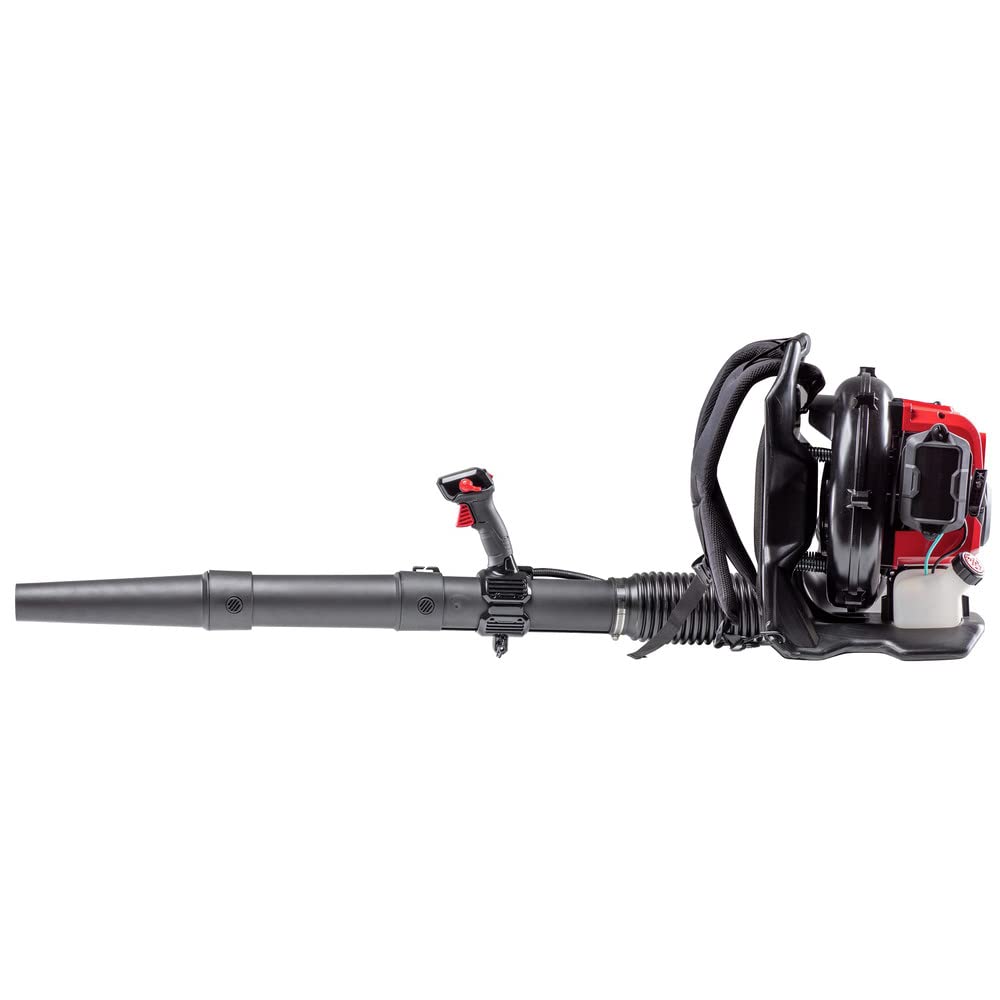
SpringAssist makes this 51cc blower easy to start, and the 600 CFM is enough for a suburban lot — but you will miss the 1020 CFM of the PRORUN PBB2884 when leaves get wet.
The Troy-Bilt TB51BP is the entry-level backpack option for anyone moving up from a handheld blower. Its 51cc 2-cycle full-crank engine outputs 600 CFM and 220 MPH — enough for a standard suburban yard. What sets this blower apart at this price is SpringAssist technology, which reduces the pull effort for easier starts, and the fully-tensioned multi-material suspension system that distributes weight comfortably between your shoulders and hips.
Shoppers say it “ran it for 4 hours on 1 gallon of gas worth,” which is good fuel economy, though the tank size itself is smaller than some would like. One reviewer with a bad back said “raking can lay me out for days” and this blower was a perfect fit. The 26-pound weight is manageable, and the backpack design does reduce operator fatigue by fitting the shape of your hips.
There are a few durability concerns in the reviews: one unit stopped starting after a single use, though the majority report good reliability for the price. This is a solid choice for the budget-conscious buyer, but if you regularly clear wet leaves or large properties, you will likely outgrow its 600 CFM quickly and want something from the mid-range tier above.
Why It Works
- SpringAssist makes pull-starting much easier than a standard cord.
- Comfortable harness with even weight distribution for back-friendly use.
- Great fuel economy at roughly 4 hours per gallon of gas.
Where It Struggles
- 600 CFM is low compared to mid-range and premium alternatives.
- Small gas tank may require refueling mid-job on larger properties.
Reach for this if: you want an affordable backpack blower for a small to medium yard and appreciate easy starting and a comfortable harness.
Look elsewhere if: you have a large property or need to move wet leaves regularly — the 51cc engine will leave you wanting more power.
7. Echo PB-580T 58.2 CC Back Pack Blower

At 22.6 pounds, this Echo is the lightest backpack here — one buyer says it reduces a 3-hour job to under 30 minutes.
The Echo PB-580T is built around a 58.2cc engine that produces 510 CFM and 215 MPH — the lowest air volume on this list, but backed by Echo’s reputation for reliability. At just 22.6 pounds, it is one of the lightest backpack models here, making it ideal for long shifts where every ounce of weight savings adds up. The tube-mounted throttle puts control at your fingertips, and the blower circulates air to reduce back sweat.
Buyers report it is “more powerful than neighbor’s Echo” and “reduces 3+ hr job to less than 30 min.” Another owner who upgraded from a 20-year-old Husqvarna said it “rips up grass/rocks if careless,” so you do not need to aim low to get results. One reviewer called it “lighter and quieter than top Echo model” and noted the backpack design saves your wrist and arm compared to a handheld. The PB-580T uses pre-measured oil packs, which simplifies the fuel mixing process.
However, the 510 CFM is a limitation when facing wet leaves or deep piles. If your property is mostly dry leaves and grass, this blower is a breeze. If you deal with heavy wet oak leaves or large debris, you will want something in the 800+ CFM range. The build quality is excellent for the price, and many owners mention years of trouble-free use with normal maintenance.
Strengths
- Lightweight at 22.6 pounds with a comfortable, sweat-reducing backpack design.
- Proven Echo reliability; customers note consistent first-pull starts.
- Tube-mounted throttle and pre-measured oil packs for convenience.
Weaknesses
- 510 CFM is the lowest on this list; struggles with wet or heavy debris.
- Not as powerful as larger-displacement models for commercial use.
Best for: homeowners and light commercial users who prioritize a lightweight, reliable blower for dry leaves and grass clippings.
pass on it if: you have a lot of wet leaves or need maximum blow force — step up to the Echo PB-9010T or a PRORUN model.
8. Echo PB-9010T 79.9 cc X Series Backpack Blower

With 1110 CFM, this Echo matches the PRORUN PBB3000 (1125 CFM) nearly blow-for-blow, but at a lighter 23 pounds, it saves you 10 pounds on your back.
The Echo PB-9010T is the top-of-the-line X Series blower, packing a 79.9cc 2-stroke engine that pushes 1110 CFM at 220 MPH. It is a massive upgrade from the PB-580T, with 1110 CFM versus the PB-580T’s 510 CFM, making it a direct competitor to the PRORUN PBB3000 (1125 CFM). The tube-mounted throttle and throttle lock give you precise control, and the heavy 23-pound weight (despite the 79.9cc engine, it is lighter than the PRORUN’s 33 pounds) is well-balanced with comfortable straps.
One buyer called it a “holy guacamole, what a machine” and noted it is a “massive upgrade from PB580/755ST.” Another reported clearing the leaves from 14 oak trees in about 2 hours, handling wet leaves and sticks with ease. A third reviewer used it to clear 6 inches of wet snow off gravel in 90 minutes, praising its “monster power” and easy starting in 20°F weather. The assembly instructions are notoriously bad — plan on some time figuring out the tube extensions — but once together, the performance is undeniable.
The main trade-off is fuel consumption: it uses about 1 gallon per 90 minutes at full throttle, and the PB-9010T is loud enough to require ear and eye protection. The cruise control shutoff is also less convenient than some prefer. But for sheer clearing power, this Echo is one of the best values in the premium tier, especially compared to a Stihl BR 800.
Where It Dominates
- 1110 CFM handles wet leaves, sticks, and even light snow with ease.
- Lighter than similar-displacement competitors at 23 pounds.
- Throttle lock and tube-mounted controls for easy one-hand operation.
Where It Frustrates
- Assembly instructions are poor; tube connections take effort.
- Thirsty at about 1 gallon per 90 minutes; heavy fuel consumption under load.
Perfect for: users who want true commercial-grade clearing power without the price of a Stihl and can tolerate thirsty fuel consumption for the payoff.
Not for you if: assembly frustration bothers you or you need a lightweight tool for small, quick jobs.
Understanding the Specs
CFM (Cubic Feet per Minute)
This is the volume of air the blower moves each minute. It is the best measure of how much leaf pile you can shift at once. A higher CFM — like 1000 or more — moves a broader column of air, which is ideal for pushing large amounts of loose material like dry leaves across a lawn. Lower CFM units (under 600) are better for focused work like clearing a single gutter line or a narrow driveway.
MPH (Miles per Hour)
This measures the speed of the air leaving the nozzle. High MPH is useful for dislodging stuck debris, like wet leaves plastered to a sidewalk or mud caked on concrete. A blower with high CFM but lower MPH will move a wide swath of light material, while one with low CFM but high MPH (like a focused jet) works best for small, stubborn spots.
Engine Displacement (cc)
The cubic centimeter displacement tells you the size of the engine’s cylinders. Generally, a larger cc number means more power and torque, which translates to higher CFM and MPH. A 51cc engine is fine for a suburban lot, while a 79.9cc engine is built for professional landscaping and multi-acre properties. Larger engines also weigh more, so there is a trade-off between power and portability.
Newton (N) Blow Force
Newtons measure the actual pushing force of the air stream. This combines both CFM and MPH into a single number. For example, 37 Newtons on the Husqvarna 570BTS gives you a very strong push, while 50 Newtons on the PRORUN PBB3000 is enough to move rocks and heavy wet leaves. If the spec sheet lists Newtons, it is the single best predictor of real-world clearing ability.
FAQ
What is the difference between a 2-cycle and a 4-cycle gas leaf blower?
What does CFM mean for a gas leaf blower?
Is a backpack blower worth it over a handheld model?
How much gas does a gas leaf blower use per hour?
Can I use a gas leaf blower to move wet leaves?
What oil-to-gas ratio do these blowers use?
How long does a gas leaf blower engine last?
What is SpringAssist or a spring-assisted starter?
Is a gas leaf blower louder than an electric one?
Can I use a gas leaf blower for snow removal?
Final Thoughts: The Verdict
If you want one dependable pick, the gas leaf blowers winner is the PROYAMA 72CC Gas Backpack Leaf Blower because it gives you 880 CFM and 275 MPH in a lightweight 21-pound frame at a price that undercuts commercial brands by hundreds. If you want maximum commercial-grade power for heavy wet debris and large properties, grab the PRORUN PBB3000. And for a reliable, lightweight pro tool with first-pull starts and Echo’s legendary durability, the Echo PB-580T is your best bet for daily commercial use without the weight penalty.
How We Picked
We do not accept paid placement. Every pick is matched to a real buyer and a real use-case; we do not hands-on test units.
Sources & Methodology
Specifications: manufacturer listings and product documentation. Review insights: verified customer reviews, as of July 2026. Pricing: not shown on this page (it changes often); check the current price via the retailer link.
As an Amazon Associate, Lawn Gear Lab earns from qualifying purchases. This does not affect which products we feature.