
Specs are compiled from manufacturer listings and verified buyer reviews and can change over time — please confirm the key details on the product page before buying.
When your camellia leaves turn yellow between the veins, or the buds drop before they open, the plant is likely starving for a specific nutrient. These acid-loving shrubs need a low-pH diet (pH stands for “potential of hydrogen” — it measures how acidic or alkaline your soil is) to open up iron and manganese from the soil. A general-purpose fertilizer often makes the problem worse by raising the pH, so the roots can’t absorb what they need. The right acid-forming formula, applied at the right time, makes the difference between a plant that survives and one that covers itself in waxy, deep-green leaves and flawless blooms.
I’m Rikta — the founder and writer behind Lawn Gear Lab. This guide is built by comparing the manufacturers’ published specifications and the patterns across verified customer reviews, so you get each pick’s real strengths and trade-offs instead of marketing spin.
Whether you have a single potted camellia on a patio or a hedge that needs a heavy spring feeding, the right fertilizer for camellias must deliver a reliable acid punch without burning the delicate feeder roots (the thin, shallow roots near the surface).
Quick Picks
- Espoma Organic Holly-Tone 4-3-4 (36 lb. Bag) — Best Overall
- True Organic Azalea, Camellia & — Premium Organic
- Jack’s Classic 17-6-6 Acid Special — Best Water-Soluble
- GARDENWISE 8-4-8 Acidic Fertilizer for Azaleas — Best Value
- Miracle-Gro Water Soluble Azalea — Budget Champion
- Fertilome (10685) Azalea, Camellia — High-Phosphorus Rescuer
- Dr. Earth Acid Lovers Azalea — Micro-Dose Organic
How To Choose The Best Fertilizer For Camellias
Camellias have shallow roots and are sensitive to salt buildup, so the wrong fertilizer can scorch the roots and set the plant back a whole season. Here are the three specs you want to check before buying anything.
N-P-K Ratio and What It Does for Camellias
The three numbers on the bag tell you the percentage of nitrogen (N, for dark green leaves), phosphorus (P, for roots and flowers), and potassium (K, for overall strength). For camellias, look for an N-P-K ratio where the middle number (phosphorus) is equal to or higher than the first number (nitrogen) — something like 9-15-13 or 4-3-4 — so the plant gets a solid boost for those big fall blooms without growing so much leafy top growth that the flowers get shaded out.
Acidifying Ingredients (Sulfur and Iron)
Camellias demand soil with a pH between 5.0 and 6.0 (on a scale of 0 to 14, where 7 is neutral). A fertilizer with added sulfur or iron helps keep the pH in that balance, which prevents chlorosis — the yellowing between leaf veins that happens when the plant cannot pull iron out of alkaline soil. Products that list 5% sulfur or iron sulfate are giving you that extra acid punch.
Water-Soluble vs. Slow-Release Granules
Water-soluble powders like Jack’s Classic 17-6-6 give you a fast green-up you can control every 7-14 days, which is great for potted camellias or a quick spring jolt. Slow-release granules such as Espoma Holly-Tone break down over months and feed the soil biology, which is a better fit for in-ground plants where you want a steady supply with fewer applications.
Quick Comparison
| Model | Best For | Item Weight | N-P-K Ratio | Form | Amazon |
|---|---|---|---|---|---|
| Espoma Organic Holly-Tone 4-3-4 | Premium all-season feeding for in-ground shrubs | 36 lb | 4-3-4 | Granules | Amazon |
| True Organic Azalea, Camellia & Rhododendron Food | Organic low-pH care with twice-yearly simplicity | 12 lb | 5-4-3 | Granules | Amazon |
| Jack’s Classic 17-6-6 Acid Special | Fast-acting water-soluble for potted plants | 1.5 lb | 17-6-6 | Powder | Amazon |
| GARDENWISE 8-4-8 Acidic Fertilizer | Budget-friendly granules for targeted iron boost | 0.96 kg / 2.1 lb | 8-4-8 | Granules | Amazon |
| Miracle-Gro Water Soluble Azalea, Camellia, Rhododendron Plant Food | Classic water-soluble with huge coverage per bag | 5 lb | — | Powder | Amazon |
| Fertilome (10685) Azalea, Camellia, Rhododendron Food 9-15-13 | High-phosphorus granular for reviving bloom-less plants | 4 lb | 9-15-13 | Granules | Amazon |
| Dr. Earth Acid Lovers Azalea, Camellia, Rhododendron & Maple Fertilizer | OMRI-certified organic for micro-dose soil health | 4 lb | — | Granules | Amazon |
In‑Depth Reviews
1. Espoma Organic Holly-Tone 4-3-4 (36 lb. Bag)
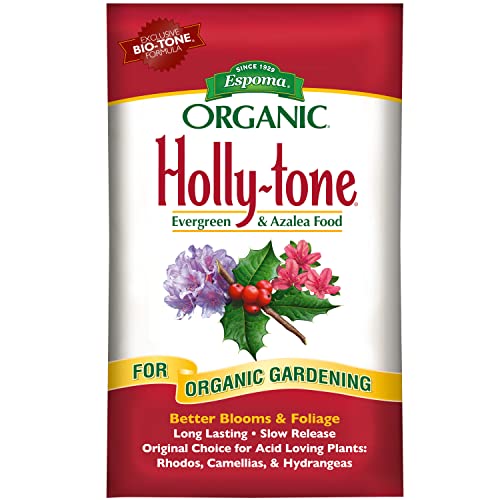
The iconic organic blend that has been feeding acid-loving plants since 1929.
You reach for this 36-pound bag when you want a single product that covers your camellias, azaleas, hydrangeas, blueberries, and all your other acid-loving shrubs — and you do not want to mix anything or remember a schedule. The Espoma Holly-Tone is the biggest bag on this list: one reviewer noted it holds enough for both spring and fall feedings without restocking. Its 4-3-4 ratio means it is moderate in nitrogen (N, for leaves) and phosphorus (P, for flowers), so your camellia gets balanced growth that puts energy into blooms instead of a leafy rush.
The 5% sulfur content actively lowers your soil pH as the granules break down, making iron and manganese available to the roots. Reviewers report their azaleas and hydrangeas produced more blooms after switching to Holly-Tone, and the organic Bio-tone formula (a blend of microbes and mycorrhizae, which are beneficial fungi) feeds the soil, not just the plant. At 36 pounds, this bag weighs 36 pounds compared to the 4-pound Dr. Earth bag, giving you a full year or more of feeding for a hedge of camellias.
Season-long confidence: The slow-release granules (meaning they break down slowly with moisture and soil biology) work throughout spring and fall, so you just apply in early spring and again in fall — no measuring spoons or watering-can mixups.
Not exactly a jolt: If your camellia is severely yellowed and needs immediate nitrogen, you will get faster results from a water-soluble product like Jack’s Classic before switching to this for maintenance.
Grab this bag if: You have multiple acid-loving shrubs in the ground and want one organic fertilizer that lasts all season and has a proven track record.
Look elsewhere if: You are feeding a single potted camellia — the 36-pound bag is overkill for a small container, and a smaller water-soluble option would be more practical.
2. True Organic Azalea, Camellia & Rhododendron Food (12 lb Bag)
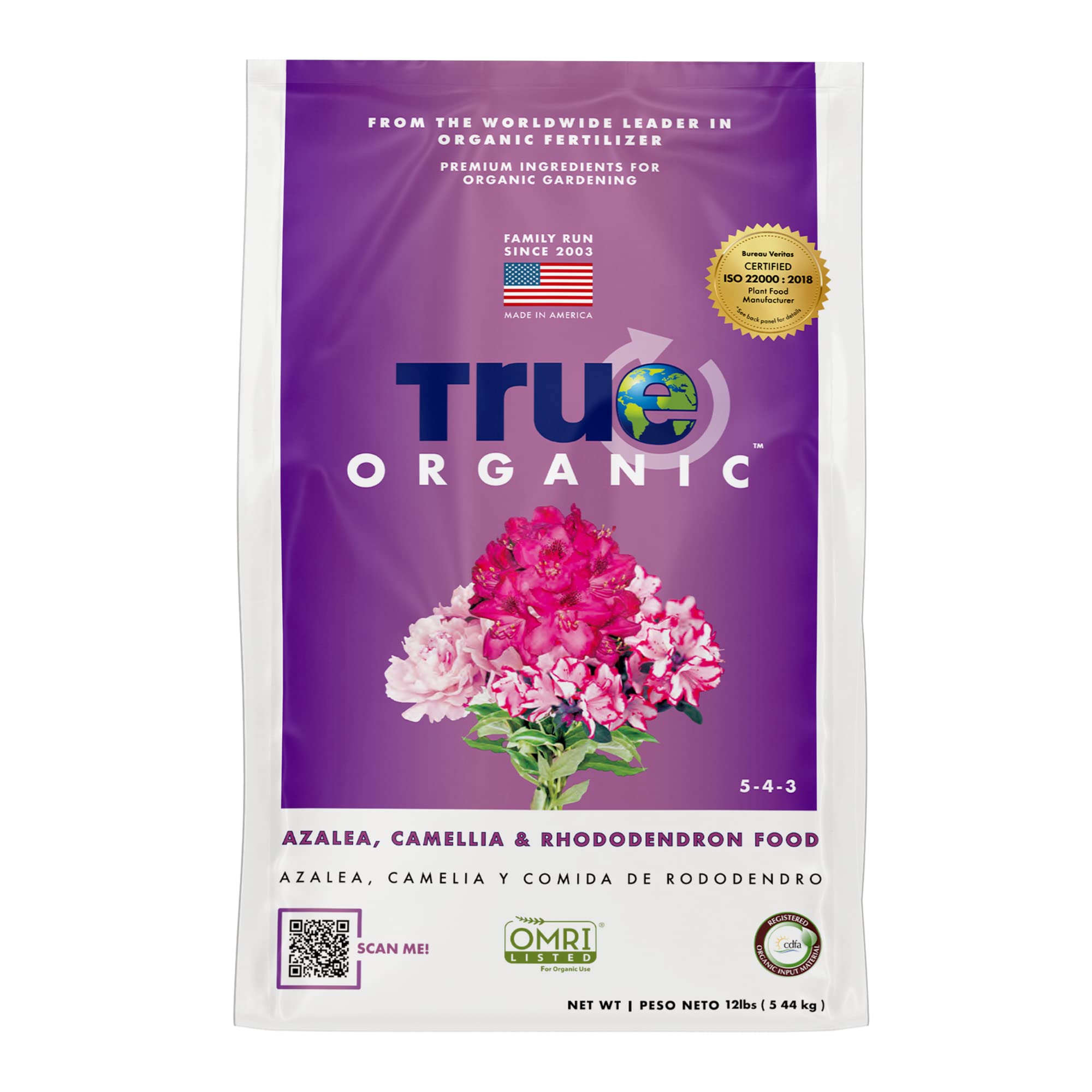
An organic formula with seabird guano and shellfish meal that naturally lowers pH.
If you want to feed the soil rather than just the plant, True Organic is your pick. The ingredients include seabird guano and shrimp and crab shell meal, which break down into rich humus (decomposed organic matter that improves soil structure). Its 5-4-3 ratio is leaner on nitrogen (N, for leaves) than the Jack’s Classic 17-6-6, so it works well for camellias in decent soil that just need a gentle seasonal push. The 5% sulfur content nudges the pH downward over time, just like the Espoma product.
The 12-pound bag covers up to 261 square feet at the recommended rate, and the twice-yearly schedule (spring and fall) is as simple as it gets. Buyers mention their plants produced fuller blossoms and stronger stems after switching, and there is no synthetic chemical smell — just an earthy marine aroma that disappears quickly. This bag weighs 12 pounds compared to the 4-pound Dr. Earth bag, so it is a practical step up for those with a small hedge.
What works
- Organic ingredients (seabird guano, crab shell meal) improve long-term soil structure.
- 5% sulfur actively acidifies the root zone.
- Twice-yearly schedule is hard to mess up.
The trade-off
- Slower release means it will not fix an acute nitrogen deficiency quickly.
- 12 lb bag may be more than a container gardener needs.
Ideal for: Gardeners committed to organic growing who want a large bag that lasts for two seasons on a modest hedge of camellias.
Not the pick for: Quick green-up — reach for a water-soluble powder like Jack’s Classic if your camellia looks pale and needs a fast jolt.
3. Jack’s Classic 17-6-6 Acid Special Water-Soluble Fertilizer (1.5 lb)

A high-nitrogen, iron-and-sulfur-loaded powder that turns water into instant camellia food.
When your camellia is planted in neutral or alkaline soil (pH above 7.0, common in many gardens), its leaves turn that sickly yellow between the veins — that is iron chlorosis (a condition where the plant cannot absorb iron). Jack’s Classic Acid Special attacks that problem directly with a 17-6-6 ratio — 17% nitrogen (N, for rapid green-up) plus improve levels of iron and sulfur. Mix one teaspoon per gallon of water and apply every two weeks for a visible green-up in days. The included measuring spoon removes any guesswork.
Unlike the granular options like Espoma or True Organic, this is a powder that dissolves completely, so it is ideal for container-grown camellias where you control the watering frequency. Reviewers mention their berry plants and gardenias responded with new growth after just two feedings. One buyer mentioned that the lower concentration (17-6-6 compared to 30-10-10 formulas) reduces the risk of root burn. The 1.5-pound box goes a long way — a little powder makes a lot of liquid.
Fast and precise: You control exactly how much the plant gets each time, which is critical for shallow-rooted camellias that hate salt buildup.
Labor trade-off: You have to mix and apply every 7-14 days during the growing season, so it demands more attention than a scatter-and-wait granule.
Reach for this if: Your camellia is in a pot, showing signs of chlorosis, or you like being able to fine-tune the feeding schedule.
skip it if: You prefer a low-maintenance approach for a large in-ground planting — slow-release granules like Espoma suit that scenario better.
4. GARDENWISE 8-4-8 Acidic Fertilizer for Azaleas, Camellias (1 Quart / 32 oz)
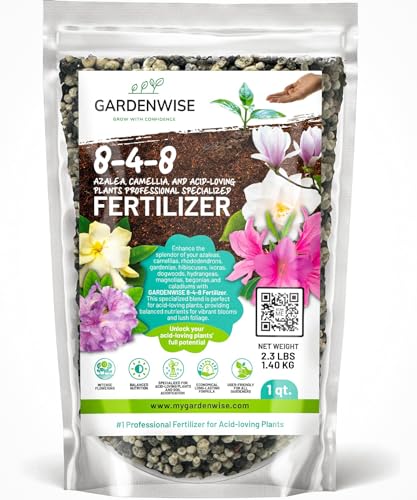
A slow-release granular with extra magnesium and iron for preventing chlorosis on a budget.
GARDENWISE delivers a balanced 8-4-8 ratio that leans a little heavier on potassium (K, for weather stress resistance) than some options, which helps your camellia stay tough through storms or heat. The 32-ounce bag is enriched with magnesium, iron, and manganese — the three micronutrients acid-lovers often miss in alkaline soil — and the slow-release granules require just three feedings per year. This container sits in a practical middle ground: at 32 ounces versus the Miracle-Gro 80 ounces but in a slow-release format that needs far fewer applications.
Buyers report that their rhododendrons doubled in size after using this, and one owner reported that a struggling magnolia in a pot is thriving with regular feedings. The application is simple: sprinkle around the base, scratch it into the soil, and water. Compared to the Espoma 36-pound bag, this is a much smaller commitment for a gardener with just a few shrubs.
Perks
- Slow-release means only 3 feedings per year.
- Iron and manganese boost targets chlorosis directly.
- Good size for a few backyard shrubs without committing to 36 lb.
Catch
- Not certified organic, so purists may pass it up.
- Granules are not water-soluble; you need soil moisture to activate.
Who should pick this: The budget-conscious gardener with a handful of acid-loving shrubs who wants a low-maintenance, mineral-rich feed.
Who should pass: Anyone looking for a full-organic certification or needing a water-soluble formula for potted plants.
5. Miracle-Gro Water Soluble Azalea, Camellia, Rhododendron Plant Food (5 lb / 80 oz)

The household-name water-soluble powder that feeds 80 ounces of concentrate for pennies per gallon.
If you have grown any plant in the last 30 years, you know the blue-green crystals — and this version is specifically formulated for acid lovers. The 5-pound bag contains 80 ounces of powder, providing 80 ounces compared to the GARDENWISE 32 ounces and making it one of the best per-ounce values on this list. You mix it at 1 teaspoon per gallon for indoor plants or about 21/2 tablespoons per gallon for outdoor use, then apply every 7-14 days during the growing season.
One buyer shared that this fertilizer “truly helped our rhododendron to recover and look stunning this summer.” Multiple reviewers also noted the resealable bag works well as long as you keep the closure free of powder. The formula will not burn foliage when used as directed, and it feeds a wide range of acid lovers — azaleas, camellias, gardenias, hollies, hydrangeas, and even orchids. The biggest drawback, flagged by a 4-star review, is that the resealable closure is basically felt-on-felt Velcro that clogs easily, so some users resort to clothespins to keep moisture out.
Huge coverage for the money: 80 ounces of powder makes many gallons of liquid — a single bag can last a whole season on a modest collection of potted camellias.
The reseal hassle: The bag’s closure is weak, so transfer the powder to an airtight container if you live in a humid climate.
Best for: The gardener on a tight budget who needs a huge volume of water-soluble feed and does not mind mixing a watering can every week or two.
Not ideal for: Those who want organic certification or prefer a low-maintenance granular — this stuff demands regular mixing and application.
6. Fertilome (10685) Azalea, Camellia, Rhododendron Food 9-15-13 (4 lbs.)

A phosphorus-heavy granular that jolts a stubborn, non-blooming camellia into producing flowers.
This fertilizer stands apart from every other pick on this list because of its 9-15-13 ratio — the middle number (phosphorus, for flower and root growth) is significantly higher than both the nitrogen and potassium. That phosphorus is specifically what drives bud formation. One buyer shared that they “didn’t know rhododendrons take a specific fertilizer, mine had not bloomed in almost 3 years until i used this!” That is a direct example of what the high-phosphorus formula can do for a plant that has been sitting there putting out leaves but zero flowers.
The instructions are clear: for plants 1 to 5 feet tall, use 1/4 to 1/2 cup; for plants 6 to 12 feet, use 3/4 to 1 1/4 cups. Apply in very early spring, again after blooming, and again in fall. The granular form makes it easy to spread by hand around the drip line, and the 4-pound bag is large enough for a handful of mature shrubs but small enough to fit on a shelf. Unlike the slow-release organic options like Espoma, this feeds the plant directly and works faster on phosphorus-deficient soil.
Biggest win
- 15% phosphorus is the highest on the list — a real flower-trigger for stubborn plants.
- Simple cup-based measurement for different plant sizes.
Limitation
- Not organic and lacks the soil-building micronutrients of the True Organic or Espoma.
- 4 lb bag runs out fast if you have a large hedge.
Grab this bag if: Your camellia or rhododendron has green leaves but refuses to bloom — the phosphorus here is exactly what it is missing.
pass on it if: You are maintaining already-healthy plants and want a more balanced, organic long-term feed like Espoma.
7. Dr. Earth Acid Lovers Azalea, Camellia, Rhododendron & Maple Fertilizer (4 lb)

A tiny bag of OMRI-listed, Non-GMO Project Verified granules built for precision organic care.
This 4-pound bag is compact, and that is by design. Dr. Earth Acid Lovers uses human and feed-grade ingredients plus multi-minerals, proteins, carbohydrates, and humic acids (organic compounds that improve nutrient uptake). It is not about dumping bulk nitrogen; it is about feeding the soil food web. One buyer summed it up simply: “Revived sad camellias with Dr. Earth fertilizer; just tossed and watered without digging or making tea.” That “toss and water” method is exactly right for the shallow roots of camellias.
The certification stack here is class-leading: OMRI (Organic Material Review Institute, which verifies organic inputs), CCOF (California Certified Organic Farmers), and Non-GMO Project Verified. It is people and pet safe — no synthetic chemicals, no GMO-infested chicken manure. At 1 pound, this bag weighs 4 pounds, compared to the 5-pound Miracle-Gro bag and the 36-pound Espoma bag, so it is really meant for a single plant or two. If you have one beloved camellia you want to treat with the cleanest possible ingredients, this is your bag.
Purity you can trust: Every major organic certification in the US is on this bag — there is no cleaner option for a single plant.
The physical limit: At 4 pounds, you get a modest volume. For a hedge, the cost per square foot becomes much higher than the 12 lb or 36 lb bags.
Buy this for: A single potted camellia or a couple of special shrubs where you want the highest organic integrity available.
it’s not for you if: You have an entire hedge or a large bed of acid-lovers — the cost per square foot becomes prohibitive compared to the 12 lb or 36 lb bags.
Understanding the Specs
N-P-K Ratio
The three numbers on the bag (for example 4-3-4 or 9-15-13) stand for the percentage of nitrogen (N, for leaves and shoots), phosphorus (P, for roots and flowers), and potassium (K, for disease and drought resistance) by weight. For camellias, you generally want the middle number (phosphorus) to be equal to or higher than the first number (nitrogen) to prioritize flowers over foliage. A high middle number, like the 15 in Fertilome’s 9-15-13, specifically helps a reluctant camellia bloom.
Water-Soluble vs. Slow-Release Granules
Water-soluble powders like Jack’s Classic or Miracle-Gro dissolve in water and feed the plant immediately — you see results in days, but you have to apply every 7-14 days during the growing season. Slow-release granules like the Espoma or True Organic are scattered around the base and break down over months through microbial action and rainfall. Granules demand fewer applications (spring and fall or three times a year) but take weeks to show results. Container plants often do better with water-soluble because you control the dose; in-ground plants benefit from the steady release of granules.
FAQ
When is the best time to fertilize camellias?
Can I use a general-purpose fertilizer on camellias?
How much fertilizer does a camellia need?
Will Epsom salt help my camellia?
Is organic or synthetic fertilizer better for camellias?
What does the 5% sulfur in a fertilizer bag do?
Can I use the same fertilizer on potted and in-ground camellias?
How long does a 36-pound bag of Holly-Tone last?
Final Thoughts: The Verdict
If you want one dependable pick, the fertilizer for camellias winner is the Espoma Organic Holly-Tone 4-3-4 because its 36-pound bag, 5% sulfur content, and organic Bio-tone formula deliver a full year or more of reliable, low-pH feeding for both camellias and every other acid-loving shrub in the yard. If you want fast green-up and precise control for a potted camellia, grab the Jack’s Classic 17-6-6 Acid Special. And for the gardener who needs a high-phosphorus kick to finally get a stubborn camellia to bloom, the standout is the Fertilome 9-15-13 Azalea, Camellia, Rhododendron Food.
How We Picked
We do not accept paid placement. Every pick is matched to a real buyer and a real use-case; we do not hands-on test units.
Sources & Methodology
Specifications: manufacturer listings and product documentation. Review insights: verified customer reviews, as of July 2026. Pricing: not shown on this page (it changes often); check the current price via the retailer link.
As an Amazon Associate, Lawn Gear Lab earns from qualifying purchases. This does not affect which products we feature.