
Specs are compiled from manufacturer listings and verified buyer reviews and can change over time — please confirm the key details on the product page before buying.
Peach trees are magnets for trouble — curled leaves from peach leaf curl, aphids clustering on new growth, and fungal spots that ruin the fruit just before harvest. A single well-chosen spray head the trouble off before it starts, but with labels listing dozens of diseases and insects, picking the right one for your tree feels like guesswork. This guide breaks down four proven sprays, each with a clear job, so you match the product to the problem your peach tree actually has.
I’m Rikta — the founder and writer behind Lawn Gear Lab. This guide is built by comparing the manufacturers’ published specifications and the patterns across verified customer reviews, so you get each pick’s real strengths and trade-offs instead of marketing spin.
For each product, you get the real-world benefit, the exact spec that makes it work, and the honest catch buyers discovered, all to help you find the right spray for peach trees without parsing through labels alone.
Quick Picks
- BioAdvanced 3-in-1 Fruit, Citrus & Nut Tree — Best Overall
- Bonide All Seasons Horticultural & Dormant — Dormant Season Champ
- Monterey Fruit Tree Spray Plus — Premium Organic Power
- Neudorff Plant Fungicide Spray — Fungal Specialist
How To Choose The Best Spray For Peach Trees
Matching a spray to your peach tree starts with one question: what are you fighting — insects, fungus, or both? A dormant oil smothers overwintering eggs before leaves emerge, while a copper fungicide stops leaf curl spores before they infect. Triple-action sprays handle both bugs and disease in one pass, and neem-oil blends offer organic knockdown. Your tree’s growth stage dictates the timing: oil goes on before bud swell, copper before bud break, and multi-purpose sprays during the growing season.
Active Ingredient — The Deciding Factor
Mineral oil in dormant sprays kills by suffocation — it coats insect eggs and mites. Copper soap (copper octanoate) disrupts fungal cell membranes and is OMRI-listed. Pyrethrins (from chrysanthemums) plus neem oil give quick knockdown plus residual control. The choice between them is not about which is stronger — it is about what your tree needs right now.
Application Method — Ready-to-Use vs. Concentrate
A ready-to-use spray attaches to your garden hose and covers a full-size tree in minutes, but some hose-end sprayers are poorly calibrated and empty too fast. Concentrates require a separate pump sprayer but give you better control and coverage per gallon. If you have more than one fruit tree, the concentrate route often saves money and frustration.
Quick Comparison
| Model | Best For | Active Ingredient | Liquid Volume | Item Weight | Amazon |
|---|---|---|---|---|---|
| BioAdvanced 3-in-1 | Triple-action control | Chemical fungicide + insecticide | 32 fl oz | 2.17 lbs | Amazon |
| Bonide All Seasons Oil | Dormant season prevention | Mineral oil | 32 fl oz | 32 oz | Amazon |
| Monterey Fruit Tree Spray Plus | Organic all-in-one | Neem oil + Pyrethrins | 32 fl oz | 2.1 lbs | Amazon |
| Neudorff Copper Fungicide | Curative fungal treatment | Copper octanoate | 16 fl oz | 1 lb | Amazon |
In‑Depth Reviews
1. BioAdvanced 3-in-1 Fruit, Citrus & Nut Tree Spray

One ready-to-spray pass that covers bugs and disease before they reach your peaches.
You spray when the first threat appears, and the BioAdvanced handles caterpillars, aphids, mites, and fungal issues like black spot, powdery mildew, and rust in a single application — no need to alternate bottles. At 2.17 lbs full, it is noticeably heavier than the 1-lb Neudorff fungicide, but that extra weight comes from the larger 32-ounce liquid volume that covers more ground before you refill.
Buyers report it is “easy to use and has helped prevent bugs and insects on my peach trees and blackberry plants,” using it every 3 to 4 weeks through the growing season. A few owners mention that the spray head can be finicky — “requires proper hose pressure” to reach the upper canopy — and some infested leaves need a separate spot treatment. For a single-product approach that works up to the day before harvest, this is the easiest place to start.
Why it earns the top spot
- Insect, disease, and mite control in one bottle — fewer trips to the shed
- Use up to day before harvest, so you protect fruit late in the season
- 32-ounce ready-to-spray bottle attaches to a garden hose for quick coverage
Real-world hiccups
- Hose-end sprayer is sensitive to water pressure; needs dialing in
- Heavily infested leaves may require separate treatment, not just a general spray
Best for: Growers who want one product to cover insects and fungus from spring through harvest without mixing.
Look elsewhere if: You prefer an organic-only approach — this is a synthetic chemical spray.
2. Bonide All Seasons Horticultural & Dormant Spray Oil

The oil that smothers overwintering aphids and mites before your peach tree even leafs out.
Unlike the BioAdvanced spray that works during active growth, the Bonide oil is designed for the dormant stage, green tip stage, and delayed dormant stage — the window before buds open. It provides a full 32 fluid ounces of ready-to-spray mineral oil that physically envelops and suffocates adelgids, aphids, scale insects, mites, and mealybugs. Because it is oil-based, the liquid volume matches the BioAdvanced at 32 fl oz, but the active mechanism (smothering vs. chemical poisoning) is fundamentally different — you time this one for late winter, not the growing season.
One reviewer noted it “took care of the black bean aphids on my Spanish Broom,” noting it worked without chemical odors. Another reviewer warns that the hose-end sprayer is “poorly calibrated” and empties too fast, recommending a pump sprayer for better control. Since it leaves no toxic residues, it is approved for organic gardening and safe around people and pets.
What makes it effective
- Works on dormant trees, green tip, and through the growing season — year-round versatility
- Mineral oil leaves no toxic residues; approved for organic gardening
- Controls a broad list: aphids, scale, mites, mealybugs, plus fungal issues like powdery mildew
The main catch
- Hose-end sprayer empties the bottle too quickly per the reviews — plan to use a pump sprayer
- Needs thorough pre-soaking of the tree for the oil to absorb and work
Reach for this if: You want a single organic oil treatment for dormant-season prevention that also works during the growing season.
Not your pick if: You need instant knockdown of an active pest outbreak — oils work by suffocation, not fast poisoning.
3. Monterey Fruit Tree Spray Plus
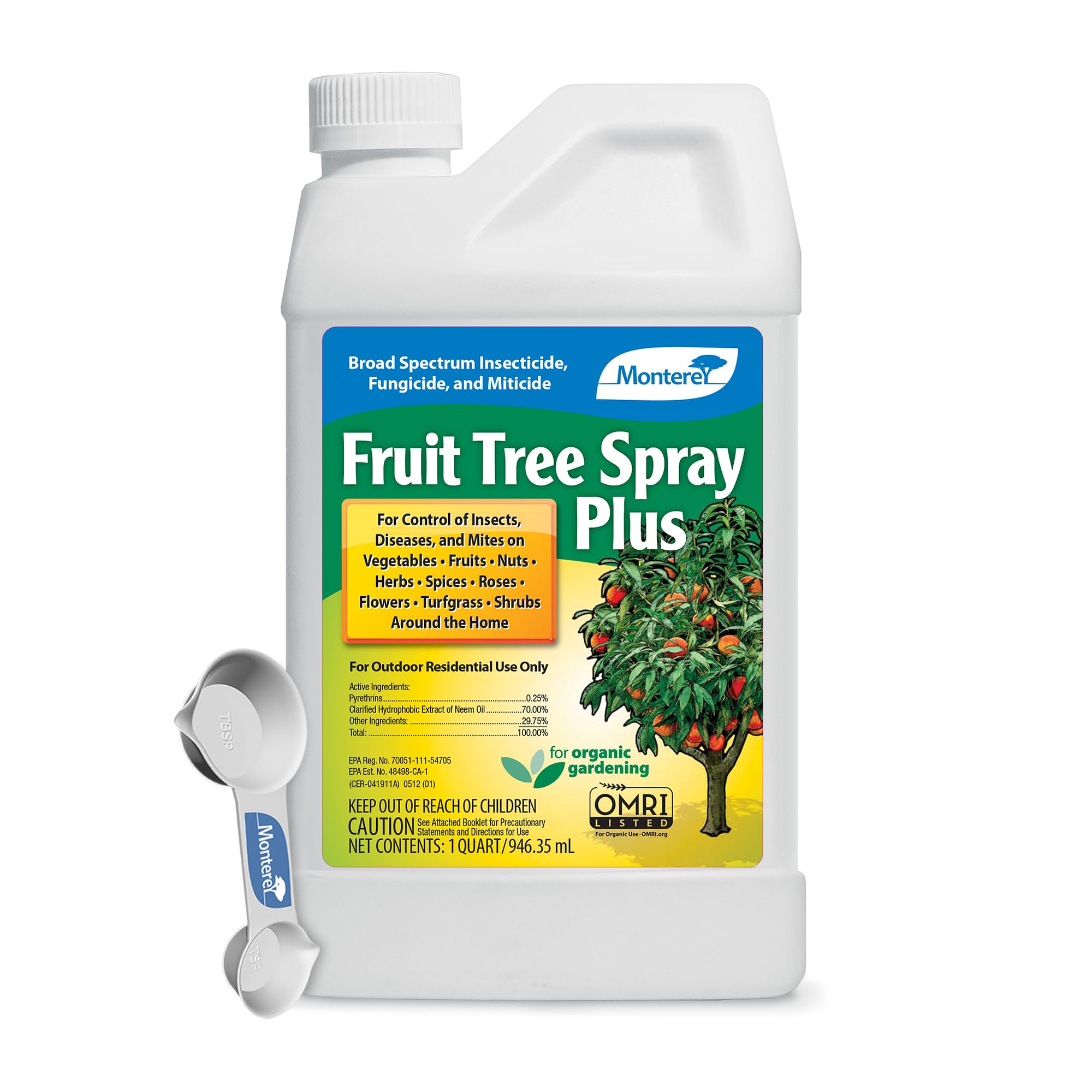
Organic neem oil plus natural pyrethrins for knockdown that still meets USDA organic standards.
This is the most potent organic option in the group — it combines 70% neem oil with natural pyrethrins (extracted from chrysanthemums) to give both quick knockdown and residual control against aphids, scales, caterpillars, stink bugs, and mites. It also works as a fungicide to prevent fungal attack on plant tissue.
One buyer described it as an “excellent product,” saying “really does work very well” when you follow the label instructions. Another reviewer noted it is “expensive but good value” given the concentrate form yields a large quantity.
Where it excels
- Two organic mechanisms: pyrethrins kill on contact, neem oil provides residual protection
- Controls larval, egg, and adult stages — not just one life cycle
- OMRI Listed; meets organic standards under the USDA National Organic Program
Potential drawbacks
- Premium price point — not the most economical for a single-tree homeowner
- A few reviewers felt the value did not match the effectiveness for their specific pest
Best for: Organic growers who need a heavy-hitter that controls multiple pest life cycles without synthetic chemicals.
Consider something else if: You are treating only a small peach tree and do not need the premium concentrate quantity.
4. Neudorff Plant Fungicide Spray, Copper Soap Fungicide

A copper soap that specifically targets peach leaf curl and other fungal threats without harsh synthetic residue.
If your peach tree’s leaves show the telltale red, puckered distortion of peach leaf curl, this is the spray you reach for. It uses copper octanoate (a copper soap) to control powdery mildew, rusts, black spot, downy mildew, fruit rot, late blight, and peach leaf curl — specifically named on the label. The 16 fluid ounces of ready-to-use liquid is half the volume of the Bonide dormant oil (32 fl oz) and weighs only 1 lb compared to the Bonide’s 32 oz, so it is noticeably lighter and travels easier, but you will need to reapply every 7 to 10 days as long as needed.
One buyer mentioned it “worked great to eliminate a fungus that almost killed our decades old gardenia,” adding that the plant “finally got its green back and even flowered.” Another reviewer noted it “burned hostas” when over-applied, so careful coverage is necessary — especially on new growth. Use it as a dormant-season preventive 2 weeks before disease normally appears, or as a curative when you first spot symptoms.
strengths
- Specifically labeled for Peach Leaf Curl — the nemesis of backyard peach trees
- Copper soap is OMRI-listed for organic gardening; decomposes into copper and fatty acid used by soil microbes
- Can be used up to day of harvest on fruits and vegetables
weaknesses
- 16 fl oz covers less area than the 32 oz options; smaller trees only, or expect to repurchase
- Can burn sensitive foliage like hostas if over-applied — test on a small branch first
Grab this for: A specific fungal problem (leaf curl, black spot) on a single peach tree where you want an organic copper solution.
skip it if: You need insect control — this is a fungicide only, with no insect-killing properties.
Understanding the Specs
Active Ingredient — The Core Weapon
The ingredient that actually stops the pest or disease defines what your spray can do. Mineral oil suffocates overwintering eggs and mites — it is a physical, residue-free method. Copper octanoate (a copper soap) disrupts fungal cell membranes and works best as a preventive for leaf curl and black spot. Neem oil plus pyrethrins combine a botanical contact killer with a residual oil. For peach trees, check that the label names peach leaf curl, aphids, or scale — a broad-spectrum label does not guarantee it covers stone fruits.
Liquid Volume — Coverage Per Bottle
Measured in fluid ounces, this tells you how much ready-to-spray product is in the bottle. A 32-ounce bottle covers a multi-tree home orchard, while a 16-ounce bottle fits a single young peach tree. Spraying a full-size canopy uses more liquid than you think — the Bonide and BioAdvanced at 32 fl oz give you more passes before a refill. If your tree is small and the problem is a specific fungus, the 16 fl oz Neudorff may be enough. If you have three trees with multiple issues, the larger bottle is the better start.
FAQ
What is the best spray for peach leaf curl?
Can I use a fruit tree spray on peach trees during the growing season?
What is the difference between dormant oil and a fungicide?
How often should I spray my peach tree?
Is organic spray as effective as chemical spray for peach trees?
Will one spray work for both insects and fungus on my peach tree?
How do I apply a ready-to-spray bottle to a peach tree?
Can I use a spray for peach trees on other fruit trees or vegetables?
What happens if I spray my peach tree at the wrong time?
How long does a 32-ounce bottle of spray last for a single peach tree?
Final Thoughts: The Verdict
For most backyard growers, the spray for peach trees winner is the BioAdvanced 3-in-1 because it handles insects, mites, and fungal disease in one ready-to-spray bottle and works up to the day before harvest. If you want an organic option that smothers overwintering pests before they emerge, grab the Bonide All Seasons Oil. And for a specific fungal attack like peach leaf curl, the Neudorff Copper Soap Fungicide is the targeted cure you need — just be prepared to reapply every 7 to 10 days.
How We Picked
We do not accept paid placement. Every pick is matched to a real buyer and a real use-case; we do not hands-on test units.
Sources & Methodology
Specifications: manufacturer listings and product documentation. Review insights: verified customer reviews, as of July 2026. Pricing: not shown on this page (it changes often); check the current price via the retailer link.
As an Amazon Associate, Lawn Gear Lab earns from qualifying purchases. This does not affect which products we feature.