
Specs are compiled from manufacturer listings and verified buyer reviews and can change over time — please confirm the key details on the product page before buying.
A crisp edge where your lawn meets the sidewalk is the difference between “he puts in the work” and “he just mows.” But grabbing a flat spade or a string trimmer leaves you with ragged lines, bent-over back pain, and a job that takes twice as long. A dedicated shovel for edging cuts that clean, vertical slice in one step, so you spend your Saturday afternoon enjoying the yard, not fighting it.
I’m Rikta — the founder and writer behind Lawn Gear Lab. This guide is built by comparing the manufacturers’ published specifications and the patterns across verified customer reviews, so you get each pick’s real strengths and trade-offs instead of marketing spin.
Whether you are defining a new flower bed or sharpening an overgrown curb line, the right tool lets you cut deeper, stand taller, and finish faster. Here are the six best manual edgers that actually deliver on the promise of a professional edge, ranked by what a shovel for edging should really do.
Quick Picks
- Root Slayer 22611 Serrated Garden Edger — Best Overall
- Radius Garden 25602 Pro-Lite Carbon Steel Edger — Premium Pick
- CKLT One-Piece 40in Manual Edger — Best Build
- Colwelt Manual Edger Lawn Tool 40-inch — Deep Digger
- Byhagern Professional Edge Lawn Tool — Multi-Purpose
- BARAYSTUS Height Adjustable Garden Edger Tool — Budget Champion
How To Choose The Best Shovel For Edging
Not every edging tool is built the same. The difference between a clean, professional-looking border and a ragged mess often depends on three things: the blade style, the handle design, and the weight of the tool. Here is what to look for.
Blade Shape: Straight vs Half-Moon vs Serrated
The blade is the whole game. A straight, flat blade works fine on soft, well-maintained soil, but it tends to slide over hard-packed clay or thick roots. A half-moon blade—curved like a crescent—traps the soil inside the curve, giving you a cleaner, more consistent vertical cut. Serrated teeth along the bottom edge add extra bite, letting the tool chew through roots and dense turf without you having to jump on it. Most of the best options here blend a half-moon shape with serrated teeth for the best of both worlds.
Handle Length and Grip Style
A 40-inch handle lets you stand upright while you work, saving your lower back from the kind of stooping a short spade demands. The grip type matters too: a T-shaped handle lets you rock and twist the blade to lever out soil, while a donut-style or ergonomic handle is easier on the hands during longer sessions. If you are taller than average, look for an adjustable handle height so you can set it where your body actually works best.
Weight and Construction Material
Heavier tools—around 4.8 to 5.24 pounds—drive deeper with less effort from you because the weight does the work. Lighter tools, down to 3 pounds, are easier to carry around the yard and lift for multiple passes, but may require more stepping force in tough soil. The best balance depends on your soil type: clay or packed earth calls for more heft; loose, sandy soil is fine with a lighter build. Look for carbon steel or spring steel blades that resist rust and hold an edge longer.
Quick Comparison
| Model | Best For | Blade Material | Weight | Handle Length | Amazon |
|---|---|---|---|---|---|
| Root Slayer 22611 | Heavy root cutting | Carbon Steel | 4.8 lbs | 39.25 in | Amazon |
| Radius Garden Pro-Lite | Ergonomic comfort | Carbon Steel | 4 lbs | 40.25 in | Amazon |
| CKLT One-Piece | Zero assembly durability | Spring Steel | 5.24 lbs | 40 in | Amazon |
| Colwelt Manual Edger | Deep cutting depth | Solid Steel | 4.38 lbs | 40 in | Amazon |
| Byhagern Professional | Versatility for wires | Carbon Steel | — | Ergonomic | Amazon |
| BARAYSTUS Adjustable | Budget-friendly start | Alloy Steel | 3 lbs | 37–41 in | Amazon |
In‑Depth Reviews
1. Root Slayer 22611 Serrated Garden Edger

The heavyweight champion that chews through roots so you don’t have to.
The Root Slayer 22611 is the one you grab when your edges have been neglected for a season or two. Its half-moon blade features an inverted V-shaped cutting tip and aggressive serrated teeth, giving it a serious bite that the Byhagern model’s more standard serrations can’t match. Buyers report that it “cuts right through the ground to define your landscape beds” even when tackling overgrown borders. The powder-coated carbon steel blade resists rust, while the resin-encased steel shaft and fiberglass handle provide the stability you need when pushing through compact soil.
At 4.8 pounds, it carries some heft—one owner noted it feels “2-3 times heavier than the cheaper models” out there. That weight works in your favor on tough ground, but it can tire you out on a long day of edging. The 39.25-inch shaft keeps you upright, and the non-latex grip stays comfortable even when your hands get sweaty. Unlike the BARAYSTUS which offers adjustable height, this one is fixed, so test it if you are especially tall or short.
What bites hard
- Inverted V serrated blade cuts roots and compact soil aggressively
- Powder-coated carbon steel resists rust and holds an edge
- Fiberglass shaft with steel core provides lasting rigidity
What weighs it down
- Heavier build can fatigue smaller users over extended use
- Fixed handle height may not suit all body types
Grab this if: you regularly fight thick roots, clay soil, or overgrown borders and want a tool that powers through them.
Pass it by if: you are a smaller-framed gardener who prefers a lighter tool for quick touch-ups.
2. Radius Garden 25602 Pro-Lite Carbon Steel Edger

The ergonomic maverick that cradles your hand while cutting clean lines.
Radius Garden took a different approach with the Pro-Lite, and it pays off in comfort. The extra-wide improve forward step gives you serious leverage, letting you transfer body weight into the cut without bending your back into a question mark. The carbon steel blade measures roughly 9 by 5 inches — a generous half-moon shape that one reviewer says “cuts clean and deep, removes roots” even in heavy clay. Unlike the one-piece CKLT, this one uses a fiberglass shaft to keep the overall weight down to 4 pounds, making it noticeably easier to swing around the yard for a full afternoon of work.
The signature donut-shaped ergonomic handle is the standout feature here. It gives you multiple grip positions, so you can twist, rock, and lever without your hand slipping off. The trade-off? Some buyers mention the edge could be sharper from the start, and the 40.25-inch length is not adjustable. For most users, though, the comfort-to-power ratio is tough to top. The manufacturer backs it with a lifetime guarantee in the continental US, which adds confidence.
Why it stands tall
- Ergonomic donut handle reduces hand fatigue during extended use
- Extra-wide forward step provides excellent leverage and balance
- Lifetime manufacturer guarantee in the continental US
The only quirks
- Some users find the blade needs a touch of sharpening out of box
- Fixed handle height, not adjustable for taller or shorter users
Best fit: the gardener who values comfort and leverage over raw weight, especially for longer edging sessions around flower beds.
Not ideal for: anyone who needs a deeper blade penetration than 5 inches in hard, dry clay.
3. CKLT One-Piece 40in Manual Edger

The single-piece brute that arrives ready to dig, no wrenches required.
Most manual edgers need assembly, but the CKLT One-Piece skips that entirely. It ships as a single welded unit: a 1.18-inch diameter manganese steel tube connected to a serrated spring steel blade. At 5.24 pounds, it is noticeably heavier than the 3-pound BARAYSTUS , and you feel that heft driving the blade down. Owners mention it “cuts through sod and roots like butter” after a rain, and one 70-year-old reviewer found it easy enough to use for a full afternoon of edging. The 40-inch length keeps you standing upright, and the blue rubber handle gives you a secure grip even with muddy gloves.
The spring steel blade is the real story here. It resists deformation, so it stays sharp longer than standard carbon steel in rocky or root-filled soil. The product dimensions are a slender 40 x 10.5 x 1.3 inches, which makes it easy to store. Unlike the Colwelt model, which cuts 5.5 inches down, the CKLT’s exact cutting depth is not specified—some buyers mention it works best in soft or damp soil and takes more effort in hard-packed ground. The included protective strip for the serrated edge is a nice safety touch for storage.
Built-in strengths
- One-piece design means zero assembly and no weak joints
- Spring steel blade resists bending and holds sharpness in tough soil
- Hefty 5.24 pounds drives deeper with less user effort
Things to know
- Heaviest option here, may be tiring for extended use by smaller users
- Best results come after rain or in damp soil, harder in dry clay
Reach for this if: you want a no-assembly, heavy-duty edger that tackles roots and compact soil with pure mass and a sharp blade.
Look elsewhere if: you prefer a lighter tool for quick, frequent touch-ups or need adjustable handle height.
4. Colwelt Manual Edger Lawn Tool 40-inch

The deep diver that cuts 5.5 inches down, burying the competition.
Most manual edgers stop at 2 to 4 inches of cutting depth, but the Colwelt pushes to 5.5 inches. That extra inch and a half makes a real difference when you are cutting through a thick root mass or renewing a neglected border. The V-shaped serrated blade bites aggressively, and customers note it “cuts down on the time needed to get a perfect-edged look.” The solid steel construction brings it to 4.38 pounds—heavier than the 3-pound BARAYSTUS but lighter than the CKLT’s 5.24 pounds—striking a balance for most users. The dimensions are 1.8 x 10 x 40 inches, with a blade width of 6.3 inches and a foot tread height of 6.7 inches, so it fits most shoe sizes comfortably.
The cushioned T-handle lets you twist and rock the blade to lever out soil, and the anti-slip foot tread ensures you do not slip when you step down hard. On the downside, some buyers mention the handle bolts stick out a bit and the blade could be sharper from the factory. Still, for the price point, the Colwelt delivers a deeper cut than anything else on this list, making it a strong value pick for anyone dealing with thick, overgrown edges.
Why it digs deeper
- V-shaped serrated blade cuts 5.5 inches deep, more than most competitors
- Solid steel construction balances weight and durability at 4.38 lbs
- Wide foot tread fits all shoe sizes comfortably for safe stepping
Small trade-offs
- Handle bolts protrude slightly, can be uncomfortable
- Some buyers find the blade needs sharpening from the start
Ideal for: homeowners who need to cut deeper edging lines or reclaim overgrown borders with thick roots.
Not for: anyone who wants a tool that works perfectly from the start without any blade tuning.
5. Byhagern Professional Edge Lawn Tool
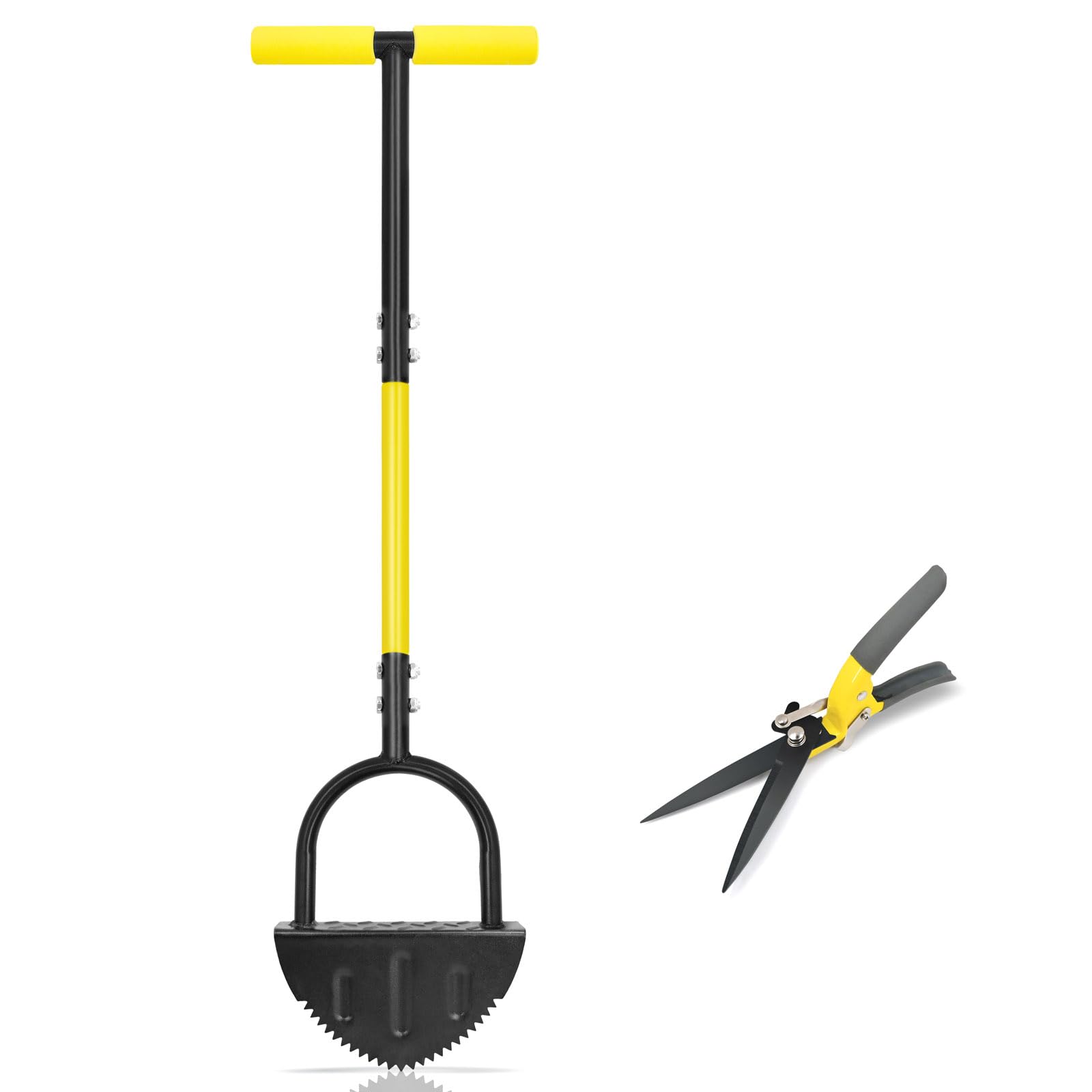
The light-footed edger that doubles as a trenching tool for low-voltage wire.
The Byhagern Professional Edge Lawn Tool brings a saw-tooth half-moon blade that does more than just edge. One reviewer noted, “I used it to bury low voltage wire, worked well to get it down about 4″ and not visible after a week or so, highly recommend.” That versatility makes it a smart pick if your yard work goes beyond just neat borders. The carbon steel construction resists rust, while the long ergonomic handle and padded grip reduce back strain during extended use. The wide footplate accommodates all shoe sizes for comfortable leverage.
Some users note the blade is almost 1/8 inch thick, which makes it effective in soft ground but a bit blunt in heavy turf from the start. A few buyers took a grinder to the teeth to sharpen them further. Unlike the Colwelt’s V-shape that cuts 5.5 inches deep, the Byhagern’s depth is not specified in the specs, so it works best for standard edging depth rather than deep trenching. It comes with a pair of garden shears and gloves, adding value for someone starting their tool collection.
What stands out
- Saw-tooth blade is effective for both edging and burying low-voltage wire
- Padded grip and ergonomic handle reduce fatigue
- Includes bonus garden shears and gloves for extra value
What to watch
- Blade thickness may require sharpening for heavy turf use
- Cutting depth is not specified, limited to standard edging
Best for: the DIY homeowner who wants one tool for edging, trenching, and small landscaping projects.
Skip if: you need a deep cut or a tool that is razor-sharp without any prep work.
6. BARAYSTUS Height Adjustable Garden Edger Tool

The budget-friendly starter that adjusts to fit you, not the other way around.
The BARAYSTUS is the lightest option here at 3 pounds, and it is the only one with real adjustability. Two settings let you switch between 37 inches and 41 inches of handle height, so it fits both a shorter and taller user within the same household. The half-moon saw-tooth blade spans 7.9 inches wide, covering more ground per pass than the narrower models. Reviewers point out it is a “reasonable price” and “quick, easy assembly with high-quality parts.” The reinforced wide foot platform transfers your body weight directly to the blade, helping the lightweight tool drive through soil. For a budget-friendly entry-level pick, it delivers solid results for occasional edging.
The trade-off is durability. Made of heavy-duty alloy steel with a heat-treated blade, it is still the lightest build here, and some buyers noted “failed welds” on a few units. It is not designed for daily professional use, but as a starter tool for weekend gardening, it gets the job done. Unlike the Colwelt’s 5.5-inch depth, the BARAYSTUS’s cutting depth is not explicitly listed, but the 7.9-inch wide head helps it clear a good path. The soft TPE grip on the T-shaped handle reduces hand fatigue during shorter sessions.
Why it fits
- Adjustable height (37-41 inches) fits multiple users in one household
- Lightweight 3-pound build is easy to carry and maneuver
- 7.9-inch wide head covers more area per pass than most competitors
Where it cuts corners
- Lighter construction not built for heavy daily or professional use
- Some units reported weld failures, so check yours on arrival
Grab this if: you are new to manual edging, want a budget-friendly adjustable tool, and plan to use it for occasional weekend yard work.
Look elsewhere if: you need a workhorse for heavy clay soil, thick roots, or extended commercial use.
Understanding the Specs
Blade Material: Spring Steel vs Carbon Steel vs Cast Iron
The blade material determines how long the tool stays sharp and how well it resists bending. Spring steel, like the CKLT uses, is heat-treated to flex under pressure without taking a set, so it bounces back from rocky soil. Carbon steel, found on the Root Slayer and Radius Garden, is very hard and holds a fine edge, but it needs to be wiped clean after each use to prevent rust. Cast iron, like on the BARAYSTUS, is durable and cheap but more brittle—it can crack under extreme stress if you hit a large rock. For most homeowners, carbon steel offers the best balance of price and performance, while spring steel is the premium upgrade for longevity.
Cutting Depth and Head Width
Cutting depth is the vertical distance the blade sinks into the soil. A depth of 5.5 inches, like the Colwelt offers, lets you cut through a thicker root layer and create a deeper trench for mulch or edging materials. Most other manual edgers stop at 2 to 4 inches, which is fine for annual touch-ups on well-maintained borders. Head width—how wide the blade is from side to side—determines how much soil you move per pass. A wider head, such as the BARAYSTUS’s 7.9 inches, covers more ground faster, but it also requires more leg force to push through hard soil. Narrower heads, around 5 to 6 inches, are easier to drive deep but take more passes to cover the same distance.
FAQ
What is the difference between a half-moon edger and a straight-blade edger?
How deep should a manual edger cut?
Will a shovel for edging work in clay soil?
Can I use an edging shovel to plant flowers or dig holes?
How do I sharpen a manual edging tool?
Is a heavier edging tool always better?
What does a T-handle do that a straight handle does not?
How do I maintain my manual edger to make it last?
Can I edge with a shovel instead of a dedicated edger?
What is the best time of year to edge your lawn?
Final Thoughts: The Verdict
For most people, the shovel for edging winner is the Root Slayer 22611 because its inverted V-shaped serrated blade and 4.8-pound build cut through roots and compact soil better than anything else here. If you prioritize ergonomic comfort and easy handling, grab the Radius Garden Pro-Lite. And for a budget-friendly starter tool that adjusts to fit multiple users, the BARAYSTUS is a solid introduction to manual edging while staying affordable.
How We Picked
We do not accept paid placement. Every pick is matched to a real buyer and a real use-case; we do not hands-on test units.
Sources & Methodology
Specifications: manufacturer listings and product documentation. Review insights: verified customer reviews, as of July 2026. Pricing: not shown on this page (it changes often); check the current price via the retailer link.
As an Amazon Associate, Lawn Gear Lab earns from qualifying purchases. This does not affect which products we feature.