
Specs are compiled from manufacturer listings and verified buyer reviews and can change over time — please confirm the key details on the product page before buying.
Picking the right bag of fertilizer for a deep-rooted oak can feel like a guessing game — dump too much and risk leaf burn, use the wrong ratio and get nothing. The real trick is matching the feed to what oaks actually need: a balanced slow-release meal that reaches their active roots without washing away in the first rain. Whether you are nursing a single sapling or a row of mature trees, the choice usually depends on spikes versus liquid, each with a clear trade-off in speed and effort.
I’m Rikta — the founder and writer behind Lawn Gear Lab. This guide is built by comparing the manufacturers’ published specifications and the patterns across verified customer reviews, so you get each pick’s real strengths and trade-offs instead of marketing spin.
To cut through the confusion, I have lined up three proven contenders that target the specific nutritional needs of oak trees, from a mess-free spike option to a fast-acting liquid formula. The Jobe’s spikes win if you want no-mix convenience with a 16-4-4 NPK ratio (16% nitrogen for leaves, 4% phosphorus for roots, 4% potassium for health) that supports steady growth. If you need speed, the TPS liquid delivers visible results in weeks. And for yellow-leaf problems, the Lutz iron spikes target chlorosis (iron deficiency) directly. With the right match, you can give your oaks the best possible start and finally find the fertilizer for oak trees that delivers real results.
Quick Picks
- Jobe’s Slow Release Tree and Shrub Fertilizer — Best Overall
- TPS Nutrients Oak Tree Fertilizer Liquid — Fast Growth
- Lutz Corporation Iron Chlorosis Tree Fertilizer — Yellow-Leaf Fix
How To Choose The Best Fertilizer For Oak Trees
The wrong fertilizer can do more harm than good for an oak tree. You need to focus on what the tree actually needs at its roots. Here are the two most important factors to consider before you buy.
NPK Ratio: The Numbers That Feed Your Oak
Every fertilizer label shows three numbers, like 16-4-4 or 8-10-10. These stand for nitrogen (N), which fuels leaf growth; phosphorus (P), which supports root development; and potassium (K), which boosts overall tree health. For established oaks, choose a balanced or slightly nitrogen-heavy formula. The 16-4-4 in the Jobe’s spikes matches what a mature oak uses during its active growing season, so leaves stay green and roots grow strong. The 8-10-10 in the Lutz spikes leans heavier on phosphorus and potassium, which helps correct specific deficiencies like poor root health or disease resistance.
Slow-Release vs. Liquid: How Fast Do You Want Results?
Spikes and granular slow-release products meter out nutrients over weeks or months. That means less risk of over-fertilizing and fewer applications per year — you just pound them in twice. Liquid fertilizers like the TPS Nutrients formula get absorbed almost immediately through the roots and leaves, so you see results faster. But you have to apply them more often. Choose spikes for a low-maintenance approach and liquids when you need to rescue a struggling tree fast.
Quick Comparison
In‑Depth Reviews
1. Jobe’s Slow Release Tree and Shrub Fertilizer Spikes

Hammer-and-go convenience that feeds oaks underground for an entire season — no mixing, no measuring, no mess.
You do not mix, measure, or risk burning your tree with Jobe’s spikes. They deliver a 16-4-4 NPK formula (16% nitrogen for lush leaves, 4% phosphorus for root growth, 4% potassium for overall health) directly to the roots where oaks actually absorb nutrients. Each spike is pre-measured, so there is no risk of over fertilizing. You only need to apply them twice a year (early spring and late fall). At just 12 ounces total for 15 spikes, the package is light enough to carry around your yard without a wheelbarrow. The plastic cap keeps the spikes from crumbling when you hammer them into damp soil.
Buyers report seeing real results compared to doing nothing. One long-time user noted that “the untreated trees across the street are definitely smaller in both height and circumference” after using Jobe’s for years. That steady, sustained feeding takes the guesswork out of oak care, making it the most balanced pick for both beginners and seasoned gardeners.
If you want a faster visible effect, the TPS liquid will green your oak in weeks — but you will need to reapply it multiple times. The Jobe’s spikes trade that speed for zero effort over months.
Why it stands out
- 16-4-4 ratio is perfect for oak leaf and root growth
- Spikes create zero runoff, mess, or smell
- Pre-measured so you cannot over-fertilize
The trade-off
- Only 15 spikes per pack — larger yards may need two boxes
- Slow release means slower visible results than the TPS liquid
Your best bet: If you want the easiest, mess-free way to feed your oak and forget it for months, this is the pick.
Look elsewhere if: You need a fast rescue for a tree that looks yellow or struggling right now — the TPS liquid is better for that.
2. TPS Nutrients Oak Tree Fertilizer Liquid
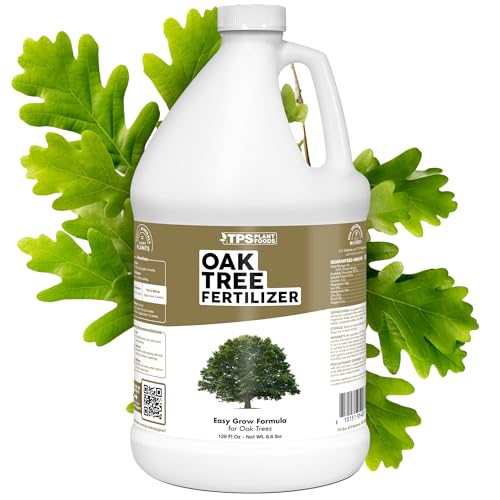
A concentrated 128-ounce gallon that makes scraggly oaks fill out with surprising speed — far faster than any spike.
This liquid formula from TPS Nutrients delivers its nutrition in a form oaks can use immediately. That means you see results far quicker than with Jobe’s spikes. The 128-ounce (1-gallon) jug is meant for repeat applications throughout the growing season. The brand claims it is specifically designed for oak trees, so you are not guessing about the right balance. One buyer described how “after 2 uses, tree filled in and looked beautiful,” and “4 uses on a scraggly oak transformed it with more branches and fullness.”
Another reviewer with baby oaks reported their trees grew a foot in a single month after just two applications. Unlike the Jobe’s spikes, which are limited to 15 placements per box, a single gallon can treat multiple trees over several weeks — one owner used it over 6 weeks on two 15-foot oaks and got 2-3 feet of new branch growth. The main catch is that you must apply it more frequently than the twice-a-year spikes. Also, owners mention the dosage instructions are a bit vague, so some buyers have to experiment to find the right amount per tree.
Speed advantage
- Produces visible greening and new growth in weeks — faster than Jobe’s spikes
- 128-ounce gallon stretches across multiple trees
- Targets roots and leaves for immediate uptake
The downside
- Needs repeat applications versus Jobe’s twice-a-year schedule
- Instructions are not clear on exact dosage per tree
Reach for this if: You want rapid results and do not mind mixing application days into your routine.
Think twice if: You prefer a one-and-done product that just sits in the ground and works — stick with Jobe’s spikes.
3. Lutz Corporation Iron Chlorosis Tree Fertilizer Spikes
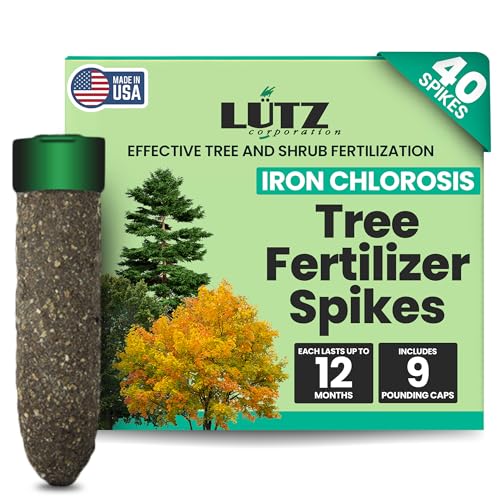
Forty iron-packed spikes designed to cure the yellow leaves that plague oaks — a specialized fix that Jobe’s and TPS cannot match.
If your oak tree looks pale with yellowing between the veins (iron chlorosis — a deficiency common in high-pH soil where iron is locked up), this Lutz spike set addresses that head-on. It contains a formula with 4.8% sulfur and added iron, plus an 8-10-10 NPK ratio (8% nitrogen, 10% phosphorus, 10% potassium). That means it provides less nitrogen and more phosphorus and potassium than the Jobe’s 16-4-4 option. The slow-release technology keeps feeding for up to 12 months from a single application, so you can treat the problem once and let it work.
Customers note the spikes helped with chlorosis and restored a beautiful green. One reviewer noted it “helped with chlorosis, but did not clear up the problem” completely — a reminder that severe cases may need a soil test first. At 40 spikes per box (versus Jobe’s 15), this pack covers more trees or a larger drip line in one purchase. The Lutz spikes also target a broader range of acid-loving species, including oak, maple, birch, and pine.
Specialized benefit
- Contains iron and sulfur to correct yellow-leaf chlorosis
- 40 spikes per box — excellent value for a large property (beats Jobe’s 15-count)
- One application feeds for up to 12 months
Consider this
- May not fully fix chlorosis without a soil test first
- 8-10-10 ratio is lower in nitrogen than the Jobe’s 16-4-4, so not ideal for general feeding
Perfect for: Oak owners battling yellow leaves who want a long-term, high-count solution that beats the Jobe’s 15-count for coverage.
Not the best if: Your tree is healthy and green and you just need a basic balanced feed — choose Jobe’s 16-4-4 instead.
Understanding the Specs
NPK Ratio (The Three Numbers)
The label on any fertilizer shows three numbers like 16-4-4 or 8-10-10. The first is nitrogen (N), which fuels leaf and stem growth. The second is phosphorus (P), which supports root development and flowering. The third is potassium (K), which helps overall tree health and disease resistance. For oak trees, a formula with a higher first number or a balanced spread tends to work best for general feeding.
Slow-Release Technology
A slow-release product breaks down gradually in the soil, feeding the tree over weeks or months instead of dumping all the nutrients at once. Spikes are the most common slow-release form for oak trees. They reduce the risk of root burn and mean you only apply them twice a year (or even once, depending on the brand), which saves time and effort compared to liquid fertilizers that need repeat mixing and pouring.
FAQ
How often should I fertilize my oak tree?
What is the best NPK ratio for oak trees?
Are fertilizer spikes better than liquid for oak trees?
Can I use a general tree fertilizer on my oak tree?
How do I apply tree spikes to an oak tree?
What causes yellow leaves on my oak tree?
How many fertilizer spikes do I need for a large oak tree?
Can I over-fertilize an oak tree?
Should I fertilize a newly planted oak tree?
Final Thoughts: The Verdict
For most people, the best fertilizer for oak trees is the Jobe’s Slow Release Spikes because it offers the easiest, mess-free application with a proven 16-4-4 ratio that supports steady growth without any mixing or guesswork. If you want a fast-acting liquid that transforms a scraggly tree in weeks, grab the TPS Nutrients Liquid. And for correcting yellow-leaf chlorosis with a massive 40-spike box, the Lutz Iron Chlorosis Spikes is the specialized choice.
How We Picked
We do not accept paid placement. Every pick is matched to a real buyer and a real use-case; we do not hands-on test units.
Sources & Methodology
Specifications: manufacturer listings and product documentation. Review insights: verified customer reviews, as of July 2026. Pricing: not shown on this page (it changes often); check the current price via the retailer link.
As an Amazon Associate, Lawn Gear Lab earns from qualifying purchases. This does not affect which products we feature.