
Specs are compiled from manufacturer listings and verified buyer reviews and can change over time — please confirm the key details on the product page before buying.
Creeping Charlie (ground ivy) is the uninvited guest that laughs at most weed killers, spreading its scalloped leaves across your lawn while ordinary sprays just wilt its neighbors. The right weed killer for creeping Charlie targets that waxy foliage and aggressive root system without torching your grass, saving you from another season of hand-pulling.
I’m Rikta — the founder and writer behind Lawn Gear Lab. This guide is built by comparing the manufacturers’ published specifications and the patterns across verified customer reviews, so you get each pick’s real strengths and trade-offs instead of marketing spin.
From ready-to-use wands that make spot-treating a breeze to concentrated formulas that tackle stubborn patches, here is the breakdown of the weed killer for creeping charlie that actually works based on real data and buyer experiences.
Quick Picks
- Bonide Weed Beater Ultra, 16 oz Concentrate — Best Overall
- Ortho WeedClear Lawn Weed Killer Ready-to-Use — Easiest to Use
- Ortho WeedClear Lawn Weed Killer Ready-To-Use — Best Value Refill
- Scotts Liquid Turf Builder — 2-in-1 Weed & Feed
- Albaugh Sublime Weed Killer, 1 Quart (32 oz) — Premium Performance
- Agrisel GlyPhoSel Pro Weed Killer, 32 Ounces — Total Vegetation Control
How To Choose The Best Weed Killer For Creeping Charlie
Creeping Charlie (also called ground ivy) is a persistent broadleaf weed with waxy leaves that many general weed sprays slide right off. To beat it, you need a targeted approach. Here are the key factors to look for.
Look for the right active ingredients
The most effective formulas against creeping Charlie contain a blend of triclopyr, dicamba, and sometimes mesotrione or 2,4-D. Triclopyr is especially good at penetrating the waxy leaf cuticle, while dicamba works through the roots. Check the label — if “ground ivy” or “Glechoma hederacea” is listed, you have a serious contender.
Selective vs. non-selective: know the stakes
A selective herbicide kills broadleaf weeds without harming your grass. Most of the picks here are selective — you can spray them directly onto creeping Charlie in your fescue, Kentucky bluegrass, or bermudagrass lawn. Non-selective options (like high-concentration glyphosate) kill everything they touch, which is only useful if you plan to reseed the bare patch afterward.
How you apply it matters
Ready-to-use sprays with a wand make spot treatment simple, but you pay a premium per ounce. Concentrates that you mix with water in a pump sprayer give you more coverage (often 16,000 to 32,000 square feet) for less money. Hose-end applicators are a middle ground — you attach a bottle to your garden hose and spray the whole lawn.
Quick Comparison
| Model | Best For | Form | Coverage | Unit Size | Amazon |
|---|---|---|---|---|---|
| Bonide Weed Beater Ultra | Best Overall | Concentrate | 16,000 sq ft | 16 oz | Amazon |
| Ortho WeedClear with Comfort Wand | Easiest to Use | Ready-to-Use | — | 128 fl oz | Amazon |
| Ortho WeedClear Refill | Best Value Refill | Ready-to-Use | 5,000 sq ft | 166.4 fl oz | Amazon |
| Scotts Liquid Turf Builder with Plus 2 | 2-in-1 Weed & Feed | Hose-end | 6,000 / 4,000 sq ft | 32 fl oz | Amazon |
| Albaugh Sublime | Premium Performance | Liquid Concentrate | 16,000 – 32,000 sq ft | 32 oz | Amazon |
| Agrisel GlyPhoSel Pro | Total Vegetation Control | Spray Concentrate | 3,456 sq ft | 32 fl oz | Amazon |
In‑Depth Reviews
1. Bonide Weed Beater Ultra, 16 oz Concentrate

The concentrated firepower that takes out over 200 broadleaf weeds with one mix.
If you want a single bottle that handles creeping Charlie and the rest of the weed roster without needing multiple trips to the store, this is the pick. Bonide Weed Beater Ultra kills over 200 broadleaf weeds including ground ivy (creeping Charlie), dandelion, clover, chickweed, and ragweed. You mix just 3 ounces of concentrate per gallon of water in a pump sprayer, and it covers a massive 16,000 square feet — more than triple the coverage of many ready-to-use sprays.
One of the best parts is the speed. Buyers report visible injury to weeds within hours of application, with plant death typically occurring within 7-14 days. The formula is also rainproof within hours once it dries, so you do not have to worry about a sudden shower washing away your work. Unlike some herbicides that leave your lawn looking bleached, this one is designed to target the weed only, not the grass.
The catch is that you need your own sprayer — it is a concentrate, so you have to mix and apply yourself. Owners mention that tough broadleaf weeds may require 2 or more treatments and possibly a follow-up next season, but most agree it is the most effective weed killer they have found.
What really stands out
- Covers 16,000 square feet, which is far more coverage than ready-to-use options.
- Rainproof within hours after drying — no need to time your application around the forecast.
- Kills weeds down to the root, with visible results in hours and full die-off in 7-14 days.
What to know before buying
- Requires a separate backpack, compression, or knapsack sprayer — not included.
- Stubborn creeping Charlie patches may need a second application for complete control.
Perfect for: Anyone with a moderate-to-large lawn (up to 16,000 sq ft) who wants the most cost-effective and powerful selective solution for creeping Charlie and other broadleaf weeds.
Not ideal if: You prefer a grab-and-go spray bottle with no mixing required
2. Ortho WeedClear Lawn Weed Killer Ready-to-Use with Comfort Wand, 1 gal.
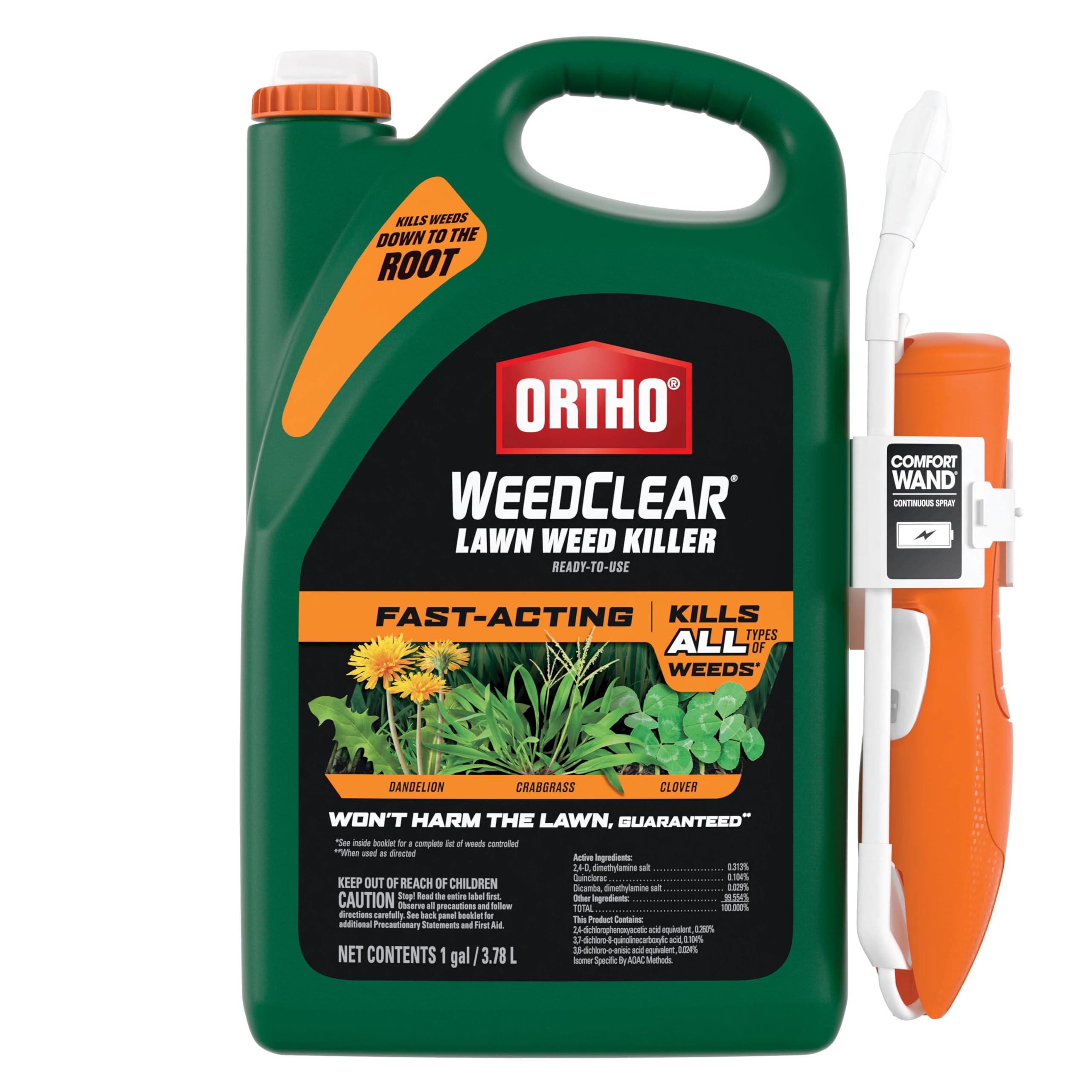
The grab-and-go wand that makes spot-treating creeping Charlie almost satisfying.
For the buyer who wants to walk outside and spray without measuring, mixing, or attaching a hose, this is the simplest option. The Ortho WeedClear comes ready-to-use in a 1-gallon container with a battery-powered Comfort Wand that has two spray settings. You just point and pull the trigger. It specifically lists creeping Charlie on the label, along with crabgrass, dandelion, clover, and chickweed.
Real customers note fast results. According to one verified review, dandelions stopped growing within 2 days, and 85% of weeds were dead and brown within 2 weeks — all without harming the surrounding grass. The formula works down to the root with a single application when used on young, actively growing weeds in spring or fall.
The trade-off is that the liquid volume is 128 fluid ounces, which is smaller than the 166.4 fluid ounces in the refill version. If you have a larger lawn or dense patches, the refill version (Product 3) is a better value because it gives you 33% more liquid for a lower per-ounce cost. A few reviewers also note that crabgrass may need extra applications, and one buyer found it ineffective, calling it the “worst weed killer ever.”
Ease of use highlights
- Battery-powered Comfort Wand lets you target individual weeds without bending over.
- Two spray nozzle settings for precision or wider coverage.
- Safe on many lawn grasses including Fescues, Kentucky Bluegrass, and Zoysiagrass.
Limitations
- Smaller volume (128 fl oz) than the Ortho refill — you will run out faster on large lawns.
- More expensive per ounce than concentrate formulas.
Best for: The weekend gardener who wants immediate, easy spot treatment of creeping Charlie without any setup time.
Skip this if: You have a large lawn (over 5,000 sq ft) or dense weed coverage — you will save money with a concentrate instead
3. Ortho WeedClear Lawn Weed Killer Ready-To-Use Refill, 1.33 gal.

The same proven formula in a bigger jug that keeps your Comfort Wand working all season.
If you already own the Ortho Comfort Wand from the ready-to-use kit above, this 1.33-gallon refill is the smarter buy. It holds 166.4 fluid ounces — 33% more liquid than the 1-gallon version (128 fl oz) — which means you get about a 30% more volume for your money. The formula is identical, killing creeping Charlie, crabgrass, dandelion, clover, and chickweed down to the root.
A buyer in the Northeast shared their maintenance routine: “I spray it when spring comes and do it another time right before summer and you should be able to keep the weeds off for the rest of the year.” They are on their third year of this simple two-application cycle. The coverage is rated at 5,000 square feet, so it is designed for spot treatment rather than blanketing your whole property.
Not every experience is perfect. One reviewer found that a single application did not fully remove the weeds and probably needs a second pass. Another noted that Ortho products seem less effective than in 2022-2023, requiring more product for the same results. On the whole, though, this is a cost-effective refill for those already in the Ortho ecosystem.
Why this refill makes sense
- 33% more liquid (166.4 fl oz) than the 1-gallon version for a better per-ounce value.
- Reuses your existing Comfort Wand, reducing plastic waste.
- Works on a wide range of lawn grasses including bermudagrass, fescues, and ryegrass.
Potential downsides
- Some users report needing multiple applications for stubborn or mature creeping Charlie patches.
- Coverage is only 5,000 square feet — not enough for full-lawn spray on a large property.
Reach for this if: You already have the Ortho Comfort Wand (from Product 2) and want the cheapest way to keep refilling it all season.
Look elsewhere if: You need a broad-coverage solution for a lawn larger than 5,000 square feet
4. Scotts Liquid Turf Builder with Plus 2 Weed Control, 32 fl. oz.

A single bottle that feeds your grass while it kills creeping Charlie — one pass, two jobs.
Here is the option that saves you a separate fertilizer application. Scotts Liquid Turf Builder with Plus 2 Weed Control is a hose-end formula that combines a quick-release nitrogen boost with a broadleaf weed killer that specifically targets ground ivy (creeping Charlie), buckhorn, chickweed, henbit, plantain, and many others. You screw the bottle onto your garden hose, turn on the water, and spray — it is that simple.
Coverage depends on your grass type: it handles up to 6,000 square feet for warm-season lawns (like bermudagrass) and 4,000 square feet for cool-season lawns. One buyer with a heavy weed infestation noted that plantain, dollar weed, and clover “started to die within 2 days and were completely gone within a week.” The nitrogen content also helps green up your grass, so the lawn looks healthier as the weeds disappear.
There are a couple of honest limitations. The formula does not kill actively growing crabgrass — you will need a separate product for that. Also, some users find it less effective on clover and Japanese clover, though it eventually works after about two weeks. If you prefer granular weed-and-feed, the reviewer tips about wetting the lawn first and not walking on treated areas are worth following.
Two-in-one benefits
- Eliminates a separate fertilization step — feeds and kills weeds in one spray.
- Hose-end applicator is easy to use; just attach and spray the whole lawn.
- Covers up to 6,000 sq ft for warm-season grasses.
Important catches
- Does not kill actively growing crabgrass — you need a different treatment for that.
- Some broadleaf weeds like Japanese clover may take up to 2 weeks to fully die.
Best for: Anyone who wants to simplify lawn care by combining feeding and weed control into one hose-end application.
Not ideal for: Lawns with a heavy crabgrass problem — you will need a separate herbicide for that
5. Albaugh Sublime Weed Killer, 1 Quart (32 oz)

The commercial-grade selective that uses triclopyr, dicamba, and mesotrione for the toughest ground ivy.
When creeping Charlie has taken over and low-strength sprays are not cutting it, this is the premium step-up. Albaugh Sublime combines three active ingredients — triclopyr, dicamba, and mesotrione — which is a more serious blend than most consumer products. It is designed for turf on golf courses, athletic fields, parks, and sod farms, but it works perfectly on a home lawn too. The coverage is massive: between 16,000 and 32,000 square feet per quart.
A reviewer who had struggled to kill the creeping Charlie in their grass said this was “the only thing that has ever killed it,” noting that you just have to be patient because it takes a week or two to really work. Another buyer using it on tall fescue reported that weeds wilted after 3 days of 85°F sun and most were eliminated by 10 days, with the grass recovering well after mowing and fertilizing.
The big selling point is that it provides selective control without the bleaching symptoms that some other herbicides leave on your turf. That said, one user found it ineffective on wild violets, so if that is a primary weed, you might need a different approach. A few buyers also mentioned that the packaging could be sturdier — one was delivered with a pinhole leak.
What makes it a premium choice
- Triple-active formula (Triclopyr, Dicamba, Mesotrione) for stubborn weeds like creeping Charlie.
- No unsightly bleaching on your grass — your lawn stays green while weeds die.
- Covers a huge area: 16,000 to 32,000 square feet per quart.
Things to consider
- Some reviewers point out it does not work on wild violets, if those are an issue in your yard.
- Packaging has been criticized for arriving with leaks or pinholes.
Reach for this if: You have a persistent creeping Charlie infestation that has survived weaker sprays, and you want a commercial-grade solution without harming your lawn.
skip it if: You are primarily fighting wild violets — this may not be effective against them
6. Agrisel GlyPhoSel Pro Weed Killer, 32 Ounces
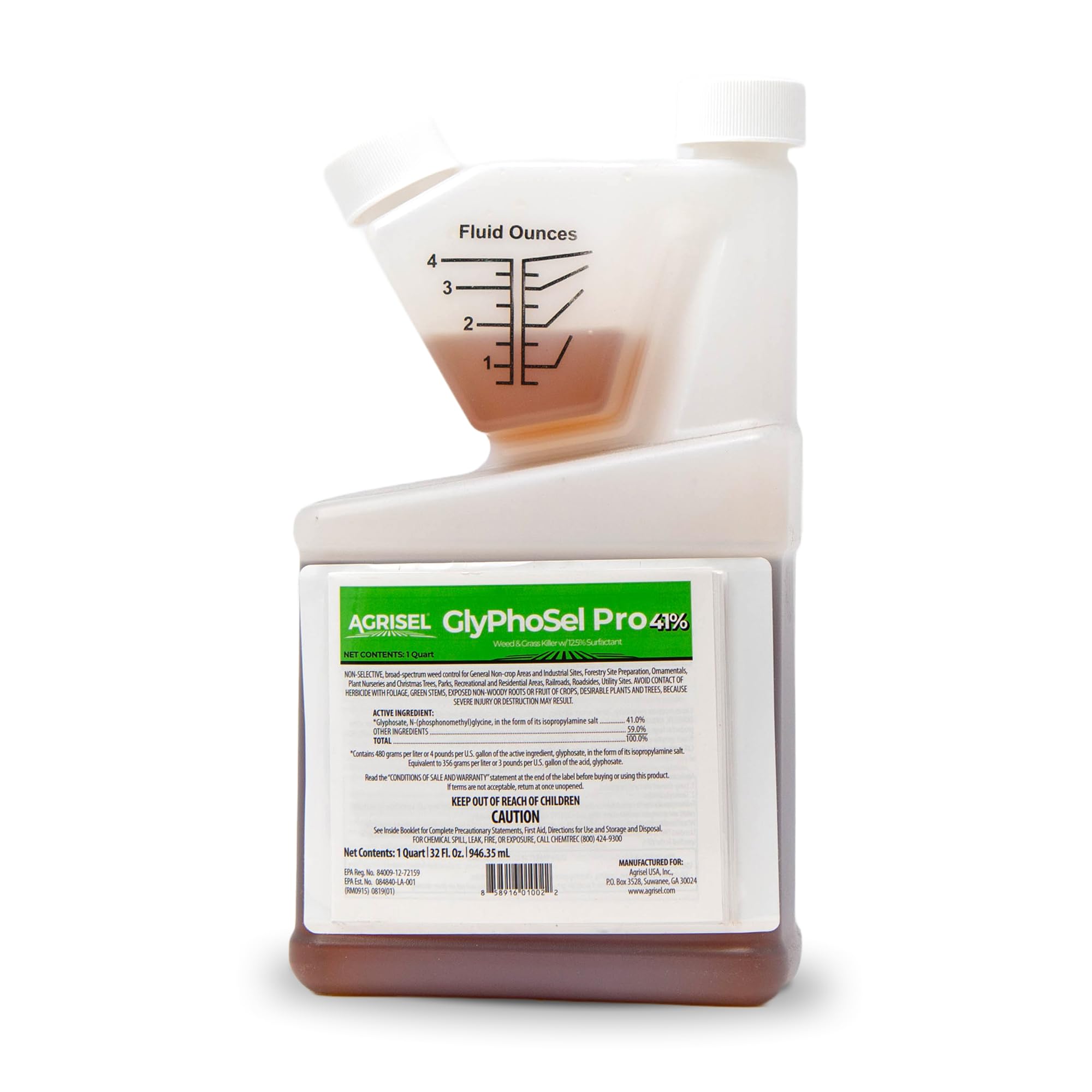
The scorched-earth option that kills creeping Charlie and anything else it touches.
Before you click “add to cart,” you need to understand: this is not a selective weed killer. Agrisel GlyPhoSel Pro is a 41% glyphosate concentrate — the same active ingredient as Roundup but at a much higher concentration. It kills everything it touches, including your grass. Buyers are emphatic about this: “Do NOT use this on your lawn,” one warned. “It will kill all your grass!!!!!”
So why is it on a list of creeping Charlie killers? Because if you have creeping Charlie in garden beds, along fence lines, in driveways, or in any area where you do not care about preserving the grass, this is the most powerful option here. It requires just a small amount mixed with water, and it will kill the toughest weeds “quite quickly,” as one reviewer noted. It is also low-odor and water-based, which reduces staining on surfaces.
The coverage is 3,456 square feet per 32-ounce bottle. Because it is a non-selective herbicide, you need to use extreme caution with overspray — a slight breeze can drift the mist onto desirable plants and kill them. Buyers consistently say it is much more potent than anything you find at a big-box store. Use this as a spot treatment in non-turf areas only, or as a total kill before reseeding.
Where it excels
- Extremely concentrated — a small amount goes a long way, making it cost-effective for spot treatment.
- Very fast-acting and effective on even the toughest creeping Charlie infestations.
- Low-odor formula that does not stain like some other non-selective sprays.
Critical warning
- Non-selective — it kills all vegetation, including grass, on contact.
- Overspray can drift and kill nearby ornamentals and desirable plants.
Only use this for: Creeping Charlie in garden beds, patios, driveways, fence lines, or any area where you want to kill everything and start fresh.
Never use this on: Your lawn — it will kill the grass just as fast as it kills the weeds
Understanding the Specs
Selective vs. Non-Selective Herbicides
A selective herbicide (like triclopyr or dicamba-based formulas) is designed to kill broadleaf weeds while leaving your grass unharmed. That is what you want for spot-treating creeping Charlie in the middle of your lawn. A non-selective herbicide (like high-concentration glyphosate) kills all plant life it contacts — use it only in areas where you do not care about the grass, like cracks in a driveway or garden beds you plan to replant.
Coverage Per Square Foot
Coverage tells you how much treated area one bottle covers. Ready-to-use sprays typically cover 5,000 square feet, while a concentrate like Bonide covers 16,000 square feet. If your yard is large, a concentrate will be more economical. For a small patch, a ready-to-use wand may be all you need. Always check the label for the specific coverage figure for your target weed.
Application Form: Ready-to-Use vs. Concentrate
Ready-to-use (RTU) sprays come pre-mixed in a bottle with or without a wand — you open and spray. Concentrates require you to mix the liquid with water in a pump sprayer at a specific ratio (often 3 oz per gallon). RTU is more convenient for quick spot treatments; concentrate gives you more coverage per dollar and is better for large-scale spraying.
Rainproof Timing
A “rainproof within hours” claim means the herbicide dries onto the leaf surface and will not wash off after a set period (usually 2-4 hours). This matters because if rain comes too soon, the chemical gets diluted and needs reapplication. For best results, apply when no rain is forecast for at least 24 hours, and check the label for the exact rainproof window.
FAQ
What active ingredient kills creeping Charlie the best?
When is the best time of year to spray creeping Charlie?
Can I use a weed-and-feed product to kill creeping Charlie?
How long does it take for creeping Charlie to die after spraying?
Will creeping Charlie weed killer kill my grass too?
What’s the difference between a ready-to-use spray and a concentrate?
How many applications are needed to completely get rid of creeping Charlie?
Can I reseed after using a creeping Charlie weed killer?
Is it safe for pets after the spray dries?
Does rain wash away weed killer before it works?
Final Thoughts: The Verdict
If you want one dependable pick, the weed killer for creeping charlie winner is the Bonide Weed Beater Ultra because its 16,000-square-foot coverage and selective triclopyr formula give you the best balance of power, coverage, and cost. If you want the easiest no-mix application, grab the Ortho WeedClear with Comfort Wand. And for a premium commercial-grade option that tackles the most stubborn infestations, the Albaugh Sublime is your best bet.
How We Picked
We do not accept paid placement. Every pick is matched to a real buyer and a real use-case; we do not hands-on test units.
Sources & Methodology
Specifications: manufacturer listings and product documentation. Review insights: verified customer reviews, as of July 2026. Pricing: not shown on this page (it changes often); check the current price via the retailer link.
As an Amazon Associate, Lawn Gear Lab earns from qualifying purchases. This does not affect which products we feature.