
Specs are compiled from manufacturer listings and verified buyer reviews and can change over time — please confirm the key details on the product page before buying.
If you are filling raised beds, repotting a decades-old houseplant, or amending clay-heavy native soil, the bag you grab makes the difference between a season of thriving growth and a constant battle with compaction, gnats, or nutrient burn. The “big bag of soil” category is deceptively simple — but volume alone does not tell you if the mix drains well, feeds your plants organically, or arrives free of debris and pests. This guide cuts through the shelf confusion to match each bag to its perfect job.
I’m Rikta — the founder and writer behind Lawn Gear Lab. This guide is built by comparing the manufacturers’ published specifications and the patterns across verified customer reviews, so you get each pick’s real strengths and trade-offs instead of marketing spin.
After weighing the volume, ingredients, and real-world results of three top contenders, you will know exactly which big bag of soil deserves a spot in your garden shed this season.
Quick Picks
- Espoma Organic Potting Soil Mix (2 cu ft) — Best Overall
- Gro-Med Coco Coir Brick (10 lbs, expands to 80 quarts) — Best Value
- Espoma Organic Vegetable & Flower Garden Soil (1 cu ft) — Garden Pick
How To Choose The Best Big Bag Of Soil
Buying soil by the bag is straightforward, but picking the right one for your specific task means looking past the pretty label. Three things matter most.
Volume: Cubic Feet vs. Quarts
Soil bags list volume, not weight. A 1 cubic foot bag fills roughly one 12-inch by 12-inch raised bed about 8 inches deep. A 2 cubic foot bag doubles that coverage. Coco coir bricks are different — they are compressed and expand to a finished volume once you add water, so a 10-pound brick can turn into 80 quarts (around 2.7 cubic feet) of fluffy potting media. Always compare the finished volume, not the compressed brick size.
Organic vs. Synthetic
Organic soil mixes use natural sources like peat moss, compost, earthworm castings, kelp meal, and mycorrhizae (a beneficial fungus that helps roots take up nutrients). They feed slowly and build long-term soil health. Synthetic mixes often include chemical fertilizers for a quick green-up but can risk root burn if misapplied. If you are growing vegetables or sensitive houseplants, organic is the safer bet for steady, gentle nutrition.
Potting Mix vs. Garden Soil
Potting mix is lightweight, contains perlite or coir for drainage, and is designed for containers — it will not compact in a pot and smother roots. Garden soil is denser, meant to be mixed into your native ground to improve its texture and fertility. Using the wrong type in a container can lead to waterlogging, while using potting mix alone in the ground can leave plants undernourished. Read the bag’s intended use before you buy.
Quick Comparison
| Model | Best For | Volume | Type | Key Ingredient | Amazon |
|---|---|---|---|---|---|
| Espoma Organic Potting Soil Mix (2 cu ft) | Premium potting for containers & houseplants | 2 Cubic Feet | Potting Mix | Peat moss, perlite, worm castings | Amazon |
| Gro-Med Coco Coir Brick (10 lbs) | Budget-friendly seed starting & mixing | 80 Quarts (expanded) | Coco Coir | Coconut coir | Amazon |
| Espoma Organic Vegetable & Flower Garden Soil (1 cu ft) | In-ground planting & transplanting | 1 Cubic Foot | Garden Soil | Organic compost with mycorrhizae | Amazon |
In‑Depth Reviews
1. Espoma Organic Potting Soil Mix (2 cu ft)

The go-to bag for container plants you cannot afford to risk with cheap filler.
This is the bag you reach for when potting a treasured houseplant or starting a serious container vegetable garden. At a full 2 cubic feet, its volume exceeds the 1 cubic foot of the Espoma garden soil below, without sacrificing the ingredient quality. The mix is a rich blend of sphagnum peat moss, humus, and perlite (tiny white volcanic rocks that keep the soil airy and well-draining) plus earthworm castings, alfalfa meal, kelp meal, and feather meal for slow-release organic feeding.
Buyers report the texture is “loamy, chunky” and does not get dense or crusty, which is exactly what roots need for oxygen. A reviewer who has houseplants over 25 years old chose this soil specifically to keep those sentimental plants thriving. The addition of Myco-Tone (a proprietary blend of endo and ecto mycorrhizae) gives roots a biological boost to absorb water and nutrients more efficiently — a detail you rarely get at this price tier.
Where It Excels
- Large 2-cubic-foot bag for serious repotting jobs
- Clean organic mix with no large sticks or debris, per multiple reviewers
- Myco-Tone added for root health — not found in basic potting soils
One Trade-off
- More expensive per bag than store-brand mixes, though buyers feel the quality justifies the cost
Reach for this if: you want a premium, ready-to-use organic potting mix with proven results for containers, vegetables, and herbs — the one-bag solution for someone who values ingredient quality.
Look elsewhere if: you are amending in-ground native soil for a vegetable patch — the garden-specific Espoma below is formulated for that job.
2. Gro-Med Coco Coir Brick (10 lbs, expands to 80 quarts)
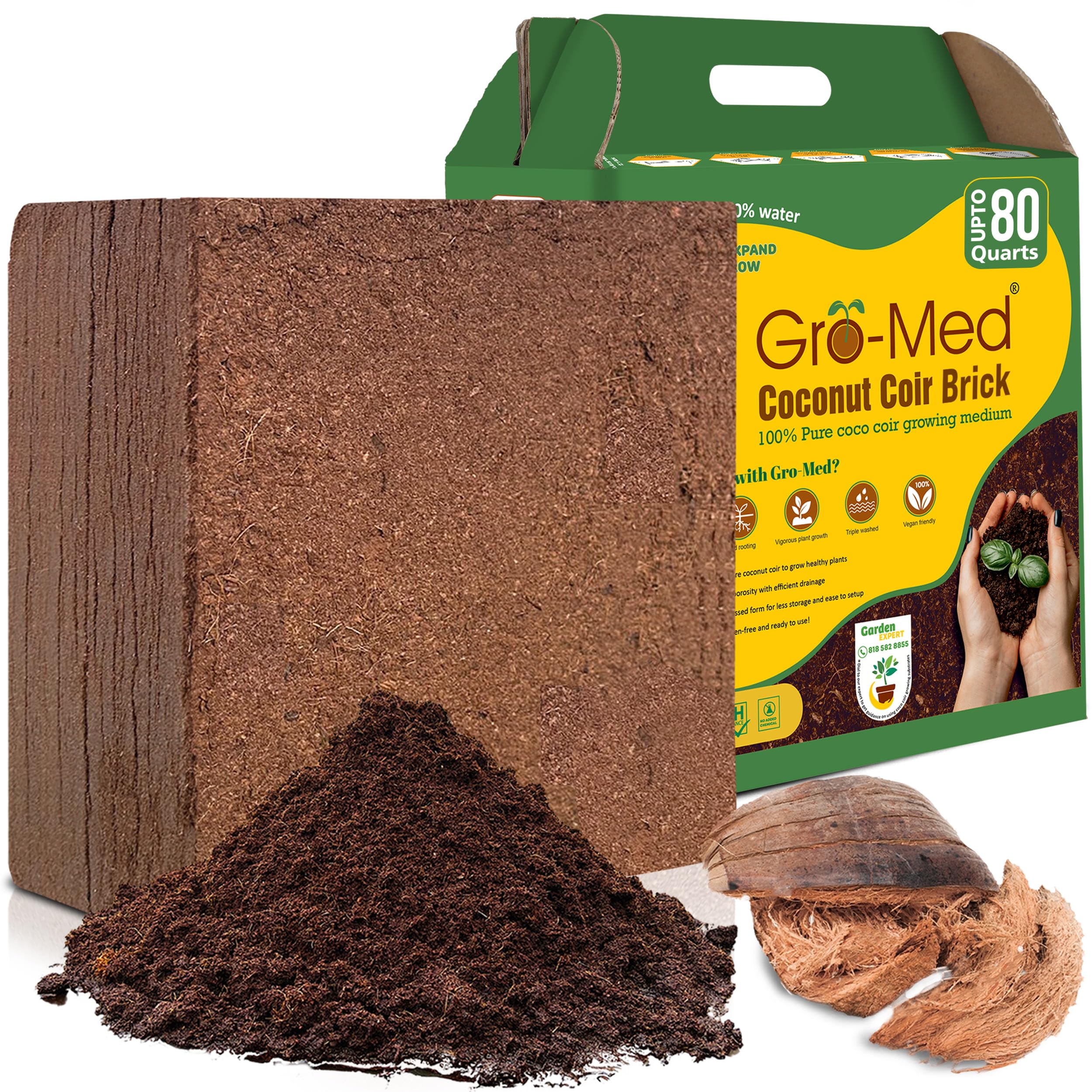
A dry brick that transforms into 80 quarts of seed-starting magic.
This one works differently than the pre-mixed soil bags. It is a 10-pound compressed block of coconut coir — the fibrous material from coconut husks — that you soak in water to expand into 80 quarts (roughly 3.1 cubic feet) of fluffy, peat-free potting media. That is a massive yield from a single package that stores in a fraction of the space of pre-mixed bags. Owners mention the brick expands significantly, so start with a small chip and rehydrate just what you need.
Coco coir holds water very effectively while staying aerated enough to prevent root rot — a major advantage for drought-prone gardens or hydroponic setups. A reviewer reported that lemon seeds sprouted 5 baby trees in just 2 weeks using this coir. Reviewers also praised its consistency, noting low dust levels and low salt content (verified by EC meter). It works as a standalone growing medium or as a bulk extender mixed with the Espoma potting mix above to stretch a bag further.
Why It Stands Out
- Expands from a 10-lb brick to 80 quarts — highest yield per dollar in this list
- Retains water very well, ideal for less frequent watering
- Lightweight and loose, preventing the hard compaction common in native clay soils
One Caveat
- Some buyers feel the bricks do not expand quite as much as expected — use a large bucket and give it time to fully hydrate
Best for the budget grower: if you need a lot of clean, soil-like media for seed starting, mixing with heavy clay, or filling many small pots, this brick delivers maximum volume per dollar with room to spare.
skip it if: you want a fully fortified mix with slow-release fertilizer and mycorrhizae — this is a base medium, not a complete soil.
3. Espoma Organic Vegetable & Flower Garden Soil (1 cu ft)

The targeted bag for improving your native garden soil at planting time.
While the 2-cubic-foot Espoma potting mix is made for containers, this 1-cubic-foot bag is designed specifically for in-ground use — you mix it directly into your garden beds when planting or transplanting vegetables and flowers. Customers note that “tomatoes and marigolds thrived” after using it. It is enriched with earthworm castings and the same Myco-Tone mycorrhizae blend found in the larger bag, but it has a denser, more soil-like texture suited to blending with clay, sand, or loam.
Reviewers consistently note that Espoma’s organic ingredients outperform store-brand alternatives in visible plant growth. One side-by-side test reported that plants potted in Espoma noticeably outperformed those in a cheaper organic alternative. A few buyers noted that if you are using it strictly for indoor containers, you may want to add extra perlite for drainage since this is a garden soil, not a potting mix. It is the most focused pick in this list — a single-purpose tool for the specific job of amending outdoor ground.
What It Gets Right
- Formulated for in-ground planting with Myco-Tone for root development
- Rich organic composition with earthworm castings — no synthetic chemicals
- Multiple bags arrived bug-free, and plants in Espoma outperformed a generic alternative in one reviewer’s test
Keep in Mind
- At only 1 cubic foot, its volume is less than the 2 cubic foot premium Espoma pick — you will need multiple bags for larger beds
- Not ideal as a standalone container mix; better blended with native soil or with added perlite for drainage
Perfect for the vegetable gardener: if you are digging a new bed or transplanting seedlings into the ground this season, this bag gives your native soil the organic boost it needs.
Hold off if: you are filling pots or raised planters — the 2-cut-foot Espoma potting mix is formulated for that task and contains perlite for drainage.
Understanding the Specs
Cubic Feet vs. Quarts
Soil bags in the U.S. almost always measure volume in cubic feet (one cubic foot is roughly 25.7 dry quarts). For example, a 2-cubic-foot bag holds 2 cubic feet, versus a 1-cubic-foot bag’s 1 cubic foot. When a product like Gro-Med’s coco coir brick lists “80 quarts,” that is around 3.1 cubic feet once expanded — meaning more finished soil volume than any pre-mixed bag in this list. Always compare the same unit (cubic feet or quarts) to know which bag actually gives you more.
Myco-Tone (Mycorrhizae)
This is a specific blend of beneficial fungi that attach to plant roots and help them absorb water and minerals from the soil. In plain terms, it acts like an extension of the root system, making nutrients more available to the plant. Both Espoma products in this list contain Myco-Tone, which is a proprietary blend of endo-and ecto-mycorrhizae. Not all bagged soils include this — cheaper bags often omit it entirely.
FAQ
Can I use garden soil in a pot or container?
How much does a 2-cubic-foot bag of soil weigh when wet?
Will a 10-lb coco coir brick really fill 80 quarts of space?
Is coco coir better than peat moss for gardening?
How long does an opened bag of potting soil last in storage?
Do I need to add fertilizer to an organic potting mix right away?
Can I mix coco coir with the Espoma potting soil?
Will these bags fit in a standard car trunk for transport?
What does Myco-Tone do for my plants?
Is the Gro-Med coco coir brick organic?
Final Thoughts: The Verdict
For most people, the big bag of soil winner is the Espoma Organic Potting Soil Mix (2 cu ft) because it combines the largest volume, clean ingredients, and proven results for both indoor and outdoor containers. If you want maximum expandable value for mixing and seed starting, grab the Gro-Med Coco Coir Brick. And for improving native in-ground garden beds at transplant time, the standout is the Espoma Organic Vegetable & Flower Garden Soil (1 cu ft).
How We Picked
We do not accept paid placement. Every pick is matched to a real buyer and a real use-case; we do not hands-on test units.
Sources & Methodology
Specifications: manufacturer listings and product documentation. Review insights: verified customer reviews, as of July 2026. Pricing: not shown on this page (it changes often); check the current price via the retailer link.
As an Amazon Associate, Lawn Gear Lab earns from qualifying purchases. This does not affect which products we feature.