
Specs are compiled from manufacturer listings and verified buyer reviews and can change over time — please confirm the key details on the product page before buying.
You want flower beds that pop with color, not mud that clumps and hardens around your roots. The secret is starting with a bagged soil that feeds your plants from day one without you having to play chemist in the yard. This guide breaks down three proven options so you know exactly which bag to grab and which to leave on the shelf.
I’m Rikta — the founder and writer behind Lawn Gear Lab. This guide is built by comparing the manufacturers’ published specifications and the patterns across verified customer reviews, so you get each pick’s real strengths and trade-offs instead of marketing spin.
Whether you are filling a new raised bed, amending tired ground, or giving roses a fresh start, the choice depends on volume, ingredients, and what your specific flowers actually need. This is your straight-to-the-point look at the best bagged soil for flower beds on the market right now.
Quick Picks
- Espoma Organic Vegetable & Flower Garden Soil (VFGS1) — Best Overall
- Espoma Organic Raised Bed Mix — Top Performer
- Coast of Maine Organic & Natural Planting Soil — Premium Pick
How To Choose The Best Bagged Soil For Flower Beds
Walking down the garden center aisle, every bag shouts “premium” and “organic.” But the real differences live in the ingredient list and the volume numbers on the front. Here is what to look for so you don’t waste money on a bag that is mostly wood chips.
Volume and Coverage: Cubic Feet vs Quarts
This is the most common point of confusion. A bag marked in cubic feet (cu ft) holds roughly 25 to 30 quarts. You need about four cubic feet of loose soil to cover a standard 4×4 foot raised bed eight inches deep. If the bag says quarts, mentally divide by 30 to get the cubic feet equivalent. More volume is not always better if the mix is full of filler — but knowing the number lets you calculate exactly how many bags your project needs.
Ingredients That Actually Feed Flowers
The best bagged soil for flower beds contains organic matter like compost, earthworm castings, or plant meals (alfalfa, kelp, or feather meal). These break down slowly and feed your flowers over a season. Mycorrhizae (beneficial fungi that attach to roots and help them absorb water and nutrients) in a proprietary blend of endo and ecto types is a strong sign of a thoughtful mix. Avoid bags where the first ingredient is “forest products” or “aged bark,” which means you are mostly buying wood.
Quick Comparison
| Model | Best For | Volume | Key Ingredient | Intended Use | Amazon |
|---|---|---|---|---|---|
| Espoma Organic Veg & Flower Garden Soil | In-ground flower beds | 1 Cubic Foot | Earthworm castings + Myco-tone | In-ground and transplanting | Amazon |
| Espoma Organic Raised Bed Mix | Raised garden beds | 1.5 Cubic Feet | Compost + Alfalfa/Kelp/Feather meal | Raised beds and containers | Amazon |
| Coast of Maine Rose & Flower Soil | Roses and perennials | 20 Quarts | Composted manure + Sphagnum peat moss | In-ground & containers | Amazon |
In‑Depth Reviews
1. Espoma Organic Vegetable & Flower Garden Soil (VFGS1)

This bag gives your in-ground flowers a real head start without synthetic shortcuts, thanks to earthworm castings and a myco-tone blend.
This is the bag to grab when you are planting directly into your existing flower beds. At 1 cubic foot, it does not overwhelm your space, but its ingredient list packs serious punch — earthworm castings for gentle, steady feeding and a myco-tone blend (a mix of endo and ecto mycorrhizae that attach to roots helping them pull in water and nutrients you cannot see). You simply mix it thoroughly with your native garden soil before planting or transplanting.
Buyers report that plants potted in this soil “significantly outperformed those in a store-bought organic alternative,” which matches the consistent 4- and 5-star feedback about how well seeds and new plants take off. Unlike the Espoma Organic Raised Bed Mix below, this one is purpose-built for in-ground use — not for filling tall improve boxes. One reviewer noted that an indoor plant later developed soil gnats, but the same reviewer confirmed the gnats did not originate from this soil. The bag ships two per box, which a pleasant surprise for first-time buyers.
Smart pick for: Anyone refreshing an existing in-ground flower bed or transplanting new plants into native soil. The myco-tone gives you a biological boost without extra fertilizer.
Keep in mind: At 1 cubic foot, you will need multiple bags for a brand-new, large bed. And if you are filling raised beds, the Espoma Raised Bed Mix is a better match.
The ground-level choice: If you want to improve your in-ground flower bed with a proven organic blend that flowers respond to visibly, reach for this. If you only have raised beds, that job needs the mix below.
2. Espoma Organic Raised Bed Mix

The raised-bed specialist comes in a 1.5-cubic-foot bag, compared to the 1-cubic-foot garden soil above, so you need fewer bags to fill a bed.
If you have raised beds, this is the bag to buy. It comes in a generous 1.5 cubic feet — the 1.5 cubic foot bag compared to the 1 cubic foot Espoma Vegetable & Flower Garden Soil above — so you need fewer total bags to fill your bed. The mix is enriched with alfalfa meal, kelp meal, and feather meal alongside earthworm castings, giving you a slow-release nutrient base that flowers and vegetables both love. You can also use it in outdoor containers.
Owners mention the 1.5 cu ft bags arrive “perfectly sealed, no mold or dry spots,” thanks to the boxed packaging that keeps the mix fresh during shipping. In a wet, cooler climate, one buyer mentioned that the mix “supports 9 veggies and 12 flowering plants well” with no manure smell. The myco-tone is here too, so roots get that fungal helper from the start. Not everyone loves it — one buyer felt it was mostly wood and saw early seedlings slow down, suggesting that very heavy feeders may need a supplemental fertilizer mid-season.
What stands out
- 1.5 cu ft bag means fewer trips to the store
- Four organic meals (alfalfa, kelp, feather) plus castings
- No synthetic chemicals, OMRI-style organic
- Retains moisture in warm weather without sogginess
The one drawback
- Some buyers found the mix heavy on wood content
- May need extra fertilizer for very hungry plants later in the season
Raised-bed winner: Grab this if you are filling or replenishing raised beds and want organic ingredients and more volume per dollar. Pass on it if you are planting directly into the ground — the in-ground formula above mixes better with native soil.
3. Coast of Maine Organic & Natural Planting Soil for Roses & Flowers
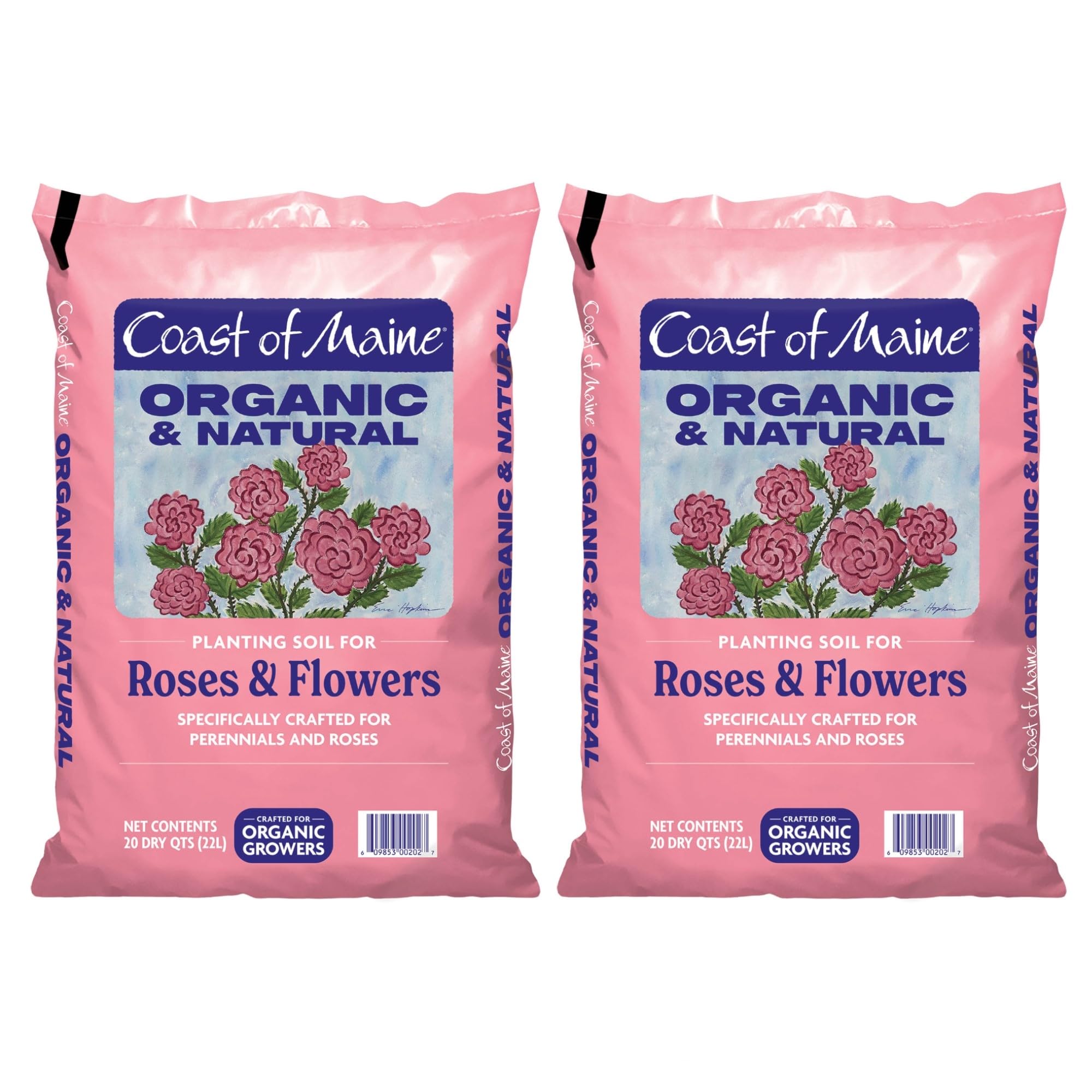
The rose whisperer — fluffed with composted manure and sphagnum peat moss, this mix balances moisture and drainage to bring perennials back from the brink.
This is the premium option for anyone who treats their flower beds as the centerpiece of the yard. At 20 quarts (about 0.67 cubic feet), it comes in a 2-pack so you get two bags to work with. The mix uses composted manure and sphagnum peat moss to balance moisture retention and drainage — exactly what roses and perennials need to avoid root rot while still getting consistent hydration. It is OMRI (Organic Materials Review Institute) listed for organic use, meaning it meets the strictest standards for organic gardening.
“I had to replant some new roses I purchased and they loved the soil so much that within a month I could see new growth beginning,” one buyer reports, describing a rose that went from a pencil-thin stick to a blooming plant in three months. Another reviewer revived a baby rose that was covered in mites just by switching to this Coast of Maine soil. The texture is noticeably fluffier than standard garden soil, which one reviewer called “high quality stuff” that all four of her rose varieties enjoyed. It works both in-ground and in containers, so you can use it for new beds, transplanting, or as a top-dressing mulch.
The big strengths
- Light, fluffy texture that roses and perennials thrive in
- Composted manure feeds slowly all season
- Revives struggling plants, per multiple buyer reports
- OMRI listed for organic gardening
Worth knowing
- 20 quarts is smaller than a 1 cubic foot bag — plan accordingly
- Premium price compared to standard garden soil options
Best for dedicated rose growers: If you are planting or nursing roses, perennials, or any prized flowers where you want the richest organic mix available, choose this one. If you are filling a full raised bed on a budget, the Espoma Raised Bed Mix gives you more volume per dollar.
Understanding the Specs
Cubic Feet vs Quarts
This is the first thing you need to compare. A bag sold in cubic feet (cu ft) is straightforward — one cubic foot of loose soil fills about 7.5 gallons of container volume. A bag sold in quarts (qt) works the same way: 30 quarts equals roughly one cubic foot. The Coast of Maine soil is listed at 20 quarts, which is about two-thirds the volume of a 1-cubic-foot bag. When you are estimating how many bags you need for a flower bed, convert everything to the same unit first. A standard 4×4-foot raised bed that is 8 inches deep needs about 10.6 cubic feet of soil — that is roughly 11 bags of the 1-cubic-foot Espoma garden soil or 7 bags of the 1.5-cubic-foot Raised Bed Mix.
Mycorrhizae (Myco-tone)
If you see “myco-tone” or “mycorrhizae” on the bag, you are getting a major biological advantage. Mycorrhizae (beneficial fungi that attach to plant roots) act like an extension of the root system, pulling in water and nutrients (especially phosphorus) from soil the root cannot reach alone. Both Espoma products contain a proprietary blend of endo and ecto mycorrhizae. For a flower bed, this means stronger blooms and better drought tolerance without extra fertilizer. Some premium soils like Coast of Maine skip the myco-tone label and rely on their composted manure for microbial life instead.
FAQ
Can I use raised bed soil in an in-ground flower bed?
How many bags of soil do I need for a 4×4 foot flower bed?
Is bagged soil for flower beds the same as potting mix?
Does organic bagged soil smell bad like manure?
Can I use Espoma garden soil for vegetables in my flower bed?
How do I prevent fungus gnats in bagged soil?
Is the Coast of Maine soil worth the higher price?
Does bagged flower bed soil expire or go bad?
Can I mix different brands of bagged soil together?
What does OMRI listed mean on a soil bag?
Final Thoughts: The Verdict
For most flower bed owners, the bagged soil for flower beds winner is the Espoma Organic Vegetable & Flower Garden Soil because it blends perfectly with native ground, feeds with mycorrhizae and castings, and comes at a fair price for the quality. If you are filling raised beds, grab the Espoma Organic Raised Bed Mix for its 1.5 cubic feet per bag and slow-release meal blend. And for roses or precious perennials that need revival, the standout is the Coast of Maine Rose & Flower Soil — light, fluffy, and proven to bring struggling plants back to bloom.
How We Picked
We do not accept paid placement. Every pick is matched to a real buyer and a real use-case; we do not hands-on test units.
Sources & Methodology
Specifications: manufacturer listings and product documentation. Review insights: verified customer reviews, as of July 2026. Pricing: not shown on this page (it changes often); check the current price via the retailer link.
As an Amazon Associate, Lawn Gear Lab earns from qualifying purchases. This does not affect which products we feature.