
Specs are compiled from manufacturer listings and verified buyer reviews and can change over time — please confirm the key details on the product page before buying.
You pull nutsedge, and days later it is back — those tall, lime-green weeds with underground tubers that survive pulling. The real fix is a selective herbicide (a weed killer that targets only the sedge, not your lawn). With the right nutsedge weed killer, you can stop the cycle in one or two applications and reclaim your turf.
I’m Rikta — the founder and writer behind Lawn Gear Lab. This guide is built by comparing the manufacturers’ published specifications and the patterns across verified customer reviews, so you get each pick’s real strengths and trade-offs instead of marketing spin.
Below you will find top-rated selective herbicides for nutsedge — from fast-acting ready-to-use bottles to concentrated powders that cover a whole acre — each matched to a specific lawn size, turf type, and patience level.
Quick Picks
- Atticus Empero Q-Pak Nutsedge Killer (2-Pack) — Best Overall
- Ortho Max Nutsedge Killer Rtu (2 Pack) – 48 fl oz total — Fastest Results
- Sedgehammer Plus Turf Herbicide (2 Packets) — Best 7-Day Knockdown
- Sedgehammer Plus Turf Herbicide (4 Packets) — Multi-Season Supply
- Sedgehammer Herbicide (1.33oz Bottle) — Large-Area Specialist
- Halo 75 WDG Select (1.33oz) — Maximum Potency
- Atticus Sertay Herbicide (1.25 oz) — Southern Lawn Specialist
How To Choose The Best Nutsedge Weed Killer
Not all selective herbicides handle nutsedge the same way. You will want to match the active ingredient to your lawn type, the size of your infestation, and how fast you need results. Here are the three factors that matter most.
Active Ingredient: Halosulfuron vs. Sulfosulfuron
The active ingredient is the chemical that actually kills the weed. Two ingredients dominate this category: halosulfuron-methyl (found in Atticus Empero and Sedgehammer) and sulfosulfuron (found in Atticus Sertay). Halosulfuron is the standard choice for most home lawns because it is gentle on a wide range of turfgrasses and moves down to the tubers. Sulfosulfuron is a stronger, southern-formulated option that also targets Poa annua and cool-season invaders that sneak into warm-season lawns. If you live in a warm-season grass region (Bermuda, zoysia, St. Augustine), either works; for heavy mixed-weed pressure, sulfosulfuron covers more.
Lawn Safety: Which Grasses Are Tolerant
Every selective herbicide lists which turfgrasses it is safe on. Halosulfuron-based products (Atticus Empero, Sedgehammer) are labeled for both cool-season types like fescue and bluegrass and warm-season types like Bermuda and zoysia. Sulfosulfuron (Atticus Sertay) is formulated specifically for southern warm-season lawns — it is safe on bahiagrass, Bermuda, centipede, St. Augustine, and zoysia but is not intended for northern cool-season turf. If you have a mixed lawn, halosulfuron is the safer bet. Always check the label before spraying; a product that is safe on Bermuda can damage bentgrass.
Coverage and Application: Ready-to-Use vs. Concentrate
Ready-to-use (RTU) bottles — like the Ortho Max Nutsedge Killer — attach to your garden hose and let you spray without any mixing. These are ideal for small patches or spot treatments because they are faster and less messy. Concentrate packets or granules (Sedgehammer, Halo 75 WDG) require you to mix the powder with water (typically one packet per gallon of water) and a surfactant to help the spray stick to the waxy leaves of nutsedge. Concentrates are much more economical for large lawns — one packet can cover 1,000 square feet, and a bottle can cover over an acre. If you have more than a few square feet of infestation, a concentrate will save you money and refill trips.
Quick Comparison
| Model | Best For | Active Ingredient | Coverage | Form | Amazon |
|---|---|---|---|---|---|
| Atticus Empero Q-Pak (2-Pack) | Versatile all-lawn control | Halosulfuron-methyl 5% | 2,000 sq ft | Water-Dispersible Granule | Amazon |
| Sedgehammer Plus (2 Packets) | Fast yellowing in 7 days | Halosulfuron-methyl | 1,000 sq ft per packet | Powder | Amazon |
| Ortho Max Nutsedge Killer (2 Pack) | Instant spot treatment | — | 48 fl oz total | Liquid RTU | Amazon |
| Sedgehammer Plus (4 Packets) | Multi-season supply | Halosulfuron-methyl | 1,000 sq ft per packet | Powder | Amazon |
| Sedgehammer Herbicide (1.33oz Bottle) | Large-area or commercial use | Halosulfuron-methyl | 1,000 sq ft per gallon | Liquid concentrate | Amazon |
| Halo 75 WDG Select (1.33oz) | Ultra-high potency per gram | Halosulfuron-methyl 75% | Up to 1 acre | Granule | Amazon |
| Atticus Sertay (1.25oz Bottle) | Southern lawns + Poa annua | Sulfosulfuron 75% | 12,500 sq ft | Water-Dispersible Granule | Amazon |
In‑Depth Reviews
1. Atticus Empero Q-Pak Nutsedge Killer (2-Pack)

The versatile all-lawn specialist that works on nearly any turf type.
This two-packet system uses 5% halosulfuron-methyl — the active ingredient turf pros reach for — and each pre-measured packet is already mixed with a surfactant (a spreader-sticker that helps the spray cling to nutsedge’s waxy leaves). You just pour it into one gallon of water and spray. It covers a generous 2,000 square feet per pack, giving you double the area of most single-packet competitors like the Sedgehammer Plus (which covers 1,000 sq ft per packet). The formula travels down to the root system tubers for complete top-to-bottom kill, and the brand says it is gentle on most established warm- and cool-season grasses, from bluegrass and fescue all the way to Bermuda and zoysia.
Buyers report that the results are real but not instant. One reviewer noted the product was “effective for nutsedge but slow-acting; took ~3 weeks to see yellowing after first treatment, with full results after a month.” That slower pace is the trade-off for the gentleness on turf — halosulfuron takes its time traveling to the tubers. A different owner added that it “killed most nutgrass in one application after 2 weeks” and was safe on a bluegrass/fescue lawn. At this price point for two packets, it undercuts many premium options on per-square-foot cost while still using the same trusted active ingredient, making it our top pick for versatility and value.
Who it fits: The homeowner with a mix of warm- and cool-season grass who wants a simple, gentle two-packet solution for medium-sized lawns (up to 2,000 sq ft).
One caution: A buyer reported the product killed their grass in a few spots — always test a small area before spraying the whole lawn.
Best for all-around use: If you have an established mixed-species lawn and want something that covers more ground per pack without extra mixing steps, start here.
skip it if: You want fast browning in 48 hours — you will need the Ortho RTU below instead.
2. Ortho Max Nutsedge Killer Rtu (2 Pack) – 48 fl oz total
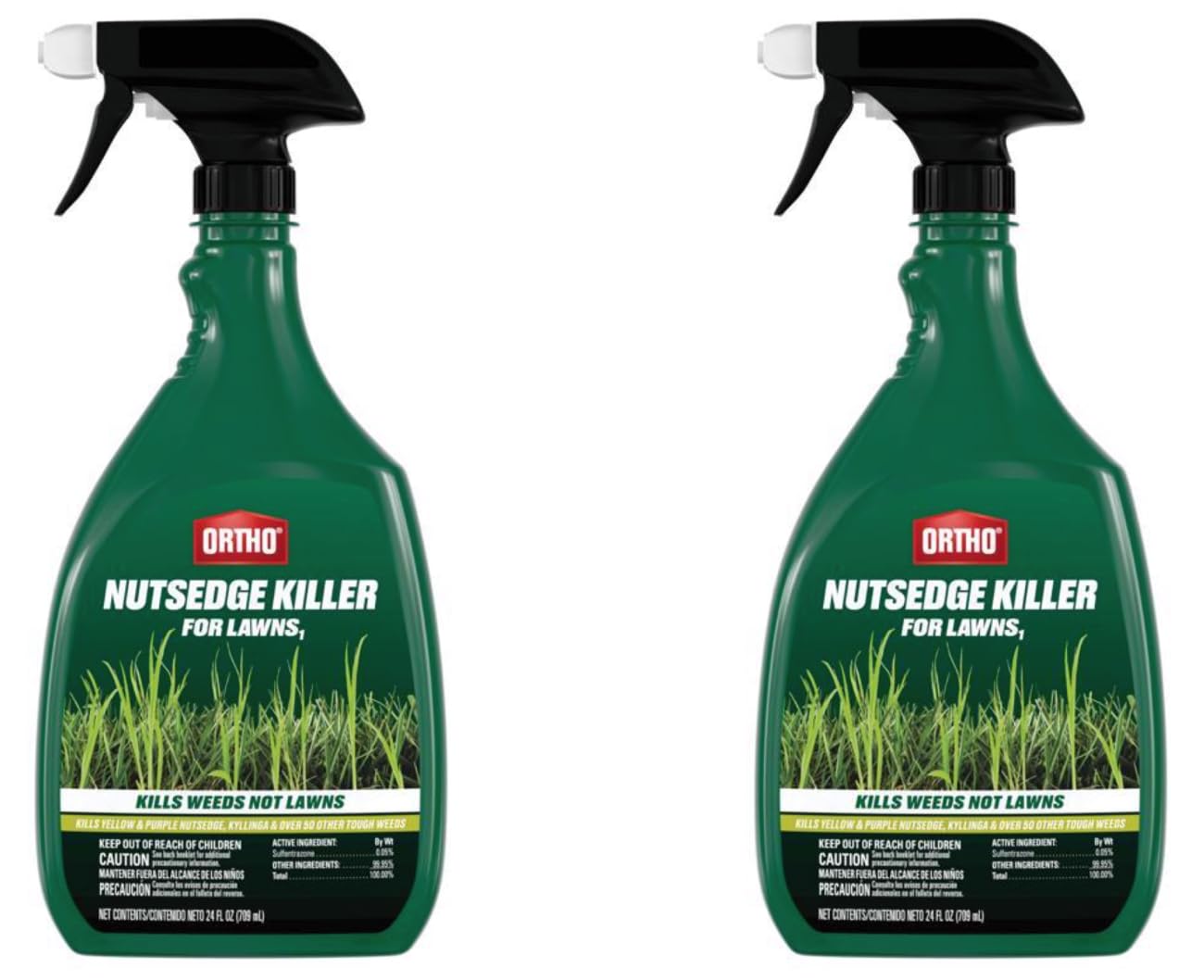
The hose-attachment sprayer that bakes nutsedge brown in two days.
This is the speed champion of the list. Buyers consistently report visible yellowing just two days after spraying and full death within four days. One owner said, “After about 2 days the nutsedge had turned brown and after about 4 days it was dead.” That is dramatically faster than the halosulfuron packets above, which typically take two to three weeks. The 24-fluid-ounce bottle — sold here as a two-pack — connects directly to your garden hose, so there is no mixing, no measuring, and no cleanup. It is rainproof in two hours, meaning a surprise shower will not wash away your work.
The trade-off is that RTU bottles are more expensive per square foot than concentrates, and this product’s label targets northern and southern turf grasses generally without specifying the active ingredient concentration. One buyer mentioned the nozzle switch is easy to bump accidentally, possibly diluting the mix with plain water. It kills more than nutsedge — the label lists over 50 tough weeds including wild onion, garlic, and dandelion — which is helpful if your yard has a mixed weed problem. For a fast, no-mix spot treatment on small to medium patches, it is the easiest solution.
Perfect for quick results: If you need nutsedge gone in a long weekend and do not want to handle any granules, this is your pick.
Watch out for: The nozzle switch can shift to water-only mode mid-spray, so keep an eye on it as you work.
Reach for this when: You want to see immediate brown-up and you are treating small patches or a single infested area.
Look elsewhere if: You have a large lawn (over a few hundred square feet of nutsedge) — the cost per treatment adds up fast versus concentrates.
3. Sedgehammer Plus Turf Herbicide (2 Packets)
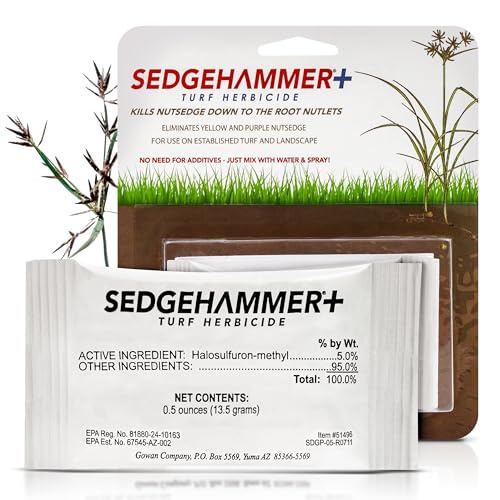
The 7-day yellowing promise that converts at a very fair price.
Sedgehammer Plus is the mid-priced halosulfuron balance. Each 13.5-gram packet already includes a dry, non-ionic surfactant so you do not have to buy a separate additive. Mix one packet with one gallon of water, and you cover 1,000 square feet. Multiple verified buyers wrote the same exact timeline: “Followed instructions to a T and after EXACTLY 7 days the nut sedge started to yellow.” That consistency is rare in this category — most products’ results spread across weeks. The formula is labeled for up to 25 different weeds and is safe for both warm and cool-season lawns once the spray dries.
One buyer left a useful tip: fill the gallon jug with water before you add the powder to avoid a foam explosion. Compared to the Atticus Empero (which uses the same active ingredient), Sedgehammer covers 1,000 sq ft per packet versus Empero’s 2,000 sq ft per pack, but Sedgehammer’s price per packet is lower, making it a good entry point if you only need to treat a small area. A reviewer mentioned it worked even after heavy rain, so the sticking power is solid. You will likely need a second application for tall, mature nutsedge, but for the price, this is the most consistent mid-range performer.
Why it wins: Predictable, repeatable results — owners mention yellowing at exactly 7 days, which lets you plan your re-treatment on a reliable schedule.
Downsides: Covers only 1,000 sq ft per packet, so a larger lawn will need the 4-packet version below.
Grab this if: You want the most predictable post-application timeline among halosulfuron packets and you are treating roughly 1,000 square feet.
pass on it if: You need a very large coverage area or you prefer a ready-to-spray bottle with no mixing required.
4. Sedgehammer Plus Turf Herbicide (4 Packets)
Four packets for the price-conscious planner who treats across multiple seasons.
This is exactly the same Sedgehammer Plus formula as the two-packet version above — same halosulfuron active, same integrated dry surfactant, same 1,000-square-foot coverage per packet — but in a 4-packet pack that drops the per-treatment cost noticeably. If you plan to do two or three applications over the growing season (which most nutsedge control programs recommend), buying the 4-pack once saves you from re-ordering mid-summer. One buyer left the same exact line as the 2-pack: “Followed instructions to a T and after EXACTLY 7 days the nut sedge started to yellow.” The formula and the results are identical; the package size is the only difference.
The real benefit here is forward-planning. Nutsedge tubers can survive multiple seasons, so even after a successful first kill, you will likely see new shoots later. Having three or four packets on hand means you can hit each wave immediately without a trip back to the store. The 4-pack covers up to 4,000 square feet total, which is enough for a typical suburban lawn with moderate infestation. The catch is the same as the smaller pack — tall, flowering nutsedge may need a second dose per packet for complete tuber kill — but at this bulk price, the margin for follow-up is built in.
Ideal for the planner: If you know you will need multiple treatments across spring and summer, this pack saves money and prevents mid-season stockouts.
Not ideal if: You have a very small patch that a single packet would cover — the 2-pack is a better fit for small yards.
Buy this for: A 3,000–4,000 sq ft lawn where you want to treat in waves without re-ordering.
One honest caveat: Store the packets in a cool, dry place — moisture can clump the powder and make mixing harder.
5. Sedgehammer Herbicide (1.33oz Bottle)

The liquid bottle designed for continuous large-area or commercial-scale spraying.
The active ingredient is the same halosulfuron-methyl used in the Sedgehammer Plus packets, but the liquid form is quickly absorbed by nutsedge within 24 to 48 hours, according to the manufacturer. Buyers on half-acre properties report going through about 7.5 gallons of mixed spray in one full treatment and seeing 95% or better control after a single application. One reviewer with a.52-acre lawn said, “I got rid of 95%+ after one application.”
The catch is that you must buy and mix your own non-ionic surfactant separately — the liquid bottle does not come with it pre-mixed like the packets do. Directions can also be tricky; a buyer noted the scooper uses cc measurements while the instructions use a different format, so you may need to do a rough conversion. The bottle is made in the USA and has a three-year shelf life, so leftover product stores well for next season. It also works on horsetail and green kyllinga, making it a broader-spectrum tool than the packet-only options. For owners of 0.5 acres or more, this is the most economical halosulfuron option per gallon of mixed spray.
Who it serves: The homeowner with a large yard or the small lawn-care operator who wants a single bottle that lasts multiple seasons.
What to know: You will need a surfactant and a 1.5-gallon sprayer — factor those into your purchase.
Choose this for: Half-acre or larger lawns where mixing custom batches saves money versus packets.
Pass if: You want a simple single-packet mix — the Sedgehammer Plus packets are easier.
6. Halo 75 WDG Select (1.33oz)
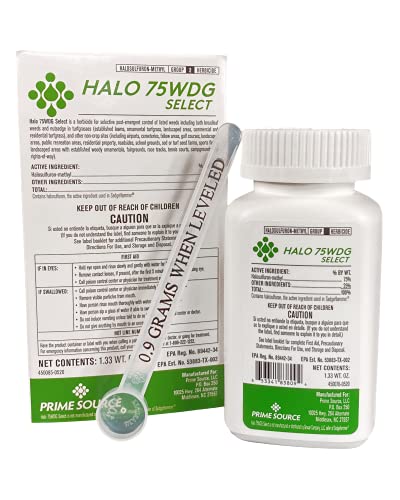
The highest-concentration halosulfuron product for serious infestation on large turf areas.
Halo 75 WDG Select packs a massive 75% halosulfuron-methyl by weight — far above the 5% found in the Atticus Empero packets. Because the active ingredient is so concentrated, a single 1.33-ounce bottle can treat up to a full acre (roughly 43,500 square feet) depending on your mixing rate. That makes it an outlier for coverage. The granule form mixes with water and requires a non-ionic surfactant for best adhesion. It is labeled for residential and commercial turf, golf courses, sports fields, and sod farms — not just home lawns — which gives it the widest use-site approval of any product on this list.
Buyers in zone 9 (NE Florida) report excellent results on St. Augustine lawns, though one noted it “does slightly yellow out the Bermuda grass but the Bermuda does recover in a couple weeks.” The same reviewer recommended adding a sticker fluid. Another owner said it did a good job controlling kyllinga but needed a follow-up application after a month. The high concentration means you must measure very carefully — a small scoop goes a long way, and over-applying can stress the turf. This is the advanced user’s pick: powerful, efficient, but requiring more precision than a pre-measured packet.
Best for power users: If you have a large property, a sprayer, and experience measuring concentrated herbicides, this delivers the lowest cost per acre.
Not for beginners: Miscalculating the mixing ratio can stress your lawn — new users should start with pre-measured packets.
Reach for this if: You are treating an acre or more and want the strongest halosulfuron concentration available without buying commercial drums.
Avoid if: You prefer pre-measured simplicity or have a small patch — the bottle is overkill for a few hundred square feet.
7. Atticus Sertay Herbicide (1.25 oz)
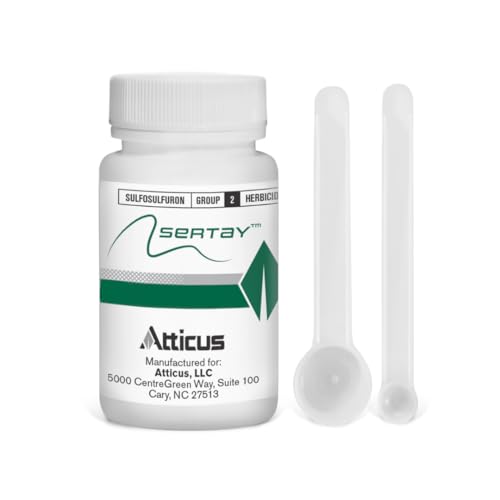
The sulfosulfuron powerhouse that takes down nutsedge and Poa annua in one pass.
Atticus Sertay is the only product on this list with sulfosulfuron as its active ingredient (75% concentration), which makes it a distinct tool from the halosulfuron-based options above. It is specifically engineered for warm-season southern lawns — Bermuda, St. Augustine, zoysia, centipede, and bahia — and it also suppresses cool-season intruders like Poa annua, tall fescue, and perennial ryegrass that invade southern turf in winter. The coverage is impressive: one 1.25-ounce bottle treats 12,500 square feet, or roughly a quarter-acre. Customers note it kills nutsedge in rock gardens and general lawn areas within about two weeks.
Where Sertay really stands out is its dual action. One reviewer called it the “best poa annua killer out there,” noting it killed all Poa annua in one week when mixed with surfactant. Another said it “took out the nutsedge” in a rock garden and avoided the need for manual pulling. The catch is the label warns that it prevents overseeding, meaning you should not apply it if you plan to plant perennial ryegrass in the fall within the treated area. It is also restricted in some states — not available for sale in Alaska, DC, or Vermont. If you have a warm-season lawn with both nutsedge and winter weed pressure, this one chemical handles both, which can simplify your annual weed control program.
Perfect for southern yards: If you fight nutsedge in summer and Poa annua in winter, this is the only single-herbicide answer on the list.
Important restriction: Do not use if you plan to overseed with ryegrass — the soil residual prevents new grass seed germination.
Buy this for: Warm-season lawns in the southern US where nutsedge and Poa annua are both persistent problems.
Pass if: You have a cool-season lawn or you plan to overseed this fall — look at the halosulfuron options instead.
Understanding the Specs
Halosulfuron-Methyl vs. Sulfosulfuron
These are the two active ingredients that define the entire nutsedge herbicide category. Halosulfuron-methyl (found in Atticus Empero, Sedgehammer, and Halo 75) is the standard selective herbicide that moves systemically through the weed down to the tubers. It is labeled for both warm- and cool-season grasses and is the gentler choice for mixed-species lawns. Sulfosulfuron (found in Atticus Sertay) is a newer chemistry with a stronger effect on cool-season invaders like Poa annua, but it is formulated mainly for southern warm-season turf and has a pre-grass-seeding restriction. Choose halosulfuron for general home-lawn use; choose sulfosulfuron if you need Poa annua control alongside nutsedge kill.
Concentration Percentage (5% vs. 75%)
The percentage tells you how much active ingredient is in the product by weight. A 5% halosulfuron packet (Atticus Empero) is a ready-to-mix formulation where the rest of the weight is filler and surfactant — you use a full packet per gallon. A 75% halosulfuron granule (Halo 75 WDG) is an ultra-concentrate where you only need a tiny scoop per gallon to get the same killing power. Higher concentration means lower per-treatment cost if you have a large area, but it requires careful measuring. For small patches, the pre-measured 5% packets are far more convenient.
FAQ
How long does it take for nutsedge killer to show results?
Will these products kill my regular grass?
How often should I apply nutsedge killer?
Can I use nutsedge killer on my vegetable garden or flower beds?
What is the best time of year to apply nutsedge killer?
Do I need to add a surfactant?
Is nutsedge killer safe for pets and children?
Can I use these products on a newly seeded lawn?
Will rain wash away the herbicide?
How does nutsedge differ from regular grass?
Final Thoughts: The Verdict
For most buyers, the nutsedge weed killer winner is the Atticus Empero Q-Pak (2-Pack) because it combines a trusted halosulfuron active ingredient with the widest turfgrass safety range and enough coverage for a 2,000-square-foot lawn at a very fair per-treatment cost. If you want the fastest visible brown-up and hate mixing anything, grab the Ortho Max Nutsedge Killer RTU. And for a warm-season southern lawn fighting both nutsedge and Poa annua, the standout is the Atticus Sertay for its one-product dual control.
How We Picked
We do not accept paid placement. Every pick is matched to a real buyer and a real use-case; we do not hands-on test units.
Sources & Methodology
Specifications: manufacturer listings and product documentation. Review insights: verified customer reviews, as of July 2026. Pricing: not shown on this page (it changes often); check the current price via the retailer link.
As an Amazon Associate, Lawn Gear Lab earns from qualifying purchases. This does not affect which products we feature.